David Cameron seeks to seize passports of Islamist fighters
2014/09/03 Leave a comment
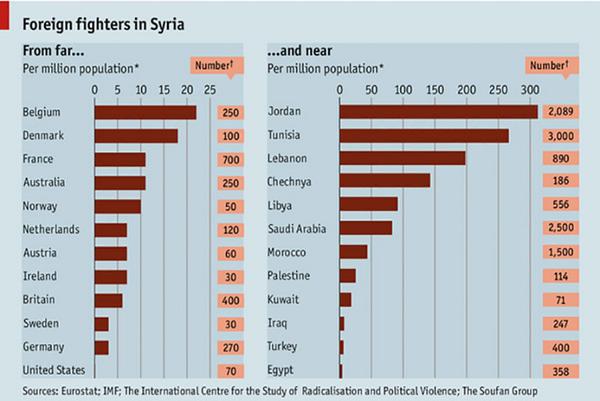
From The Economist
More on efforts to curb home-grown radicalization in the UK. While these are “hard” approaches to prevention, UK has also invested considerably in “soft” approaches as well.
As with all these initiatives, particularly their expanded application of revocation to prevent born-Britons without dual nationality to return home, questions about who decides and whether the person accused can defend himself.
One thing to hold them for investigation (legitimate), another to make a decision without due process.
One could argue that refusing entry, understandable from a security perspective, simply means that any such extremist would return to Syria or Iraq to continue their brutality, rather than being under the watch of the police in the UK:
“There are two key areas where we need to strengthen our powers to fill specific gaps in our armoury. These are around preventing suspects from travelling and dealing decisively with those already here who pose a risk.”
David Cameron’s new anti-terrorism proposals come days after the U.K. raised its terrorism alert to its second-highest level.
Cameron said he would bring in new “specific and targeted legislation” to give the police powers to temporarily seize a suspects passport at the border to give authorities time to investigate them. Currently only Britain’s interior minister has the power to withdraw a passport.
He also said the government would consult on a discretionary power to prevent Britons from returning home if they have pledged allegiance to extremist causes. This would extend existing powers which can only be applied to foreign nationals, naturalized citizens and those with dual nationalities.
David Cameron seeks to seize passports of Islamist fighters – World – CBC News.
Meanwhile, in Canada, more on the RCMP’s High Risk Travel Case Management Group approach to prevention (see also 2014 Public Report on the Terrorist Threat to Canada):
While the report’s emphasis is on prevention and intervention, several recent cases related to the Syrian conflict have raised questions about the effectiveness of efforts to reason with determined youths blinded by zeal.
After serving a prison sentence for his role in the Toronto 18 terrorist group, which plotted bomb and shooting attacks in southern Ontario, Ali Dirie used a fraudulent passport to travel to Syria, where he fought and died last August.
A British Columbia man charged with terrorism in July, Hasibullah Yusufzai, 25, was known to Canadian authorities because of a previous trip he had made to Afghanistan. Although he was on a no-fly list, he still managed to make his way to Syria using a passport that did not belong to him.
When Ahmad Waseem returned to Windsor, Ont. after he was wounded in combat in Syria, his mother hid his passport, his mosque counseled him and police spoke to him. But he returned to Syria last year and now calls the Islamic State of Iraq and Al-Sham his “brothers.” He has been charged with passport fraud.“
Early intervention through a joint community/law enforcement response is no guarantee that a person will not radicalize to violence,” the report says. “However, early intervention is one constructive way to deter potential violent extremists from causing harm.”
 About Andrew
 Multicultural Meanderings