Ottawa urged to remove citizenship by birth on Canadian soil | Toronto Star

Nicholas Keung’s story on the recently released under ATIP birth tourism briefing material (Citizenship Reform Proposal #19: Birth on Soil link to document), including my quote:

The proposal, marked “secret” and with inputs from various federal departments, found fewer than 500 cases of children being born to foreign nationals in Canada each year, amounting to just 0.14 per cent of the 360,000 total births per year in the country.

The issue of citizenship by birth on Canadian soil once again raises concerns among critics over the current government’s policy considerations being based on ideologies rather than evidence and objective cost-benefit analyses.

“An impartial observer would conclude that the evidence supports no need for change, given the small number of cases. Yet the recommendation supports the government’s public rhetoric and anecdotes on the need for change,” said Andrew Griffith, a former director general for citizenship and multiculturalism at Citizenship and Immigration Canada, and author of Policy Arrogance or Innocent Bias.

The Conservative government overhauled the Canadian Citizenship Act earlier this year by further restricting eligibility. However, the “birth on soil” provision was left intact and required further studies.

“Eliminating birth on soil in order to ensure that everyone who obtains citizenship at birth has a strong connection to Canada would have significant cost implications,” said the 17-page report prepared for former immigration minister Jason Kenney, obtained under an access to information request.

“The challenge of communicating this change would be convincing the public that restricting the acquisition of Canadian citizenship is worth that cost, particularly in a climate of deficit reduction.”

The office of Chris Alexander, Kenney’s successor, confirmed with the Star that the government is still reviewing citizenship policy with regard to the issue of “birth tourism” — a term referring to foreigners travelling to give birth in Canada so the baby can claim automatic citizenship here.

Dubbed “anchor babies,” these children are eligible to sponsor their foreign parents to Canada once they turn 18. It is unknown how many of them actually return to their birth country with their parents, but it’s believed the number is low.

“As provinces and territories are responsible for birth registration, consultation and co-ordination with the provinces is required,” said Alexis Pavlich, a spokesperson for Alexander.

“Canadian citizenship is an honour and a privilege, and our Conservative government is committed to increasing its value. Birth tourism undermines the integrity of our citizenship program and takes advantage of Canadian generosity.”

I have some outstanding ATIP requests to the key provinces (QC, ON, BC) on their data on “anchor babies” and will share when released.

And if you have a different take than me on Citizenship Reform Proposal #19: Birth on Soil, please share.

Ottawa urged to remove citizenship by birth on Canadian soil | Toronto Star.
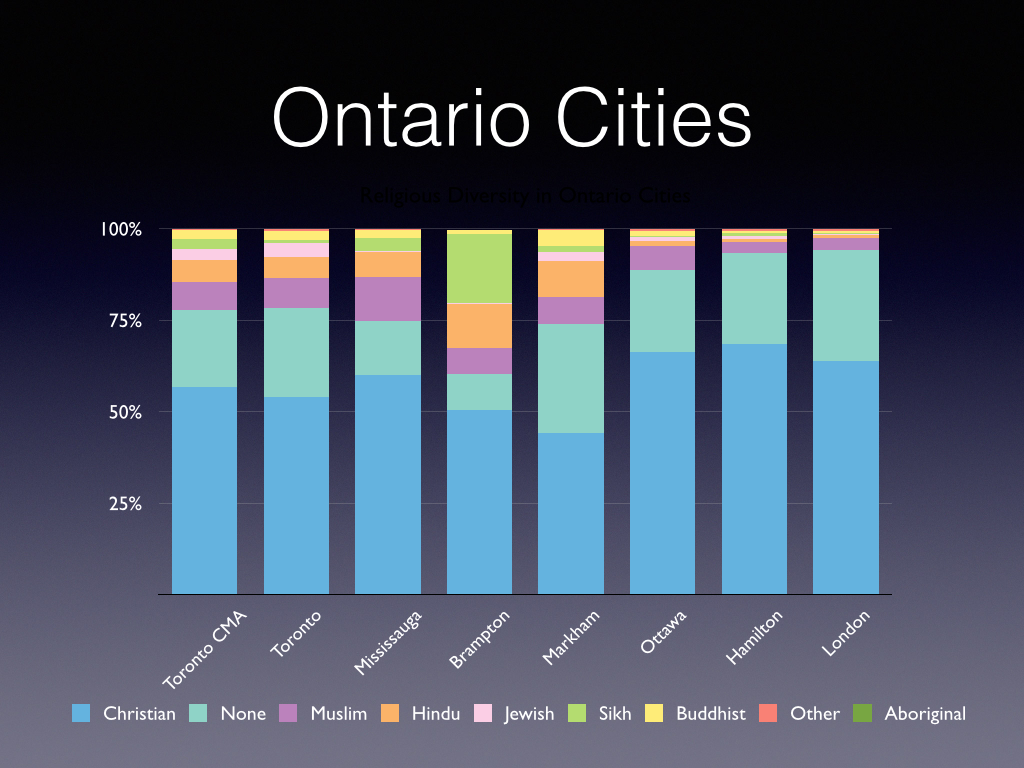
Charts, Colour Palettes, and Design

Ethnic Origin Based Charts.001

NHS 2011

As some of you may know, working fairly intensely on analyzing and charting Canadian multiculturalism as seen through the National Household Survey data from 2011 (not as reliable as the Census but what we have).

In looking at how to make charts as simple as clear and possible, came across some good design and related sites.

The above sample is illustrative of the work I am doing.

Starting with Perceptual Edge on data visualization, and the advantages of simplicity. A short clear article outlining good design principles, with some suggested colour palettes:

Practical Rules for Using Color in Charts – Perceptual Edge

For a wider choice of colour palettes, see Every ColorBrewer Scale.

And for users of iWork, this nifty and easy to follow tutorial on how to use the “Colour Picker” effectively and create customized palettes:

Using Apple’s “Color Picker” in Pages 5, Numbers 3, & Keynote 6 (iWork 2013)

Any feedback or suggestions always welcome.

Refugee claimants struggling to find health care after cuts – The Globe and Mail

Contrast between the Government narrative and the human stories behind the impact of the cuts, following the recent court decision striking down the Government’s decision (Federal government to appeal ruling reversing cruel cuts to refugee health):

“We will vigorously defend the interests of Canadian taxpayers and the integrity of our fair and generous refugee determination system,” Alexis Pavlich, press secretary to Citizenship and Immigration Minister Chris Alexander, said in an e-mail.

While the legal battle drags on, some refugees must rely on the help of volunteers or struggle to pay large medical bills.

At Toronto’s FCJ Refugee Centre, one of dozens across Canada, Loly Rico is compiling evidence of how the cuts have affected refugees so it can be used as ammunition against Ottawa’s appeal. “We need to be ready,” says Ms. Rico, an El Salvadorian refugee who founded the centre in 1991 with her husband, Francisco Rico-Martinez.

Since the cuts came into effect, their centre has run a small free clinic for the uninsured every second Saturday. It has seen about 100 patients, many of whom Ms. Rico says were turned away by hospitals and walk-in clinics uninterested in filing complex paperwork that would not guarantee payment.

Refugee claimants struggling to find health care after cuts – The Globe and Mail.

Farah Mohamed Shirdon of Calgary, fighting for ISIS, dead in Iraq, reports say – Politics – CBC News

Hard to feel any sympathy for Shirdon given his actions and rhetoric but we can for family members:

Farah Mohamed Shirdon, a Calgarian fighting overseas with the militant group Islamic State of Iraq and Syria, was seen in the video burning his Canadian passport and threatening to destroy Iraq’s oppressors.

The Department of Foreign Affairs says it is aware of reports that a Canadian was killed in Iraq and is following the situation closely.

Farah Mohamed Shirdon of Calgary, fighting for ISIS, dead in Iraq, reports say – Politics – CBC News.

A good profile on Shirdon in The National Post:

Mr. Little said he didn’t recognize his friend in the video.

“It clearly wasn’t him anymore,” he said. When he learned of his death, Mr. Little tweeted: “The guy I knew was already dead inside, it’s still very disheartening to hear the news about my former friend. R.I.P. Farah Shirdon”

….. Mr. Shirdon’s family, including a mother, two brothers and at least one sister, were members of Calgary’s Somali-Canadian community.

Mohamed Jama, the Somali Canadian Society of Calgary president, described the family as “normal.”

“It’s very hard for his family,” he said. “Even the parents have no idea why this young man has [gone] to join this radical group.”

Mr. Jama was unaware Mr. Shirdon had been killed, calling the news “shocking.”

On a Twitter account believed to belong to Mr. Shirdon, a tweet from June read, “Beheading Shias is a beautiful thing.”

The account, under the pseudonym Abu Usamah, had more than 10,000 followers.

Mr. Jama said the Somali community in Calgary didn’t understand why Mr. Shirdon radicalized.

“It’s very hard to believe,” he said. “Especially a young person who grew up in the Western [world] and goes to a place he has no ethnicity, no community, no language.”

Mr. Jama described the actions of ISIS as a “killing phenomena.”

Farah Mohamed Shirdon, Calgary ISIS fighter reportedly killed in Iraq, was ‘dead inside’ long ago, friend says

ISIS child recruitment push hints at long-term ambitions – World – CBC News

Pretty nasty stuff, but in character of ISIS and its equivalents (and reminiscent of the Kadr family):

HRW [Human Rights Watch] said that children who joined armed groups in Syria did so after enduring torture by the regime, after participating in protests, or because schooling was no longer an option.

But, according to the report, others “simply … had a desire to go to battle.”

“The images of child soldiers I’m most familiar with are out of Africa, where there’s the practice of taking young children and sort of breaking them down psychologically and remoulding them as trained killers said Michael Dartnell, a terrorism expert who teaches political science at Georgian College in Ontario.

“I’m not certain if that’s actually what is going on in Syria and Iraq right now.”

Even so, Dartnell added he wasn’t sure about the capacity for such young minds to make independent ideological choices so early in life.

While Roggio said his monitoring of jihadi social-media feeds brought up images of young ISIS supporters brandishing weapons, marching in extremist parades and hitting posters of perceived infidels with their shoes, “I don’t see them being deployed on the battlefields or into towns” as one might expect a child soldier to do.

Instead, he believes youths are considered by ISIS as being more of a long-term “asset.”

“The children aren’t disposable to them,” he said, adding that their exploitation is a means of survival for the movement.

Becker, with HRW, said that child soldiers have been shown in the past to be used in some of the most dangerous tasks, such as suicide missions.

“It’s deeply concerning,” she said. “All children in Syria are suffering incredibly from the violence there, but to put children directly into battle is just beyond the pale.”

ISIS child recruitment push hints at long-term ambitions – World – CBC News.

Don’t beat up Statscan for one data error – Cross

More on StatsCan from Phillip Cross, former chief economic analyst. Worth reading for some of the history and how the agency reacted to previous cuts:

People should get agitated about Statscan over substantive issues. Wring your hands that the CPI over-states price changes over long periods. Write your MP complaining that the Labour Force Survey doesn’t follow the U.S. practice and exclude 15 year olds. Take to the barricades that for an energy superpower like Canada, measuring energy exports has become a monthly adventure, routinely revised by $1-billion a month. But don’t use the July employment incident to evaluate how the statistical system is functioning overall. They messed up one data point in one series. Big deal. Anyone who lets one data point affect their view of the economy should not be doing analysis. Move along folks, nothing to see here.

Don’t beat up Statscan for one data error – The Globe and Mail.

Tony Clement hatches open government plan: Goar | Toronto Star

Evidence vs. rhetoric, or Government irony at play:

Here is the oddest part: this is the second phase of Clement’s open government project. Phase 1 ended in 2012. According to Clement it succeeded in enhancing accessibility and transparency. The evidence suggests otherwise:

Complaints to Canada’s information commissioner were up 30 per cent last year. Suzanne Legault warned parliamentarians that the public’s right to know is worryingly fragile.

Parliamentary committees attempting to scrutinize government spending were denied access to essential facts and figures. When MPs persisted in delving into federal expenditures, the Tories adjourned the hearings.

The parliamentary budget officer was also stymied. Ministers withheld departmental documents and bureaucrats ignored his requests. At wits’ end, Kevin Page threatened to take the government to court.

Members of the media, who act as the public’s eyes and ears in Ottawa, were barred from speaking to cabinet ministers. They had to settle for anodyne statements approved by the Prime Minister’s Office PMO tweeted or emailed by Tory aides.

In Clement’s defence, he did download 172,000 government documents on a new Open Data Portal . An additional 100,000 have been now been posted.

Tony Clement hatches open government plan: Goar | Toronto Star.

A distinctly Canadian oath – I’ll swear to that – Yakabuski

Konrad Yakabuski, in an otherwise good overview of the Canadian oath of citizenship, misplaces the question of the oath with the question of being a republic.

“Constitutional monarchy is the best form of government that humanity has yet tried,” Dylan Matthews concluded in an empirical report, published last year in The Washington Post. “It has yielded rich, healthy nations whose regime transitions are almost always due to elections and whose heads of state are capable of being truly apolitical.”I’ll swear to that.

After all, Australia changed its citizenship oath while remaining a constitutional monarchy:

From this time forward, under God (under God optional),

I pledge my loyalty to Australia and its people,

whose democratic beliefs I share,

whose rights and liberties I respect, and

whose laws I will uphold and obey.

A distinctly Canadian oath – I’ll swear to that – The Globe and Mail.

The Star, argues the opposite from Yakabuski, noting Australia as above and the UK change for new citizens to  “give my loyalty to the United Kingdom and respect its rights and freedoms,” in addition to swearing allegiance to the Queen:

But that doesn’t mean the oath to the Queen cannot — or should not — be changed by the people and their Parliament. The very principles symbolized by the Crown guarantee the right of all Canadians to work through the constitutional system for this kind of political reform.

In fact, the oath of allegiance can — and should — be changed. Not because it violates any newcomer’s private political beliefs. It should be changed because a straightforward declaration of loyalty to Canada, its laws and traditions would be much more meaningful to the quarter million who choose this country every year.

Adopting an oath of allegiance to Canada would not affect the Canadian monarchy one bit. Elizabeth II would remain the Queen of Canada, and the Crown would remain the symbol of our constitutional, democratic system.

New citizens should pledge loyalty to Canada: Editorial


In remote Xinjiang province, Uighurs are under siege

Good long piece by the Globe’s Beijing correspondent on Xinjiang and Beijing’s treatment of the Uighurs, China’s Muslim minority:

That the “Xinjiang Uighur Autonomous Region” is religiously and culturally unique, however, is beyond dispute. Islam arrived in the ninth century, largely displacing Buddhism. Today, many Uighurs are intellectually and linguistically oriented west toward Central Asia and the Middle East – watching Iranian music videos and reading Turkish news sites – rather than east toward coastal China.

Their home territory has, however, experienced tremendous change since the Communist Revolution in 1949. Briefly an independent state in the early 20th century, Xinjiang has in the past few decades become home to vast numbers of ethnic Chinese, many of them sent here by government settlement policies.

They now outnumber the Uighurs, and continue to arrive, drawn by untrammelled space and the jobs that flow from a land rich in resources.But the wealth hasn’t necessarily benefited the Uighur population. As the region’s oil and gas flow east, local filling stations routinely run short, with lineups 150 cars long.

In remote Xinjiang province, Uighurs are under siege – The Globe and Mail.

Jonathan Kay: Petty language spats have all but vanished in Quebec since Marois’ ouster

While anecdotal, and drawing from those of similar views, Jon Kay’s lengthy column on how the tone has changed in Quebec following the defeat of the PQ and their Quebec Values Charter is worth a read:

Much has been written about the PQ’s insidious impact on Quebec politics. What has been less remarked upon — in other provinces, at least — is how thoroughly the shrill nastiness of Ms. Marois and her administration seeped into the everyday life of ordinary Quebecers. On the subway, in restaurants, at gas stations, interactions between English and French, Jew and gentile, Muslim and non-Muslim, became more fraught. In one notorious case, at the cafeteria of Montreal’s Jewish General Hospital, a worker became so enraged when a customer refused to speak French that she allegedly assaulted him with a thrown tomato sandwich. English-language social media and radio call-in shows were full of similar stories. Then came the April 7 election, and suddenly the stories stopped.

A reminder of the effect that Government rhetoric can have on how people perceive their relations with others, and their being accepted by wider society.

Jonathan Kay: Petty language spats have all but vanished in Quebec since Marois’ ouster