Welcoming the 150,000th New Citizen of 2014 – Canada News Centre

Citizenship backlogThe latest citizenship processing stats:

Today, Canada’s Citizenship and Immigration Minister Chris Alexander announced that Canada has welcomed its 150,000th new citizen of 2014. This is double the number of new citizens compared to the same period in 2013 and thanks to the action taken by the government to reduce backlogs and improve processing times.

Alexander attended a citizenship ceremony in Scarborough and welcomed the country’s newest Canadians. At the event, Alexander highlighted the government’s recent changes to the citizenship system, which have led to improved processing times and an eight percent reduction to the citizenship backlog.

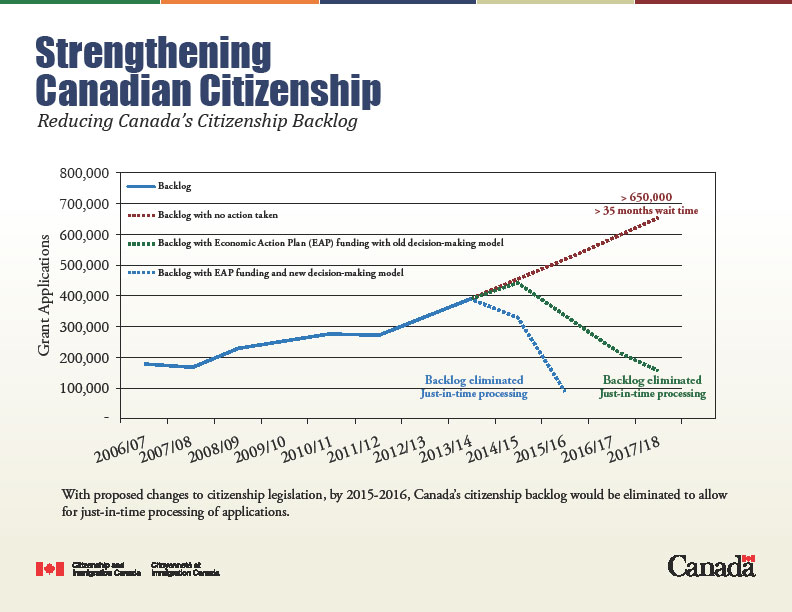
Given the backlog according to the February briefing package (C-24) was about 400,000 this means that it now stands at around 368,000, a reduction rate of roughly 4,000 per month (32,000 over 8 months – the exact rate may differ but this calculation is based on improved processing as of January 2014).

Accordingly to the graphic (above) in the briefing package, this rate should accelerate in 2015-16, given the impact of C-24 streamlining.

Welcoming the 150,000th New Citizen of 2014 – Canada News Centre.

Staffing cuts strain Justice Department

Confirms other reports (e.g., Justice Canada chops research budget by $1.2-million), and provides additional explanation for the large number of cases lost by the Government. An amusing, if sad, contrast between the comments of former officials and the everything is fine assurance from the political and bureaucratic levels:

Separately, in the Public Safety Department, lawyers were given just one week to draft a new law on parole, according to Mary Campbell, who retired last year from her job as the department’s director-general of the corrections and criminal justice directorate.

By her count, 30 bills on justice, sentencing and corrections are either currently before Parliament or were given royal assent in June. She likened the legislative development process to a sausage factory.

“When you’ve got a pace that says, ‘Keep the sausage machine going,’ you’re going to get errors,” she said in an interview.

Jason Tamming, a spokesman for Public Safety Minister Steven Blaney, said the government has passed more than 30 measures to get tough on crime. “Our Members of Parliament work very hard to pass the best legislation to keep our communities safe,” he said. “We expect our civil servants to do the same.”

The Justice Department, in an internal report on the criminal policy section released on its website, did not use the colourful language that Ms. Campbell did. But it spoke of lowered morale as research and statistics staff have been cut from 35 to 17, between 2008-09 and 2012-13. It said 81 per cent of the department’s lawyers said the quality of their work has suffered because of the short timelines they must meet.

However, when contacted directly, a Justice Department spokesperson said it is important to note that the criminal policy section is achieving its objectives and the government has a high degree of satisfaction with its work.

David Daubney, a former senior bureaucrat in the Justice Department who retired in 2011, said the purpose behind the research staffing cuts is obvious. “They don’t want to encumber their minds with the facts,” he said of the government. “We always at Justice prided ourselves as being ‘stewards of the criminal law.’ We were seen as the go-to place for the facts and research on criminal policy, justice and corrections. That’s certainly no longer the case.”

He said morale has dropped as advisers conclude the government doesn’t want their advice. At a recent retirement party, an assistant deputy minister he wouldn’t name “confirmed that they’re not bothering to put as much background data as they used to into anything going into the minister’s office or into memoranda to cabinet.”

In the 2010 C-37 Citizenship Act revisions, we only had three weeks to draft legislation which my staff and the lawyers were concerned about.

Not sure how much time was given to the drafting of the recent C-24 Citizenship Act comprehensive changes, but the Canadian Bar Association did comment on what they considered poor quality drafting (may be sniping between lawyers but I also found the changes hard to follow):

The government has an opportunity to improve the poor drafting in the current Act. However, Bill C-24 uses excessive cross-referencing within the Act and to previous citizenship legislation to the point of near incoherence. This results the legislation being inaccessible to the public as well as many public servants, politicians, lawyers, and judges, delayed processing times for citizenship applications and an increased backlog, and an increased burden on Canadian courts. Plain language drafting is in the interest of all parties.

Staffing cuts strain Justice Department – The Globe and Mail.
Sikhs denied exemption from Ontario’s motorcycle helmet law | Toronto Star

Good decision, not without courage given support in all party caucuses for the exemption, that other provinces have provided and exemption, and the importance of the Sikh vote in a number of ridings (but expect that most Sikh voters are not single issue voters).

Riding a motorcycle is a choice, not a right. While accommodation for turbans and other head (but not face) coverings is appropriate in most settings,  it is not for this one.

Motorcycle-riding Sikhs in Ontario will not be exempted from the province’s helmet law, Premier Kathleen Wynne has decided.The Canadian Sikh Association says it received a letter last week from Wynne stating the Liberal government, for safety reasons, will not allow Sikh motorcycle riders to wear only turbans as British Columbia and Manitoba currently allow.

“After careful deliberation, we have determined that we will not grant this type of exemption as it would pose a road safety risk. Ultimately, the safety of Ontarians is my utmost priority, and I cannot justify setting that concern aside on this issue,” Wynne said in her letter dated Aug. 14.

Wynne said safety trumps religious freedoms in this case.“As you know, the issue of balance between religious accommodation and public safety has been considered by the courts in Ontario which, on this issue, have found that Ontario’s mandatory helmet law does not infringe on the Charter of Rights and Freedoms, nor the Ontario Human Rights Code,” she said.

The Ontario Highway Traffic Act requires all motorcyclists to wear a helmet. This poses a problem for Sikhs, whose turbans don’t fit under most helmets.

Sikhs denied exemption from Ontario’s motorcycle helmet law | Toronto Star.

Khurram Sher not guilty on terrorism charge

The former Canadian Idol contestant and medical doctor Khurram Sher is found not guilty, given not enough proof to support a criminal conviction:

In his decision, Superior Court Justice Charles Hackland said that while Sher, 32, probably harboured some jihadist sympathies, he was not convinced the doctor genuinely intended to join a conspiracy.

As a result, the Crown had not proven its case beyond a reasonable doubt, Hackland said.

The judge described Sher as an undoubtedly bright, but ultimately “quite naive, immature and inarticulate young man.”

….The judge said it was relevant to ask whether a medical doctor with a track record of humanitarian support “would so readily sign on to a group planning potential terrorist activity in Canada without any careful consideration or reflection.”

Khurram Sher not guilty on terrorism charge.

As online anti-Semitism grows, so do efforts to counter it | Religion News Service

Haven’t seen much reporting on efforts to combat hate speech on the internet recently and this one regarding a Dutch organization was picked up by Feedly:

It’s been 17 years since Suzette Bronkhorst co-founded the Dutch Complaints Bureau for Discrimination on the Internet, but she said she doesn’t remember the level of anti-Semitic speech on social media platforms ever being this high.

“There are thousands of incidents and we’re getting so many complaints,” she said of her organization, which registers complaints of hate speech online. “There’s been a huge surge since Gaza.”

The Gaza conflict, which has led to the deaths of 1,900 Palestinians and 68 Israelis, has also sparked a wave of counter speech, with organizations like Bronkhorst’s attempting to tackle hate speech by debunking myths and stereotypes on blogs, forums and social media.

“There’s a lot of chatter on the Internet that is not based on fact and there are different ways in which you can do counter speech,” said Bronkhorst, whose organization goes by the name MDI. “For instance, if there’s a discussion on Facebook, you join in and you try to give counterpoints to people who are just ill-informed.”

In one instance, Bronkhorst’s volunteers asked a Twitter user writing “Hamas, Hamas, Jews to the gas” whether he really wanted to murder people by gassing them. The user removed the tweet, apologized and said he didn’t mean it.

In July, the number of Dutch-language anti-Semitic Facebook pages ran into the hundreds, according to MDI, which cannot keep up with the amount of hate-fueled posts, ranging from statements such as “Jews must die” to those praising Adolf Hitler. On Twitter, the hashtag “Hitler was right” appeared more than 10,000 times in July in connection with Gaza and became a trending topic, says MDI.

As online anti-Semitism grows, so do efforts to counter it | Religion News Service.

Can You Overcome Inbuilt Bias?

Interesting psych experiment, showing that appealing to higher motives less effective than more targeted tasking to reduce implicit biases:

Interestingly, most of the successful interventions were explicit about what they were trying to achieve and why. It’s important to remove the taboos around workplace discrimination and to educate people that bias is natural – what matters is that it doesn’t influence behavior. But worryingly, the majority of the successful interventions both associated black people with positive attributes and white people with negative attributes, reversing the natural direction of the white participants’ bias. Clearly reducing workplace bias by encouraging negativity towards a different group is not a solution.

The results of this comparison also raise an interesting question about the means of change and the outcome it achieves. Interventions which appealed to participants’ moral, conscious beliefs didn’t work, while those which targeted specific task behaviors – e.g. responding faster when black was paired with good – did. Some may argue that these interventions addressed the symptoms and not the cause. But in the workplace, when the ‘symptoms’ of implicit bias include unconsciously excluding and ostracizing others, addressing these behaviors may be a more effective use of time and resources than trying and failing to change the underlying beliefs which cause them.

It’s a tricky, emotive subject, but as more organizations wake up to the damaging consequences of implicit bias in terms of workforce engagement and performance, we can only hope for more research to shed light on how best to overcome it.

Can You Overcome Inbuilt Bias?.

Federal Liberals cultivate Mandarin powerhouse in GTA

This is not good, by any standard, relying exclusively on one ethnic community to win party nominations.

Even if in ethnic communities like Surrey, Richmond, Brampton, Markham etc, most candidates from all parties are from the largest community as part of “Shopping for Votes,” this is not an example to be emulated.

And as noted in the article, this may not help in the election when more than one community’s votes are needed:

By either grand design or ferocious grassroots organization, Toronto’s suburbs are shaping up to be a Mandarin-speaking powerhouse for the federal Liberal Party.

Four ridings around the GTA have Chinese-Canadians candidates, and in sharp contrast to the Conservatives’ top-down ethnic strategy of wooing voters through messaging that appeals to a specific minority, the Mandarin community is fielding its own candidates. In Don Valley North’s nomination contest, scientist Geng Tan upset presumed front-runner Rana Sarkar, a veteran party member and friend of Gerald Butts, Leader Justin Trudeau’s top adviser. Mr. Geng accomplished this by appealing almost solely to a monolithic base of Mandarin-speakers in Mandarin only.

On one hand, this trend represents the essence of the multicultural experiment. Arnold Chan, elected in Scarborough-Agincourt last month, is the GTA’s first Liberal Chinese MP. On the other hand, pursuing a single group for support, as Mr. Geng appears to have done, may alienate other minorities. It strikes critics as anti-pluralistic.

A pivotal figure in this wider political development is Michael Chan, an influential Ontario cabinet minister and fundraiser who stepped outside his daily sphere during June’s provincial election to bolster his community’s voice in the federal party. Mr. Chan’s involvement, along with the number of Chinese-Canadian candidates, indicates the growing demographic power of the Mandarin vote, whose participation has long been seen as dormant. The Conservatives and New Democrats have vowed to conduct open nominations as well – meaning the party leadership does not protect its preferred candidates – clearing the way for other ethnic groups to launch similar campaigns.

In the case of Mr. Geng’s campaign, his website was mostly in Mandarin and was changed to English only after a conversation with The Globe and Mail last week. His membership list, which The Globe reviewed, was composed exclusively of Chinese names.

Federal Liberals cultivate Mandarin powerhouse in GTA – The Globe and Mail.

Immigration to Ontario has declined 33% due to Federal government rule changes | The Mowat Centre

ON immigration and PNPMowat Institute on impact of federal Immigration policy changes in Ontario:

In particular, these policies have reduced the number of people that come to Ontario through economic immigration programs. There are three main categories of immigrants to Canada: economic immigrants who are selected on the basis of their ability to succeed in our economy, family class immigrants sponsored by relatives to join them here and humanitarian/refugee immigrants.

The national target set by federal and provincial immigration ministers aims to have about 70 per cent of immigrants to each province come through economic programs and the remaining 30 per cent through the other streams. But as a result of federal changes to immigration policy, the balance in Ontario has tipped further and further away from economic immigrants, leaving the province with a share of economic immigrants well below the Canadian average. [50 percent compared to 62 percent]

Immigration to Ontario has declined 33% due to Federal government rule changes | The Mowat Centre.

Watch John Oliver Deliver a Flawless Takedown of the Turmoil in Ferguson

One of the better pieces on Ferguson (15 minutes):

Watch John Oliver Deliver a Flawless Takedown of the Turmoil in Ferguson | TIME.

Australian jihadists fighting overseas should be stripped of their citizenship | Malcolm Fraser

Malcolm Fraser, former Prime Minister of Australia 1975-83, advocating for citizenship revocation in cases of terrorism or fighting for foreign forces:

In Barwick’s time [1960-1], dual citizenship was rare. Today it is common. Australia would be totally justified in saying anyone who has dual citizenship will forthwith lose their Australian citizenship if they fight abroad with any other forces. Australians should only fight overseas with the Australian Armed Services. I don’t think any Australian should be able to fight in foreign wars, unless that action is supported by the Australian government. Importantly, that would preclude an Australian going to do national service in any other country.

If someone with dual citizenship wants to go overseas and fight in another country, they should then lose their Australian citizenship and have no right to return. The Australian government should do all in its power to bring such people before the International Criminal Court.

Not sure how Australian Jews would feel about such a broad definition, as it would include those fighting for the IDF.

Australian jihadists fighting overseas should be stripped of their citizenship | Malcolm Fraser | Comment is free | theguardian.com.