Don’t call it diversity, call it real life

ABC President Paul Lee on diversity in television programming:

ABC is not on a mission to change TV, Lee insisted. He sees it as reflecting society as it is today.

“We think that’s our job,” he said. “Its not so much diversity as authenticity, if you’re reflecting America. We think these shows are deeply relatable, When I watch Black-ish or when I watch Cristela, I am one of those families.”

……ABC president Lee said his own background as an outsider – a British immigrant who studied Portuguese at Oxford and worked in Brazil before settling down in the U.S. – has helped give him a different perspective.

“Being an outsider is sometimes a great advantage and sometimes a disadvantage,” Lee said. “Sometimes you gain more than you lose from that perspective. It gives me a chance to look at things from another angle. The reality is, great stories resonate in the heart and gut of the audience, and that’s true anywhere in the world.

“I was brought up on American shows as much as I was on British shows,” Lee said. “My job isn’t to sit here as a Brit, commissioning American shows. My job is to see whether these shows move me, whether they move me to laughter or tears. If they do, and they do it in an authentic way, then we have a chance to resonate in the U.S. and beyond.”

Don’t call it diversity, call it real life.

Finance Canada survey finds Canadians at odds with Conservatives’ priorities

Interesting but not necessarily surprising. Those Canada’s Economic Action Plan ads may have not been as good value for money, let alone for taxpayers:

Public-opinion research for the federal Finance Department suggests key government policies are out of step with Canadians’ priorities, including the Northern Gateway project.

Members of focus groups consulted prior to the February budget had “little enthusiasm” for the proposed bitumen pipeline to the British Columbia coast — even those who said they support the controversial project.

And among the 12 groups consulted — from Coquitlam, B.C., to Bridgewater, N.S. — the economy itself was not a top-of-mind concern.

Rather, the groups spontaneously raised education, health care, pensions and veterans as their key issues.

They also called for more processing and refining of Canada’s oil resources at home, and to do so in a more environmentally safe manner.

The findings of the January focus groups, commissioned from NRG Research Group, suggest the Harper government’s central policy themes — trade and the economy, with an emphasis on energy exports — are resonating less with ordinary Canadians.

http://www.ipolitics.ca/2014/07/20/finance-canada-survey-finds-canadians-at-odds-with-conservative-government-priorities/ (pay wall)

Angry Second-generation Immigrants – New Canadian Media

Richard Landau on radicalization and second-generation immigrants. Not very conclusive, understandably, as there are no simple solutions.

And Leiken, the author of a recent Foreign Policy article cited, fails to link to the broader social and economic context of the various approaches to diversity:

And here we have arrived at a dangerous intersection. While young men may find an international conflict exotic, I have seen enough disaffected youths drawn to religious cults and extremism to know that it, too, has a special idealistic lure. Young men, drifting and unaccustomed to lives of prayer, obligation and fasting, may find the rituals alluring. Ritual + an exotic overseas conflict + romanticism may equal something like catnip for young men who are not well grounded. Et voila, radicalization!

Yes, there are extremist pied pipers who prey upon the young, the lonely and disaffected, telling them they are being disrespected and that the society at large hates them. Extremists like the late Anwar Al Awlaki tell young men that they will finally find meaning in their lives when they take up arms against the West. Simple, uneducated minds buy this drivel. The Boston Marathon bombers had a cult-like belief they were doing the Almighty’s will. The thing about fundamentalism, be it religious conversion or political, is that converts have an unending reservoir of zeal.

So how should Western societies deal with the roots of homegrown terrorism? With only limited successes, they have tried three approaches for dealing with immigrant populations:

  • Multiculturalism: Promotion and financing of integration, and equality of opportunity;
  • Assimilation: Forced assimilation/melting pot that leads to resentment;
  • Avoidance: Laissez faire benign neglect that produces a Balkanized and segregated society.

Writing in a Foreign Affairs article “Europe’s Angry Muslims,” Robert S. Leiken observed: “Yet it is far from clear whether top-down policies will work without bottom-up adjustments in social attitudes. Can Muslims become Europeans without Europe opening its social and political circles to them? So far, it appears that absolute assimilationism has failed in France, but so has segregation in Germany and multiculturalism in the Netherlands and the United Kingdom.”

It appears there is no simple, proven answer that will assuage the angry second generation. The answers may involve an amalgam of the three approaches and an educational system that addresses the issues of this generation head on.

Angry Second-generation Immigrants – New Canadian Media – NCM.

ICYMI: For Israelis and Palestinians, Separation Is Dehumanizing – NYTimes.com

Interesting commentary on how Israelis and Palestinians have moved further apart by Ethan Bronner of the NYTimes:

Israelis — especially in the heartland around Tel Aviv, where two-thirds of the country lives — can now go weeks without laying eyes on a Palestinian or ever having to think about one. In Gaza, Israelis do not exist except in a kind of collective nightmare. In the West Bank, the Israelis are mostly settlers and soldiers. Apart from a few pockets of industry and shopping where Palestinians are employed, interaction is highly limited.

At the height of the peace efforts, in the 1990s, Israeli and Palestinian leaders, locked in rooms negotiating with one another, built a poignant bond and developed a form of trust that they then sought to spread — not always successfully — to their peoples.

Yossi Beilin, then an Israeli official, and Mahmoud Abbas, who went on to become the president of the Palestinian Authority, wrote a peace plan together. In the early 2000s, Sari Nusseibeh, a Palestinian official and intellectual, joined with Ami Ayalon, a former head of the Israeli Shin Bet security services, and gathered hundreds of thousands of Palestinian and Israeli signatures for a two-state solution. They traveled together for months. They got along famously.

The relationship between Prime Minister Benjamin Netanyahu and Mr. Abbas is one of mutual loathing, according to Martin S. Indyk, who resigned last month as American envoy for peace negotiations after nine months of futile efforts. The two sides and their leaders have become total strangers. Each vilifies the other and imagines its own people to be morally superior, forced to defend itself against the cruel predations of the other.

A generation ago, there were plenty of causes for tension and concern. But Palestinians building what they hoped would become their state, and Israelis working with them, had an often moving sense of shared purpose. Some discovered that they liked one another and looked forward to working together. Today, those feelings are virtually dead. And while mixing the populations in those years was no panacea, divorcing them has only made things worse.

For Israelis and Palestinians, Separation Is Dehumanizing – NYTimes.com.

ICYMI: Myanmar Begins Controversial Citizenship Verification Process

Disturbing. Linking citizenship to ethnicity and religion in Myanmar:

Many Rohingyas are skeptical that a government that already classifies them as Bengalis will grant them citizenship based on the testimonies of village elders.

Washington has, in the past, pressured the Myanmar government on the 1982 Citizenship Law. And in its 2014 report on religious freedom, called on authorities to promote the rights of Rohingya Muslims and provide “durable solutions” for refugees outside the country.

Matthew Smith, director of the international human rights group Fortify Rights, says giving Rohingya equal access to citizenship rights is crucial to preventing the conflict in the future. He says foreign nations should press the government more on the issue.

“The fact that the immigration department is handling this issue is indicative of the perception that all Rohingya come from Bangladesh,” Smith said. “Immigration is an issue on all of Myanmar’s borders, but the wholesale denial of Rohingya citizenship, Rohingya ethnicity, has contributed to these abuses that we’ve been documenting now for two years.”

Have not seen much Canadian government representation on the citizenship issue although Andrew Bennett, the Ambassador for Religious Freedom, routinely mentions Rohingyas in his speeches.

Casts a blemish on Aung San Suu Kyi and Myanmar’s democratization.

Myanmar Begins Controversial Citizenship Verification Process.

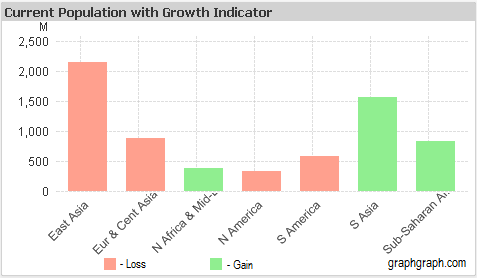
Pie Charts Are Terrible | Graph Graph

PieCharts_WorldBarColor


I am doing more and more charting to illustrate citizenship and multiculturalism issues and in consulting with those who have a better graphic sense than I, came across this convincing article and illustration against the use of pie charts.

Means I have to redo a number of what I have been working on but always good to learn something new that helps tell the story (I haven’t read his recommended book yet):

Let’s start this off with some honesty.  I used to love pie charts.  I thought they were great, just like the way I used to think Comic Sans was the best font ever.

But then I had some #RealTalk, and I’ve been enlightened in the error of my ways, and I want to pass on what I’ve learned to show people why pie charts aren’t the best choice for visualization.  For my day job, part of my work involves creating visualizations out of business data for our customers.  I picked up a copy of “Information Dashboard Design” a book by Stephen Few of Perceptual Edge.  If you’re at all interested in data visualization, I highly recommend his books, and on this site we attempt to use a lot of the principles in creating the visualizations we present to you.

Pie Charts Are Terrible | Graph Graph.

Convert, pay tax, or die, Islamic State warns Christians

Depressing – and another legacy of the Gulf War of 2003:

In the statement, Isis said Christians who wanted to remain in the “caliphate” declared earlier this month in parts of Iraq and Syria must agree to abide by terms of a “dhimma” contract – a historic practice under which non-Muslims were protected in Muslim lands in return for a special levy known as “jizya”. “We offer them three choices: Islam; the dhimma contract – involving payment of jizya; if they refuse this they will have nothing but the sword,” the announcement said.

….Mosul, once home to diverse faiths, had a Christian population of around 100,000 a decade ago, but waves of attacks on Christians since the 2003 US-led invasion to topple Saddam Hussein have seen those numbers collapse.

The Mosul residents who saw the Islamic State announcement estimated the city’s Christian population before last months militant takeover at around 5,000. The vast bulk of those have since fled, leaving perhaps only 200 in the city.

Convert, pay tax, or die, Islamic State warns Christians | World news | theguardian.com.

‘Hawking index’ charts which bestsellers are the ones people never read

Fun example of innovative analysis (and for all those of you who claim to read Piketty or other similar tomes):

Jordan Ellenberg, a mathematician at the University of Wisconsin, Madison, has just about proved this suspicion correct.

In a cheeky analysis of data from Kindle e-readers, Mr. Piketty’s daunting 700-page doorstopper emerged as the least read book of the summer, according to Prof. Ellenberg, who calls his ranking the Hawking Index in honour of Mr. Hawking’s tome, famous as the most unread book of all time.

As a result, he is tempted to rename it the “Piketty Index,” because Mr. Piketty scored even worse than Mr. Hawking.

As such, both stand as extreme case studies in aspirational reading. Like the Economist magazine’s Big Mac index of hamburger prices around the world, which is both silly and serious, Prof. Ellenberg’s Hawking Index is funny, in that it reveals the vanity of many book choices. But it also offers an interesting psychological perspective on reading that is born of good intentions, and dies of boredom on the dock or beach.

The calculation is simple, and as Prof. Ellenberg says, “quick and dirty.” It exploits a feature of Kindle that allows readers to highlight favourite quotes. It averages the page number of the five most highlighted passages in Kindle versions, and ranks that as a percentage of the total page count. Although it does not measure how far people read into a book, it makes a decent proxy for it.

“Why do you buy a book? One reason is because you know you’re going to like it,” Prof. Ellenberg said. “Another reason might be, ‘Oh, I think this book will be good for me to read.’”

….. He said his formula illustrates what mathematicians call the problem of inference, meaning he cannot say for sure these books are going unread, just that he has strong evidence for it.

“You can make some observation about the world, but there’s some underlying fact about the world that you’d like to know, and you want to kind of reverse engineer. You want to go backwards from what you observed to what you think is producing the data you see,” he said.

Other books reveal different insights into why people buy books they start but do not finish. Michael Ignatieff’s political memoir Fire And Ashes, for example, scores comparatively well for non-fiction at 44%, far better than Hillary Clinton’s Hard Choices, which barely cracked 2%. Lean In, the self-help book by Facebook executive Sheryl Sandberg, scored 12.3%.

In fiction, The Luminaries, by Canadian-born New Zealand author Eleanor Catton, which won last year’s Man Booker Prize, scores a mere 19%, and would score a lot lower if not for one highlighted quote near the end.

Prime Minister Stephen Harper’s book on hockey, A Great Game, curiously has no highlighted passages, so cannot be ranked on the Hawking Index (or, equivalently, ranks as low as is theoretically possible).

Fiction tended to score higher, likely reflecting the tendency for non-fiction authors to put quotable thesis statements in the introduction. The only novel that was down in the range of the non-fiction books was Infinite Jest by David Foster Wallace.

Prof. Ellenberg does not mean to disparage the low ranking books, he said, noting that the reason people buy them in the first place is that they are rich in content.

“I think it’s good to do back of the envelope computations as long as you do them with the appropriate degree of humility, and understand what it is that they’re saying,” he said. “I think any statistical measure you make up, you take it as seriously as it deserves to be taken.”
‘Hawking index’ charts which bestsellers are the ones people never read

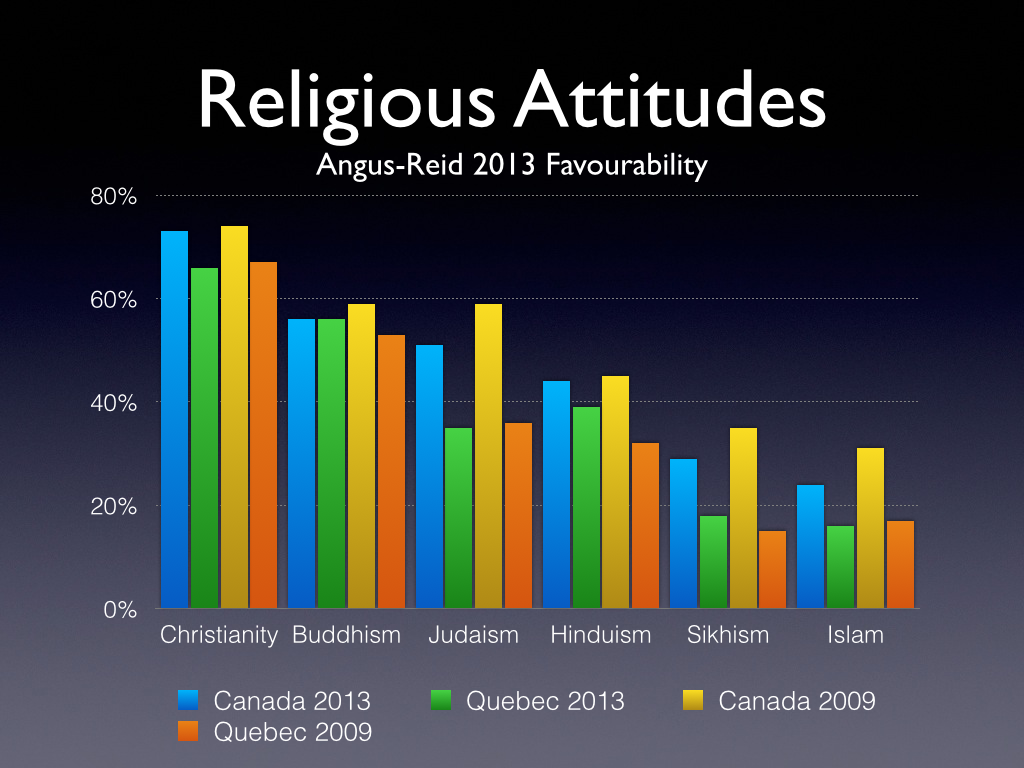
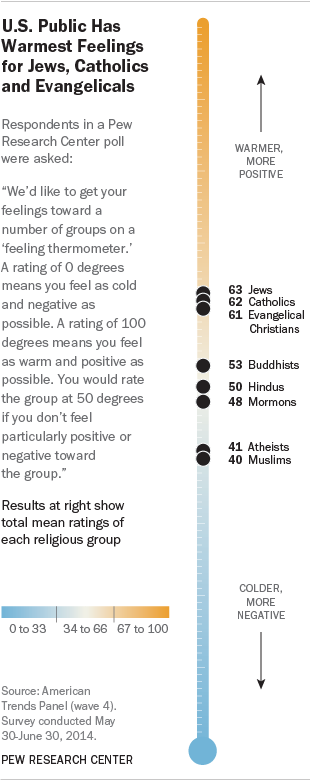
Chart of the Day: Religious Attitudes – USA, Canada and Quebec

Although not strictly compatible, the just issued Pew Research survey of US attitudes towards religions can be compared with a 2013 Angus-Reid Survey.

No real surprise in the relative ranking, Christianity on top, Islam on the bottom.

But in US, Jews are comparable to Christians but not so in Canada. US survey also includes attitudes towards atheists (tied at the bottom with Muslims) but does not include Sikhs.

Pew PF_14.07.16_interreligiousRelations_totalRatings1

Religiious Attitudes Angus Reid.001

Expatriates: The Unofficial Ambassadors

More good thought-provoking commentary from Victoria Ferauge on expats. While written from an American perspective, relevance to Canada given the large number (close to 3 million) Canadians abroad:

The Face of Americans Abroad:  7 million people with very different reasons for being abroad and of every color, creed, class.  Some are indeed missionaries.  Many are teachers or professors.  There are retirees, economic and marriage migrants, true expatriates sent by their companies, and so much more.  The Peace Corps, for example, is still around.  There is also the military and former military.

There is an almost infinite number of combinations here that begin with who these people were before they left the US, why they went abroad, what they do and where they went or were sent and with whom.

[David] Kuenzi [author of Wall Street Journal Op-Ed] qualifies his statement by referring to three categories:  “businesspersons, scholars or trailing spouses” but these are only a small fraction of the Americans living abroad.

I think that the largest group of Americans abroad looks like this:  they don’t want any or minimal contact with the US government and other Americans while they are living abroad, they do not want to join any American organization be it Democrats Abroad, Republicans Overseas, AARO or ACA: they are keenly interested in being good denizens of their countries of residence, and these days more and more of them aspire to become citizens of those states.  They make no demands on the United States while they are abroad.  In many cases the very minimal protection of the US government is neither attractive nor relevant to them since they know the limits of the local consulates assistance a list of local lawyers who speak English and they understand that the US government will not expend political capital on their behalf to get them out of trouble.    And if it weren’t for the fact that they have to have a passport to enter the US to see family, they would probably forgo that as well.  What they want is to be left alone to go about their business and their lives.

Are these people good “unofficial ambassadors”?  I have no idea and neither does anyone else.

For those Canadian expatriates, or former expatriates among you, Victoria would appreciate your help in the following:

And for those of you who are members of other diasporas, I’d be very interested in knowing if a similar situation exists between you and your home country.

The Franco-American Flophouse: The Unofficial Ambassador.