Nine things everyone should know how to do with a spreadsheet | Macworld

As I am starting to use spreadsheets to analyze demographic and related data, my basic knowledge of spreadsheets is being challenged. Another primer from Macworld (but applies to Excel and Google’s Sheets as well).

As I have been only using sum and average functions, these examples of other functions caught my eye:

=MAXRANGE and =MINRANGE: Return the largest and smallest values in a range. Related to these two, I also often use =RANKCELL,RANGE, which returns the rank of a given cell within the specified range.

=NOW: Inserts the current date and time, which is then updated each time the spreadsheet recalculates. In both Excel and Sheets, you need to add a set of parentheses: =NOW.

=TRIMCELL: If you work with text that you copy and paste from other sources, there’s a good chance you’ll find extra spaces at the beginning or end of some lines of text. The TRIM function removes all those leading and trailing spaces but leaves the spaces between words.

Nine things everyone should know how to do with a spreadsheet | Macworld.

Nine things everyone should know how to do with a presentation app | Macworld

Most of these are fairly familiar to people who use presentation software regularly but there is always a useful tip or two.  Tip that worked for me:

Menu commands in Google Docs, PowerPoint, and Keynote let you arrange objects by their center, top, bottom, or right/left margins. Keynote’s and PowerPoint’s Arrange menus include additional commands to distribute three or more objects top-to-bottom or side-to-side equally without affecting their positions in the other direction. A convenient option in Keynote 6.2 Arrange > Distribute Objects > Evenly spaces selected objects uniformly along an imaginary line using the objects closest to the edge of the slide as end points.

Nine things everyone should know how to do with a presentation app | Macworld.

Ten things everyone should know how to do with a word processor | Macworld

Macworld has published a useful series on the basic programs many of us use on a regular basis. Covers Apple, Microsoft and Google versions of word processing, spreadsheet and presentation software.

As will be travelling over the next few days, will post one of these articles per day for those interested.

Even though I am somewhat of a power user, particularly for word processing and presentation software (I use the Apple suite), usually learn something new from these articles.

The biggest timesaver is the use of shortcuts:

When I’m in the flow of writing, there’s nothing worse than having to lift my fingers from the keyboard, grab the mouse, and click to select, copy, cut, paste, or format text, or to save or print a document. But in most cases, my hands never actually need to leave the keys to take care of these things. I use keyboard shortcuts instead.

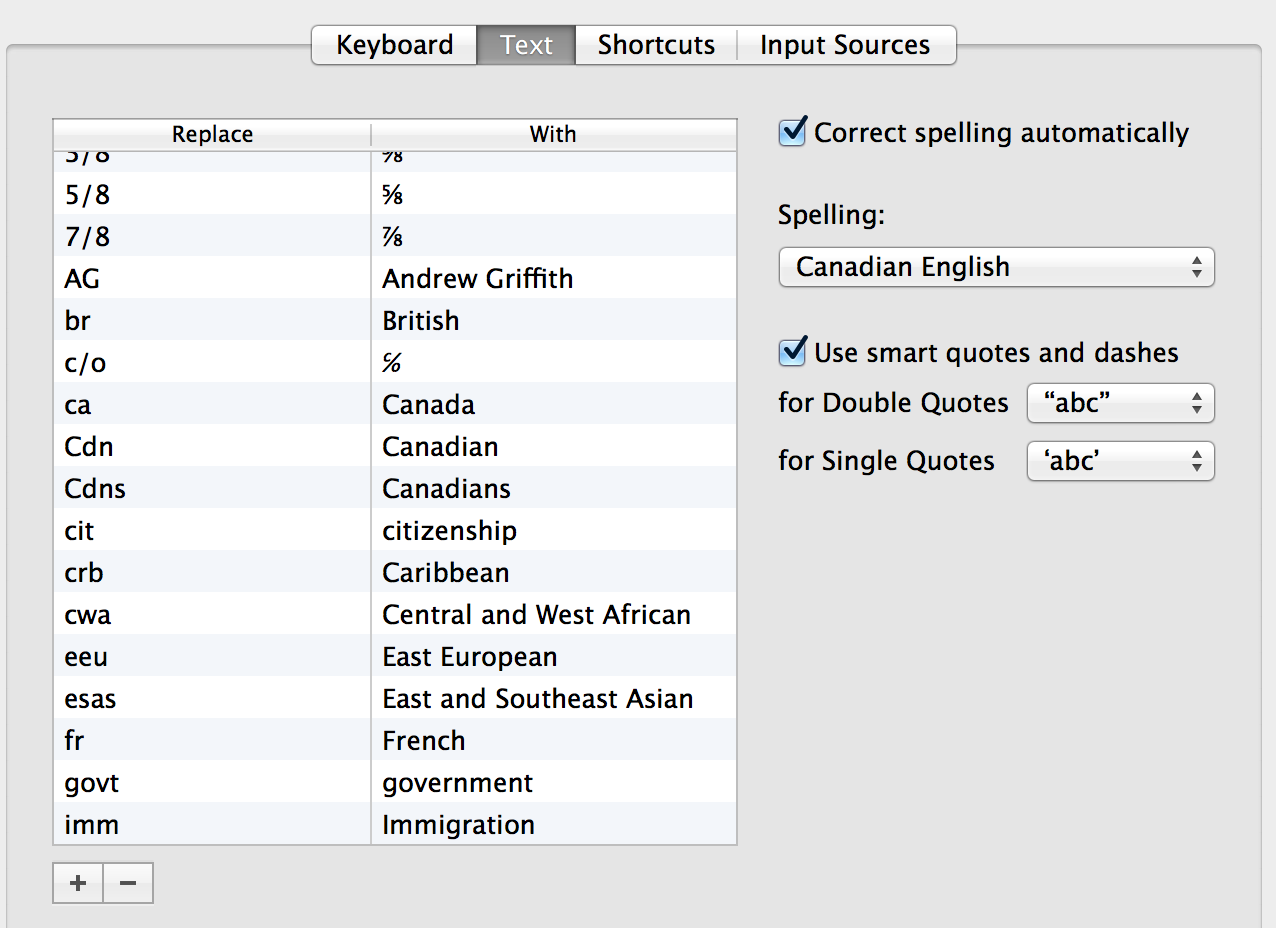
While outside word processing, I also use computer wide shortcuts for frequently used words (in my case, government, citizenship, multiculturalism, Temporary Foreign Workers etc). In the Mac world, go to System Preferences, Keyboard, Text and you will see the standard text shortcuts and can add your own.

Keyboard Text

Ten things everyone should know how to do with a word processor | Macworld.

Permanent Resident Voting: A Movement on the Rise – But does it make sense?

I am not a fan of allowing Permanent Residents to vote although I understand the rationale of supporters.

We have enough problems encouraging citizens to vote and it remains to be seen whether Permanent Residents would have significantly greater interest in voting.

More significantly, there are relatively few differences between citizens and Permanent Residents in terms of rights, social programs and other benefits (and responsibilities) and to a certain extent, if Permanent Residents can vote, this may reduce the incentive to become citizens.

Of course, in the context of the new citizenship act making citizenship harder to acquire, this may increase pressure to allow municipal voting. The old argument about Canadian citizenship being relatively easy to acquire in a relatively short period of time applies less and less:

Finally, we must connect with and support groups who are currently engaging other critical advocacy for newcomers. Earlier this year, the city of Hamilton proclaimed itself a sanctuary city – in other words, the city committed to ensure that every resident, regardless of immigration status, has access to city services. It is no coincidence that a similar proclamation in Toronto preceded the successful motion on permanent resident voting. City Vote must situate itself within the broader movement to ensure newcomers have equal rights and opportunities in Canada.

Thankfully, the campaign has a history of strong partnerships within this larger newcomer-serving community. Thorncliffe Neighbourhood Office, a multi-service community hub in central Toronto, incubated the campaign in 2008 and helped it grow. Maytree has been supporting policy development and hosting forums on the issue since 2007. Groups as large as the Canadian Civil Liberties Association and as small as warden Woods Community Centre have offered their time, energy and support. The foundation for growth is solid and diverse.

Permanent Resident Voting: A Movement on the Rise.

Serving in foreign militaries

Serving in the IDF or other foreign militaries raises sensitive issues related to dual loyalty (see my earlier article Which Country Would You Die For?).

Serving in a foreign military implies a greater loyalty to that country, given the risk of ultimate sacrifice.

But serving in a foreign military, with its own discipline, regulations and codes, is distinct from extremist irregular forces without such developed frameworks (even if there are some common elements).

In the former in democratic societies the broad frameworks and values are largely similar. Needless to say, the same could not be said for those fighting for ISIS or equivalents:

Two Americans serving as lone soldiers were among 13 Israeli soldiers and scores of Palestinians over the weekend who died during the first major ground battle in two weeks of fighting between Israel and Hamas. Max Steinberg, a 24-year-old sharpshooter in the Golani Brigade, was killed as well as Nissim Sean Carmeli, 21, from South Padre Island, Texas.

There were about 5,500 lone soldiers serving in the military in 2012, according to the Israel Defence Forces. Groups for families of lone soldiers, like the support group in Toronto, have recently started in Los Angeles and other cities, providing a support network as the fighting intensifies.

“Lone soldiers are a kind of star in Israel,” Jewish Journal reported. “For Israeli kids, army service is a rite of passage. But because it is a choice for the young members of the Diaspora who re-direct their own life paths to protect Israel, those enlistees are given a hero’s welcome — and a lifetime of Shabbat dinner invitations from their fellow soldiers, who become their surrogate families.”

‘I just want her to get through this in one piece’: Canadians serving with Israeli military amid Gaza conflict, parents say

And in LaPresse, a fairly critical look at Canadian Ambassador Vivian Bercovici’s one-sided perspective as seen through her tweets.

To be fair, she is simply expressing the Government’s policy on Israel and Palestine but given that she formally is the Ambassador to both Israel and the Palestinian Authority, she does seem to be even more one-sided than necessary:

Norman Spector, qui a été ambassadeur du Canada en Israël de 1992 à 1995 et chef de cabinet du l’ancien premier ministre Brian Mulroney, s’est dit surpris du «parti pris» de ces déclarations. «Cela me surprend de lire ses tweets et retweets», a-t-il affirmé.

«Par contre, à mon époque, l’ambassadeur était responsable pour les relations avec Israël et pour les relations avec les Palestiniens, ce qui n’est pas le cas aujourd’hui, si je ne me trompe pas», a-t-il ajouté.

Le bureau du ministre des Affaires étrangères, John Baird, a confirmé que cette dernière responsabilité incombe au Bureau de représentation du Canada auprès de l’Autorité palestinienne.

Le ministre John Baird n’a pas bronché lorsque La Presse lui a demandé de réagir. «Elle est là pour représenter les intérêts canadiens, les valeurs et la position canadienne, et elle le fait très bien», a déclaré un porte-parole par courriel. «Elle a tout notre appui.»

Des experts n’ont pas été particulièrement surpris en lisant ces propos. «Elle a été choisie au départ parce qu’elle avait ces convictions», a souligné Rex Brynen, professeur de sciences politiques à l’Université McGill.

«Je ne crois pas que cette distinction [entre diplomatie et activisme politique] existe réellement, a quant à lui noté le professeur Roland Paris, de l’Université d’Ottawa. Les diplomates ont plusieurs fonctions, et l’une d’elles est d’être un défenseur des positions de leur gouvernement.»

http://www.lapresse.ca/actualites/politique/politique-canadienne/201407/22/01-4785985-israel-les-tweets-de-lambassadrice-du-canada-font-jaser.php

Consumers More Borderless Than Multinationals – New Canadian Media – NCM

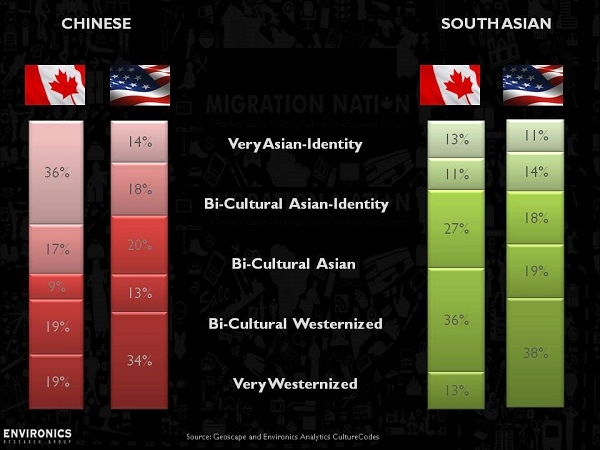
Environics Canada USFascinating market research and comparison between Canadian and American acculturation models and behaviours by Robin Brown of Environics.

The cliché of the melting pot versus the cultural mosaic appears to still apply, at least for those of Chinese and South Asian origin (two of the largest communities in Canada):

Our recent research compared Chinese and South Asian Americans and Canadians’ level of acculturation using Geoscape and & Environics Analytics CultureCodes see graph. These analytical tools classify the population into five categories of acculturation based on their home language, knowledge of English/French and period of immigration. We found much higher levels of acculturation in the U.S. than in Canada for both groups. This results from a number of factors, including the “melting pot” vs. multicultural culture of each country. Of course, this means that these populations will differ and marketing efforts to reach them must navigate that difference.

But, understanding the diasporas may not be the biggest challenge faced by multinationals. The current reality for many multinationals is that many of their consumers are in some respects more global than they are. There may be good business reasons why an Asian Canadian cannot find Nescafe iced coffee here in Canada, but consumers are not aware or don’t care about the constraints of separate business units, tariffs and supply chain logistics. They are connected globally and informed of products and services that are used by their ethnic diaspora across the world.

Consumers More Borderless Than Multinationals – New Canadian Media – NCM.

Filipino Canadians fear end of immigrant dreams for nannies

Nicholas Keung’s article on the future of the Live-in Caregivers program:

Critics of the government’s approach, including some Conservative loyalists, warn that the growing Filipino Canadian vote could also be at stake in next year’s federal election if the government removes access to immigration from the live-in caregiver program LCP — 90 per cent of those participating are from the Philippines.

Family separation, lost skills the biggest challenges for immigrant nannies“This is a defining issue for the Filipino Canadian community,” said Chris Sorio of Migrante Canada, an international advocacy group for Filipino migrants.

“This is something very close to our hearts. It is worrying us because we feel this could be a smoke-screen for changes that are coming to the LCP program. Our concern is they are going to further restrict family reunification under the program.”

In recent meetings with the media to discuss Ottawa’s planned reforms to the controversial temporary foreign workers program, Employment Minister Jason Kenney criticized the LCP as being “out of control” and having “mutated” into a program of family reunification.

… Findings of the nanny study [by Ethel Tungonan of U of Alberta]

Researchers surveyed 631 Filipina caregivers about their jobs, recruitment, education, use of community supports and health, in the first national study of Canada’s live-in caregivers.

It found:

  • Caregivers’ average age on arrival was 34

  • 86% had university education or above.

  • Nearly 90% arriving in the past five years were recruited by employment agencies or directly hired by unrelated employers.

  • Two-thirds had children; about half experienced continued separation because their children had grown too old to be considered dependants for immigration.

Filipino Canadians fear end of immigrant dreams for nannies | Toronto Star.

Mideast conflict affects all Muslims and Jews: Marmur

Interesting column by Dow Marmur, rabbi emeritus at Toronto’s Holy Blossom Temple, and the need to focus on relations between Jewish and Muslim communities at home, as some of the recent tensions at demonstrations attest:

Christians act as catalysts here. Thus the proposed centre is to be built on a site where churches had stood since the Middle Ages; the last was damaged in the Second World War and subsequently demolished. Berlin is now to have a home promoting religious tolerance erected on Christian ground.

Christians in post-war Germany have a history of trying to bring Jews and Muslims together without meddling in the politics of the Middle East. Already more than 40 years ago, Christian institutions in what was then West Germany helped to create an organization called Jews, Christians and Muslims in Europe. To this day JCM promotes fruitful interfaith encounters, particularly between theology students. The Berlin House of Prayer and Learning would be a logical and more far-reaching extension of this work.

Toronto has a sizeable Jewish community and an even larger Muslim minority. Canada is known for its commitment to multiculturalism and peace. This city may, therefore, be the right place to imitate and fine-tune what’s being done in Berlin, not by seeking to import the Palestinian-Israeli conflict but by bringing together committed Christians, Jews and Muslims who would help to enrich our lives here despite the tensions there.

The Canadian Association of Jews and Muslims is already engaged in this kind of non-political work. What I know of it suggests that it could benefit from active Christian involvement and resourcefulness reflecting Canada’s commitment to peace and coexistence. Where Chicago and Los Angeles failed, Toronto taking its cue from Berlin might succeed.

Mideast conflict affects all Muslims and Jews: Marmur | Toronto Star.

Calgary mom targeted by jihadist blogger after her radicalized son killed in Syria

Not exactly a nice gesture to a grieving mother seeking explanation for her son, Damian Clairmont’s, turn to radical Islam and death in Syria:

Chris Boudreau has been reeling for months after learning her son died fighting with a terrorist group overseas. Now, a self-proclaimed jihadist is urging the Calgary mother to embrace an extremist ideology she suspects was used to brainwash her son.

On his blog, Abu Dujana al-Muhajir claims he was among a group of young men who left Calgary to join “various fronts of Jihad” after forming a study group at a downtown mosque. Damian Clairmont, Boudreau’s son who was also part of the group, was later killed during rebel infighting in Syria.

Clairmont’s death devastated and confounded his mother, who continues to struggle with how her boy, raised in a loving Canadian family, could adopt radical views and die fighting for them.

In his latest blog post, Abu Dujana writes an open letter to Boudreau in which he explains the ideology behind her son’s path to violence and encourages her to become sympathetic to the cause.

“The attempt to get me to fall for the same thing just made me shake my head,” said Boudreau, who has branded herself an advocate against homegrown radicalization, and has met with officials across Canada and abroad to advance her cause.

“At least it means I must be getting to somebody enough that they are trying to find another way to get me to see their point of view, so that I don’t continue what I’m doing.”

… Boudreau recently returned from Europe, where she met with three other mothers whose sons had also died fighting alongside radical Islamic groups. One of those sons was killed just two months before Clairmont in the same Syrian town northwest of Aleppo.

She was able to build a bond with the other women, something she had been searching for, and learned their sons spouted the same kind of rhetoric she read in Abu Dujana’s blog.

“After talking to these mothers and hearing the exact same story over and over again, you know that (radicals are) using the same verbiage with everybody.”

… The blog posts offer an apparent window into the group’s ideology and their path to violence.

The latest missive advances a form of Islam based on a selective reading of the Qur’an, ignoring verses that contradict its point of view, said Aaron Hugues, an author who has written extensively on religion and holds a PhD on Islamic studies.

“What these guys do is they have very little understanding of the tradition … and they tell themselves these ludicrous stories that they’re waging jihad and that if they die they’ll go to paradise, and it’s brainwashing,” said Hughes, who used to teach at the University of Calgary but now lectures at the University of Rochester.

“In many respects, I think this radical Islam is a cult, and these kids need to be deprogrammed,” Hughes said.

“This thing that he wrote is really meant to unsettle us, Canadians, because it’s very articulate … and he’s trying to say, we know full well what we’re doing and we’re not brainwashed,” he said.

Mubin Shaikh, a former Muslim radical who joined CSIS as an undercover operative in a Toronto terrorism investigation, said he was considering a formal response to the blog post on behalf of Boudreau, whom he’s been helping.

He called the open letter propaganda that “cherry-picks” verses of the Qur’an to promote a radical version of Islam.

He said the missive is simply an attempt to justify Clairmont’s “indoctrination.”

“These guys are relative nobodies, and they put on this hero costume and they want people to follow them,” Shaikh said. “He’s wrong on so many levels.”
Calgary mom targeted by jihadist blogger after her radicalized son killed in Syria

Opinions on Rob Ford divide Toronto’s black community | Toronto Star

Interesting article on Rob Ford and the black community in Toronto and how his “retail politics” as well as follow-up to specific requests by constituents continues to resonate with some:

[Ken] Bryan, raised in foster homes in some of the city’s most impoverished neighbourhoods, says he “gets” Ford’s support in communities ignored by other politicians unless they are “pandering for votes.”“

Ford shows up and helps someone fix their door that’s been broken for three months and they say, ‘Hey, this guy is a great guy,’” Bryan said. “His sort of populism appeals to that … ‘I’m just this poor little guy and there are these downtown elites who hold their noses up at us; they don’t come into our communities.’”

But Bryan bristles when he hears claims that Ford has done more for black people than any other politician, or that youths, as Ford has said, would be “dead or in jail,” if it weren’t for him and his football charity.

“It’s patently false,” said Bryan, “but he believes it and he says it and the people who don’t know any better believe it. And that’s unfortunate.”

…. Those struggling to eke out a living in Toronto may not have the time, or inclination, to follow the decision-making at city hall closely enough to realize the inconsistencies between Ford’s words and his policy positions, says Bryan.

“It is low information, not necessarily low education,” he said.For that reason, it’s up to those who are paying attention to bring those who feel left out “into the fold,” and get them involved in the political process, Bryan adds.

“The question to be asked is why do all these black people feel disenfranchised? The answer is larger and has to do with a lot more than Rob Ford.”

Opinions on Rob Ford divide Toronto’s black community | Toronto Star.