Canada Today: Less Hotel, More Live-in Condo – My Take

Growing Diversity (National).001My take on changes to the multiculturalism program by Jason Kenney over the past 7 years, starting with this initial 2008 quote from him:

But having criss-crossed this great country; having attended hundreds of events and talked to thousands of new Canadians, I am certain of this: we all want a multiculturalism that builds bridges, not walls, between communities.

We want a Canada where we can celebrate our different cultural traditions, but not at the expense of sharing common Canadian traditions.We want a country where freedom of conscience is deeply respected, but where we also share basic political values, like a belief in human dignity, equality of opportunity, and the rule of law.

We don’t want a Canada that is a hotel, where people come and go with no abiding connection to our past or to one another, where citizenship means only access to a convenient passport. We want a Canada where we are citizens loyal first and finally to this country and her historically grounded values.

The key to building such a Canada, to maintaining our model of unity-in-diversity, is the successful integration of newcomers.And that should be the focus of today’s multiculturalism.

Canada Today: Less Hotel, More Live-in Condo – New Canadian Media – NCM.

The Runner-Up Religions Of America

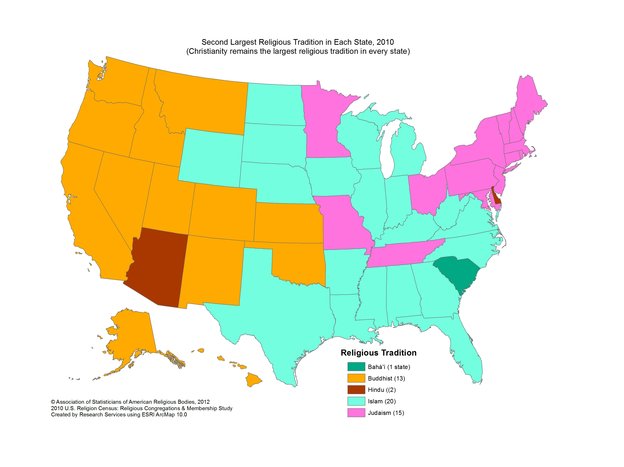
US relions by stateA partial snapshot of US religious diversity, along with some interesting histories of some of the communities involved:

Glance at the map above, Second Largest Religious Tradition in Each State 2010, and you will see that Buddhism orange, Judaism pink and Islam blue are the runner-up religions across the country.No surprises there.

But can you believe that Hindu dark orange is the Number Two tradition in Arizona and Delaware, and that Bahai green ranks second in South Carolina?

The map — created by the Association of Statisticians of American Religious Bodies and published recently in The Washington Post — “looks very odd to me,” says Hillary Kaell. She is a professor at Concordia University in Montreal who specializes in North American Christianity. “These numbers, although they look impressive when laid out in the map, represent a very tiny fraction of the population in any of the states listed.”

True that. Christianity is the Number One religious tradition across the board. A 2012 Gallup poll showed that 77 percent of Americans identify as Christians. But a deeper look into the stories behind the maps data reveal a bit more about a nation in flux.

The Runner-Up Religions Of America : The Protojournalist : NPR.

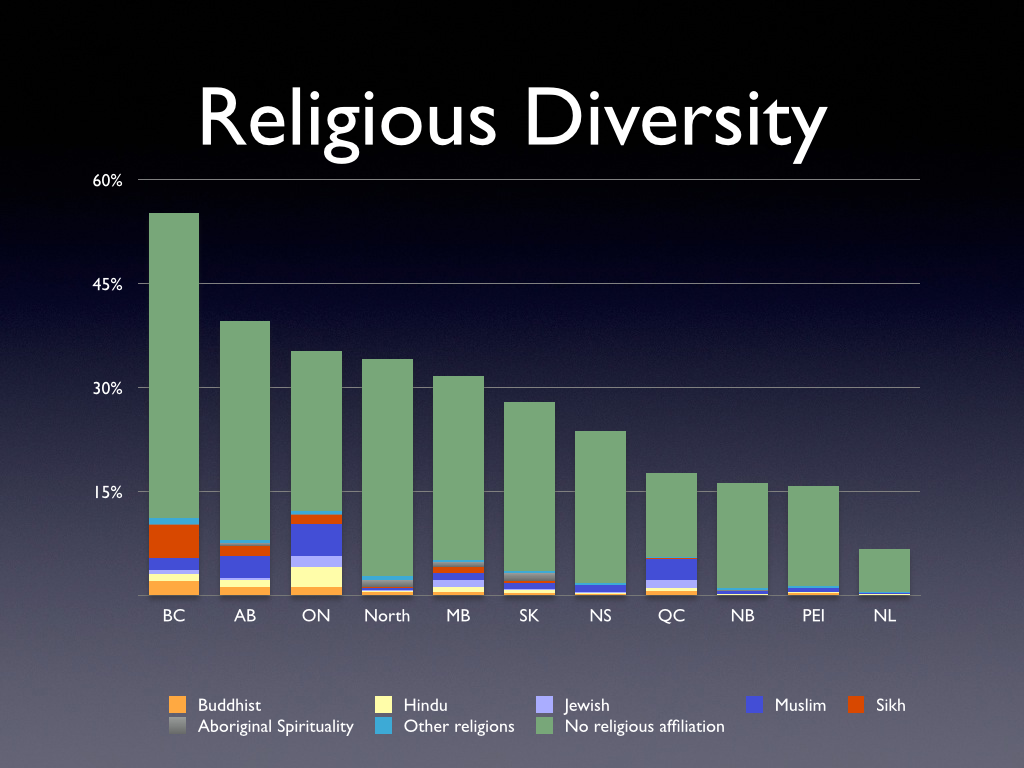
Canadian Comparison:

Religious Diversity by Provinces.001

UNESCO Exhibition on Jewish History in Middle East

In addition to the meeting with Hollande, the UNESCO exhibit on Jewish history and presence in the Holy Land finally sees the light of day (Canada led campaign to save exhibition on Jewish history in Middle East after Arab coalition quashed it):

Meanwhile, Cotler was effusive in his description of the Wistrich exhibit, which he called “historic.”

“It is a remarkable dramatization of history and heritage, of people, book, land, memory and state,” he said.

In 24 panels, it traces Jewish history back to the patriarch Abraham, through Moses, King David and all the way through to the struggle for Soviet Jewry, the birth of Zionism and the reconstitution of the State of Israel.

The exhibit, which will run for nine days, had been scheduled to open last January. Pressure from 22 Arab countries, who argued it would prejudice the peace process, prompted UNESCO to cancel it.

Responding to that decision Rabbi Hier stated, “It is ironic, that while the Arab League was trying to kill this exhibition and all the attention was focused on Paris, the UN headquarters in New York is hosting an exhibit entitled, Palestine, based entirely on the Arab narrative, which was not criticized as an interference with Secretary [John] Kerry’s mission.”

Following public criticism from Canadian Foreign Minister John Baird and U.S envoy Samantha Power, the exhibit was rescheduled to open last week, but with the name “Israel” removed from the title and replaced with “Holy Land.” UNESCO also required the removal of an image of the Dead Sea Scrolls, which had been part of the initial exhibit prepared by Wistrich, a professor of European and Jewish history at the Hebrew University in Jerusalem.

Hollande’s stand on anti-Semitism impresses delegation | The Canadian Jewish News.

How much of a threat do terrorists pose to Ottawa?

Wark’s comments appear to be the most sensible of those cited:

So, has Iran reached a violent tipping point with Canada? Is Ottawa sufficiently fortified? How concerned should we be?

Experts interviewed this week conclude this: Hezbollah is an important threat, but the probability of an Iranian-Hezbollah hit on the capital is low. If the aim was to strike against the West, there are other higher-value targets outside Canada.

“Canada is by and large off the political radar screens of most of these groups. It’s hard to see al-Qaida affiliates or terrorist movements abroad turning their sights on Ottawa specifically,” says Wesley Wark, a national security expert at the University of Ottawa.

“But a Canadian urban centre might be the bullseye of some disaffected Canadian who went the route of jihad and had the means to try violence. We’ve been there before in terms of the so-called Toronto 18 plot.”

How much of a threat do terrorists pose to Ottawa? | Ottawa Citizen.

Kenney Op-Ed: Foreign workers in Canada: Let’s separate the facts from the myths

From anecdotes (“”There are tens of thousands of employers who tell me that they would go out of business if they couldn’t find people to fill those jobs.”) to Minister Kenney’s more evidence-based approach announcing the changes to the Temporary Foreign Workers program.

His op-ed is particularly revealing:

Several recent studies have come to this conclusion, suggesting that over-reliance on the program’s general low-skilled stream has prevented wages from rising in some low-paid occupations in parts of Western Canada, and may have reduced labour mobility. For example, overall median wages in Alberta have gone up by an average of 31 per cent since 2006, but wages in the province’s food services sector, a heavy user of the program, increased by only 8 per cent. This kind of distortion is unacceptable.

Former Bank of Canada governor Mark Carney put it well last year when he said “We don’t want an over-reliance on temporary foreign workers for lower-skilled jobs, which prevent the wage adjustment mechanism from making sure that Canadians are paid higher wages, but also so that firms improve their productivity as necessary… The intent of the government’s review is to ensure that this is used for transition, for those higher-skilled gaps that exist and can hold our economy back.”

Foreign workers in Canada: Let’s separate the facts from the myths – The Globe and Mail.

Lots of coverage on the changes, largely targeted towards abuse of the program for the fast food service industry. CBC overview on the changes, Changes to Temporary Foreign Worker Program include limits and fines, Macleans (Temporary foreign worker rules reformed, but tensions remain) and the Government briefing package with the key message of Overhauling the Temporary Foreign Worker Program.

Initial commentary of interest:

Campbell Clark in the Globe, makes some valid points in Reforms to foreign worker program are welcome, but why the long wait?:

To their credit, they produced a serious plan. The reforms provide greater incentives for employers to find low-wage workers at home by raising application fees and limiting the percentage of each company’s work force that can be brought in from abroad. The caps will be phased in over two years. And Mr. Kenney promised to increase transparency by reporting the numbers for each employer.

Even the style used to unveil the reforms was refreshingly grown-up for a government that typically prefers slogans to explanations. The ministers briefed journalists on technical details, and did a talk-till-you-drop press conference explaining their rationale. They acknowledged some businesses might be hurt, but said companies should turn more to recruitment, training and wage increases. Mr. Kenney said he wants to return the program to what it is supposed to be: a last resort.

But there is also the past. Should the Conservatives have woken to the problems before? “No,” Mr. Kenney said. The Conservatives, he explained, accepted the policy in place when they took power as “normal.”

That is a frank admission. Governments do not look under every rock for worms. But it is a tad short on mea culpa. Under the Conservatives, the number of low-wage workers – those not in special programs for nannies or farm workers, or covered by agreements like NAFTA – grew from a few thousand to tens of thousands. Mr. Harper’s government spent to speed up processing for TFWs. If it is broken now, they should have fixed it sooner.

Helpfully, to the Government’s communications strategy, negative reaction from Alberta and the tone-deaf Canadian Federation of Independent Business (Alberta decries changes to foreign worker program):

“This is an appalling over-reaction,” said Dan Kelly, president of the Canadian Federation of Independent Business, which has supported the Conservative government’s economic approach in the past. “This will be a serious knock on this government’s small-business credentials to have taken the kind of move that they just did.”

Restaurants Canada, which represents restaurant owners, predicts the formula, combined with new $1,000 user fees, will force some restaurants to close, while others will need to raise prices to cover higher wages.

“I think there are going to be business casualties,” said Joyce Reynolds, Restaurants Canada’s vice-president of government affairs. “Are Canadians prepared to pay double what they pay now for a steak?”

Andrew Coyne starts off with a somewhat predictable more libertarian economic approach in Hiring foreign workers in Canada is a crime, but outsourcing overseas is fine but ends up arguing for a pathway to citizenship:

And the reforms themselves? They will be widely praised, and should succeed in moving the controversial program off the front pages, adding to Mr. Kenney’s reputation as the safest pair of hands in cabinet. Unfortunately, that does not make them good policy.

Consider an employer in the manufacturing sector, who finds himself unable to attract enough workers for certain kinds of unskilled labour, at least at the going wage. He is entirely at liberty to outsource the work to a company overseas, paying a fraction of the wages he would have had to pay his Canadian employees. He can move the whole plant offshore if he likes, laying off every one of its current employees, and import the product he sells rather than make it here. ….

This is the crime of which these [food service] employers, whom Mr. Kenney vows to harass and punish with $100,000 fines, are guilty: operating a business while in the service sector. They “cost” no more jobs than their manufacturing counterparts. It’s just that the hard-working, low-wage foreigners they employ are in our midst, and visible to us, not toiling away in some sweatshop overseas we never see. …

It certainly won’t help the foreign workers themselves, who will now be subject, as a support group, the Migrant Workers Alliance for Change, put it, to a kind of “mass deportation order.” Many had hoped to convert their demonstrable fitness for life in Canada into permanent residency, and ultimately citizenship. Those hopes will now be dashed.

Yet if any reform were needed, that remains the more promising route. If temporary foreign workers were not temporary, they would no longer be foreign. They would not be “taking jobs” from Canadians. They would be Canadians.

John Ivison sides with the CFIB and other small businesses in With the temporary foreign worker changes Jason Kenney has done a great deal to insulate himself:

The Employment Minister has certainly gone to great lengths to insulate himself from more incendiary allegations of abuse. Unfortunately, the risks will be borne by those small businesses that are about to see their costs soar.

Tom Walkom from the Star, from a different perspective, ends up in the same place (Jason Kenney’s temporary foreign worker changes not enough):

Public pressure has forced Kenney to make the arrangement seem more palatable. But it is not. If we need more foreign labourers, let them come as full-fledged immigrants.

If paying Canadian fast-food workers a decent wage means we must shell out more for a cup of coffee, so be it.


Chris Selley: Stripping jihadis’ citizenship feels good. But what good does it do?

Another good column by Chris Selley on citizenship revocation (see his earlier Actually, my citizenship is a right | National Post). Quite funny in places too, but his fundamental point is serious:

But that only leads us to the biggest question, which is why we would want to banish terrorists at all — not in our guts which is understandable but as policy. British terrorism suspects recently stripped of their citizenship are currently at large in Sudan, Kenya, Somalia, Afghanistan and other places that could certainly use fewer terrorism suspects rather than more. Home Secretary Theresa May has denaturalized and deported at least one British citizen over the advice of her own security officials, who would have much preferred to keep an eye on him.

FOX News types pitch a fit whenever a former Guantanamo detainee pops up on the frontlines — as many have. They went nuts when it emerged the Americans released Abu Bakr al-Baghdadi from custody in Iraq in 2009, only to have to deal with him now as leader of the Islamic State in Iraq and the Levant.

You can’t keep people in custody forever. Sometimes you have to make tough choices and cross your fingers. But why would we deliberately choose to set ostensibly dangerous people loose in the Middle East? No doubt it would give some of us a cheap thrill. But Chris Alexander is not Minister of Cheap Thrills.

National Post | Chris Selley: Stripping jihadis’ citizenship feels good. But what good does it do?

Federal executives lack training, flexibility, Hubbard and Paquet

Ruth Hubbard and Gilles Paquet on the public service:

Hubbard draws her conclusions from a series of confidential discussions she and University of Ottawa Prof. Gilles Paquet held with more than 100 executives between 2006 and 2009 about thorny topics the public service doesn’t like to publicly air or even acknowledge – from disloyalty, security and ethics to in-house operational and institutional challenges.

“In our view, the state of mind of senior executives has come to be tainted by a multitude of bad habits: creeping cognitive dissonance and political correctness, erosion of critical thinking. These bad habits of the mind have unwittingly led to reprehensible behavior; rewarding failure, punishing success; failure to confront, disloyalty,” the pair wrote in a recently released book.

They argue this state of mind, coupled with the lack of capabilities, could, if left unchecked, lead to the further “deterioration” or “fading away” of the public service.

Federal executives lack training, flexibility, expert says | Ottawa Citizen.

Her direct reply to Ralph Heintzman (Public service needs ‘moral contract’ to keep it neutral, study says | Ottawa Citizen):

Only a very bizarre and unfit public servant would suggest

(1) that the technocracy should always oppose the political, and would conclude that, when there is accord, there must have been promiscuity; and

(2) that a senior bureaucrat should not work collaboratively with his minister unless the minister has a notion of the public interest aligned completely with his own.

Such would appear to be Heintzman’s views, and they are unreasonable.

While Hubbard and Paquet are correct to point out some of the failings of the public service, they largely ignore or dismiss the failings on the Government side.

Of course, the public service must adapt to the government of the day, but the Conservative government came from a very different space in terms of values and ideologies, combined with a high level of distrust that made this more challenging. Its dismissal of evidence and expertise, rather than merely challenging public service advice,  its unwillingness to listen to alternate views and its systematic attempt to weaken independent bodies are also part of the picture.

Just as Heintzman goes to far in his view of the independence of the public service, Hubbard and Paquet go too far in the other direction (readers may recall that in the end, the divergence between Paquet’s and my views was too great to publish with his private press – see my earlier post Gilles Paquet’s Critique of Policy Arrogance or Innocent Bias).

Ruth Hubbard: The real problem with the public service

Forget MacKay, a woman’s place is on the bench

One of the better rebuttals to MacKay’s arguments on lack of diversity:

Mr. MacKay essentially suggests that female lawyers have no judicial ambition. But where is his proof? The federal government’s Office of Federal Judicial Affairs refuses to publish statistics about the number or breakdown of applicants. It can and it should. Consider Ontario, which does publish such statistics. Between 2006 the year the Harper government came to power and 2012, 299 women applied out of a general pool of 636; in other words, 47 per cent. And Ontario appointed 32 of those women to bench out of a total of 72, or 44 per cent.

Can Mr. MacKay plausibly explain why this pattern would be markedly different at the federal level? We doubt it.

Mr. MacKay’s comments perpetuate tired tropes about women, motherhood and professional ambition. Forget the fact that most women applying for or considering judicial office will be well past the stage where they are balancing a toddler on each hip. Forget that the reference to “riding circuit” dates back to times when judges traveled by horse and buggy some Canadian superior court judges do travel, but none who sit on provincial courts of appeal or the Supreme Court of Canada. Even more troubling is that suggestion that women define themselves by motherhood. Not only is the claim sexist and unsupported by evidence, but it locates the fault for any disparity among women themselves.

Equally disturbing is the government’s apparent lack of interest in other aspects of judicial diversity. Statistics from a 2012 Globe and Mail study combined with Ms. Cairns Way’s recent findings suggest that the appointment rate of aboriginal judges hovers at 1 per cent, while the appointment of members of visible minority communities is an abysmal .5 per cent. Clearly, ensuring that the judiciary reflects the community it serves is not a priority for this government.

Make no mistake – the failure to appoint women to the bench is not “a women’s issue”. It affects us all. It is not the fault of women, either. It is a pattern by a government hostile to the judicial role and apparently indifferent to pervasive patterns of under-representation in our judiciary.

Forget MacKay, a woman’s place is on the bench – The Globe and Mail.

Ottawa to fight court ruling giving ex-pats a vote

“Is there a substantial change in the ex-pat Canadian citizen that takes place after five years and one day?” O’Brien asked in court.

Well, not for one day after, but the longer one lives outside Canada, the less the direct connection to Canadian issues and debates, not to mention expatriates do not pay Canadian taxes. Government is right on this one.

Ottawa to fight court ruling giving ex-pats a vote – Politics – CBC News.

Government welcomes Royal Assent of Bill C-24, Civil Liberties Groups Plan Legal Challenge

Key messages from the CIC’s Press Release:

Improving efficiency

Canada’s citizenship program is being improved by reducing the decision-making process from three steps to one. It is expected that, by 2015–2016, this change will bring the average processing time for citizenship applications down to under a year. It is also projected that by 2015-2016, the current backlog will be reduced by more than 80 percent.

Reinforcing the value of Canadian citizenship

The government is ensuring citizenship applicants maintain strong ties to Canada. These amendments to the Citizenship Act provide a clearer indication that the “residence” period to qualify for citizenship in fact requires physical presence in Canada.

More applicants will now be required to meet language requirements and pass a knowledge test to ensure that new citizens are better prepared to fully participate in Canadian society. New provisions will also help individuals with strong ties to Canada, such as by automatically extending citizenship to additional “Lost Canadians” who were born before 1947 as well as to their children born in the first generation outside Canada.

Cracking down on citizenship fraud

The updated Citizenship Act includes stronger penalties for fraud and misrepresentation a maximum fine of $100,000 and/or five years in prison and expands the grounds to bar an application for citizenship to include foreign criminality, which will help improve program integrity.

Protecting and promoting Canada’s interests and values

Finally, the amendments bring Canada in line with most of our peer countries, by providing that citizenship can be revoked from dual nationals who are convicted of serious crimes such as terrorism, high treason and spying offences depending on the sentence received or who take up arms against Canada. Permanent residents who commit these acts will be barred from citizenship.

As a way of recognizing the important contributions of those who serve Canada in uniform, permanent residents who are members of the Canadian Armed Forces will have quicker access to Canadian citizenship. The Act also stipulates that children born to Canadian parents serving abroad as servants of the Crown are able to pass on Canadian citizenship to children they have or adopt outside Canada.

Government welcomes Royal Assent of Bill C-24 – Canada News Centre.

And the press release from the Canadian Association Of Refugee Lawyers and British Columbia Civil Liberties Association (BCCLA):

Bill C-24, introducing sweeping changes to Canada’s citizenship laws that make citizenship harder to get and easier to lose, has passed through the House of Commons and is now being considered by the Senate.  CARL, BCCLA and Amnesty International take the position that this proposed law has dramatically negative effects on Canadian citizenship, eliminating equal citizenship rights for all, and violates the Charter of Rights and Freedoms as well as international human rights. According to the organizations, the new law will take away rights from countless Canadians, creating a two-tier citizenship regime that discriminates against dual nationals and naturalized citizens.

“This proposed law would allow certain Canadians to be stripped of citizenship that was validly obtained by birth or by naturalization. We think that is unconstitutional, and we intend to challenge this law if it is passed,” said Lorne Waldman, President of the Canadian Association of Refugee Lawyers. “We have presented our arguments to the House of Commons and to the Senate, in an attempt to get them to change or stop this Bill. But the government hasn’t listened, it refuses to amend the bill, and we feel we will have little choice but to challenge it in the courts.” …

“The ‘Strengthening Canadian Citizenship Act’ does exactly the opposite of what the title proclaims. It makes citizenship less secure,” said Josh Paterson, Executive Director of the BC Civil Liberties Association. “In Canada, lawfully-obtained citizenship has always been permanent – once a Canadian, always a Canadian – and all Canadians have always had equal citizenship rights. This bill turns the whole idea of being Canadian upside-down, so that the Canadian citizenship of some people will be worth less than the Canadian citizenship of others. That is wrong, and it must be challenged.”

PRESS RELEASE: New citizenship law will be challenged on constitutional grounds, if passed, say rights groups

In case you missed it, my assessment, The new citizenship act is efficient. Is it fair?