A 10-year record of immigrant success: TRIEC

Good profile on Toronto Region Immigrant Employment Council (TRIEC) celebrating its 10 year anniversary:

Over the past decade TRIEC has become so admired that it is now copied in 12 cities across Canada and in countries around the world, including the U.S., Finland, Germany and New Zealand.

Indeed, it is a true Canadian success story.

“Ten years ago the landscape facing skilled immigrants was pretty dim,” Omidvar said at a recent event in Toronto celebrating the 10th anniversary of TRIEC. The event was attended by hundreds of newcomers and employers who have been helped by TRIEC.

“Today, we’ve made much progress, but we’ve a long way to go and in many cases have actually fallen back in terms of immigrant jobless rates and poverty levels,” she said.

In general, poverty rates have been rising among immigrant groups and falling among Canadian-born residents. More than 36 per cent of immigrants who have been in Canada less than five years live in poverty, according to a 2012 Canadian Labour Market Report. In the 1980s the rate was 25 per cent.

At the same time, researchers have found that while 70 per cent of immigrants find a job within six months of arriving here, only 40 per cent of those get work in their chosen occupation.

A 10-year record of immigrant success: Hepburn | Toronto Star.

Non-profits benefiting from data access – Post-Census

Good piece in the Globe on the use of data at the neighbourhood level and how the private sector has partially filled the gap caused by the cancellation of the Census and its replacement by the weaker National Household Survey (which does not offer the same level of granularity – the Census went down to the 250 household level):

“We’re not saying we didn’t need the mandatory census or that these data would be as good as if Statistics Canada had done a mandatory long-form census, but businesses absolutely rely on income and ethnicity data for small areas and Statscan didn’t release them,” said Jan Kestle, president of Environics Analytics.

“It’s easier to do when you’re only five years out from a [mandatory long-form] census. In five years time, we’re going to either need more mandatory questions or we’re going to need better access to good quality administrative data.”

Most people use the company’s data in conjunction with a mapping tool and segmentation analysis, which sorts the population into lifestyle categories such as “Middleburg Managers” and “Young Digerati,” to better understand their habits and tastes. A library, for example, found that despite having a large population of senior citizens, programs advertised to “seniors” were a bust. Having looked more closely at their income and lifestyle data, they targeted the same group as “mature adults” and had much more success.

“Often, the real power is in the melding of the data. They know things about their users, but not their neighbourhood, then they marry them,” said Doug Norris, chief demographer at Environics Analytics.

Non-profits benefiting from data access – The Globe and Mail.

How Change.org amplified the act of protest

For those interested in social media campaigns, an interesting article on change.org and what makes a successful campaign:

Started in 2007 as an online activism platform by Ben Rattray, a Californian educated at Stanford and the London School of Economics, Change.org transitioned to a petition-only platform in 2011. The site made world headlines when a Change.org petition started by the parents of murdered teen Trayvon Martin helped secure charges against George Zimmerman, his killer. That earned Rattray a spot on Time’s 100 most influential people of 2012. Today, the site has offices in 18 countries—and nearly 70 million users across the globe.

The site is an often-cacophonous clearing house for petitions calling for some sort of action in just about every imaginable domain. In Canada alone, there are petitions to “add women from Canadian history to Canadian bank notes”; to have fluoride removed from tap water; to have fluoride added to tap water; to have a “fully independent investigation” into the Senate scandal; to reverse Canada Post’s decision to end home delivery; to have Prime Minister Stephen Harper stop “using Sir Paul [McCartney’s] beautiful music to humanize his evil robot-man public image.” Some are successes. Most aren’t.

Successful campaigns “have two things,” Rattray says. “It has to be specific, for one, and there needs to be good reason to think that a sufficient amount of public attention around an issue can convince a decision-maker to make the choice to change.” David and Goliath narratives seem to work best, which might explain why Garrett’s petition was so successful. It spiked the contentious issue of animal rights with a dose of celebrity (Barenaked Ladies) and pitted both against a large, faceless corporate entity. Not coincidentally, animal rights is also one of 10 “cause areas”—criminal justice, environment and immigration are among the others—Change.org tends to promote on its site. In Garrett’s case, Change.org staff contacted him to help in the PR push for the petition, and emailed the petition to site users who had signed animal rights petitions in the past.

“We look at things that are most popular, that are trending, that people are interested in, and some things that are already taking off in the media or that have an appeal to a wide audience that the media might want to cover,” says Rattray. “Those are the ones where we’ll reach out to the petition creator and make sure that they’re using the tool most effectively.”

How Change.org amplified the act of protest.

Higher immigrant population means lower municipal voter turnout: Study

Interesting analysis of municipal voting and immigrants and minorities in Toronto:

Siemiatycki said the top 10 wards in 2010 had average voter turnout at 56.8 per cent, with 36.3 per cent of their population being immigrants and 27.3 per cent being minorities.

In contrast, the bottom 10 had a turnout of just 44.6 per cent, with an average of 63 per cent and 62.7 per cent of their population being immigrants and minorities.

Siemiatycki attributed the low turnouts in wards with high immigrant and minority concentration to the nature of municipal elections, which are not guided by a party system like the provincial and federal elections.

“Municipal elections are confusing and it’s hard to wrap your head around because candidates have no open party affiliations. It’s more difficult for voters to identify with the candidates and what they stand for,” he explained.

“There is also the incumbent advantage in local elections. There are fewer immigrants and visible minorities elected municipally. People are less likely to vote if they are less likely to see themselves in the candidates.”

Higher immigrant population means lower municipal voter turnout: Study | Toronto Star.

5 Things Bill Maher Got Wrong In Latest Islam Rant | Omar Baddar

More on the Bill Maher controversy. I think Omar Baddar has it about right:

Ultimately, this isn’t about scoring points against Maher or his panel; this is about making this world a better place. The Muslim world is incredibly diverse, and can by no means be reduced to a single cohesive unit. From Eastern Europe to the horn of Africa, and from Lebanon to Indonesia, we are talking about fundamentally different societies and cultures. Some of these societies are more socially progressive than others; but in all of these societies, there are Muslims who are fighting for women’s rights and against extremism and violence, and they deserve our support against their reactionary opponents. To lump them all together under an ugly stereotype that’s defined by the Muslim world’s worst elements only alienates our progressive allies in Muslim societies and makes their causes all the more difficult to advance.

Bill Maher attempted to cite an Egypt poll, saying it showed that 80-90% of people in the country approved of death as a punishment for leaving Islam. The actual number is 64%, which is still horrifyingly high, and I am alarmed by it. An Israeli or a Palestinian may also be alarmed by the poll that found the majority of Israelis favor discrimination against their non-Jewish neighbors. But how we express these concerns also matters. If some random city in America had a high crime rate in the African American community, and one public official said “I’m concerned about this problem” and another public official said “the blacks are a problem,” which of these two would we all (probably including Bill Maher) condemn as a racist? When concern for certain problems within societies turns into hostility towards inexcusably large groups of people who have little in common beyond some random demographic factor (in this case, religion), then that is a paradigmatic example of bigotry. And this type of bigotry puts entire communities under attack from the outside, thus distracting from their fight to advance and tackle problems within. If Bill Maher wants to take his progressivism seriously, he should really let go of reckless rhetoric and join the real fight to advance progressive causes within and without Muslim societies.

5 Things Bill Maher Got Wrong In Latest Islam Rant | Omar Baddar.

C-24 Citizenship Act Hearing – 14 May

The abrupt end to Monday’s hearing was apparently caused by the Government’s not wanting to give the floor to Don Chapman on Lost Canadian issues. Not clear whether the other two speakers will be invited back. See Government muzzles expert witnesses on major citizenship bill.

Testimony at Wednesday’s meeting also ended early given in camera discussion of a NDP motion to extend hearings by three hours to hear more witnesses.

This hearing was largely dominated by witnesses supporting the Government to greater or lesser degrees.

Bal Gupta, Air India 182 Victims Families Association (no website) talked poignantly about his personal loss and those of the other families in the Air India terrorist attack. He supports the provision that provides one year’s credit towards citizenship for those serving in the Canadian Forces (but the Canadian Forces website states that one already has to be a Canadian citizen in order to apply – see here). He also supports the revocation provisions, particularly those on national security or treason grounds, as such crimes demonstrate “no loyalty to the Canadian democratic system” and there is a need to deter those who wish to take up citizenship “of convenience” to further their terror or criminal objectives. He noted CSIS evidence of dozens of Canadians travelling abroad for terrorism and that he hoped these provisions would “help free Canadians from terrorism.”

Salma Siddiqui, Coalition of Progressive Canadian Muslim Organizations (no website, press release Launch of Coalition for Progressive Canadian Muslim Organizations), noted her immigrant background and how her families struggles and success were a shared experience of many immigrants to Canada. Canada needed immigrants not only to contribute to the economy but the broader development of the country. The coalition supports the increased residency and physical presence requirements as there have “unfortunately been far too many examples in the past of abuse.” Supporting the requirement to submit tax returns as part of the application process, she also advocated that Canadians living abroad file income tax returns, citing the example of the 2006 evacuation of Lebanese Canadians, many of whom had little or no connection to Canada. She picked up on Mr. Gupta’s point about Canadians travelling abroad to various terrorism hotspots and supported the government’s proposed revocation measures. She did not agree with the “knee jerk reaction” against stripping dual nationals of Canadian citizenship for terror or treason given that this is contrary to Canadian values and abusing the privilege of citizenship. Moreover, she argued for suspension of immigration from failed states, given widespread false identities that allowed criminals, hate mongers and others to enter Canada.

R. Reis Pagtakhan, Immigration Lawyer (bio here) started off by supporting the increase in residency to 4 years out of 6, given that increased time should increase connection to and understanding of Canada. Requiring income tax returns was logical. He was concerned regarding no longer counting pre-Permanent Residents time, as Canada has largely an employer-driven system, with most working as Temporary Foreign Workers, and half-time credit should be restored. He also noted that the flexibility within IRPA for counting certain days outside Canada as Canadian time should be applied (e.g., working full-time abroad for a Canadian business, along with dependents). He opposed the intent to reside provision, stating that many Canadians contribute to the “world stage.” Moreover, there was a contradiction between Canada negotiating free-trade agreements that provide preferential treatment for Canadians working abroad and this the intent to reside (“can’t do both”). On revocation, while he supported the general approach, this was only in the context that the person was tried and convicted in a Canadian court. If the Government persists, perhaps it could draw on a list of countries with which Canada has extradition treaties (e.g., he contrasted Syria and Iran with the US). For criminal convictions, it should not be for minor offences, and suggested that the five-year sentence of the Bill may be too short.

Jonathan Chodjai, Immigrant Québec, supported the increased residency requirements but opposed the removal of credit for time spent pre-Permanent Residents. No issues with tax returns. He also, like Pagtakhan, noted the need for more flexibility for absences from Canada for professional reasons. The planned reduction in processing time was welcome. On revocation, he had concern over the increased discretion of the Minister in the case of fraud, given that there may be room for political interference and that the criteria could be clearer. He did not address clearly the question of revocation for terror or treason, but stressed that he believed there should be equal treatment of  born and naturalized Canadians. In terms of criminal convictions abroad, these had to be equivalent to Canadian courts, and suggested that it should be on a reciprocal basis (e.g., if Canada accepts US judgments, US should accept Canadian judgements). He also supported the proposed fines for fraudulent consultants.

Questions of interest:

CPC/Menegakis and Shory probed Gupta and Siddiqui on what she was hearing from people on the Government’s approach. She noted the ongoing effects of 9/11 on increased suspicion of the Muslim community, how many went into depression, and how her religion had been “hijacked”. All political parties had to stop associating with those who “glorify terrorists.” She expressed here satisfaction on the Supreme Court ruling upholding the use of security certificates for terrorism cases. She also flagged abuse of the now suspended investor immigrant program, citing examples of citizens of convenience that had used the program.

NDP/Sandhu probed both Gupta and Siddiqui on charter compliance of the revocation provisions, and whether “laws should conform to the Charter.” Gupta noted that he was not a lawyer but while laws have to conform to the Charter, there was “too much political correctness,” some people only want rights, not duties, and his reading of the Bill is that nothing contradicted Charter rights. Siddiqui confirmed but was quickly cut-off before likely nuancing her reply. Sandhu also probed question of pre-Permanent Residents time; Siddiqui supported Government on no longer crediting this time.

Liberal/McCallam probed on situations of wrongful accusal and safeguards, citing Mandela as example where Canada would not agree with overseas courts. Gupta stated that Canadians would not condemn comparable situations and that wording of the Bill makes that clear. McCallam stated that all other lawyers disagreed with his interpretation. Siddiqui expressed confidence that “everything right will be done” and Gupta reminded McCallum that revocation in cases of terror or treason would be under the Federal Court, not the Minister.

There was some interesting back and forth on the legality of revocation with NDP/Sitsabaiesan, after she cited A Tale of Two Citizenships: Citizenship Revocation for ‘Traitors and Terrorists’. Siddiqui replied that academics don’t know everything, they are not experts living every day with these issues. Sitsabaiesan probed, “what to you mean living everyday?” Siddiqui stated that “taking the war on the street that we are” is as important as the experts, and that terrorists or sympathizers were not “penalized enough.”

In the second shorter session, Pagtakhan and Chodjai were probed on crediting pre-Permanent Residents time. Both supported, including full-time credit for spouses with conditional Permanent Residents status. On revocation, Pagtakhan reiterated his concern that only decisions by Canadian courts be considered, comparing a conviction for a restaurant bombing in North Korea to one in the US as being different situations.

Then some theatre. CPC/Menegakis asked for a ruling by the Chair on interrupting of witness testimony by NDP/Sitsabaiesan. In the end, the Committee ruled that Sitsabaiesan could use her time as she deemed fit.

Followed by the motion for additional testimony time and the in camera session.

Next week is a parliamentary break week. Will do a summary of what I have heard so far next week.
TFW’s are just one piece of immigration puzzle – New Canadian Media


TFWs

My piece on Temporary Foreign Workers and the linkages to permanent residency and citizenship:

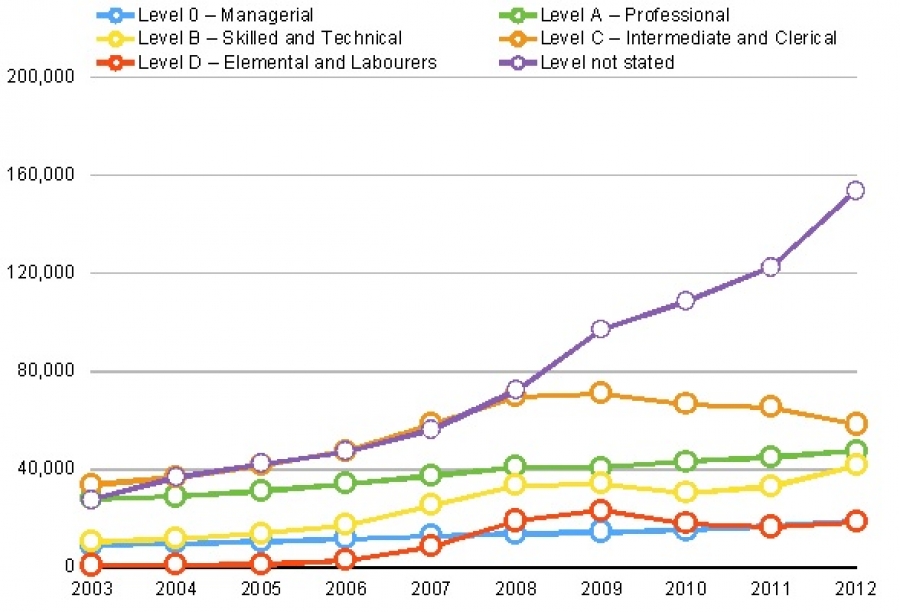
Over the past 10 years, permanent immigration levels and citizenship applications have largely remained stable. The only major growth that has occurred is for Temporary Foreign Workers, many at lower skill levels, most of whom do not have a pathway to permanent residency. Moreover, the pathway from permanent resident to citizen has also become harder, and will become even more so, undermining the overall Canadian model of immigration and citizenship.

Over reliance on anecdote and weakness in the evidence base have contributed to a number of these policy changes. Policy change is complex and the effects are only known after a number of years. It took four years before the flaws in the redesign of Temporary Foreign Workers became apparent. It will likely take that long to know whether the new “Express Entry” immigration approach works as intended. The full effect of changes to the Citizenship Act will only be known in about 10 years, given the increased residency and related requirements.

TFW’s are just one piece of immigration puzzle – New Canadian Media – NCM.

UK backs stripping citizenship over terrorism

Interesting amendment in light of the Canadian hearings on Bill C-24 Citizenship Act on the revocation provisions.

Shimon Fogel of CIJA took great pains in his testimony to state that Israel’s law of return only granted the right to citizenship; people still have to apply formally for citizenship. Under the UK approach, the law of return would mean that revocation in the case of Jews would not require them to formally take up Israeli citizenship – just having the right would be enough.

The proposed Canadian approach is that one has to have dual citizenship, not potentially have dual citizenship, plus a court process rather than Ministerial discretion. But the onus of proof is on the person the government proposes to revoke his or her citizenship:

In April, the upper house of the British parliament had rejected the measure proposed by Theresa May, the UK’s interior minister, but passed the law on Monday after a government amendment.

Members of the house voted 286 to 193 in favour of the amended legislation, peers from the opposition Labour party voted against.

The lords reversed course after May accepted the addition of a clause that would only allow citizenship to be taken away if there were “reasonable grounds” to believe suspects could acquire another nationality.

UK backs stripping citizenship over terrorism – Europe – Al Jazeera English.

The NY Times also covers this:

Britain has been one of the few Western countries that can revoke citizenship and its associated rights from dual citizens, even native-born Britons, if they are suspected or convicted of acts of terrorism or disloyalty. The government has stepped up its use of this tactic in recent years. In two cases, suspects have subsequently been killed in American drone strikes.

The new rules will broaden these so-called deprivation powers to include Britons who have no second nationality, provided that they were naturalized as adults. If the home secretary deems that their citizenship is “seriously prejudicial to the vital interests of the United Kingdom,” it can be taken away, effective immediately, without a public hearing. A suspect whose citizenship rights have been stripped has 28 days to appeal to a special immigration court.

 Britain Expands Power to Strip Citizenship From Terrorism Suspects

Canadians more likely to be anti-Semitic than Americans, ADL, and commentary

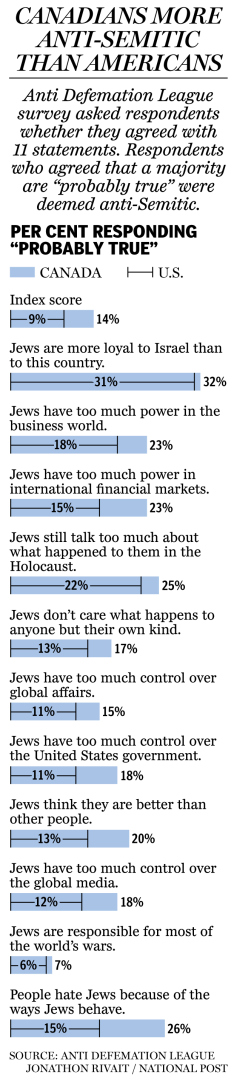
NP_antisemitism_c_jrFrom the recent ADL worldwide study on antisemitism, the Canadian data showing Canada slightly worse that the US but comparatively better than most other countries:

I’m a little bit surprised that the figures aren’t greater in the United States but I’m not surprised at the 14% in Canada,” said Frank Dimant, chief executive officer of B’nai Brith Canada. “We have always surmised that it is in that range — that range of ‘hardcore.’”

….

“We’re talking about 4.8 million people. That’s a lot of people who harbour this kind of hatred in their hearts.”

….

“Once, we had certain pre-conceived notions as to the stereotypic image of an anti-Semite as an illiterate boor. Today, that is simply not the case,” he said.

“We see the penetration of this disease of anti-Semitism in many new components of society… much of it is in the guise of anti-Israel.

“The coalition of hate is widespread so it ranges from academics to neo-Nazis to Islamic jihadists to radical feminists to trade unionists.”Shimon Koffler Fogel, head of the Centre for Israel & Jewish Affairs (CJIA), said the survey should provide the catalyst for a national discussion.

“For us, the real take-away is that issues like anti-Semitism and racism in general have not diminished to the point where as a society we can say we don’t have to address these concerns,” he said.

Canadians more likely to be anti-Semitic than Americans, poll finds | National Post.

And the two contrasting takes on the worldwide results, starting with Commentary on the right:

Anti-Semitism has survived the death of European theocracies, Nazism, and Communism and metastasized into a belief system embraced by Muslims and Arabs, and remains a deadly force. Though some might claim that the existence of Israel and allegations about its behavior has become the single greatest motivating factor for anti-Semitism (judging by the survey, the Palestinians are the most anti-Semitic people on Earth), that assertion must be placed up against the fact that the attitudes that indicate hostility to Jews long predate the birth of the Jewish state or its coming into possession of the West Bank in 1967. Seen in that perspective, it’s clear that Israel is just the latest, albeit a vicious, excuse for Jew hatred. If not all those who hate Israel also embrace the full roster of anti-Semitic stereotypes, their willingness to embrace the war against the Jewish state demonstrates the way Jews remain the planet’s boogeyman and the objects of unthinking bias and potential violence.

Many Jews will look at these numbers and, no doubt, wonder how they can change the minds of the haters or adopt behaviors that will undercut the stereotypes. But whatever else it tells us, the survey is a reminder that anti-Semitism is about the minds of the anti-Semites and their desire to seek out a small group for hostility, not what the Jews do. Those who will seek to blame Israel or Jewish power for these numbers are deceiving both themselves and others. Anti-Semitism is an ancient belief system that can adapt itself to any set of circumstances or locale.

Israel and the Reality of Anti-Semitism

From Haaretz on the left:

4. Iran, on the other hand, not only emerges unscathed from the survey but actually stands out for the positive. It has the lowest “Anti-Semitic Index” (56%) of all Middle East countries. It is a finding sure to confound hasbara people and one that can be attributed, among other things, to the relative sophistication of the Iranian people, to the continued existence of the local Jewish community – unlike in most Arab countries – and to the Iranian leadership’s ongoing protection, for its own reasons, of Iranian Jews.

5. In fact, the ADL poll more or less upsets the apple cart altogether in disestablishing the causal connection between anti-Jewish and what are widely perceived as anti-Israeli sentiments. Sweden – Sweden, for God’s sake – a hotbed of anti-Israeli agitation that is routinely labeled as anti-Semitic is the LEAST anti-Semitic country in Western Europe, according to this survey, along with its Nordic neighbors – Iceland, Finland, Norway and Denmark.

On the other hand, Eastern European countries such as Poland, Bulgaria and Ukraine, whose governments are rock solid supporters of Israel, harbor large segments of anti-Semitic feelings. The outliers are the Czechs, god bless them, who have always felt themselves more Western than Eastern European anyway. And what can you say about South Korea, a country with excellent diplomatic and commercial ties to Israel whose population – 53%, by ADL’s standards – has very questionable views of Jews.

….

7. The worst anti-Semitism, by ADL’s definition, was measured in the Middle East and North Africa, from the West Bank and Gaza (93%) and Iraq (92%) to Saudi Arabia (74%) Turkey (69%) and Iran (56%). No surprise there, really, given that in most Middle Eastern countries the media freely engages in anti-Jewish agitation, with governments either sitting idly by or actively taking part.

Nonetheless, it is an open question whether anti-Jewish sentiment in a region in which a. there are hardly any Jews and b. sees itself at war with the Jewish state and/or as the usurpers and oppressors of the Palestinians should really be included in the same rankings as all the rest, or whether Muslim anti-Semitism isn’t a category all to itself.

Ten comments on ADL’s global survey of anti-Semitism (It’s not all bad)

Of course, while dispiriting, in most developed countries Jews are more favourably viewed than other minorities such as Sikhs and Muslims (see as an What Europe Thinks of Jews, Muslims and Roma – Pew).

The link to the ADL study:


ADL Global 100

What Europe Thinks of Jews, Muslims and Roma – Pew

Some interesting comparative data on European country attitudes towards Jews, Muslims and Roma in the recent Pew study:

Roma, often dismissively referred to as “gypsies” in Europe, have suffered discrimination in Europe for centuries, and some estimates suggest that 70 percent of their European population was killed during the Holocaust. Last year, Europe’s tabloid media got into a frenzy over allegations that Roma families in Greece and Ireland had stolen “blond girls.” (In both cases, it was later confirmed that the children were actually Roma).

Many are predicting a good showing for right-wing and nationalist groups in the elections, which begin May 22. If so, these charts may be worth remembering: As Pew notes, “negative sentiments about all three groups are consistently more common among people on the ideological right.”

What Europe thinks of Muslims, Jews and Roma