Bruce Springsteen, Trevor Phillips and when a cluster becomes a ghetto | UK news | The Guardian

Hugh Muir on the distinction between “benign clustering”, part of the normal lives we lead, and ghettoization:

Relating his experience as part of Mapping Integration, a new project by the think tank Demos, Phillips called it “benign clustering”. We tend to look askance at events or spaces that exhibit monoculture – because many people still embrace multiculturalism, and even those who don’t insist they crave a culture shared by all. But, through background, tradition, we occasionally make choices that draw those of a similar background together in one place. That’s no bad thing, Phillips says, so long as there is no barrier or prescription to integration. “We can survive this kind of benign clustering,” he writes. “What we do with our own time, and who we do it with should have no impact on public policy.”

And yet he is also right to differentiate, for when the clustering occurs in other spheres, people get nervous. When monocultural clustering newly impacts on a neighbourhood or a school, we talk of segregation, of ghettoisation and feel we are losing one of the elements that make community relations less fraught than they are in countries such as the US. We readily accept that the motives for clustering around Springsteen at Wembley are harmless, whereas those that drive others towards residential clusters in Bradford or religious free schools in Tower Hamlets are troubling. One presents as celebration, the other as rejection. I fall into this trap myself; but then I was raised in a mixed London suburb. That’s my default position. There’s more to this than logic.

Bruce Springsteen, Trevor Phillips and when a cluster becomes a ghetto | UK news | The Guardian.
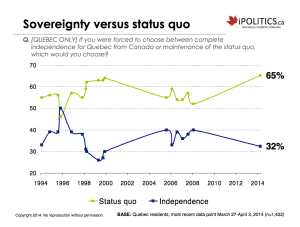
Quebec Liberals holding lead as Quebecers turn their backs on sovereignty — and on Canada | iPolitics

EkosFrank Graves of Ekos on the Quebec election and attitudes towards Canada and independence:

More interesting, however, is the surprising triumph of the status quo. In a forced-choice exercise, respondents were asked whether they would prefer to pursue complete political independence or leave things the way they are now. By a two-to-one margin, Quebec residents said they prefer the status quo.

In emotional and symbolic terms, Quebec has already left the building. Quebecers seem content with this achievement and they have little appetite for taking on the risks associated with complete independence.

Quebec Liberals holding lead as Quebecers turn their backs on sovereignty — and on Canada | iPolitics.

Suggests that while “independence is dead” in the short-to-medium term, the lack of attachment to Canada remains an issue. While the PQ will have to undergo a fundamental rethink should it be defeated today, as appears likely, I would be more cautious than some of the pundits who are saying that the PQ’s project is gone forever.

Quebec Election Editorial Endorsements

Starting with a somewhat tortured editorial by Le Devoir favouring the PQ:

Cette campagne fut difficile pour la première ministre Marois, qui a commis des erreurs dont elle devra tirer des leçons. La réaction des électeurs sur l’enjeu référendaire ne peut être ignorée, tout comme sur la charte sur la laïcité. Sur ce plan, elle a payé pour sa décision de défendre de façon absolutiste ce projet sans écouter ce que pensaient les Québécois, y compris les membres de son parti.

Il est bien possible, si le Parti québécois est réélu, qu’il soit à nouveau minoritaire. La première ministre devra accepter cette situation et gouverner avec les autres partis en recherchant les consensus. Il y a des erreurs à ne pas répéter. Elle nous a dit en campagne que si elle était déterminée, elle savait par ailleurs écouter. Prenons cela comme un engagement.

Le choix du Devoir

André Pratte’s editorial in La Presse favour of the Parti liberal de Québec, citing three reasons: pour un Québec prospère, pour un Québec stable and pour un Québec accueillant

Trois raisons de voter libéral : économie – référendum – Charte | André Pratte.

The Montreal Gazette predictably endorses the Liberals:

A PQ government would continue to play the politics of division that it has pushed while in office, and in this campaign, by proceeding with its discriminatory values charter and repressive language legislation. And, if granted a majority, it would surely try to pick fights with Ottawa to manufacture “winning conditions” for another referendum. All this would be to the further detriment of a sagging provincial economy and fragile social fabric.

That reviving this economy would be the principal focus of a Liberal government, a government also dedicated to harmonious interculturalism and the playing of a constructive role in the Canadian federation, makes the election of a majority Liberal government the optimal outcome of Monday’s election.

Editorial: The Couillard Liberals deserve to govern

Douglas Todd: ‘Best and brightest’ slogan popular with leaders who don’t get its satirical edge

Good critique of the indiscriminate use of the term the “best and brightest” in relation to immigration and Canadian values. Obviously, we do not want the “worst and dumbest” but the definition of what is the “best and brightest” in real world terms is hard to measure :

Most Canadian are aware that students who score the highest marks are not necessarily the “best.” How many times have you heard about doctors, academics, MBAs or psychiatrists who have no people skills, vision, collegiality or insight?

And what about the central value of the world’s major religions? Christianity, Islam and Sikhism, to name three, do not teach that society should focus on privileging “the best and the brightest.” Instead, along with most secular philosophies, they stand for upholding the dignity and value of all.

Instead of Canadian officials in government and public education using the language of universal worth, they are reverting to buzzwords to tell us to bestow even more status on the “best and brightest.”

There will always be a need for talent spotting to keep the wheels of society churning, but the growing proclivity in Canada for “best and brightest” sloganeering runs the danger of careering into elitism.

Let’s not forget the Vietnam era, when the phrase was most often used to expose pretense, deception and a lack of common sense.

Douglas Todd: ‘Best and brightest’ slogan popular with leaders who don’t get its satirical edge.

Countries With Less Religious Diversity Have More Faith-Based Violence

Interesting study with the caveats below:

Of course, these findings come with some limitations. The diversity study doesn’t account for different denominations within religions, like Sunnis and Shiites in Muslim countries or Protestants and Catholics in Christian countries; apparently it was too difficult to gather enough data to make those distinctions. It’s also impossible to make conclusions about cause and effect: Pluralism itself might help reduce violence, or countries that tolerate high levels of diversity might attract people less inclined to violence. And these trends may be related to overall patterns of violence and political instability in the world—in the past several years, some of the countries with the highest levels of religious affiliation have been hit hard by war, especially in the Middle East.

Still, the two studies reveal an interesting pattern: Spiritual consensus is not the key to peace or stability. And this seems to be true across faiths: The most violent, homogenous places include countries that are primarily Buddhist, Muslim, and Christian. It may not be true everywhere, but these data suggest something remarkable: Religious pluralism can be, and often is, compatible with peaceful societies.

Countries With Less Religious Diversity Have More Faith-Based Violence – Emma Green – The Atlantic.

Why the PQ is losing Quebec’s election

Great piece by Paul Wells. Of course, polls are polls and we will see what will happen Monday evening:

The PQ has always been the party of hope when it was winning. (I know, anglophones never felt it that way, but the René Lévesque was a pure product of the Quiet Revolution, when Quebec left behind insularity and finger-pointing and tried to do great things in the world. Those of us who are too young to remember those days directly can get a taste of that spirit reading Rick Salutin’s classic play Les Canadiens (written “with an assist by Ken Dryden”), whose climax is set at the Forum on the night of Nov. 15, 1976; as the bewildered Habs play a winning game, they notice the crowd cheering at odd moments and realize the Forum’s scoreboard is showing election results as Lévesque’s PQ is elected to government for the first time. Salutin has said it’s a moment when Quebecers found new heroes. Whose hero is Pauline Marois?

While the PQ’s self-destructive campaign is the story of this election, I think too much commentary overlooks the contribution Philippe Couillard is making to his own success. And yet he’s making no secret of things. The biggest word on the side of his bus is ENSEMBLE, together. His ads are upbeat and explicitly inclusive in message:

Why the PQ is losing Quebec’s election.

Why the Quebec values charter hasn’t been a runaway success, PKP interview

Martin Patriquin’s analysis of why the Charter has not worked out the way the PQ hoped for:

Yet for a variety of reasons, the charter hasn’t been nearly the electoral success the PQ thought it would be. Durand calls the charter support “weak and volatile”, largely because the PQ lost nearly as much support as it gained. For PQ strategists, minister Bernard Drainville in particular, it must be a vexing question: why would a piece of legislation tailor-made to exploit the deep fears felt by French Quebecers be only a mitigated success?

One answer may be Quebecers aren’t as obsessed about language and identity as they once were. For all the charter’s sound and fury, the charter barely registers on Quebecers’ radar of priorities. They are far more preoccupied with the meat-and-potato issues of government spending, taxes and corruption, according to a L’Actualité poll conducted following the charter’s introduction. The charter was 10th out of a list off 11 priorities. The 11th priority? A sovereignist government.

There’s another reason why Quebecers might not be so peachy keen on the charter, one teased out in a telling Léger Marketing poll from January. Support for the charter, at 57 per cent amongst Francophones, plummeted by 17 points when Léger raised the spectre that people might lose their jobs as a result of what’s on their head or around their neck.

Why the Quebec values charter hasn’t been a runaway success.

And an interesting interview with Pierre Karl Peladeau, the star candidate for the PQ and media mogul who sent the PQ campaign off-message with his strong independence messaging at the beginning of the campaign:

C’est beau tout ça, vous parlez en tant qu’actionnaire de contrôle de Québecor, mais vous êtes en politique, M. Péladeau. Comment allez-vous faire pour éviter les conflits d’intérêts là-dessus si vous êtes au gouvernement ? Vous ne pourrez pas participer aux décisions sur le sport professionnel, la culture, la politique de prix unique du livre…

« J’espère que je vais pouvoir continuer à en parler, au contraire, ce sont des sujets sur lesquels je pense avoir une grande expertise », répond-il, insensible aux critiques. Certains ont même comparé Pierre Karl Péladeau à Berlusconi, l’ancien président et magnat de la presse en Italie. Il s’en fout : « Andrew Coyne a dit que j’étais devenu un oligarque russe et Lysiane Gagnon a dit que j’étais d’extrême droite. Allez-y, en termes de comparaison, tout est permis. »

Un café avec PKP

Chris Selley: Pauline Marois’ alternate reality, Farzana Hassan’s Endorsement of the Charter

Good summary by Chris Selley of some of the reasonable accommodation issues that have arisen in Quebec over the past years, and a reminder that the proposed Charter would not address any of them:

But finally, this week, Mr. Couillard seemed to gain some traction. “If the PQ is saying you can’t work with something on your head that doesn’t please certain people, the logical conclusion is that you will be fired if you don’t do it,” he said. Indeed. Also: If you lower the speed limit on Highway 401 from 100 to 90, people might get tickets for going 100. Also: If you mandate a six-month minimum sentence for people who grow six marijuana plants, people might get six-month sentences for growing six marijuana plants. See how this works?

The incoherence is to some extent understandable. Like all effective wedge policies, the PQ’s secularism charter invites people to project content, motivations and outcomes on to it that aren’t really there. Janette Bertrand thinks it will prevent rich Muslims from taking over private swimming pools and barring women from them. Commentator Tarek Fatah thinks it will combat “Saudi-based Islamism” — which it theoretically might, if indeed Saudi-based Islamists are “us[ing] the freedom of religion clauses enshrined in the Canadian Charter of Rights and Freedoms to ‘impose their political agenda’ in Quebec,” but which hardly explains it targeting Jews and Sikhs as well.

Chris Selley: Pauline Marois’ alternate reality | National Post.

And Farzana Hassan’s different take in The Sun, similar to Tarek Fatah’s (I say ‘Vote PQ to save Canada’!).

While I can understand the visceral fear some have given past experience in their country of origin (and have spent enough time in Saudi Arabia and Iran to appreciate this), I can’t understand just how far Tarek and Farzana take this fear.

For example, the nurse who took my blood sample this week wore a hijab. She works in a mixed environment, provides service to women and men, and whether or not she chooses to wear a hijab is irrelevant, as it is for others who provide public services of other faiths who wear a kippa, turban, or cross.

Part of our national identity includes religious freedom, subject of course to the balance of other freedoms, and religious “headgear” is largely not a problem (apart from the niqab):

Many religious people do not feel obliged to wear or display their religious symbols at work, one of the exceptions being devout Muslims, who have distinct religious attire they consider mandatory.

In fact, the Quebec charter seems mainly aimed at fundamentalist Muslims, who often seek to advance a political agenda rather than simply express pious serenity through their dress.

In my view, invoking the notwithstanding clause to counter this assertive religiosity is desirable.

Using the Quebec values charter would help check the spread of patriarchal values and the virtual segregation of women.

If you are a hijabi or niqabi worried about this, rest assured Islam does not mandate the veiling of women.

Marois may appear xenophobic to some and a liberator to others, but her nationalistic zeal has shown Canada a way to preserve its own identity.

The rest of Canada should also move to ban such religious symbols from public display.

Sun News : Quebec’s values charter is a good idea.


Daniel Kahneman Testimonials

For policy wonks and “nudge nerds”, a good collection of testimonials to the impact of Daniel Kahneman’s work, summarized in his best-selling book, Thinking Fast and Slow. One example from Richard Thaler and Sendhil Mullainathan:

Kahneman and Tversky’s work did not just attack rationality, it offered a constructive alternative: a better description of how humans think. People, they argued, often use simple rules of thumb to make judgments, which incidentally is a pretty smart thing to do. But this is not the insight that left us one step from doing behavioral economics. The breakthrough idea was that these rules of thumb could be catalogued. And once understood they can be used to predict where people will make systematic errors. Those two words are what made behavioral economics possible.

Consider their famous representativeness heuristic, the tendency to judge probabilities by similarity. Use of this heuristic can lead people to make forecasts that are too extreme, often based on sample sizes that are too small to offer reliable predictions. As a result, we can expect forecasters to be predictably surprised when they draw on small samples. When they are very optimistic, the outcomes will tend to be worse than they thought, and unduly pessimistic forecasts will lead to pleasant but unexpected surprises. To the great surprise to economists who had put great faith in the efficiency of markets, this simple idea led to the discovery of large mispricing in domains that vary from stock markets to the selection of players in the National Football League.

ON KAHNEMAN | Edge.org.

We’re Not No. 1! We’re Not No. 1! – Porter’s Social Competitiveness Report

Interesting, and a reminder that GDP, while important, is one indicator among many. I remember Porter’s earlier work which was very influential in the 80s and 90s. Canada scored 7th, the highest among G7 countries:

The Social Progress Index is a brainchild of Michael E. Porter, the eminent Harvard business professor who earlier helped develop the Global Competitiveness Report. Porter is a Republican whose work, until now, has focused on economic metrics.

“This is kind of a journey for me,” Porter told me. He said that he became increasingly aware that social factors support economic growth: tax policy and regulations affect economic prospects, but so do schooling, health and a society’s inclusiveness.

So Porter and a team of experts spent two years developing this index, based on a vast amount of data reflecting suicide, property rights, school attendance, attitudes toward immigrants and minorities, opportunity for women, religious freedom, nutrition, electrification and much more.

We’re Not No. 1! We’re Not No. 1! – NYTimes.com.