Olsi Jazexhi has been busy the last couple of months.
The historian has appeared on television, made presentations at universities and written op-ed articles, all to report on the ground-breaking observations he made of the camps where China is detaining as many as a million or more Uyghur Muslims.
But the Albanian-Canadian joint citizen has suddenly been deprived of paid work, and blames fallout from his outspoken testimony.
Jazexhi was denied any courses to teach at his university in Albania this semester, the first time that has happened since he started there four years ago.
Meanwhile, he’s been accused of lying and spreading “fake news” by Chinese Communist Party media and even a Chinese ambassador.
Jazexhi says the university rector told him only that the decision on his teaching work was out of her hands. In a country that has grown increasingly close to China, and where his university also has ties to Beijing, he believes he is being punished for the Uyghur exposés.
“I don’t have any proof … but I see with concern the great influence (the Chinese) are having in my university, and other universities in Albania,” he said in an interview. “There was no reason for them to reject me.”
Charles Burton, a China expert at Ontario’s Brock University who spoke alongside Jazexhi at campus talks in Montreal and Hamilton recently, said he has no direct knowledge of the history PhD’s employment record.
But he said it’s more than plausible the academic is facing retribution.
“It seems like a likely scenario to me,” said Burton. “Olsi has made an enormous contribution to our understanding of the situation in Xinjiang.”
Olsi Jazexhi: “There was no reason for them to reject me.”YouTube/File
Neither the university’s rector, Kseanela Sotirofski, nor Endri Fuga, spokesman for Albanian Prime Minister Edi Rama, responded to emailed requests for comment on Jazexhi’s case.
While he immigrated to Canada a decade ago and did a post-doctoral fellowship at Toronto’s York University, Jazexhi divides his time between here and Albania.
On Tuesday, he, former Canadian MP David Kilgour and others were part of a panel discussion at the European Parliament in Brussels on the Uyghur situation.
Jazexhi’s role in exposing China’s treatment of the group centred in Jinjiang province is an unusual one. Convinced that reports of systematic repression of the minority were a plot by the West to turn Muslims against China, he obtained a spot on a stage-managed media tour of Jinjiang earlier this year.
But instead of reporting back that all was well, he documented with video-recorded interviews what he considered a systematic attempt to suppress the Uyghur’ language, culture and religion.
China says it’s “vocational training” centres are designed to de-radicalize extremist Muslims and prevent terrorism.
But a teacher at one centre revealed on video to Jazexhi that “students” at the camps are not even allowed to pray, and a typical reason for ending up at the facility was getting married according to Muslim tradition and not obtaining a government marriage licence.
His videos showed detainees refusing to speak their Turkic language and responding to his repeated Muslim greetings with “ni hao,” Mandarin for hello. Students revealed in interviews they had been sent to the camp for such offences as downloading videos saying Muslims should not join the Communist Party, taking part in “illegal” Koran classes and reading material encouraging Muslims to pray regularly.
The recent leak of a trove of internal Chinese government documents offered a written account of the country’s Uyghur policy, but Jazexhi’s videos provide a unique glimpse inside the camps.
The Global Times, a tabloid-like Communist Party newspaper, published two articles wholly or partly dedicated to discrediting him, one last week saying Jazexhi “spread fake information on the region and what he did was out of malice and went against the basic professional ethics as a reporter.”
In Turkey’s Daily Sabah newspaper, the Chinese ambassador to Turkey decried an article of Jazexhi’s “in which facts are distorted and basic knowledge is absent. It is hard to believe that its author is a ‘historian.’ ”
Meanwhile, though Albania is still part of NATO and trying to join the EU, it has forged ever-closer ties with Beijing, according to leading China expert Anne-Marie Brady of New Zealand’s University of Canterbury. Albania is a founding member of the 17+1 alliance of China, central Asian and eastern European countries, and part of Beijing’s Belt and Road infrastructure-investment initiative.
A Chinese company took over management of the capital’s international airport in 2016. The same year, Canada’s Bankers Petroleum sold its Albanian oil rights to China’s Geo-Jade Petroleum in the wake of controversial fraud allegations against it.
Jazexhi said his own university also has links, with rector Sotirofski signing a co-operation agreement with Yangzhou University last year in China, a Chinese-run Confucius Institute on campus, and professors often taking all-expense-paid trips there.
Good and unless I am missing it, all too rare commentary:
Between Aug. 16 and Aug. 25, I was in the Xinjiang Uighur Autonomous Region in China. Invited by the State Council Information Office of China and Xinjiang, I was part of a group of journalists who were sent to visit three major cities: Urumqi, Aksu, and Kashgar. Our visit, which was covered by the Chinese authorities, was stage-managed by Xinjiang authorities who wanted to convince us that things are fine in Xinjiang.
I arrived in Urumqi on Aug. 16. From Aug. 17 to Aug. 19, we attended several lectures by Communist Party officials regarding the history, religion and human rights practices in Xinjiang. In these sessions, Chinese officials like Xu Guixiang and Ma Pinyan delivered the white paper on Xinjiang, issued by the Chinese government.
In these lectures we were told that the Uighurs and other Turkic Muslims were migrants in this region, Islam was forcefully imposed by the Arabs and Turks, and Xinjiang has always been part of China. During our stay, we visited the Museum of Xinjiang Uighur Autonomous Region in Urumqi, the Aksu Museum and the Kashgar Museum. In these museums, the Chinese government is delivering the same message from the white paper: Xinjiang has historically been Chinese, the Uighurs and other Turkic Muslims are migrants, Islam is a foreign religion and it was imposed by force on the Uighurs.
On top of that, the Chinese were showing to the visitors that Islam was causing much trouble in Xinjiang since it was a source of extremism and terrorism. To fight that, the government of China had built some “Vocational Education and Training Centers” where the extremists were being deradicalized.
On Aug. 20, our hosts sent us to the city of Aksu to visit the Onsu County Vocational Skills Training Center. Here we were supposed to meet the “extremists and terrorists” whom China was “deradicalizing.”
However, when we interviewed the “students” of these “Vocational Training Centers” we found that they were not students but prisoners and they were not terrorists but Muslim believers who were forced to renounce their faith under duress.
Their crimes were practicing Islam, praying to Allah, watching Muslim televangelist videos on the internet, reading the Holy Quran or articles about Islam, writing about Islam, reading Uighur history, wearing hijabs, consuming halal food, burying their dead or marrying according to Islam and preaching Islam to their relatives.
The interviews which I have recorded and uploaded on my YouTube channel prove that the so-called “Vocational Training Centers” are not schools but mass detention centers. These centers are used to mass brainwash the Turkic Muslims of China, be them Uighur, Kazakh, Kirghiz, Uzbek, Tatar, etc, and force them to renounce Islam and their Turkic identity and become Han Chinese.
The claims in vain
Even though China claims that it is fighting “three evils” in Xinjiang, ethnic separatism, terrorism, and religious extremism, in fact, it is fighting the Islamic identity of the Uighurs which makes them a different nation from Han Chinese.
China is fighting against the diversity which in Xinjiang is represented by Islam. It wants to destroy any sign of Islam and totally Sinicize the province, which is a major power hub in China’s One Road, One Belt project.
The Chinese Muslims of Xinjiang, who do not present a separatist threat for China, are also suffering similar problems like the Uighurs. Under the excuse of fighting extremism, the Chinese authorities have declared Islam an extremist religion and do not want a Muslim presence to stand in the center of their Silk Road project which stretches from Beijing into Asia, Africa, and Europe.
The Chinese have banned the preaching and practice of Islam in Xinjiang and all state institutions have been ordered to fight any sign of religious practice (“The Xinjiang Regulation on De-extremification,” Chapter IV, Article 18).
The Xinjiang policy
China is treating Xinjiang as an occupied territory and its native Turkic inhabitants are considered as enemies who must be assimilated or destroyed. Xinjiang authorities are destroying mosques, graveyards and ancient Islamic buildings, and any sign of Islamic civilization that exists.
As Ma Pinyan told us during the lectures in Urumqi, the Chinese government wants to Sinicize Islam. It does not want to see any Arabic or Turkic signs among its Muslims. It does not want them to pray every day, to reject alcohol or women to wear headscarves or marry according to the Quran.
The Sinicization of Islam is legally ordered in “The Xinjiang Regulation on De-extremification,” (Article 4) and the practice of Islam is totally outlawed (“Regulation on De-extremification,” Chapter II, Article 9). Group reading of the Quran, teaching Islam to children, speaking about Islam, having or reading Islamic literature, wearing religious clothing, watching religious shows or advocating Islam in any sense is a crime that is punishable with imprisonment or a long and painful “re-education” in “The Vocational Training Centers.”
The bans on practice
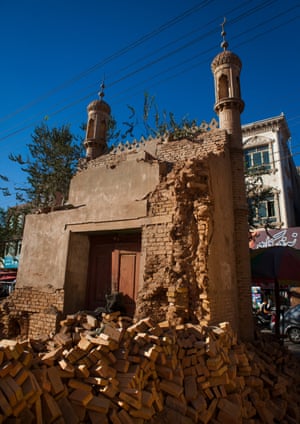
Chinese authorities have prohibited the existence of minarets, the azan (call to prayer), mosques with domes and when a new mosque is ever built it must be shaped in Chinese architecture since the teleological narrative of the Chinese government claims that Islam needs to be Sinicized, and it should not have any Arabic or Turkic symbols.
To force the Sinicization of Islam, Xinjiang authorities sponsor the Islamic Institute of Xinjiang where selected imams are taught a restricted Chinese version of Islam. The campaign of terror against the Muslim population has created a climate of fear. We saw fear in the eyes of all the Muslims that we managed to meet.
The Chinese government has been mass colonizing Xinjiang with Chinese colonists since the 1950s. The Chinese, who in the 1950s counted for 5% to 9% of the population in 2010 count for 40%. The colonization is continuing very aggressively nowadays and it aims to turn the Muslims into a minority.
The Uighurs who are not being arrested and sent to concentration camps (“Vocational Training Centers”) or prisons are forced to take into their homes Chinese colonists who live and sleep in the same house with Muslim families. Many Uighur Muslim women are forced to marry Chinese men. Many Muslims are not allowed to fast during Ramadan.
Muslim restaurants are forbidden to refuse to sell alcohol. The Uighurs who show the slightest sing of Islam are separated from their families have their children taken away and raised by the Chinese. The reign of fear, religious persecution and ethnic assimilation that China is doing in East Turkistan amounts to cultural genocide.
However, while the world is witnessing the mass persecution of Turkic Muslims of China the Muslim world is ignoring it. To the shame of the Muslim world on July 8, 2019, some 22 non-Muslim states signed a letter addressed to the president of the U.N. Human Rights Council and the U.N. High Commissioner for Human Rights calling on China to end its massive detention program in Xinjiang.
While the Muslim majority states were absent from joining this letter, some 20 Muslim states joined a list of 37 countries in support of China for what it is doing in Xinjiang.
In the letter prepared by the Chinese, it was written: “We appreciate China’s commitment to openness and transparency. China has invited several diplomats, international organizations officials and journalists to Xinjiang to witness the progress of the human rights cause and the outcomes of counterterrorism and deradicalization there. What they saw and heard in Xinjiang completely contradicted what was reported in the media. We call on relevant countries to refrain from employing unfounded charges against China based on unconfirmed information before they visit Xinjiang…”
After coming back from Xinjiang, as a Muslim scholar and journalist that I am, I would like to tell the Muslim world that the “outcomes of counterterrorism and deradicalization” measures that China is doing in Xinjiang have been the total prohibition of Islam and mass persecution of Muslims.
China invited me like it has invited “several diplomats, international organizations officials and journalists to Xinjiang to witness the progress of the human rights cause and the outcomes of counterterrorism and deradicalization there.” However, my findings prove that China is persecuting the Uighurs only because they believe in Islam and are Muslims.
Through this open letter, I would like to appeal to all the Muslim countries who signed the pro-China letter to reconsider their position. I am ready to testify anywhere in the Muslim world about what China is doing with its Muslim populations.
What to do?
The Muslim countries should reconsider their position and urge China to immediately stop the persecution of Muslims and the prohibition of Islam in Xinjiang. China must close its “Vocational Training Centers,” release the religious and political prisoners from prisons and detention camps, abolish the Islamophobic and criminal “Xinjiang Uighur Autonomous Region De-extremification Regulations,” stop sending Chinese colonists to the homes of Uighurs and order all state apparatuses and organs to stop their persecution of Muslims.
China must stop its Islamophobic policies that target the Muslims, their religion, history, culture and way of life. It must stop the forced Sinicization of Turkic people (Uighur, Kazakh, Kirgiz, Uzbek, Tatar, and et cetera), the destruction of mosques and historical buildings.
It must allow the Muslims of Xinjiang to have passports, to move freely in and out of China, to call the adhan from their mosques, to have halal food, to perform Hajj in Mecca and to be able to teach Islam to their children.
Xinjiang authorities should adopt multiculturalism and accept the Uighurs and other Turkic Muslims of China as ordinary citizens equal to native Chinese, and Islam as one of the religions of China. China should revise the way it perceives its history and should accept Islam as an integral part of China and not as an enemy.
By raising these demands and reminding China that the Muslim world is a very important client, the Muslim countries must ask for the protection of their Muslim brethren who, at present, are suffering mass-persecution in the Xinjiang Uighur Autonomous Region.
More good in-depth reporting regarding Chinese repression of Muslims:
This August, Aibota Zhanibek received a surprising call in Kazakhstan from a relative through Chinese chat app WeChat. It was about her sister, Kunekai Zhanibek.
Aibota, 35, a Kazakh citizen born in China, knew that Kunekai, 33, had been held for about seven months in a detention camp in China’s Shawan county, in the northwestern region of Xinjiang. For six of those months, Kunekai was forced to make towels and carpets for no pay, Aibota says. On the call, Aibota was told that Kunekai had been released and assigned a job in Urumqi, the capital of Xinjiang.
That was the good news. But the relative also told Aibota Zhanibek that her 65-year-old mother, Nurzhada Zhumakhan, had been sentenced in June to 20 years in Urumqi’s No. 2 Women’s Prison. According to a verdict sent to Zhanibek ‘s relatives, Zhumakhan was guilty of “illegally using superstition to break the rule of law” and “gathering chaos to disrupt social order.”
As Muslim Kazakhs, Zhanibek’s mother and sister are among the targets of a sprawling security operation by Chinese authorities. Human rights experts estimate that 1.5 million Uighur Muslims and members of other ethnic minority groups, including Chinese-born Kazakhs, have been detained in Xinjiang since 2016. Former detainees say that while in detention they were forced to memorize Chinese communist propaganda and learn Mandarin and were occasionally violently interrogated orbeaten..
The government has said the operations are part of a reeducation campaign and defends its detentions and sophisticated surveillance system across Xinjiang as necessary counterterrorism measures. Senior Xinjiang officials have said that most of those brought to the centers have been returned to society. But reporting suggests that these are not mere vocational training centers and that detentions, surveillance — and worse — continue.
Last month in Kazakhstan, NPR interviewed 26 relatives of ethnic Kazakhs and Uighurs currently detained or imprisoned in Xinjiang and five former detainees. They said that rather than setting free reeducated citizens, the authorities have been transferring many detainees to formal prisons. Those who have been released remain under strict surveillance.
“I miss my mother,” Zhanibek says in her home in Almaty, Kazakhstan. Since this summer, twice a month, her relatives have been able to go to an Urumqi police station and have video calls with her mother. Zhumakhan is nearly blind, hairless and extremely thin since being detained on June 8, 2018, her relatives said.
Zhanibek still also worries about her sister, despite her release: “Nobody is in a good situation. My sister has been released and has a job, but she still has no freedom. She cannot go where she wants. How can you say things are getting better?” she says.
“Targeting people somehow related to religion”
Xinjiang courts have been sentencing detainees to lengthy prison terms — sometimes up to 20 years — in hasty trials where little but a verdict is presented, according to relatives and an ex-detainee. The sentences overwhelmingly target citizens with religious Muslim backgrounds; 23 of the 32 people sentenced in Xinjiang recently were religious students, imams or people who prayed regularly, according to their family members.
“It was a closed court trial. … They just read the verdict to him, according to his parents,” Shakhidyam Memanova says of proceedings in May in which her husband, Nuermaimaiti Maimaitiyiming, a Chinese-born Uighur, was sentenced to 17 years. He is now in prison in Xinyuan county.
One night in May 2018, her husband, a carpet seller, was taken out in handcuffs and a hood in front of their two young children. Memanova suspects it was because he took Quranic classes when he was 14. But in the absence of any trial documentation, neither she nor her husband’s parents can be sure. Her in-laws can video call with their son once a month at a police station, and what they have described to her is not reassuring. “[Maimaitiyiming] looks very bad. He has lost a lot of weight,” Memanova says.
Bahedati Aken, 27, is also being held in a Xinyuan county prison, sentenced last June to 15 years in prison for studying the Quran with an also-imprisoned imam named Muhtourhan Kanodil, according to Aken’s aunt, Gulbaran Omirali.
“[Aken] was 13 when he attended two months of religious courses,” Omirali says. “I do not understand why something so long ago and which was legal at the time is now a crime.”
Kassym Tursynkan’s two younger brothers were given lengthy prison sentences this summer, he says, for being religious Muslims.
“They are targeting people somehow related to religion,” concludes Kassym Tursynkan. His two younger brothers — Kasyem, an imam, and Karkyn, who prayed regularly — were sentenced to 20 and 10 years, respectively, this summer and are now being held in the northern Xinjiang city of Wusu.
Tursynkan believes his brothers were betrayed, particularly Kasyem the imam, who he says was regularly praised by local religious authorities for upholding ethnic harmony: “They were not extremists. They did what they were allowed to do within the state limits.”
Some detention centers have been outfitted with makeshift courts, according to former detainees. Ergali Ermekuly was tried on April 7, 2018, in a detention center court in Xinjiang’s Huocheng county. He received a three–year sentence based on evidence allegedly taken from his cellphone showing he had visited Kazakhstan, downloaded WhatsApp and listened to audio describing China’s mosque-destruction campaign in Xinjiang. He was not allowed to see the evidence itself.
“They did tell me I could hire a lawyer, but based on cases of other people in the detention camp, those who hired lawyers were given longer sentences because it was seen as a sign of opposition to the state,” says Ermekuly, now living in Kazakhstan.
Ermekuly was freed during an agreement between Kazakhstan and China to release 2,000 Chinese-born ethnic Kazakhs at the end of 2018. But he says his life has already been destroyed. “I do not have a family, and I do not have my home,” Ermekuly, whose wife divorced him this year, says. “I came back [to Kazakhstan], but I have nothing.”
“They threatened my father”
While relatives describe being able to contact their loved ones through video monitors at local police stations, they say they have not been able to visit them in prison. What little information they can glean from infrequent contact suggests that those sent to Xinjiang’s prisons are held in poor conditions.
Almakhan Myrzan says her brother Bakytzhan, a former imam at a mosque in Xinjiang, was sentenced in May to 14 years in prison in a closed trial with no relatives present. The verdict was delivered by mail to his family.
Myrzan says her brother was allowed one phone call from prison in Urumqi. “When he finally called his wife, he sounded really faint. He could not even remember his own name at first,” Myrzan says.
The family members of another prisoner in Wusu, Berzat Bolatkhan, have phoned police repeatedly to find out why he was sentenced to 17 years in August.
“They threatened my father, saying, ‘If you keep asking about your son, you will end up the same way,’ ” Bolatkhan’s brother Yerzat recalls.
Construction tenders for Wusu prison show it underwent an expansion beginning in August 2016.
“Suitable jobs”
Xinjiang officials, however, say they are winding down the sprawling network of detention centers.
“Most people who received educational training returned to society and returned home,” Alken Tuniaz, the Xinjiang government’s vice chairman, said at a news briefing in July.
The government’s chairman, Shohrat Zakir, said about 90% of those released have found “suitable jobs.”
Some younger, well-educated detainees have been released and assigned to jobs, say relatives. But once they leave detention, they remain closely monitored through heavy state surveillance set up in the region.
University-educated Razila Nural, an ethnic Kazakh woman, was forced to work in a textile factory in Xinjiang after authorities deemed her fit for release from a detention facility in August 2018. Since being released from the factory late last December, Nural has effectively disappeared, says her mother.
“I last spoke to Razila this January and have not had contact since,” says her mother, Aiytkali Ganiguli. “She said, ‘I am healthy. I am working now. Do not believe fake media reports about my working in a black factory.’ ”
A graduate student forced to work in a textile plant located within another detention facility was allowed to resume his graduate studies this year — under strict monitoring. “He is not permitted to travel anywhere except the route from his home to his classes and back,” says a relative in China who did not provide a name for fear of retaliation from the authorities.
Aydarhan Salamat’s aunt Meniarbek Mariya has been imprisoned, and her mother and cousin are under constant surveillance.
Relatives of Xinjiang residents describe how they are effectively under house arrest; they must get permission to leave the township where their residency is registered.
The rules are enforced by a network of closed-circuit TV cameras, some equipped with facial recognition. Relatives say the cameras can spot whether someone in a household receives undeclared visitors, takes an unauthorized trip or turns on the lights suspiciously early or late.
“Once, my mother left to attend a relative’s funeral without public security permission, and the public security bureau called my nephew within an hour to have her come back. At checkpoints, her identification card sets off alarms. She is 80 years old,” says Aydarhan Salamat. She thinks her mother is monitored because Salamat’s aunt, Meniarbek Mariya, 46, is being held in a prison in the Xinjiang county of Yining for an unknown length of time.
Even nondetained Xinjiang residents who have relatives in detention or who have been previously detained have to check in with local administrative offices to report their movements.
“Every day, my brother still has to go to ideology classes at the local government office to rid him of religious thoughts,” says the brother of a Muslim former detainee living in the city of Hami, Xinjiang. He withheld both their names because he still lives in China and risks detention for speaking to a foreign journalist.
Gulserik Kazykhan is struggling to get more information about her detained brother-in-law from visiting relatives. “If you don’t return, the guarantors will suffer.”
Chinese state control covers all spheres of life in Xinjiang. Kunekai Zhanibek, the woman released in August and assigned a job in Urumqi, “got married recently but had to ask for state permission beforehand,” says her sister Aibota. “Can you imagine having to ask for permission about such a personal decision?”
Passports in exchange for good PR
Relatives in Kazakhstan desperate to learn more about loved ones in China are turning to a new potential source of information: the slow trickle of ethnic Kazakhs born in Xinjiang who can now get Chinese passports to travel to Kazakhstan.
Once forbidden from traveling abroad, some of Xinjiang’s ethnic Kazakh residents have even been able to procure Chinese passports this year to visit relatives in Kazakhstan for one month at a time. As a condition for the passports, the residents are told by local authorities to share only positive news about the region. Travelers must name guarantors in China, such as friends or relatives, who are punished if the travelers don’t return or if they meet people they aren’t supposed to.
“If you don’t return, the guarantors will suffer,” says Gulserik Kazykhan. Her brother-in-law Raman uly Zahrkyn was sentenced to 3 1/2 years in February for praying and for donating to his local mosque. He is being held in Wusu’s prison. She finally learned of uly Zahrkyn’s fate this May from relatives living in China who visited her in Kazakhstan. They stayed for a month before they were forced to return to Xinjiang.
Access to passports still appears strictly controlled. “There are three people from the village who can go abroad for a month, and they take turns,” says Aitalim, who goes by one name. From his fellow village residents, Aitalim learned that his cousin Aiturgan Turlan, a former religious affairs state employee, remains detained in Xinjiang’s Zhaosu county for allowing a local mosque to be built too large.
Gunikai Naruzibieke’s cousin Bayimulati Naruzibieke will spend the next decade in a Xinjiang prison.
Gunikai Naruzibieke is seeking information about the condition of her cousin Bayimulati Naruzibieke, sentenced to a decade in prison this summer and now held in the military garrison city of Shihezi.
Gunikai Naruzibieke has had a hard time persuading relatives from Xinjiang to talk to her. “My relatives are terrified to talk because there was an imam in my family who is now in Kazakhstan — he didn’t come back from a trip [there],” she says. As punishment, the imam’s guarantor, his daughter Saule, was briefly placed in a detention camp last year.
State control over Xinjiang residents extends internationally, says Ainur Turlyqozha, who lives in a village outside Almaty. Her younger brother Baiasyl disappeared into the detention system in October 2018. Turlyqozha heard he had been sentenced to prison, but she could not get confirmation from relatives who recently visited Almaty.
“One relative even came just five days ago,” says Turlyqozha. “But when they come, they will not answer my questions about my brother. They just say vaguely, ‘We have heard of something like this.’ “
One has to wonder what the International Metropolis Conference board members were thinking by planning to hold the immigration and integrationconference in Beijing in 2020. Or not thinking:
Chinese authorities are sending Christian Uyghurs and even members of the Han Chinese majority to internment camps in China’s northwestern Xinjiang region, an indication that the regime’s indoctrination strategy is broader than previously understood.
Most of the hundreds of thousands of people – perhaps more than a million – sent to a sprawling network of centres for political indoctrination and vocational training are Muslims, members of minority groups such as Uyghurs and Kazakhs, according to former detainees and instructors. Beijing has said the centres are being used to stamp out extremism.
But six accounts from people who have recently lived in the region or have family there – three Christian Westerners, a lawyer, a Chinese petitioner and a Uyghur family living in France – reveal that others are also being incarcerated.
Some are Uyghurs who have converted to Christianity. Others are Han Chinese – the ethnic group that comprises more than 90 per cent of China’s population – who have challenged local authorities by petitioning for official redress, as well as people considered politically unreliable.
The reports indicate that Beijing’s campaign in the region goes beyond the stated goal, published in an August white paper on Xinjiang, of countering “the breeding and spread of terrorism and religious extremism.” The strategy claimed to be focused on quelling Islamic radicalization rather than a unique cultural group inside China.
But “all signs point to cultural assimilation” as the chief goal of the Chinese campaign, said Timothy Grose, a scholar at Terre Haute, Ind.’s Rose-Hulman Institute of Technology who studies Uyghur culture and is the author of an upcoming book about Uyghurs who study elsewhere in China. What is taking place in Xinjiang is an “accelerated, comprehensive and violent program to jettison meaningful markers of Uyghur identity, such as language, Islam and tangible connections to Central Asia, and replace them with elements of a Han-centric Chinese culture.”
Indeed, “even secular, atheist and Christian Uyghurs are being targeted, I believe, because their milieu has still been largely shaped by Central Asian and Islamic norms.”
Over the past year, Uyghurs living outside China have documented the incarceration of dozens of scholars, artists, musicians and other cultural leaders who have been taken to facilities that China calls vocational skills and training centres but which foreign critics call re-education camps.
In a July white paper, Chinese authorities directly linked Islamic belief with the spread of separatist ideology by what it called “anti-China forces attempting to split China.”
But the incarceration of Christians on extremism grounds underpins an argument that Chinese authorities have used extremism as a cover to conduct a broader campaign of sinification, irrespective of religion.
“We know of at least 14 Christians” who have been taken away by authorities in Xinjiang, said Robert Paix, a Christian businessman who has lived and worked in the region, in part to share his faith. “Islam is just one of the matrix of problems the Chinese government has with Uyghur people,” he said.
In Xinjiang, “any ideology which really captures someone’s conscience that is other than the [Communist] Party is a threat,” Mr. Paix said. “So in essence, it doesn’t matter what religion it is – or even if it was a non-religious ideology.”
Xinjiang is home to an estimated 11 million Uyghurs, a people whose customs, language, architecture and art are among the most distinct of the country’s 55 official minorities.
One Westerner who lived in the regional capital, Urumqi, with his family described the case of a Christian Uyghur woman who lived with a Han Chinese roommate. The Uyghur woman spoke Mandarin and ran a business teaching English. But in December, 2017, police took her from her apartment, put her in a prison uniform and handed her clothes, glasses and national identification card back to her roommate, said the source, a Christian whose identity The Globe and Mail is not disclosing out of concern for the safety of the person’s friends in Xinjiang.
Police said they had found questionable content on her computer, according to the source.
“The sentencing basically was very quick. From what we could understand, it was just ‘You are a terrorist,’ and there was a document that she had to sign – basically like a confession.”
Christian Uyghurs likely number only in the thousands, according to foreigners who have lived in the region. Most Uyghurs are practising Muslims or maintain cultural ties to that faith.
But from what the Westerner could see, the incarceration of Uyghurs “did not seem religious in nature. It seemed just from our experience there that the religious extremist angle was being used to really just suppress the entire people group and culture.”
Another Christian, Gulbahar Haitiwaji was incarcerated for two years, her family said. “She converted to Christianity several years ago and eschews violence,” her husband, Kerim Haitiwaji, told religious liberty magazine Bitter Winter early this year. “There is no reason to imprison her. She is not a danger to China.” The family has declined further public statements since Ms. Hatiwaji was released, and she is now with her husband and daughter in France.
Any responsible government must “remove the malignant tumour of terrorism and extremism” and ensure its people “enjoy a peaceful and harmonious social environment,” the State Council Information Office wrote in an August white paper. It defended Xinjiang’s indoctrination and training apparatus as a “deradicalization” project in line with international principles, providing free education to trainees who “have fallen under the influence and control of religious extremism.”
At the same time, the construction of a system of internment centres has provided local authorities new options for punishment outside the formal legal system – even for people who are ethnic Chinese.
Authorities can send people to the centres for making statements deemed contrary to government dictates; for spreading politically unwelcome thoughts among colleagues; and for posting politically incorrect views to Chinese social-media platform WeChat, according to a lawyer who has travelled in the region and whose identity is not being disclosed because describing the camps could lead to his own incarceration.
The Globe reviewed documents collected by a Chinese human-rights activist that described the case of a Chinese man in Xinjiang who spent years fighting embezzlement charges that dated back to 2004. He disappeared last year but reappeared this spring.
“I studied for seven months,” he said in a recorded interview with an activist reviewed by The Globe. “Studying” is a common word to describe time in indoctrination facilities. “There are Han people” in such centres, he added.
Gulzira Auelhan, an ethnic Kazakh and former detainee, told The Globe this year that she had seen four ethnic Chinese people in the centre where she was held.
Political enforcement has been employed against Uyghurs, too. One Uyghur woman who recently left Xinjiang described how her father-in-law had been sentenced to eight years in prison for “distributing incorrect political views.” The charges were rooted in an incident that, authorities said, occurred more than two decades earlier, when he was working at a government office and complained that ethnic Chinese farmers were receiving a larger allocation of water than ethnic Uyghurs. He was held for 10 months before being tried and sentenced in a single day of court proceedings, the woman said.
The woman’s identity is not being revealed because she fears retribution against members of her family still in Xinjiang. The Globe verified elements of her account with a Canadian family member and with a Western embassy that helped her leave China.
She spoke out, she said, because “I want the world to know how insane it is” for Uyghurs in Xinjiang.
When Turkey’s leader, Recep Tayyip Erdogan, visited Beijing this summer, he hailed a new Silk Road bridging Asia and Europe. He welcomed big Chinese investments for his beleaguered economy. He gushed about China’s sovereignty.
But Mr. Erdogan, who has stridently promoted Islamic values in his overwhelmingly Muslim country, was largely silent on the incarceration of more than one million Turkic Muslims in China’s western region of Xinjiang, and the forced assimilation of millions more. It was an about-face from a decade ago, when he said the Uighurs there suffered from, “simply put, genocide” at the hands of the Chinese government.
Like Mr. Erdogan, the world has been noticeably quiet about Xinjiang, where China has built a vast network of detention camps and systematic surveillance over the past two years in a state-led operation to convert Uighurs into loyal, secular supporters of the Communist Party. Even when diplomats have witnessed the problems firsthand and privately condemned them, they have been reluctant to go public, unable to garner broad support or unwilling to risk financial ties with China.
Backed by its diplomatic and economic might, China has largely succeeded in quashing criticism. Chinese officials have convinced countries to support Beijing publicly on the issue, most notably Muslim ones in Africa, Asia and the Middle East. They have played to the discord within the West over China. And they have waged an aggressive campaign to prevent discussion of Xinjiang at the United Nations.
At a special event ahead of the General Assembly this week on protecting religious freedom, President Trump, the host of the event, did not mention the Uighurs. Vice President Mike Pence gave a nod to the Uighurs, after mentioning the persecution of Christians in China.
China contends that its state-mandated detention camps, surrounded by high walls and watchtowers, are central to its fight against Islamist extremism. Beijing has called them boarding schools, explaining detainees are there voluntarily. China said recently that it has reduced the numbers in the camps, although doubts persist about the claim.
“There has not been a single case of violent terrorism in the past three years,” Wang Yi, state councilor and foreign minister of China, said at an event on the sidelines of the United Nations summit. “The education and training centers are schools that help the people free themselves from terrorism and extremism and acquire useful skills.”
As countries weigh their options over Xinjiang, China’s economic heft looms large.
Officials in the Trump administration have been among the most vocal critics. Secretary of State Mike Pompeo has denounced the treatment of the Uighurs as the “stain of the century.” One of his deputies, John Sullivan, who convened a panel Tuesday on the sidelines of the United Nations meeting with several other countries to condemn Beijing’s policies, said China has carried out a “horrific campaign of repression.”
While the National Security Council has pushed economic sanctions over the issue, the Treasury has the power to punish China in that way. So far, the trade talks have taken precedence. And Mr. Trump has largely ignored the issue, essentially giving China a pass.
The administration’s limited action probably affects the global calculus. If the United States does not take a leadership role on the issue, other countries do not feel the pressure to act, either.
Some governments tiptoe around China for economic reasons. When New Zealand’s prime minister, Jacinda Ardern, visited Beijing shortly after the massacre of 51 Muslims in Christchurch, she said she had discussed Xinjiang privately with Mr. Xi. She didn’t do much more. New Zealand sells much of its main exports, such as milk, meat and wine, to China.
Last year, China helped Turkey secure a $3.6 billion loan for energy and transportation. Since then, the Turkish economy has further faltered. And during Mr. Erdogan’s visit to Beijing in July, Mr. Xi praised him for supporting what he called China’s core interests, including Xinjiang.
“Many, many governments are looking the other way and self-censoring on the issue of Xinjiang,” said Daniel R. Russel, the Obama administration’s assistant secretary of state for East Asian and Pacific affairs. “Beijing is notoriously prickly about its self-declared ‘core interests,’ and few countries are willing to put the economic benefits of good relations with China at risk — let alone find themselves on the receiving end of Chinese retaliation.”
When countries do criticize China, they tend to do so in a group, seemingly as a way to diffuse and lessen possible retribution.
In Geneva this summer, nearly two dozen, mostly Western, countries, along with Japan, banded together at the United Nations Human Rights Council to call on China to close the camps. No one country was willing to be the organizer. Instead, the statement’s signers relied on a rarely used procedure that allowed it to be circulated without a principal leader.
Not to be outmaneuvered by the critics, China quickly prepared a counter-roster of 37 friendly nations praising its “contribution to the international human rights cause.” Among the cheerleaders were members of the Organization of Islamic Cooperation that unanimously endorsed China’s Xinjiang policies in April.
How China Turned a City Into a Prison
Children are interrogated. Neighbors become informants. Mosques are monitored. Cameras are everywhere.
China is carefully shaping its image of Xinjiang in the diplomatic world. Over the past nine months, Beijing has invited select visitors on circumscribed tours of the detention camps to garner positive publicity.
China has generally handpicked the visitors, including journalists from friendly countries. They are then often quoted in the state-run Chinese news media offering flattering comments. “I saw genuine smiles on the faces of trainees I interviewed,” Abdul Aziz Raddad A. Alrabie of the Saudi newspaper Okaz said in China Daily, a newspaper of the Communist Party.
The trips do not always go as planned. Two reports — one by a Malaysian diplomat and another by European Union officials — were highly critical after their visits.
The private account by the Malaysian diplomat, reviewed by The New York Times, contradicted China’s contention that the Uighurs were voluntarily attending the re-education centers.
“Delegates could actually sense fear and frustration from the students,” the Malaysian wrote after his December visit with a dozen other diplomats from mostly Muslim nations. “China may have legitimate reasons to implement policies intended to eliminate the threat of terrorism, especially in Xinjiang. However, judging by its approach, it is addressing the issue wrongly and illegitimately, e.g. preventing Muslim minors from learning the Quran.”
The diplomat referred to two cities in Xinjiang — once-bustling Kashgar and Hotan — as “zombie towns,” saying the streets were virtually empty and that China was probably “using the threat of terrorism as an excuse to ‘sanitize’ Uighur Muslims until they become acceptable Chinese citizens.”
The report was never made public. At the time, Malaysia was working hard to repair relations with China over a troubled infrastructure deal. It has also become increasingly dependent on China for purchases of palm oil, its biggest export.
“The $100 billion in annual bilateral trade is enough to focus the minds of Malaysian policymakers,” said Shahriman Lockman, a senior analyst at the Institute of Strategic and International Studies in Kuala Lumpur. “China is too big a market to lose.”
Three diplomats from the European Union visited Xinjiang’s capital, Urumqi, this year in what one of the participants said turned out to be a “Potemkin village tour.” The officials were shown a hastily built display of weapons that the Chinese guides said Uighurs had used in terrorist attacks; a mosque where there was no sign of religious observance; and a kindergarten where the children sang songs praising the party.
At one camp, the class sang the Communist Party anthem. As they did, one Uighur man caught the eye of a diplomat and held up his wrists as if clamped together by handcuffs.
Afterward, the European Union circulated an internal document saying that the visit “does not invalidate the E.U.’s profound concerns about human rights in Xinjiang, including in relation to mass detention, political re-education, religious freedom and Sinicization policies, as well as concerns that similar measures could be applied in other regions of China with notable Muslim minorities.”
Rifts within the European Union on how to deal with China prevent a common front. Leaders in France and Germany are publicly silent on Xinjiang, while several Eastern European countries are supporters of China.
At the United Nations, China has made Xinjiang its main cause.
The Human Rights Council in Geneva is often considered a diplomatic backwater. The United States is no longer a member, with the Trump administration withdrawing last year in protest over policies toward Israel. As authoritarian governments gain power around the world, human rights are less of a front-and-center issue, leaving the council with less sway.
But China regards the council as a serious arena where it can outmaneuver its opponents, pursue its diplomatic agenda and score points.
A long-scheduled review of China’s human rights record was on the council’s schedule last November just as the Uighurs’ incarceration was gaining attention.
China prepared meticulously. About 60 Chinese diplomats flew to Switzerland from Beijing, a delegation headed by the influential vice foreign minister, Le Yucheng.
He was backed by 40 more members of Chinese government organizations. Such a large entourage of nondiplomats was almost unheard-of at the council, according to diplomats. They acted as cheerleaders, clapping at key moments.
One goal of the performance was to limit backing for an inspection of Xinjiang by Michelle Bachelet, the United Nations’ human rights chief.
“If you’re really serious about a fact-finding mission, please go check the southern border, Guantánamo, the Mediterranean to see if there have been fact-finding missions,” one of the Chinese advocates said, according to a recording by the International Service for Human Rights.
At the end of China’s presentation, more than 120 countries gave a positive review of its human rights record. Fewer than three dozen countries expressed real concern. Ms. Bachelet has not visited Xinjiang.
At the United Nations in New York, China has assiduously worked many angles. At one Security Council meeting last year that was set to discuss human rights violations in Syria, China intervened. It was concerned that the discussion would veer into one on Xinjiang.
The United Nations’ high commissioner of human rights at the time, Zeid Ra’ad al-Hussein, traveled to New York to address the session.
Suddenly, as the diplomats were about to convene, Ivory Coast withdrew support for the discussion on Syria. Since there was no longer a quorum for the session, it was canceled.
Ivory Coast’s ambassador explained that his president had received a call from Beijing instructing him to ensure the session did not happen.
“If you can’t get a discussion on Syria after all these seven years of brutality, of course you can block a discussion on Xinjiang,” Mr. al-Hussein said.
More evidence of Chinese repression of minorities. Another great backdrop for the 2020 International Metropolis Conference in Beijing:
Authorities in the Chinese capital have ordered halal restaurants and food stalls to remove Arabic script and symbols associated with Islam from their signs, part of an expanding national effort to “Sinicize” its Muslim population.
Employees at 11 restaurants and shops in Beijing selling halal products and visited by Reuters in recent days said officials had told them to remove images associated with Islam, such as the crescent moon and the word “halal” written in Arabic, from signs.
Government workers from various offices told one manager of a Beijing noodle shop to cover up the “halal” in Arabic on his shop’s sign, and then watched him do it.
“They said this is foreign culture and you should use more Chinese culture,” said the manager, who, like all restaurant owners and employees who spoke to Reuters, declined to give his name due to the sensitivity of the issue.
The campaign against Arabic script and Islamic images marks a new phase of a drive that has gained momentum since 2016, aimed at ensuring religions conform with mainstream Chinese culture.
The campaign has included the removal of Middle Eastern-style domes on many mosques around the country in favor of Chinese-style pagodas.
China, home to 20 million Muslims, officially guarantees freedom of religion, but the government has campaigned to bring the faithful into line with Communist Party ideology.
It’s not just Muslims who have come under scrutiny. Authorities have shut down many underground Christian churches, and torn down crosses of some churches deemed illegal by the government.
But Muslims have come in for particular attention since a riot in 2009 between mostly Muslim Uighur people and majority Han Chinese in the far western region of Xinjiang, home to the Uighur minority.
Spasms of ethnic violence followed, and some Uighurs, chafing at government controls, carried out knife and crude bomb attacks in public areas and against the police and other authorities.
In response, China launched what it described as a crackdown on terrorism in Xinjiang.
Now, it is facing intense criticism from Western nations and rights groups over its policies, in particular mass detentions and surveillance of Uighurs and other Muslims there.
The government says its actions in Xinjiang are necessary to stamp out religious extremism. Officials have warned about creeping Islamisation, and have extended tighter controls over other Muslim minorities.
‘NEW NORMAL’
Analysts say the ruling Communist Party is concerned that foreign influences can make religious groups difficult to control.
“Arabic is seen as a foreign language and knowledge of it is now seen as something outside of the control of the state,” said Darren Byler, an anthropologist at the University of Washington who studies Xinjiang.
“It is also seen as connected to international forms of piety, or in the eyes of state authorities, religious extremism. They want Islam in China to operate primarily through Chinese language,” he said.
Kelly Hammond, an assistant professor at the University of Arkansas who studies Muslims of the Hui minority in China, said the measures were part of a “drive to create a new normal”.
Beijing is home to at least 1,000 halal shops and restaurants, according to the Meituan Dianping food delivery app, spread across the city’s historic Muslim quarter as well as in other neighborhoods.
It was not clear if every such restaurant in Beijing has been told to cover Arabic script and Muslim symbols. One manager at a restaurant still displaying Arabic said he’d been ordered to remove it but was waiting for his new signs.
Several bigger shops visited by Reuters replaced their signs with the Chinese term for halal – “qing zhen” – while others merely covered up the Arabic and Islamic imagery with tape or stickers.
The Beijing government’s Committee on Ethnicity and Religious affairs declined to comment, saying the order regarding halal restaurants was a national directive.
The National Ethnic Affairs Commission did not respond to a faxed request for comment.
While most shopkeepers interviewed by Reuters said they did not mind replacing their signs, some said it confused their customers and an employee at a halal butcher shop accused authorities of “erasing” Muslim culture.
“They are always talking about national unity, they’re always talking about China being international. Is this national unity?”
Sigh…. Rewriting and reinterpreting history (and yes, Islam dates from the 7th century, spread by conquest and conversion, but to question its legitimacy 1,400 years later?)
Perhaps the 2020 International Metropolis Conference in Beijing will have this or other tendentious presentations justifying this approach to integration:
Uyghurs in Xinjiang were forced to become Muslim and have been an integral part of China for thousands of years, Beijing said in a new report, in an attempt to justify its controversial crackdown against the ethnic minority in the far-western region.
Key points:
China has sought to justify treatment of Uyghurs that Western countries have condemned as “cultural genocide”
Beijing’s report hits back at “double standards” of critics and defends “anti-terrorism” efforts
Experts say the white paper is a classic case of China’s ongoing information warfare
A white paper released yesterday by China’s State Council Information Office — the Government’s propaganda arm — presents the ruling Communist Party’s interpretation of history, claiming “Islam is neither an indigenous nor the sole belief system of the Uyghur people”.
The report also said that Islam spread into Xinjiang by “the Arab Empire” and that the Turkic Uyghur people “endured slavery” at the hands of “the Turks”.
“Conversion to Islam was not a voluntary choice made by the common people, but a result of religious wars and imposition by the ruling class,” it said, declaring that the Government nevertheless respects “the Muslims’ right to their beliefs”.
More than a million Uyghurs, Kazakhs and other Muslim ethnic minorities are thought to be detainedin what the Communist Party calls vocational education centres, referred to by the UN as “re-education camps”.
The report was published as part of Beijing’s broader campaign to deflect international criticism of its crackdown against the Uyghurs, and reiterates its stance that repressive measures in Xinjiang are “counter-terrorism” tactics against Uyghur separatists and Islamic extremists.
“I don’t think anybody outside China who follows what happens in Xinjiang is fooled by this white paper,” Elaine Pearson, Australia director at Human Rights Watch, told the ABC.
James Leibold, a La Trobe University expert on Uyghurs and other Chinese ethnic minorities, said the white paper is a “classic case of China’s ongoing information warfare.”
“Like any piece of propaganda, it’s filled with partial truths,” he said.
But state-run English-language newspaper the Global Times applauded the report, claiming that with the paper, “kind-hearted people can distinguish between right and wrong.”
“It is hoped malicious agitators will zip their lip,” it said.
Beijing claims Turkic Uyghurs have always been Chinese
The Uyghurs are a mostly Turkic-speaking minority who share more in common linguistically and culturally with Turks than they do with China’s ethnic Han majority.
Historians believe parts of the Xinjiang region have been referred to as Turkestan since the medieval era.
According to China’s white paper, however, the region has “long been an inseparable part of Chinese territory” and has never been East Turkestan — a term it claims is used only by separatists in their “clamour for independence”.
Mr Leibold said this claim was “frankly not true”.
Beijing’s report claims that “from the very beginning”, Uyghur culture “reflected elements of Chinese culture” and was an integral part of Chinese civilisation.
“It’s foolish to speak about the existence of a unified Chinese nation 5,000 or even 3,000 years ago to include what is today Xinjiang and the Uyghur people,” Mr Leibold said, adding that claims about religious freedom in Xinjiang were “laughable”.
“Xinjiang always upholds equality for all religions,” the white paper said.
A report from Amnesty International in 2018 claimed that public expressions of faith in Xinjiang were now deemed “extremist” by authorities, including growing a beard, praying or fasting during the Islamic holy month of Ramadan.
“We have seen many ways in which Uyghur identity has been suppressed in recent years,” Ms Pearson said, noting that China has also banned names deemed too Islamic.
Mass incarceration criticised by Western countries
China’s white paper criticised unnamed countries it said “apply double standards to terrorism and human rights and have issued unjustified criticism of Xinjiang’s effort.”
“This kind of criticism betrays the basic conscience and justice of humanity, and will be repudiated by all genuine champions of justice and progress,” it added.
Dozens of Australian citizens have been caught by the dragnet of China’s crackdown against Muslims in Xinjiang, many of whom have family members detained in the province.
The Chinese government’s campaign of internment in the northwestern region of Xinjiang is extraordinary, by dint of its scale — but also, its contradictions.
Up to 1.5 million people from predominantly Muslim Turkic minorities — Uighurs, Kazakhs and Kyrgyz — have been arbitrarily detained in political re-education camps designed in part to make them renounce their religious beliefs.
At times, the Chinese authorities have portrayed this mass detention campaign as a “strict preventative measure” against violent extremist ideologies. At others, they have called it a benign “vocational training” initiative, comparing detainees to “boarding school students.”
But eyewitnesses — as well as the government’s own documents — reveal that these facilities are prisonlike internment camps that rely on intensive brainwashing procedures and forms of psychological torture. (There also have been reports of physical torture and rape.) Beyond the camps, the state’s social re-engineering efforts involve systematically separating childrenfrom their parents and enlisting more and more adults in forms of forced labor.
Although China has occasionally faced violent resistance from some Uighur groups, notably terrorist attacks in Beijing in 2013and Kunming in 2014, the re-education campaign in Xinjiang isn’t really about combating extremism. (The United States’ antiterrorism czar, Nathan Sales, said as much earlier this month.) Those detained aren’t just young men — the group most vulnerable to radicalization, it is thought — but also the elderly and pregnant women, as well as atheists and converts to Christianity. One can be interned for putting too much gas in one’s car, refusing to smoke in public (abstention is taken to be a sign of piety) or receiving phone calls from relatives overseas. Members of ethnic minorities who said that they had tried everything to become “model Chinese citizens” have reported that those efforts didn’t save them from internment.
Why not? And why is the Chinese government repressing entire ethnic groups when such heavy-handed tactics are likely to only promote resistance and radicalization? And why is it willing to risk alienating Muslim governments in Central Asia and beyond even as President Xi Jinping has made the grand Belt and Road Initiative his flagship international project?
Because the Chinese Communist Party cannot not try to coerce assimilation. Its ultimate goal in Xinjiang — as elsewhere in China — is to exercise complete ideological supremacy, and that also entails trying to transform the very identity of the country’s minorities. The C.C.P. lives in perennial fear that, short of having a complete grip on Chinese society, its long-term survival is in danger.
And so the C.C.P. is doubling down today on a campaign of forced assimilation in Xinjiang that has failed elsewhere in the past.
The party’s current re-education drive is an upgraded version of the Cultural Revolution. This campaign, too, seeks to achieve ideological control by eradicating alternative ideological and belief systems. But it does so in a much more sophisticated and high-tech way. In Xinjiang, reams of personal information about Uighurs and other minorities are entered into police databases after being collected at checkpoints, through feeds from surveillance systems or during house visits.
Only this effort seems to ignore that one effect of the Cultural Revolution was to create a spiritual vacuum and that in the decades since China has experienced various spiritual revivals. Many Uighurs and Tibetans, as well as members of the Han majority, have ardently embraced both traditional and new beliefs.
The number of Christians in China is thought to have increased from 3.4 million in 1950 to about 100 million today — or more than the C.C.P.’s entire membership. Even C.C.P. members have either openly embraced a major religion or have anonymously admittedthat they attend religious services, seek divination, burn incense or keep idols in their homes. Many of the devout see no contradiction between their faith and their patriotism or respect for the party.
Still, the C.C.P.’s campaign of assimilation today continues to target religion, because, in the party’s eyes, religion, which tends to represent a person’s deepest allegiance, competes with loyalty to the state and undercuts the party’s ideological foundation: materialism.
China’s spiritual revival has thoroughly confounded the core Marxist assumption that economic development would naturally extinguish religious beliefs; in fact, it has occurred even as the country has been lifted out of poverty. Increasing wealth also seems to have fueled corruption, including within the C.C.P. — undermining the party’s legitimacy and moral standing. The C.C.P. is now doubly on the ideological defensive.
The government, beyond targeting religion, has also tried to promote ethno-linguistic assimilation — again, through material incentives. Some minorities have pursued a Chinese language education in order to achieve upward social mobility. But many more have only become more entrenched in their distinct ethnic and religious identity.
Earlier this year, Tibetan nomads were told they could obtain state subsidies only if they replaced their altars devoted to Buddhist deities with images of Chinese political leaders. Likewise, Christian villagers in southeast China had previously been told to replace depictions of Jesus with portraits of President Xi if they wanted to continue to receive poverty-alleviation subsidies. Local officials then reportedly claimed, according to social media, that the initiative had successfully “melted the hard ice” in Christians’ “hearts” and “transformed them from believing in religion to believing in the party.”
Valid critique (and understatement of their human rights record):
The US envoy on religious liberty has said he is “disappointed” at the response of governments in the Islamic world to China’s mass incarceration of Uighur Muslims, suggesting they had been threatened by Beijing.
Sam Brownback, ambassador at large for international religious freedom, said some majority-Muslim states did not want to draw attention to their own human rights record. He was hopeful that the more Muslim populations around the world heard about the imprisonment of an estimated more than 1 million Uighurs, the more they will put pressure on their governments to speak out.
The Trump administration has severely criticised Beijing for its campaign against Islam in Xinjiang province, western China, where more than two dozen mosques and Islamic shrines have been razed since 2016. But Washington, in the midst of a tense trade dispute with China, has yet to impose sanctions, and Brownback said he could not say whether any punitive measures were pending.
Meanwhile, Washington’s closest allies in the Islamic world – Saudi Arabia, the United Arab Emirates and Egypt – have been silent in the face of the mass incarceration of Muslims in Xinjiang.
At the beginning of March, the Organisation of Islamic Cooperation passed a resolution which praised China for “providing care to its Muslim citizens”.
The Saudi crown prince, Mohammed bin Salman, has also defended China’s “right to carry out anti-terrorism and counter extremism work for its national security”.
In an interview with the Guardian, Brownback said that the US has been “in discussion” with Riyadh about its response to China, but did not single out the Saudis for criticism, arguing it was an issue for the whole Islamic world.
He applauded Turkey for taking a outspoken approach, and “a number of western countries that have spoken out aggressively on this”.
But Brownback, a former Kansas governor, added: “I have been disappointed that more Islamic countries have not spoken out. I know the Chinese have been threatening them and but you don’t back down to somebody that does that. That just encourages more actions.
“If China is not stopped from doing this they’re going to replicate and push this system out in their own country and to other authoritarian regimes,” he said.
Brownback did not specify what kind of threats China is alleged to have made, but after the Turkish foreign ministry called the incarceration of Uighurs a “great shame for humanity”, China scaled down diplomatic ties and warned of damaged economic relations.
Brownback suggested another reason for reticence of some governments in the Islamic world was they felt vulnerable on their own record on religious rights.
“I think a number of who are concerned about their own human rights record and then they’re saying look: we don’t want people criticizing us [so] we’re not going to criticize somebody else,” he said.
But Brownback said he was hopeful that governments would increasingly come under pressure from their own people to take a stand on the abuses in China.
“I think as more information gets out and particularly as it gets out to the population in some of these places that you’ll see more of their governments act and react,” he said.
Around this time of the year, the edge of the Taklamakan desert in far western China should be overflowing with people. For decades, every spring thousands of Uighur Muslims would converge on the Imam Asim shrine, a group of buildings and fences surrounding a small mud tomb believed to contain the remains of a holy warrior from the eighth century.
Pilgrims from across the Hotan oasis would come seeking healing, fertility, and absolution, trekking through the sand in the footsteps of those ahead of them. It was one of the largest shrine festivals in the region. People left offerings and tied pieces of cloth to branches, markers of their prayers.
Visiting a sacred shrine three times, it was believed, was as good as completing the hajj, a journey many in underdeveloped southern Xinjiang could not afford.
Before and after images of the Imam Asim Shrine. Credit: Digital Globe/ Planet Labs
But this year, the Imam Asim shrine is empty. Its mosque, khaniqah, a place for Sufi rituals, and other buildings have been torn down, leaving only the tomb. The offerings and flags have disappeared. Pilgrims no longer visit.
It is one of more than two dozen Islamic religious sites that have been partly or completely demolished in Xinjiang since 2016, according to an investigation by the Guardian and open-source journalism site Bellingcat that offers new evidence of large-scale mosque razing in the Chinese territory where rights groups say Muslim minorities suffer severe religious repression.
Using satellite imagery, the Guardian and Bellingcat open-source analyst Nick Waters checked the locations of 100 mosques and shrines identified by former residents, researchers, and crowdsourced mapping tools.
Out of 91 sites analysed, 31 mosques and two major shrines, including the Imam Asim complex and another site, suffered significant structural damage between 2016 and 2018.
Of those, 15 mosques and both shrines appear to have been completely or almost completely razed. The rest of the damaged mosques had gatehouses, domes, and minarets removed.
A further nine locations identified by former Xinjiang residents as mosques, but where buildings did not have obvious indicators of being a mosque such as minarets or domes, also appeared to have been destroyed.
Uprooted, broken, desecrated
In the name of containing religious extremism, China has overseen an intensifying state campaign of mass surveillance and policing of Muslim minorities — many of them Uighurs, a Turkic-speaking group that often have more in common with their Central Asian neighbours than their Han Chinese compatriots. Researchers say as many as 1.5 million Uighurs and other Muslims have been involuntarily sent to internment or re-education camps, claims that Beijing rejects.
Campaigners and researchers believe authorities have bulldozed hundreds, possibly thousands of mosques as part of the campaign. But a lack of records of these sites — many are small village mosques and shrines — difficulties police give journalists and researchers traveling independently in Xinjiang, and widespread surveillance of residents have made it difficult to confirm reports of their destruction.
The locations found by the Guardian and Bellingcat corroborate previous reports as well as signal a new escalation in the current security clampdown: the razing of shrines. While closed years ago, major shrines have not been previously reported as demolished. Researchers say the destruction of shrines that were once sites of mass pilgrimages, a key practice for Uighur Muslims, represent a new form of assault on their culture.
Three-way composite of Jafari Sadiq shrine. Photograph: Planet Labs
“The images of Imam Asim in ruins are quite shocking. For the more devoted pilgrims, they would be heartbreaking,” said Rian Thum, a historian of Islamat the University of Nottingham.
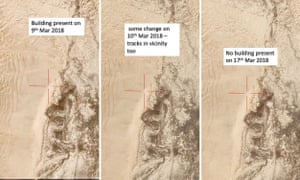
Before the crackdown, pilgrims also trekked 70km into the desert to reach the Jafari Sadiq shrine, honouring Jafari Sadiq, a holy warrior whose spirit was believed to have travelled to Xinjiang to help bring Islam to the region. The tomb, on a precipice in the desert, appears to have been torn down in March 2018. Buildings for housing the pilgrims in a nearby complex are also gone, according to satellite imagery captured this month.
Before and after imagery of the Jafari Sadiq shrine. L-R Dec 10 2013, April 20, 2019. Photograph: Google Earth/ Planet Labs
“Nothing could say more clearly to the Uighurs that the Chinese state wants to uproot their culture and break their connection to the land than the desecration of their ancestors’ graves, the sacred shrines that are the landmarks of Uighur history,” said Thum.
‘When they grow up, this will be foreign to them’
The Kargilik mosque, at the centre of the old town of Kargilik in southern Xinjiang, was the largest mosque in the area. People from various villages gathered there every week. Visitors remember its tall towers, impressive entryway, and flowers and trees that formed an indoor garden.
The mosque, previously identified by online activist Shawn Zhang, appears to have been almost completely razed at some point in 2018, with its gatehouse and other buildings removed, according to satellite images analysed by the Guardian and Bellingcat.
Three locals, staff at nearby restaurants and a hotel, told the Guardian that the mosque had been torn down within the last half year. “It is gone. It was the biggest in Kargilik,” one restaurant worker said.
Another major community mosque, the Yutian Aitika mosque near Hotan, appears to have been removed in March of last year. As the largest in its district, locals would gather here on Islamic festivals. The mosque’s history dates back to 1200.
Despite being included on a list of national historical and cultural sites, its gatehouse and other buildings were removed in late 2018, according to satellite images analysed by Zhang and confirmed by Waters. The demolished buildings were likely structures that had been renovated in the 1990s.
Two local residents who worked near the mosque, the owner of a hotel and a restaurant employee, told the Guardian the mosque had been torn down. One resident said she had heard the mosque would be rebuilt but smaller, to make room for new shops.
“Many mosques are gone. In the past, in every village like in Yutian county would have had one,” said a Han Chinese restaurant owner in Yutian, who estimated that as much as 80% had been torn down.
“Before, mosques were places for Muslims to pray, have social gatherings. In recent years, they were all cancelled. It’s not only in Yutian, but the whole Hotan area, It’s all the same … it’s all been corrected,” he said.
Activists say the destruction of these historical sites is a way to assimilate the next generation of Uighurs. According to former residents, most Uighurs in Xinjiang had already stopped going to mosques, which are often equipped with surveillance systems. Most require visitors to register their IDs. Mass shrine festivals like the one at Imam Asim had been stopped for years.
Removing the structures, critics said, would make it harder for young Uighurs growing up in China to remember their distinctive background.
“If the current generation, you take away their parents and on the other hand you destroy the cultural heritage that reminds them of their origin … when they grow up, this will be foreign to them,” said a former resident of Hotan, referring to the number of Uighurs believed detained in camps, many of them separated from their families for months, sometimes years.
“Mosques being torn down is one of the few things we can see physically. What other things are happening that are hidden, that we don’t know about? That is what is scary,” he said.
The ‘sinicisation’ of Islam
China denies allegations it targets Muslim minorities, constrains their religious and cultural practices, or sends them to re-education camps. In response to questions about razed mosques, foreign ministry spokesman Geng Shuang said he was “not aware of the situation mentioned”.
“China practices freedom of religion and firmly opposes and combats religious extremist thought… There are more than 20 million Muslims and more than 35,000 mosques in China. The vast majority of believers can freely engage in religious activities according to the law,” he said in a faxed statement to the Guardian.
A demolished mosque in the old town of Kashgar, Xinjiang Uyghur autonomous region, China. Photograph: Eric Lafforgue/Art in All of Us/Corbis via Getty Images
But Beijing is open about its goal of “sinicising” religions like Islam and Christianity to better fit China’s “national conditions”. In January, China passed a five-year plan to “guide Islam to be compatible with socialism”. In a speech in late March, party secretary Chen Quanguo who has overseen the crackdown since 2016 said the government in Xinjiang must “improve the conditions of religious places to guide “religion and socialism to adapt to each other”.
Removing Islamic buildings or features is one way of doing that, according to researchers.
“The Islamic architecture of Xinjiang, closely related to Indian and Central Asian styles, puts on public display the region’s links to the wider Islamic world,” said David Brophy, a historian of Xinjiang at the University of Sydney. “Destroying this architecture serves to smooth the path for efforts to shape a new ‘sinicised’ Uighur Islam.”
Experts say the razing of religious sites marks a return to extreme practices not seen since the Cultural Revolution when mosques and shrines were burned, or in the 1950s when major shrines were turned into museums as a way to desacralise them.
Today, officials describe any changes to mosques as an effort to “improve” them. In Xinjiang, various policies to update the mosques include adding electricity, roads, news broadcasts, radios and televisions, “cultural bookstores,” and toilets. Another includes equipping mosques with computers, air conditioning units, and lockers.
“That is code to allow them to demolish places that they deem to be in the way of progress or unsafe, to progressively yet steadily try to eradicate many of the places of worship for Uighurs and Muslim minorities,” said James Leibold, an associate professor at La Trobe University focusing on ethnic relations.
Critics say authorities are trying to remove even the history of the shrines. Rahile Dawut, a prominent Uighur academic who documented shrines across Xinjiang, disappeared in 2017. Her former colleagues and relatives believe she has been detained because of her work preserving Uighur traditions.
Dawut said in an interview in 2012: “If one were to remove these … shrines, the Uighur people would lose contact with earth. They would no longer have a personal, cultural, and spiritual history. After a few years we would not have a memory of why we live here or where we belong.”


 Multicultural Meanderings