The complicated task of getting more women involved in politics

The debate over how to get more women involved in politics, contrasting the NDP’s Kennedy Stewart’s private members bill linking election expense reimbursement with female candidate share with Michelle Rempel’s encouragement and education approach:

Mr. Stewart’s academic research has shown that the party selection processes are biased, and that men are five times more likely to win nominations just because the selectors are biased against women.

So, the problem is with the political parties, and their old-boy networks and structures.

Equal Voice, a non-partisan group that advocates for more elected women, notes that only 32 per cent of candidates in last year’s federal election were women.

Based on the formula in his bill, Mr. Stewart says $1.25-million would be deducted from the Conservatives’ reimbursement for the 2015 election, because 20 per cent of their candidates were female; the Liberals, with 31 per cent female candidates, would lose about $900,000, and the NDP, which ran 43 per cent female candidates, would have lost about $200,000.

Mr. Stewart’s bill was debated earlier this month in the Commons; it comes back for a vote in September.

Some note that, even if it passes, the desired change might not come. Equal Voice says that in France, for example, the major parties will simply take the financial hit.

For Ms. Rempel, the bill would not make “real change.” She says women need to be educated on how to win nominations – raising money, dealing with the media, and building networks – to prepare them for the “fiery furnace” of a federal election. She believes going through rigorous internal party vetting is a positive exercise for women.

“The propensity is – and frankly you see it in all political parties in Canada – I don’t want to see women that are thrown into non-winnable ridings just to be a token so that [the party] is not financially penalized,” she says. “I think that actually takes women a step back.”

She fears a bill such as Mr. Stewart’s will change the calibre of women in the Commons: “There are women in our House of Commons across party lines that have really strong CVs or really strong life experiences. All of the women that are in the House of Commons are there because they won elections, full stop. They are not there because of tokenism.”

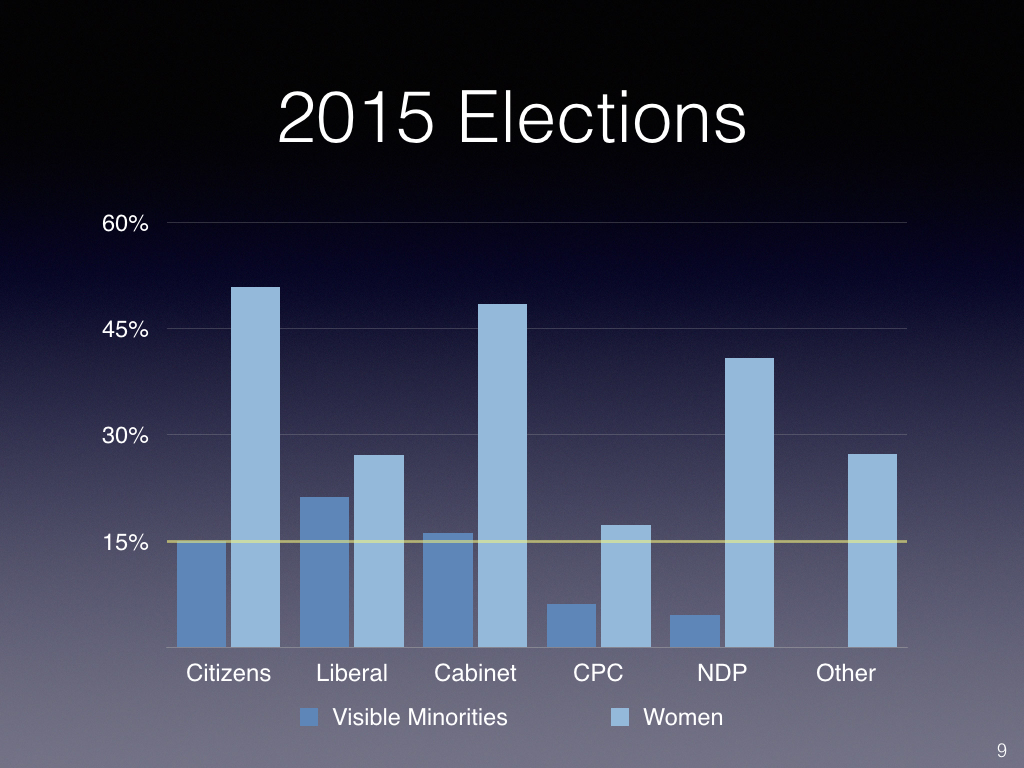
The NDP has the strongest female representation in caucus (41 percent), the Conservatives the weakest (17 percent, identical to 2011 election), the Liberals 27 percent.

Source: The complicated task of getting more women involved in politics – The Globe and Mail
Canada can do better on getting more women elected, 60th place in world right now

Election 2015 - VisMin and Foreign-Born MPs.002Nancy Peckford and Grace Lore of EqualVoice argue for a gender-based lens with respect to evaluating electoral reform proposals. Women who are now more under-represented than visible minorities, where all parties have made major and successful recruiting efforts:

But, it is crucial to understand that “proportional representation” is not one thing and neither is “women’s political representation.” Proportional representation systems vary widely in how individuals become candidates, how votes are cast, and how those votes are translated into seats. UBC political scientist Grace Lore, and EV’s senior researcher, has just finished a multi-country study of electoral systems in Europe and North America with a specific focus on their effect on women’s representation. The data from that research strongly reveals that while the number of women elected is an important indicator of success, so is the ability of these women to act to represent their constituents, including women.

In ‘closed list’ PR systems, parties determine a set list of pre-approved candidates and voters simply pick a party and, de facto, accept the list of candidates in the ordered that is proposed by the party. In ‘open list’ systems, voters have the opportunity to indicate preferences between candidates. In some countries that use open list proportional representation, voters can even indicate a preference for candidates from multiple parties. Like open list proportional systems, alternative vote systems give voters the chance to rank parties instead of just indicating their top choice.

These are not minor or mechanical details—they matter greatly to how one participates in the democratic process. The nuts and bolts of each system also shape the role of parties and the choices available to voters, including the possibilities for women’s political representation. Some features of electoral systems, whether based on proportional representation or not, lead to the election of a greater number of women, while potentially reducing women’s capacity to represent women’s and other interests once they are in office. Other features improve the power of individual women to have influence, but do not maximize the possibilities for the sheer number of women elected. Lore’s extensive research of electoral systems on two continents and 15 countries underscores that if women representatives are more beholden to a political party for their election (versus having a direct relationship with constituents), their lack of independence frequently prevents them from effectively advocating on behalf of other women.

In short, proportional representation is neither necessary nor sufficient to ensure women’s equal representation. Political culture matters significantly, i.e. voters and parties need to seek more women to appear on the ballot and create the conditions for their participation. More women also need to choose politics as the place to dedicate their time, energy, and skills. If we do not also tackle other systemic barriers, including inequality in access to political resources and the uncertainty of the nomination processes, we cannot count on this happening. These concerns can and should be part of the electoral reform discussion. Revisiting the rules around financing and timing of nomination races are two key areas where there is much room for improvement.

Canada can do better than its current 60th place in the global community for its representation of women. Open discussion around electoral reform provides us all—voters, parties, MPs, and organizations, with an opportunity to take action. Action, however, must be thoughtful and evidence based. A consideration of the impacts on women in politics should be incorporated at every stage of the process—from broad principals to basic mechanics.

Source: Canada can do better on getting more women elected, 60th place in world right now |

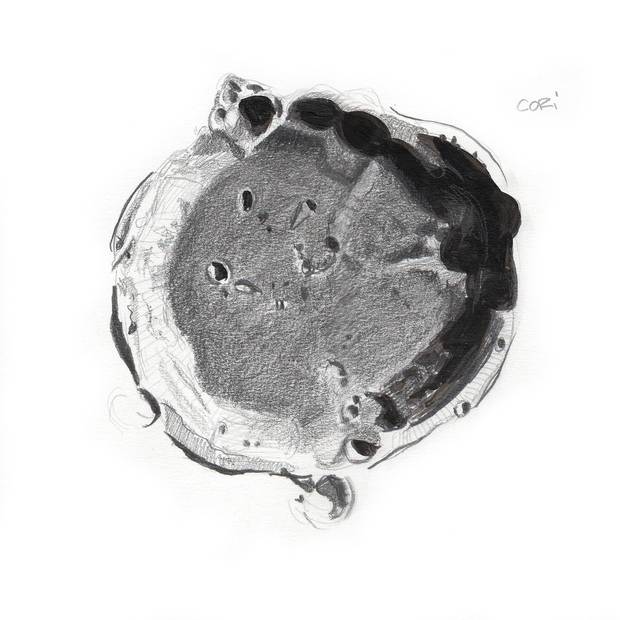
Artist draws moon’s craters named after women to illustrate inequality

web-craters09nw6Lack of historical diversity – only 27 out of 1,600 (0.02 percent):

Last year, Montreal artist Bettina Forget was looking at an atlas of the moon when something suddenly struck her as odd.

She knew the moon’s surface is pockmarked with craters of varying size. These circular depressions are the lasting record of billions of years’ worth of interplanetary bombardment dating back to the formation of the solar system. But, in a way, they also record an artifact of science and culture that hits much closer to home – because, no matter where Ms. Forget looked, the craters were named after men.

Soon, Ms. Forget found herself combing through the International Astronomical Union’s catalogue of lunar features. Of the more than 1,600 named craters on the moon, she discovered that a mere 27 honour famous women in science and space exploration.

That’s when she decided to draw all 27 by hand.

Source: Artist draws moon’s craters named after women to illustrate inequality – The Globe and Mail

Canadian woman will be on next series of bank notes, Trudeau announces

One has to admire the choreography of this announcement on International Women’s Day with other related elements: the PM’s op-ed in the Globe ( Gender equality is an opportunity, not a threat) and the announcement of DM changes, which included four women (one of whom is visible minority) and one man – because its 2016?:

The image of an iconic Canadian woman will appear on the next issue of bank notes, Prime Minister Trudeau announced today.

“A Canadian woman will be featured on the very first of the next series of bills expected in 2018,” Trudeau said.

“Today, on International Women’s Day, the Bank of Canada is taking the first step by launching public consultations to select an iconic Canadian woman to be featured on this new bill.”

The government and the Bank of Canada did not indicate which denomination would showcase the iconic female Canadian.

Finance Minister Bill Morneau, who stood alongside the prime minister with other members of the Liberal caucus and former Mississauga, Ont., mayor Hazel McCallion during the announcement, noted that it is “high time to change.”

“One of the very first things I had the honour of doing as the new finance minister was asking the governor of the Bank of Canada, Stephen Poloz, and his colleagues at the bank whether it’s in fact possible to put a woman on the bank note,” said Morneau.

The finance minister said he was told the central bank had been looking into the possibility for some time and was keen to support the initiative.

Source: Canadian woman will be on next series of bank notes, Trudeau announces – Politics – CBC News

Today’s feminist problem? Black women are still invisible: Anderson

More than an element of truth in this critique by Septembre Anderson:

A few weeks ago, I got a press release about the 100th anniversary of women getting the vote in Canada. The e-mail goes on about women’s suffrage and the commemoration of that fight for a few hundred words and then begins to catalogue when women got the right to vote throughout the country – women in Manitoba in 1916, those in Newfoundland in 1925 and so on and so on – and then, in brackets, near the end, “Unfortunately, the right to vote was withheld from indigenous women, as well as those of Asian and African descent, for years longer.”

Nowhere in the press release was there any mention of how anti-black many suffragettes were; how much of these women’s activism was about gaining the vote for white women only; and how championing eugenics for racialized women was also part of their politics. Heck, there wasn’t even a mention of when indigenous, Asian and African women got the vote in Canada.

And this is the problem with feminism as it exists today. Black women and other women of colour are continuously rendered invisible beneath the “women” banner. The default definition for women is white women – those with the most systemic power – and the issues of the most privileged of us take precedence over the trials and tribulations of the least privileged of us.

We saw this clearly during the Academy Awards. While white women used the hashtag #AskHerMore to bring awareness to and combat sexist reporting on the red carpet, women of colour were bringing attention to #OscarsSoWhite, created by movie critic April Reign, to protest the lack of racial diversity in Oscar nominees.

We saw this with the celebration of Justin Trudeau’s recent cabinet – that boasted gender parity “because it’s 2015” but not racial parity. We see this with continuing discussions about the gender pay gap – but there’s a greater disparity between race than gender.

While white women experience the repercussions of sexism, racism isn’t one of the barriers that they have to come up against. It’s actually one that benefits them. The unique issues that black women have to deal with are far too often overshadowed by the issues that white women deal with, leaving those of us with less institutional power to wait and hope for a trickle-down equity that history has shown us will never come.

Black women exist at the intersection of blackness and womanhood and, therefore, our feminism isn’t a single issue struggle. Our battle for equity and inclusion is with both misogyny and systemic anti-blackness, from within and without feminist circles. Feminism, as it is popularly practised, whitewashes the experience of racialized women and does not acknowledge the intersectionalities within womanhood. It does not acknowledge the distinctive ways different women experience sexism.

Through this myopic definition of womanhood, mainstream feminism is embroiled in elevating the women closest to the top rather than those struggling and suffering on the margins.

In Canada, black women and other women of colour find themselves missing not only from movements for gender diversity, but also from seats of power. Bank boards, newsrooms, hospital boards and executive positions are all spaces where white women see themselves better represented.

Source: Today’s feminist problem? Black women are still invisible – The Globe and Mail

Canada’s top general launches push to recruit women

Military, RCMP, CSIS.001The Forces have struggled with increasing diversity for some time, as has the RCMP. The target of a one percent increase per year is ambitious; their annual employment equity report (available from the Library of Parliament) will allow public tracking of progress over the next few years:

Canada’s top general has set out to transform the military with a new effort to boost the number of women in the ranks.

Gen. Jonathan Vance, the chief of defence staff, revealed on Friday that he has given a directive to do what good intentions have so far failed to accomplish — get more women into the Canadian Armed Forces.

Vance said he has tasked Lt.-Gen. Christine Whitecross, the chief of military personnel, to boost the number of women in uniform by 1 per cent a year over the coming decade.

That would allow the military to meet its long-standing goal of having women make up 25 per cent of its members.

“I have asked Gen. Whitecross to increase the percentage, through retention and recruiting, . . . of women in the armed forces by 1 per cent a year over the next 10 years,” Vance told a defence conference on Friday.

“If we don’t make it a task, if I don’t give an order, it’s not going to get done. We can’t just hope that it happens. We’re going to try hard to meet our diversity targets the same way.”

Officials said later that Vance had given the directive on Wednesday during a meeting with Whitecross.

…But meeting the goal could be a challenge. There are some 15,000 women in uniform, making up 15 per cent of the regular and reserve forces.

In all, the defence department has about 66,000 full-time soldiers, short of its approved staffing level of 68,000, and about 21,000 reservists, well below its target of 27,000.

In the past, many women who joined the military were familiar with the organization, thanks either to family connections or past involvement with cadets, Leuprecht said. As the military now looks to recruit more women, it will have to broaden its appeal, he said.

Leuprecht also said that the armed forces must work to have women better represented in trades across the organization, rather than concentrated in areas such as logistics and medicine.

Vance made clear Friday that his efforts to diversify the ranks won’t stop with boosting the number of women.

“I’m also wanting to increase all manner of diversity in the armed forces to better reflect the Canadian public. It’s important. We are of the public,” Vance said.

Visible minorities currently make up 6.5 per cent of the armed forces, short of the goal of 11.8 per cent. Aboriginal peoples represent 2.5 per cent of those in uniform, shy of the goal of 3.4 per cent.

Canadian women give birth to children of ISIS fighters

No real surprise here that Canada is not exempt from this trend of some women living in the West, hard as it is to understand why, both objectively and from their families’ perspective.

Decisions have consequences, as other accounts of women who have traveled to Iraq and Syria have found out (‘There’s no way back now’: For female ISIL members, Syria is one-way journey).

These studies are helpful to highlight this (fortunately small) trend, and more important, inform counter-extremism strategies:

Canadian women are helping to grow the so-called Islamic State.

According to researchers at the University of Waterloo, three Canadian women have given birth to children of ISIS fighters, while another two are pregnant. The new details are part of a larger study following foreign fighters who flee to Syria and Iraq. The women travelled separately over the past two years, leaving their families back home devastated.

“They’re quite worried about what is going to happen to their daughter, but also their grandchild,” said Amarnath Amarasingam, a co-lead author of the study. “For most of the parents, I think there’s kind of a double reaction. First they’re kind of happy a grandchild is involved, but at the same time, they’re quite devastated that a child was born into a war zone, to somebody they’ve never met.”

The researcher also said the challenges these women face are quite obvious. Although they have a place to live, it is difficult to find basic supplies like clothing and diapers. Some of the families back in Canada are keen to help their daughters, but are afraid of the legal consequences.

“If you were to send diapers to Syria, I don’t know if that contributes to real support of a terrorist organization, but it does rest on very shaky legal ground, in terms of what you’re allowed to send to a place like Raqqa,” said Amarasingam.

Public Safety Minister Ralph Goodale said this is “obviously a very disturbing development,” and recommitted to opening a national counter-radicalization office.

“We will be moving forward shortly, as rapidly as we can, on the creation of this new office for community outreach and counter radicalization,” said Goodale.

“I’m concerned with every dimension about this type of problem, it runs contrary to everything Canada stands for, in terms of values in the world,” he added.

The creation of a new office was part of a mandate letter from Prime Minister Justin Trudeau to the public safety minister late last year. The Liberals aren’t saying yet if funding for the office will be included in the upcoming budget, but there are signs this program will be a priority.

Amarasingam said the challenges these women face become more complex because of their age. “These girls are very young,” he added, “they don’t have much experience in how to raise children, but they’re also raising these children under circumstances many others don’t have to worry about.”

Source: Canadian women give birth to children of ISIS fighters | CTV News

Dozens of nations discriminate against women in citizenship laws – study

Good overview and not surprising that most of these countries are in Africa and the Mid-East:

More than a quarter of the world’s nations have sexist laws on nationality, such as stripping women of citizenship if they marry a foreigner, that can deprive women of access to jobs, education and other benefits available to men, a new study says.

The discriminatory laws range from forcing women to give up their acquired citizenship if they are divorced or widowed or denying children the citizenship of their mother, said the report released on Monday by Equality Now, an international human rights organization.

Not having legal citizenship can mean being unable to obtain a passport or work permit, being unable to attend public schools or living under threat of deportation, the report said.

It also can leave women stuck in abusive marriages or unable to win custody of their children, it added.

The report found 53 countries with discriminatory nationality laws, 20 of them in sub-Saharan Africa and 16 in the Middle East and North Africa.

“Sex discrimination persists in nationality and citizenship laws in over 50 countries around the world, continuing to trap women and their families in a web of sexist nationality laws,” the report said.

“Too many governments have simply decided that a woman should have fewer rights than a man to pass on her citizenship to her children or her foreign spouse, or to acquire, change or keep her nationality,” it said.

For example, women cannot pass their citizenship to adopted children the way men can in the Bahamas, Barbados and Mauritius, it said.

Foreign women who take on their spouse’s nationality lose it if their marriage ends in Bahrain, Togo, Tunisia and Yemen, it said.

The report cited recent progress in several countries, including Senegal and Suriname, where laws were changed to give women the same rights as men to transfer their nationality to their husband and children, and Vanuatu, where married women won the right to pass their nationality to a foreign spouse on the same terms as married men.

Source: Dozens of nations discriminate against women in citizenship laws – study

Labour Market Participation of Immigrant and Canadian-born Wives, 2006 to 2014 (StatsCan study)

A good detailed StatsCan study comparing labour market participation of immigrant and non-immigrant women with an abundance of detailed data and breakdowns.

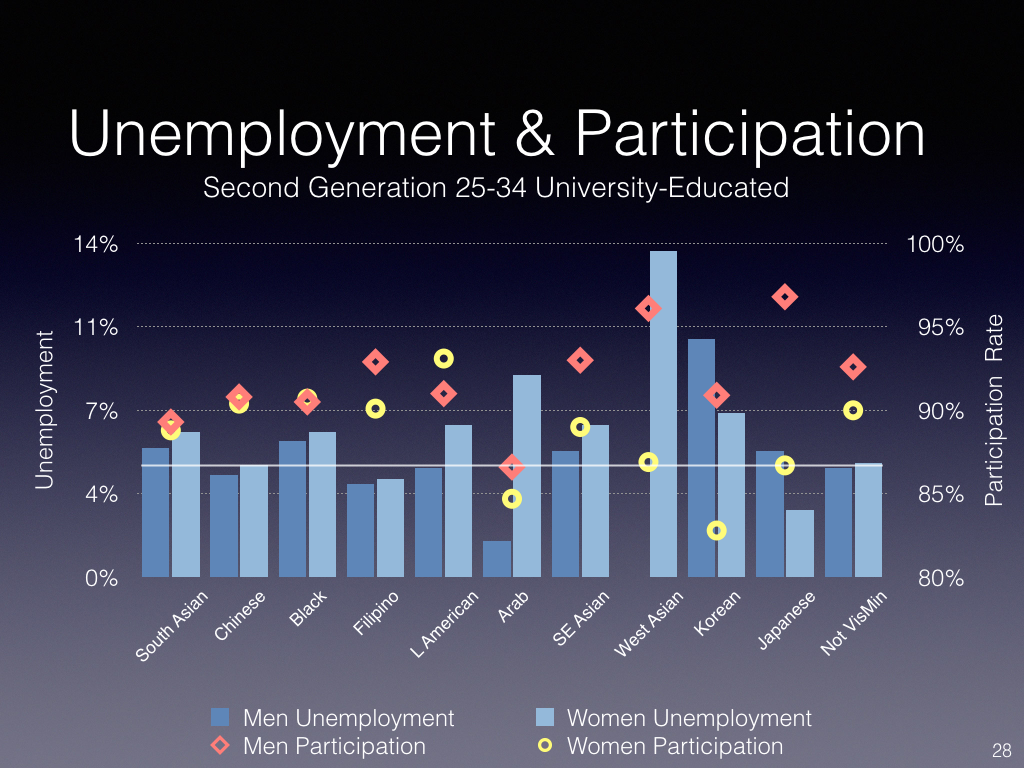
MiC Deck - Dec 2015.028The chart above compares 2011 NHS unemployment and participation rates for visible minority groups with non-visible minorities for second-generation, aged 25-34, university-educated, which shows some interesting gender differences between groups.

Summary of the StatsCan study:

Immigrant wives participate in the Canadian labour market less than do Canadian-born wives. Because this lower participation has implications for the income and living standards of immigrant families, understanding the sources of the difference is important.

This study shows that differences in socioeconomic characteristics account for about half of the difference in labour market participation between immigrant wives and their Canadian-born counterparts observed for the 2006-to-2014 period. The results indicate that female-to-male labour market participation ratios in the source country and, to a lesser extent, family size are key drivers of the difference in participation observed between the two groups of women. The lower wages received by immigrant women in the Canadian labour market appear to play a role, but their contribution is difficult to quantify.

The results raise the question of which factors country-level female-to-male labour market participation ratios capture. Frank and Hou (2015) show that these ratios remain statistically significant in models of the labour market participation of immigrant women even after source-country gender-role attitudes are controlled for. This finding suggests that these ratios capture, at least partly, other influences that affect the participation of immigrant women.

Overall, the study shows that a thorough understanding of differences in family income between immigrants and the Canadian-born requires an understanding not only of wage differences―as most Canadian studies have achieved so far―but also of differences in the labour market participation of wives.

Source: Labour Market Participation of Immigrant and Canadian-born Wives, 2006 to 2014

Muslim men must learn to treat women as equals: Sheema Khan

One of the more interesting sessions we held on multiculturalism and faith was a small multi-faith roundtable, with the most interesting exchange being between Sheema Khan and Alia Hogben (Canadian Council of Muslim Women) who challenged some of the more conservative or traditional male Imams present on gender issues.

Both have continued to be outspoken as seen in this latest piece by Sheema:

From 2000 to 2005, I served as the chair of CAIR-CAN, a grassroots advocacy organization that fought discrimination against Muslims. Whether it was a Muslim woman denied employment because of her hijab, or the rendition of Maher Arar, we fought for basic human rights based on the Canadian Charter of Rights and Freedoms. This journey opened my eyes to my own double standards: I fought for Muslims to be treated with basic human dignity by the wider society, yet looked the other way when such treatment was denied to women within my own community.

Toward the end of my CAIR-CAN tenure, I could no longer stand the hypocrisy, and decided to tackle a fundamental problem that our community has been content to ignore: the treatment of women as second-class human beings. As chair, I came across incidents against Muslim women that would never have been tolerated had these been perpetrated by a non-Muslim. But if a Muslim did it, well, we would let it go, hoping that attitudes would one day change.

It was, and continues to be, the denial of the fact that many Muslim cultures have a bias against women. Consider the past few years of the Gender Gap Index, published by the World Economic Forum. It continually lists predominantly Muslim countries in the bottom rung of societies that equitably distribute resources between men and women. From the super rich (such as Saudi Arabia and other Gulf States) to the impoverished, a large chunk of Muslims live in societies where women are shortchanged in terms of development, opportunity and participation.

The bulk of Muslims in Canada are immigrants who naturally bring to this country the attitudes and norms shaped by their culture of birth. These will be transformed by Canadian norms; the transformation varies from person to person. Suffice it to say that many traditional Muslim institutions continue to operate on a patriarchal model, in which women are either unwelcomed or merely tolerated, but are always expected to keep the status quo. Those who demand basic rights are labelled with the “f” word – feminist.

….Some will be critical of the airing of “dirty laundry” during difficult times for Muslims. Yet meaningful discussions about the treatment of women have been avoided for far too long. To what end? What we don’t need is another lecture about the dress and behaviour of the “ideal” Muslim woman. Instead, we need to hear more about men taking responsibility for their actions, and treating women as equal human beings.

Source: Muslim men must learn to treat women as equals – The Globe and Mail