Are animals citizens? Queen’s prof nets $100K prize for digging into that question

Well deserved award to one of Canada’s best political philosophers, Will Kymlicka, although I am much more familiar with his work on multiculturalism. This work raises some uncomfortable questions about animal rights beyond avoiding cruelty and how expansive a definition is appropriate:

Do animals have citizenship rights?

It’s not a question that comes up every day at the dog park or the vet’s office, but philosopher Will Kymlicka has been thinking long and hard about it.

Kymlicka’s work on the rights of animals is just one of the reasons the Queen’s University professor was recently awarded the Social Sciences and Humanities Research Council Gold Medal.

It’s the council’s highest research honour, and one that comes with a $100,000 prize.

Pets and democracy

As the university’s Canada Research Chair in Political Philosophy, Kymlicka is a frequent adviser to government and non-government agencies, as well as one of the country’s top thinkers on topics such as multiculturalism, justice and democracy.

Over the past decade, he’s also been exploring ways of thinking about domesticated animals within the context of democracy, and what our obligations toward them might include.

After all, there are dozens of laws governing almost all aspects of a pet dog or cat’s life — where they can roam, what they can eat, and how they die.

And for obvious reasons, they have no say in those laws.

“The idea is that animals that we deal with most directly are domesticated animals, which is to say, animals that we have brought into our society through this long historical process,” Kymlicka told CBC Radio’s All In A Day Wednesday.

“And so the idea is that having done this — having brought animals out of the wild and brought them into our society — we need to recognize that they are now, in fact, members of a shared society.”

Health care for pets?

If animals are indeed full members of Canadian society, Kymlicka believes that opens up questions about what rights we owe them — including whether they should have access to health care like any other citizen.

“Most Canadians think that that is a kind of right of citizenship. If you’re a member of Canadian society, you should have publicly funded health care,” Kymlicka said.

“So I think that’s true about domesticated animals. I think there should be a scheme of public health care for domesticated animals. No animal should die because they didn’t have the resources for health care.”

There are also implications, he added, as to how we think about the rights of animals to public space.

“Animals are often very limited in where they can go. We have all sorts of laws that prohibit dogs or cats entering restaurants, when they can be on- or off-leash, or so on,” Kymlicka said.

“We only allow animals when it’s convenient for us. But in our view, it’s their society as well.”

Source: Are animals citizens? Queen’s prof nets $100K prize for digging into that question
Sadiq Khan and the Future of Europe: Mehdi Hasan

Mehdi Hasan on Sadiq Khan’s election, contrasting multiculturalism and integration in Britain and other European countries:

Mr. Khan’s resounding victory was a stinging rebuke to the peddlers of prejudice. Here is a Muslim who prays and fasts and has gone on the hajj to Mecca. But he sees no contradiction in being a card-carrying liberal, too. As a member of Parliament, he voted — despite death threats from Islamist extremists — in favor of same-sex marriage and he campaigned to save a local pub in his constituency from closure. He has pledged to serve as a “feminist mayor” of London and made his first public appearance after the election at a Holocaust memorial service.

The capital, admittedly, is a city apart — diverse, immigrant-friendly and home to around four in 10 of England’s 2.6 million Muslims. But even outside London, the more relaxed and tolerant British model of multiculturalism has done a far superior job of integrating, even embracing, religious and racial diversity than the more muscular, assimilationist models in Continental Europe.

While Angela Merkel and Nicolas Sarkozy have declared multiculturalism a failure, the truth is that their countries, Germany and France, have never tried it. As Tariq Modood, the author of “Still Not Easy Being British,” writes, multiculturalism is the “political accommodation of difference.” For the French, however, difference has never even been tolerated, much less accommodated. In contrast, British-style multiculturalism has treated integration, as even David Cameron conceded almost a decade ago, as “a two-way street” and never required, in the words of Will Kymlicka, the author of “Multicultural Odysseys,” that “prior identities” must “be relinquished” in order to build a national identity.

Is it surprising that polls find that British Muslims are more patriotic and take more pride in their national identity than their non-Muslim counterparts and studies show that ethnic and religious segregation in Britain is either steady or in decline?

That isn’t to deny the problems. Britain’s Muslims tend to have the highest unemployment, worst health and fewest educational qualifications of any faith community. But this likely has more to do with a history of racism than it does with an unwillingness to integrate. A 2013 study found that Muslim men in Britain were up to 76 percent less likely to get a job offer than Christian men of the same age holding similar qualifications, while Muslim women were 65 percent less likely to be employed than Christian women.

The situation, then, is far from perfect, but there is a good reason that British Muslims look across the English Channel and breathe a sigh of collective relief.

Source: Sadiq Khan and the Future of Europe – The New York Times

Multiculturalism Policies in Contemporary Democracies

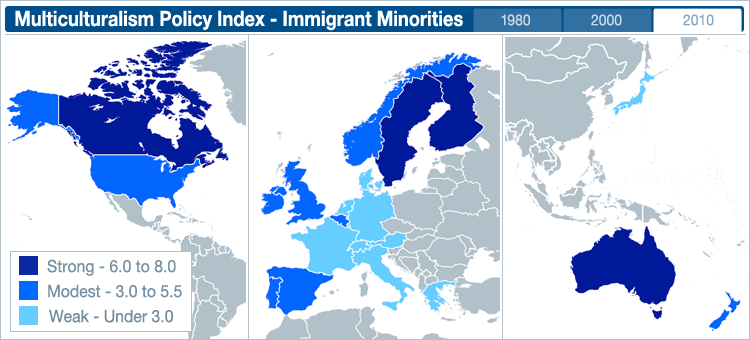
Map2010The comparative work by Keith Banting and Will Kymlicka of Queen’s University. A wealth of detailed and general information in this site.

Expect that Australia’s score will change following the change in government.

Multiculturalism Policies in Contemporary Democracies – Home.

Pax Ethnica, by Karl E. Meyer and Shareen Blair Brysac – The Globe and Mail

Good review by Will Kymlicka, and reminder that standard of success is not absence of violence, and that success is more widespread than commonly portrayed.

Pax Ethnica, by Karl E. Meyer and Shareen Blair Brysac – The Globe and Mail.