Budget to include millions to help foreign-trained workers get credentials recognized, expand skilled-trades training

Good reality check from WES/Madhany in terms of the need for all the players to work together and ideally harmonize provincial accreditation body standards (the anecdote regarding doctors being Uber drivers needs substantiation regarding the extent):

…The money is welcome news, but won’t solve the issue of underemployed immigrants on its own, said Shamira Madhany, managing director for World Education Services Canada, a non-profit organization that provides credential evaluations for people who have studied outside of Canada.

Even more vital than money, said Madhany, is getting all levels of government — and provincial accreditation bodies — pulling in the same direction.

“You end up with a situation where the federal government says, ‘but this is provincial jurisdiction,’ and the provinces say, ‘but we need more money,’ and then the licensing bodies say, ‘but, you know, we want to have making of standards,’ ” said Madhany. “What I would be looking for is a pan-Canadian approach.”

The federal government recruits skilled immigrants to come to Canada, but then those immigrants see their credentials turned down by individual provinces or regulatory bodies, something Madhany said is a waste at a time when many Canadians are struggling to find a doctor.

“Who’s going to fill our labour shortages? We know it’s immigrants and highly skilled immigrants,” said Madhany. “So if you don’t leverage those skills, you end up with this continuous kind of circling around, and doctors and others in the health professions driving Ubers.” …
Source: Budget to include millions to help foreign-trained workers get credentials recognized, expand skilled-trades training

Why is this nurse working at a Toronto insurance firm? Ontario’s battle to get foreign-trained nurses into the field

Useful analysis and report:

…The report by World Education Services (WES) Canada, a non-profit organization that assesses foreign credentials, surveyed 758 internationally educated nurses not currently working as nurses in Ontario, and found that half had not begun the province’s registration process to practise, even if they wanted to. 

The respondents cited financial barriers as the top factor affecting their ability to become registered. (Registration costs, exams and testing fees can total $3,000 at the low end.) The need to show evidence of recent nursing practice, a lack of clarity around the registration process and the time it takes to get registered also played a role.

The report also said data gaps make it “nearly impossible” to track how many internationally educated nurses are in Canada, how many intend to or are trying to qualify, and how many are practising. 

“No one can tell us how many internationally educated nurses are actually out there who could potentially be working,” said Joan Atlin, strategy, policy and research director at WES Canada. “There’s still a significantly underutilized population of nurses in the province who are still falling outside of the supports.”

The pandemic has forced health officials to confront the underutilization of skills brought by immigrants meant to fill labour needs, said Atlin, who has been engaged in foreign credential issues for two decades.

The province is well aware of the issues in the report and has worked with the College of Nurses of Ontario, which regulates the profession, to help internationally educated nurses become registered. 

In 2022, the Health Ministry introduced changes, including covering the cost of exams and registration with the college, and made it easier to meet language proficiency requirements. 

Just last month, the province made permanent a program that places these nurses under an employer’s supervision to gain work experience. The college says that as of the end of March 2024, it had matched 4,230 applicants with employers, enabling 3,324 nurses to register. 

“It has created that opportunity for health-care employers to hire those who have already applied for licensure and allow nurses to meet the practice and language proficiency requirement, by actually working and having their employer attest to their ability to work in English,” said Atlin.

In total, the college says as of April 1, it had registered more than 7,500 international applicants, with 5,215 new internationally educated nurses registered in 2022 alone. …

Source: Why is this nurse working at a Toronto insurance firm? Ontario’s battle to get foreign-trained nurses into the field

WES Survey: Are Intentions to Immigrate to Canada Changing in the Face of COVID-19?

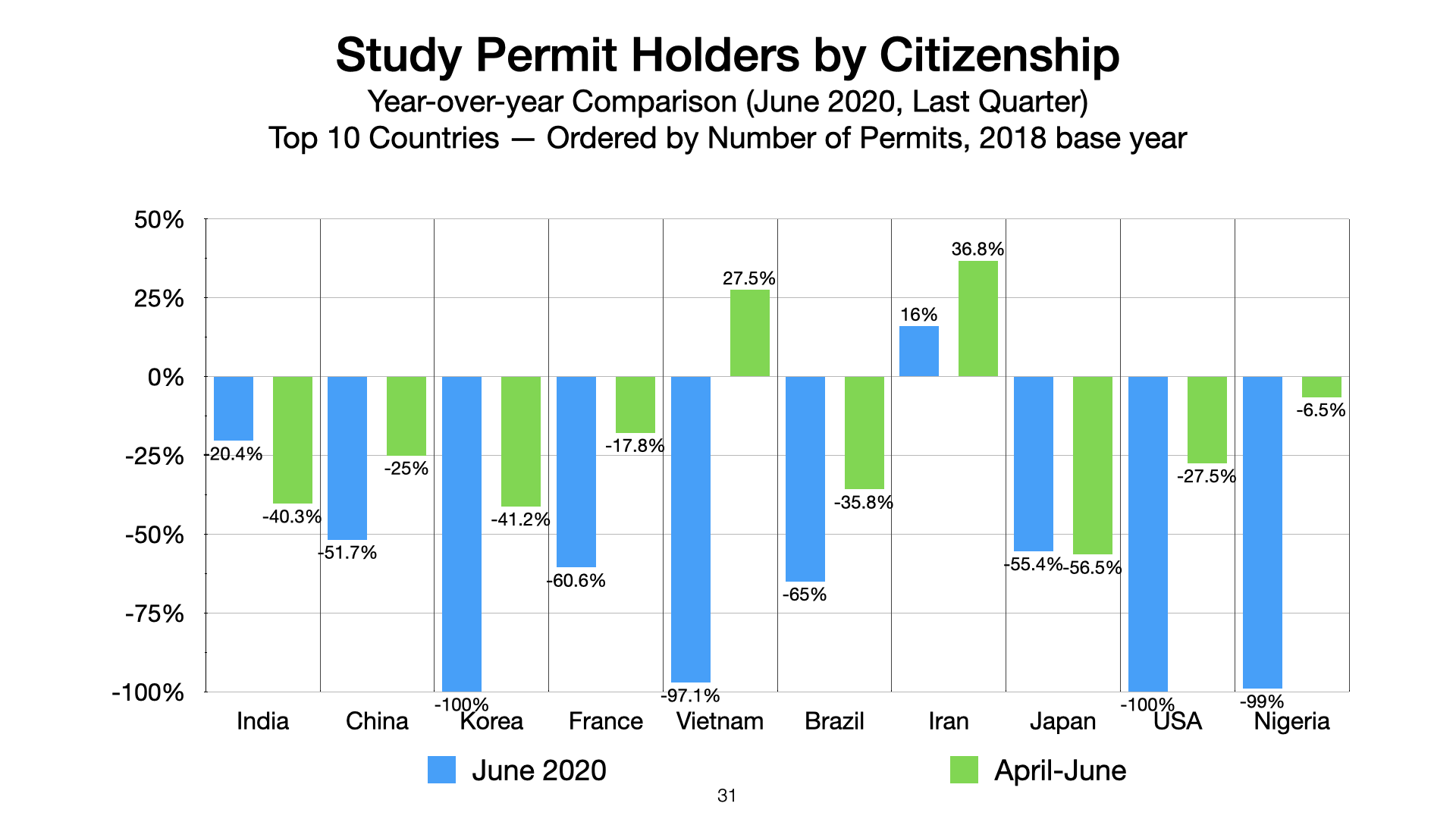
The second survey, showing increased interest in immigrating to Canada. Like all surveys, it is a snapshot, and interest doesn’t necessarily translate into action. The chart above highlights the year-over-year change in study permit holders for the 10 top source countries. As this quarter – July to September – is the historic peak, August numbers will be particularly important to assessing the impact:

What impact will COVID-19 and the resulting global economic recession have on prospective immigrants’ interest in moving to Canada? Recent research from World Education Services (WES) shows how these twin crises have affected the intentions of aspiring immigrants, shedding some light on this question.

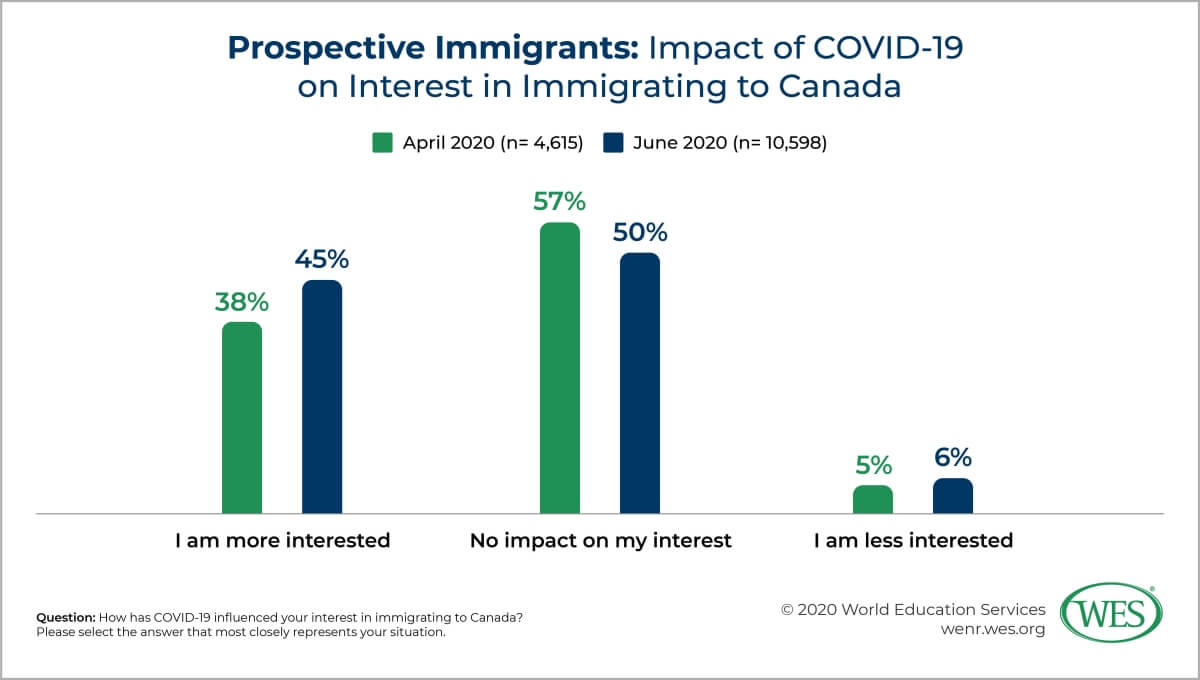
Fully 45 percent of respondents to a June 2020 survey reported that COVID-19 had increased their interest in immigrating to Canada, up from 38 percent in a similar survey in April. The survey will be sent out again in late August.

As a designated provider of the educational credential assessments required for those invited to apply to immigrate to Canada under one of the country’s economic immigration categories, WES is uniquely positioned to gauge the intentions and motivations of aspiring immigrants. Each week, WES interacts with thousands of prospective immigrants who apply for an educational credential assessment. This work gives us ready access to a pool of prospective immigrants who, by completing our surveys, can provide insight into their aspirations. What we’ve learned in these surveys may prove helpful to Canada’s immigration advocates, policy makers, and employers as they plan for a successful economic recovery.

INTEREST IN IMMIGRATING TO CANADA IS INCREASING AS A RESULT OF THE PANDEMIC

Despite COVID-19’s severe disruptions to international mobility and the global economy, both surveys reveal that the pandemic has increased interest in immigrating to Canada among a high and rising percentage of immigrant hopefuls, as noted above. Far fewer—just 5 percent in April and 6 percent in June—reported that the pandemic had decreased their interest in immigrating to Canada.

Are Intentions to Immigrate to Canada Changing in the Face of COVID-19? Image 1: Bar chart showing the impact of COVID-19 on the interest of prospective immigrants in immigrating to Canada

Image 1: Prospective Immigrants: Impact of COVID-19 on Interest in Immigrating to Canada

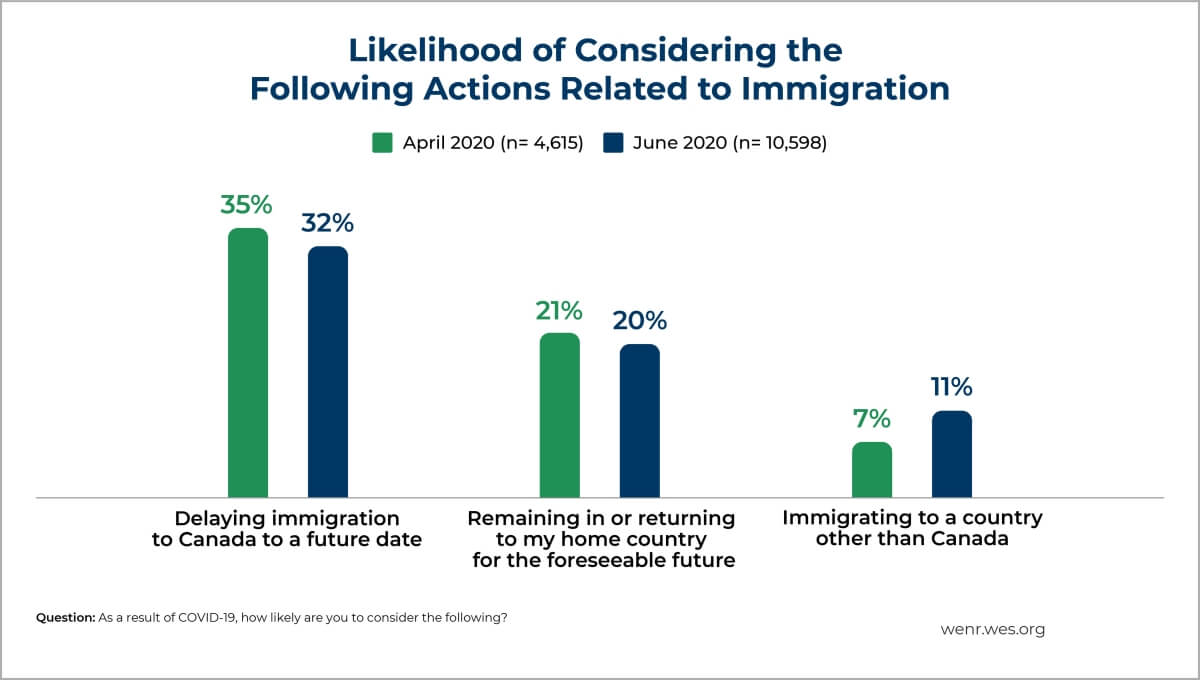
Respondents also reported that they were reconsidering their immigration plans and timelines in response to the pandemic. In June, around a third (32 percent) reported that they were considering delaying their immigration to Canada, a slight decline from the percentage in April (35 percent). A smaller proportion—11 percent of respondents in June, up from 7 percent in April—said they would consider immigrating to a country other than Canada.

Are Intentions to Immigrate to Canada Changing in the Face of COVID-19? Image 2: Bar chart showing the likelihood of prospective immigrants to consider certain immigration-related actions

Image 2: Likelihood of Considering the Following Actions Related to Immigration

ECONOMIC CONDITIONS IN CANADA AND ABROAD MAY BE DRIVING INTEREST

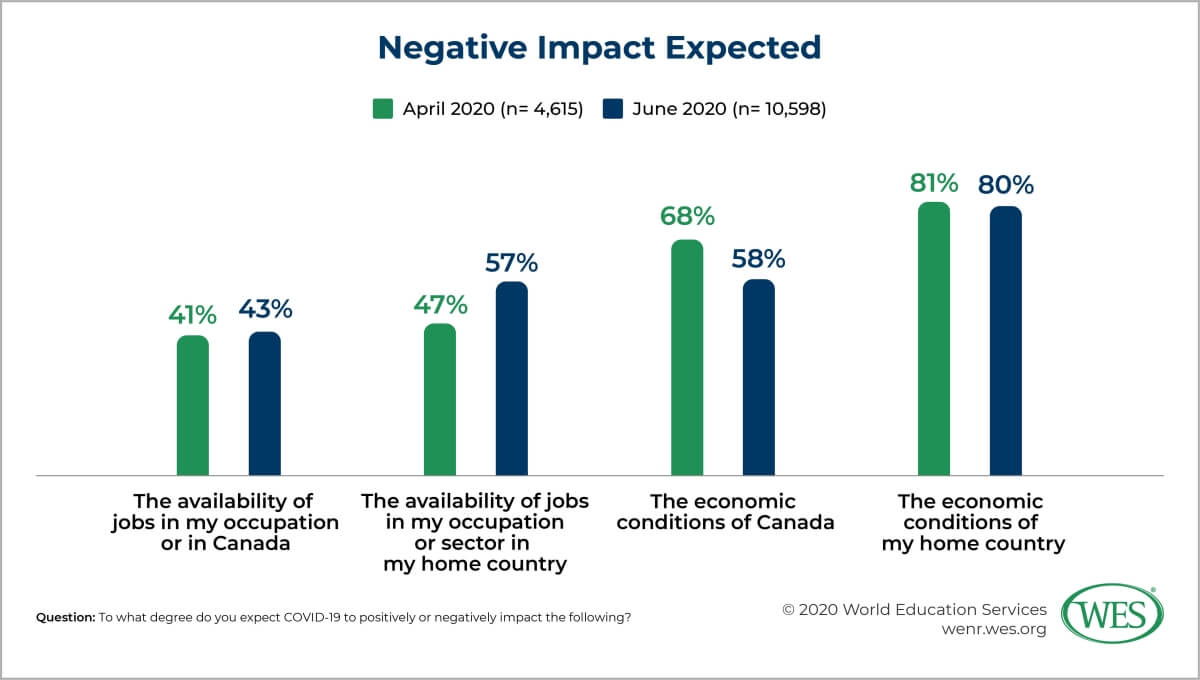
The relative resilience of Canada’s economy may be driving some of the interest in immigrating. While the surveys found that COVID-19-related economic concerns were widespread among immigrant hopefuls, our research also revealed that many respondents expected the economic impact in Canada to be less extreme than in their home country. The difference in expectations has grown greater over time. In April, 81 percent expected a negative impact on economic conditions in their home country, while fewer, 68 percent, expected a negative impact on conditions in Canada. In June, that expectation remained roughly the same for the respondents’ home country (80 percent), but by then only 58 percent expected a negative impact in Canada.

Similarly, by June, 57 percent of respondents expected a negative impact on jobs in their occupation or sector in their home country, up considerably from 47 percent in April. Far fewer—43 percent in June, up from 41 percent in April—expected a negative impact on jobs in their sector in Canada. This overall expectation of a less negative impact in Canada in terms of both overall economic conditions and the availability of sector-specific jobs may help to explain why by June nearly half of the respondents were more interested in immigrating to Canada as a result of COVID-19.

Are Intentions to Immigrate to Canada Changing in the Face of COVID-19? Image 3: Bar chart showing the prospective immigrants' expectations of the negative impact of COVID-19 on economic conditions in Canada and their home countries

Image 3: Negative Impact Expected

IMMIGRANTS WILL PLAY A VITAL ROLE IN CANADA’S RECOVERY

Canada’s continued attractiveness to those looking to settle there is good news for the country. Newcomers will play a critical role in the nation’s recovery. Despite high unemployment rates brought on by the pandemic, Canada still faces long-term talent shortages due to high rates of retirement and a shrinking pool of individuals entering the workforce each year. In the coming years, studies projecting workforce composition and growth estimate that immigrants will make up 100 percent of the net growth of the country’s labour force. Newcomers will be vitalboth to reenergizing and sustaining Canada’s post-pandemic economic recovery.

APPENDIX

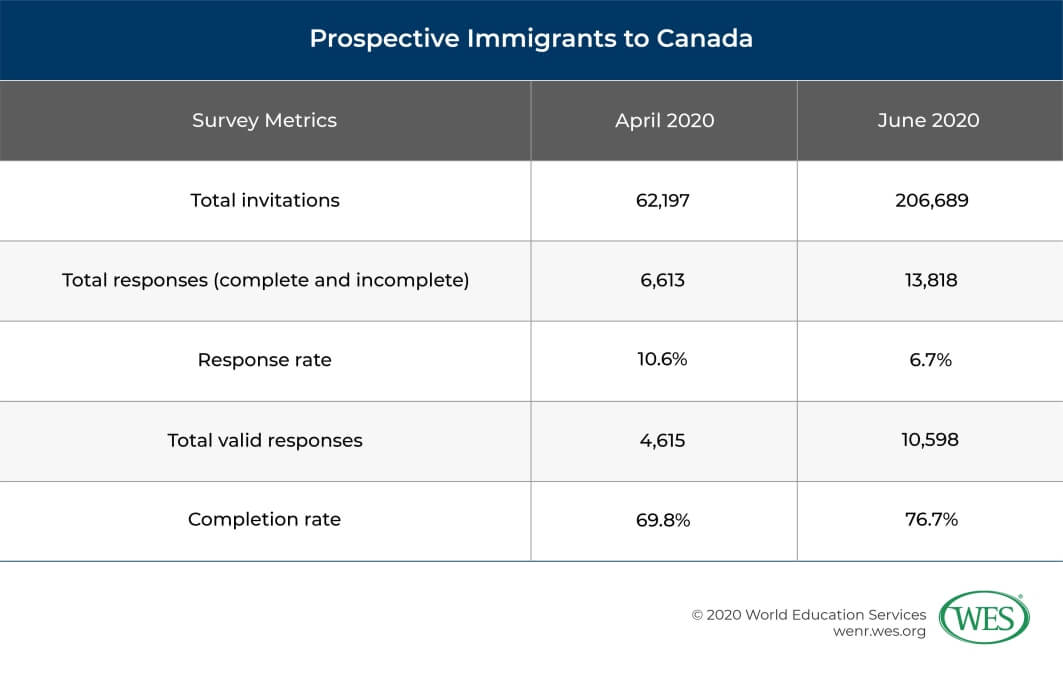
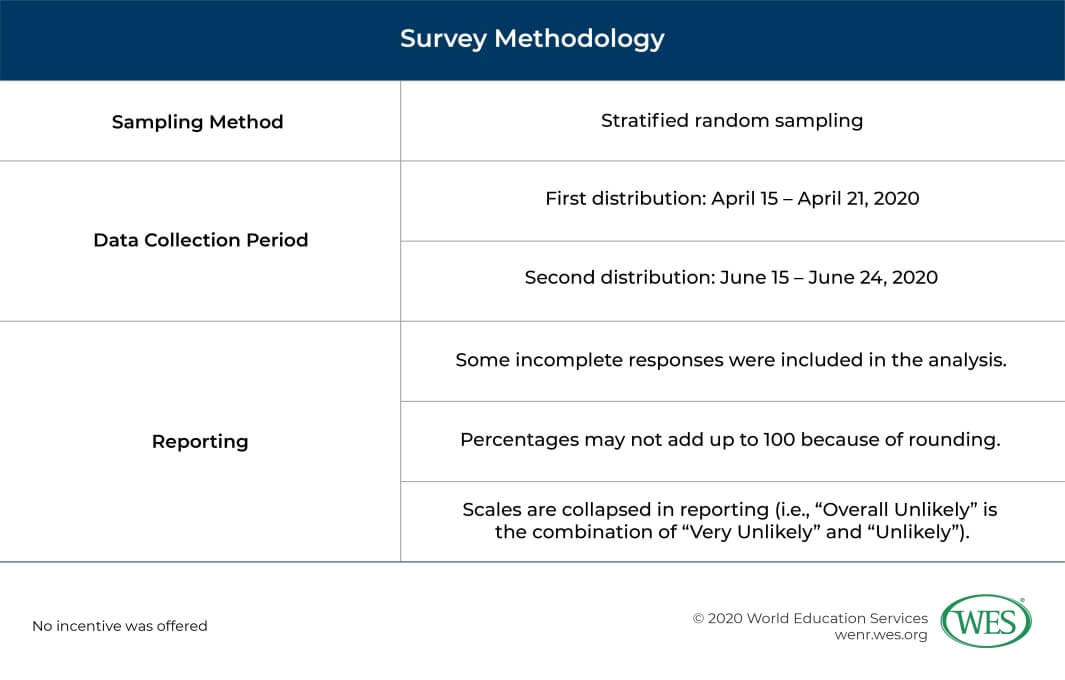
Are Intentions to Immigrate to Canada Changing in the Face of COVID-19? Image 4: Table displaying survey metrics

Image 4: Survey Metrics