In British Columbia, a real-estate rage gets real

Understandable anger and fears.

The negligence of governments in not addressing the issue, starting with failing to address data gaps that leave space for anecdotes, along with a real estate industry  whose commission-based model only abets property flipping and escalating prices, it is no wonder that people are angry and fearful:

In the last six months, Eby, who unseated Premier Christy Clark in the last election—the kind of brass-knuckled political play rarely seen outside B.C.—has become B.C.’s most-watched opposition figure by skillfully assuming control of the housing debate.

Last November, the 38-year-old Vancouver-Point Grey MLA and former head of the B.C. Civil Liberties Association helped a city researcher undertake a study showing that more than 70 per cent of homes sold in Vancouver’s West Side went to Mainland China buyers over a six-month period; remarkably, this was some of the first hard data illustrating the extent of foreign ownership in the local market.

For years, the debate relied mostly on anecdotal evidence. And anyone who dared suggest Chinese buyers were flooding the market was branded a racist—primarily by those with skin in the game, the city’s leading developers and condo marketers whose earnings soared as the market has climbed and climbed and climbed, unchecked. Screaming racism was an effective means to shutter the debate. Until now.

This could yet get ugly. Belcarra, and its “English-only” bylaw, is just the beginning. But in channeling rage over foreign buyers, wild speculative activity, shadow flipping, and realtor misconduct, Eby—rake-thin, young and passionate—has found a way to break the logjam, and tap into something deep and powerful in the psyche of residents of B.C.’s Lower Mainland, where the bulk of the province’s seats are found. There are few more powerful emotions in politics than anger. And for the first time in years, the NDP have found an issue with widespread appeal.

“People are really upset,” Eby said Wednesday night. “Their wages have no connection to the amount of money that is being charged for rent and for housing. People think their kids aren’t going to be able to afford to live here, they see the communities they love really no longer belonging to the community.”

“My younger child is sleeping in my bathroom,” said Jennifer Lloyd, a UBC researcher, who spoke after Eby. Lloyd and her husband, who both have PhDs and can only afford a tiny, rented condo for their family of four.

“This is not a generational issue, this is not a class issue,” said Lloyd. “I want to know that the virtues that I hold dear—hard work, educating ourselves, trying to better our lives—mean something in this city.”

It’s still far from clear that this surging anger risks unseating Clark, in an election slated for next spring. But right now, few are talking about the premier. And no one can seem to get enough of David Eby. One year before an expected election, that’s a dangerous place for the premier to be.

Source: In British Columbia, a real-estate rage gets real – Macleans.ca
Immigrants help drive Metro Vancouver’s housing market: study

Dan Hiebert and David Ley continue their insightful work in assessing ethnic concentration and impacts on housing:

Immigrants have a major impact on fast-rising house prices in Metro Vancouver and Toronto, according to the author of a new study.

In a unique research project, UBC geographer Daniel Hiebert discovered that ethnic Chinese and South Asians become homeowners at a much higher rate than other immigrants and the general population.

“There is definitely an impact on the housing market,” said Hiebert, who believes a key factor behind the phenomenon is many new immigrants arrive in Canada’s major cities with a great deal of money.

The veteran researcher’s exclusive cross-tabulation of housing and immigration data, including between 2006 and 2011, found on average that 53 per cent of immigrants to Metro Vancouver during those five years became homeowners in that period.

They bought roughly 100,000 homes in Metro Vancouver during the five years, ranging from suburban condos to ritzy mansions.

“New Chinese immigrants were at the top of all this. Kind of incredibly, their rate of home ownership was 73 per cent,” said Hiebert.

Roughly 52 per cent of newly arrived South Asians, the second largest immigrant group in Metro Vancouver, bought homes in that same five-year period.

Rounding out the five largest recent newcomer groups during that period, the rate of home buying among South Koreans was 51 per cent and among white and Filipino immigrants it was each about 44 per cent.

Hiebert, who has published major studies on immigration, housing and ethnic enclaves, believes immigrants are seriously affecting housing affordability at both the high and low ends of the market.

Prices of Metro Vancouver’s expensive properties, those in the $4-million-plus range, are being dramatically affected by immigrants, Hiebert said. But, at the low end, so are costs for new Syrian refugee families, who need government subsidies to afford a basic place to live.

While some of the new immigrants who end up classified as homeowners might be among the relatively few who arrive on a family reunification program and join an existing household, Hiebert believes most would be buying homes by transferring large financial resources into Canada.

“I think it would be a pretty big stretch for someone to arrive tabula rasa (without a lot of money) in a housing market like Vancouver and within five years be able to purchase a home in this place. That would be really difficult to expect.”

Hiebert’s findings support the conclusions of UBC’s David Ley, holder of the Canada Research Chair in geography and author of Millionaire Migrants. The Oxford-educated professor has found an “unusually decisive” correlation between high immigration to Metro Vancouver and high home prices.

The overall rate of home ownership among all residents in Metro Vancouver is almost 70 per cent — out of a total 1.5 million households, according to Hiebert’s work.

Based solely on visible-minority status, and disregarding immigrant status, ethnic “Chinese have the highest ratio of home ownership, followed by South Asians,” Hiebert said.

“The percentage of home ownership among Chinese is 81 per cent,” accounting for 290,000 Metro households, Hiebert said. “And South Asians are second at 75 per cent,” or roughly 160,000 households.

“Between these two largest groups, you’ve got much of the immigrant picture, which is why the immigrant picture looks better than the other picture (for non-immigrants),” said Hiebert.

Among smaller ethnic groups in Metro Vancouver, 62 per cent of Filipinos own homes, as do 59 per cent of West Asians (mostly Iranians).

Hiebert, who frequently advises the federal government, said his research did not include studying the rate of home ownership among non-immigrants, long-standing residents of Canada, or whites.

Nor does it delve into the specific effects of foreign ownership on Metro Vancouver housing costs.

And even though Hiebert said the high rate of home ownership among immigrants has a “definite” impact on housing, he said more careful analysis of sales is needed to measure it precisely.

He speculated the roughly 100,000 homes bought quickly by immigrants who arrived in Metro Vancouver between 2006 and 2011 would represent a “reasonable fraction” of all houses sold in that period, adding that proportion could be calculated after learning how many homes sell each year in the region.

Craig Munn, spokesman for the Real Estate Board of Greater Vancouver, said in an interview the average number of houses sold between 2006 and 2011 across the region of Metro Vancouver (which contains 21 municipalities from West Vancouver to Langley) was about 44,000 annually.

That adds up 220,000 home sales over that five-year period, which means the proportion bought by immigrants who arrived in that time alone would be about 45 per cent.

Hiebert, basing his work on novel cross-tabulations of the National Household Survey, found “stark differences” in new immigrants’ home ownership rates between Canada’s three largest cities.

While the home ownership rate in Metro Vancouver was 53 per cent and in Toronto 50 per cent among those who arrived between 2006 and 2011, it was just 23 per cent in Montreal.

“The much lower rate of home ownership in Montreal is ironic, because of course housing can be had for (roughly) 40 per cent of the price of Toronto or Vancouver,” he said.

“When housing prices escalate quickly, people feel they have to dive into home ownership. But there’s no sense of urgency in Montreal.”

Source: Immigrants help drive Metro Vancouver’s housing market: study

Vision Vancouver pushes gender parity motion

One aspect of diversity but as the DiverseCityonBoard initiative makes clear, this challenge goes beyond gender given the increased (and increasing) ethnic diversity in our larger cities:

All City of Vancouver advisory committees could soon be required to have 50-per-cent female representation.

To mark International Women’s Day on Tuesday, Vision Vancouver Coun. Andrea Reimer plans to introduce a motion that would create a formal policy ensuring that at least half of all committee members are women.

Mayor Gregor Robertson indicated he’ll be supporting the motion, and hopes it will pass unanimously.

Reimer’s motion also calls for a review of how the city funds subsidized housing and social policy grants to make sure that women and girls are getting an equal share of services.

“While we often think of Vancouver as a progressive city, there’s more we could be doing to remove barriers to women and ensure that we are providing an equitable delivery of services,” Robertson said in a press release. “We continue to see women underrepresented in public life and in 2016 there’s no reason that should be acceptable.”

But unanimous support may not be possible. NPA Coun. Melissa De Genova said she has yet to decide which way she’ll vote on the motion, but she does have concerns about the 50-per-cent standard.

“We all would like to see more women become involved in our city and in our community, but I think perhaps we don’t agree on how we should get there,” she said.

Source: Vision Vancouver pushes gender parity motion

British Columbia Imposes Citizenship Disclosure for Home Buyers – Bloomberg Business

Long overdue. The lack of data hampers knowing what, if any, policy response is needed:

British Columbia will require home buyers to disclose their citizenship to help the government monitor foreign ownership and address a housing boom that has made Vancouver one of the least affordable cities in the world.

Proposed changes to the property transfer tax will enable the government to collect information on property buyers, including their citizenship status and whether they hold the property as bare trustees. Bare trusts are typically used for real-estate assets and pass taxes and benefits directly to the beneficiary.

“We think it’s time to start collecting again,” Finance Minister Michael de Jong said in a briefing in Victoria. “At least we’ll be in a position to aggregate the information and provide data for the public discussion.”

The measures are meant to provide more transparency in the country’s hottest real-estate market. Prices in Vancouver are the highest in Canada, topping C$1.3 million ($940 million) for a detached home in January, a 28 percent rise over the prior year, according to that city’s real estate board, with sales up 32 percent in that period.

More transparency is not meant to slow investment from abroad, de Jong said. The province will continue to spend taxpayer money to promote the province as an investment destination.

Source: British Columbia Imposes Citizenship Disclosure for Home Buyers – Bloomberg Business

Tougher Immigration Rules Test Conservative Support in Chinese Community | The Tyee

Political differences among the Cantonese and Mandarin speaking Chinese Canadians:

The battle for votes in Vancouver’s large Chinese community is being complicated by deep divisions over immigration issues here and across the Pacific in Hong Kong.

Chinese-language radio talk-show hosts say callers are more worked up than ever about the federal election.

And their support seems largely determined by where they came from in China and their attitude toward tougher immigration rules introduced by the federal government since the 2011 election.

Cantonese-speakers, mainly people from Hong Kong and southern parts of Mainland China, tend to be staunch Conservative supporters.

But for Mandarin-speakers, from northern China and Taiwan, new immigration rules have become the focus of opposition to Stephen Harper’s party.

Gordon Houlden of the University of Alberta’s China Institute said the link between issues in China and Canada is not entirely unexpected, but still fascinating. I

t’s a reminder that the Chinese community isn’t as monolithic as outsiders assume, he said.

New immigration rules focus more on skill set and education than family reunification, he said, so it makes sense that Mandarin speakers would be upset about the changes. The changes reduce the opportunity for relatives to join family members already in Canada.

On the other hand, the Cantonese community may support tougher immigration rules because it tends to be older and more established.

“If you’ve been here longer and you’re more settled, you may not welcome a wave of people who are similar in some ways, but different in others,” he said.

Houlden said protests in Hong Kong last year over Beijing’s refusal to allow open elections may have added to the divisions between the two groups.

Chen, who is originally from Taiwan, said that Mandarin-speaking Taiwanese immigrants who call in generally also voice opposition to Harper.

“We have the free election right in Taiwan, so we don’t like the government staying too long,” Chen said. “The Conservatives kept power over 10 years, so some Taiwanese people think it’s time to change.”

Source: Tougher Immigration Rules Test Conservative Support in Chinese Community | The Tyee

University backs professor who says Asian immigration damages Vancouver – The Globe and Mail

More on Professor Duchesne (see his UNB website here) for his overall philosophy on immigration and multiculturalism and the “uniqueness of Western Civilization.”

Not that one cannot have concerns about the pace and nature of change but his phraseology and ideology suggest a less than dispassionate view:

He said Prof. Duchesne is using academic freedom to hide poor scholarship. “He’s only providing one view to students and shaping their minds,” he said. “That whole academic enterprise of why we send our kids to school to become broad thinkers is not being upheld.”

Mr. Jang also said Prof. Duchesne’s views on Asian immigration to B.C. are simply untrue. “It really comes across as very white supremacist. That’s just not Canada. It’s a country of immigrants.”

But Prof. Duchesne, on Wednesday, disputed Mr. Jang’s views, noting that the university’s dean of arts came to see him earlier in the day and upheld his academic-freedom rights.

This week, Prof. Duchesne was quoted by CBC as saying the influx of Asians and Chinese to Vancouver was “too fast, too quick,” leading a “beautiful British city” to take on “a strongly Asian character.”

In an interview from Saint John, he stuck by that view Wednesday, describing Vancouver as a city dramatically altered by Chinese immigrants. “Vancouver can still be seen as a city that still remains British in many areas, but also has this strong, growing Asian side. There is this two-faced character to the city,” he said. “The fast pace of the change is bad.”

University backs professor who says Asian immigration damages Vancouver – The Globe and Mail.

Chinese immigrants happy with life in Metro Vancouver: survey

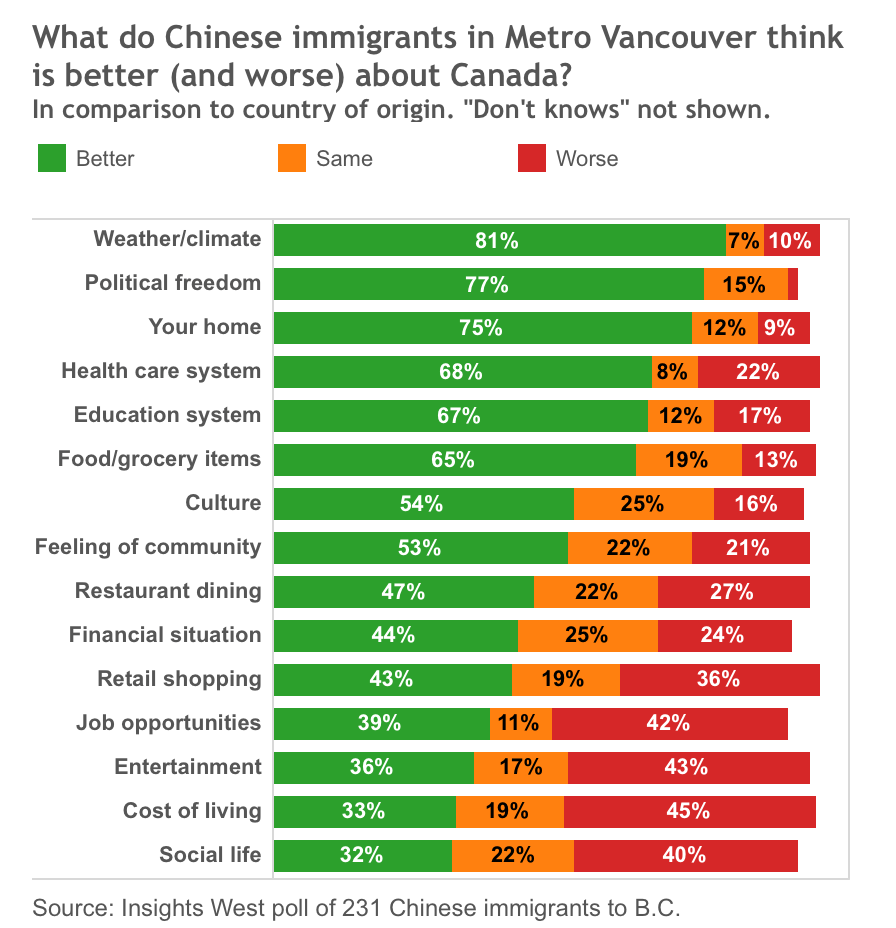
Chinese_immigrants_happy_with_life_in_Metro_Vancouver__surveyNot necessarily surprising results but interesting nevertheless, as well as the differences between mainland and Hong Kong Chinese:

The survey found Chinese immigrants are very happy with their level of political freedom in Canada, with 77 per cent saying it’s better here and only two per cent saying it’s worse. They also like the weather, with 81 per cent saying the climate here is better than where they came from. And government services get a thumbs up, with 68 per cent saying Canada’s health care system is better and 67 per cent preferring our education system.

Immigrants are less impressed, however, with the job opportunities available to them in this country. Just 39 per cent say their job opportunities in Canada are better than in their country of origin, compared to 42 per cent who say they’re worse.

The cost of living in Metro Vancouver is also a concern, with 45 per cent saying life is more costly here.

Chinese immigrants happy with life in Metro Vancouver: survey.

Vancouver real estate titles reveal city’s racist history

A reminder of our not so distant past, and how it has been overtaken by reality (Vancouver, along with Toronto, are almost 50 percent visible minority):

Early immigrants to B.C. faced not only the hardship of settling into a new home, but also seemingly racist policies — Chinese and Indo-Canadians did not have the right to own property and only got the right to vote in 1947.

In Vancouver, West Vancouver and Victoria, owners tried to use restrictive land covenants to keep minorities from buying land — and many of those covenants remain in place to this day.

Realtor Wayne Hammil recently spotted a covenant in a land title dating back to 1928 when he was putting a Vancouver home up for sale.

“One of the clauses in the restrictive covenant makes reference to not selling to certain ethnic minorities in the world,” said Hammil.

The covenant prevents the sale or rent of the land to people who are of Chinese, Japanese, Indian and African descent or any other Asiatic race.

“[Theres a ] total irony because most of the buyers are from mainland China,” said Hammil. “If this was enforced, it would preclude them from purchasing the property.”

Ron Usher, general counsel for the Society of Notaries Public of British Columbia, says Sec. 222 of the Land Title Act makes the discriminating covenants void.

“I would imagine though there are probably hundreds if not several thousand lots covered by this,” said Usher. “Where they find these, they’ve already put on the title the Except for Clause X notation.”

If this note has not yet been made on the title, Usher says its simple to have title updated through a phone call to the province’s Land Title and Survey Authority.

The race-based covenants are still embarrassing because of what they stand for, he says, but getting them completely removed from the land title can be an expensive process as they almost always have other provisions that are valid restrictions on the use of the property.

Vancouver real estate titles reveal city’s racist history – British Columbia – CBC News.