US Sikhs feeling vulnerable amid anti-Islam rhetoric, but joining Muslims to fight backlash | Fox News

Have not heard of recent similar attacks here on Sikhs but likely that there are some:

Pradeep Kaleka spent several days after 9/11 at his father’s South Milwaukee gas station, fearing that his family would be targeted by people who assumed they were Muslim. No, Kaleka explained on behalf of his father, who wore a turban and beard and spoke only in broken English, the family was Sikh, a southeast Asian religion based on equality and unrelated to Islam.

But amid a new wave of anti-Islamic sentiment since the terror attacks in Paris and San Bernardino, Kaleka is vowing to take an entirely different approach.

“For us it does not matter who they’re targeting,” said Kaleka, a former Milwaukee police officer and teacher whose father was one of six people killed in 2012 when a white supremacist opened fire at a Sikh temple in Oak Creek, Wisconsin. “This time we cannot differentiate ourselves; when hate rhetoric is being spewed we cannot be on the sidelines.”

Across the U.S., Sikhs and Muslims are banding together to defend their respective religions. Someone bent on harming Muslims wouldn’t understand — or care — about the distinction between the two faiths, they say, and both also deserve to live in peace.

So they plan educational sessions and rallies. They successfully pushed the FBI to track hate crimes against Sikhs. They speak to lawmakers and support each other’s legal action, including a lawsuit filed over a New York City police surveillance program targeting New Jersey Muslims.

“We are in this fight together,” said Gurjot Kaur, a senior staff attorney at The Sikh Coalition, founded the night of Sept. 11.

Sikhism, a monotheistic faith, was founded more than 500 years ago in Southeast Asia and has roughly 27 million followers worldwide, most of them in India.

There are more than 500,000 Sikhs in the U.S. Male followers often cover their heads with turbans — which are considered sacred — and refrain from shaving their beards.

Reports of bullying, harassment and vandalism against Sikhs have risen in recent weeks.

Last week, a Sikh temple in Orange County, California, was vandalized, as was a truck in the parking lot by someone who misspelled the word “Islam” and made an obscene reference to ISIS.

Source: Sikhs feeling vulnerable amid anti-Islam rhetoric, but joining Muslims to fight backlash | Fox News
Parable on Bigotry and Citizenship Plays Out in a Supermarket – The New York Times

A good parable:

At the end of the aisle, Ms. Macksoud noticed a couple of middle-age white men talking. One in particular caught her eye with his beer belly, tattooed forearms and large golden cross. As she neared him, she heard the word “Bible.” When she passed him, he said in a raised voice: “not like the Quran those Muslims read.” He included an obscenity to describe Ms. Macksoud and 1.6 billion coreligionists.

Ms. Macksoud grew up on Staten Island, competing in soccer and track, and liked to think that she had that outer-boroughs bravado. Instead of firing back, though, she answered with forced calm: “You didn’t have to say that.”

Surface composure aside, she was shaken. Her flesh felt as if it were quivering. Her mind went so blank she made a wrong turn, and instead of heading into frozen foods, she was adrift and searching for Ms. Yu. “She was shocked and angry,” Ms. Yu recalled the other day. “More in a kind of disbelief that something like this could happen to her.”

Indeed, nothing before ever had. Even after the Sept. 11, 2001, attacks, when Ms. Macksoud began wearing the hijab as her personal way of reclaiming Islam from jihadists, nobody had ever said a word to her. No one objected even when she was working for MTV in Times Square and her building was evacuated during a failed car bombing by a militant Muslim in May 2010.

But in the United States of 2015 — weeks before the terrorist attacks in Paris and San Bernardino, Calif. — someone had insulted and implicitly threatened her in her favorite ShopRite. It felt to her as if all the toxic language of the Republican presidential campaign, with its various forms of Islamophobia, had infiltrated even a store she cherished for its commitment to diversity.

With Ms. Yu at her side, she went to the Customer Service counter to report what had happened. The agent there called for the store’s assistant manager, Mark Egan. “I’m not done shopping,” Ms. Macksoud recently recalled telling him, “but I don’t feel safe here.”

Mr. Egan was about as much of a Jersey guy as a Jersey guy can get. He grew up in Freehold, Bruce Springsteen’s hometown, and married in the young Springsteen’s parish church, Saint Rose of Lima. Mr. Egan, his hair starting to thin at 43, has worked at ShopRite for 13 years.

He told Ms. Macksoud he would protect her. And for the next half-hour, he walked alongside her on the pretense of checking inventory as she did the rest of her shopping. They never did find the man who had insulted her. Before leaving, Ms. Macksoud asked for Mr. Egan’s name so she could send a thank-you letter to the store.

The next day she wrote about the incident on Facebook. She had nearly 300 replies, some from other American Muslims on their experiences with bias — being called a “raghead” or a “Christian killer,” being almost run over, being told to go home, as if home were not here. Many offered solidarity and solace.

One of those correspondents, Sheryl Olitzky, is the wife of a rabbi and the mother of two others. Five years earlier, she and a friend, Atiya Aftab, had formed a group called the Sisterhood of Salaam Shalom, to bring Jewish and Muslim women together. Since then, it has grown to 20 local chapters across the country with another 15 in formation.

With Ms. Macksoud’s permission, Ms. Olitzky called Mr. Egan and told him, “I heard what happened, and you’re my hero.” He replied, “I was just doing my job.”

Modesty aside, Mr. Egan did agree to attend the Sisterhood’s annual convention last weekend to receive an award. His wife and father-in-law came with him, and the Saker family, which owns the North Brunswick ShopRite, made a donation to the group.

Source: Parable on Bigotry and Citizenship Plays Out in a Supermarket – The New York Times

US Conservatives Call For ‘Religious Freedom,’ But For Whom? : NPR

Good article on the ongoing hypocrisy of the religious right and Republican contenders:

Such prejudice bothers some advocates of religious freedom, including Russell Moore, president of the Ethics and Religious Liberty Commission of the Southern Baptist Convention.

“If we really believe in religious liberty, then religious liberty applies to everyone, and that means I’m not threatened by non-Christians having religious liberty,” he says. “I think the only way the Gospel can advance is with free consciences, and I think evangelical Christians particularly ought to be the most vocal about religious liberty for our non-Christian neighbors and friends.”

Robert George, the McCormick Professor of Jurisprudence at Princeton University and a leading lay Catholic intellectual, is also outspoken on the need to defend religious liberty for people of all non-Christian faiths, including Islam.

“It’s scandalous to me when members of a community say, ‘We don’t want a mosque in our town, because the Muslims are terrorists,'” George says. “The vast majority of Muslims are not terrorists or sympathizers of terrorists. They want the same things for themselves and for their children that Christians want, that Jews want, that Hindus want, that all of our fellow citizens want.”

In the aftermath of the Paris and San Bernardino shootings, the fear of more attacks has inflamed anti-Muslim sentiment, fueled in part by Donald Trump and others who are highlighting the threat of “Islamic terrorism.” Those candidates who have emphasized the struggle for religious liberty as a mobilizing cause, from Cruz to Jeb Bush, have either ignored Trump’s repeated anti-Muslim comments or condemned them.

For some conservatives, however, recent events may bring a decision point. They may need to choose between opposing Islam and advocating for religious freedom. To wage both fights at the same time is likely to become increasingly awkward.

Source: Conservatives Call For ‘Religious Freedom,’ But For Whom? : NPR

Americans Can’t Pass the U.S. Citizenship Test

Not surprising and there would be similar results in Canada, particularly given the Canadian test is more onerous and that immigrants study for the test:

One of the biggest parts of the application process for becoming a U.S. citizen is passing the naturalization test, a prueba covering pivotal history and government facts that only 1-in-3 Americans can pass.

To highlight just how ridiculous this crucial test is, the funny journos at the Flama put together a video of U.S. citizens being asked some of the questions that American hopefuls have to answer correctly.

Questions like “when was the Constitution written,” “how many voting members does the House of Representatives have” and “who said, ‘give me liberty or give me death'” had these americanos scratching their heads. And these are just a handful of the 100 preguntas immigrants can be asked.

One exam-taker came up with a brilliant plan after failing the test miserably: “There should be a good person test to become an American. Like are you human? Do you care about other people? That’s what we need. People shouldn’t have to answer this shit,” he said.

Despite many Americans’ inability to pass the naturalization test, 91 percent of immigrants are successful.

The point of the video, though, couldn’t be any more clearer: Naturalization test answers give little indications as to whether someone would be a so-called “good” citizen, and we probably shouldn’t be forcing immigrants to memorize random U.S. facts that their neighbors won’t even know.

Don’t forget to watch the hilarious video above.

Source: Americans Can’t Pass the U.S. Citizenship Test

How Billionaire Techies Hope To Reshape The US Immigration Debate : NPR

Needed antidote to much of the rhetoric in the US, and a natural for the tech industry given their need for talent:

The immigration-reform advocacy group founded by Facebook’s Mark Zuckerberg — FWD.us (pronounced “forward U.S.”) — and funded by fellow Silicon Valley entrepreneurs including Microsoft’s Bill Gates and Yahoo’s Marissa Mayer — is rolling out a plan for the 2016 election that will include “substantial” investments in battleground states.

This primary campaign season, the immigration conversation has been dominated by hard-line rhetoric about border walls, mass deportations and birthright citizenship, and now Donald Trump’s Muslim immigration ban. FWD.us says it’s trying to refocus the conversation on comprehensive immigration reform.

“We are making the case over the next year that immigration reform needs to be something that gets done right away under the next presidency,” said
Todd Schulte, president of FWD.us. “That starts with making clear the awful and absurd policies of mass deportation that we’re hearing.”

FWD.us won’t be targeting a particular candidate. But with a focus on mass deportations, it’s clear one immediate target for these tech billionaires is a fellow billionaire — Donald Trump, and the immigration rhetoric his campaign has sparked this primary season.

“The stakes are incredibly high,” said Schulte. “Embracing this mass deportation agenda is absolutely toxic.”

Schulte said the rules of the game have changed since the 2014 midterms, and this election cycle, there’s a whole new side to the immigration debate.

FWD.us would not disclose its spending plans, but it is considered the most well-funded immigration reform group in the country.

In 2013 and 2014, FWD.us spent $10 million on digital, radio, tv and cable advertising, according to a spokesman with the group. Schulte said the group intends to spend similar amounts of money this election cycle. Records indicate it also spent $1.3 million on lobbying activities in 2013 and 2014.

“One role that FWD.us did is put a big voice out there on TV, with a serious amount of money behind it, to fill a void that otherwise exists on the campaign airwaves,” said Elizabeth Wilner, who tracks campaign ads with the research firm Kantar Media. “It’s not typical of something we’ve seen in the past,” she added. “It’s only fairly recently that business has made it their business to take a side.”

The group’s current mission this election season does not focus on huge ad expenditures; instead, FWD.us is working on voter education through research, engagement and polling, with just one lofty goal in Schulte’s words: “Pass immigration reform right out of the gate under the next president, plain and simple.”

FWD.us launched in 2013 with a splash (and an estimated $50 million). It was considered an ambitious big-money venture with the potential to legitimately move the dial on comprehensive immigration policy overhaul.

“In a knowledge economy, the most important resources are the talented people we educate and attract to our country,” Zuckerberg wrote in an op-ed announcing the group. “A knowledge economy can scale further, create better jobs and provide a higher quality of living for everyone in our nation.”

Source: How Billionaire Techies Hope To Reshape The Immigration Debate : NPR

If Donald Trump were campaigning in Canada, could he be charged for hate speech?

Good comparative analysis:

On Monday Donald Trump called for a complete ban on Muslims entering the United States “until our country’s representatives can figure out what’s going on.” Despite universal outrage, the billionaire presidential candidate has only doubled down on his vow, the latest in a string of anti-minority comments ranging from the offensive to the downright absurd. Even respectable commentators have started calling him a fascist.

These comments are in bad taste at best and hateful at worst, why are there no legal repercussions for Trump making them? 

The short answer is because it’s the United States. The U.S. has extremely strong protections for free speech, which is only considered hateful if it will incite direct and immediate violence. Trump pontificating at a podium or in an interview doesn’t qualify. Until he starts an angry mob, he’s free to say whatever he likes.

So for argument’s sake, what if this were happening in Canada? Would anything be different?

Trump’s most recent comments might offend you, but they likely still couldn’t be prosecuted under Canadian law. Though hate speech laws in Canada are broader than they are south of the border, speech needs to meet some very specific requirements to be considered hateful here, too.

Section 319 (1) of the Criminal Code states that hate speech “incites hatred against any identifiable group where such incitement is likely to lead to a breach of the peace” and where the comments are made in a public place.

This would pose two problems for charges under hate speech law.

“[T]he immediacy of the breach of the peace would make it extremely difficult to convict someone for saying what Trump said,” said Faisal Kutty, a Toronto lawyer and human rights activist.

Trump also isn’t making any outright claims despite the subtext of his statements, said Richard Moon, a law professor at the University of Windsor.

“That’s the main problem with trying to fit his current statement under the hate speech law: it doesn’t have any real hateful content in the sense of making a claim about the nature of character of Muslims,” said Moon. “Of course, why should they be excluded other than, presumably, on the belief that they are somehow dangerous? But he leaves that slightly open.”

But I’ve seen and heard people call his comments hate speech. What does that mean?

That’s due to the technicality of law. While his comments might be considered hateful, the burden of proof under the law is higher. The comments must meet specific criteria to be prosecuted, and his comments likely don’t meet these standards.

What about some of his other comments? He’s said a lot more extreme things in the past.

Some of his previous remarks could more easily be prosecuted, like his remarks about Mexican immigrants during his announcement speech on June 16: “They’re bringing drugs. They’re bringing crime. They’re rapists.”

“That is the very stuff of hate speech, and a claim like that made in Canada might well constitute hate speech contrary to the Criminal Code,” Moon said.

So why are Canadian and American hate speech laws so different?

It’s probably due to a lot of factors, but part of it traces back to the founding of the country. America is old, and so are some of the laws, said David Matas, a Winnipeg-based lawyer and author of Bloody Words: Hate and Free Speech.

“In the United States you’ve got a bill of rights which is very old.  It comes from the 18thcentury. Everywhere else, the concept of rights is post-Holocaust, post-Declaration of Human Rights. Being ahead of the gun at the time has left them far behind when it comes to the 21st century.”

Source: If Donald Trump were campaigning in Canada, could he be charged for hate speech?

Distinct societies: Why Canada, U.S., diverge on Syrian refugees: Adams

Michael Adams on the contrast between Canada and the USA:

Americans certainly enjoy unique latitude in the individual pursuit of happiness, but the pursuit of happiness doesn’t always look like much fun. In an environment where there is a lot to fear (financial ruin in an unforgiving system, illness leading to bankruptcy, gun violence inflicted by a stranger, a family member, or an unsupervised toddler), it is perhaps not surprising that some are eager to control the one variable that seems like a no-brainer: don’t give jihadists a green card. But one of the San Bernardino jihadis seems to have been born in Chicago. The “big and beautiful wall” Donald Trump proposed to build to keep dangerous people out of America would require complex architecture indeed. No society is or can be perfectly safe. But societies that have traditionally put a little more stock in collective well-being seem to have better odds. To be fair, those safer, quieter places have also not been the birthplaces of Apple, Google, Tesla, Amazon, Wikipedia and the first man on the moon.

As I have written elsewhere, despite the current apparent spasm of xenophobic sentiment and the din of gun violence, our values research suggests that in fact Americans’ values are tilting in a slightly more Canadian direction – toward greater openness to social difference, a more nuanced sense of personal autonomy, and even a less suspicious attitude toward government. The shift is by no means a sea change, but the election of Mr. Obama (twice) was indeed the product of deep and meaningful changes in the electorate, no matter how lonely he may sometimes appear in White House press briefings these days. As younger voters, women (especially single women), and America’s diverse, city-dwelling voters become more influential politically, America is changing. But those who are on average less keen on this direction of social change (older, more conservative, whiter, more religious and patriarchal voters) have some innings left, as the tremendous polarization of U.S. political discourse attests.

What will become of America in the next election cycle and beyond? And how will the noisy debates and decisions of our neighbour to the south influence our own public conversations and political aspirations? As we wait to welcome 25,000 Syrian refugees, Canada feels like a fairly peaceable corner of a turbulent world. Recent reports suggest, however, that of the more than 25,000 refugees interviewed by the UN, fewer than 2,000 were interested in coming to Canada. Many are likely hoping for reunification with family members in Europe. It would be interesting to know how many are holding out for their shot at the American Dream.

Source: Distinct societies: Why Canada, U.S., diverge on Syrian refugees – The Globe and Mail

Trump’s Anti-Muslim Plan Is Awful. And Constitutional. – Peter Spiro, The New York Times

Good piece by Peter Spiro on the constitutionality of race or religion-based immigration restrictions:

In the ordinary, non-immigration world of constitutional law, the Trump scheme would be blatantly unconstitutional, a clear violation of both equal protection and religious freedom (he had originally called for barring American Muslims living abroad from re-entering the country as well; he has since dropped that clearly unconstitutional notion). But under a line of rulings from the Supreme Court dating back more than a century, that’s irrelevant. As the court observed in its 1977 decision in Fiallo v. Bell, “In the exercise of its broad power over immigration and naturalization, Congress regularly makes rules that would be unacceptable if applied to citizens.”

The court has given the political branches the judicial equivalent of a blank check to regulate immigration as they see fit. This posture of extreme deference is known as the “plenary power” doctrine. It dates back to the 1889 decision in the Chinese Exclusion case, in which the court upheld the exclusion of Chinese laborers based on their nationality.

Unlike other bygone constitutional curiosities that offend our contemporary sensibilities, the Chinese Exclusion case has never been overturned. More recent decisions have upheld discrimination against immigrants based on gender and illegitimacy that would never have survived equal protection scrutiny in the domestic context. Likewise, courts have rejected the assertion of First Amendment free speech protections by noncitizens.

Nor has the Supreme Court ever struck down an immigration classification, even ones based on race. As late as 1965, a federal appeals court upheld a measure that counted a Brazilian citizen of Japanese descent as Asian for the purposes of immigration quotas.

In the context of noncitizens seeking initial entry into the United States, due process protections don’t apply, either. This past June, the court upheld the denial of a visa for the spouse of an American citizen based on the government’s say-so, with no supporting evidence.

The courts have justified this constitutional exceptionalism on the grounds that immigration law implicates foreign relations and national security — even in the absence of a specific, plausible foreign policy rationale. The 1977 Fiallo case, for instance, involved a father seeking the admission of his out-of-wedlock son from the French West Indies — hardly the stuff of national interest.

Indeed, contrary to the conventional understanding, President Trump could implement the scheme on his own, without Congress’s approval. The Immigration and Nationality Act gives the president the authority to suspend the entry of “any class of aliens” on his finding that their entry would be “detrimental to the interests of the United States.” President Obama has used this to the better end of excluding serious human rights violators.

But here’s the interesting thing: Just because Mr. Trump’s proposal has a judicial pedigree, that doesn’t make it “constitutional” in a broader sense. The Constitution and the courts are not synonymous, nor do the courts have a monopoly on constitutional interpretation. Politicians, the legal community, scholars and the public at large are all a part of our continuing constitutional conversation. Clear popular consensus can establish constitutional norms, with or without the courts.

The leading example comes out of the internment of Japanese-Americans during World War II. The Supreme Court upheld the internment in its 1944 Korematsu decision, and that ruling has never been judicially reversed. Technically, it remains good law. But it has been effectively overridden by other actors, and in the court of public opinion. A formal apology and payment of reparations, enacted by Congress and signed into law by Ronald Reagan in 1988, supplies the formal evidence. Korematsu continues to provoke popular shame.

We may be seeing that same shame at work today. Mr. Trump’s plan has triggered an uproar across the partisan divide. Perhaps a religion-based immigration bar may be consistent with court-made doctrine. But it doesn’t reflect our deeper, broadly assimilated understandings of the Constitution.

Source: Trump’s Anti-Muslim Plan Is Awful. And Constitutional. – The New York Times

Donald Trump’s no-Muslims immigration idea right in line with U.S., Canadian history

Canada, of course has its equivalents (Chinese head tax and related restrictions, World War 1 internment, Continuous Journey clause, Japanese World War 2 internment, restrictions on Jewish immigrants etc):

1.Chinese Exclusion Act of 1882

exclusion_act

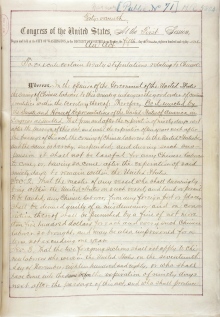
The first page of the Chinese Exclusion Act of 1882. (U.S. National Archives and Records Administration)

The first major law restricting immigration to the U.S. was the Chinese Exclusion Act, which barred all Chinese people from entering the United States.

Signed into law on May 6, 1882, the act came amid outcry from American-born citizens that Chinese workers were to blame for the high unemployment and declining wages plaguing the West Coast.

Not only did the law bar Chinese immigration, but it also prevented Chinese people already living in the country from gaining citizenship.

The law, originally written to last 10 years, was repeatedly amended and extended until its repeal in 1943, when China became an ally against Japan during the Second World War.

2. Immigration Act of 1917

This U.S. federal law was the first to restrict immigration to those who could pass a literacy test.

It also banned all immigration from the so-called “Asiatic Barred Zone,” which encompassed  India, Afghanistan, Persia (now Iran), Arabia, parts of the Ottoman Empire and Russia, Southeast Asia and the Asian-Pacific islands.

Furthermore, it expanded an already-existing category of barred “undesirables” to include sex workers, criminals, alcoholics, political radicals, contract labourers, “idiots, imbeciles, and [the] feeble-minded,” people with epilepsy, tuberculosis or contagious disease, as well as anyone else deemed “mentally or physically defective.”

3. Chinese Immigration Act of 1923

The United States wasn’t alone in discriminating against Chinese immigrants.

In Canada, the federal government imposed a $50 head tax on Chinese immigrants in 1885 after Chinese workers were no longer needed to work on the Canadian Pacific Railway. The amount was raised to $500 in 1903, the equivalent of about two years’ wages at the time.

On July 1, 1923, the head tax was replaced by the Chinese Immigration Act, which barred any Chinese immigrants — or ethnic Chinese people of other nationalities — from entering the country. There were some exceptions for merchants, diplomats and foreign students with proper documentation.

Canada also cast suspicion on those already living here, forcing all people of Chinese origin or descent to register with authorities and to obtain an identity certificate.

The act remained in effect until 1947.

4.Immigration Act of 1924

Travel-NYC-Holocaust Exhibit

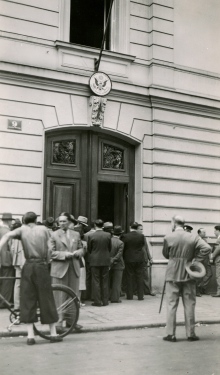
In this 1938 photo, prospective immigrants line up outside the U.S. consulate in Vienna after the German annexation of Austria. American Jews struggled to get refugees out of Nazi-era Europe due to strict immigration quotas in the U.S. (Museum of Jewish Heritage/ Franklin D. Roosevelt Presidential Library/Associated Press)

In an attempt to stem the tide of eastern European immigration to America, the U.S. enacted a quota system, stipulating that visas be provided only to two per cent of the total number of people of each nationality in the United States as of the 1890 national census.

Because so many eastern Europeans moved to the U.S. in the decades leading up to the First World War, lawmakers opted not to use the more recent census of 1910 to calculate the quotas.

The act also barred entry to “any alien who by virtue of race or nationality was ineligible for citizenship” — a provision aimed at the Japanese.

The effects of the quota system were particularly devastating for European Jews, who struggled to obtain visas leading up to the Second World War and the Holocaust.

5. ‘Excessive demand’

The Canadian Immigration and Citizenship Act states “a foreign national is inadmissible on health grounds if their health condition might reasonably be expected to cause excessive demand on health or social services.”

This wording has been used to bar entry of people with illnesses or disabilities.

In 2011, a South Korean family living in New Brunswick faced deportation because their teenage son is autistic. The deportation order was later reversed amid public outcry.

Again in 2012, the National Post reported that a University of Victoria professor from the U.S. and his family were denied permanent residency in Canada because their four-year-old son’s autism.

Source: Donald Trump’s no-Muslims immigration idea right in line with U.S., Canadian history – World – CBC News

Minorities Get Less Pain Treatment in E.R. – The New York Times

Highlights a problem, with a large gap in treatment:

White patients receive more pain treatment in emergency rooms than African-Americans and other minorities, a new study reports.

Researchers studied four years of data collected nationwide by the Centers for Disease Control and Prevention. They used a sample of 6,710 visits to 350 emergency rooms by patients 18 and older with acute abdominal pain.

White and black patients reported severe pain with the same frequency — about 59 percent. But after controlling for age, insurance status, income, degree of pain and other variables, the researchers found that compared with non-Hispanic white people, non-Hispanic blacks and other minorities were 22 percent to 30 percent less likely to receive pain medication. Patients were also less likely to receive pain medicine if they were over 75 or male, lacked private insurance or were treated at a hospital with numerous minority patients. The study is in the journal Medical Care.

The senior author, Dr. Adil H. Haider, the director of the Center for Surgery and Public Health at Brigham and Women’s Hospital in Boston, said: “It may be that different people communicate differently with their providers. If we as providers could improve our ability to better communicate with patients so that we could provide more patient-centered care, we’ll be making several steps toward reducing and hopefully eliminating these disparities.”

Source: Minorities Get Less Pain Treatment in E.R. – The New York Times