Trump administration weighs suspending program for foreign students, prompting backlash from business, tech

Yet another example of Trump administration considering further immigration restrictions, one that would reduce the attractiveness of studying in the US:

At the direction of the White House, the Department of Homeland Security has sent recommendations for further restricting legal immigration during the COVID-19 pandemic, according to one former and two current administration officials.

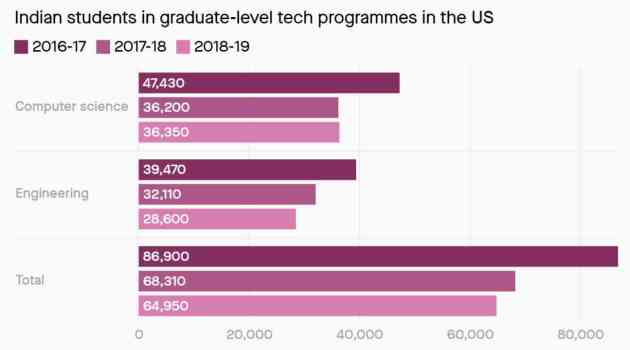
Among the recommendations expected to be considered is the suspension of a program for foreign students to stay in the U.S. to get one or two years of occupational training between secondary education and full-time employment, a move many in the business and university communities are fighting.

The program, known as Optional Practical Training, or OPT, is an incentive for foreign students to come to U.S. universities, as it provides some cushion between school and employment. Talk of suspending OPT has pitted business interests against immigration hard-liners like President Donald Trump’s senior adviser Stephen Miller, the officials said.

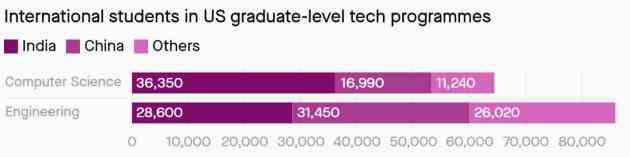
Miller, acting DHS Secretary Chad Wolf and Sen. Tom Cotton, R-Ark., have all said the program has been rife with abuses, particularly by Chinese students whom they accuse of getting American educations and then returning to China. Data from the Congressional Research Service, however, shows otherwise.

“Suspending or ending OPT makes no practical sense — it solves no problem, it reduces the quality of America’s higher education system, and it threatens the international exchange of ideas so vital to academic freedom,” said Julie Schmid, executive director of the American Association of University Professors.

“International students contribute nearly $41 billion a year to the U.S. economy. Our campuses and our communities benefit from the contributions international students make to education and research,” Schmid said. “This move does nothing to ensure the health of U.S. citizens during the COVID crisis. As with Trump’s Muslim ban, this is just bigotry posing as concern for national security.”

The new guidelines, expected to be announced in an executive order this month, would expand curbs on legal migration announced by the White House in April. The administration is expected to frame the move as economic protection for Americans faced with staggering unemployment rates.

Representatives of the White House and DHS did not respond to requests for comment.

A U.S. official familiar with the matter said, “While we won’t comment on internal administrative policy discussions one way or the other, millions of Americans have been forced out of work by the pandemic and they ought to be first in line for jobs — not lower-paid imported labor. Polling shows Democrats, Republicans and Independents agree.”

Critics of the proposals say Miller and other immigration hawks are using the pandemic to accomplish a goal they have had since Trump took office: bringing down the overall number of legal immigrants.

When Miller served on the staff of then-Sen. Jeff Sessions, R-Ala., he helped draft a bill that would have eliminated OPT. Now, four Republican senators have asked the White House to take the issue of curbing OPT and other legal migration programs into their own hands.

“We urge you to continue to suspend new nonimmigrant guest workers for one year or until our new national unemployment figures return to normal levels whichever comes first,” Cotton and Sens. Ted Cruz of Texas, Chuck Grassley of Iowa and Josh Hawley of Missouri said in a letter to the White House on May 7. The letter said OPT, along with H-1B visas for highly skilled workers and H-2B visas for non-agricultural seasonal workers, should be suspended.

Todd Schulte, president of FWD.US, a pro-immigration reform group of business and tech leaders that counts Bill Gates and Mark Zuckerberg among its founders, said the plan is too similar to previous proposals to be framed as a legitimate response to the economic crisis caused by COVID-19.

“Three years ago, when unemployment was at 4 percent, the signatories who were in the Senate at the time tried to slash legal immigration by more than 50 percent. … Today, as unemployment has skyrocketed, these senators now say we need to slash legal immigration in response to the COVID-19 crisis,” Schulte said.

An official familiar with discussions at the White House said the influence of the business community, often communicated by the U.S. Chamber of Commerce, could sink plans to suspend OPT.

But Rosemary Jenks, executive vice president of NumbersUSA, which shares Miller’s goal of decreasing overall immigration, said it would be a mistake to keep the program open. Jenks noted that OPT is a regulatory program not protected by statute.

“At a time when millions of Americans and lawful permanent residents are graduating from college with severely limited job opportunities due to COVID-19, it makes absolutely no sense for the administration to continue a regulatory program that allows foreign graduates to take jobs Americans need,” she said.

Immigrants with work visas, suddenly jobless, must leave the US if they aren’t rehired

Trump administration continues its anti-immigration push:

Like millions of American workers, an Indian software engineer, a British market researcher and an Iranian architect lost their jobs amid the coronavirus pandemic. Unlike Americans, they are not entitled to unemployment benefits, despite paying taxes, because they are on foreign work visas. And, if they fail to find similar jobs soon, they must leave the country.

Rejish Ravindran analyzed data for a national footwear retailer, helping make sales projections and investment decisions. After hiring him on an H-1B skilled-worker visa nearly two years ago, the company recently sponsored his application for legal permanent residency, a process that takes several years to complete.

“It was going good. I thought I would be in Michigan forever. We were going to buy a house and settle down here,” said Ravindran, 35, who lives in Grand Rapids, Michigan. His wife, Amrutha, a nurse, was finishing a course and hoped to put her training to use soon.

But battered by the coronavirus outbreak, the retailer furloughed Ravindran last month, which is not allowed under the terms of his visa. So two days later, the company terminated him.

“Everything came crashing down,” said Ravindran, who arrived in the United States in 2012.

Now, he is scrambling to find another job before the 60-day grace period for transferring his visa to another employer expires early next month. He is not optimistic.

The lives of tens of thousands of foreign workers on skilled-worker visas, such as H-1Bs, have been upended by the economic fallout from the COVID-19 crisis. Many have been waiting in a backlog for several years to obtain permanent legal residency through their employer, and now face the prospect of deportation.

The Trump administration is also expected within the next few weeks to halt the issuance of new work visas such as the H-1B, for high skilled foreigners, and the H-2B, for seasonal employment. The new measures under review, according to two current and two former government immigration officials, would also eliminate a program that enables foreign graduates of American universities to remain in the country and work.

The tightening work rules come as unemployment in the U.S. soared last month to 14.7%, the highest level on record, and as calls escalated in Congress for Americans to be given priority for jobs.

“Given the extreme lack of available jobs for American job-seekers as portions of our economy begin to reopen, it defies common sense to admit additional foreign guest workers to compete for such limited employment,” a group of Republican senators said in a letter last week calling for a suspension of new visas to guest workers who have not yet entered the country.

For those already rooted in the U.S., the consequences of canceling the existing visas are “life-altering,” said Shev Dalal-Dheini, director of government relations for the American Immigration Lawyers Association.

“They have been thrown into limbo. It’s not like they can go and just find any job, like at a pizza place,” said Dalal-Dheini. A new job must meet specific criteria for the visa, such as by paying a certain salary and requiring at least a bachelor’s degree.

Dalal-Dheini’s association of 15,000 lawyers has asked U.S. Citizenship and Immigration Services to extend the grace period, giving H-1B holders at least 90 days after the public health emergency has ended to find employment.

An agency spokesman did not address whether an extension was under consideration. He said the agency would continue to monitor the coronavirus and “assess various options related to temporary worker programs.”

Since taking office, President Donald Trump has thrust immigration and job displacement onto center stage, introducing a series of policies to curtail both legal and illegal immigration. More recently, his administration has cited the pandemic to justify even stricter restrictions.

On April 22, Trump suspended the entry of new immigrants for 60 days. Less noticed in his proclamation was the order to the secretaries of labor and homeland security for a speedy review of nonimmigrant work visa programs.

As of Jan. 21, there were 421,276 people in the United States on H-1B visas, three-quarters of them Indians, and many of them technology workers. About 220,000 people were enrolled in the 2018-19 academic year in the Optional Practical Training program, which allows foreign students to work after completing their studies.

The strong economy had fueled brisk demand for foreign workers in recent years, with H-1B applications by private companies far outstripping the annual supply of 85,000, a situation that prompted the government to resort to a lottery to award them.

But proponents of limiting immigration say that if there was ever a time to prioritize American workers, it is now.

“If an H-1B visa holder is terminated from their job and is unable to find another employer willing to sponsor them, they should go back home,” said Kevin Lynn, executive director of Progressives for Immigration Reform, which advocates for American technology workers.

U.S. citizens with foreign partners on visas are also affected.

Andrew Jenkins and Krista York of Minnesota began more than a year ago to plan their wedding. The couple had settled on getting married Aug. 20 at the majestic Cathedral of St. Paul, where York’s grandparents were married decades ago and she was confirmed in the church as a teenager. Then the coronavirus struck.

York was furloughed. Jenkins, who is British, lost his job as a market research analyst. Because he is on an H-1B visa, Jenkins is not eligible for unemployment. “It’s far from ideal to not have any income when you’re planning your wedding,” said Jenkins, 27.

What’s worse, the couple said, is that Jenkins is in a race against time to find another job before his visa expires in July.

Unless he succeeds, they may have to hurriedly get married at a courthouse so that Jenkins can salvage his immigrant status — by filing an application for a green card through a spouse. If that happens, the couple will not be allowed to hold a religious ceremony at the cathedral.

“Everything is ready to go for the cathedral. But if we have to get married on paper, we’ll have to find another church,” said York, 27.

Bahar Shirkhanloo of Iran completed a master’s degree in architecture two years ago and used the Optional Practical Training program to get a job at a firm in Chicago, where she is part of a team that designs high-rise residential buildings.

Early this year, the firm decided to sponsor her for a green card. But she was abruptly terminated in early April when projects came to a standstill, leaving her with 60 days, under the terms of the program, to find a new job.

“I’m applying every day, everywhere in the U.S. you can think of,” said Shirkhanloo, 28. Most often, she hears the same thing: “They are interested, but, for now, there’s a hiring freeze.”

In Michigan, Ravindran is contemplating selling his 2013 Honda Accord to make the rent and pay outstanding bills, including $6,000 for a hospital visit by his wife last year.

The son of a tea stall owner and the first to attend college in his family, the software engineer said that if he ends up having to return to India, “I want to clear all my debts. I need to make a smooth exit from the U.S.”

But there is a wrinkle: Commercial flights to India have been suspended since that country went into lockdown in March. While the government recently started repatriating some Indians stranded abroad, it has stipulated that pregnant women, older people and those with medical conditions will have priority.

That could put someone like Ravindran at risk of overstaying his visa, which could jeopardize his ability to live in the United States in the future.

“If I don’t find a new job, I can’t stay here,” he said.

Source: Immigrants with work visas, suddenly jobless, must leave the US if they aren’t rehired

12 New Immigration Ideas for the 21st Century

Compiled by the libertarian Cato Institute, a range of ideas ranging from the practical to the more ideological.

On the more practical side:

  • Chapter 1: Automatic Adjustment of the H-1B Visas and Employment‐ Based Green Cards Caps
  • Chapter 2: Reducing Long Wait Times for Family‐​Sponsored and Employment‐​Based Immigrants
  • Chapter 3: Shared Border, Shared Future: A US-Mexican Bilateral Worker Agreement
  • Chapter 5: State-Sponsored Visas (similar to the Provincial Nominee Program)
  • Chapter 6: The Community Visa: A Local Solution to America’s Immigration Deadlock

    Chapter 8: Immigration Moneyball (variant of points system/express entry)

On the more wish list and/or ideological side:

  • Chapter 3: Shared Border, Shared Future: A U.S.-Mexican Bilateral Worker Agreement
  • Chapter 4: Constructing a US-Canadian Bilateral Labor Agreement
  • Chapter 7: Building a Congressional Constituency for Immigration through “Earmarks”
  • Chapter 9: Immigration Designed to Enhance American Lives (IDEAL)
  • Chapter 10: Don’t Restrict Immigration, Tax It
  • Chapter 11: Choosing Immigrants through Prediction Markets
  • Chapter 12: Transferable Citizenship (citizenship as a traceable good)

Congress has repeatedly considered and rejected comprehensive immigration reform legislation over the past few decades. The most bitter debates were in 2006, 2007, and 2013 when comprehensive bills passed one house of Congress and not the other. Those reforms each failed for particular reasons—groundswells of populist opposition, Democratic senators working with Republicans to remove guest worker provisions, or Republican failure to bring it to the floor in the House of Representatives—but the bills were all basically identical.


Those failed immigration reforms all included three policies: legalize illegal immigrants currently living in the United States, increase border and interior enforcement of the immigration laws, and liberalize legal permanent immigration and temporary migration through an expanded guest worker visa program for lower‐​skilled workers. A domestic amnesty for illegal immigrants was supposed to clear the black market and allow those who have made a life here to settle permanently; extra enforcement was supposed to reduce the potential for illegal immigrants to come in the future; liberalized immigration was supposed to boost U.S. economic prosperity and drive future would‐​be illegal immigrants into the legal market.

In theory, this comprehensive approach was supposed to make future amnesties unnecessary by fixing the laws that encouraged illegal immigration in the first place. The bill Congress considered in 2013, the last attempt at comprehensive immigration reform, followed the same model, which is a major reason the bill failed. For instance, the guest worker provisions for lower‐​skilled workers were all clones and the result of negotiations between the same stakeholders.

Liberalizing legal immigration is the most important component of workable, long‐​term reform. The legal immigration system sets and regulates numbers, procedures, and the types of foreigners who can come to the United States from abroad to work, live, and in some cases eventually naturalize. Providing legal paths for more immigrants, either for temporary work or permanent citizenship, is the best way to secure the border and would help provide for the future prosperity of the United States. The government cannot regulate a black market of illegal immigrants, but it can regulate legal immigrants.

Expanding legal immigration is a worthy goal, but there are many ways to accomplish it. The mission of this collection of essays from policy analysts, economists, political scientists, journalists, and advocates from around the world is to provide new policy suggestions that future Congresses could use to liberalize the legal immigration system. We intentionally avoided seeking proposals from the usual stakeholders and included many original ideas that could increase legal immigration or improve the selection of legal immigrants. The essays fall into four broad categories based on how much they would transform the current legal immigration system. The first category includes proposed rule changes that would substantially improve the current system. In one essay, Daniel Griswold of the Mercatus Center proposes that Congress abolish the static numerical caps on certain visas and instead create a built‐​in numerical escalator that automatically grows the number of visas as employment grows. For example, the number of H‐​1Bs issued would increase as employment in certain hightechnology sectors increases. Similarly, Stuart Anderson of the National Foundation for American Policy recommends addressing the extreme wait times that skilled immigrants currently face by guaranteeing them legal permanent residence within five years, essentially replacing numerical quotas with a specific wait time.

The second category of essays includes discussions of adding visa categories to the current system. Many of the ideas in this category are based on older visa programs that have been discontinued, visa programs in other countries, logical extensions to the current U.S. system, or admissions policies in other public institutions, such as military academies.

Michael Clemens of the Center for Global Development proposes a jointly regulated migration system with Mexico based on lessons learned from the past and best practices from other bilateral migration programs enacted around the world. Michelangelo Landgrave, a political science doctoral candidate at the University of California, Riverside, proposes a similar policy for Canada based on the principles of reciprocity in work authorization and limited access to welfare, of which, according to survey data, Americans and Canadians alike approve.

David Bier of the Cato Institute proposes state‐​based visas that would allow state governments to accept immigrants based on their diverse economic conditions. In a similar vein, coauthors Jack Graham and Rebekah Smith propose a system whereby local governments would work with private sponsors to bring immigrants into their communities. Both essays highlight the importance of engaging state governments to implement important reforms.

Grover Norquist of Americans for Tax Reform offers a proposal inspired by the acceptance policies of U.S. military academies. It would allow each member of Congress to sponsor 100 immigrants for legal permanent residence— similar to how they nominate recruits for U.S. military academies.

The third category includes proposed changes that would transform how the current U.S. immigration system works.

George Mason University professor Justin Gest envisions a major overhaul of the selection process for immigrants. Under his system, the government would collect much better data on various immigrant outcomes and track immigrants over time to see how they integrate. It would then assign points for immigrants with certain characteristics that the data show correlate with immigrant success.

Steve Kuhn of IDEAL Immigration proposes selling visas to employers, provided they’ve made job offers to foreign workers and paid the workers premiums that match the cost. Nathan Smith’s proposal would increase the number of immigrants admitted but charge them an extra 20 percent tax on their incomes so long as they reside and work in the United States.

The fourth category and the last two fundamental policy reform ideas come from Robin Hanson, associate professor of economics at George Mason University. His reforms would increase immigration, cause more Americans to profit directly from the immigration system, and provide a way to select immigrants that are more beneficial to the United States.

Hanson’s first essay is similar to Gest’s proposal but relies on a more decentralized decisionmaking process to select immigrants using prediction markets. Under this proposal, the public would place cash bets in an open market on which immigrants would succeed based on objectively measurable criteria such as net‐​fiscal impact. The immigration system would then select those priced the highest. In his second essay, Hanson suggests letting U.S. citizens sell or lease their citizenship to noncitizens abroad in exchange for leaving the country. This would monetize the value of American citizenship and create an asset held by every American.

These proposed reforms are just a few of the new and interesting ideas out there. Hopefully, some will be incorporated into future bills; others could spark new and more creative ways of how to change immigration laws. We don’t endorse every essay in this paper, but the stagnant state of the current debate shows the need for bold new ideas and out‐​of‐​the‐​box thinking that will better prepare us for the next immigration reform debate.


Chapter 1: Automatic Adjustment of the H-1B Visas and Employment‐ Based Green Cards Caps

By Daniel Griswold

Congress should tie the growth of employment‐ based visas to growth in the most relevant sectors of the U.S. labor force to assure that the annual number of visas available more closely matches the demands of the U.S. economy over time. Two of the most important visas for foreign‐​born workers are the H-1B visa and the employment‐​based green card, both for more‐​skilled and more‐​educated foreign born workers. Yet the number of such visas available has not changed significantly in almost three decades despite transformational growth in the U.S. labor market.


Chapter 2: Reducing Long Wait Times for Family‐​Sponsored and Employment‐​Based Immigrants

By Stuart Anderson

Congress should tie the growth of employment‐ based visas to growth in the most relevant sectors of the U.S. labor force to assure that the annual number of visas available more closely matches the demands of the U.S. economy over time. Two of the most important visas for foreign‐​born workers are the H-1B visa and the employment‐​based green card, both for more‐​skilled and more‐​educated foreign born workers. Yet the number of such visas available has not changed significantly in almost three decades despite transformational growth in the U.S. labor market.


Chapter 3: Shared Border, Shared Future: A U.S.-Mexican Bilateral Worker Agreement

By Michael Clemens

The U.S. government has mismanaged labor mobility and failed to cooperate meaningfully with migrant countries of origin for the past half‐​century. Foreign workers have come for fundamental jobs, which are those that are critical to the U.S. economy and that do not require formal higher education, such as personal care, construction, warehousing, and others. They have come almost exclusively via family‐​based green cards, “low‐​skill” temporary guest worker visas for seasonal jobs tied to a single employer, or through a vast black market in labor. Many of the ills associated with migration arise from this regulatory system, not from migration itself. The United States needs a bilateral system of labor mobility for fundamental jobs that should begin


Chapter 4: Constructing a U.S.- Canadian Bilateral Labor Agreement

By Michelangelo Landgrave

The U.S. government has mismanaged labor mobility and failed to cooperate meaningfully with migrant countries of origin for the past half‐​century. Foreign workers have come for fundamental jobs, which are those that are critical to the U.S. economy and that do not require formal higher education, such as personal care, construction, warehousing, and others. They have come almost exclusively via family‐​based green cards, “low‐​skill” temporary guest worker visas for seasonal jobs tied to a single employer, or through a vast black market in labor. Many of the ills associated with migration arise from this regulatory system, not from migration itself. The United States needs a bilateral system of labor mobility for fundamental jobs that should begin


Chapter 5: State‐​Sponsored Visas

By David J. Bier

The federal government has maintained a near monopoly on the criteria for the admission of foreigners to the United States since the late 19th century. This centralization makes little sense in such an economically diverse country. Every state and locality have specific social and economic circumstances that the current centralized immigration system ignores. This centralization has ultimately polarized and paralyzed the national immigration debate and directly led to a threedecades‐ long delay of major reforms to a system that most agree desperately needs it. For this reason, Congress should allow state governments to sponsor migrants based on their own criteria under federal supervision.50


Chapter 6: The Community Visa: A Local Solution to America’s Immigration Deadlock

By Jack Graham and Rebekah Smith

Immigration is one of the most significant drivers of prosperity, but its potential is suppressed by restrictionist politics, centralized bureaucracies, and out‐​of‐​date policies. Furthermore, its benefits are concentrated in a few regions. Communities with the greatest need for immigrants, especially in rural areas and the Rust Belt, are receiving few immigrants as the majority move to big coastal cities. Rural areas also tend to have the highest levels of anti‐​immigrant sentiment, in part because they do not benefit from migration the same way that people in big coastal cities do.77 The United States needs a new approach to help businesses of all sizes get the workers they need, to renew communities threatened by demographic decline, and to build local support for more liberalized immigration.


Chapter 7: Building a Congressional Constituency for Immigration through “Earmarks”

By Grover Norquist

For many years, U.S. presidents have had significant discretion to make immigration policy, liberalizing or restricting rules on entry and setting deportation priorities. Congress has enacted little legislation of its own because it lacks the overwhelming national consensus required to pass reforms on the issue. But giving individual members of Congress more authority to select immigrants for permanent residence could overcome this stalemate.


Chapter 8: Immigration Moneyball

By Justin Gest

President Trump wants to overhaul the U.S. immigration system so that it stops favoring visa applicants with U.S. family ties and instead gives priority to highly skilled applicants and those with job offers.94 His proposal is based on the assumption that immigrants’ educational credentials—what the administration calls “merit”—will lead to increased U.S. wages and immigrants who better integrate into U.S. culture.


Chapter 9: Immigration Designed to Enhance American Lives (IDEAL)

By Steve Kuhn

The immigration reform proposals most likely to succeed are those that create benefits for Americans and immigrants and that garner bipartisan support. The Immigration Designed to Enhance American Lives (IDEAL) proposal strikes a balance between competing interests by allowing more legal immigrants to work in the United States by paying the federal government for the opportunity. That revenue could then be used to reduce the tax burden or otherwise benefit native‐​born Americans. This essay and planks are based on the IDEAL Immigration Policy.100


Chapter 10: Don’t Restrict Immigration, Tax It

By Nathan Smith

Many economists—including Nobel laureate Gary Becker—favor taxing immigration because charging a “price” can produce a more efficient result than restricting it with government‐​established caps or quotas. Good immigration policy ought to bring the greatest good to the greatest number, subject to the constraints of being compatible with human rights and incentives and of making many people better off without making others worse off. Consistent with those principles is a proposed policy called “Don’t Restrict Immigration, Tax It.”


Chapter 11: Choosing Immigrants through Prediction Markets

By Robin Hanson

On immigration, the big political camps are in a tug of war. One side favors more immigrants; the other side wants fewer immigrants. But when faced with such a struggle, policymakers who care more about influence than about feeling solidarity should consider tugging the rope sideways, where fewer might oppose their efforts. To tug the rope sideways on immigration, policymakers should take a policy position that is perpendicular to the axis of more versus fewer immigrants. One sideways‐​pull policy would be to reform immigration laws to use prediction markets to admit different immigrants, without increasing the total number.


Chapter 12: Transferable Citizenship

By Robin Hanson

Governments have long worked hard to create strong feelings of solidarity between citizens. National leaders often appeal to a common history of mutual aid, sacrifice, and even ethnic and cultural ties to garner support for government actions. All of this has helped create a relatively sacred and exclusive aura regarding citizenship that, in the words of Abraham Lincoln, is “the mystic chords of memory, stretching from every battle‐​field, and patriot grave, to every living heart and hearthstone, all over this broad land.”112 According to long‐​standing human norms, such associations are not to be created lightly and are debased when they are mixed with material motives such as money or other expressions of self‐​interest.

Source: 12 New Immigration Ideas for the 21st Century

Americans Giving Up Citizenship Faster Than Ever Before Reports Bambridge Accountants New York

Significant increase.

As for the Canadian angle, ApCPC leader Andrew Scheer has not yet renounced his American citizenship (Stephen Lautens on Twitter: “Still no sign of Still no sign of Andrew Scheer in the US’s Quarterly Publication of Individuals Who Have Chosen To Expatriate (lose United States citizenship) …twitter.com › stephenlautens › status).:

Americans are renouncing their citizenship at the highest levels on record, according to research by the Enrolled Agents and accountants Bambridge Accountants New York.

  • 2,909 Americans gave up their citizenship in the first 3 months of 2020
  • Showing a 1,104% increase on the prior 3 months to December 2019where only 261 cases were recorded
  • 2,072 Americans gave up their citizenship in 2019 in total
  • This is the highest quarter on record, the previous record was 2,365 cases for the fourth quarter of 2016
  • It seems that the pandemic has motivated U.S. expats to cut ties and avoid the onerous tax reporting

Americans must pay a $2,350 government fee to renounce their citizenship, and those based overseas must do so in person at the U.S. Embassy in their country.

There are an estimated 9 million U.S. expats. The trend has been that there has been a steep decline over the last few years for U.S. citizens expatriating – the first 3 months of 2020 is a huge increase in the number of Americans renouncing their citizenship.

Under the IRS rules (section 6039g), every three months the U.S. Government publishes the names of all Americans who give up their citizenship. The first 3 months for 2020 had 2,909 Americans renouncing their citizenship, far more than the total of the four quarters for 2019 (2,072 Americans renounced).

Alistair Bambridge, partner at Bambridge Accountants New York, explains: “There has been a huge turnaround of U.S. expats renouncing, where the figures have been in steep decline since 2017.”

“The surge in U.S. expats renouncing from our experience is that the current pandemic has allowed individuals to get their affairs in order and deal with an issue they may have been putting off for a while.”

“For U.S. citizens living abroad, they are still required to file U.S. tax returns, potentially pay U.S. tax and report all their foreign bank accounts, investments and pensions held outside the U.S. For many Americans this intrusion is too much and they make the serious step of renouncing their citizenship as they do not plan to return to live in the U.S.”

“There has been a silver lining for U.S. expats that they have been able to claim the Economic Impact Payment of $1,200, but for some this is too little, too late.”

Source: Americans Giving Up Citizenship Faster Than Ever Before Reports Bambridge Accountants New York

USA: Minority-Owned Small Businesses Were Supposed To Get Priority. They May Not Have

Of note. Will be interesting to see eventual analysis of take-up by immigrants and visible minorities of the various COVID-19 support programs in Canada:

The first time Rosemary Ugboajah applied for a small-business relief loan, it didn’t go well. She needed the money for her small Minneapolis-based company, which has created ad campaigns for brands like the NCAA Final Four.

So she went to her credit union.

“They were hard to reach, but eventually I got through to someone and they emailed me back saying they can’t process the loan because they don’t process SBA loans,” she said. “I wasn’t aware of that.”

Lawmakers did set aside $30 billion for smaller lenders, in part with the aim of helping business owners of color — like Ugboajah.

But a new report from the Small Business Administration’s inspector general found that businesses owned by people of color may not have received loans as intended under the Paycheck Protection Program. There was no evidence, the report said, that the SBA told lenders to prioritize business owners in “underserved” markets, including business owners of color — something the CARES Act had specifically instructed the SBA to do.

The report also recommends that the agency start collecting demographic information. Without that information for past loans, it will be hard to know how well the program served business owners of color.

Some businesses owned by one person — such as some sole proprietorships, like Ugboajah’s Neka Creative — were only allowed to apply for funds one week after other businesses. That put them in the back of the line to get the money, which ran out quickly during the first round.

After trying and failing at two other banks, Ugboajah managed to find one that was accepting applications from new customers, and she quickly applied. But that also went poorly.

“The next week, I got an email from them saying, you know, the money’s running out. And they’re now just going to prioritize their clients that have borrowed before,” she said with a weary laugh.

Ugboajah has applied there again during this second round of funding but hasn’t heard back yet.

But she could use the money, and fast — her team is currently working through the pandemic without pay.

“We had a healthy pipeline coming into this year. And as soon as this came down, everything went on hold and then disappeared,” she said.

An additional problem for these owners is that their businesses are more likely to be sole proprietorships, according to Ashley Harrington, senior policy counsel at the Center for Responsible Lending.

“When we’re talking about businesses of color, most of them are very small businesses. So they’re sole proprietorships or they have less than 10 employees or in fact more likely to be a sole proprietorship than any of the other small businesses,” Harrington said.

Ugboajah has six people on her team — and they’re all contractors — making her business one of those one-person sole proprietorships. African American-owned businesses are particularly likely to be one-person firms.

And relationships with banks matter, according to Michael Roth, managing partner at Next Street, which works with local governments on small-business policy.

“Black- and Hispanic-owned businesses, because of their lack of access to capital from banks and financial institutions and friends and family, are far more likely to use personal funds to finance their businesses,” he said. “And generally, that’s run out of personal checking accounts.”

That could be a problem for some businesses in the program, because some banks would loan only to people with business accounts. So owners without those — who were, for example, running their businesses out of their personal accounts — were shut out.

Ugboajah says that if she doesn’t get the funding, it won’t take her business down completely, but it could make life harder.

“The main thing that we’re on the verge of losing is our office space. But, yeah, we won’t go out of business,” she said.

But it has already hurt the contractors who rely on her for income, she added: “One of my team members has taken a job with Amazon, for example. But we’re still pushing to get business in.”

For now, she says, they’re working on a new project: to make sure health information about the coronavirus can reach poor and immigrant communities, as well as communities of color.

Source: Minority-Owned Small Businesses Were Supposed To Get Priority. They May Not Have

USA: Immigration Review Could Lead To New H-1B Visa Restrictions

Which would likely benefit Canada and possibly other countries:

The Trump administration may soon propose another set of immigration restrictions, this time on H-1B visas for foreign-born scientists and engineers. Some observers view these public displays of limiting immigration as an effort to deflect criticism of the administration’s handling of the coronavirus pandemic. Before enacting new measures, analysts recommend the administration take into account the restrictions on H-1Bs already in current law, including the low annual limit for new H-1B petitions, and the high denial rates imposed by U.S. Citizenship and Immigration Services (USCIS). The latest data show H-1B denial rates are at record levels.

On April 22, 2020, the Trump administration issued a presidential proclamation that suspended the entry of most new immigrants for at least 60 days and ordered a 30-day review to recommend additional measures on temporary visas. Following the review, observers expect new restrictions on H-1B visa holders, F-1 students and others. A new restriction could take the form of suspending the entry of anyone on an H-1B visa coming from outside the country and/or imposing new conditions on their entry that would be difficult to satisfy.

Due to USCIS policies, the H-1B category remains highly restrictive, say attorneys, and the data support this contention. Denial rates rose from 6% in FY 2015 to 30% in the first quarter of FY 2020 for new H-1B petitions for initial employment, according to a new National Foundation for American Policy (NFAP) analysis. (H-1B petitions for “initial” employment are primarily for new employment, typically a case that would count against the H-1B annual limit.) In FY 2019, the denial rate for initial employment was 21%, while the rate was 24% in FY 2018, between 3 to 4 times higher than the FY 2015 denial rate (i.e., prior to the Trump administration.)

All 25 companies with the most approved new H-1B petitions saw their H-1B denial rates for initial employment increase from FY 2015 to the first quarter of FY 2020. (See Table 2.) Even large technology companies that had denial rates of only 1% in FY 2015 experienced much higher denial rates for H-1B petitions for initial employment in the first quarter of 2020: Amazon’s denial rate was 16%, Google’s was 14%, Facebook’s was 8% and Apple’s H-1B denial rate was 8%. Data for additional quarters will tell us how long this trend persists.

“As in earlier fiscal years, the highest denials rates are for companies that provide information technology or other business services to American companies,” according to the NFAP report. “The data indicate USCIS has established a different standard for deciding cases for companies that provide information technology (IT) services. This is the case even though, as attorneys point out, immigration law does not indicate a different standard for adjudications based on the type of firm or the location work will be performed.”

In the first quarter of FY 2020, the H-1B denial rate for initial employment increased by 20 percentage points or more compared to FY 2015 for 12 major companies that provide IT services or other business consulting services. Many of these and other companies hit by high denial rates are U.S. companies. (Data show the use of H-1B visas by Indian-based companies has declined significantly in recent years, see here.)

People who follow technology trends like Everest Group CEO Peter Bendor-Samuel say by providing technical talent many high-skilled foreign nationals and companies that offer services increase the competitiveness of American companies. “Digital transformations and digital platforms are just starting to take off and, as we look into the near future, the current skill shortages are going to grow as the demand for digital and IT skills explodes,” said Bendor-Samuel. “If this administration wanted to harm U.S. competitiveness, then restricting access to this vital labor would be an excellent approach.”

Advanced analytics and cloud computing are two elements of digital transformation. “Digital transformation is the integration of digital technology into all areas of a business, fundamentally changing how you operate and deliver value to customers,” explains the Enterpriser’s Project. “A business may take on digital transformation for several reasons. But by far, the most likely reason is that they have to: It’s a survival issue for many.”

Replacing outdated legacy information technology systems is a key element of digital transformation, notes the Enterpriser’s Project, which points out, “Often, it’s more about shedding outdated processes and legacy technology than it is about adopting new tech.” This sometimes leads to poorly managed transitions. “In a handful or so of cases in past years, H-1B visa holders were blamed for layoffs after some foreign nationals came on-site to manage the transition to new contracts – contracts that went out for bid and, industry professionals note, would have resulted in layoffs or at least a transfer of personnel whether or not the entity awarded the contract employed some H-1B visa holders,” notes the NFAP analysis. “In retrospect, these cases should have been recognized as attempts by companies to undertake digital transformations, transformations that unfortunately can leave longtime employees trained primarily on legacy systems in untenable career situations. Ongoing training efforts for such employees before being placed in these situations would offer the best career protection.”

Judges have ruled against several USCIS policies that have contributed to high denial rates, targeting restrictive agency interpretations of what qualifies as an H-1B specialty occupation, an employer-employee relationship and whether an H-1B employee must list all future work or contracts.

The March 10, 2020, decision in ITServe Alliance v. L. Francis Cissnawould allow any company that believes an H-1B petition was denied in a way ruled unlawful by Judge Collyer’s opinion to file a case in the District of Columbia, notes Jonathan Wasden of Wasden Banias, LLC. (See here.)

Following the 30-day review, the administration could recommend moving forward with an H-1B regulation already on the agenda (but not issued) that would: “[R]evise the definition of specialty occupation . . . revise the definition of employment and employer-employee relationship . . . [and] propose additional requirements designed to ensure employers pay appropriate wages to H-1B visa holders.”

Policymakers often ignore that due to a low annual limit, current immigration law already significantly restricts companies and their ability to employ high-skilled foreign nationals in technology fields. For the past 18 fiscal years, employers have exhausted the annual supply of H-1B visas due to those limits.

Under U.S. law, companies collectively can only use, in effect, 85,000 new H-1B petitions a year – an annual limit of 65,000 and an exemption of 20,000 from that limit for foreign nationals with a U.S. advanced degree. To put that number in perspective, 85,000 new H-1B petitions equals 0.05% of the U.S. labor force of 165 million.

In March 2020, employers sent in registrations for approximately 275,000 foreign-born professionals for the H-1B lottery – more than three times the annual limit of 85,000. That indicates the demand was at least 190,000 scientists, engineers and other professionals beyond current law, and likely would be higher if one included demand that might arise in later months.

It’s worth noting the sectors hardest hit by the economic downturn – airlines, hotels and restaurants – employ few H-1B visa holders. H-1Bs are typically the only practical way to hire a foreign national to work in the United States long-term. (H-1B professionals selected in the March lottery cannot start work until October 1, 2020, or later.)

A study by economists Giovanni Peri, Kevin Shih, Chad Sparber and Angie Marek Zeitlin looked at the last recession and discovered that denying the entry of H-1B visa holders due to the annual limits harmed job growth for U.S.-born professionals. “The number of jobs for U.S.-born workers in computer-related industries would have grown at least 55% faster between 2005-2006 and 2009-2010, if not for the denial of so many applications in the recent H-1B visa lotteries,” concluded the economists.

The Trump administration appears poised to enact new restrictions on foreign-born engineers and the ability of international students to work in the United States after graduation, even though the president has stated he favors “merit-based” immigration and these are the most highly skilled people admitted to America. Economists note the way to recover from an economic downturn is to attract more investors, entrepreneurs and highly productive individuals – not to drive them away to other countries.

Source: Immigration Review Could Lead To New H-1B Visa Restrictions

The path to citizenship for those who put on American uniform has narrowed

Of note. One of the ironies is that Canada modelled a similar provision in the 2014 C-24 citizenship legislation after the US approach (not repealed in C-6):

When Baron Friedrich von Steuben, a Prussian officer helping the Continental Army, asked for a translator at Valley Forge to address some troops during America’s revolutionary war, the story goes that he was told there was no need. This particular group were immigrants and spoke German. Colonial militias offered state citizenship to soldiers. The Continental Congress granted citizenship even to enemy soldiers who switched sides. The baron was later given American citizenship for helping to see off the Brits.

Since 1952, immigrants have been able to apply for citizenship after one year of honourable service during peacetime. In wartime they have been able to become Americans almost as soon as they join up. Since the September 11th attacks in 2001, more than 100,000 service members have become citizens. But this avenue to citizenship is no longer assured.

In order for the naturalisation process to begin, the Department of Defence has to sign an honourable-service certification form. Without it, the Citizenship and Immigration Services (uscis) will not consider the applicant. In October 2017 the department adopted stricter vetting; as a result, claims a new lawsuit, it is very difficult for service members to be naturalised speedily. This policy change is “a departure from pretty close to 200 years of us history”, says Muzaffar Chishti of the Migration Policy Institute, a think-tank.

Ange Samma, along with five other active-duty service members, and the American Civil Liberties Union (aclu), an advocacy group, filed a class-action lawsuit against the Department of Defence on April 24th. Private Samma enlisted in 2018 and is serving in South Korea. Originally from Burkina Faso, he came to America as a teenager. According to the suit, it took multiple requests for him to receive the honourable-service certification form. When he finally did, uscis rejected it as his officers had not filled it out properly. Without citizenship, he cannot get security clearance for some army work. He is not alone. Scarlet Kim, an aclulawyer, says that thousands of service members are having similar difficulties.

In 2018 there was a 70% drop in naturalisation applicants from the armed forces after the extra vetting was put in place. The lawsuit says the servicemen would have been naturalised faster if they had taken the lengthy civilian route. Their applications are being rejected at a higher rate than civilian ones. Margaret Stock, a retired lieutenant-colonel and now an immigration lawyer, says some serving soldiers are placed in deportation proceedings by the same government that they volunteered to fight for, before the application process has been completed.

Some countries are loosening citizen-enlistment rules because of military-recruitment problems, but only a few make service a path to citizenship as America does. This distinction helps with recruiting. Without immigrants the army would have failed to meet its goals nearly every year between 2002 and 2013. A Department of Defence report in 2016 found that non-citizens perform better, have lower attrition rates and are more likely to have medical and it expertise than their citizen counterparts. Not only do they make useful recruits to the armed forces; they would make good citizens, too.■

Source: The path to citizenship for those who put on American uniform has narrowed

Mexico Deports Most of Its Detained Migrant Population

Of note, reflecting in part the effect of the Trump administration cutting off Central American access to the American asylum system:

On Sunday, Mexico’s National Institute of Migration (INM) announced the repatriation of 3,653 Central American migrants. The measure comes after growing concern over Covid-19 spreading in INM detention facilities throughout Mexico.

Mexico recently has faced issues attempting to deport Central American citizens back to their home countries. Guatemala, Honduras, and El Salvador closed their borders to citizens and aliens.

The INM said: “In the face of the health emergency caused by Covid-19, the Ministry of the Interior, the National Institute of Migration (INM), acts responsibly and safeguards the integrity of the population in the context of migration by seeking to fully guarantee their human rights.”

Guatemalan nationals were sent back by bus and Honduran and Salvadoran migrants were transported by aircraft to their countries of origin. The International Organization for Migrants administered the flight arrangements to Central America.

In March, the INM had 3,579 foreign nationals housed throughout its 65 detention facilities and shelters. As of Sunday, the number had decreased to 106 migrants — a 97 percent reduction in the detained migrant population.

The remaining aliens gave their consent to stay in Mexican custody. Religious organizations have assisted with shelter accommodations for migrants choosing to stay in Mexico.

The United Nations, the National Human Rights Commission of Mexico, and dozens of other activist organizations supported the mass release of foreign nationals from INM custody.

Additionally, the INM expressed its support of Mexican nationals being repatriated from the United States to prevent the spread of Covid-19 amongst their countrymen.

And Mexico’s Ministry of Foreign Relations announced that it had been able to repatriate more than 129 Mexican people from Honduras and 30 from El Salvador.

Source: Mexico Deports Most of Its Detained Migrant Population

New Trump Immigration Order Does What Congress Rejected In 2018

The pandemic as opportunity. Good explanation of what is covered and what is not covered:

Donald Trump has issued a proclamation that would block indefinitely immigrants in categories the administration failed to eliminate in a bill before the U.S. Senate in February 2018. Economists consider the justification for the president’s action devoid of serious analysis and unconvincing. U.S. citizens will no longer be able to obtain immigrant visas for a parent, adult child or sibling, and the proclamation contains a lit fuse in the form of a 30-day review of H-1B and other temporary visas. In effect, the Trump administration has used the COVID-19 crisis to rewrite immigration law without passing a bill through Congress.

The presidential proclamation contains nearly identical provisions on legal immigration to those of a White House-designed bill the U.S. Senate rejected on February 15, 2018, which it voted down on a “cloture motion” 60-39.

The legislation, like the proclamation issued on April 22, 2020, would have eliminated the ability of U.S. citizens to sponsor a parent, as well as adult children and siblings (the family preference categories). It also ended the Diversity Visa lottery. (See page S1036 here.) The U.S. unemployment ratein February 2018 was only 4.1% when the administration attempted to stop immigrants from entering the United States in the same categories as were included in the April 22, 2020, presidential proclamation.

Originally, based on early discussions, the 2018 legislation was to represent a compromise between Democrats and Donald Trump to provide permanent legal protection for individuals brought to America as children, particularly those granted Deferred Action for Childhood Arrivals (DACA). However, press reports indicate White House adviser Stephen Miller intervened to ensure any administration-supported bill contained a “wish list” of immigration restrictions that Democrats would be unlikely to support. Miller is credited with drafting the new proclamation.

“Congress considered and rejected legislation that would have cut the same family-based visa categories that President Trump targets in the executive order,” said Lynden Melmed, a partner at Berry Appleman & Leiden and former chief counsel for USCIS, in an interview.

The ‘Ferociously Contested’ Story of How Blackness Became a Legal Identity

Interesting historical account:

How did Africans become “blacks” in the Americas?

Those who were forced into the ships of the infamous slave trade probably thought of themselves using ethnic and territorial terms that have been lost to us. But across the ocean, enslavers and local elites lumped Africans of many different backgrounds into a single category of debasement, “n—–s,” and sustained this category through laws that regulated freedom.

But the creation of racial identity through legal means took some surprising turns.

From the beginning, enslaved people and free people of African ancestry used those same laws to claim freedom and citizenship for themselves and their loved ones. They created spaces for communities where “blackness” and freedom were not only possible, but foundational.

Although free people of color were few in number compared to enslaved people, and lived on the margins of plantation societies in many ways, the contests over their identities, status, and rights were the terrain on which race was made. Legal contests over freedom determined whether and how it was possible to move from slave to free status, and whether claims of citizenship would be tied to racial identity.

By the early 18th century, Cuba, Virginia, and Louisiana (all colonies themselves, of the Spanish, British, and French Empires, respectively), had legal regimes that constituted blackness as a debased category equivalent to enslavement. But 150 years later, by the mid-19th century, the social implications of blackness in each of these regions were fundamentally different.

In Cuba in the 1850s, a free man of color could marry a white woman, attend public school, and participate in a religious association that gave him opportunities to be part of public life. But, in 1850s Louisiana or Virginia, a free man of color saw his churches and schools being shut down, faced prosecution for marrying across the color line, and ran the risk of being kidnapped, imprisoned, and even re-enslaved for remaining in the state in which he was born.

In Louisiana or Virginia, when a person sought to prove in court that he was not a person of color, he would bring evidence of civic acts, because citizenship and whiteness were so closely linked in political thought and legal doctrine that a citizen must be a white man, and only a white man could be a citizen. In Cuba, similar conduct was not necessarily incompatible with blackness.

The key to understanding these divergent trajectories lies in the law of freedom. Different approaches to freedom were rooted in various legal traditions. The right to manumission, for example, was firmly entrenched in the Spanish law of slavery, and so in Cuba manumission, or release from slavery, was not tied to race, a crucial difference from both Louisiana and Virginia.

One turning point in this story was the Age of Revolution. The populations of free people of color, who claimed freedom in rising numbers, exploded in all three jurisdictions, and the example of the Haitian Revolution inspired the enslaved as it struck fear in the hearts of enslavers.

In Cuba in the 1850s, a free man of color could marry a white woman, attend public school, and participate in a religious association that gave him opportunities to be part of public life. But, in 1850s Louisiana or Virginia, a free man of color saw his churches and schools being shut down, faced prosecution for marrying across the color line, and ran the risk of being kidnapped, imprisoned, and even re-enslaved for remaining in the state in which he was born.

But the expansion of freedom meant different things in the Spanish empire and in the U.S. republic. Communities of people of color in Cuba and Spanish Louisiana owed their existence to legal understandings and customary practices anchored in traditions of the ancien regime. Enslaved people who managed to purchase their freedom or, more rarely, obtained manumission through other means, became members of highly stratified societies. Black freedom did not imply social equality and republican rights.

By contrast, in Virginia during the Age of Revolution, the expansion of manumission, and the increase in freedom lawsuits, were tied to questions of citizenship, and of black participation in the new political order under conditions of equality. Enslaved and free people of color alike infused these questions with a sense of urgency, as they made use of every available legal loophole to purchase or make claims for their own freedom. Their actions produced dramatic results: by the early 19th century, the proportion of free people of color in Virginia had increased significantly.

Virginia’s white citizens witnessed these trends with horror and petitioned to outlaw manumissions. It was, literally, a reactionary request: to restore the colonial law of freedom. The 1806 law requiring freed slaves to leave the state fell short of that goal, but marked the first step towards a social order in which blacks could only exist as slaves.

After Nat Turner’s rebellion in 1831, whites’ political will to exclude free blacks intensified. Slaveholding states in the U.S. South responded to threats of rebellion, and to Northern abolitionists’ demands for immediate emancipation, with a defense of slavery as a positive good: the best possible condition for debased “Negroes.” To galvanize the support of non-slaveholding whites, Southerners cemented white solidarity by defining citizenship and voting rights along racial lines.

This movement created a paradox: egalitarian democracy would go hand-in-hand with the expansion of racist practices and ideologies. As slaveholders appealed to non-slaveholders with the promise of broad citizenship rights for all white men, free people of color became increasingly anomalous, and even dangerous to the polity. That is why colonization efforts that sought to remove free blacks to a distant location in Africa prospered in 19th-century Virginia and Louisiana (which changed hands to the United States in 1803), but not in Cuba.

That is also why Virginia and Louisiana acted in the 19th century, especially in the 1850s, to end the possibility of manumission, self-purchase, or freedom suits. By 1860, free people of color in Virginia and Louisiana were increasingly forced to leave the state upon emancipation or to live under threat of prosecution. A few even chose “voluntary” re-enslavement in order to remain with their families.

Free people of color continued to claim freedom in court, and fought tenaciously for the basic rights to a homeland, to remain close to friends and kin, and to live in their communities of origin. Yet they saw their militia and schools shut down, and their churches survived only under white leadership. Increasingly contested battles in court over racial identity attested to the growing anxiety over black citizenship and the need to prove whiteness in order to claim basic rights.

By 1860, Cuba had diverged significantly from Louisiana and Virginia—not in its legal regime of slavery, but rather in its regime of race. Enslaved people in Cuba took advantage of legal reforms that were not intended for their benefit to carve out greater freedoms for themselves. But in Virginia and Louisiana, where the status of communities of color was reduced to something closer to slavery. Race rather than enslavement became the true “impassable barrier,” in the words of Justice Roger B. Taney. In Cuba, where free people of color could be rights-bearing subjects, enslavement was the dividing line.

Laws regulating free people of color also served as a template for post-emancipation societies seeking ways to keep black people in their place. Slavery laws did not translate forward in the same way that regulations based on race did. When Southerners sought to restore the antebellum order after the Civil War, they could not re-impose slavery, but they passed Black Codes whose language echoed the laws regarding free people of color almost exactly. Under the Black Codes, freedmen could enter into contracts, own property, and appear in court on their own behalf. But in myriad other ways, their lives were constricted, just as they would have been if emancipated before 1861.

In the U.S., laws limiting the immigration of free people of color from one state into the other were the first immigration restrictions. These statutes echo into the 20th century—and to the present day—in limitations on the right to immigrate into the U.S. based on racial and national identity. In Cuba, on the other hand, legal racial barriers came under increasing attack even before final emancipation in 1886. In the 1880s, limitations on interracial marriages were eliminated and racial segregation in public services and education was outlawed. These changes were an imperial imperative. As the colonial state of Spain sought to retain control over its restive colony of Cuba, it had to cultivate the political support of the free black population. By 1898, the island’s short-lived political regime of “autonomy” recognized black males as voting subjects with equal rights.

The transition from black slavery to black citizenship was neither linear nor preordained. It was as contentious and ferociously contested a process in Cuba as it was in Virginia and Louisiana. But the new struggles for standing and citizenship took place against the backdrop of significantly different legal regimes of race. From being enslaved to being a citizen, the connecting tissue before and after emancipation for black people was not “from slave to citizen,” but from black to black.

Source: The ‘Ferociously Contested’ Story of How Blackness Became a Legal Identity