Immigration Policy and the Global Competition for AI Talent

Some really interesting cross-country comparisons, highlighting the gap between the current US approach and other countries:

This paper analyzes policies relevant to four categories of immigrants: students in AI-related fields of study, workers in AI-related industries, distinguished AI workers (that is, individuals internationally renowned for their achievements in AI), and AI entrepreneurs. These groups represent the range of backgrounds and experience levels that nations need to compete in AI. We explore trends that, taken together, may be making the U.S. immigration system less attractive to these groups relative to other countries’ systems:

  • Within the last five years, the UK, Canada, France, and Australia have adopted major immigration reforms to attract talent in AI and other technical fields. The United States has not.
  • Despite growing job opportunities, recent graduates and others may be restrained from contributing to the U.S. AI workforce to their full potential—partly due to current caps, backlogs, and sponsorship processes at the expense of the employer for temporary work visas and permanent residency. In contrast, Canada’s new immigration policies quickly bring in skilled migrants and integrate graduates into the workforce. The UK is proposing similar changes to ease and expedite the immigration process for technically skilled migrants.
  • The United States’ per-country quotas on permanent residency—which remain unchanged for decades—have created a significant bottleneck, especially for Indian nationals who make up the 25 percent of Silicon Valley’s technical workforce. The other countries in this analysis forego quotas on permanent residency status and allow immigrants who meet permanent residency requirements to apply.
  • Although data is scarce and important trends are in nascent stages, empirical indicators suggest that some new AI-focused immigration policies in other countries are successful.
  • The United States has long attracted immigrant entrepreneurs with its innovative culture, but does not offer an entrepreneur visa. Entrepreneur visas offered by other countries in this analysis have largely failed due to unrealistic and vague metrics for business success or long processing times. The United States could learn from the mistakes of competitor countries and design its own visa to increase its immigrant entrepreneur population and create jobs for Americans.

The United States historically and presently benefits from a strong baseline of technological innovation through existing institutions. Immigration trends alone are unlikely to eliminate the U.S. advantage in the near term. However, the global landscape is shifting, and restrictive immigration policies threaten to undermine U.S. AI progress in the long term. To ensure America remains competitive for AI talent in the coming years, U.S. policymakers should consider reforms to current immigration statutes, regulations, and agency guidance. Other countries’ immigration reforms suggest three main lessons:

  • Improve temporary visa options for skilled workers. The structure of the H-1B temporary work visa prevents AI talent from contributing to the United States to their full potential. In particular, workers seeking permanent residency while on H-1B status—a process that could take years or decades—would need another sponsorship if they wished to switch positions or employers. Further, the H-1B lottery occurs only once a year, forcing employers to wait until the annual draw on April 1 to learn whether critical employees have been selected. In contrast, Canada has no cap on the number of work permits that can be provided year-round and issues these permits in as little as two weeks.

  • Expand opportunities for permanent residency. Allocating permanent residency status based on decades-old caps and immigrants’ countries of origin, rather than the skills they bring to the United States, has created a bottleneck for highly skilled AI workers who wish to contribute to the U.S. AI workforce in the long term. Specifically, the employment-based green card wait time for Indian nationals, who make up 25 percent of Silicon Valley’s technical work force, is 89 years. There are no formal caps or quotas on permanent residency in the UK, France, Australia, and Canada. Instead, immigrants are eligible to apply once they have lived or worked in the country for a set number of years.

  • Expand opportunities for entrepreneurs. While each of the other four countries in this analysis offers some form of an entrepreneur visa, initial results suggest they have been relatively unsuccessful. The United States should strengthen AI innovation by adopting an entrepreneur visa informed by the flaws of competitor nations to better attract and retain AI entrepreneurs.

Officials: Pentagon eyes new way to bar Confederate flag

Clever move:

Defence leaders, who for weeks have been tied in knots over the incendiary issue of banning the Confederate flag, are weighing a new policy that would bar its display at department facilities without actually mentioning its name, several U.S. officials said Thursday.

No final decisions have been made, but officials said the new plan presents a creative way to ban the Confederate flag in a manner that may not raise the ire of President Donald Trump, who has defended people’s rights to display it. The officials spoke on condition of anonymity to discuss ongoing internal deliberations.

Secretary Mark Esper discussed the new plan with senior leaders this week, triggering some bewilderment over the lack of an appetite for a straight-forward ban on divisive symbols. The Marine Corp has already banned the Confederate flag saying it can inflame division and weaken unit cohesion. Military commands in South Korea and Japan quickly followed suit and the other three military services were all moving to do the same when they were stopped by Esper, who wanted a more uniform, consistent policy across the whole department.

An early version of the Department plan banned display of the Confederate flag, saying the prohibition would preserve “the morale of our personnel, good order and discipline within the military ranks and unit cohesion.”

That policy was never finalized, and a new version floating around the Pentagon this week takes a different tack, simply listing the types of flags that may be displayed at military installations. The Confederate flag is not among them – thus barring its display without singling it out in a “ban.”

Acceptable flags would include the U.S. and state banners and the widely displayed POW/MIA flag. Official military division and unit flags are also likely to be allowed.

The move is an attempt at finding compromise, as Esper tries to enact a ban that passes legal muster, gives military leaders what they want, but doesn’t infuriate the commander in chief. That delicate balance has proven difficult and officials said Thursday there was no guarantee that this latest version would make the final cut.

An apparent sticking point is whether the military services will be allowed to develop their own more stringent policies on what they consider to be divisive symbols, and whether the policy will state that or leave it unsaid.

Army Secretary Ryan McCarthy told reporters on Thursday that he is still working on a policy that would remove all divisive symbols from Army installations.

He specifically didn’t mention the flag, but said, “we would have any divisive symbols on a no-fly list.”

Confederate flags, monuments and military base names have become a national flashpoint in the weeks since the death of George Floyd. Protesters decrying racism have targeted Confederate monuments in multiple cities. Some state officials are considering taking them down, but they face vehement opposition in some areas.

Trump has flatly rejected any notion of changing base names, and has defended the flying of the Confederate flag, saying it’s a freedom of speech issue.

Source: Officials: Pentagon eyes new way to bar Confederate flag

Trump immigration policy sparks anxiety among Canadians studying in U.S.

No surprise:

Questions over whether thousands of international students could be deported from the U.S. under a new Trump administration policy are causing consternation among school officials and anxiety among Canadians studying south of the border.

The policy — which triggered a lawsuit from Harvard University and the Massachusetts Institute of Technology (MIT) on Wednesday — stipulates that international students who take a fully virtual course this fall will not be allowed to remain in the country.

Under the new guidelines, international students would still be able to take more online courses than normal, but will have their visa rescinded if they attempt to take a fully online course load.

According to a statement released by the U.S. Immigration and Customs Enforcement agency on Monday, international students will only be able to remain in the country if they are taking a mix of in-person and virtual classes.

While Canadians do not need a visa to study in the U.S., they are still required to produce a similar form, known as an I-20, signed by the school they are attending. That school will now need to offer hybrid courses in order for Canadian students to stay in the country.

Sarah Klassen, an accounting student at Wichita State University, said her school has not yet determined how it will deal with the policy.

But Klassen, 19, notes that being forced to leave the U.S. would likely be a death blow for her studies, as she relies on a bowling scholarship to pay her tuition.

“I’m scared even going down (to the border) now that I might not be able to get back in. There’s so many strict guidelines,” Klassen said over the phone from her family home in Niagara-on-the-Lake, Ont.

Yvonne Kang, who is earning her law degree at the University of Connecticut, said being forced to move back home to Toronto would involve breaking a newly signed lease on an apartment and cost her thousands of dollars in unnecessary expenses.

Kang, 23, said says she doesn’t understand why ICE is targeting international students when they are such a major contributor to the American economy.

“We pay American landlords, we go grocery shopping in American stores, they charge international students double the tuition (of domestic students),” she said.

The Institute for International Education puts the number at roughly $45 billion in 2018, with more than $1.1 billion of that coming from Canadians. A report from the institute estimated there were 26,170 Canadians studying in the U.S. in 2018-2019.

The new guidelines have provoked backlash from universities across the U.S., with Harvard president Lawrence Bacow saying the order’s “cruelty” is surpassed only by its “recklessness.”

“It appears that it was designed purposefully to place pressure on colleges and universities to open their on-campus classrooms for in-person instruction this fall, without regard to concerns for the health and safety of students, instructors, and others,” Bacow said.

“This comes at a time when the United States has been setting daily records for the number of new (COVID-19) infections, with more than 300,000 new cases reported since July 1.”

Edward Alden, a senior fellow with the Council on Foreign Relations, a New York-based think tank, said the new policy creates an “onerous” task for students and institutions to undertake.

“Most schools are still trying to figure out what their mix (between online and in-person classes) is going to be,” Alden said.

“Now they’re going to have to scrape together a new program and reissue I-20s — and make it all happen in under a month.”

ICE is enacting the policy through a program that was introduced after 9/11 to handle the screening and verification of international students.

The program designates whether an individual qualifies for the F, M or J-class visas that are required to enter and reside in the U.S. as a student.

Normally, guidelines forbid international students from taking more than one course online per semester, but that restriction was relaxed when the COVID-19 pandemic caused a global lockdown in March.

International students who were outside of the country when the pandemic began and continue to take online courses from abroad will not have their status affected, nor will their visa be rescinded, according to documents from ICE.

But students who are currently living in the U.S. and whose schools are going fully online next semester will have only two options: leave the country or transfer to a different school.

The news from ICE, released on the same day Harvard announced that all of its 2020-2021 fall classes would be online-only, sent ripples of outrage across the country.

Dozens of colleges have said they plan to offer at least some classes in person this fall, but some say it’s too risky.

The University of Southern California last week reversed course on a plan to bring students to campus, saying classes will be hosted primarily or exclusively online.

Source: Trump immigration policy sparks anxiety among Canadians studying in U.S.

Americans Want More, Not Less, Immigration for First Time

Behind all the extreme partisanship and polarization, and political gridlock, a significant finding from Gallup, coming closer to mirroring the Canadian pattern of thirds (one third for more, one third for less, one third for about the same), with of course the Republicans not having changed their anti-immigration beliefs:

Thirty-four percent of Americans, up from 27% a year ago, would prefer to see immigration to the U.S. increased. This is the highest support for expanding immigration Gallup has found in its trend since 1965. Meanwhile, the percentage favoring decreased immigration has fallen to a new low of 28%, while 36% think it should stay at the present level.

This marks the first time in Gallup’s trend that the percentage wanting increased immigration has exceeded the percentage who want decreased immigration.

Immigration1

Line graph. The rate of those who want immigration increase reaches historic high of 34%. 28% of Americans want immigration decrease, and 36% want immigration kept at current levels.

These results are from a Gallup poll conducted May 28-June 4 and predate the Donald Trump administration’s recent decision to halt issuing any new H-1B and other worker visas through the end of the year. It also preceded the Supreme Court’s recent ruling that invalidated the Trump administration’s action to end the Deferred Action for Childhood Arrivals Act, which offers legal protection for undocumented immigrants who came to the U.S. as children. In terms of a public focus, the topic of immigration may have currently taken a sideline to issues of race relations, but just two years ago, Americans cited it as the most important problem facing the country.

Desire for More Immigrants Rises Among Democrats and Independents

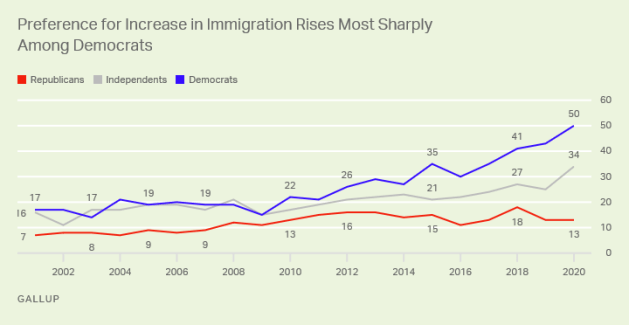
Support for increased immigration is at historic highs this year among both Democrats and political independents. Republicans’ views on increasing immigration have not changed much over the past decade. The rise among Democrats and independents coincides with a period of time when Republican leadership has attempted to limit immigration via physical barriers or changes to visa restrictions and de jure bans of immigrants from over 10 countries.

Immigration2

Line graph. Half of Democrats prefer to see immigration increased in US; 13% of Republicans agree. 34% of independents also favor higher levels of immigration.

Most Say Immigration Is Good for America

Nearly 8 in ten (77%) Americans think immigration is a good thing for their country. When measured in this more general sense, public support for immigration shows far less of a partisan divide, and both parties express a more generally positive view of immigration.

Immigration3

Line graph. Nearly 8 in 10 Americans say immigration is a good thing for America. This is virtually unchanged since 2018.

Bottom Line

Gallup’s 2020 update on Americans’ views about immigration finds that public attitudes toward immigration remain mostly positive overall, and support for expanding it is rising noticeably among Democrats and independents.

Immigration has been a key topic for President Trump since he arrived on the political scene. Yet many of his efforts, such as building a physical barrier across the border and opposing a path to citizenship for DACA immigrants, have failed to garner widespread support beyond his political base. But Trump may not be as concerned with getting majority support for his policies as he is in using the issue to energize his political base.

Trump’s policies and rhetoric on the issue are likely accomplishing that goal but may also be serving to make people outside his base more positive toward immigration.

Source: Americans Want More, Not Less, Immigration for First Time

How innovative news outlets are meeting the needs of immigrant communities

Ethnic media in the USA study:

At a time when all of journalism is in an existential crisis, the financial pressure on resource-deprived immigrant outlets is greater than ever. Yet the pandemic, and the protests over the killing of George Floyd, Breonna Taylor and dozens of others, have put innovative immigrant-serving digital outlets into overdrive, as reporters squelch rumors via WeChat and Facebook Live and beam interviews with local officials into living rooms via Roku and JadooTV boxes.

The most successful of these outlets – as measured by ballooning audience numbers – rely on tireless reporters and anchors with a direct line to listeners and viewers. Journalists like Mario Guevara with Mundo Hispánico in Atlanta have made it their business to maintain contact with immigrants using social media. Guevara listens to their questions, hears their complaints, and then gives them the critical information and support they need. That, rather than news flashes or push notifications, has become the lifeblood of immigrant media. Guevara, with nearly half a million Facebook followers on his personal account, recently livestreamed as he took a rubber bullet to his leg while interviewing Latino kids on why they were out protesting against the police.

For many immigrant communities, these outlets provide information they just can’t get from other sources. “The local media landscape is predominantly white,” said Mukhtar Ibrahim, the Somali-American editor of Sahan Journal in St. Paul. When he went to report on the protests and looting in Minneapolis, which occurred essentially in the backyard of many Somali residents, he was struck by how few journalists of color were covering the story. But he was not surprised. Most newsrooms in Minnesota, said Ibrahim, are “slow in making news coverage more inclusive, despite the increasing diversity and the rapid growth of Minnesota’s immigrant population.”

In contrast, immigrant outlets are vital sources of information for people from indigenous farmworkers to Chinese engineers to Somali Uber drivers. On the Chinese social media app WeChat, Houston Online documented empty Chinese-owned businesses well before most U.S. outlets were paying attention to the pandemic’s reach. Punjabi Radio USA in Northern California reported on dangerous rest stop conditions for truckers, one of their main listener groups. And as Queens emerged as an epicenter of coronavirus in the U.S., TBN24, a Bangladeshi digital television outlet with more than 2.7 million followers on Facebook alone, informed viewers about everything from how to get a stimulus check to how to connect with funeral homes.

The technology may be new, but today’s immigrant outlets build on a long history of serving their communities in crisis. During the 1992 Los Angeles civil unrest and riots, Radio Korea shut down all broadcasting operations and became a control center fielding hundreds of calls for help as businesses burned and police were nowhere to be found. These days, when the station does live programs, hosts will often collect comments and poll listeners via KakaoTalk, a social media popular in Korea, as well as run a YouTube live chat.

Radio Korea connects with listeners via KakaoTalk and live broadcasts on YouTube where there is active commentary.

Wielding new technologies can generate huge followings for immigrant media outlets, but these followers are not paying the bills. In coming months, while some immigrant outlets will surely go out of business, the nimble and the scrappy may yet show the way to survive and even thrive. They’ve embraced virtually cost-free digital platforms and delivery systems, so there’s not much room to slash expenses. On the revenue side, ads have plummeted dramatically. Still, glimmers of hope can be found in new models, from going the non-profit route to building auxiliary businesses that aren’t journalism, but fund it.

For the past year, the Center for Community Media has been studying news outlets serving immigrant communities for models of growth and innovation. The cross-currents that have battered community media outlets across the nation threaten their sustainability, and the Center for Community Media has responded by redirecting its mission to help outlets develop survival skills. This report is part of that effort. [A shorter “preview” version of this report was published by CCM in early April.]

We interviewed and surveyed more than 150 people in 30 states to identify outlets that are in the vanguard. The editors and reporters we spoke with come from around the world and have different strengths in radio, broadcast, print, and digital. Yet we found that the best of them have been successful at converging around multiplatform practices. In particular, we found that immigrant-serving news outlets are evolving in four key ways:

  • Wielding social media for community engagement. In recent years the internet decimated classified ads, shrinking revenues for many immigrant-serving newspapers, while social media that trafficked in rumors decimated their audiences. Now, successful immigrant-serving outlets are using social media as a way to offer verified information, cultivate community conversations, and respond to concerns. Live broadcasting is booming, with the unparalleled immediacy and shareability of bringing viewers to a news conference, community festival, or a drive-through coronavirus testing station. Some outlets are even operating primarily on social media platforms like WeChat, WhatsApp, YouTube, and Facebook.
  • Leveraging a small staff to reach big audiences. Media outlets serving immigrant communities have historically been relatively small operations, but with delivery technologies like livestreaming on Facebook or “micro-TV stations,” being small is no longer an impediment to being timely, and may even work in an outlet’s favor. One-person operations can report, produce and broadcast – and consequently boost audiences substantially at very low cost at a time when revenue models are challenged.
  • Globalizing both production and audiences. Increasingly, outlets are hiring staffers overseas to cut costs, while stateside reporters serve both the diaspora in the U.S. and home country audiences. The geolocation of audiences has shifted dramatically in recent years, as reverse migration, press restrictions overseas, and far-flung diasporas boost audiences for immigrant media based in the U.S. Dynamic outlets are becoming transnational enterprises. One Brazilian newspaper in Massachusetts reported it has 60% of its audience in the U.S. and 30% in Brazil while a Hmong outlet in Wisconsin reported 40% of its audience comes from outside of the U.S.
  • Diversifying business models and revenue streams. Even before the pandemic, immigrant media was feeling the pain of ad cuts. Now, though, a few are reporting that their funding sources are stable or even growing modestly. That’s thanks to a grab-bag of strategies, from operating as a non-profit to lining up grant funding to getting government advertising to targeting supplement funding sources. Our database shows 13 out of 50 outlets are non-profit, while a handful have put up e-commerce sites, developed a consulting business and even launched English-language classes to boost the bottom line.

You can read the Center For Community Media’s full report here, plus find case studies and a database.

Source: How innovative news outlets are meeting the needs of immigrant communities

As Donald Trump tightens immigration rules, Indian tech students ditch the American Dream for Canada

Yet another article of the shift with some interesting data:

Indian students are slowly getting over their fascination with the US.

The number of Indians enrolled in graduate-level computer science and engineering courses at American universities declined by more than 25% between 2016-’17 and 2018-’19, according to an analysis of government data by the National Foundation for American Policy.

The key factors for this decline are “more restrictive immigrationand international student policies under the [Donald] Trump administration and the difficulty of obtaining green cards in the United States,” the think tank focused on public policy research on trade and immigration said in a report published on June 8.

Data: National Foundation for American Policy, US Department of Homeland Security, US Immigration and Customs Enforcement, special tabulations (2018) of the Student and Exchange Visitor Information System (SEVIS) database via Quartz

This decline is a massive hit to the entire international tech student population in the US, as Indians form an outsized proportion of the group.

Data: National Foundation for American Policy, US Department of Homeland Security, US Immigration and Customs Enforcement, special tabulations (2018) of the Student and Exchange Visitor Information System (SEVIS) database via Quartz

America’s loss

In a letter dated June 2, 21 members of the US Congress highlighted that international students and their families contributed approximately $41 billion to the US economy in 2018-’19 alone, despite making up just 5.5% of overall US college enrollments. This cohort subsidises tuition for many domestic students.

Moreover, “as a source of research assistants, graduate students help professors conduct research and retain top faculty,” the National Foundation for American Policy report said. “Without the ability to perform high-level research, many leading professors would move on to other careers, which would weaken American universities as a global centre for science.”

While the US is losing out on Indian talent, its neighbour is making strides.

Canada’s gain

National Foundation for American Policy’s research shows that the share of Indian students in Canada more than doubled between the academic years 2016-’17 and 2018-’19.

Data: Canadian Bureau for International Education, National Foundation for American Policy via Quartz

Unlike America’s hardline approach, Canada’s policies have been incentivising students. In June 2018, Immigration, Refugees and Citizenship Canada announced the Student Direct Stream for China, India, Vietnam, and the Philippines. Students from these four countries enrolled in any of the 1,400-plus designated learning institutes in Canada can fast-track their applications, as long as they pass English-language tests and prove they are financially stable.

While the US has suspended immigration due to coronavirus outbreak and is reconsidering the post-graduate work programme Optional Practical Training, Canada isn’t letting Covid-19 get in its way.

As of May 14, international students with valid study permits in Canada from before March 18 have been exempted from the travel restrictions contingent on passing health checks and following isolation protocols.

Not just students but even Indian working professionals have been flocking to Canada as Trump’s anti-immigration rhetoric builds up. Several Indian techies have been swapping Silicon Valley for the more immigrant-friendly neighbour.

“Canada is benefiting from a diversion of young Indian tech workers from US destinations, largely because of the challenges of obtaining and renewing H-1B visas and finding a reliable route to US permanent residence,” said Peter Rekai, founder of the Toronto-based immigration law firm Rekai LLP. The country even offers express entry for skilled immigrants.

Moreover, Canada allows permanent residents to apply for citizenship after six years. Indian permanent residents admitted into the country jumped up over 117% between fiscal years 2016 and 2019, National Foundation for American Policy found.

Source: As Donald Trump tightens immigration rules, Indian tech students ditch the American Dream for Canada

What Do Coronavirus Racial Disparities Look Like State By State?

More on race-based data:

In April, New Orleans health officials realized their drive-through testing strategy for the coronavirus wasn’t working. The reason? Census tract data revealed hot spots for the virus were located in predominantly low-income African-American neighborhoods where many residents lacked cars.

In response, officials have changed their strategy, sending mobile testing vans to some of those areas, says Thomas LaVeist, dean of Tulane University’s School of Public Health and Tropical Medicine and co-chair of Louisiana’s COVID-19 Health Equity Task Force.

“Data is the only way that we can see the virus,” LaVeist says. “We only have indicators. We can’t actually look at a person and tell who’s been infected. So what we have is data right now.”

Until a few weeks ago, racial data for COVID-19 was sparse. It’s still incomplete, but now 48 states plus Washington D.C., report at least some data; in total, race or ethnicity is known for around half of all cases and 90% of deaths. And though gaps remain, the pattern is clear: Communities of color are being hit disproportionately hard by COVID-19.

Public health experts say focusing on these disparities is crucial for helping communities respond to the virus effectively — so everyone is safer.

“I think it’s incumbent on all of us to realize that the health of all of us depends on the health of each of us,” says Dr. Alicia Fernandez, a professor of medicine at the University of California San Francisco, whose research focuses on health care disparities.

NPR analyzed COVID-19 demographic data collected by the COVID Racial Tracker, a joint project of the Antiracist Research & Policy Center and the COVID Tracking Project. This analysis compares each racial or ethnic group’s share of infections or deaths — where race and ethnicity is known — with their share of population. Here’s what it shows:

  • Nationally, African-American deaths from COVID-19 are nearly two times greater than would be expected based on their share of the population. In four states, the rate is three or more times greater.
  • In 42 states plus Washington D.C., Hispanics/Latinos make up a greater share of confirmed cases than their share of the population. In eight states, it’s more than four times greater.
  • White deaths from COVID-19 are lower than their share of the population in 37 states and the District of Columbia.

Major holes in the data remain: 48% of cases and 9% of deaths still have no race tied to them. And that can hamper response to the crisis across the U.S., now and in the future, says Dr. Utibe Essien, a health equity researcher at the University of Pittsburgh who has studied COVID-19 racial and ethnic disparities.

“If we don’t know who is sick, we’re not going to know in six months, 12 months, 18, however long it takes, who should be getting the vaccination. We’re not going to know where we should be directing our personal protective equipment to make sure that health care workers are protected,” he says.

A heavy toll of African-American deaths

NPR’s analysis finds that in 32 states plus Washington D.C., blacks are dying at rates higher than their proportion of the population. In 21 states, it’s substantially higher, more than 50% above what would be expected. For example, in Wisconsin, at least 141 African Americans have died, representing 27% of all deaths in a state where just 6% of the state’s population is black.

“I’ve been at health equity research for a couple of decades now. Those of us in the field, sadly, expected this,” says Dr. Marcella Nunez-Smith, director of the Equity Research and Innovation Center at Yale School of Medicine.

“We know that these racial ethnic disparities in COVID-19 are the result of pre-pandemic realities. It’s a legacy of structural discrimination that has limited access to health and wealth for people of color,” she says.

African-Americans have higher rates of underlying conditions, including diabetes, heart disease, and lung disease, that are linked to more severe cases of COVID-19, Nunez-Smith notes. They also often have less access to quality health care, and are disproportionately represented in essential frontline jobs that can’t be done from home, increasing their exposure to the virus.

Data from a recently published paper in the Annals of Epidemiology reinforces the finding that African-Americans are harder hit in this pandemic. The study from researchers at amfAR, the Foundation for AIDS Research, looks at county-level health outcomes, comparing counties with disproportionately black populations to all other counties.

Their analysis shows that while disproportionately black counties account for only 30% of the U.S. population, they were the location of 56% of COVID-19 deaths. And even disproportionately black counties with above-average wealth and health care coverage bore an unequal share of deaths.

“There’s a structural issue that’s taking place here, it’s not a genetic issue for all non-white individuals in the U.S.,” says Greg Millett, director of public policy at amfAR and lead researcher on the paper.

Hispanics bear a disproportionate share of infections

Latinos and Hispanics test positive for the coronavirus at rates higher than would be expected for their share of the population in all but one of the 44 jurisdictions that report Hispanic ethnicity data (42 states plus Washington D.C.). The rates are two times higher in 30 states, and over four times higher in eight states. For example, in Virginia more than 12,000 cases — 49% of all cases with known ethnicity — come from the Hispanic and Latino community, which makes up only 10% of the population.

Fernandez has seen these disparities first-hand as an internist at Zuckerberg San Francisco General Hospital. While Latinos made up about 35% of patients there before the pandemic, she says they now make up over 80% of COVID-19 cases at the hospital.

“In the early stages, when we were noticing increased Latino hospitalization at our own hospital and we felt that no one was paying attention and that people were just happy that San Francisco was crushing the curve,” she says. “It felt horrendous. It felt as if people were dismissing those lives. … It took people longer to realize what was going on.”

Like African-Americans, Latinos are over-represented in essential jobs that increase their exposure to the virus, says Fernandez. Regardless of their occupation, high rates of poverty and low wages mean that many Latinos feel compelled to leave home to seek work. Dense, multi-generational housing conditions make it easier for the virus to spread, she says.

The disproportionate share of deaths isn’t as stark for Latinos as it is for African-Americans. Fernandez says that’s likely because the U.S. Latino population overall is younger — nearly three-quarters are millennials or younger, according to data from the Pew Research Center. But in California, “when you look at it by age groups, [older] Latinos are just as likely to die as African-Americans,” she says.

Other racial groups

While data for smaller minority populations is harder to come by, where it exists, it also shows glaring disparities. In New Mexico, Native American communities have accounted for 60% of cases but only 9% of the population. Similarly, in Arizona, at least 136 Native American have died from COVID-19, a striking 21% of deaths in a state where just 4% of the population are Native American.

In several states Asian Americans have seen a disproportionate share of cases. In South Dakota, for example, they account for only 2% of the population but 12% of cases. But beyond these places, data can be spotty. In Iowa, Maine, Michigan, Oklahoma and Wisconsin, Asian Americans and Hawaiian and Pacific Islanders are counted together, making comparison to census data difficult.

Fernandez points out that if COVID-19 demographic reporting included language, public health officials might see differences among different Asian groups, such as Vietnamese or Filipino Americans. “That’s what’s going to allow public health officials to really target different communities,” she says. “We need that kind of information.”

Understanding the unknowns

Months into the pandemic, painting a national picture of how minorities are being affected remains a fraught proposition, because in many states, large gaps remain in the data.

For instance, in New York state — until recently the epicenter of the the U.S outbreak — race and ethnicity data are available for deaths but not for cases. In Texas, which has a large minority population and a sizable outbreak, less than 25% of cases and deaths have race or ethnicity data associated with them.

There are also still concerns about how some states are collecting data, says Christopher Petrella, director of engagement for the Antiracist Research and Policy Center at American University. For example, he says West Virginia, which claims to have race data for 100% of positive cases and 82% of deaths only reports three categories: white, black and “other.”

Also some states appear to be listing Hispanics under the white category, says Samantha Artiga, director of the Disparities Policy Project at Kaiser Family Foundation,

“There’s a lot of variation across states in terms of how they report the data that makes comparing the data across states hard, as well as getting a full national picture,” Artiga says.

But experts fear that the available data actually undercounts the disparity observed in communities of color.

“I think we have the undercount anyway, because we know that minority communities are less likely to be tested for COVID-19,” says Millett. NPR’s own analysis found that in four out of six cities in Texas, testing sites were disproportionately located in whiter communities. Millet points to a recent study, released pre-peer review, that found that when testing levels went up in disadvantaged neighborhoods in Philadelphia, Chicago and New York City, so too did the evidence of the disproportionate impact of COVID-19 on these communities.

Lawmakers have raised concern about the way the Centers for Disease Control and Prevention reports racial and ethnic data; the agency didn’t report on demographics early on in the crisis, and even now it updates it weekly but with a one- to two-week lag. Democratic senators Patty Murray of Washington and Democratic Rep. Frank Pallone, Jr., of New Jersey called a recent report on demographics the CDC submitted to Congress “woefully inadequate.”

“The U.S. response to COVID-19 has been plagued by insufficient data on the impact of the virus, as well as the federal government’s response to it,” Murray and Pallone wrote in a letter sent May 22 to Health and Human Services Secretary Alex Azar. They called on the Trump administration to provide more comprehensive demographic data.

A tailored public health response

Essien says he’s heard concerns from colleagues that by focusing on race and ethnicity in the disease, “some of the empathy for managing and treating is going to go away.”

“If people feel like, ‘Well, this is a them problem and not a me problem… then that may potentially affect the way that people think about the opening up of the country,” he says.

But unless testing and other resources are directed now to communities that need them most, the pandemic will go on for everyone, says Nunez-Smith.

“This is important for everyone’s health and safety,” she says.

Nunez-Smith says race and ethnicity data is necessary for officials to craft tailored public health responses.

For many people, physical distancing is a privilege,” she says. “If you live in a crowded neighborhood or you share a household with many other people, we need to give messaging specific to those conditions. If you need to leave work every day or leave home for work every day, if you need to take public transportation to get to an essential front line job, how can you keep safe?”

A tailored public health response is already happening in Louisiana, where LaVeist says his task force has recently recruited celebrities like Big Freedia, a pioneer of the New Orleans hip-hop subgenre called bounce, to counter misinformation and spread public health messages about COVID-19 to the African-American community.

Given the pandemic’s disparate toll on communities of color, in particular low-income ones, Fernandez and Nunez-Smith say the public health response should include helping to meet basic needs like providing food, wage supports and even temporary housing for people who get sick or exposed to the virus.

“We have to guarantee that if we recommend to someone that they should be in quarantine or they should be in isolation, that they can do so safely and effectively,” Nunez-Smith says.

Nunez-Smith says if you don’t direct resources now to minority communities that need them most, there’s a danger they might be less likely to trust and buy into public health messaging needed to stem the pandemic. Already, polls show widespread distrust of President Trump among African-Americans, and that a majority of them believe the Trump administration’s push to reopen states came only after it became clear that people of color were bearing the brunt of the pandemic.

Fernandez notes that among Latinos, distrust could also hamper efforts to conduct effective contact tracing, because people who are undocumented or in mixed-status families may be reluctant to disclose who they’ve been in contact with.

“This is a terrible time for all of us who do health equity work,” says Fernandez, “partly because this is so predictable and partly because we’re standing here waving our arms saying, ‘Wait, wait. We need help.’ “

Source: What Do Coronavirus Racial Disparities Look Like State By State?

COVID-19 can’t be used as an excuse to limit skilled immigration

More commentary in the US business press on the risks to the US economy of restrictions on high-skilled immigration (H-1B and OPT:

Memorial Day is an excellent opportunity to celebrate the contributions immigrants have made to America. However, worrying news has emerged that the Trump administration plans to limit highly skilled immigration in an attempt to goose employment.

Such a policy shift would not only be deleterious to our nation, but an ill-founded solution to spiraling unemployment.

From the earliest days of the republic, immigrants have been vital to our national identity. Hot dogs andhamburgers are products of immigrants, and immigrants have played a part in founding iconic American companies like Google, Tesla, and Uber. But now, the administration and some lawmakers are using the coronavirus crisis as an excuse to tear down programs that have helped bring talented workers and students to the U.S., where they are crucial contributors to our economy.

The two most prominent programs being targeted are H-1B visas and Optional Practical Training, or OPT. H-1B visas allow U.S. employers to temporarily hire foreign workers in occupations that require specialized knowledge and skills, with stays ranging from three to six years. OPT allows foreigners with student visas to work in the U.S. following graduation for periods between one and three years, depending on their field of study.

Restricting these programs could have an enormous impact on the tech and engineering fields. Many leading U.S. companies were founded by immigrants and depend upon these programs to employ talented international students and workers. About 18% of the entire labor force is foreign-born, with one in four STEM workers being an immigrant, according to an American Immigration Council analysis of American Community Survey data.

Furthermore, more than half of startups with revenues of $1 billion or higher have immigrant founders or cofounders, according to a National Foundation for American Policy study. And immigrants or children of immigrants are responsible for founding or cofounding 45% of 2019’s Fortune 500 companies, per New American Economy.

International students, who make up over 5% of American university students with more than 1 million studying here, contributed about $45 billion to the U.S. economy in 2018, according to the Institute of International Education.

Our health care system will also be at risk from a policy change. The pandemic has highlighted the role of health care workers in our society, so limits on highly skilled immigration could have fatal consequences for Americans.

Colleges are already fearing the impact of COVID-19 on enrollments and endowments; we are simply not in a financial position to reject qualified students who dream of studying and working in our nation.

To be sure, some schools operate as irresponsible “visa mills” that trade a substandard education for work opportunities in the U.S. But that problem can be solved by not extending H-1B and OPT authorization to students from those colleges and universities.

COVID-19 has had a devastating impact on all of us, but this crisis should not be used as an excuse to allow xenophobia to stifle our future growth. The U.S. has been and always should be a nation of immigrants. Now more than ever, we must remember the importance of immigration, which has fueled technological ingenuity and economic productivity for our entire history, shaping America’s character as a symbol of freedom and innovation.

Welcoming highly skilled and talented foreign students and workers is our best path to promoting employment of native-born Americans. We need great minds from all corners of the world to preserve America’s technological prowess, social diversity, and economic vitality. Preserving the H-1B and OPT programs will benefit us all.

Source: COVID-19 can’t be used as an excuse to limit skilled immigration

COVID-19: Thousands of Canadians getting US$1,200 cheques simply because they’re still U.S. citizens

Including, presumably Conservative leader Andrew Scheer and Green leader Elizabeth May:

Thousands of people in Canada can expect a letter shortly from the U.S. Treasury Department.

However, you’re (probably) not in trouble. In fact, you’re most likely receiving a US$1,200 cheque thanks to America’s stimulus package.

One of the responses to the COVID-19 pandemic put in place by the U.S. government was Economic Impact Payments. Through it, most current American citizens who filed taxes in 2018 or 2019 will automatically be sent US$1,200 ($1,680) as long they make less than US$75,000 if they are single or US$150,000 if married.

And that includes U.S. citizens in Canada. Unlike Canadian benefit programs put in place during the pandemic, the U.S. program doesn’t require beneficiaries to live in their own country.

“The reason being that the U.S. is one of only two countries in the world that tax based on citizenship. So a U.S. citizen, wherever they live in the world, is always subject to U.S. tax, which is different than Canada,” said Mark Feigenbaum, an Ontario-based attorney and accountant specialized in cross-border taxes.

But that doesn’t mean his Canadian clients aren’t surprised when the money suddenly arrives in their mailboxes.

“I get a couple of pictures of cheques every day from clients,” he said. “First of all, they weren’t maybe even aware that they were supposed to get a cheque, and secondly, that they were even qualified for a cheque. And then they got a bunch of money.”

According to Statistics Canada 2016 census data, 284,870 people in Canada declared having U.S. citizenship.

One of them is Charles Lewis, a dual U.S. and Canadian citizen who received a cheque in the mail last week.

“I read three weeks ago that the payment was coming to those who file so when it did come I was not surprised at all. It came in an envelope from the U.S. Treasury Department. Soon as I looked at the envelope I knew what it was. I had to laugh that Trump’s name was on the cheque, given it’s not his money,” Lewis told the National Post.

“I think those who get it and were not really in need should donate it to charity, which is what I’m going to do. It’s really found money. I did nothing to earn it. Though filling out all those tax forms every year was a pain in the ass.”

According to the Internal Revenue Service, the agency that administers the Economic Impact Payment program, nearly 750,000 stimulus cheques have gone out to “foreign addresses,” totalling $1.2 billion.

But the IRS can’t say how many of those went to people in Canada.

“Foreign addresses doesn’t necessarily imply non-Americans. Members of the military and U.S. citizens who live or work abroad would be in that category, along with non-citizens who may have, for tax purposes, U.S. resident alien status,” spokesman Eric Smith said via email.

“The domestic numbers likely also include resident aliens, and Canadians are likely in both the domestic and foreign categories,” Smith said.

A large number of U.S. citizens living in Canada are also interested in finding out how they can get their hands on an American stimulus cheque.

According to Steve Nardi, chair of Democrats Abroad Canada, a workshop his group hosted a few weeks ago about the American stimulus package attracted 600 people, 80 per cent of whom were from Canada.

“In the last two weeks, I’ve had another thousand people on tax filing webinars, and most of them are interested in at least accessing the information about the stimulus cheques,” Nardi said in an interview.

He said he’s mainly encountered two groups of recipients: those who knew from the very start that they’d receive a cheque, and those who were stunned (and sometimes concerned) when the money arrived at their door.

“I had emails from members asking if they were eligible, and the only thing that happened at that point was the Senate approved the (stimulus) bill late the night before. It hadn’t even gotten across the building to the House yet,” he recounted.

“And then we’ve had others who were completely shocked that they would be eligible with no expectation.”

But be warned, if you’re an American in Canada who’s eligible to apply for the Canada Emergency Response Benefit (CERB) because you lost your job due to COVID-19, you may want to think twice before cashing that US$1,200 cheque.

To be eligible to receive CERB payments, you have to have made less than $1,000 in the period during which you’re applying. Depending on if the Canada Revenue Agency determines that stimulus money from the American government is revenue or not, depositing that cheque from the U.S. may make you ineligible for CERB.

Employment and Social Development Canada was not able to provide a comment.

Source: COVID-19: Thousands of Canadians getting US$1,200 cheques simply because they’re still U.S. citizens

OPTing out of immigration is not an option for India or the United States

Although written for an Indian audience, given the likely significant number of Canadians studying in the US, this change, should it proceed, will have an impact on them:

Although some students return home to India after graduating, for the majority, the US academic journey is premised on continuing pursuit of the ‘American dream’. Their F-1 student visa allows a one-year (three years in case of STEM students) paid Optional Practical Training (OPT) that usually results in a full-time job, typically on an H-1B visa. Separately, tens of thousands of skilled white-collar professionals from India also come to the US on H-1B visa, for short- and long-term projects that often turn into life-long employment in the US. Over decades, these two streams have combined to form the core of a thriving Indian-American community of more than 4 million people that is America’s best educated and highest earning ethnic group.

The pandemic has not only disrupted the annual commencement ritual but also threatens to dismantle the template that led to the formation of this cohort. The destruction of the job market that has rendered some 36 million Americans jobless has all but destroyed the ‘American dream’ of millions of eventually high net worth immigrants who have made the US what it is: a rich, vibrant, innovative melting pot. Thousands of students and guest workers are currently in limbo, not knowing what the future holds, their academic planning, job prospects, and just about everything, including travel plans, on hold.

Their misery is compounded by rising nativist, xenophonic, anti-immigrant sentiment from a Trump base that sees foreign students and guest workers “stealing” American jobs. It’s an understandable sentiment in times of despair, except this was an undercurrent even before the coronavirus struck. There are other issues with this argument: The US by itself does not produce enough qualified graduates, particularly in STEM fields, to meet the needs of its industries and corporations. The reason Microsoft, Google, Apple and other companies back immigration is not because foreign workers come cheap (a fiction that ignores the fact that the labour department requires certification that they are well-paid); they do it because they need global talent.

Such a composite internationalist workforce also gives US companies a foothold into new markets. The entry of Texas Instruments, Hewlett Packard, and other companies into India in the 1980s was spearheaded by Indians working for those companies in America. This globalist engagement is lost on nativists in the US, and even in India, where for the longest time there were complaints about losing its best minds and talent before realisation dawned that “brain drain is better than brain in the drain”. India’s investment in human capital in the US and elsewhere yielded unexpected benefits, among them foreign exchange remittances that offset the $8 billion spent on foreign education and influencing global perception of India.

Of course, US nativists and critics of the guest worker visa are correct that there has been abuse of the programme. Unscrupulous body shoppers and companies have manipulated the system, and this needs cleaning up. But hosting foreign students and guest workers is a net gain for the US and for countries that send their students and workers to America. Physicist and futurist Michio Kaku calls the H-1B visa America’s “secret weapon” without which the US would be an also ran, pointing out that 50% of all PhD candidates in the US are foreign born.

The salience of immigrants has been particularly striking during the pandemic, when they have been on the frontlines. According to the National Academies of Sciences, Engineering and Medicine, while 16% of the US workforce is foreign born, immigrants account for nearly 25% of physicians and dentists, 20% of engineers, 23.5% of computer specialists and almost 30% of scientists.

The skills that H-1B workers bring with them can be critical in responding to national emergencies, argues the American Immigration Council, pointing out that over the past decade eight companies currently trying to develop a coronavirus vaccine – Gilead Sciences, Moderna Therapeutics, GlaxoSmithKline, Inovio Pharmaceuticals, Johnson & Johnson Pharmaceuticals, Regeneron Pharmaceuticals, Vir Biotechnology, and Sanofi – received approvals for 3,310 biochemists, biophysicists, chemists, and other scientists through the H-1B programme.

So opting out of immigration is not an option for the US, or for countries such as India that thrive in a myriad ways on US immigration. April was the cruellest month for travel, tourism and immigration. Rough winds did shake the darling buds of May, but may June restore reason and sanity.

Source: Darling buds of may: OPTing out of immigration is not an option for India or the United States