US citizenship test changes are coming, raising concerns for those with low English skills

Similar debates when Canada changed the citizenship test in 2009. The initial drop in pass rates from about 95 percent to 85 percent eventually resulted in changes that resulted in a more reasonable pass rate of 91-92 percent more recently. But literacy, education and the related familiarity with tests all played a role:

The U.S. citizenship test is being updated, and some immigrants and advocates worry the changes will hurt test-takers with lower levels of English proficiency.

The naturalization test is one of the final steps toward citizenship — a monthslong process that requires legal permanent residency for years before applying.

Many are still shaken after former Republican President Donald Trump’s administration changed the test in 2020, making it longer and more difficult to pass. Within months, Democratic President Joe Biden took office and signed an executive order aimed at eliminating barriers to citizenship. In that spirit, the citizenship test was changed back to its previous version, which was last updated in 2008.

In December, U.S. authorities said the test was due for an update after 15 years. The new version is expected late next year.

U.S. Citizenship and Immigration Services proposes that the new test adds a speaking section to assess English skills. An officer would show photos of ordinary scenarios – like daily activities, weather or food – and ask the applicant to verbally describe the photos.

In the current test, an officer evaluates speaking ability during the naturalization interview by asking personal questions the applicant has already answered in the naturalization paperwork.

“For me, I think it would be harder to look at pictures and explain them,” said Heaven Mehreta, who immigrated from Ethiopia 10 years ago, passed the naturalization test in May and became a U.S. citizen in Minnesota in June.

Mehreta, 32, said she learned English as an adult after moving to the U.S. and found pronunciation to be very difficult. She worries that adding a new speaking section based on photos, rather than personal questions, will make the test harder for others like her.

Shai Avny, who immigrated from Israel five years ago and became a U.S. citizen last year, said the new speaking section could also increase the stress applicants already feel during the test.

“Sitting next to someone from the federal government, it can be intimidating to talk and speak with them. Some people have this fear anyway. When it’s not your first language, it can be even more difficult. Maybe you will be nervous and you won’t find the words to tell them what you need to describe,” Avny said. “It’s a test that will determine if you are going to be a citizen. So there is a lot to lose.”

Another proposed change would make the civics section on U.S. history and government multiple-choice instead of the current oral short-answer format.

Bill Bliss, a citizenship textbook author in Massachusetts, gave an example in a blog post of how the test would become more difficult because it would require a larger base of knowledge.

A current civics question has an officer asking the applicant to name a war fought by the U.S. in the 1900s. The applicant only needs to say one out of five acceptable answers – World War I, World War II, Korean War, Vietnam War or Gulf War – to get the question right.

But in the proposed multiple-choice format, the applicant would read that question and select the correct answer from the following choices: A. Civil War B. Mexican-American War C. Korean War D. Spanish-American War

The applicant must know all five of the wars fought by the U.S. in the 1900s in order to select the one correct answer, Bliss said, and that requires a “significantly higher level of language proficiency and test-taking skill.”

Currently, the applicant must answer six out of 10 civics questions correctly to pass. Those 10 questions are selected from a bank of 100 civics questions. The applicant is not told which questions will be selected but can see and study the 100 questions before taking the test.

Lynne Weintraub, a citizenship coordinator at Jones Library’s English as a Second Language Center in Massachusetts, said the proposed format for the civics section could make the citizenship test harder for people who struggle with English literacy. That includes refugees, elderly immigrants and people with disabilities that interfere with their test performance.

“We have a lot of students that are refugees, and they’re coming from war-torn countries where maybe they didn’t have a chance to complete school or even go to school,” said Mechelle Perrott, a citizenship coordinator at San Diego Community College District’s College of Continuing Education in California.

“It’s more difficult learning to read and write if you don’t know how to do that in your first language. That’s my main concern about the multiple-choice test; it’s a lot of reading,” Perrott said.

U.S. Citizenship and Immigration Services said in a December announcement that the proposed changes “reflect current best practices in test design” and would help standardize the citizenship test.

Under federal law, most applicants seeking citizenship must demonstrate an understanding of the English language – including an ability to speak, read and write words in ordinary usage – and demonstrate knowledge of U.S. history and government.

The agency said it will conduct a nationwide trial of the proposed changes in 2023 with opportunities for public feedback. Then, an external group of experts — in the fields of language acquisition, civics and test development — will review the results of the trial and recommend ways to best implement the proposed changes, which could take effect late next year.

The U.S. currently has the easiest citizenship test compared to other Western countries — including Germany, Canada and the United Kingdom — according to Sara Goodman, a political science professor at the University of California, Irvine.

Goodman said she uses the following metrics to determine the difficulty of a test: the number of questions required to pass and the number of questions overall, the percentage of applicants who pass the test, the language level of the test, and whether or not questions with answers are made available to study before taking the test.

In the U.S. test, applicants must answer six out of 10 questions correctly to pass. About 96% of applicants pass the test, according to recent estimates. The test is at a “high beginner” level of English, Goodman said, and a question bank with answers is made available to study beforehand.

But in the German test, Goodman said applicants must answer 17 out of 33 questions correctly to pass. About 90% of applicants pass the test, according to recent estimates. The test is at an “intermediate” level of German, according to Goodman. And a question bank with answers is made available.

The Canada and United Kingdom tests are even harder, and a question bank is not provided in the latter, Goodman said.

Elizabeth Jacobs, director of regulatory affairs and policy at the Center for Immigration Studies – a nonprofit research organization that advocates for less immigration – said the proposed changes would make the U.S. citizenship test even easier for many people.

“We think that’s in the wrong direction,” Jacobs said on behalf of the organization.

The proposed multiple-choice format for the civics section would put the answer to each question in front of applicants, Jacobs said, and would get rid of the memory challenge that’s in the current test.

Jacobs said her organization would prefer a test that includes more material and emphasizes American values, such as religious freedom and freedom of speech, more.

She added that most people who naturalize in the U.S. are not in the country because of merit or refugee status, but because of family sponsorship, where someone in their family became a U.S. citizen before them and petitioned for them to naturalize.

Jacobs said having a stricter test would help ensure that new citizens integrate into American society – and the economy – with sufficient English language skills, as well as promote a healthy democracy with civics knowledge and engagement.

Not everyone agrees.

“Is it important for us to even have a civics test in the first place? I don’t know the answer to that question,” said Corleen Smith, director of immigration services at the International Institute of Minnesota, a nonprofit that connects immigrants to resources.

Smith said USCIS already evaluates whether applicants have past criminal histories, pay taxes and support their children financially.

“They’re already evaluating that portion of your background. Is it also important to know this information about history and government and be able to memorize it?” Smith said, adding: “People that were born in the U.S. and are natural-born citizens — a lot of those folks don’t know many of these answers to the history of government questions.”

More than 1 million people became U.S. citizens in fiscal year 2022 — one of the highest numbers on record since 1907, the earliest year with available data — and USCIS reduced the huge backlog of naturalization applications by over 60% compared to the year before, according to a USCIS report also released in December

Source: US citizenship test changes are coming, raising concerns for those with low English skills

Maximum Canada is happening

Rather naive in terms of minimizing the practicalities of ensuring adequate housing, healthcare and infrastructure, one of the key points that Saunders needed to be addressed in Maximum Canada. And the nation-building aspect overstated, given this gap and persistent low productivity that current policies, with few exceptions, are not addressing. Same large population fallacies:

A lot of people — at least, a lot of people who read this blog — know of Matt Yglesias’ book One Billion Americans. It’s good, you should read it. But not as many seem to know that it’s actually a riff on a book that came out three years earlier called Maximum Canada: Why 35 Million Canadians Are Not Enough, by Doug Saunders. In fact, the books are pretty different; Saunders spends most of his time justifying the idea of a bigger Canada with appeals to the country’s history, culture, and politics, where Yglesias mostly discusses the practical details of how we’d fit the newcomers into the country. 

But what these two books share is that they’re both advocating a certain type of nation-building strategy — the idea of deliberately promoting large-scale immigration in order to expand a country’s population toward a numerical target. This isn’t something the U.S. has really done in the past. We enacted laws to make immigration more or less restrictive, but this was typically done either as an ad-hoc reaction to a wave of immigration pressure from abroad (e.g. in 1924), or out of moral and ideological concerns (e.g. in 1965). To a large extent, we didn’t really have to do this; people were almost always beating down our door to get here, and all we had to do was sit back and decide who to let in. (In the two decades after the Civil War, there was some talk of recruiting immigrants from abroad to populate the Midwest and West, but this was shelved when it turned out lots of people wanted to come of their own accord.) 

Canada, for much of its own history, was similar. But in recent years, the Canadian government has begun to set hard targets for immigration, such as last year’s target of 1.5 million more by 2025. And the country is deliberately encouraging more people to come, with one of the world’s most aggressive recruitment strategies. 

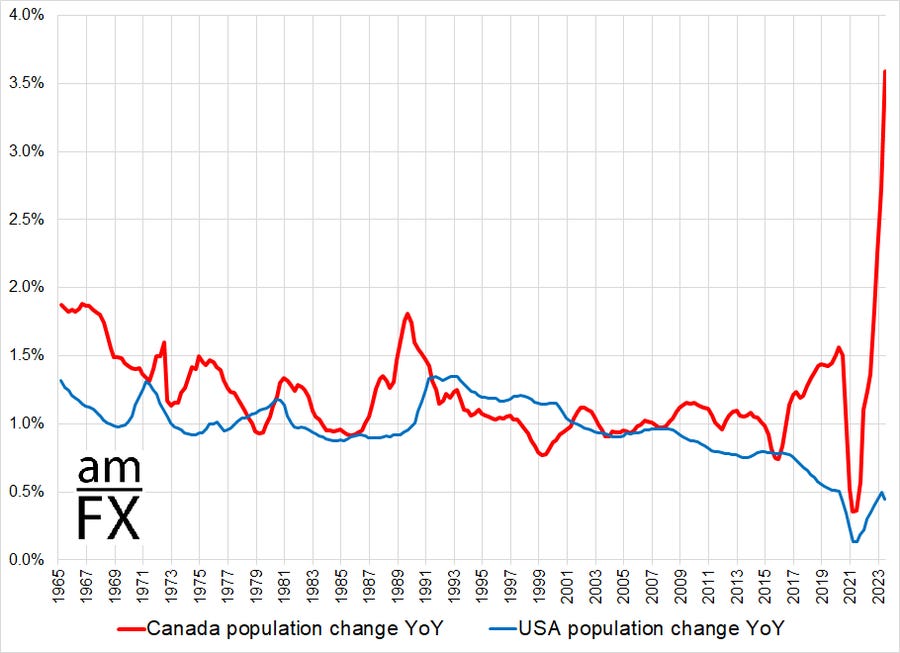
First, let’s just take a look at the results Canada is achieving. The country’s population has just passed 40 million — a 14% increase from when Doug Saunders published Maximum Canada. The national statistics agency loudly celebrated the achievement. And the country’s population growth rate has just shot up to over 3.5%, which is among the world’s fastest:

Source: Brent Donnelly

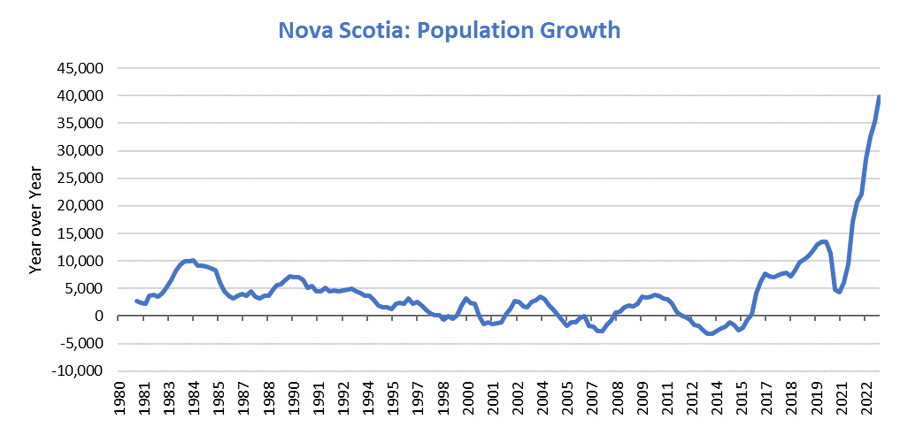
Here’s another fun graph, just from Nova Scotia:

Source: Deny Sullivan

And this is all from immigration. The country’s total fertility rate is 1.4, far below the replacement rate. Yet population is booming because Canada is recruiting from abroad.

This isn’t quite Maximum Canada yet, but it’s clearly headed in that direction. 

And Canada’s zeal for greater population inflows is matched by its determination to recruit the best and the brightest en masse. The country’s points-based immigration system, the Federal Skilled Worker Program, is well-known, as is the Provincial Nominee Program that allows individual Canadian provinces to recruit immigrant workers to specific locations. But the country keeps adding more programs for grabbing talent. Its latest idea includes an offer of permanent residency to people working in the United States on H-1B visas — basically, poaching America’s own skilled immigrants! Here are some excerpts from the announcement:

As part of Canada’s first-ever Tech Talent Strategy, Minister Fraser announced the following aggressive attraction measures:

  • the creation of an open work permit stream for H-1B specialty occupation visa holders in the US to apply for a Canadian work permit, and study or work permit options for their accompanying family members
  • the development of an Innovation Stream under to the International Mobility Program to attract highly talented individuals…
  • the promotion of Canada as a destination for digital nomads
  • the creation of a STEM-specific draw…under the Express Entry program…
  • improvements to the Start-up Visa Program

Canada also has family-based and humanitarian immigration programs like the U.S. does, but the big difference here is that they take absolutely massive numbers of skilled immigrants from all over the world.

All of this adds up to what looks to me like a nation-building strategy. Canada has a clear vision for itself as a multicultural mecca for all of the world’s smart and hard-working people. It’s a bit like Singapore, except more democratic, and without that country’s emphasis on preserving a single ethnicity’s demographic dominance. If you’re smart and you want to work and you like Canadian culture, it doesn’t matter what you look like; you’re in the club. 

What’s amazing is that the vast majority of the country’s populace appears to have signed onto this strategy. As Derek Thompson writes, immigration has not produced a big backlash in Canada, outside of some highly localized concerns (like Chinese capital flight buying up property in Vancouver). A little of this might be from the Anglophone majority’s desire to reduce the political influence of Quebec, but much of it is just that multiculturalism and immigration are deeply rooted in the country’s self-defined national identity. And on top of that, the fact that so much of Canada’s immigration is based on employment prospects and skills probably reduces social friction; immigrants are likely to make a lot of money and not commit much crime. 

There’s also one additional factor that no one talks about, but which would definitely be on my mind if I were Canadian: national security. Canada has a very large, very powerful, and occasionally politically unstable neighbor to its south. It has already defeated one invasion from that southern neighbor, and while more recently relations between the two countries have been friendlier, you never know when attitudes might shift. A country of 100 million would be a lot more capable of resisting the U.S. than a country of 40 million. 

Of course, there are major challenges for Canada’s nation-building strategy. Chief among these is NIMBYism; Canada is huge, but you can’t just scatter your population randomly across the plain (I mean, you can try, but the results are comedic). Modern knowledge-based economies harness clustering and agglomeration effects, which means Canada needs to fit those new millions into its cities. And despite very low crime rates, Canada is having a bit of trouble doing this. Unlike Japan, Canada does not have simple national zoning laws administered by a competent technocratic bureaucracy; instead, local municipalities are free to block housing as they choose. 

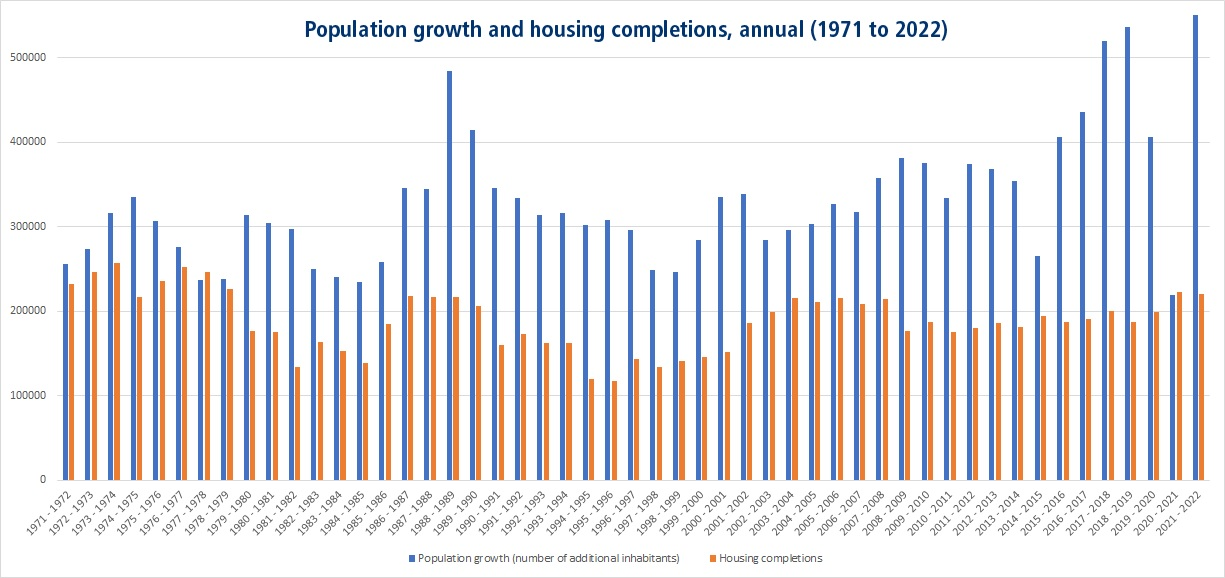
And block it they do. The Fraser Institute notes that Canada is not building nearly enough housing to house its massive population inflows:

And the mismatch has been getting worse over time:

Source: Fraser Institute

Jean-François Perrault of Scotiabank notes that Canada has fewer housing units per 1000 people than France, Germany, Japan, the UK, or even the United States. He writes:

A key challenge is finding an approach that can overcome the political obstacles to a better supply response. Very often within city limits, measures to increase density pit current owners versus prospective residents. Municipal councillors are politically responsive to their voters given the nature of the democratic process. What may be great policy from a national perspective, like high immigration, runs into obstacles when it means finding practical solutions at the local level to increase the housing stock…

To get a sense of the main obstacles to a more elastic supply response, we have polled several of our clients in real estate and development across the country to find the cross-cutting factors they see as most limiting supply growth. To no surprise, the key impediments are in the planning and approval process. In many major cities, the entitlement process is very lengthy and unduly political. Many processes can delay or derail development applications and this can be exacerbated by under-resourced planning departments within cities.

Hmm, where have I heard this story before??

Even Canada’s commitment to multiculturalism is starting to come into conflict with its anti-housing NIMBY instincts. The government returned a plot of land in the middle of downtown Vancouver to the Squamish Nation, which promptly planned a very cool dense housing development with solarpunk aesthetics. The project is still going ahead, but urban planners are now starting to complain about the density, and local residents are trying to stop an access road to the development.

This will simply not do. If you let in tens of millions of people, you must house them; there is simply no other option, other than to let rents continue to skyrocket until the people revolt. Canadian leaders would do well to supplement Doug Saunders’ book with Matt Yglesias’ pragmatic tome. If Canada can’t figure out how to beat its entrenched NIMBY instincts and replace its old ideal of quiet pastoral low-rise cities with one of dense, bustling, efficiently functioning metropolises, it will never achieve Maximum Canada. 

In the meantime, though, we Americans to the south need to take a hard look at what Canada is doing, and ask ourselves why we can’t do something similar. Like Canada, the U.S. is a highly diverse nation of immigrants. Like Canada, our fertility is below replacement (though not quite as bad), and we rely on immigration for population growth. Like Canada, we face the inherent economic disadvantage of being located far from the world population supercluster in Asia, and thus we will always be fighting an uphill battle to get high-value industries to want to locate here. So like Canada, we should be importing huge numbers of skilled immigrants — especially because our software and finance and biotech industry clusters, and our world-beating research universities, make it easier for us to attract skilled immigrants in the first place. We should be playing to our strengths. 

And yet in the U.S., immigration of any kind is now at the center of a vicious culture war. The political right may occasionally claim that they only oppose illegal immigration, or that they want skilled immigration, but when it comes time for actual policy proposals, what they want is just to decrease all types of immigration. The days of pro-immigration Republicans like George W. Bush are gone. In fact, various hard-right figures have specifically railed against immigration from India, which is America’s most important source of skilled immigrants. 

Meanwhile, American progressives, unlike their Canadian counterparts, seem generally unenthusiastic about the idea of mass recruitment of high-skilled foreign workers; my suspicion is that they fear the competition the children of these immigrants will provide for their own children in the academic system. Instead, in recent years, some progressives have begun to lean toward the idea that immigration should be viewed as a form of reparations for colonialism, rather than a strategy for nation-building. Naturally, that absurd idea just triggers the right even more. 

This is a terrible political equilibrium. Survey after survey finds that Americans very strongly support high-skilled immigration, but because it’s a political football, only centrists like Biden seem interested in doing anything about it. Without a popular political mandate, any nation-building strategy like Canada’s is doomed. 

I wish Americans could tell themselves a positive narrative like Canada’s — of immigration as the way to build a multicultural nation. Many of us have tried to tell that narrative, and have foundered on the rocks of America’s age of division. As John Higham wrote, when America is underconfident — when we start to doubt who we are as a people and a nation — we instinctively think about closing the door. Right now, America definitely doesn’t know who we are, as a people and as a nation. Maybe next decade we’ll remember.

Canada, however, does know who they are. And good for them. Now all they have to do is build a bunch of housing, and they’ll be golden. 

Source: Maximum Canada is happening

Here’s what happened when affirmative action ended at California public colleges

Useful case study:

For decades, the question of affirmative action — whether colleges should consider race when deciding which students to admit — has been the subject of national debate.

And as the nation’s highest court has grown more conservative in recent years, court-watchers wondered if it would reverse decades-old precedents allowing affirmative action.

This week, it happened: The Supreme Court struck down race-based admissions practices at public and private universities and colleges.

Supreme Court justices ruled that the admissions policies at the University of North Carolina, one of the country’s oldest public universities, and Harvard University, the country’s oldest private university, violated the equal protection clause of the 14th Amendment.

As college admissions offices prepare to tailor their policies to the Supreme Court ruling, California offers lessons on what may be in store for the rest of the country.

Here’s the upshot: A quarter-century after California banned race-based admissions at public universities, school officials say they haven’t been able to meet their diversity and equity goals — despite more than a half billion dollars spent on outreach and alternative admissions standards.

In an amicus brief sent to the Supreme Court in support of Harvard and UNC’s race-based admissions programs, University of California chancellors said that years of crafting alternative race-neutral policies have fallen short.

“Those programs have enabled UC to make significant gains in its system-wide diversity,” the brief said. “Yet despite its extensive efforts, UC struggles to enroll a student body that is sufficiently racially diverse to attain the educational benefits of diversity.”

The shortfall is especially apparent at the system’s most selective schools, the university leaders said.

An affirmative action ban first caused a huge drop in diversity at top California universities

In 1996, California voters approved Proposition 209, an affirmative action ban at public universities in the state. Before the ban, UC Berkeley and UCLA were roughly representative of the California high school graduate population who were eligible for enrollment at universities, according to Zachary Bleemer, an economist at Princeton University.

The ban first took effect with the incoming class of ’98. Subsequently, diversity plummeted at UC’s most competitive campuses. That year, enrollment among Black and Latino students at UCLA and UC Berkeley fell by 40%, according to a 2020 study by Bleemer. As a result of the ban, Bleemer found that Black and Latino students who might have gotten into those two top schools enrolled at less competitive campuses.

“Black and Hispanic students saw substantially poorer long-run labor market prospects as a result of losing access to these very selective universities,” Bleemer told NPR. “But there was no commensurate gain in long-run outcomes for the white and Asian students who took their place.”

Black and Latino students were also less likely to earn graduate degrees or enter lucrative STEM fields.

“If you follow them into the labor market, for the subsequent 15 or 20 years, they’re earning about 5% lower wages than they would have earned if they’d had access to more selective universities under affirmative action,” Bleemer said.

The ban has in fact acted as a deterrent to prospective Black and Latino students, Bleemer said. His study found that high-performing minority students were subsequently discouraged from applying to schools where minority students were underrepresented.

“Most do not want to attend a university where there’s not a critical mass of same race peers,” said Mitchell Chang, the associate vice chancellor of equity, diversity and inclusion at UCLA. That’s because attending a school made less diverse by an affirmative action ban, “puts them at greater risk of being stereotyped and being isolated,” he said.

These findings “provide the first causal evidence that banning affirmative action exacerbates socioeconomic inequities,” Bleemer’s study said.

A learning curve

Faced with plummeting minority enrollment, admissions offices began a years-long effort to figure out ways to get their numbers back up.

Admissions offices pivoted to a more holistic approach, looking beyond grades and test scores. Starting in the early 2000s, the UC system implemented a couple of initiatives to increase diversity: The top-performing students graduating most high schools in the state were guaranteed admission to most of the eight UC undergraduate campuses. It also introduced a comprehensive review process to “evaluate students’ academic achievements in light of the opportunities available to them” – using an array of criteria including a student’s special skills and achievements, special circumstances and location of high school.

In 2020, the UC system eliminated standardized test scores as an admission requirement, nixing a factor that advocates say disadvantages underserved students.

However, the effort to boost diversity has come with a heavy price tag. Since Prop 209 took effect, UC has spent more than a half-billion dollars on outreach programs and application reviews to draw in a more diverse student body.

It’s taken 25 years of experimentation through race-neutral policies, for UC schools have begun to catch up to the racial diversity numbers lost in the wake of the affirmative action ban, says UCLA vice chancellor Chang.

“There was no magic bullet. Some things worked better than other things. And this is also work that doesn’t happen overnight,” Chang said.

Still, the California schools are unable to meet their diversity goals systemwide. Chang says his school is not where it wants to be. It still enrolls far fewer Black and Latino students than their share of California high school graduates — a problem it didn’t have before the affirmative action ban.

As with the UC system, experts think that across the country, similarly competitive universities will be most affected by the Supreme Court’s ruling.

Gabrielle Starr, president of Pomona College, a small Southern California school that wasn’t subject to the state ban, fears the selective, private university will lose its racial diversity under the nationwide affirmative action ban.

Starr says that being able to consider race has allowed her school to ensure its ability to put together a diverse class.

“Having a campus that looks like the world in which our students will go onto live is really important just as a bedrock value,” she said.

Source: Here’s what happened when affirmative action ended at California public colleges

Supreme Court Decisions on Education Could Offer Democrats an Opening

Interesting take. Welcome return to “class” as a differentiator, although there is intersectionality with race and identity:

Ever since President Bill Clinton advised “mend it, don’t end it,”affirmative action has had an uneasy place in the Democratic coalition, as omnipresent as the party’s allegiance to abortion rights and its promises to expand financial aid for higher education — but unpopular with much of the public.

Now, in striking down race-conscious college admissions, the Supreme Court has handed the Democrats a way to shift from a race-based discussion of preference to one tied more to class. The court’s decision could fuel broader outreach to the working-class voters who have drifted away from the party because of what they see as its elitism.

The question is, will the party pivot?

“This is a tremendous opportunity for Democrats to course-correct from identity-based issues,” said Ruy Teixeira, whose upcoming book “Where Have All the Democrats Gone?” looks at the bleeding of working-class voters over the last decade. “As I like to say, class is back in session.”

Conservative voters have long been more animated by the Supreme Court’s composition than liberals have. But the last two sessions of a high court remade by Donald J. Trump may have flipped that dynamic. Since the court overturned Roe v. Wade in 2022, energized Democratic voters have handed Republicans loss after loss in critical elections.

Republicans’ remarkable successes before the new court may have actually deprived them of combative issues to galvanize voters going into 2024. Several Republican presidential hopefuls had centered their campaigns on opposition to affirmative action. And the court’s granting of religious exemptions to people who oppose gay marriage, along with last year’s Dobbs decision, may take the sting out of some social issues for conservatives.

In that sense, the staunchly conservative new Supreme Court is doing the ugly political work for Democrats. Its decision last year to eliminate the constitutional right to abortion elevated an issue that for decades motivated religious conservatives more than it did secular liberals.

Friday’s decision to strike down President Biden’s student debt relief plan enraged progressive Democrats, who had pressed the president to take executive action on loan forgiveness. A coalition of Generation Z advocacy groups, including Gen-Z for Change and the climate-oriented Sunrise Movement, said on Friday that the court “has openly declared war on young people.”

But while the Supreme Court made retroactive higher education assistance far more difficult, it may have boosted the Democratic cause of financial aid, through expanded Pell grants and scholarships that do not saddle graduates with crushing debt burdens. Democrats have long pushed expanded grant programs and legislative loan-forgiveness programs for graduates who embark on low-paid public service careers. Those efforts will get a lift in the wake of the court’s decision.

The high court’s declaration that race-based admission to colleges and universities is unconstitutional infuriated key elements of the Democratic coalition — Black and Hispanic groups in particular, but also some Asian American and Pacific Islander groups who said conservatives had used a small number of Asian Americans as pawns to challenge affirmative action on behalf of whites.

“They were using the Asian community as a wedge,” said Representative Judy Chu, Democrat of California, after the decision was handed down on Thursday. “I stand with the unified community.”

But while they have expressed anger and disappointment over the conservative decisions, Democrats also acknowledge their inability to do much to restore affirmative action, student loan forgiveness and the right to an abortion in the foreseeable future, as long as the 6-3 majority on the Supreme Court holds.

“There’s a constitutional challenge in bringing it back,” said Representative Bobby Scott of Virginia, a longtime Democratic leader on the House education committee.

Simon Rosenberg, a Democratic strategist pressing his party to expand its outreach to the working class, said adding a new emphasis on class consciousness to augment racial and ethnic awareness would fit well with Mr. Biden’s pitch that his legislative achievements have largely accrued to the benefit of workers.

Infrastructure spending, electric vehicles investment, broadband expansion and semiconductor manufacturing have promoted jobs — especially union jobs — all over the country but especially in rural and suburban areas, often in Republican states.

“By next year, Democrats will be able to say we’ve invested in red states, blue states, urban areas, rural areas,” he said. “We’re not like the Republicans. We’re for everybody.”

But bigotry, discrimination and the erosion of civil rights will remain central issues for Democrats, given the anger of the party base, Mr. Rosenberg said. The Supreme Court’s siding on Fridaywith a web designer in Colorado who said she had a First Amendment right to refuse to provide services for same-sex marriages cannot be separated from the affirmative action, student loan and abortion decisions.

Mr. Teixeira said Democrats were not likely to see their new opportunities at first.

“If you want to solve some of the underlying problems of the party, this should be a gimme,” he said of pivoting from racial and ethnic identity to class. But, he added, “in the short term, the enormous pressure will be not to do that.”

Indeed, the initial Democratic response to the Supreme Court’s actions was not to elevate economic hardship as a key preference in college admissions. Instead, Democrats seemed focused on striking down other areas of privilege, especially the legacy admission preference given to the children and grandchildren of alumni of elite institutions.

“What we’re fighting for is equal opportunity,” said Representative Joaquin Castro, Democrat of Texas. “If they get rid of affirmative action and leave rampant legacy admissions, they’re making merit a slogan, not a reality.”

Republicans saw a political line of attack in the Democratic response to the court’s decision. Even before 1990, when a campaign ad by Senator Jesse Helms of North Carolina featured white hands crumpling a job rejection to denounce “racial quotas,” Republicans had used affirmative action to their political advantage.

Mr. Clinton’s “mend it, don’t end it” formulation came after a 1995 speech before California Democrats in which he said of affirmative action programs: “We do have to ask ourselves, ‘Are they all working? Are they all fair? Has there been any kind of reverse discrimination?’”

June survey by the Pew Research Center found that more Americans disapprove than approve of colleges and universities’ using race and ethnicity in admissions decisions, and that Republican and Republican-leaning independent voters are largely unified in their opposition, while Democratic voters are split.

After Mr. Biden expressed his opposition to the Supreme Court’s decision, the campaign arm of the Senate Republicans issued a statement calling out three vulnerable Senate Democrats up for re-election in Republican states: Joe Manchin III of West Virginia, Jon Tester of Montana and Sherrod Brown of Ohio.

“Democrats are doubling down on their racist agenda and want to pack the Supreme Court to get their way,” said Philip Letsou, a spokesman for the National Republican Senatorial Committee. “Will Democrats like Joe Manchin, Jon Tester and Sherrod Brown denounce Joe Biden’s support of racial discrimination and state unequivocally that they oppose packing the court?”

The House Republican campaign arm called Democratic outrage “the great limousine liberal meltdown.”

But the Supreme Court has offered Democrats a way forward with many of its decisions — based on class. The affluent will always have access to abortions, by traveling to states where it remains legal, and to elite institutions of higher education, where they may have legacy pull and the means to pay tuition.

Those facing economic struggles are not so privileged. Applicants of color may have lost an edge in admissions, but poor and middle-class students and graduates of all races were dealt a blow when the court declared that the president did not have the authority to unilaterally forgive their student loans.

Representative Marilyn Strickland, Democrat of Washington, said her party now needs to recalibrate away from elite institutions like Harvard and the University of North Carolina, the defendants in the high court’s case against affirmative action, and “respect all types of education and all types of opportunity,” mentioning union training programs, apprenticeships, trade schools and community colleges.

Mr. Scott agreed. “This is going to cause some heartburn,” he said, “but what we need to campaign on is that we’re opening opportunities for everybody.”

Source: Supreme Court Decisions on Education Could Offer Democrats an Opening

Blood-Quantum Laws Are Splintering My Tribe

US example but parallels in Canada:

Even though I am a citizen of the Jamestown S’Klallam Tribe, because of my blood I may also be the last tribal member in my family line.

My tribe requires that members be at least one-eighth Jamestown S’Klallam by blood. Because I am exactly one-eighth, unless I have kids with another citizen, my kids will be ineligible to join. Regulations like this, known as blood-quantum laws, are used by many tribal nations to determine citizenship. They do this in the name of preservation, fearing that diluting the bloodline could mean diluting the culture. However, by enforcing these laws, tribal governments not only exclude some active members of their communities, but also may be creating a future in which fewer and fewer people will be eligible for citizenship. Watching enrollment in my tribe dwindle, I’ve started to wonder: What if there were another way to think about the preservation of a community?

Blood-quantum laws were originally created by white settlers in the 18th century. They were used to prohibit interracial marriages, and to keep people deemed Native American out of public offices or on reservations—essentially to determine who would (and wouldn’t) benefit from the privileges of whiteness. By the time of the Indian Reorganization Act in 1934, tribal governments had begun implementing these laws themselves. In theory, the act was designed to preserve Native American identity. In addition to restoring Indigenous people’s fishing and hunting rights, it also offered funds and land to people who volunteered to move to reservations. This system cemented the importance of blood-quantum laws because many tribes that had previously relied on kinship and relationships to determine citizenship now used blood to determine who was allowed to settle on reservations

The act also split my own tribe, the S’Klallam, into three. The federal government paid tribal members to move to two new parcels of land in Washington State and start new tribes; they became the Port Gamble S’Klallam and Lower Elwha. Those who stayed in place on the Strait de Juan de Fuca, on the northern coast of the state, had to pool their money together to buy our ancestral land even though they lived on it already; they became the Jamestown S’Klallam. Now, because of the federal government’s requirements when it offered the land, legally we are separate tribes, even though we all share the same ancestors. Someone can be enrolled in only one of the three. Cousins of mine who have a grandfather in one tribe and a grandmother in another must choose to commit to only half of their family tree and leave behind part of their heritage. Even though they are one-quarter S’Klallam, they are only one-eighth Jamestown S’Klallam—and, unless they have children with another tribal citizen, their kids will be ineligible for citizenship, just like mine could be.

Despite these laws, the three tribes continue to gather to drum and sing together, and to host potlatches—feasts with giveaways that celebrate abundance—to welcome in canoes from other local tribes during their annual journey along the Washington coastline, a cultural tradition. Still, we have been splintered. We stand side by side at gatherings, but when we introduce ourselves, we separate ourselves by saying our family name, what tribe we are connected with, and, often, whether we are an official tribal citizen. I wish we would hold together the community the U.S. tried to splinter; instead, in moments like these, we break it apart.

Tribal citizenship is more than symbolic. It determines eligibility for educational assistance, medical care, and other social benefits. Plus, only members can attend citizen meetings and vote in tribal elections. If my future children don’t meet the blood requirements for my tribe, they could still participate in events, cultivate plants in the traditional-foods garden, and take Klallam-language courses. But no matter how much they served the community in love and time, they would be deemed a “descendant” and marked as separate.

Watching others in this situation now, I’ve come to realize that a community that doesn’t serve all of its members risks falling apart. I know young people who aren’t eligible for citizenship who believe they aren’t valued. They have begun to lose their drive, pulling back from attending events and helping with programs. In prioritizing blood purity, tribes lose out on another type of preservation that comes from being involved in and learning about the tribe. They lose out on opportunities for descendants to create new memories that could eventually become stories told to future generations—a more powerful, active form of preservation than blood.

We are facing cultural extinction if blood-quantum laws stay in place. The Jamestown S’Klallam Tribe has fewer than 600 members. A future in which no one will have enough Native blood to qualify for citizenship is not only possible, but imminent. Though descendants may continue to honor the memories of those who came before, and continue teaching lessons, they will be denied the hunting and fishing rights that past generations fought hard to keep. If there are no more citizens, tribes may even lose ownership of the land that their buildings sit on. Community is so much more than laws can ever capture, but without official recognition, we could lose the foundation we have built on. It’s hard for a community to hold itself together when, legally, people are slowly being cut out of it. Though memory and cultural practices can fan the flames of heritage, only a change in the laws defining citizenship can keep the fire bright for generations to come. Otherwise all that will be left is smoke.

If tribal communities came together instead of focusing on separation, we could help our culture to flourish. We might have to cast aside the old rules governing heritage, but we could do something more important: hold on to our identity and one another as the world changes around us. One way to do this would be to discard blood-quantum regulations and instead grant citizenship to anyone who could trace their lineage back to a full-blooded member. Such a policy would keep the thread of family kinship within the enrollment guidelines, but would not exclude the children of current tribal citizens. Providing benefits to more members might be more expensive for the tribe, but those costs would be outweighed by the longevity we’d gain; our tribe would still be around for members to engage in, rather than learn about from history books. Future generations could participate as much or as little as they would like, but all descendants would be engaging as equals.

In the meantime, I will do as I have always done to preserve memories of our community while also currently living in it. I will collect photographs, researching the names of the faces they show and noting them where I can. I will tell our stories to anyone who will listen and write them down to create a record for the future. If I have children, I will teach them everything I know about our culture so that they can keep the memory alive. I will tell our stories to anyone who will listen. Even if no one is left to claim citizenship, I want there to be a way to remember the Jamestown S’Klallam Tribe.

Leah Myers is a writer based in Alabama and the author of Thinning Blood.

Source: Blood-Quantum Laws Are Splintering My Tribe

U.S. is rejecting asylum seekers at much higher rates under new Biden policy

Of note:

A new Biden administration policy has dramatically lowered the percentage of migrants at the southern border who enter the United States and are allowed to apply for asylum, according to numbers revealed in legal documents obtained by The Times. Without these new limits to asylum, border crossings could overwhelm local towns and resources, a Department of Homeland Security official warned a federal court in a filing this month.

The new asylum policy is the centerpiece of the Biden administration’s border efforts.

Under the new rules, people who cross through a third country on the way to the U.S. and fail to seek protections there are presumed ineligible for asylum. Only people who enter the U.S. without authorization are subject to this new restriction.

The number of single-adult migrants who are able to pass initial screenings at the border has dropped from 83% to 46% under the new policy, the Biden administration said in the court filing. The 83% rate refers to initial asylum screenings between 2014 and 2019; the new data cover the period from May 12, the first full day the new policywas in place, through June 13.

Since the expiration of Title 42 rules that allowed border agents to quickly turn back migrants at the border without offering them access to asylum, the administration has pointed to a drop in border crossings as proof that its policies are working.

But immigrant advocates and legal groups have blasted Biden’s new asylum policy, arguing that it is a repurposed version of a Trump-era effort that made people in similar circumstances ineligible for asylum. (Under Biden’s policy, certain migrants can overcome the presumption that they are ineligible for asylum.) The ACLU and other groups have sought to block the rule in federal court in San Francisco, in front of the same judge who stopped the Trump policy years ago.

The new filing provides the first look at how the Biden administration’s asylum policy is affecting migrants who have ignored the government’s warnings not to cross the border.

“This newly released data confirms that the new asylum restrictions are as harsh as advocates warned,” said Aaron Reichlin-Melnick, policy director at the American Immigration Council. “The data contradicts conservative attacks on the rule for being too lenient. Less than 1 in 10 people subject to the rule have been able to rebut its presumption against asylum eligibility.”

The numbers show that, thus far, 8,195 asylum-seekers who crossed the border have had the new rules applied to them and 88% had the policy limit their chance at asylum. These migrants were forced to pass a higher standard of screening reserved for different forms of protection under U.S. law. Some 46% of migrants who were forced to go through the new approach either cleared the higher standard or established an exception to the rule, like a medical emergency.

These individuals will now have the chance to seek asylum, and other protections, in immigration court.

“As intended, the rule has significantly reduced screen-in rates for noncitizens encountered along the [Southwest border],” Blas Nuñez-Neto, a senior DHS official, wrote in the filing. “The decline in encounters at the U.S. border, and entries into the Darién Gap, show that the application of consequences as a result of the rule’s implementation is disincentivizing noncitizens from pursuing irregular migration and incentivizing them to use safe and orderly pathways.”

Reichlin-Melnick said that the few who did get past the new rule probably would not succeed in getting asylum in immigration court due to the policy but could still gain the other, lesser forms of protections offered under U.S. law.

Nuñez-Neto said that without the policy, DHS expects to see an increase in border crossings that would hurt local border communities and overstretch government resources.

He explained that DHS intelligence indicates that there are an estimated 104,000 migrants in northern Mexico and that many of these migrants appear to be “waiting to see whether the strengthened consequences associated with the rule’s implementation are real.”

Nuñez-Neto said the population in northern Mexico is within eight hours of the U.S. border. He cited the increase in arrests at the border in the run-up to the end of Title 42 earlier in May, when border agents were seeing upward of 10,000 migrants cross in a single day.

“DHS anticipates that any interruption in the rule’s implementation will result in another surge in migration that will significantly disrupt and tax DHS operations. This expectation is not speculative. DHS needs only to look back to the pre-May 12 surge, which was only blunted by the application of strengthened consequences at the border and expanded access to lawful pathways and processes, in large part as a result of the rule’s implementation on May 12, to identify the repercussions of losing the rule,” he wrote.

The Trump administration barred asylum for migrants who crossed the U.S. border and did not seek protections in another country on their journey. U.S. District Judge Jon Tigar later blocked the policy. The Supreme Court stayed the order.

The Times interviewed migrants in Mexico who said they were still assessing the border changes in May — including some who were worried about the new policy and its potential consequences. The Biden administration has advertised deportations and the immigration consequences for those who cross the border without authorization on social media and in statements.

Julia Gelatt, a senior policy analyst at the Migration Policy Institute, said the data revealed the policy changes at the border were making a difference in who was able to access asylum, though she noted that families were not included in the statistics presented by Nuñez-Neto.

“These data show that a much smaller share of single adult migrants are able to get into the United States to seek protections than before Title 42,” she said. “This represents a significant narrowing of the possibility of asylum for single adults coming to the border.”

Source: U.S. is rejecting asylum seekers at much higher rates under new Biden policy

How the U.S. Census Penalizes Arab Americans

Interesting history to the lack of a Middle Eastern and North Africa (MENA) category (in Canada, Arab and West Asian) and the reasons why needed:

The exact number of Middle Eastern residents in the United States is unclear, with estimates ranging from 1.8 to 3.7 million people. The uncertainty is not primarily due to undocumented immigration, poor data maintenance, or limited survey reach, but how the U.S. Census Bureau classifies individuals of Middle Eastern descent. While federal demographic databases typically include five categories (Hispanic, non-Hispanic White, African American/Black, Asian/Pacific Islander, and American Indian or Alaska Native), those of Middle Eastern ancestry do not fit neatly into any of these groups. The federal government and the U.S. Census Bureau address this concern by classifying white as “a person having origins in any of the original peoples of Europe, the Middle East, or North Africa.”

This categorization originated from the 19th-century wave of Arab immigration when being classified as white in the United States provided clear advantages such as access to citizenship, legislative programs, and governmental employment. Arab immigrants campaigned to avoid being categorized as Asian, and arguments were made based on Social Darwinism and Christian superiority, as the majority of the initial immigrants were Christian Arabs. They argued that if Jesus, who was from the same region, was the son of God and at the top of the social pyramid alongside Anglo-Saxons, then Lebanese and Syrian immigrants were also white.

This theory faced legal challenges in 1909 when George Shishim, a Lebanese American police officer in L.A. County, arrested the son of a prominent lawyer. The lawyer and his son argued that Shishim, due to his Asian race, was not a U.S. citizen and had no right to arrest U.S. citizens. At the time, Shishim argued, “If I am Mongolian, then so was Jesus, because we came from the same land.” Arab American community leaders rallied around Shishim and hired attorney Byron C. Hanna. In response to the argument, Judge Hutton of the Superior Court of Los Angeles ruled that Shishim was eligible for citizenship and that Lebanese and Syrians belonged to the “white race.” This classification gradually extended to all individuals of Middle Eastern and North African descent across the United States.

While this classification initially benefited Arab Americans, it presented challenges in policy formulation as the United States embraced multiculturalism. Arab individuals are not commonly viewed as white and often have different socio-cultural backgrounds. These differences have significant policy implications. For example, if policymakers or researchers wanted to study alcohol consumption prevalence among Arab residents in California, public health data would not provide specific categories for Arab and European respondents. This lack of differentiation makes crafting effective policy increasingly difficult. Sociology professor Kristine J. Ajrouch, who studies Alzheimer’s disease among Arab Americans, faces this difficulty in her research. “[The current classifications] make it very difficult to identify Middle Eastern and North African individuals or those of Arab ancestry.”

The current categorization prevents Arab Americans from accessing policy programs designed for minority groups. Minority-owned businesses often receive specific advantages in government contracts through local, state, and federal programs. Despite being a minority group, Arab-owned businesses do not benefit from these programs. Legislative actions, such as Executive Order 13769, labeled the “Muslim travel ban” by critics 0f the former Trump administration, which disproportionately impacted travel from many Arab countries, have targeted Arab communities, raising the question of whether Arab Americans are viewed and treated as white. Samer Khalaf, President of the American Arab Anti-Discrimination Committee, believes otherwise, arguing, “We’re counted as ‘white,’ but we’re not treated as ‘white.’ We have the ‘no-fly’ lists, and we’re subjected to heightened security wherever we go.”

However, there is a possibility of change in the 2030 Census, as it might include a “Middle Eastern or North African” option. During preparations for the 2020 Census, researchers concluded that a MENA category “helps respondents to more accurately report their MENA identities.” However, a lack of approval from the Office of Management and Budget (OMB) during the Trump administration prevented the implementation of this plan. In 2021, the Biden administration confirmed that it had reviewed the proposal. If the OMB approves a MENA classification before the finalization of the 2030 Census, it could appear on the nationwide survey for the first time in U.S. history.

Racial categorization is an ever-evolving concept in the United States, and the classification of white has often been contentious. However, beyond symbolic portrayals of group identity, this categorization has significant legislative implications. Not tracking the unique cultural, linguistic, and social patterns found in Arab communities hinders the creation of effective policy. Cities and states across the United States must act and include a Middle Eastern and North African racial option on official surveys in order to pursue effective legislation.

Source: How the U.S. Census Penalizes Arab Americans

With new “talent visas,” other countries lure workers trained at U.S. universities

Of note and good overview:

When Cansu (pronounced “Johnsu”) Deniz Bayrak was deciding where to emigrate from her native Turkey, she first considered San Francisco.

Only in her 20s, she had already co-created an e-commerce website that rose to the top of its category in her home country, gotten snatched up by a tech company, then been poached by another tech firm. But she saw more opportunity in the United States, where there is a projected demand for more than 160,000 new software developers and related specialists per year, and where tech companies said in a survey that recruiting them is their biggest business challenge.

Bayrak quickly learned, however, that to come to the United States, she’d need an employer sponsor. Even then, she’d have to enter a lottery for an H-1B visa, with only one-in-four odds of being approved. If she was laid off, she’d have 60 days to find a new job, or she’d likely have to leave.

Source: Highly skilled workers thwarted by the U.S. immigration system find …

Shielding Israel from criticism is not part of US strategy for combating anti-Semitism

Of note (on the IHRA and other definitions):

Supporters of Israel advocating for the controversial International Holocaust Remembrance Alliance (IHRA) definition of anti-Semitism have suffered a major blow in their ongoing effort to shield the apartheid state from criticism, following the release of a strategy document by the White House detailing its plan to combat the rise of anti-Jewish racism. Since at least 2016, anti-Palestinian groups have been clamouring to place the IHRA at the heart and centre of regulatory frameworks, which critics say is designed to police free speech on Israel and Palestine.

Yesterday, the US President Joe Biden had his say on the issue and the outcome is far from what advocates of the IHRA had been calling for. Instead of adopting the IHRA as the only definition of anti-Semitism, which hundreds of pro-Israel groups had been advocating for during consultation, its status has been demoted as one of the definitions of anti-Jewish racism alongside others that “serve as valuable tools to raise awareness and increase understanding of anti-Semitism.”

The White House’s strategy for combatting anti-Semitism refers to IHRA as “most prominent” but also “non-legally binding working definition” alongside other definitions it “welcomes and appreciates”. The US Administration also cites the non-controversial “Nexus Document” as a valid definition of anti-Semitism. Unlike the IHRA, the Nexus Document does not conflate criticism of Israel with anti-Semitism. Interestingly, the IHRA is only mentioned once in the report, alongside other less controversial definitions of anti-Semitism, that do not mention Israel.

Noticeably, the White House did offer its own definition of anti-Semitism: “Anti-Semitism is a stereotypical and negative perception of Jews, which may be expressed as hatred of Jews” said the strategy document, without mentioning Israel once. “It is prejudice, bias, hostility, discrimination or violence against Jews for being Jews or Jewish institutions or property for being Jewish or perceived as Jewish. Anti-Semitism can manifest as a form of racial, religious, national origin, and/or ethnic discrimination, bias, or hatred; or, a combination thereof. However, anti-Semitism is not simply a form of prejudice or hate. It is also a pernicious conspiracy theory that often features myths about Jewish power and control.”

To the disappointed of pro-Israel groups, the White House’s definition does not mention the apartheid state once. Seven of the eleven examples of anti-Semitism in the IHRA conflate criticism of Israel with ant-Jewish racism. Because of this fact, opponents of the IHRA have warned that instead of focusing on how to keep Jews safe, the so called “working definition” is fixated on shielding Israel from accountability. The Biden administration seems to be implicitly sympathetic to this view. With no mention of Israel in the White House’s own definition of anti-Semitism, there is no other way to interpret the position of the Biden administration other than to view it as a snub to advocates of the IHRA. Having campaigned hard and long to make sure that the IHRA was at the heart and centre of the White House’s strategy to combat anti-Semitism, it was mentioned once and only in passing.

The Biden administration’s strategy represents “the most comprehensive and ambitious US government effort to counter anti-Semitism in American history”. To develop this strategy, the White House held listening sessions with more than 1,000 diverse stakeholders across the Jewish community and beyond. These sessions have included Jews from diverse backgrounds and all denominations. The White House also met with Special Envoys who combat anti-Semitism around the globe to learn from their best practices. Bipartisan leaders in Congress and from across civil society, the private sector, technology companies, civil rights leaders, Muslim, Christian and other faith groups, students and educators and countless others were engaged during “listening sessions”.

A bitter row had ensued during the consultation period over the status of the IHRA. Though there is said to have existed a broad consensus that anti-Semitism in America is a crucial problem and must be addressed, some Jewish organisations tried to undermine this effort, according to Hadar Susskind, the President and CEO of Americans for Peace Now. By insisting on the prioritisation of the IHRA above all other issues, Susskind claimed that a number of American Jewish organisations had prioritised shielding Israel from criticism over combatting anti-Semitism.

“Rather than support this far-reaching  plan to truly combat anti-Semitism, there are those in our community who, instead, insist that this plan should be about the IHRA definition, and only the IHRA definition,” said Susskind on twitter, while revealing details of the polarisation in the Jewish community over the IHRA. “Why are some insisting that the IHRA definition is so unique that it alone is worthy of inclusion in this effort?” Susskind asked. “Why do those same people insist that the Nexus definition and the Jerusalem Declaration on Anti-Semitism are so unacceptable as tools to combat anti-Semitism?”

Explaining the difference, Susskind said that “the IHRA definition and only the IHRA definition has been weaponised by the Israeli government and those who defend its worst policies and actions”. He mentioned how the IHRA definition has been used repeatedly to define anti-Zionism as anti-Semitism and “honed into a weapon to shut down criticism of Israeli policy and discourse on Israel-Palestine.”

J Street, another liberal pro-Israel advocacy group, which had urged the Biden administration not to incorporate the IHRA in its strategy, also welcomed the report. “Importantly, the strategy avoids exclusively codifying any one specific, sweeping definition of anti-Semitism as the sole standard for use in enforcing domestic law and policy, recognising that such an approach could do more harm than good” said J Street. “While some voices have pushed the White House to give the full force of US law to the IHRA Working Definition of Anti-Semitism and its accompanying examples, the Biden Administration rightly cites this definition as just one of a range of illustrative and useful tools in understanding and combating anti-Semitism.”

J Street went on to add that it was supported by many other advocates in the Jewish community – including the definition’s original author, Kenneth Stern – in warning that the IHRA and examples of anti-Jewish racism cited in the definition have been used to focus attention disproportionately on criticism of Israel and advocacy of Palestinian rights.

In refusing to endorse the IHRA as the only definition of anti-Semitism, President Biden has shown that a genuine effort to combat the rise of anti-Jewish racism cannot have a document shielding Israel from accountability at the heart and centre of its strategy.

Source: Shielding Israel from criticism is not part of US strategy for combating anti-Semitism

Here’s why the U.S. is pushing Ottawa to require visas from Mexicans

Good explainer:

When Canada lifted the visa requirements on Mexicans in late 2016, one of the first things Selene Mateos did was book a vacation to visit Vancouver with her girlfriend.

Drawn by Canada’s reputation as an “open and friendly” country, the couple jumped on the travel opportunity without the hassles of having to put together an application package and line up in queues —and without the prospect of cancelling their trip if a visa didn’t come through.

“If I’d needed a visa, I would’ve had to think about it three or four times more, even though I had all the proofs, of a job, income and ties to Mexico,” says the 35-year-old environmental engineer. “This makes travel easier and faster.”

Mateos was surprised when she learned from media reports this week that Washington has requested that Ottawa reimpose visas on Mexico after a surge of Mexican irregular migrants trying to cross into the U.S. through the northern border via Canada.

“I don’t think that’s fair, to be honest,” said Mateos, who now works in hospitality in Toronto on a work permit. “Even the U.S., Canada and Mexico are trade partners, we are the poor partner. We are not equal.”

That inequality is at the centre of concerns some have over the potential move — one critics say would severely restrict asylum seekers and punish residents of Mexico, a country that is a significant trading partner, but lacks the clout to resist whenever the U.S. wants to change the rules of the relationship.

The situation at the border

Mexicans are increasingly crossing the land border into the U.S. from Canada. The number caught crossing illegally has risen from a total of 1,169 in 2016 to some 300 a month since October, according to U.S. Customs and Border Protection data.

Mexican refugees made up 7,483 of Canada’s 60,158 asylum claimants in 2022. During that year, more than 400,000 Mexicans came to visit. (That number of claims was up significantly from 250 in 2016, which was before Ottawa lifted its visa requirements on Mexico.)

In March, in response to the irregular migration at the northern border, Washington and Ottawa expanded the Safe Third Country Agreement across the entire land border, not just at official ports of entry, so asylum seekers crossing anywhere are turned back.

Still, compared to the U.S. southern border, where more than 2.5 million irregular migrants were stopped last year, the U.S.-Canada frontier is peanuts, says Laura Macdonald, a political science professor at Carleton University.

So why the increased amount of attention?

“There is some pressure being exerted by Republicans in Congress, Republicans from the northern states. Some of the northern states who want to make an issue out of this partly because they’re trying to convey the message that the Biden administration is weak on border control policies and weak on migration control,” said Macdonald, who studies North American relations and Latin American politics.

“I don’t think it’s a huge issue for the Biden administration. They have many other issues to deal with. But you could see how politicians in the border states could get caught up in that kind of dynamic. So he’s telling Canada they have to fall into line about policies that the U.S. government wants to enact.”

An unequal relationship

The U.S. has always required visas from Mexicans in order to screen out those who come to seek asylum or likely overstay their visits, while Canada has changed its policy back and forth under different governments.

In 2009, Stephen Harper’s Conservative government slapped Mexico with a visa rule in response to an influx of Mexican refugees who fled gang violence and drug cartels. The requirement was lifted in 2016, after Justin Trudeau’s Liberals came to power.

For Washington and Ottawa, visa decisions are tied to border control and economic interests, said Macdonald, but Mexico can never afford to put up travel barriers against its northern neighbours.

“Tourism is such a huge interest. So that goes back to the power asymmetries in the region. The U.S. and Canada could contemplate having such a visa and Mexico will never, ever retaliate in that form,” she said.

The reasons for crossing from Canada into the U.S.

Ramiro Arteaga, founder of a Mexican Canadian Facebook group, says there’s been a lot of discussions within the diaspora about the Biden administration’s visa proposition to Ottawa, with many worrying about further stigmatization of the community.

Arteaga says he’s against visa requirements which would restrict Mexicans’ families and friends from visiting them in Canada, and he doesn’t believe such measures would stop irregular migrants determined to cross into the U.S. at all costs.

He said it has always been easier for Mexicans to get to Canada than to the U.S., even when both countries required visas. And some of his compatriots have always had their eyes set on the U.S., for a variety of reasons.

“The language is not a barrier down there. You can go to Los Angeles, Chicago, New York, anywhere you go, you can find someone who speaks Spanish. You can find your own church, your own community, your own places to gather,” said Arteaga, 48, whose Facebook group has 250,000 members, mostly in Canada.

“It’s more likely to have a family member or someone from the same town back home living in the U.S. You can get jobs easily there. It’s more difficult if you are coming here and you don’t know the language and you don’t know anyone.”

The fallout of imposing visas

Efrat Arbel, an immigration law professor at University of British Columbia, said a visa requirement is a blunt instrument imposed by western countries to stem asylum flow from so-called refugee-producing countries.

“ If an asylum seeker is fleeing for their lives, then they don’t have the time, the ability or the capacity in most situations to apply for a visa in order to set foot on Canadian soil,” she said.

“The effect is that those individuals are prohibited from travel, are prohibited from making access of lawful routes of entry in order to seek refuge from persecution. It works contrary to the basic commitments of refugee protection that underpin our asylum regime.”

The visa requirement is among many tools Canada has implemented over the years to restrict people from certain regions and countries from coming, she said.

Even valid visa holders can be kept off a Canada-bound flight by air carriers that fear sanctions for bringing in “improperly documented persons,” or by border liaison officers stationed abroad, who flag travellers at their discretion.

“All of these mechanisms operate in tandem and Canada is systematically closing its borders to refugees,” said Arbel.

How will a decision be made?

In assessing whether to impose or abolish visa requirements, Canada’s immigration department said officials look at the socio-economic profile of the country, immigration issues, travel documents, security concerns, border management, human rights and bilateral relations.

“Canada values its strong ties with Mexico. The visa lift (ending the requirement in 2016) underscores the commitment Canada made to further enhance and expand its relationship with Mexico,” said department spokesperson Stuart Isherwood.

“The visa lift has generated positive results for Canadians and Canadian business. It has deepened our bilateral relations and expanded trade, investment, and tourism between both countries.”

Since the visa requirement was removed against Mexico, Isherwood said, Canada has welcomed more than two million Mexican visitors and they’ve spent more than $2.4 billion in Canadian hotels, restaurants and other businesses.

Mexican officials said leaders of the three countries met in a summit in Mexico City in January where they reaffirmed their commitment to collaborate on regional migration issues.

“Mexico is working closely with the United States and Canada to achieve safe, orderly and humane migration in the region through a holistic approach that includes addressing its root causes,” the Mexican Embassy in Ottawa said in a statement. 

Mateos is well aware that the political wind can shift at any moment. She just hopes any visa change won’t come before her wedding this August; 20 guests, including her family, are expected from Mexico.

“It’s going to be devastating for me not having my family and friends on my side on this very important day of my life,” she said.

Source: Here’s why the U.S. is pushing Ottawa to require visas from Mexicans