U.S. investors begin to imagine a return to Iran – Washington Post

Not terribly surprising that US companies, like companies from other countries, are positioning themselves for a post-sanctions environment should the current nuclear talks lead to a deal:

“There will be phenomenal opportunities for American investors. I would definitely consider investing in Iran, and I think that’s the universal answer,” said Dick Simon, chief executive of RSI, a Boston-based real estate development and investment management company, who helped organize a recent trip to Iran composed of mostly U.S. entrepreneurs, as well as several who were Canadian or British.

In the absence of diplomatic relations, such contact can serve to de-escalate tensions between the two governments — which analysts say is a strategic goal for the administrations of President Obama and Rouhani — as negotiations over Iran’s controversial nuclear program are ongoing.“

An increasing number of Americans, both inside and outside government, understand the value of whetting the appetite of business people in Iran,” said Reza Marashi, research director at the National Iranian American Council NIAC.

According to Marashi, NIAC has been inundated this year by calls from Americans who want to travel to Iran. The organization, which favors greater contact between Americans and Iranians, is one of the few non-governmental entities in regular communication with officials in both governments.

As to Canada, still stuck in its standard “huff and puff” rhetoric, with no sign of change (see my earlier piece in the GlobeIf Iran opens for business, Canada will need a new approach – and fast).

U.S. investors begin to imagine a return to Iran – The Washington Post.
Women From China, Taiwan Pay $30,000 To Give Birth In Bay Area, Get U.S. Citizenship For Child « CBS San Francisco

No hard numbers (“growing numbers,” “dozens of agencies”) but interesting. Certainly parents are thinking ahead; whether the children eventually move to the US when the grow up will depend on the relative opportunities between China, Taiwan and the US:

Women From China, Taiwan Pay $30,000 To Give Birth In Bay Area, Get U.S. Citizenship For Child « CBS San Francisco.

Ethnic Origin, Age and Religious Views (US)

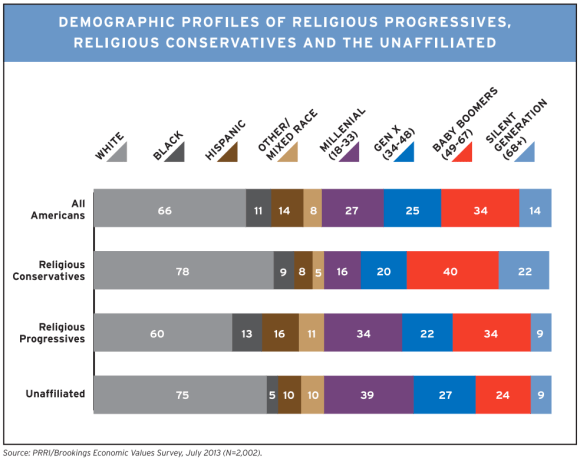
Interesting analysis by Emma Green cross-referencing ethnic origin, age, and religious views in the US:

Blacks, hispanics, and people of mixed race are all more likely to be religious progressives than conservatives; these groups are also among the fastest-growing demographics in the United States. Similarly, Millennials are more than twice as likely to be religious progressives than religious conservatives; in fact, people older than 50 make up more than 60 percent of those who are considered to be religious conservatives. Although it’s impossible to talk to an 18-year-old about her views on culture and predict what she’ll think in two decades, these demographic trends suggest that the religious right is about to start shrinking.

But the question of influence is a little fuzzier. Although more than a third of Millennials are considered religious progressives, roughly 40 percent don’t have any faith at all: A growing number of young people don’t identify with a particular religion. That, along with the fact that an overwhelming majority of religious progressives don’t see religion as “the most important thing in their life,” suggests that faith is losing its overall influence over how people think about social and cultural issues.

Chart Of The Day « The Dish.

Why Race Has Been the Real Story of Obama’s Presidency All Along

Lengthy but interesting article by Jonathan Chait on the enduring legacy of slavery, and how it plays into the political and ideological divides in the US. Worth reading:

And the truth is almost too brutal to be acknowledged. A few months ago, three University of Rochester political scientists—Avidit Acharya, Matthew Blackwell, and Maya Sen—published an astonishing study. They discovered that a strong link exists between the proportion of slaves residing in a southern county in 1860 and the racial conservatism (and voting habits) of its white residents today. The more slave-intensive a southern county was 150 years ago, the more conservative and Republican its contemporary white residents. The authors tested their findings against every plausible control factor—for instance, whether the results could be explained simply by population density—but the correlation held. Higher levels of slave ownership in 1860 made white Southerners more opposed to affirmative action, score higher on the anti-black-affect scale, and more hostile to Democrats.

The authors suggest that the economic shock of emancipation, which suddenly raised wages among the black labor pool, caused whites in the most slave-intensive counties to “promote local anti-black sentiment by encouraging violence towards blacks, racist norms and cultural beliefs,” which “produced racially hostile attitudes that have been passed down from parents to children.” The scale of the effect they found is staggering. Whites from southern areas with very low rates of slave ownership exhibit attitudes similar to whites in the North—an enormous difference, given that Obama won only 27 percent of the white vote in the South in 2012, as opposed to 46 percent of the white vote outside the South.

The Rochester study should, among other things, settle a very old and deep argument about the roots of America’s unique hostility to the welfare state. Few industrialized economies provide as stingy aid to the poor as the United States; in none of them is the principle of universal health insurance even contested by a major conservative party. Conservatives have long celebrated America’s unique strand of anti-statism as the product of our religiosity, or the tradition of English liberty, or the searing experience of the tea tax. But the factor that stands above all the rest is slavery….

And yet—as vital as this revelation may be for understanding conservatism, it still should not be used to dismiss the beliefs of individual conservatives. Individual arguments need and deserve to be assessed on their own terms, not as the visible tip of a submerged agenda; ideas can’t be defined solely by their past associations and uses.

Liberals experience the limits of historically determined analysis in other realms, like when the conversation changes to anti-Semitism. Here is an equally charged argument in which conservatives dwell on the deep, pernicious power of anti-Semitism hiding its ugly face beneath the veneer of legitimate criticism of Israel. When, during his confirmation hearings last year for Defense secretary, Chuck Hagel came under attack for having once said “the Jewish lobby intimidates a lot of people up here,” conservatives were outraged. (The Wall Street Journal columnist Bret Stephens: “The word ‘intimidates’ ascribes to the so-called Jewish lobby powers that are at once vast, invisible and malevolent.”) Liberals were outraged by the outrage: The blog Think Progress assembled a list of writers denouncing the accusations as a “neocon smear.” The liberal understanding of anti-­Semitism is an inversion of conservative thinking about race. Liberals recognize the existence of the malady and genuinely abhor it; they also understand it as mostly a distant, theoretical problem, and one defined primarily as a personal animosity rather than something that bleeds into politics. Their interest in the topic consists almost entirely of indignation against its use as slander to circumscribe the policy debate.

Why Race Has Been the Real Story of Obama’s Presidency All Along — New York Magazine.

The American Middle Class Is No Longer the World’s Richest

Understandably, the Government has claimed credit for Canada now having a higher middle class income than the US (any government would do the same, even though this is a 30-year trend involving many governments).

I recall during the 1990s the then Mulroney government had a “prosperity initiative” that included studies by Michael Porter who was then a major figure on theories and factors involved in growth (and has broadened his focus since then: see We’re Not No. 1! We’re Not No. 1! – Porter’s Social Competitiveness Report). At the time, one of the talking points was that Canada was a Honda Civic nation, the US was a Honda Accord. Times have changed.

And the most interesting part is the explanation, which has public policy implications:

Three broad factors appear to be driving much of the weak income performance in the United States. First, educational attainment in the United States has risen far more slowly than in much of the industrialized world over the last three decades, making it harder for the American economy to maintain its share of highly skilled, well-paying jobs.

Americans between the ages of 55 and 65 have literacy, numeracy and technology skills that are above average relative to 55- to 65-year-olds in rest of the industrialized world, according to a recent study by the Organization for Economic Cooperation and Development, an international group. Younger Americans, though, are not keeping pace: Those between 16 and 24 rank near the bottom among rich countries, well behind their counterparts in Canada, Australia, Japan and Scandinavia and close to those in Italy and Spain.

A second factor is that companies in the United States economy distribute a smaller share of their bounty to the middle class and poor than similar companies elsewhere. Top executives make substantially more money in the United States than in other wealthy countries. The minimum wage is lower. Labor unions are weaker.

And because the total bounty produced by the American economy has not been growing substantially faster here in recent decades than in Canada or Western Europe, most American workers are left receiving meager raises.

American Incomes Are Losing Their Edge, Except at the TopInflation-adjusted, after-tax income over time

Finally, governments in Canada and Western Europe take more aggressive steps to raise the take-home pay of low- and middle-income households by redistributing income.

The American Middle Class Is No Longer the World’s Richest – NYTimes.com.

Spotlighting a law that stripped U.S.-born women of citizenship

Good reminder of some of the past history of citizenship policy, and how people lost their citizenship, in this case due to marriage of an immigrant:

Daniel Swalm was researching his family when he came across a disturbing episode in immigration history. That discovery would lead to a move in the U.S. Senate to apologize for action the nation took more than a century ago.

Swalm discovered that under an obscure 1907 law, his grandmother Elsie, born and raised in Minnesota, was stripped of her U.S. citizenship after marrying an immigrant from Sweden.

Swalm had never heard of the Expatriation Act that required a U.S.-born woman who married a foreigner to “take the nationality of her husband.”

Swalm, who lives in Minneapolis, found out about the law when he stumbled across an alien registration form filled out by Elsie Knutson Moren.

“I could not figure out why Grandma Elsie had to fill one out, because she was born in the United States,” he said.

The law has caught others by surprise, too.

“There are all these people doing their genealogy, and they come across relatives who were declared alien enemies during World War I, and they’re trying to figure out why that would be if they were born in the United States,” said Candice Bredbenner, a history professor at the University of North Carolina Wilmington.

Spotlighting a law that stripped U.S.-born women of citizenship – latimes.com.

A New Muslim Renaissance is Here | TIME.com

Rabia Chaudry in Time on some of the progressive trends among Muslim Americans, reminding of the diversity within Muslim communities and on change from within:

It’s heady, scary, and exciting to watch the face and discourse of American Muslims change and expand before your eyes. The Islam I grew up with in America is not the Islam my children are experiencing. The possibilities for their lives are much more expansive than the possibilities for my life were. The largely comfortable integration and success of American Muslims that sets them apart from their counterparts in Europe also lends space for these possibilities. From tremendously increased participation in American civic and cultural life, to pressing internal demands on religious orthodoxy, another generation or two will see a vastly different American Islam that will likely have an impact on Muslims globally. From marginalized minority, American Muslims are poised to become mainstream leaders and influencers. And it’s no small irony that while historians bemoan conquest and Western colonialism as the death knell for Islam’s “Golden Age”, this new Muslim renaissance is growing out of the West itself.

A New Muslim Renaissance is Here | TIME.com.

British Home Secretary Waited Until Terror Suspect Was Abroad Before Stripping Citizenship | Global Research

Interesting debate in the UK over revocation of suspected terrorists. UK has gone further than proposed changes to revocation in the revisions to Canada’s Citizenship Act, namely;

  • Ministerial discretion rather than through the courts; and,
  • Not respecting the international statelessness convention.

MPs voiced concern on Tuesday that prospective changes to the Immigration Bill allowing the Home Secretary to make people stateless would result in ‘two classes of British citizens.’

Theresa May is seeking the power to strip terror suspects of their UK nationality even if it renders them stateless – currently she can only use the law against dual-nationals, who won’t be left stateless by the loss of their British nationality. The changes in legislation will only apply to foreign-born or naturalised British citizens.

Diane Abbott, Labour MP for Hackney North and Stoke Newington, said: ‘We will have two classes of British citizens. That is a dangerous road to go down.’

Abbott added: ‘The fear will be that although this has started with suspected terrorists, where will it end, once the state decides that British citizenship is not indivisible?’

Security minister James Brokenshire replied: ‘We do not accept that there is, or will be, a two-tier citizenship system.’

But a recent Home Office briefing showing how the Immigration Bill amendment seeks to comply with EU law, said it was ‘satisfied that there is an objective and reasonable justification for treating naturalised citizens differently from others.’

British Home Secretary Waited Until Terror Suspect Was Abroad Before Stripping Citizenship | Global Research.

The US approach is more draconian: revocation through targeted drone strikes.

With A Citizen In The Crosshairs, Where’s The Line Drawn For Drones?

Canadian commentary on the risks of mistakes and lack of due process of the proposed revocation provisions of the Citizenship Act revisions by Azeezah Kanji in the National Post:

Moreover, neither [former Minister of Citizenship and Immigration] Mr. Kenney nor the proposed legislation specifies that revocation of citizenship is permitted only for acts of terrorism executed against Canada or Canadians. Vile as it may be, an act of terrorism committed on non-Canadian soil, against non-Canadian nationals or interests, should not be considered a “fundamental breach of mutual loyalty” against Canada.

The inherently political nature of terrorism means that terrorism accusations, prosecutions and convictions are also deeply politicized, and subject to radical re-evaluation in hindsight. Yesterday’s terrorists may be today’s honorary Canadian citizens — as the case of Nelson Mandela demonstrates.

Banishing those convicted as terrorists does not “strengthen” Canadian citizenship; it only leaves Canadians more vulnerable to the political prejudices of the day.

Sometimes I think that we should have another version of Godwin’s law that prohibits always using Nelson Mandela as an example of “one man’s freedom fighter is another one’s terrorist,” as many of the extremists are a particularly nasty lot with little if anything in common with Mandela’s early days (he targeted infrastructure, not people).

This is not to say that we should not be extremely cautious and examine carefully the implications of such a fundamental change to the long-standing Canadian policy of considering Canadians as equal, whether born-here or elsewhere.

Stripping convicted terrorists of their citizenship leaves all Canadians vulnerable