The Unbearable Whiteness of Congress – The Daily Beast

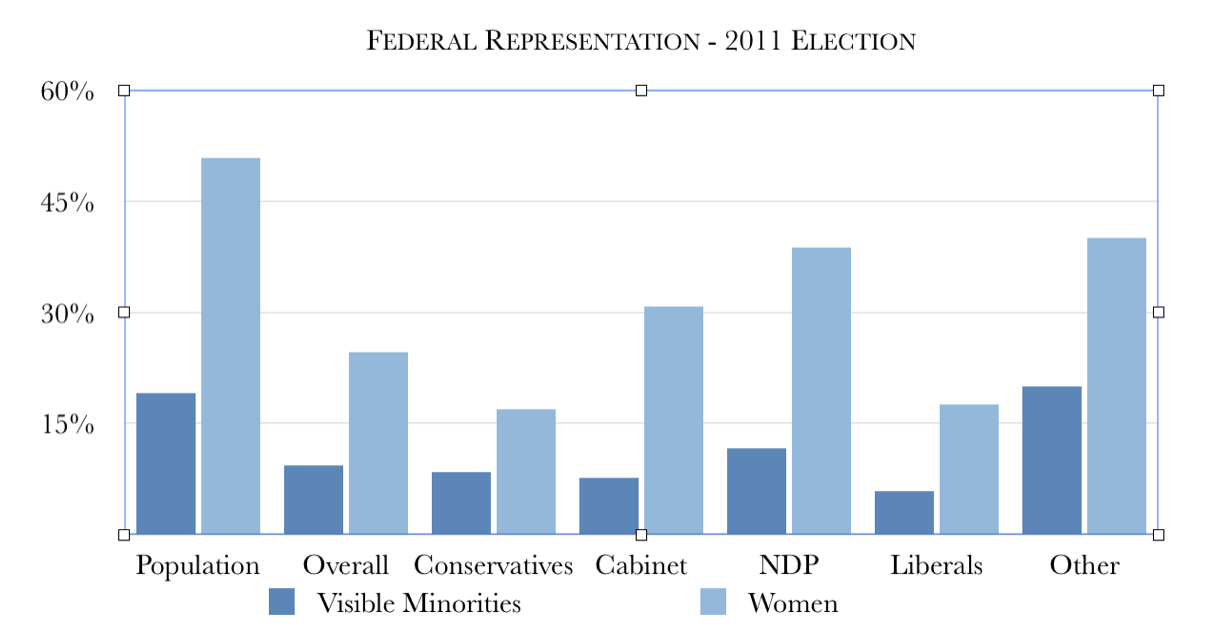
Federal_Representation_-_2011_ElectionA reminder in the US of gaps in political representation for women, blacks and hispanics (chart above shows Canadian representation from the 2011 federal election):

Cue the confetti: The new Congress sworn in on Tuesday is the most diverse in our nation’s history!

That would truly be a milestone to celebrate—until you see what that record “diversity” actually means. Ready? The breakdown of the 114th Congress is 80 percent white, 80 percent male, and 92 percent Christian.

… Look, I don’t care if you are a liberal or a conservative. It’s impossible to make the claim that our Congress accurately reflects the demographics of our nation. And it’s not missing by a little but a lot. If Congress accurately reflected our nation on the basis of race, about 63 percent would be white, not 80 percent. Blacks would hold about 13 percent of the seats and Latinos 17 percent.

But what do we really see? The new Senate has only two black senators. That statistic is even more striking given that earlier this week the first black person ever elected to the Senate, Edward Brooke, was laid to rest. Brooke won his seat in 1966 and served two terms. How far has Congress really evolved on race when in 50 years it has gone from one black senator to two? (Even the arguably more democratic House is only at 10 percent black members.)

Congress moves slowly, and I don’t mean just on passing legislation.

Latinos, the fastest growing minority group in America, are even more underrepresented in Congress. They hold 3 percent of the Senate and a little over 7 percent of the House.

And let’s look at religion. Congress is now 92 percent Christian, resembling more to a papal enclave than our religiously diverse nation. The latest Pew Poll found that nearly 20 percent of Americans identify as atheist, agnostic, or not being affiliated with any religion. Yet there’s only one member of Congress, Rep. Kyrsten Sinema (D-AZ), who openly acknowledges she’s not a member of any religious group.

OK, let’s put race, ethnicity, and religion aside and address the most glaring under representation in Congress of any group: women. This Congress will welcome more women than ever before at 19 percent of the House and 20 percent of the Senate.

The Unbearable Whiteness of Congress – The Daily Beast.

ICYMI: White? Black? A Murky Distinction Grows Still Murkier – NYTimes.com

While not based on a random sample, nevertheless interesting results, showing just how much mixing has occurred, and continues to occur, in the US:

In the United States, there is a long tradition of trying to draw sharp lines between ethnic groups, but our ancestry is a fluid and complex matter. In recent years geneticists have been uncovering new evidence about our shared heritage, and last week a team of scientists published the biggest genetic profile of the United States to date, based on a study of 160,000 people

The researchers were able to trace variations in our genetic makeup from state to state, creating for the first time a sort of ancestry map.

“We use these terms — white, black, Indian, Latino — and they don’t really mean what we think they mean,” said Claudio Saunt, a historian at the University of Georgia who was not involved in the study.

The data for the new study were collected by 23andMe, the consumer DNA-testing company. When customers have their genes analyzed, the company asks them if they’d like to make their results available for study by staff scientists.

Over time the company has built a database that not only includes DNA, but also such details as a participant’s birthplace and the ethnic group with which he or she identifies. (23andMe strips the data of any information that might breach the privacy of participants.)

The scientists also have been developing software that learns to recognize the origins of the short segments of DNA that make up our genomes. Recently they used their program to calculate what percentage of each subject’s genomes was inherited from European, African or Native American forebears.

“This year we saw that we were in a great position to do the analysis,” said Joanna L. Mountain, senior director of research at 23andMe.

On average, the scientists found, people who identified as African-American had genes that were only 73.2 percent African. European genes accounted for 24 percent of their DNA, while .8 percent came from Native Americans.

White? Black? A Murky Distinction Grows Still Murkier – NYTimes.com.

Reasons To Hope On Race – More residential mixing and marriage

PrintInteresting data and situating Ferguson in a broader context:

William H. Frey marks the slow, steady decline of segregation:

The average white resident, for example, lives in a far less diverse neighborhood—one that is more than three-quarters white—than residents of any other group. Nonetheless, the average white person today lives in a neighborhood that includes more minorities than was the case in 1980, when such neighborhoods were nearly 90 percent white. Moreover, the average member of each of the nation’s major minority groups lives in a neighborhood that is at least one-third white, and in the case of Asians, nearly one-half white.

He expects the continuation of these trends:

Population shifts that are bringing Hispanics and Asians to previously whiter New Sun Belt and Heartland regions will most certainly continue to alter the neighborhood experiences of these groups by bringing them into more contact with whites. The nation’s blacks are moving onto a path that more closely follows that of other racial minorities and immigrant groups as more blacks move to more suburban and integrated communities. The broader migration patterns are moving in the direction of greater neighborhood racial integration, even if segregation is far from being eliminated.

Reasons To Hope On Race « The Dish.

The following chart on mixed marriages (the equivalent Canadian figures include common law relationships, with the total being 4.6 percent):

Print

The Racial Divide Over Ferguson « The Dish

racial-divide-fergusonNo surprise in the different perceptions, but still striking.

The Racial Divide Over Ferguson « The Dish.

US Congresswoman-Elect Mia Love: Personification of GOP Hypocrisy on Immigration

Sigh …

On November 4, 2014, the Republican Party made black history. Mia Love is the first Republican black woman elected to Congress. Black women aren’t exactly clamoring to join the Republican Party, so it’s obvious why this is an impressive feat. Love also became another “first” that night—the first Haitian-American elected to Congress.

But, as a woman born to immigrants, a group Republicans have been hostile towards for decades, Mia Love’s membership in the Grand Old Party is downright hypocritical.  Her parents, Marie and Jean Maxime Bourdeau, fled Haiti in the 1970s after Jean Maxime had been threatened by the Tonton Macoutes, the brutal police force of Francois Duvalier, the late dictator. According to Mother Jones, the immigration law in place at the time offered the possibility of her parents gaining citizenship if they had a child born in the United States. The law was set to expire in January 1976. On December 6, 1975, Love was born in a Brooklyn hospital.

“My parents have always told me I was a miracle and our family’s ticket to America,” Love told the Deseret News in a 2011 interview.

Congresswoman-Elect Mia Love: Personification of GOP Hypocrisy on Immigration.

Taking the Plunge: Immersion Programs Help Children Learn Other Languages

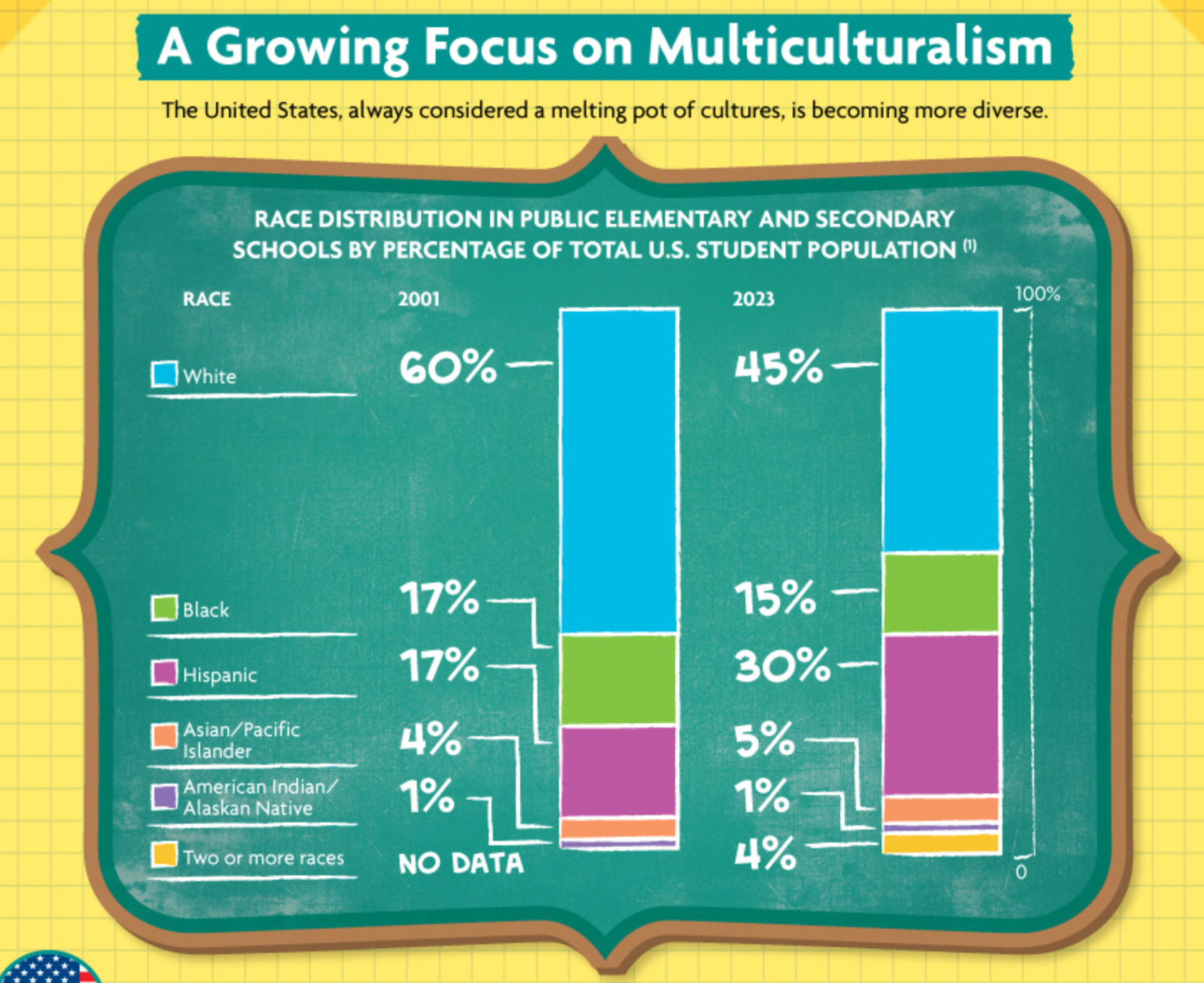
Taking_the_Plunge__Immersion_Programs_Help_Children_Learn_Other_LanguagesNice infographic on US multiculturalism and immersion education (link below has full infographic).

Taking the Plunge: Immersion Programs Help Children Learn Other Languages.

The evolving acceptance of dual citizenship – LA Times

Peter Spiro on dual citizenship and the question of potential dual loyalties in the US context. Agree with him mostly, and reflects the Canadian approach, but no discussion of where some of the dual loyalty issues lie (e.g, violent extremism, foreign military service):

Recent efforts to enforce the renunciation oath have gone nowhere because the advantages of dual citizenship cut across a variety of politically powerful constituencies. Our new citizens deserve a revised oath reflecting contemporary realities. In the meantime, the archaic phraseology wont stop many from holding on to their original nationality.

And shouldnt they? Citizenship is an important part of individual identity. Theres no reason it needs to be exclusive. Those of us who are U.S. citizens also have other associations: religions, civic institutions, advocacy groups. That some of us belong to other nations doesnt undermine our capacity to be good Americans.

The evolving acceptance of dual citizenship – LA Times.

The birthright citizenship debate – LA Times Editorial

LA Times editorial in support of birthright citizenship.

No numbers or estimates, however, on how many cases of “birth tourism,” although USA has greater concerns over illegal immigrants living in the USA, rather than the “birth tourists:”

Birthright citizenship is an emblem of equality and inclusion. Many other countries confer citizenship on the basis of bloodlines, what the law calls jus sanguinis. That makes sense when nationality is conceived of primarily in terms of ancestry or tribe or race or ethnicity.

But in America, a nation of immigrants, citizenship is defined differently. That principle was established when the 14th Amendment was adopted, and it should not be tinkered with today in an effort to keep out unwanted immigrants. Indeed, the decision to grant citizenship to everyone born on U.S. soil was made in part so that members of particular minority groups would not be required to win the favor of the majority to claim the privileges of American citizenship.

Birthright citizenship provides a clear standard that sweeps away questions about whether someone has the proper ethnicity or antecedents to be an American. There are too many examples in history of people being victimized because of who their parents were. There is no good reason to add to them.

The birthright citizenship debate – LA Times.

Veiled Women Need Not Apply « The Dish

Interesting US reasonable accommodation case with respect to the hijab and Abercrombie & Fitch (the company, while allowing a yarmulke, argued against the hijab):

The company has changed its dress code since then, but it’s fighting this case on the ground that it didn’t deny her a religious accommodation because she didn’t ask for a religious accommodation. That is, it had a dress code that applied to everyone, and she violated it, so she was treated like anyone else who fails to comply with the dress code, not subjected to discrimination based on religion.

If she’d asked for an accommodation based on religion, the company would have had to make some conscious decision about whether an exception to the usual rule could be made. Without having been given that chance, the company argues, there’s no discrimination, the company says. The EEOC, which brought the case on behalf of Elauf, doesn’t want the burden to bring up religion to rest entirely on the employee.

Veiled Women Need Not Apply « The Dish.

U.S. Is Trying to Counter ISIS’ Efforts to Lure Alienated Young Muslims – NYTimes.com

Good piece in the NY Times about US Government efforts to engage American Muslims in countering extremism, with some of the same issues that likely arise in Canada. The last line captures the conundrum:

American officials have been able to identify Americans fighting for the Islamic State or other Syrian rebel groups based on intelligence gathered from travel records, family members, intercepted electronic communications, social media postings and surveillance of Americans overseas who had expressed interest in going to Syria, counterterrorism officials said.

But efforts at countering violent extremism, especially at home, “have lagged badly behind other counterterrorism pillars,” said Michael Leiter, a former director of the National Counterterrorism Center. “It is heartening to see the administration attempt to invigorate those efforts, but it is unfortunate that it has, despite the efforts of many, been so long in coming.”

Government supporters question whether funds will be available to sustain these programs. “The administration has the right framework for doing this, but long-term success will depend on sustainable resourcing to help local government, communities and law enforcement build initiatives that can have impact,” said Quintan Wiktorowicz, a former senior White House aide who was one of the principal architects of the current strategy.

That strategy here at home, called countering violent extremism, has proved much more difficult for American officials to master than the ability of the Pentagon and spy agencies to identify, track, capture and, if necessary, kill terrorists overseas.

Among its efforts, the Department of Homeland Security provides training to help state and local law enforcement officials in identifying and countering the threat, including indicators of violent extremism and “lone wolf” attacks.

The department awarded the International Association of Chiefs of Police a $700,000 grant last year to develop training on how to prevent, respond to and recover from acts of terrorism.

The department has also sponsored exercises in seven cities, including Houston, Seattle, and Durham, N.C., to improve communication between local law enforcement and communities and to share ideas on how best to build community resilience against violent extremism. “We’re raising awareness,” said David Gersten, who was recently named the department’s coordinator for the overall effort.

Carter M. Stewart, the United States attorney in the Columbus area, said he and his staff meet regularly with Somali-American and other community leaders.

But Muslim advocates say there is deep suspicion that, despite all the meetings and the talk of outreach, the government’s main goal is to recruit informants to root out suspected terrorists.

“I don’t know how we can have a partnership with the same government that spies on you,” said Linda Sarsour, advocacy director for the National Network for Arab American Communities.

Indeed, those who met with Mr. Johnson were conflicted, some saying they were pleasantly surprised he had traveled here to put a face on the federal effort, but clearly embittered by their past experiences with the government.

Dr. Iyad Azrak, 37, a Syrian-American ophthalmologist, recounted how he and his family had been forced on numerous trips to Canada to wait for hours at border crossings while inspectors reviewed his records.

“Not once when we’re coming home do they say to me, ‘Welcome home,’ ” said Dr. Azrak, who said he has been a naturalized citizen for six years.

U.S. Is Trying to Counter ISIS’ Efforts to Lure Alienated Young Muslims – NYTimes.com.