Massey College and insidious racism on Canadian campuses – Abdullah Shihipar

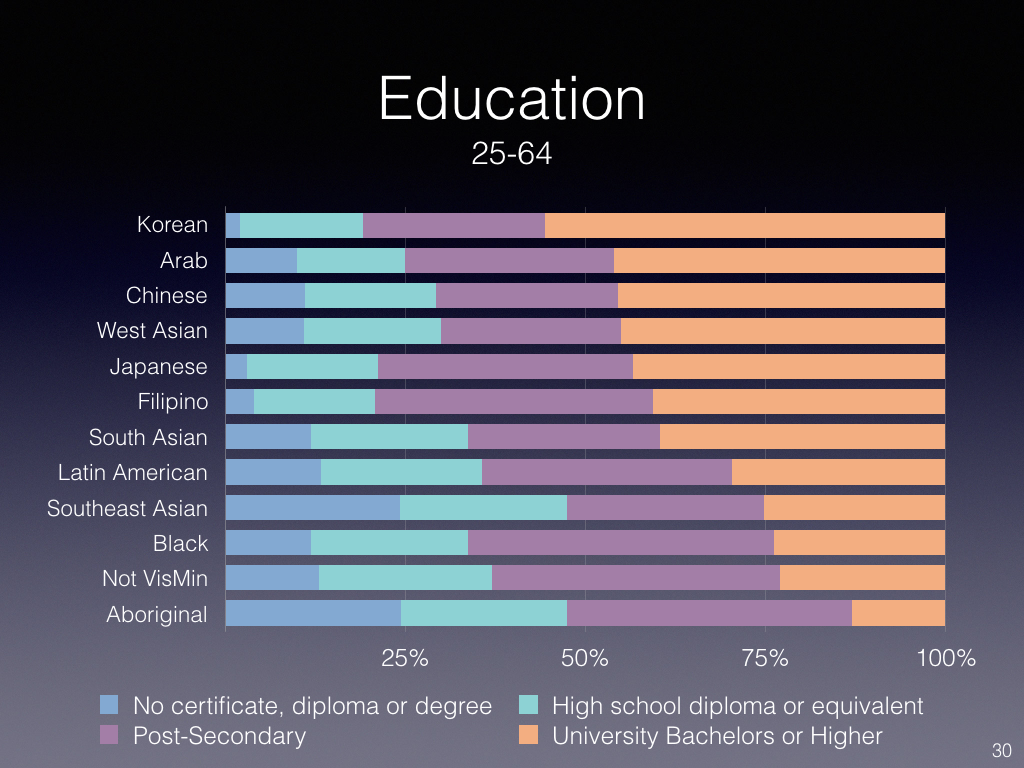
Some context for this article: visible minority students are more likely to have a university education compared to non-visible minorities.

While there are issues, it does not appear to be holding back visible minority educational achievements:

While U of T weathered the Massey controversy, student leaders are beginning their terms across campus. They’re now busy working with their teams to plan for the new year and navigating racial tensions is bound to be a topic of discussion. Dealing with these situations would be difficult enough for anybody, but people of colour face an additional burden when taking on leadership roles.  I can relate to the latter experience.

I am of Sri Lankan descent. From 2014 to 2016, I served as the President of the Arts and Science Students’ Union (ASSU) at the University of Toronto, one of the largest academic student unions in North America. As president, I led a team of seven executives to advocate to the faculty on behalf of students, as well as run campaigns, services and events. My time at ASSU proved invaluable in my personal development, shifting my politics and dramatically changing not just how I saw the world, but how I interacted with it too. As much as I loved being president, the experience exposed me to subtle ways that racism operates. Too often, we think of racism in terms of extreme—the slur said on the bus or the mosque that was torched. More often than not, it’s more insidious.

Racism manifested itself to me mainly as a set of double standards. Student leaders are minor public figures on a university campus, so some criticism is to be expected. But during my tenure, it quickly became obvious which representatives were under the most scrutiny. For example, while it was commonly accepted that  representatives could be compensated for their labour, there were those who sought to challenge a meager honorarium I received.  These conversations happened in meetings and in face-to-face conversations, where I was made to feel guilty about collecting something that others were taking without challenge. These challenges did not seem to happen when the representative in question was a white man.

Leadership often requires making tough decisions on behalf of the student body. When you are a person of colour, you constantly wonder how your calls will be construed. From what I have seen on campus, people of colour are more likely to be accused of corruption, of not being transparent and, crucially, not being representative of the student body. This frequently manifested itself when student representatives would use their role to advocate for marginalized people and their causes. Just this past summer at Ryerson, two executives—who happened to be Black and Indigenous—at the Students’ Union launched a Colonialism 150 campaign in response to Canada 150 festivities. Other members of the unions’ executive complained of being allegedly kept out of the process and not consulted, adding that they would have taken a different direction had they been involved.

When you are agreeable, your race is rarely an issue. It’s only when you offer pushback or articulate policies that are deemed “too radical,” that you face harassment. Caricatures are created and  quickly posted on online message boards like reddit. White men are praised for strong leadership. But people of colour, myself included, are described as “bullies,” “aggressive” and “angry.”  In my case, more than one anonymous commentator on reddit thought it appropriate to call me a “dictator” and “tyrant.” Society already views people of colour, specifically Black and Brown people, as more violent, so it should come as no surprise that we are being described this way when we disagree. This sends a chilling message to representatives of colour—agree or be subjected harassment.

While people of colour can face harassment, on other occasions they’re simply not taken seriously at all. Ondiek Oduor knows all about what that’s like. Oduor, served as President of ASSU from 2016-2017 and as Student Head of Non-Resident Affairs at U of T’s Trinity College in 2014.  That year, the Student Heads team, who ran Trinity’s student government, wanted to implement equity reforms.  When it came to selling these ideas to the student body and the administration, the team made a strategic choice about who would speak.  “We collectively made a choice for the Male Head of College, who happened to be a white man to speak on these issues,” he says. “We knew it would be taken more seriously coming from him, rather than from person of colour or a woman.”

Ondiek, who is Black, describes his involvement at Trinity as “frustrating” and says everyday interactions made him acutely aware of the fact that he was in white space.  Frequently, when attending parties as a student leader with alumni at Trinity, some of the older alumni would often ask him “where he was from” or explicitly reference how rare Black students are at Trinity, whereas white student leaders would be asked about their studies.

Chris Ramsaroop, an organizer for Justicia for Migrant Workers, echoes some of Ondiek’s concerns about representation. Serving as President of the Student Administrative Council at U of T (now known as the University of Toronto Students’ Union) in 1998,  Ramsaroop says whenever people of colour raised concerns to those in the administration or to their peers, they were met with token gestures that were meant to pacify dissent. After a scandal surrounding Professor Kin-Yip Chun allegedly being denied a tenure track job because he was Asian, the university committed to reviewing its practices, but the promises were forgotten when student leaders inevitably ended their terms and passed responsibility to their successors.

If the consequences of getting involved in student politics are high for people of colour, then they are disproportionately high for women of colour.  Najiba Ali Sardar, a first generation Bangladeshi-Canadian activist served as Vice President Equity for the University of Toronto Students’ Union from 2014 to 2015. She says she found being a woman of colour in a students’ union to be one “one of the most taxing experiences of her life.” During her time as a student leader, a campus society decided to throw an insensitive “Mexican-themed” party. As VP Equity she started a dialogue around the event to explain to individuals why it was offensive. Rather than listening to her, she was attacked and harassed for weeks. Later, when the society did make changes, she found that her contributions to the discussion were not acknowledged. “It’s a bit disheartening to put all of your time, labour, and energy towards issues you’re incredibly passionate about, just to have all of that be disregarded.”

Racism in student politics is rarely visible to the average student, but takes its toll on student representatives. Accused of playing the race card, representatives are more likely to recede and play less of a role in the future; almost everyone I interviewed referenced being burned out.  This discourages people of colour from pursuing leadership roles in the future. If student leaders, a privileged group of students, are undergoing this type of harassment, then chances are, members of the student body are too. The people who contribute to this climate may not be bad individuals or may not intend to be racist, but that is how systemic bias works, it operates under the radar. This is not about accusing people of wrongdoing but rather about actively confronting these biases.

Universities can start to take steps to tackle this problem. The collection of race-based data is a first step, which some universities, like U of T, have committed to implementing. It will allow for better, targeted policies. To mitigate the barriers that prevent marginalized groups from getting involved in student government, universities and student organizations must work together to introduce bursaries, awards and honorariums to people of colour, especially for those who demonstrate financial need.  Finally, once in their roles as leaders, people of colour need access to support systems and student organizations need to ensure they have robust harassment policies that work.

When we talk about representation, whether at the workplace or at our universities, we have to talk about what that actually looks like; there is no use in having a diverse board if you don’t value the contributions of the people on it. We have a choice, we can either choose to do the hard work of achieving meaningful diversity, or we can continue on this unproductive path of tokenism.

Source: Massey College and insidious racism on Canadian campuses – Macleans.ca

Free expression at universities gagged by anti-Trump backlash

James Turk, Ryerson’s Director of the Centre for Free Expression, on free speech in universities following Ryerson’s cancelling an event with right-wing speakers (Jordan Peterson, Faith Goldy):

That harmful legacy of university cowardice and complicity took years to overcome. We need to remember this past if we do not want to relive it, albeit in the name of new passions and different ideologies and concerns.

Instead, it appears as if we are starting down a dark road that threatens the raison d’être of the university and the fundamental rights to freedom of expression guaranteed by Canada’s Charter of Rights and Freedoms.

If standing by its principles requires a university to make a greater investment in security personnel to protect freedom of expression, that must be seen as a proper cost of doing business.

If threats continue to blossom, then there needs to be discussions with governments to ensure universities have the additional financial resources to ensure free expression does not fall victim to intimidation.

Not only are censorship and suppression fatal to the purpose of the university, they undermine the foundation of democratic society.

When individual rights to freedom of expression are diminished or taken away for an allegedly good cause, they are necessarily invested in some higher authority that is given the right to determine what is acceptable.

The result is censorship from above — ultimately the state — with the likelihood that the champions of that censorship today are its vulnerable targets tomorrow.

Source: Free expression at universities gagged by anti-Trump backlash

Universities need diversity plans or will lose research money, says council

Yet another illustration of how the government’s diversity and inclusion agenda is being implemented (gap is with respect to women, Indigenous peoples, and persons with disabilities, not with respect to visible minorities):

Universities have less than two years to find ways to recruit more women and minorities for Canada Research Chairs, or they won’t get any more positions funded by the federal government.

The Social Sciences and Humanities Research Council, which reviews and approves applications from universities for Canada Research Chair positions, issued that edict this week.

“We’ve been talking about this for some time, we’ve been monitoring progress to meet the targets,” said council president Ted Hewitt.

The move comes a week after Science Minister Kirsty Duncan told The Canadian Press that she was dismayed universities had not improved the rate at which they recruited women for the lucrative research jobs and was prepared to force their hand.

Hewitt said the change was in the works before Duncan’s remarks.

The council reviews the program every five years and last summer, when the preliminary results of a 15-year review came out, existing efforts to get more women, minorities, people with disabilities and indigenous people appointed to research chairs did not appear to be working.

“We said ‘OK, that’s it’ we have to think about what we can do here to speed up progress,” said Hewitt. “That was a very serious catalyst for us.”

Universities with at least five of the research positions will be required to submit an equity plan by Dec. 15 showing how they intend to meet the equity targets laid out by the granting council. They have until December 2019 to recruit and appoint enough researchers to meet their targets.

If their appointment applications do not match their equity targets by then, the council will withhold funding for new positions until they do.

Hewitt said universities submit twice as many male applicants as female applicants, so the council wants to find a way to force them to seek out more diverse applicants.

“At this pace, they’re never going to meet their targets,” he said.

Canada Research Chairs run for five or seven years and bring $100,000 or $200,000 in annual funding, depending on whether it’s a more experienced tier one position, or an emerging researcher, tier two position.

Universities cannot terminate positions early to open up spaces for more diverse applicants, which is why the council is giving them a deadline more than 18 months away.

The program provides $265 million a year to pay for up to 2,000 research positions in engineering, natural sciences, health sciences, humanities and social sciences.

As of this month, there are 1,615 positions filled, of which 30 per cent are held by women. Women account for just 17 per cent of the more lucrative tier one jobs and 37 per cent of the tier two jobs.

The program also wants to increase the presence of people with disabilities, visible minorities and indigenous people. In the 2015 to 2017 period, 15 per cent of researchers were from visible minorities, which met the target set by the council. However only one per cent of positions were filled by a researcher who had a disability, below the four per cent target. The universities had granted positions to about 16 indigenous researchers, which met the one per cent target.

Source: Universities need diversity plans or will lose research money, says council – Macleans.ca

New Rule: White Women Should Not Study Black Communities | commentary

Sigh…

Alice Goffman, assistant professor of sociology at the University of Wisconsin, is a controversial scholar. Her book, On the Run: Fugitive Life in an American City is based on Goffman’s six year immersion in a black neighborhood in West Philadelphia.

The book was published in 2014 to wide acclaim. But it soon attracted critics, including the estimable Steven Lubet, who thinks that Goffman embellished her experiences, repeated as fact things she had heard from her subjects though they were unlikely to have been true, and, most sensationally, became so caught up in the lives of the people she was writing about that she could have been charged with conspiracy to commit murder under Pennsylvania law. Goffman replies here, and Lubet takes up part of Goffman’s reply here. Suffice it to say that there is enough to the controversy to make it unsurprising that when Goffman’s hire as McConnell Visiting Professor of Sociology at Pomona College was announced, some people were disappointed.

But the “collective of Sociology students, alumni, and allies at Pomona College” who have stepped forward to complain in an open letter were not disappointed about the kinds of issues Lubet raised. They seem troubled mainly by the fact that Professor Goffman is a white researcher who had the effrontery to study a black community. The hire “boasts the framework that white women can theorize about and profit from Black lives while giving no room for Black academics to claim scholarship regarding their own lived experiences.” We are given to understand that one should not boast such a framework.

Let’s be clear: Goffman is not a right winger. Cornel West, who blurbed the book, called it “the best treatment I know of the wretched underside of neo-liberal capitalist America. Despite the social misery and fragmented relations, [Goffman] gives us a subtle analysis and poignant portrait of our fellow citizens who struggle to preserve their sanity and dignity.” The book won praise, in part, because it is a vivid illustration of the argument, as one reviewer put it, that the criminal justice system has become “a kind of invading force, aimed mostly at young black men.”

That is one reason it drew criticism from conservatives like Heather Mac Donald, who arguedthat Goffman had portrayed her subjects as “helpless pawns of a criminal-justice system run amok” when they in fact created “their own predicaments through deliberate involvement in crime.” Our Pomona activists, by the way, express sympathy with “student organizers” at Claremont McKenna, whose most recent act of social justice was to shout Mac Donald down. So I suppose they can be forgiven for not knowing what Mac Donald has to say.

But Goffman’s support for the basic storyline of the Black Lives Matter movement cannot absolve her of the charge of researching a black community although she is white. The “collective”—is there any hope we can retire this poseur term?—demands that Goffman’s job offer be rescinded. They also demand a response, like, pronto. If they don’t hear back by Tuesday at 5, the “direct action” begins.

The open letter, which must be read to be believed, is an embarrassment through and through. , At one point, they quote a New York Times Magazine article concerning the existence of a sixty page anonymous document, widely circulated among sociologists, that attacks Goffman. They do not note that the author of this same article deemed Goffman’s responses to this document largely persuasive, found that “many claims against her are… easy to rebut independently,” and reported that “most sociologists have found the mainstream criticisms of the book to be baseless.” To note such things would be to undermine their suggestion that the hire of Goffman amounts to an act of flagrant disregard for black people.

If the 128 “Sociology students, alumni, and allies” who signed this thing reflect what very many people in Pomona’s sociology department think, Goffman’s controversial work is the least of that department’s problems.

Source: New Rule: White Women Should Not Study Black Communities | commentary

Threats to academic freedom aren’t just a white-guy problem

One of the more thoughtful commentaries on the Potter controversy from a different angle by Amanda Bittner, Elizabeth Goodyear-Grant and Erin Tolley (disclosure: Erin is a former colleague):

Look at the demographics of any large organization, and you’ll find that most positions of power are occupied by white men. That’s true, too, of academia. In Canadian universities, there are almost no Indigenous administrators or administrators of colour; tenured positions, particularly at the highest levels, belong disproportionately to white men. Women, people of colour, and Indigenous peoples typically don’t have the opportunity to lose their prestigious positions amid controversy because they don’t even get those positions to begin with.

Adjunct and contract positions—the most precarious academic work of all—are often carried out by women, Indigenous scholars, and scholars of colour.As one U.S. study notes, just as under-represented groups began to gain a toehold in the professoriate, the academic job market contracted. Permanent positions have been replaced by those with almost no job protection, as well as long hours and little institutional support. Even if scholars in these roles had time to pen op-eds on controversial topics, seeing a person of privilege be so easily cut loose would almost certainly only heighten the instinct for women, Indigenous scholars and scholars of colour to stay quiet. And yet these are the voices we need.

We know we also write from a position of privilege: we are white women (two with tenure, one without) who work in academic institutions and have the luxury to follow these debates on social media. And yet, whenever we comment publicly on an issue, we look over our shoulders and wonder about the potential effect that public engagement might have on our careers. We debated the wisdom of even commenting on this case, concerned as we are about the blowback it might elicit, but we are intervening because we believe that the burden of exposing problematic institutional practices shouldn’t fall only on the shoulders of the most marginalized.

This isn’t just a white-guy problem. The incident sends a signal to our colleagues who have important things to say, who don’t have a platform of privilege from which to say it, and who don’t have a safety net to fall back on if things go south—or a coterie of well-connected commenters who mount a forceful defence. When voices are silenced by universities, there is a real risk to those who dare make controversial observations based in rigorous empirical research, or conclusions that point to systemic discrimination, injustice, and current and past wrongs. These are things that might “bother” or “offend” the public, and which have the potential to place even greater pressure on institutions.

Indeed, McGill’s principal, Suzanne Fortier, suggests that the Institute’s role is not “to provoke, but to promote good discussion.” This is a prescription for tepid public discourse. We have brilliant colleagues whose provocative voices need to be made louder, not silenced. And if universities can’t stand up to this pressure and defend their researchers on the “easy” cases—like ones involving a privileged white man—they most certainly won’t have the courage to do so when confronted with the “difficult” ones.

Source: Threats to academic freedom aren’t just a white-guy problem – Macleans.ca

‘The rose-coloured glasses are off’: Why experts, students suspect racism under-reported on campuses

But low numbers are, of course, better than high numbers, and overall university graduation numbers are higher for visible minorities than non-visible minorities (not to discount the issue):

CBC News investigation has found many Canadian universities received few or no complaints of racial discrimination on campus over the past five years, but experts and students — and even a couple of the universities — say the low numbers aren’t necessarily a sign of racial harmony.

Instead, they say the data might suggest students are reluctant to come forward with official complaints. Experts also say significant barriers exist for students who do pursue complaints.

Back in October, Julia-Simone Rutgers of King’s College in Halifax was concerned about a hip-hop-themed night planned for the campus pub because she was disturbed by what she witnessed at a previous event with a similar theme.

“It created a space where people felt kind of comfortable using racial slurs and kind of celebrating a music and a culture that was not critically discussed anywhere else on campus,” she said.

Despite her concerns, she said her first instinct wasn’t to make a complaint.

Dua

York University professor Enakshi Dua says students are sometimes discouraged from pursuing the formal complaint process. (CBC News)

“I just didn’t feel like they would be able to understand that experience, and so I didn’t feel like it would be productive for me to go through that route.”

York University professor Enakshi Dua studies anti-racism policies at Canadian universities and says trust is important for racialized students looking for help.

“On the most basic levels, students want someone who can appreciate and understand, help them sort out the situation that they’re dealing with,” says Dua…..

Numbers not the whole story

CBC News asked 76 universities to provide their yearly totals for student complaints of race-based discrimination and/or harassment for calendar years 2011 to 2015. Forty-seven schools provided data, but the vast majority reported either no complaints or numbers in the single-digits over the five-year period (not all schools provided data by the calendar year).

“Over five years? To me, hard to believe that,” said Girish Parekh, a former investigator with the Canadian Human Rights Commission who worked as a complaint resolution adviser at Ryerson University in Toronto in 2014/15. “Even for one year I wouldn’t believe that.”

He says some cases aren’t counted because they’re resolved outside of the prescribed complaint process, without the involvement of a human rights or equity office.

But Parekh says many incidents don’t result in complaints because students don’t think they will be taken seriously.

“They say, ‘Well, there is no point wasting time unless it’s something extremely serious,'” he said.

Dua says that even when these complaints are brought to the attention of the appropriate office, students are often discouraged from pursuing the formal procedure for dealing with them because the process can be long, tense and emotional….

Students reluctant to file complaints

Western University in London, Ont., is one of almost two-dozen universities that reported zero complaints over the five-year period from 2011 to 2015. Jana Luker, the school’s associate vice-president of student experience, says the numbers don’t always reflect the reality on campus.

“I would say that this does not necessarily indicate that racism is not a part of our campus — our city, our country — at all,” she said.

Luker

Jana Luker, Western University’s associate vice-president of student experience, says increasing staff diversity is an important way to help make students comfortable coming forward with racial discrimination and harassment complaints. (CBC News)

Luker acknowledges that students aren’t always comfortable taking their experiences forward and points to staff diversity as an important part of making the process more welcoming.

Mount Royal University in Calgary, which reported 11 complaints over five years, raised the issue of under-reporting in a statement to CBC News: “We’re always looking for ways to cultivate a culture in which members of our community feel safe to share their experiences.”

Source: ‘The rose-coloured glasses are off’: Why experts, students suspect racism under-reported on campuses – Canada – CBC News

Why so many Canadian universities know so little about their own racial diversity

Census data allows one to analyse university graduation rates by visible minority and ethnic origin, and first and second generation immigrants are more educated than non-immigrants, although there are variations among groups as shown in the above chart.

However, this is not at the individual university level, where it may help identify issues and gaps:

Many Canadian universities proudly promote the diversity and inclusiveness of their communities, but a CBC News investigation has found that most can’t provide data about how their students identify racially.

As part of an investigation of race and racial discrimination at Canadian universities, CBC News discovered that most of the country’s largest institutions have an incomplete picture of the racial diversity within their student populations, with more than 60 schools saying they don’t collect the data.

Experts, human rights advocates and recently the government of Ontario have endorsed the collection of race-based data as a means of uncovering inequality and better understanding the needs of racialized groups. Racialized is a term used to describe people who identify as being part of a visible minority.

Vettivelu

Ryerson University student Renee Vettivelu says she would have no problem indicating on a school survey how she identifies racially. (CBC News)

“Personally I wouldn’t mind sharing my background and my identity, I’m quite comfortable with it, proud of it,” said Renee Vettivelu, a second-year aerospace engineering student at Ryerson University in Toronto.

She’s Tamil-Canadian and says her parents helped to foster her appreciation for her culture through community events and Saturdays spent at Tamil school.

Ryerson is one of many schools that couldn’t provide details about how members of its student community identify, but it recently confirmed it intends to start gathering this data from students.

“I think that there’s a lot that Ryerson would be able to do if they had that knowledge,” said Vettivelu. She says counselling services for racialized students and financial support for cultural groups and events are examples of where more data would make a difference.

Dua

York University professor Enakshi Dua says universities have been reluctant to collect race-based data from students. (CBC News)

Enakshi Dua, a professor in York University’s gender, feminist and women’s studies department, agrees.

“We need to collect data to have an understanding of how accessible our universities are and where there are barriers and hurdles,” Dua said.

Dua has worked on equity issues in the university environment for more than 15 years and says universities haven’t been receptive to calls to collect information about race.

No clear picture of student diversity

Over the past five months, CBC News asked 76 universities from across the country to provide a breakdown of their student populations by race. While some gave more detail than others, most schools couldn’t provide much information about the diversity of their students.

Some universities pointed to data from third-party surveys that target specific groups like first- or senior-year undergraduates. Other schools provided information in broader categories like “visible minority,” or only offered information about specific groups such as black or Indigenous students.

In all, 63 universities said they couldn’t answer the question on racial demographics because they don’t ask students to provide information about their racial identity. In many cases, data about Indigenous students is already available to universities.

Benefits of collecting data

“If you want to really serve the population, I think you first need to know who’s in your student body,” said Renu Mandhane, chief commissioner of the Ontario Human Rights Commission. “And not just at an eyeballing it sort of way, actually understanding in a much more discrete way.”

She says it isn’t just students who benefit from data collection, but the institutions themselves because they can track the effectiveness of their programs.

“Many of these universities have anti-racism departments or diversity offices. Well, are they able to actually track how students feel about their experience based on, you know, data?”

Mandhane

Renu Mandhane, chief commissioner of the Ontario Human Rights Commission, says race-based data can help universities address racial discrimination. (CBC News)

Mandhane says the need for more race-based data goes beyond higher education into sectors like policing and child welfare, even though it’s rare for institutions to collect it.

She suspects some universities are still concerned about addressing the uncomfortable topic of race. “If I collect the data and it reveals that you know this many per cent of my students are black, what does that mean? What does that require me to do?” she said.

Concerns about collecting race data

The 63 schools that said they don’t collect race data include larger institutions like York University and the University of British Columbia, along with smaller schools like Huron University College in London, Ont., Cape Breton University and the University of Prince Edward Island.

Concordia University in Montreal was up front about why it doesn’t ask students for race information: “In Quebec, this is not an option and it is considered illegal to ask.”

Source: Why so many Canadian universities know so little about their own racial diversity – Canada – CBC News

Stephen Gordon: Canada doesn’t have a Harvard, and that’s a good thing

Stephen Gordon on the weakness of the US elite college system in terms of social mobility:

It’s hard to tell which theory is correct: human capital models and signalling models both make the same basic prediction about the salaries of university graduates. Researchers are obliged to leverage information from natural experiments to distinguish between the two theories, and it’s usually the case that evidence that seems to support one side can be re-interpreted as supporting the other as well. A reasonable conclusion is that both stories have support in the data, and that each may play stronger roles in different contexts.

This brings us back to Harvard. The lengths to which people will go in order to obtain a Harvard degree are easier to understand if you think if a Harvard degree as a signal, and not a measure of human capital. To be sure, Harvard’s faculty deserves its reputation, but to the extent that teaching assistants and contract lecturers are responsible for much of the teaching at the undergraduate level (as is the case at so many other universities), the amount of human capital on offer at Harvard is unlikely to justify the prestige a Harvard degree conveys.

A more plausible story is that a Harvard degree conveys a signal: it shows that you have what it takes to get into Harvard in the first place. And indeed, the signalling story would also explain the trend to grade inflation at Harvard and other Ivy League universities. The grade most frequently awarded at Harvard is an A, and the median grade is A-. If students (and their parents) are paying for a signal, elite universities are going to be expected to provide it.

Signalling — and the wasted effort that goes with it — is much less pervasive in the Canadian university system. While some universities and some programs may have relatively higher entrance standards, getting into a “top” Canadian university is nowhere near as difficult as entering an elite U.S. college: the entire undergraduate population of the Ivy League is roughly equivalent to that of the University of Toronto. Moreover, the consequences of not getting into a top Canadian school are relatively minor: those who graduate from a Canadian undergraduate program are on a much more equal footing than they are in the U.S.

The U.S. has a rigid hierarchy of universities: the fact that they have a certain number of high-prestige schools has to be set against the fact that access to them is extremely limited, and that those who don’t make it into the top are at a permanent disadvantage. And since children from high-income families have greater access (elite universities typically offer “legacy” admissions to children of alumni), post-secondary education in the U.S. is at best a weak force for social mobility.

If — as available evidence suggests — Canadian social mobility is significantly greater than it is in the U.S., then much of the credit goes to the fact that there is no Canadian university that plays the prestige-signalling game that Harvard does. A “Harvard of Canada” is the last thing we need.

Source: Stephen Gordon: Canada doesn’t have a Harvard, and that’s a good thing | National Post

Science review panel must tackle barriers to funding, encourage diversity: researchers

Actually, I suspect the diversity of visible minorities may be stronger than Jeremy Kerr, a biology professor at the University of Ottawa, asserts, given that they are relatively over-represented in universities (about 24 percent compared to the 19 percent of the overall population):

Funding issues aside, Mr. Kerr urged the panel to tackle the lack of diversity in the scientific community, highlighting, specifically, the under representation of women in senior positions.

“For those of us in this younger cohort of researchers, we recognize that there are terrible disparities in terms of the presence of women…in senior research ranks, and this is not changing at anything like an acceptable pace,” he said.

“We need to do a much better job of bringing [in] diversity. We’re basically leaving half of our talent out of our science enterprise, and that’s frankly nuts.”

Although he didn’t have the statistics, Mr. Kerr said he assumed indigenous peoples and minorities were likely even more underrepresented than women.

He also said researchers must do a better job in communicating and engaging with the general public to help inform national and local decision-making.

Source: Science review panel must tackle barriers to funding, encourage diversity: researchers – The Hill Times – The Hill Times

U of T gets personal with staff to track race, gender data

Lessons for the federal public service and other organizations?

Particularly significant is the removal of names from resumés to remove implicit (and explicit) bias.

Ontario EducationI was able to drill down to visible minority groups using NHS data for the  education sector as in the chart above for Ontario, as differences among groups are increasingly more important than between visible minorities and non-visible minorities:

Canada’s largest university is asking its employees remarkably personal questions — from what race they are and where they come from to whether they’re transgendered — in a bid to make sure certain groups aren’t being left out of jobs and promotions.

In a new survey given this week to all 10,000 employees from professors to secretaries, the University of Toronto goes beyond asking staff if they see themselves as “persons of colour” or “racialized,” to whether they are black, white, Asian, Latin/Hispanic, Middle Eastern or mixed.

And that’s just to start.

The updated Employment Equity Survey then dives to a level believed unmatched on any other Canadian campus: If you answer ‘black,’ are you African, Caribbean, European, North American or South American?

If you said Asian, do you mean East Asian (Chinese, Japanese, Korean), South Asian (Indian, Pakistani, Sri Lankan), Southeast Asian (Malaysian, Filipino, Vietnamese) or Asian Caribbean from, say, Trinidad? Hispanic employees are asked if their heritage is Caribbean, Central American, European or South American.

The questions also offer a sneak peek at what the university’s 85,000 students will be asked this fall on its first student demographic survey.

“Students have made it very clear they don’t see themselves reflected in faculty and staff, so collecting data is part of an overall move to get a better sense of who is under-represented so we can do better outreach and targeted recruitment,” said Angela Hildyard, vice-president of human resources and equity.

Like other organizations that do a certain amount of business with the federal government, U of T has for decades been required to track its employees by gender, disability, whether they’re aboriginal or members of a ‘visible minority.’

“But this language no longer makes sense,” said Hildyard, especially with students. “If you’ve been to one of our convocations lately, you’ll see we’re so diverse, the visible minority would likely be white.” Even changing the category last year to “person of colour or racialized person” shed little light on the true diversity of campus workers.

“If equity and diversity are linked to excellence — and we are the only university in North America to have a statement making it clear we’ll only be excellent with diversity and equity — then we need to collect more information on how different groups are represented on campus.”

Some black faculty members have been vocal about the need to increase their ranks, she said, “but we have no idea how many we have because we don’t have data. This gives us a better sense of who we have here and if they are under-represented, and target candidate pools.”

Moreover, the university will start giving the survey to job applicants as well, so it can track where the gaps begin.

“Black students feel woefully under-represented (among U of T faculty and staff), so this will allow us to actually see the numbers of black applicants in the first place, and are they being shortlisted? Is there some kind of discrimination going on?”

Too, U of T will take the unusual step of removing names from job applicants’ resumés “to see if that enhances certain groups’ possibility of being interviewed. We always want to be sure we hire the best candidate, but is there something happening (that blocks particular groups) like hiring committees having a bias against certain kinds of names?”

Anecdotally, the ranks of professors at Canadian universities “are not very representative of the wider population,” noted David Robinson, executive director of the Canadian Association of University Teachers, “so gathering this kind of information is a positive thing.” It also could help reveal which university departments are less diverse than others, not only with regards to race, but also gender and abilities.

The U of T survey asks about disabilities and sexual orientation, and a new question on gender includes check-boxes for man, woman, two-spirit, “another gender identity” or “trans: a person who identifies with a gender other than the one assigned to them at birth, or differs from stereotypical masculine and feminine norms.”

Said Hildyard: “The data can help us learn who applies, who gets shortlisted, who gets interviewed for jobs, so if we find the candidate pool is not diverse, that’s where we can focus our efforts.”

Source: U of T gets personal with staff to track race, gender data | Toronto Star