Canada announces new measures for emergency visa program for Ukrainians affected by war

Expected:

The federal government says Ukrainians who arrived in Canada under a special program set up after Russia invaded their country will have more time to apply for a new open work permit.

Immigration Minister Marc Miller announced Thursday that Ukrainians residing in this country under the Canada-Ukraine Authorization for Emergency Travel (CUAET) as of March 31, 2024, will now have an extra year to apply for the new open work permit. The change extends the deadline to apply to March 31, 2026, from March 31, 2025, and the visa will be valid for up to three years.

Ukrainians who arrived under CUAET will also be able to renew an existing work permit by that deadline or apply for a study permit, subject to standard fees.

“These temporary measures will allow Ukrainians and their family members to continue to work and study in Canada during this difficult time and eventually return home when it is safe to do so,” Mr. Miller said in a statement….

Source: Canada announces new measures for emergency visa program for Ukrainians affected by war

Allowing Ukrainians who fled war to settle in Canada not off the table, Immigration Minister says

Not unexpected:

Immigration Minister Marc Miller says he is not ruling out allowing Ukrainians who fled the war in their homeland to settle here eventually and has no plans to send them back to a war zone.

In an interview, Mr. Miller said granting permanent residence to hundreds of thousands of Ukrainians is not “off the table,” although he said it is not a priority for the government.

“It isn’t on the front burner for a variety of reasons, not that I don’t take it seriously. Because as time goes on, people have kids and families, integrate to Canada, and so there’s obviously a want and a need to stay and in many circumstances, we shouldn’t say no,” he said.

When Russia invaded Ukraine in February, 2022, the Canadian government enacted the Canada-Ukraine authorization for emergency travel, allowing an unlimited number of Ukrainians fleeing the war to work, study and stay in Canada for up to three years. In August, the government allowed Ukrainians who came here on the program to apply for new three-year permits to stay in Canada.

Of the 1.2 million Ukrainians who applied to come to Canada, 298,000 arrived here, a few thousand of whom are believed to have since returned.

More than 90 per cent of the Ukrainians with special temporary visas want to settle here, according to Pathfinders for Ukraine, an advocacy group for Ukrainians displaced by the war….

Source: Allowing Ukrainians who fled war to settle in Canada not off the table, Immigration Minister says

Graffiti on monument commemorating Nazi SS division being investigated as a hate crime by police

How is the original monument not considered a symbol reflecting hate, if not a hate crime in itself. That being said, a petition or activism to remove the monument is the appropriate response, not anonymous spray painting:

An incident involving graffiti spray painted on a monument to those who fought in Adolf Hitler’s SS is being investigated as a hate crime by an Ontario police force.

Someone painted “Nazi war monument” on a stone cenotaph commemorating those who served with the 14th SS Division. The monument is located in Oakville in the St. Volodymyr Ukrainian Cemetery.

In response to questions from this newspaper, Const. Steve Elms, spokesman for Halton-Regional Police, cited a section of the Criminal Code that noted those communicating statements in any public place inciting hatred against any identifiable group could face imprisonment not exceeding two years. “This incident occurred to a monument and the graffiti appeared to target an identifiable group,” he explained in an email to questions about how a hate crime could be perpetrated against members of the SS.The 14th SS Division, also known as the Galizien Division, was formed in 1943 when Nazi Germany needed to shore up its forces as allied troops, including those from the U.S., Canada, Britain and Russia, started to gain the upper hand and turn the tide of the war. In May 1944, SS leader Heinrich Himmler addressed the division with a speech that was greeted by cheers.  “Your homeland has become more beautiful since you have lost – on our initiative, I must say – the residents who were so often a dirty blemish on Galicia’s good name – namely the Jews,” Himmler said. “I know that if I ordered you to liquidate the Poles, I would be giving you permission to do what you are eager to do anyway.”

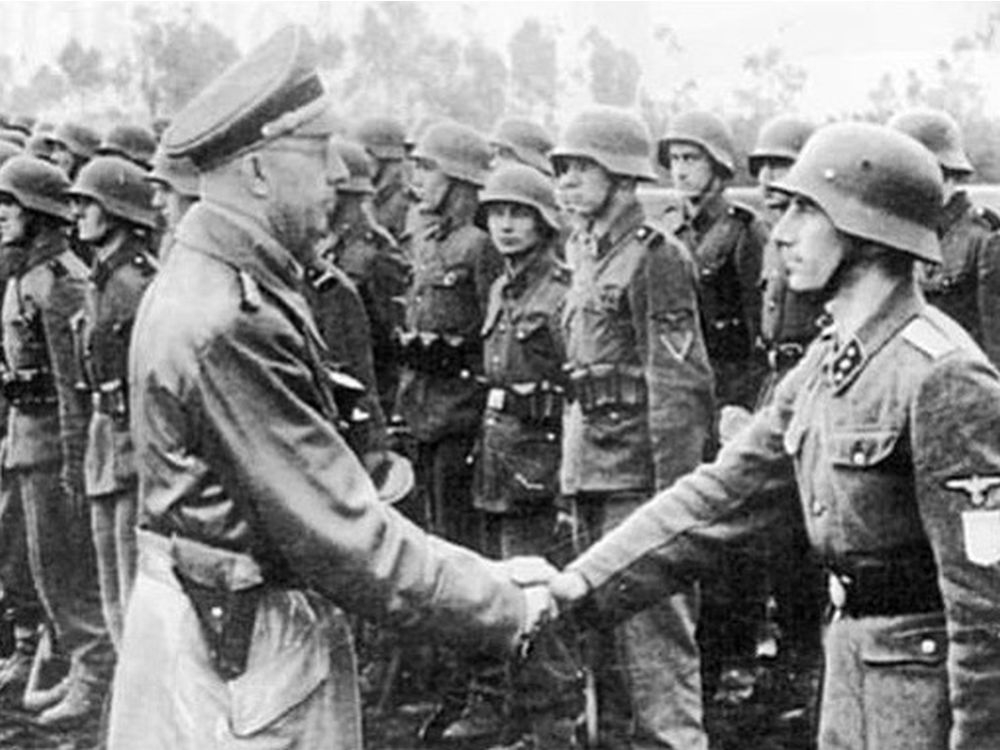
SS leader Heinrich Himmler greets members of the 14th SS Division during the Second World War. Police say graffiti left on an Oakville monument to the SS division is being investigated as a hate-motivated crime. (Photo courtesy US Holocaust Memorial Museum)
SS leader Heinrich Himmler greets members of the 14th SS Division during the Second World War. Police say graffiti left on an Oakville monument to the SS division is being investigated as a hate-motivated crime. (Photo courtesy US Holocaust Memorial Museum) /jpg

There are allegations members of the 14th SS Division took part in killing hundreds of Polish civilians in 1944 in the village of Huta Pieniacka. Some Ukrainians dispute that the SS division took part in the killings or they argue that only small elements from the unit – and under Nazi command – were involved. Others argue the SS members were heroes who fought against the Russians.

In 2017, a Polish judge issued an arrest warrant for then 98-year old Michael Karkoc, a 14th SS Division deputy company commander for war crimes. Karkoc, living in the U.S., died before he could be tried in court. He had been accused of coordinating the massacre of 44 civilians, including women and children, in the Polish village of Chłaniów in 1944.

Bernie Farber of the Canadian Anti-Hate Network said there is a need for Halton Regional Police to better educate themselves on what constitutes a hate-motivated crime. “Yes, it’s destruction of property for sure,” Farber said of the graffiti on the monument. “But a hate crime? Far from it.”

The monument to the 14th SS Division was also in the headlines in 2017 when the Russian Embassy in Ottawa posted images on its Twitter account pointing out the “Nazi monuments” in Canada.

Source: Graffiti on monument commemorating Nazi SS division being investigated as a hate crime by police