Changing the minds of wannabe terrorists

More commentary on deradicalization approaches:

And while these may seem to be the only two options open to Canadians who turn down the path of violent extremism — death or a court date — experts say a third option — deradicalization — isn’t receiving the attention it deserves.

“These programs can work,” said Jocelyn Bélanger, a psychology professor at the Université du Québec à Montréal who has studied radicalization around the world.

“Even though the number of cases (of homegrown extremism) are limited, we know how much damage just a few individuals can create. … If we do it well, if we read the research on this, we can develop better programs. We can be preventive as well, flagging individuals who are at risk, and once they are flagged they go into a (deradicalization) program.

”Existing approaches to this type of “deprogramming” have had varying degrees of success, and the rehabilitation is usually offered on a voluntary basis, Bélanger said. In most cases, the “beneficiary” is given a choice, to serve their sentence in jail or in a special facility.

“I know it sounds like a false choice, but it is nonetheless psychologically important,” explained Bélanger. In Saudi Arabia, he noted, “Imams will actually use the Qur’an, will engage in discussion with the beneficiary about the Qur’an, ultimately trying to convince them that Islam does not support the killing of innocents.”

Changing the minds of wannabe terrorists.

Farzana Hassan, who seems to be oblivious to the many messages from Canadian Muslims against extremism:

Muslims need to transcend the propaganda that has so defined their narrative on these issues and reject the naive “crusader” fiction.

Tragically, this is a point lost on the majority of the faithful, even supposed moderates.

Mosques must discredit this narrative actively, and they must preach the values of Canadian identity even above religious affiliation.

While Muslims are of course entitled to remain distinct, they must abide not only by the laws of the land but also by its universal values.

Inciting the murder of innocent Canadians is a clear violation of those laws and values.

In dealing with religious extremism, true moderation involves more than refusing to commit violence; it involves campaigning against the absurd political assumptions that may encourage it in others.

…It is the obscurantist views of extremists like Maguire that have hampered progress towards economic prosperity and political stability in the Muslim world for so long.

Muslims must not see attacks on ISIS as attacks on their religion as a whole.

On the contrary, they may help alleviate all the burdens that have bedeviled the Islamic world for so many decades.

Al Canadi’s rants are those of an impressionable and disturbed young man brainwashed by a lethal world view, a view so simplistic we can only wonder at its appeal.​

http://www.torontosun.com/2014/12/11/john-maguire—brainwashed-disturbed …

Michel Petrou provides a good overview of some of the challenges with deradicalization and the absence of an equivalent program in Canada, citing the UK experience in particular:

Usama Hasan, a British imam and senior researcher at the Quilliam Foundation, a counter-extremism think tank in Britain, says he is “astonished” that Canada does not have a de-radicalization program for Canadians who have returned from Syria and Iraq.

“There may be a risk that they’ve spent time with extremist groups and been brutalized by the war. So there’s always a risk that their minds won’t be thinking straight. So it’s very important to have ‘de-rad,’ which has to include a bit of mental health counselling and looking at PTSD and things like that,” he says.

“Even if they are prosecuted and convicted, you still need to de-rad them, because they will eventually be released from prison, and quite possibly they will be even more of a threat then because they will have been hardened in prison, and so they’re a threat either way.”

When he was a student at Cambridge University in the early 1990s, Hasan left Britain and briefly joined the Islamist insurrection, or jihad, against Afghanistan’s communist government.

At the time, Hasan was a radical Salafist and followed an extreme interpretation of Islam. He has since become much more moderate. In addition to officiating at interfaith marriage ceremonies, he now advises the British government on its own de-radicalization program, dubbed Channel.

People immersed in extremist groups “live in a kind of disconnected world,” says Hasan.

“They have their own reality, which they invent and perpetuate among their group by repeating the same old propaganda over and over again, but also blocking out anything that runs counter to that world view. We have to find holes in their world view and try to get through to them in as many ways as possible to make them doubt and rethink those kinds of ideas.”

Has likens the process to convincing someone to leave a gang. “You have to give them alternatives, address their needs,” he says.

When extremists rely on their faith to justify their world view, “you have to address all those religious points as well,” he says, “with better religion.”

Hasan describes recently counselling a young man who was determined to go to Syria. Hasan says the man knew “almost nothing” about the conflict there, or about the Middle East in general.

“People had just told him it was a war between Muslims and non-Muslims, and it was his duty to go and fight for Islam.”

The man believed there were American ground troops in Syria whom he could fight. Hasan educated him about the war, especially its sectarian nature and the ongoing slaughter occurring between Muslims. The potential recruit decided to stay in Britain.

He was lucky. Many others have left from Britain, Canada and other Western countries and died far from home. Some have committed horrific atrocities. Some will come back. Whether we like it or not, we’re going to have to figure out a way to live with them.

Canada’s extremist problem – Macleans.ca

From the US and the need for a more differentiated approach:

“Should they be prosecuted, should they be counseled, should they be reintegrated in a more compassionate way?” says Juan Zarate, who used to be a terrorism official at the Treasury Department. He’s now at the Center for Strategic and International Studies.

“Those are important questions because to the extent they are not fully radicalized, they perhaps were lured by a romanticized vision of what life was like in Syria,” he says. “Maybe it is appropriate to apply different tools and measures to peel them away from the movement as opposed to the same tools we have applied to more hard-core members of the group.”

When Americans Head To Syria, How Much Of A Threat Do They Pose?
UK: Theresa May cancels family’s British citizenship

Revocation for dual nationals, born in Britain:

A British-born man and his three grown-up sons have been stripped of their citizenship by Theresa May, the Home Secretary over alleged terrorism links.

The 51-year-old man, who was born in Newcastle-upon-Tyne, and his London-born sons, who are all in their twenties, had their British nationality rescinded two years ago while they were out of the country.

Mrs May’s decision was upheld by the Special Immigration Appeals Commission (Siac) but now the father, who can only be identified as ‘S1’, has claimed they are “innocent of all the allegations”.

They are now living in Pakistan, where S1s parents were born.

S1 admitted his daughter had travelled to Syria with a jihadist but he told the Sunday Times newspaper that she did so without his knowledge.

The father said he and his sons had been unfairly accused of supporting terrorism because of his daughter’s actions.

In a ruling from 2012, Siac heard S1 and his sons – known as T1, U1 and V1 – were linked with al-Qaeda.

Theresa May cancels family’s British citizenship – Telegraph.

BBC News – Radicalisation risk at six Muslim private schools, says Ofsted

Ongoing issue in UK schools, this time at private faith-based Muslim schools:

At one school, inspectors found pupils did not know the difference between sharia and British law.

And they said the curriculum at Mazahirul Uloom School in Tower Hamlets “focused solely” on Islamic themes.

In a letter to Ms Morgan, Sir Michael said he was “extremely concerned about the large number of failings” in each of the six schools and was “not convinced” current managers were capable of making necessary improvements.

“I believe that, in all six schools, pupils physical and educational welfare is at serious risk,” he wrote.

“Given the evidence gathered from these inspections, particularly in relation to the narrowness of the curriculum, I am concerned that pupils in these schools may be vulnerable to extremist influences and radicalisation.”

BBC News – Radicalisation risk at six Muslim private schools, says Ofsted.

Douglas Todd: Lessons from U.K. migration debate

One take on the UK’s immigration and related debates in a lengthy discussion between Douglas Todd and Eric Kaufmann, professor of politics at Birkbeck College, University of London:

Where is successful integration occurring in Britain?

The proportion of mixed-ethnicity households doubled between 2001 and 2011, Kaufmann says. “The fastest-growing group in England are those of mixed race who share English descent with the majority.”

Many second-generation immigrants are also integrating. “A significant share of the children of European immigrants and some of mixed-race background come to identify as white British, melting into the majority.”

Also, opposition to immigration is lower in neighbourhoods where a large share of minorities has been present for over a decade, giving people time to habituate to each other.

It is the rapid pace of change, rather than diversity itself, Kaufman says, that is causing most Britons to want to reduce immigration levels.

Douglas Todd: Lessons from U.K. migration debate.

Lady Warsi on Palestine, Islam, quitting … and how to stay true to your beliefs | The Observer

Good interview with former UK Minister Sayeeda Warsi:

On domestic issues such as extremism and the government’s approach to counter-radicalisation, Warsi refuses to be drawn. “My argument is that extremists are more of a threat to British Muslims than the community as whole; not only do those people cause us harm like everybody else – they’re indiscriminate – but also the backlash. It’s a double whammy. British Muslims have more incentive to rid society of extremists.”

However, she says there is mounting concern among Muslim organisations that the government is failing to engage enough and build trust. “If the British government doesn’t keep the majority of the community on board then they are not helping resolve the issue.”

For her, the issue is how will Islam evolve and overcome an atmosphere of mistrust and misunderstanding towards it. “What will British Islam look like for my kids, grandkids? Chinese Islam is very different to Saudi Islam; the challenge for our times is how we find this place.”

In the immediate future, she says, the challenge is tackling the normalisation of anti-Islamic views among some, an Islamophobic mindset she referred to in 2011 as having “passed the dinner table test”.

Another concern is the threat to repeal the Human Rights Act and withdraw from the European convention on human rights. “I hope we don’t move away from our commitment to human rights, domestically and internationally. We have to be careful we aren’t seen as defenders of human rights overseas but behave differently at home.”

Lady Warsi on Palestine, Islam, quitting … and how to stay true to your beliefs | Politics | The Observer.

UK and US Muslim communities key to tackling rise of Islamic extremism?

Starting with the UK:

‘As the prime minister said, the root of these actions lies in a poisonous political ideology that a small minority supports. In contrast, Islam is a religion which is observed peacefully and devoutly by more than a billion people.’

But commenting on Mr Brokenshire’s remarks, Nadim Nassar said distancing the extremism from Islam would not help the problem.

‘Mr Brokenshire is right to condemn these horrible acts of terrorism in Iraq and Syria,’ he told Lapido, ‘and to work with the community to get some aid to those areas. I do not agree that the problem is purely political and ideological because the extremists are abusing religion for political ends and they are recruiting religious leaders to help them.‘

It is simplistic to say that this is “nothing to do with Islam or any other faith”. Young people are being recruited not through political speeches; they are being recruited by religious leaders that use the Quran and the Hadith. We have to acknowledge that Islamic extremism is not a true representation of Islam any more than the Crusades are a true representation of Christianity; in both cases, however, they are “to do with” Islam and Christianity.’

Muslim communities key to tackling rise of Islamic extremism? | Lapido Media – Centre for Religious Literacy in World Affairs.

And from the US, a more theological message:

The Prophet Muhammad, who was a head-of-state as well as a prophet, established a society that is the model to all Muslims. That state was declared a sanctuary, protecting and securing all members of his community including non-Muslims. He said that the Jews were a community alongside the Muslims. They had their religion and the right to practice their customs and religious laws. Fourteen hundred years later, the advancement of civilization made by Islam remains idealistic to all Muslims today. At the very least, let these ideals can extinguish the venom from ISIS.

That’s the message that needs to be conveyed to Muslims worldwide in order to isolate ISIS from Islam and provide Islam as the antidote to the ideological distortion of ISIS and its destructive ambitions. That’s the substance in countering the narrative of violent extremism. It needs a vehicle and that’s where media, government and civil society can help.

The Key to Defeating ISIS Is Islam

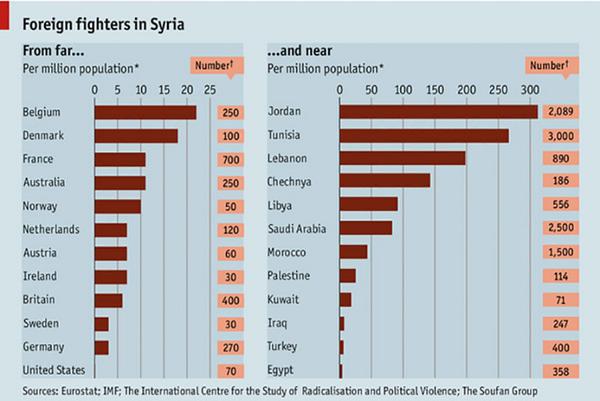
David Cameron seeks to seize passports of Islamist fighters

From The Economist

From The Economist

More on efforts to curb home-grown radicalization in the UK. While these are “hard” approaches to prevention, UK has also invested considerably in “soft” approaches as well.

As with all these initiatives, particularly their expanded application of revocation to prevent born-Britons without dual nationality to return home, questions about who decides and whether the person accused can defend himself.

One thing to hold them for investigation (legitimate), another to make a decision without due process.

One could argue that refusing entry, understandable from a security perspective, simply means that any such extremist would return to Syria or Iraq to continue their brutality, rather than being under the watch of the police in the UK:

“There are two key areas where we need to strengthen our powers to fill specific gaps in our armoury. These are around preventing suspects from travelling and dealing decisively with those already here who pose a risk.”

David Cameron’s new anti-terrorism proposals come days after the U.K. raised its terrorism alert to its second-highest level.

Cameron said he would bring in new “specific and targeted legislation” to give the police powers to temporarily seize a suspects passport at the border to give authorities time to investigate them. Currently only Britain’s interior minister has the power to withdraw a passport.

He also said the government would consult on a discretionary power to prevent Britons from returning home if they have pledged allegiance to extremist causes. This would extend existing powers which can only be applied to foreign nationals, naturalized citizens and those with dual nationalities.

David Cameron seeks to seize passports of Islamist fighters – World – CBC News.

Meanwhile, in Canada, more on the RCMP’s High Risk Travel Case Management Group approach to prevention (see also 2014 Public Report on the Terrorist Threat to Canada):

While the report’s emphasis is on prevention and intervention, several recent cases related to the Syrian conflict have raised questions about the effectiveness of efforts to reason with determined youths blinded by zeal.

After serving a prison sentence for his role in the Toronto 18 terrorist group, which plotted bomb and shooting attacks in southern Ontario, Ali Dirie used a fraudulent passport to travel to Syria, where he fought and died last August.

A British Columbia man charged with terrorism in July, Hasibullah Yusufzai, 25, was known to Canadian authorities because of a previous trip he had made to Afghanistan. Although he was on a no-fly list, he still managed to make his way to Syria using a passport that did not belong to him.

When Ahmad Waseem returned to Windsor, Ont. after he was wounded in combat in Syria, his mother hid his passport, his mosque counseled him and police spoke to him. But he returned to Syria last year and now calls the Islamic State of Iraq and Al-Sham his “brothers.” He has been charged with passport fraud.“

Early intervention through a joint community/law enforcement response is no guarantee that a person will not radicalize to violence,” the report says. “However, early intervention is one constructive way to deter potential violent extremists from causing harm.”

Canadian government plans ‘targeted interventions’ to stop citizens from joining armed Islamists in Syria

Sexual exploitation: See no evil, hear no evil, speak no evil | The Economist

Institutional and ethnic misogyny reinforcing each other in the UK town of Rotherham:

The investigation by Alexis Jay, a former chief inspector of social work, uncovers a catalogue of offences, mostly by Pakistani men against white girls. Children as young as 11 were plied with drink and drugs, raped, beaten and trafficked to be abused by men in other cities. One was doused in petrol and threatened with being set alight. Another told the investigation that gang rape was a usual part of growing up in her district. The report estimates that some 1,400 children—some from fragile family backgrounds, some in the care of the state—were abused between 1997 and 2013.

All of which is grim enough. But the local council knew at least ten years ago of widespread abuse and yet appears to have downplayed the problem. Nor did the police pay much attention to it. On one occasion, officers attended a derelict house and found an intoxicated girl with several adult men. They arrested the girl for being drunk and disorderly but detained none of the men. Some fathers tracked down their daughters and tried to remove them from houses where they were being abused, only to be arrested themselves.

…. What the report does not spell out, but which is true, is that the horrors in Rotherham fit into a pattern. In other northern towns such as Oldham and Rochdale, as well as in southern cities such as Oxford, gangs of Asian men have been convicted of grooming and abusing young, mostly white girls. This is a specific ethnic issue more than a religious one, says a community worker in a city near Rotherham.

Young Pakistani men are increasingly alienated from their conservative parents, who want them to marry girls from back home often the Mirpur district in Kashmir and also from religious leaders, who often cannot speak English. Discussions of sex are taboo at home and in the mosque, so some learn about it from pornography, about misogyny from rap music and come to view white women as fair game though the report also suggests Pakistani girls were abused, and that this was hushed up.

In Rotherham, this ethnic misogyny then ran up against the institutional misogyny of the police and the mostly white council. Ms Jay writes of one female employee at the council being told that if she wore shorter skirts to meetings “she’d get on better” and other senior male officials making explicit sexual remarks to female workers. Some senior police officers clearly saw the abused girls simply as sexually precocious young women.

Sexual exploitation: See no evil, hear no evil, speak no evil | The Economist.

ICYMI: In Britain, School Report Cites Division Over Islam

I think the issue is not that this ‘turns’ students to or from terrorism, but the overall message it sends to students about acceptable behaviour in a multicultural and diverse society, based upon equality (see also UK: Michael Gove (Education Sec’y) accused of using ‘Trojan Horse’ row to push anti-Islam agenda):

British education inspectors investigated 21 schools after claims that Islamic fundamentalists had taken over leadership of schools in Birmingham, home to a significant Muslim population.

The inquiry found that the influence of hard-line school board governors sometimes left staffs polarized between those who favored a more Islamic approach and others who did not. In British state schools many governors are elected by parents or staff members.

Some teachers, for example, “actively discourage girls from speaking to boys,” the report said, adding that in one school “boys and girls are also taught separately in religious education and personal development lessons.”

At one school, Oldknow Academy, “governors have used the academy’s budget to subsidize a trip to Saudi Arabia for only Muslim staff and pupils,” the document said.

Among the striking details to emerge from the report was that a senior figure in one school was so scared of being seen talking to school inspectors that a meeting had to be arranged in a supermarket parking lot. Another school hired private investigators to check staff email, the report said.

Ofsted’s chief, Michael Wilshaw, described some of the findings as “deeply worrying and, in some ways, quite shocking.”

But the findings were criticized by the Muslim Council of Britain, which says it has more than 500 affiliated national, regional and local organizations, mosques, charities and schools. It argued that “extremism will not be confronted if Muslims, and their religious practices are considered as, at best, contrary to the values of this country and at worst, seen as ‘the swamp’ that feeds extremism.”

“There is scant evidence that the education system or the Muslim community are the reasons for why people turn to terrorism,” it added in a statement.

In Britain, School Report Cites Division Over Islam – NYTimes.com.

What the Jihadists Who Bought Islam For Dummies on Amazon Tell Us About Radicalisation | Mehdi Hasan

More on radicalization in the UK (but applicable more universally). I also recommend the film Four Lions:

Sarwar and Ahmed, both of whom pleaded guilty to terrorism offences last month, purchased Islam for Dummies and The Koran for Dummies. You could not ask for better evidence to bolster the argument that the 1,400-year-old Islamic faith has little to do with the modern jihadist movement. The swivel-eyed young men who take sadistic pleasure in bombings and beheadings may try to justify their violence with recourse to religious rhetoric – think the killers of Lee Rigby screaming “Allahu Akbar” at their trial; think of Islamic State beheading the photojournalist James Foley as part of its “holy war” – but religious fervour isnt what motivates most of them.

In 2008, a classified briefing note on radicalisation, prepared by MI5s behavioural science unit, was leaked to the Guardian. It revealed that, “far from being religious zealots, a large number of those involved in terrorism do not practise their faith regularly. Many lack religious literacy and could . . . be regarded as religious novices.” The analysts concluded that “a well-established religious identity actually protects against violent radicalisation”, the newspaper said.

For more evidence, read the books of the forensic psychiatrist and former CIA officer Marc Sageman; the political scientist Robert Pape; the international relations scholar Rik Coolsaet; the Islamism expert Olivier Roy; the anthropologist Scott Atran. They have all studied the lives and backgrounds of hundreds of gun-toting, bomb-throwing jihadists and they all agree that Islam isn’t to blame for the behaviour of such men and, yes, they usually are men.

Instead they point to other drivers of radicalisation: moral outrage, disaffection, peer pressure, the search for a new identity, for a sense of belonging and purpose. As Atran pointed out in testimony to the US Senate in March 2010: “. . . what inspires the most lethal terrorists in the world today is not so much the Quran or religious teachings as a thrilling cause and call to action that promises glory and esteem in the eyes of friends, and through friends, eternal respect and remembrance in the wider world”. He described wannabe jihadists as “bored, under­employed, overqualified and underwhelmed” young men for whom “jihad is an egalitarian, equal-opportunity employer . . . thrilling, glorious and cool”.

Or, as Chris Morris, the writer and director of the 2010 black comedy Four Lions – which satirised the ignorance, incompetence and sheer banality of British Muslim jihadists – once put it: “Terrorism is about ideology, but it’s also about berks.”[idiots]

What the Jihadists Who Bought Islam For Dummies on Amazon Tell Us About Radicalisation | Mehdi Hasan.