UKIP Could Be About To Talk More About Islam

Interesting developments and analysis:

UKIP under Farage, by comparison, concentrated more generally on the impact of immigration. So could we start to see more of a specific focus on Islam in the party’s rhetoric?

“It’s quite plausible,” says Rob Ford, a professor of politics at Manchester University and co-author of Revolt on the Right , a book on UKIP. “In some ways, if you just look at some of the raw attitudes, it looks like there’s a very big potential market for it. British views of Muslims are often quite negative, there are a lot of anxieties particularly around cultural practises, cultural integration and so on.”

The party is also in need of a new USP (unique selling proposition) after Britain voted for Brexit, and its old rhetoric on immigration was largely focused on the issue of unskilled immigration from the European Union. Assuming new restrictions are placed on freedom of movement once Britain leaves the bloc, that won’t cut it any more.

But, Ford says, there are caveats to this. First, under the U.K.’s first-past-the-post electoral system, winning even the 20 to 25 percent of the vote that might be highly concerned about Muslim integration is not a recipe for success, unlike in some European countries with more proportional systems.

But also Britain has, Ford says, “been ethnically, racially diverse for longer than many countries and we’ve been actively talking about it for a lot longer than many countries.

“Germany denied that it was even a country of immigration until the late 90s and in France they still won’t gather statistics by race… We’ve had 50 years of discussion and work in terms of setting up and policing certain boundaries of political rhetoric,” Ford says.

An ongoing row in France, and Duffy’s response to it, illustrates his point. Fifteen towns on the French coast have moved to ban the “burkini,” full-cover swimwear worn by some Muslim women. When asked about the bans, Manuel Valls, the country’s prime minister and a politician on the mainstream center-left, responded without hesitation that the burkini was “not compatible with the values of France.”

Duffy [UKIP leadership candidate], by contrast, doesn’t even back the ban, which she calls a step too far. “If a motorcyclist sat on the beach and he wanted his helmet on, that’s up to him. He might sweat a bit. But I’m not going to prescribe what people should or shouldn’t be wearing,” she says.

Duffy says that her policy on Islam is aimed at boosting equality for Muslim women as much as anything else. “I’ve worked with a lot of British Muslim females and they haven’t had the same opportunities that I’ve had or my daughters will have,” she says. Of course, plenty of politicians with far tougher anti-Islam platforms make the same argument.

Still, however cautiously, the issue of British Islam has been forced higher up UKIP’s agenda, and it’s hard to imagine it won’t stay there in some form. UKIP is, Duffy tells Newsweek, “unique as a party in talking about challenging issues and opening the debate. And I think if we don’t start talking about the potential of what radical Islam can do to our country moving forward then we are missing a trick.”

Racial Inequality in U.K. Is Getting Worse, Report Finds | TIME

Post-Brexit hate crime numbers and overall poor integration data:

A new report on racial equality in the U.K. found that the level of opportunities for young minorities, especially in the black community, is failing to improve and may have gotten worse.

Human rights watchdog the Equality and Human Rights Commission (EHRC) said in a wide-ranging review that urgent government action is needed to tackle the “very worrying combination” of a post-Brexit rise in hate crime and “deep-rooted” racial inequality faced by Britain’s ethnic minorities.

It also found that race (82%) was the most commonly recorded motivation for hate crimes in England and Wales. The findings come after a spike in recorded hate crimes following the June 23 referendum, as British police saw a 57% increase in reported incidents .

“We must redouble our efforts to tackle race inequality urgently or risk the divisions in our society growing and racial tensions increasing” David Isaac, chair of EHRC said in a statement. “If you are black or an ethnic minority in modern Britain, it can often still feel like you’re living in a different world.”

The public body’s report also found that black people are more likely to be victims of crime, be treated harshly in the criminal justice system and are three times more likely to be prosecuted than the white people.

Black university graduates are paid 23.1% less than the average white worker with a degree, the report found. Black, Asian and ethnic minority workers with degrees are also two and a half times more likely to be unemployed than white workers with a university education, while black workers with degrees earned 23% less on average than a white worker with similar qualifications.

Ethnic minorities unemployment rates (12.9%) were twice as high than the white community (6.3%), the report said, and minorities were “hugely underrepresented in positions of power,” such as police chiefs and judges. In the U.K., 14% of the population is from an ethnic minority background but only 5.9% of all judges were in England and Wales were from an ethnic community.

Source: Racial Inequality in U.K. Is Getting Worse, Report Finds | TIME

Muslim Women in the U.K. Are The Most Economically Disadvantaged | TIME

Not surprising given patterns of UK immigration. Comparable numbers in Canada: the unemployment rate of Muslim women is 10 percent higher than Christian women, the participation rate 8 percent lower:

A new report has found that Muslim women are the most economically disadvantaged group in Britain, blighted by the highest level of unemployment compared to other religious and ethnic groups in the country.

Muslims, who make up 4.8% of the population of England and Wales, are more than two times likely to be unemployed compared to the general population. Women make up 65% of economic inactive Muslims are women, compared to 59% across all religions, says the report released by the House of Commons Women and Equalities Committee, a cross-party group of British lawmakers.

The report also found that traditional family practices affected Muslim women’s job prospects; 44% of all economically inactive Muslim women were not in work because they were looking after the home, compared to a national average of 16%.

The report says Muslim women looking for work or in employment also face a “triple penalty” of being a woman, part of an ethnic minority and being Muslim. It said Muslim women suffered the “impact of Islamophobia” on women’s job prospects, facing discrimination due to their beliefs, culture or clothing.

“We heard evidence that stereotypical views of Muslim women can act as a barrier to work,” the Committee Chair and Conservative Member of Parliament Maria Miller said in a statement. “The data suggests that in communities these patterns are shifting across generations but we remain concerned that this shift is happening too slowly and that not all Muslim women are being treated equally.”

The committee called on the government to roll out a plan to tackle these inequalities by the end of 2016. They also called for “name-blind recruitment” for all employers, following studies that suggest people with white-sounding names are more likely to get interviews.

Source: Muslim Women in the U.K. Are The Most Economically Disadvantaged | TIME

Why applying for citizenship is an anxiety filled process – and not just for applicants

I think Anne-Marie Fortier takes the arguments too far: some degree of language fluency and knowledge of the country is required, and the question is more how best to do so in a manner that is reasonable, fair and transparent.

Like all processes, particularly significant ones, some anxiety is natural and to be expected:

As we consider what post-Brexit citizenship might look like, it is crucial to understand the pervasiveness of anxiety and its integral role in shaping policy processes. Here, Anne-Marie Fortier discusses how anxiety is attached especially to English language ability for applicants, whilst also highlighting the role it plays for those on the other side of the process: the registrars checking applications  for citizenship or settlement.

Writing for The Guardian, Pakistan-born author Kamila Shamsie described how she never felt safe when she was applying for British citizenship: ‘I wasn’t prepared for the mutable nature of immigration laws, and their ability to make migrants feel perpetually insecure’. EU nationals have been feeling similar insecurities about their future status in Britain for months now. Brexit, of course, can only heighten such worries.

These experiences of insecurity resonate with that of many applicants I met in the course of my research on ‘becoming citizen’ in the UK. But those applying for citizenship or permanent resident status (known as ‘settlement’) are not alone in experiencing uncertainty and anxiety about citizenship and nationality rules: local authority registrars also at times feel anxious about the responsibilities and roles they are expected to fulfil as part of the citizenship attribution process.

Like many countries in Western Europe since the 1990s, Britain has undertaken a radical reform of its naturalisation measures. The revised process was put in place in 2004 and subsequent amendments followed in 2007, 2012, 2013, and 2016 (proposed). Today, applicants for settlement or citizenship must provide evidence of English fluency, complete the Life in the UK test (known as the ‘citizenship test’), and attend a citizenship ceremony when granted British citizenship.

The process of acquiring or attributing settlement or citizenship is riddled with anxiety in three interrelated ways: 1) anxiety is built into the process itself; 2) anxiety affects those who are involved in the process in different ways; and 3) anxiety ties into the reproduction of hierarchies of entitlement and belonging.

Building anxiety into the citizenship process

First, at the very heart of the requirement for immigrants to prove their English fluency and knowledge of ‘Life in the UK’ is an anxiety about ‘incursions’ of foreign cultures into the national domestic space. Since the summer of civil disturbances in Northern England in 2001, several British politicians have linked disaffection and risks of radicalisation among racial minority youths with ‘growing up in an English-free home’. These politicians include former Labour MP Ann Cryer in 2001, former Labour Home Secretary David Blunkett in 2002, as well as David Cameron at the start of this year.

Language and citizenship education should be available in order to provide new arrivals with crucial tools to facilitate their integration. But when language proficiency becomes politicised and conceived of as evidence of ‘integration’ rather than a tool for integration, it becomes the site where anxieties about protecting the ‘national culture’ are projected onto immigrants, residents or citizens with poorer or different English language skills. This lays the foundation for linguistic xenophobia that many have been subjected to for the past ten years, and which rose sharply in the immediate aftermath of the Brexit vote.

How anxiety affects different people within the application process

‘Khebat’ was a 27-year old Kurdish man from Iran when I met him in May 2013 in a private language school where he was taking a one-week intensive English language class to try to fulfil the language requirement for settlement. He had arrived as an asylum seeker in 2004 and was refused refugee status. He was living in Britain on a three-year leave to remain visa. As a ‘failed’ asylum seeker, Khebat knew he was ineligible for settlement. But he felt it unfair that a ‘friend’ who ‘don’t speak English’ passed the citizenship test and ‘got British’ (citizenship).

English fluency operates like a ‘checkpoint’ at the borders of citizenship rights, and Khebat internalised that logic. Khebat and many others (including applicants who are eligible for settlement) struggle to fit themselves into the policy. And a tension arises between how applicants read the requirements for English fluency and the way that the law reads them as perpetual outsiders regardless of their English fluency.

But it is not only applicants who are anxious about the securing of settlement or citizenship. Integral to citizenship processes is another anxiety about ‘fraudulent’ applicants, namely in the case of ‘sham marriages’ (or civil partnerships), which registrars have the statutory duty to report.

As part of the citizenship process, many local authority registrars (who deal with births, deaths and marriages) also provide optional services to settlement or citizenship applicants: the Settlement Checking Service (SCS) for applications for settlement on the basis of marriage (SET[M]), and the Nationality Checking Service (NCS) for citizenship applications. The role of registrars is to ensure that applications are complete and ready to be sent to UK Visa and Immigration, where decisions are made.

Conducting the SCS includes ensuring that couples have enough evidence of co-habitation. When I observed a training session about new SET(M) regulations in 2013, an extensive discussion arose about what counts as satisfactory evidence. Aside from the anxiety about getting it right, this discussion also revealed the limitations registrars see with the tools at their disposal to make a definitive assessment. The law operates in clear binary codes that separate the ‘genuine applicant’ from the ‘fraudulent applicant’ as if these were coherently and clearly gaugeable. But when faced with the much less coherent ways in which people organise their lives, registrars find themselves in the ambivalent position of exercising the state’s anxiety about ‘sham marriages’, while at the same time experiencing their own anxieties about the limits of the tools the state gives them to make that judgement and the fear of wrongly suspecting ‘genuine’ applicants.

Anxiety and hierarchies of belonging and entitlement

By attaching itself to linguistic competence, anxiety is projected onto individuals with perceived poorer or different English language skills who are judged according to a hierarchy of deservedness and belonging. Anxiety also attaches itself to bureaucratic processes that registrars find inadequate for distinguishing between ‘genuine’ and ‘fraudulent’ applicants.

Embedded in state practices such as citizenship attribution are anxieties about foreigners, such as those ‘not able to speak’ English and ‘not willing to integrate’ as David Cameron has stated, or foreigners who defraud the system. Such anxieties then recirculate among those who are variously involved in acquiring or attributing settlement or citizenship. However, the circulation of anxiety will have different effects on different subjects, as they are differently placed within the relations of power between the state and ‘foreigners’.

The pervasiveness of anxiety, and its integral role in shaping policy processes, is something then that needs to be studied in more depth; this is particularly the case as we consider what post-Brexit citizenship might look like.
Source: Why applying for citizenship is an anxiety filled process – and not just for applicants | British Politics and Policy at LSE

Security agencies face ‘real challenge’ fighting terrorism: London police head

Worth noting:

Identifying and tracking people who could turn into terrorists remains a challenge. At least 800 people from Britain went to Syria in recent years, with many joining the Islamic State and others in the fight against the Syrian government. Roughly 400 have returned to Britain and the police now have to assess their potential threat. They are ranked on a scale of 1 to 4, with 1 being the most dangerous.

Many of those who returned from Syria were legitimate aid workers or IS fighters who became frightened of the conflict, he said. “You could, therefore, regard them as a lower-risk group. But we can’t absolutely guarantee that,” he added. “They remain a continuing concern.”

He had praise for controversial programs such as Prevent, which obliges teachers and others in Britain to report people engaging in radical behaviour. Critics have said Prevent stigmatizes those who have been reported and unfairly targets Muslims. Sir Bernard said that while it isn’t perfect, the program can offer help to vulnerable people and families.

Putting guns in the hands of police officers isn’t a solution, he added, because that only increases barriers between cops and communities. The Metropolitan force remains one of the few in the world where the vast majority of officers do not carry guns. Of the city’s more than 32,000 officers, only 2,100 are armed. However, that number is slated to increase by 600 because of the attacks in Paris last November that killed 130 people.

“Just arming all police is not always the answer,” he said. “And our way is to have well-trained specialist officers, well equipped, well led, who we’d be deploying in large numbers to deal with that type of attack.”

One of the most effective tools to combat terrorism, and most other crimes, is the city’s vast network of CCTV cameras. After rioting in 2011, which spread across several parts of London, police gathered 250,000 hours of camera footage to seek out the culprits. About 800 officers spent a year combing through the material, leading to 5,000 arrests. Of those charged with a crime, 90 per cent “pleaded guilty because [the video footage] was such powerful evidence,” he said.

Britons have become so accustomed to the proliferation of cameras in the subway, on buses, across public places and in some taxis that the country has not had a major debate about privacy issues.

Sir Bernard said that is because the cameras were introduced at the local level. “It wasn’t the government saying you’re all going to have CCTV cameras. This was local authorities saying we want it in a public space, in shopping centres, and buses wanted it,” he said, adding that for police work, the cameras are “incredibly powerful.”

Source: Security agencies face ‘real challenge’ fighting terrorism: London police head – The Globe and Mail

ICYMI: Labour anti-Semitism inquiry academic on being caught in a storm

Interesting and thoughtful reflection:

What is it like for academics to try and bring scholarly analysis to issues that are at the centre of fierce public debate?

On 29 April, Jeremy Corbyn appointed Shami Chakrabarti to chair an inquiry into “anti-Semitism and other forms of racism including Islamophobia, within the [Labour] party”, after a series of incidents involving Ken Livingstone, Naz Shah and others.

It soon attracted comment from both “sides”. There were those who believe that the Labour Party is riddled with anti-Semitism and feared that the inquiry would be a whitewash. Others suggested that the issue was just a storm in a teacup, an attempt to curb legitimate criticism of the state of Israel or part of a coordinated campaign against Mr Corbyn’s leadership.

One of those caught in the crossfire was David Feldman, vice-chair of the inquiry, and director of the Pears Institute for the Study of Antisemitism at Birkbeck, University of London.

“My role in the Chakrabarti inquiry was announced at a time of great controversy and concern around the allegations of anti-Semitism in the Labour Party,” he told Times Higher Education.

“The sort of complexities and nuance that academics can bring to an argument are not always listened to – people are not at their most receptive. I didn’t recognise some of the views that were attributed to me.”

Most of the attacks, Professor Feldman went on, came from “the Jewish communal leadership, figures and institutions who strongly identify with Israel”. He was taken to task for distancing himself from what he calls the “subjective” definition of racism, that “if a group or an individual regards something as racist, then it is”.

Some also called attention to the fact that he had signed a declaration by Independent Jewish Voices, a group which has raised concerns about “the proliferation in recent weeks of sweeping allegations of pervasive anti-Semitism within the Labour Party”, although he responded that the particular declaration he signed was “very uncontroversial: in favour of human rights, international law, Israelis and Palestinians living in peace and security; against racism and especially anti-Semitism”.

“When one is misrepresented in the public sphere,” reflected Professor Feldman, “that is unpleasant and not something that academics are used to in their day-to-day job. And being in that situation is still something I am coming to terms with.”

The launch of the report on 30 June was overshadowed by controversy over Mr Corbyn’s comments that “our Jewish friends are no more responsible for the actions of Israel or the Netanyahu government than our Muslim friends are for the self-styled Islamic states or organisations” and by the verbal abuse of the Jewish Labour MP, Ruth Smeeth, who left the room in tears.

Professor Feldman takes comfort in the fact that the report itself “has been very well received across a broad spectrum of opinion…It is striking that groups and institutions [such as the Board of Deputies of British Jews and the Jewish Labour Movement] who did express concern are among those who have welcomed the report as a step forward.”

It has led him to “reflect on how the histories of racism and anti-Semitism have shifted in recent decades, and that is something that will feed into my research and academic publications”.

Source: Labour anti-Semitism inquiry academic on being caught in a storm | THE News

‘I didn’t get anti-Semitism as racism,’ says Labour MP Naz Shah | UK

Incredible but at least her words were better than the usual “I am worry if my remarks offended anyone.” Actually, given the nature of her comments, one wonders how a MP could be so ignorant and unaware:

Naz Shah has said the comments which resulted in her suspension from the Labour party were anti-Semitic but, at the time, she “didn’t get anti-Semitism as racism”.

Ms Shah, the Bradford West MP, was suspended from the party in April amid controversy over a social media post appearing to endorse the relocation of Israelis to the US. Labour’s governing body, the National Executive Committee, has since reinstated Ms Shah.

In a Facebook post in 2014, before she became MP for Bradford West, Ms Shah shared a graphic which showed an image of Israel’s outline superimposed onto a map of the US under the headline “Solution for Israel-Palestine Conflict – Relocate Israel into United States”, with the comment “problem solved”.

Asked by BBC Radio 4’s World at One what she thought when she now looked back at the posts, Ms Shah replied: “How stupid I was and how ignorant I was. At the time, I didn’t understand it.

“The language that I used was anti-semitic, it was offensive. What I did was I hurt people and…the clear anti-semitic language, which I didn’t know at the time, was when I said the Jews are rallying. Now that is anti-semitic.

“I wasn’t anti-semitic, what I put out was anti-semitic,” she added.

“I didn’t get anti-Semitism as racism,” said Ms Shah. “I had never come across it. I think what I had was an ignorance.”

 Asked whether she thought “silly” for not knowing that it was anti-semitic, she added: “Of course. I will always own my ignorance and it was ignorant. Let’s be clear about it. It has been a journey that I’ve been on… I’ve had amazing compassion from the Jewish community. And I have to earn that trust. I have to be able to say ‘this is what I did’.

Ms Shah also explained her initial reaction to the furore: “One of the tough conversations I had to have with myself was about, God, am I anti-Semitic?

“And I had to really question my heart of hearts. Yes, I have ignorance, yes everybody has prejudice, sub conscious biases, but does that make me anti-Semitic? And the answer was no, I do not have a hatred of Jewish people.”

Source: ‘I didn’t get anti-Semitism as racism,’ says Labour MP Naz Shah | UK Politics | News | The Independent

Immigration point systems – What’s the point? | The Economist

Good overview of the shift towards an employment-offer based point system but mischaracterizes this as a shift away from using points – it is just that the weighting system has changed, in Canada’s case, from a human capital model, to one that privileges immigrants with concrete job offers (50 percent of all points):

Canada created the world’s first points system, in 1967. Would-be immigrants who scored highest on youth, education, experience and fluency in English or French were offered permanent residency. In 1979 Australia created a similar system. Both countries were abandoning racist schemes that had favoured whites (Australia ran one called “bring out a Briton”). Henceforth, the aim would be to lure talent, wherever it was from.

The new systems soon attracted admirers. New Zealand built a points-based immigration system in 1991; Britain, the Czech Republic, Denmark and Singapore began to experiment. But it gradually became clear that Australia and Canada were much better at attracting accomplished immigrants than at using their skills.

Employers were unimpressed with the new arrivals’ qualifications and foreign work experience. In Australia, 13.5% of recently arrived immigrants who had applied from overseas under the points system were unemployed in late 2013, compared with just 1% of those who had come in with a job offer. Pure points systems “don’t work”, says Madeleine Sumption of the Migration Observatory at Oxford University.

Another problem in Canada was that the number of applicants exceeded the number allowed in each year. At the worst point, applicants for the Federal Skilled Workers programme were waiting up to eight years for a decision. Businesses complained that superb applicants were languishing behind merely decent ones.

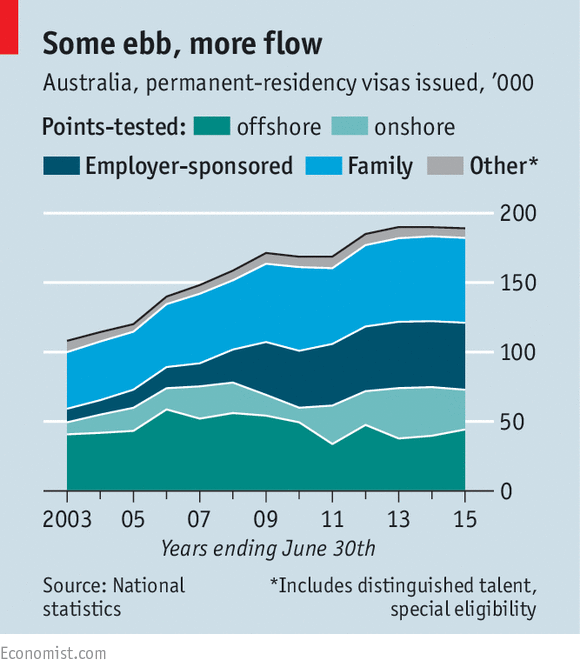
To deal with these flaws Australia and Canada have transformed their immigration systems. Both now weigh local work experience and job offers more heavily. Between 2002-03 and 2014-15 the number of Australian visas granted on the basis of job offers rose five-fold, from 9,700 to 48,300 (see chart). In Canada, the points system has been reworked so that any skilled applicant with a job offer scores higher than any applicant without.

Both countries have also inverted the process of applying for visas. Instead of putting applicants in a queue, they now invite people merely to express an interest in migrating. Those who pass an initial points test are put into a pool, where they can remain for a year or two. Every so often the best candidates are skimmed off and invited to apply for visas. Companies and provinces can trawl the pool, looking for promising immigrants to sponsor. Anybody they pluck out is likely to get a visa quickly.

These reforms seem to have had some effect. Immigrants to Australia are still less likely than natives to be economically active, but the gap has closed—from 9.8 percentage points in 2002-03 to 6.3 points in 2013-14. Canada’s huge backlog has gone: many of those stuck in the queue were ejected and given their fees back.

Businesses are less happy, though. In Canada, a firm that wants to offer a job to a foreigner must prove that it tried and failed to hire a Canadian—a slow, costly and sometimes daft process. Kumaran Thillainadarajah, an immigrant entrepreneur who founded a firm as a student, had to explain why he and not a native should be chief executive. The system is too cumbersome, says Sarah Anson-Cartwright of the Canadian Chamber of Commerce. She looks enviously at Britain, which has a fast-track visa scheme for technology workers.

….Britain’s experiment with a points-based system in 2008 was also thwarted by business pleading. The scheme was never as flexible as Australia’s or Canada’s. But at least it was simple—until the lobbying began. Firms moaned that vital foreign workers were blocked because they lacked the required qualifications. Carve-outs were duly created: butchers and ballet dancers were given special treatment and footballers were not required to speak English. What remained of the system was then bulldozed by a Tory-led government that had pledged to slash immigration.

A simple immigration system that attracts global talent, calms the natives and gives businesses the workers they crave seems an impossible dream. Perhaps it is also a foolish one. Governments cannot know what kind of immigrants their economies will require because they do not know how their economies will evolve. There will always be special pleading and exceptions. As Mr Byrne puts it: “Migration systems are complicated because people are complicated.”

Source: What’s the point? | The Economist

Did Britain’s E.U. Referendum Spark a Surge in Hate Crimes? | TIME

Spoiler alert – it predates it.

Last para makes appropriate warning, however, not to dismiss those who voted leave:

Matthew Collins, a researcher for the anti-racism group Hope not Hate, says he has observed virulent anti-immigrant rhetoric seeping into the mainstream for years. Part of his job involves monitoring far-right online media in the U.K. But in recent years he has found himself checking national newspapers like the Daily Mail and the Express, which have been using language and symbolism that was once considered taboo. In 2015, an editorial cartoon by the Mail was criticized as using 1930s Nazi anti-Semitic propaganda as it seemed to equate migrants fleeing wars into Europe with rats.

Traditional far-right groups have collapsed in the U.K. due to their language being “mainstreamed” and used by populists like UKIP, Collins says. “When David Cameron was elected as Prime Minister for the second time [in 2015] he promised things like being tough on immigration, he promised people a referendum on E.U. membership. That is when we really saw a real hardening of language in reporting.”

The bigotry that has emerged has different roots to the popular ethno-nationalism of the 1970s, says Collins, who was a member of far-right groups like the National Front before he “grew up” in 1989 and began helping anti-extremist organizations. The xenophobic schisms in today’s Britain, he says, have less to do with “ideas of [racial] superiority and more and more of it is just based on desperation.”

Collins suspects today’s hate crime perpetrators largely come from marginalized white communities who largely voted for Britain to leave the E.U. in the referendum. These communities exist in a constant “fight for resources” caused by years of austerity, he says, where the struggle to find jobs and get doctors’ appointments, school places and housing can seem exacerbated by migration levels.

The question now becomes how to fix the levels of distrust and fear among certain sections of the British population. The U.K.’s equality watchdog, the Equality and Human Rights Commission will look into how race policy in the U.K. must be strengthened. Speaking to TIME, its chair David Isaac says that projecting the message that diversity is a source of opportunity in the U.K. should be supported. “The referendum has created all sorts of splits and schisms, and that’s why getting the message across that diversity can enhance what the U.K. has to offer…[is] important.”

But Collins says it’s important for anti-racism campaigners not to widen the empathy gap that opened up during the referendum campaign. Dismissing the 52% of voters who elected to leave the E.U. as “fuddy duddy and racist” could exacerbate tensions even further, he says. “If you victimize someone, if you go around calling someone a racist for long enough, they will become a racist.”

Source: Did Britain’s E.U. Referendum Spark a Surge in Hate Crimes? | TIME

Britons ‘as French as Edith Piaf’ apply for citizenship over Brexit worries | Reuters

Not large numbers but interesting as people hedge their bets:

Twenty-nine year-old Briton Colette Taylor-Jones rushed to become French before the referendum that will decide whether Britain stays in the European Union or not.

“I decided to change my nationality when the whole ‘Brexit’ story started,” the book publisher told Reuters at the end of a ceremony organised by authorities for naturalized citizens.

Worried she might find herself an alien in the country she calls home, Taylor-Jones, who grew up in Nice, filled in the forms to become French when Britain’s Conservative Party promised to hold a referendum on EU membership if it won 2015 parliamentary elections.

Under EU rules, her British passport has so far guaranteed her the same rights to live and work in France as her French neighbours and she did not want to have to ask for a residency permit in case of Brexit, she said.

The latest polls ahead of the June 23 referendum show Britons are almost evenly split over whether to stay or go.

Some 279 Britons became French in 2014, the latest year for which data is available, with the numbers fluctuating between 205 and 354 per year in the five previous years, French Interior Ministry data shows.

Officials said they cannot provide data on how many have applied for a passport.

Twenty-eight year-old Jack McNeill, who has been living in France for six years, says he considers it home too. The prospect of having to ask for a residency permit or not being able to move freely around Europe if Britain left the EU pushed him to apply for a French passport.

McNeill, who is from Edinburgh and works at an international organization based in Paris, is now going through the paperwork and filling in the forms required for his citizenship request.

“What it means to be French is to adhere to the values of the country. ‘Liberté, égalité, fraternité’,” he said, referring to the French motto of freedom, equality and solidarity.

“That’s what it means and you can be from any ethnicity or your first language could be any other language but if you believe in these values and the importance of them, and the importance of preserving them and so on, then you are as French as anyone else, as Edith Piaf,” he said – while acknowledging he might not quite share the late singer’s musical skills.

Both Britain and France allow their nationals to hold dual citizenship and McNeill, speaking in a pub that sells fish and chips in the heart of Paris, said he still feels British too.

The French foreign ministry estimates that about 400,000 Britons live in France. There is no official data because they are not obliged to register.

Source: Britons ‘as French as Edith Piaf’ apply for citizenship over Brexit worries | Reuters