Turkey a late entry in lucrative economic citizenship bandwagon – Daily Sabah

citizenship-investmentOne of the latest countries to embrace the trend, without the pretence that this will help the economy beyond real estate:

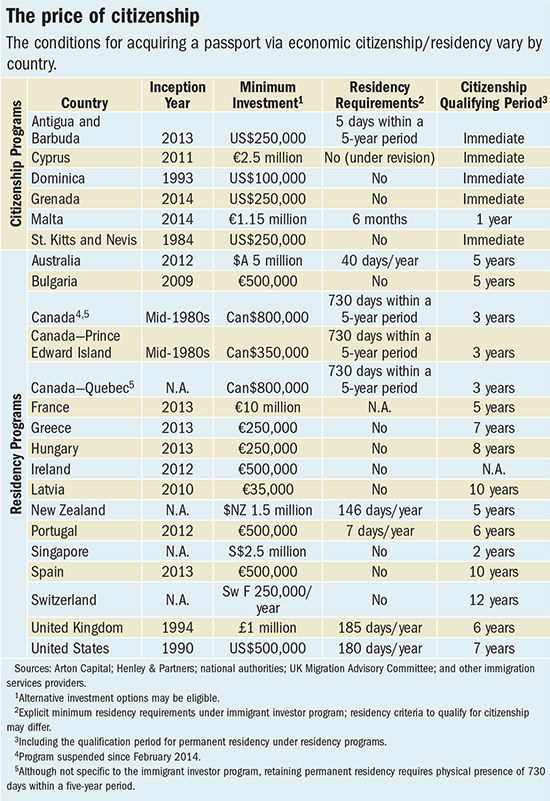
The increasing phenomenon of citizenship-by-investment – economic citizenship – has come to occupy the Turkish agenda with Thursday’s amendment of a citizenship law that offers citizenship to foreigners via four types of investment choices, including a real-estate investment of $1 million. In particular, the real-estate option is expected to boost Turkey’s real estate market and increase the ratio of real estate purchased by foreign investors.

Granting citizenship to foreigners in return for a determined amount of investment is a global phenomenon applied in many developed and developing countries, such as the U.S., Canada, the U.K., France, Australia, Dominica and Bulgaria. The growing phenomenon of “buying citizenship” is defined as “economic citizenship” by the International Monetary Fund (IMF).

Economic citizenship is offered by a number of small states and advanced economies, some of which, such as Canada, the U.K. and U.S., have had immigrant investor programs since the late 1980s or early 1990s, offering a route to citizenship in exchange for specific investment conditions with significant residency requirements. The rapid growth of private wealth, especially in emerging market economies, has increased the interest of wealthy people in greater global mobility and fewer travel obstacles posed by visa restrictions.

Source: Turkey a late entry in lucrative economic citizenship bandwagon – Daily Sabah

ICYMI: Ankara’s citizenship plan for Syrian refugees raises Kurdish worries

The politics of citizenship:

Turkey’s Kurdish lawmakers say the government’s decision to gradually grant citizenship to over 3 million Syrian refugees in the country’s Kurdish cities can disturb the population makeup of the area and incite ethnic tensions.

“We support efforts to embrace and help the refugees but the government’s plan is not assistance, it is part of a wider political game to strengthen its roots here,” said Mahmoud Togrul, a member of parliament from the pro-Kurdish Peoples’ Democratic Party (HDP) in the city of Entab.

Togrul believes Ankara is exploiting the refugee crisis, and by giving voting rights to the Syrian migrants it plans to secure votes ahead of the 2019 elections.

“Most of the Syrians will choose to stay in Turkey and that will be decisive in the coming elections,” he said.

According to the Turkish law, applicants will be granted citizenship after five years of residence in the country. This makes the bulk of the Syrian refugees eligible candidates for Turkish citizenship in the coming years, and able to vote in the next elections.

Official data also show that nearly 152,000 children have been born in Turkey whose parents came as refugees from Syria.

Ankara has said by getting citizenship, the refugees will have brighter prospects in the labor market and reduce the overall migration to Europe.

As part of an agreement with the European Union, called the Facility for Refugees in Turkey, Ankara will be receiving 6 billion euros over the next three years and resume the EU membership talks that stalled in late 2000.

Critics say giving millions of refugees citizen status will serve the strategic plans of the ruling Justice and Development Party (AKP).

“There will be over 1 million new voters in the 2019 elections if the government goes through with the proposal, which will in turn change the outcome of the elections,” said lawmaker Erdogan Toprak from the opposition Republican Peoples’ Party (CHP), quoted by Turkish daily Hurriyet.

Toprak said the government plans to create settlements for the refugees with the financial help it will receive from the EU, influencing the demographic development in the southeast where Kurds are in the majority.

The majority of the Syrian refugees in Turkey are of Arab origin, along with large numbers of Kurdish and Turkmen asylum seekers.

“What is strategically important for the government is the bordering areas connecting Kurdish lands in Syria, Iraq and Turkey, which Ankara wants to influence by placing the refugees’ families there,” said Kurdish author Fehim Ashiq.

Source: Ankara’s citizenship plan for Syrian refugees raises Kurdish wor

Turkey commemorates Holocaust, vows to fight antisemitism

Now if the Turkish government could be more open about the Armenian genocide… Also wonder whether this appeared in Turkish-language media or only in English:

Turkey has voiced resolve in continuing its fight against anti-Semitism, racism, xenophobia and Islamophobia in a message to mark International Holocaust Remembrance Day.

“We commemorate with respect millions of people who lost their lives in the Holocaust which is one of the darkest and most painful eras in the history of humanity,” the Turkish Foreign Ministry said, recalling that Jan. 27 had been chosen by the United Nations to commemorate victims of the Holocaust during World War II.

“As it has done so far, our country will continue to fulfill its responsibility to ensure such atrocities are not experienced again and will continue its fight with determination against phenomena, such as anti-Semitism, racism, xenophobia and Islamophobia which have unfortunately been observed and strengthened,” the ministry said in a written statement released late Jan. 26.

Source: Turkey commemorates Holocaust, vows to fight anti-Semitism – DIPLOMACY

We Have Lost | Turkish Reaction to Paris Attacks and Implications

Thoughtful commentary on Turkey’s lack of full condemnation for the Charle Hebdo attacks, and lack of support – and understanding – of free expression.

And if this is the tenor of Turkish debate and understanding, as the conclusion notes, not the cheeriest but perhaps most realistic way to start the new year:

I could go on, but hopefully by now you get the point. A NATO-member country, with massive commercial and defense links to the U.S. and Europe, whose leaders speak English and many of whom have been educated in the U.S. and Europe, should know better. It should know that terrorism against civilians must be condemned full-stop, that drawing offensive cartoons does not mean that you deserve to be killed, that the Mossad did not just engage in a deadly false flag operation, and that no government is killing its own people in order to gin up anti-Muslim sentiment and create a pretext for persecuting its own Muslim population. When it doesn’t seem to know these things, it means we have lost the battle of ideas, and the extremists are winning. Not insignificant numbers of educated and sophisticated people in the Middle East genuinely believe that what happened in Paris is part of a larger conspiracy to frame Muslims for violent acts, that the U.S. created ISIS as an excuse to launch new military operations in Iraq and Syria, that 9/11 was a false flag operation designed to further a clash between the West and Islam, and on and on. The debate over whether the appropriate approach to combating jihadi terrorism is a military one or a law enforcement one is the wrong debate, because it misses the point. Neither approach is going to do the job, because this is a war of ideas, and so killing or prosecuting terrorists will only get you so far. People need to be convinced that extremism is both futile and the wrong way of seeing the world, and I don’t know how best to wage that battle, but I am pretty confident it is the one that needs to be waged.

One of the widespread techniques used when teaching international relations to undergraduates is to look at the fall of the Soviet Union and the end of the Cold War and apply different schools of international relations theory toward explaining this earth-shattering event. If you are a realist, you point to the fact that U.S. military spending and economic superiority were too much for the Soviets to overcome, and they were brought down by overwhelming American hard power that can be measured. If you are a constructivist, you look at the battle of ideas and trace the way in which Communism became so discredited in the face of Western liberal democracy and capitalism that the entire Communist edifice collapsed as it lost its legitimacy. I have always been more drawn to the latter explanation for a number of reasons, but most of all because it wasn’t just the Soviet Union that disappeared overnight, but Communism itself. Yes, small pockets of it remain (and no, China is not Communist today in any meaningful way), but for a political and economic system that controlled nearly half the world to just disappear is remarkable, and it wouldn’t have happened had the only blow been the fall of its largest state patron.

The same thing needs to happen when it comes to the philosophy of extremism motivating the type of jihadi terror as we saw in Paris last week. There is no way to prevent these types of attacks from a logistical perspective; Paris was not an intelligence failure, and while the French police can deploy thousands of soldiers and police to protect nearly every potential Jewish target in France, there is not enough manpower to sustain that permanently. Even if there was, it wouldn’t be a failsafe solution. Until attitudes change in a major way, until jihadi extremism is discredited, until more extremists believe that there is a better way, and until the ideas animating jihadi extremist terror are demonstrated to have failed abjectly and completely, we will continue to lose. Pretty depressing way to start the new year, huh?

We Have Lost | Ottomans and Zionists.