How corporate America got DEI wrong

More on corporate DEI post-Trump:

The “ethical case for diversity” is stronger

Still, Bermiss and others point out that DEI policies can have significant business impacts, even if they’re not apparent in short-term financial results. Having a more diverse team can help create products that appeal to more consumers, or help employees feel more satisfied with their jobs.

Costco, for example, recently told investors that its DEI efforts “help bring originality and creativity to our merchandise offerings” and “enhance our capacity to attract and retain employees who will help our business succeed,” among other benefits.

The massive retailer, which also calls DEI part of its “code of ethics,” successfully brushed off an anti-DEI shareholder proposal last month. Meanwhile, JPMorgan Chase CEO Jamie Dimon, who runs the nation’s largest bank, has called DEI “good for business; it’s morally right; we’re quite good at it; we’re successful.”

It probably helps that both JPMorgan Chase and Costco are financial powerhouses, whose profits and share prices keep their investors happy. But both companies are also framing their DEI policies as a matter of morality or ethics, rather than just profits.

That’s exactly how more companies should be thinking about DEI, according to Bermiss — if (and only if) they see it as valuable. Bermiss acknowledges that not all companies will want to continue pursuing greater diversity, equity, and inclusion. But he argues that if business leaders decide that pursuing such workplace goals is morally right and aligned with a company’s values, then they’ll be better able to stand up to criticisms or attacks.

And, as he adds, that’s firmer ground than hoping that “if we get two more Latinos on the board, our stock price will go up.”

Some DEI work will continue — by any other name

Despite the ongoing pressures, Costco and JPMorgan aren’t the only employers still spending money on DEI. In fact, some companies are ramping up: Paradigm, a tech consultancy that advises employers on diversity and inclusion, says it saw a 12 percentage-point increase last year in how many of its customers had dedicated DEI budgets.

Paradigm CEO Joelle Emerson says that even companies that are ending DEI programs may rebrand the work rather than abandoning it altogether. Corporate America’s diversity results have been “a mixed bag,” she adds, “in part because companies often spent too much time and energy on initiatives that didn’t have a measurable impact.”

Now she’s hoping that employers are taking the time to create more thoughtful — and effective — programs to increase fairness.

“I see this less as a rollback of DEI and more as sort of an evolution to the next phase of this work,” Emerson says.

Many of the companies ending DEI programs are scrubbing the now-politically-toxic acronym from their websites and corporate statements. But their public statements insist that they still want to make everyone feel included.

That could be a tricky balance, especially as the Trump Administration continues ramping up attacks on DEI — including efforts to uncover rebranded diversity efforts inside of federal agencies.

And it remains to be seen whether corporate America can really be more effective while softening its language — and goals — around diversity, equity, and inclusion. But Emerson, at least, is bullish.

“I’m actually pretty optimistic about the future of this work,” she says. “I’m not optimistic about the acronym DEI — nor do I particularly care.
Source: How corporate America got DEI wrong

Brooks: The Six Principles of Stupidity

Good list:

Principle 1: Ideology produces disagreement, but stupidity produces befuddlement. This week, people in institutions across America spent a couple of days trying to figure out what the hell was going on. This is what happens when a government freezes roughly $3 trillion in spending with a two-page memo that reads like it was written by an intern. When stupidity is in control, the literature professor Patrick Moreau argues, words become unscrewed “from their relation to reality.”

Principle 2: Stupidity often inheres in organizations, not individuals. When you create an organization in which one man has all the power and everybody else has to flatter his preconceptions, then stupidity will surely result. As the German theologian Dietrich Bonhoeffer put it: “This is virtually a sociological-psychological law. The power of the one needs the stupidity of the other.”

Principle 3: People who behave stupidly are more dangerous than people who behave maliciously. Evil people at least have some accurate sense of their own self-interest, which might restrain them. Stupidity dares greatly! Stupidity already has all the answers!

Principle 4: People who behave stupidly are unaware of the stupidity of their actions. You may have heard of the Dunning-Kruger effect, which is that incompetent people don’t have the skills to recognize their own incompetence. Let’s introduce the Hegseth-Gabbard corollary: The Trump administration is attempting to remove civil servants who may or may not be progressive but who have tremendous knowledge in their field of expertise and hire MAGA loyalists who often lack domain knowledge or expertise. The results may not be what the MAGA folks hoped for.

Principle 5: Stupidity is nearly impossible to oppose. Bonhoeffer notes, “Against stupidity we are defenseless.” Because stupid actions do not make sense, they invariably come as a surprise. Reasonable arguments fall on deaf ears. Counter-evidence is brushed aside. Facts are deemed irrelevant. Bonhoeffer continues, “In all this the stupid person, in contrast to the malicious one, is utterly self-satisfied and, being easily irritated, becomes dangerous by going on the attack.”

Principle 6: The opposite of stupidity is not intelligence, it’s rationality. The psychologist Keith Stanovich defines rationality as the capacity to make decisions that help people achieve their objectives. People in the grip of the populist mind-set tend to be contemptuous of experience, prudence and expertise, helpful components of rationality. It turns out that this can make some populists willing to believe anything — conspiracy theories, folk tales and internet legends; that vaccines are harmful to children. They don’t live within a structured body of thought but within a rave party chaos of prejudices.

As time has gone by, I’ve developed more and more sympathy for the goals the populists are trying to achieve. America’s leadership class has spent the last few generations excluding, ignoring, rejecting and insulting a large swath of this country. It’s terrible to be assaulted in this way. It’s worse when you finally seize power and start assaulting yourself — and everyone around you. In fact, it’s stupid.

Source: The Six Principles of Stupidity

Trump signs executive order to cancel student visas of ‘Hamas sympathizers’ who protested Israel’s war in Gaza

Already prompting similar calls in Canada, we article on Poilievre comments below:

President Donald Trump has signed an executive order promising “immediate action” from federal law enforcement against noncitizen college students and others in the United States who participated in pro-Palestinian demonstrations during Israel’s war in Gaza.

The president has pledged to “deport” all “resident aliens” who joined protests, Trump said in a White House fact sheet.

“Come 2025, we will find you, and we will deport you,” he vowed.

Trump also pledged to “quickly cancel the student visas of all Hamas sympathizers on college campuses, which have been infested with radicalism like never before,” he claimed.

The Department of Justice will “aggressively” prosecute what it characterizes as “terroristic threats, arson, vandalism and violence against American Jews” after “the explosion of antisemitism” on college campuses in the wake of Israel’s campaign, according to the White House.

“It shall be the policy of the United States to combat anti-Semitism vigorously, using all available and appropriate legal tools, to prosecute, remove, or otherwise hold to account the perpetrators of unlawful anti-Semitic harassment and violence,” the executive order states.

As The Independent has reported, both antisemitism and Islamophobic threats and violence surged after Hamas invaded Israel in 2023, kicking off the war in Gaza and widespread protests on U.S. campuses.

Under the order, government agencies have 60 days to produce a report “identifying all civil and criminal authorities or actions” to “curb or combat” antisemitism, with an inventory of complaints “against or involving” antisemitism in colleges and universities.

The U.S. Attorney General is “encouraged to employ appropriate civil rights enforcement authorities” to combat antisemitism, the order states.

Source: Trump signs executive order to cancel student visas of ‘Hamas sympathizers’ who protested Israel’s war in Gaza

Meanwhile in Canada:

FIRST READING: As anti-Israel rallies continue unabated, Poilievre calls for deportations

We see on our own streets antisemitism guided by obscene woke ideologies that have led to an explosion in hate crimes,” Poilievre said in a brief address at the official Holocaust Memorial Day ceremony in Ottawa.

He then added, “we must not just condemn these things, we must take action against them.”

“We must deport from our country any temporary resident that is here on a permit or a visa that is carrying out violence or hate crimes on our soil.”

Ever since the October 7 Hamas-led terrorist attacks against Israel, Canada has been hit by hundreds of anti-Israel rallies, blockades, and other actions — many of them organized by a handful of openly anti-Zionist groups including Toronto4Palestine, the Palestinian Youth Movement, and student groups such as McGill University’s Students for Palestine’s Honour and Resistance.

Some of the rallies were initially celebratory, but they quickly shifted to calls for “ceasefire,” often with the claim that Israel was committing genocide.

Now that a Gazan ceasefire has been in place since Jan. 19, rallies have continued unabated, often with calls for Palestinian “resistance” to continue until Israel’s complete destruction.

“The fight isn’t over. In fact, it has just begun,” Toronto4Palestine

Michael Barutciski: With Trump’s deportations underway, what will Canada’s asylum policy look like? 

Useful reminder of limits. But Trump policies undermine the principles underlying the STCA:

In light of the Trump administration’s early moves to deport migrants without legal status in the U.S., there’s been heightened debate here in Canada about how we may (or may not) be positioned to handle a surge of claimants seeking refuge. Beyond the logistical capacity issues of handling high volumes of cases at our border, there are outstanding questions about Canada’s legal obligations to claimants and what, if any, policy and legal scope we have to manage the potential influx. The truth is it is greater than is often understood.

A key source of the confusion is that for years many in Canada have held a false assumption about the legal constraints imposed on our asylum procedures through a landmark Supreme Court decision in 1985, Singh v. Canada. The Globe and Mail’s editorial board recently repeated this mistake, asserting that Canada’s top court decided the Charter guarantees asylum seekers the right to a hearing as soon as they set foot in the country. This misreading of Singh has a real effect on our immigration predicament.

The Supreme Court did establish an important general rule in Singh: all persons who arrive at the border are covered by the Charter, regardless of their immigration status. Yet establishing that the Charter applies is not the same as interpreting the content of these Charter rights in various contexts.

In terms of refugee status determination procedures, the Supreme Court noted in Singh that the claimants, all Sikhs, were going to be sent by Canadian authorities back to their home country. For six of the seven claimants, this meant being returned to India, a country the Court considered dangerous for them given the violent internal tensions at the time. (The other claimant was to be returned to Guyana.)

However, the Supreme Court never generalized by saying that all claimants always have a right to a hearing. That is the exaggerated interpretation encouraged for years by activists and wishful-thinking academics. If claimants come to Canada via a safe third country, such as the U.S., then they can be returned to that country. This is the basic principle at the heart of the Safe Third Country Agreement (STCA), which the Court accepted last year when it refused to declare the agreement unconstitutional (as activists and academics have been demanding for years).

In other words, dealing with asylum claimants coming from the U.S. is a different situation than the one addressed in Singh and the legal constraints are not the same. This nuance is recognized in both the 1951 Refugee Convention and Canadian legislation. The convention does not even mention anything about hearings. Its most basic protection is the principle of “non-refoulement,” which stipulates that refugees cannot be returned to a country where their “life of freedom would be threatened.” It allows claimants to be returned to safe countries, which is why the adoption of the STCA was possible in the first place.

Section 101 of the Immigration and Refugee Protection Act specifically includes eligibility clauses that should suggest caution to anyone who believes automatic access to a hearing is part of Canada’s system. There is an initial determination as to whether the migrant is eligible to make a claim, including various security-related grounds of inadmissibility.

Moreover, there is also a clause rendering claimants ineligible when they come “directly or indirectly to Canada from a country designated by the regulations.” This is the legislative provision that enables return to the U.S. Even a cursory reading of the act should make clear that an automatic right to a refugee hearing was never intended or established by Parliament.

Despite these legal provisions, the Liberals have spent years reinforcing the confusion regarding Singh, constantly asserting that asylum seekers trying to enter “irregularly” at Roxham Road had the right to a hearing. When the government’s inaction regarding the illegal crossings led to record numbers of asylum claimants and public anxiety over the lack of border control, the government eventually negotiated an amendment to the STCA that essentially closed Roxham Road. Nobody seemed to notice that the supposed right to a hearing in Canada disappeared.

It is ironic that Prime Minister Trudeau recently acknowledged in the French version of a YouTube video that asylum seekers at Roxham Road were actually abusing the system. This incoherent and unserious approach was again revealed when Immigration Minister Marc Miller repeated the false argument about a supposed unqualified right to a hearing during a press conference explaining the reimposition of visas on Mexican nationals (who he claimed were abusing the asylum system).

After many years of lax asylum policies, followed more recently by continual controversies, there now appears to be an attempt to debate the country’s genuine asylum dilemmas with the Globe’s editorial board suggesting “new thinking is needed.” Most reasonable Canadians realize that tightening the current asylum system in a manner that treats claimants fairly is sufficiently challenging; we do not need to make it even more difficult by inventing legal constraints.

Singh established that asylum seekers in Canada who risk being returned to a dangerous country benefit from a right to a hearing if they claim protection. The corollary is equally important if we are to explore creative solutions to Canada’s asylum problems: there cannot be a Charter violation if asylum seekers are sent to a safe country. Although it will disappoint activists, the future of a sustainable asylum system will inevitably involve extraterritorial procedures and an extension of the safe third-country idea. We need to properly grasp basic legal constraints to make sure these procedures are as fair and humane as possible.

Source: Michael Barutciski: With Trump’s deportations underway, what will Canada’s asylum policy look like?

Galston | Trump’s Attack on Birthright Citizenship

Good informative commentary:

James C. Ho, the son of immigrants from Taiwan and a naturalized U.S. citizen, received a juris doctor with high honors in 1999 from the University of Chicago Law School, where he joined the Federalist Society. He went on to work in the private sector, in the Justice Department and as a legal adviser to subcommittees of the Senate Judiciary Committee. Between 2005-06, he clerked for Justice Clarence Thomas. In 2008 he became solicitor general of Texas, succeeding Ted Cruz, who became one of his strongest supporters in the U.S. Senate. 

In October 2017, President Trump nominated Mr. Ho to fill a seat on the Fifth U.S. Court of Appeals, based in New Orleans. The Senate confirmed Mr. Ho two months later. In late 2020, Mr. Trump included Judge Ho on a list of potential Supreme Court nominees, where he reportedly remains today.

Judge Ho is a staunch cultural conservative. He supports an expansive understanding of religious liberty and in 2022 publicly pledged not to hire law clerks from Yale Law School, charging that the school not only tolerates but actively practices cancel culture. He vigorously opposes illegal immigration, arguing that a country that can’t control its borders isn’t fully sovereign. 

But Judge Ho is also the author of a 2006 legal article that strongly argued in favor of birthright citizenship, including for the children of illegal immigrants. In support of his conclusion, he cited the text and history of the 14th Amendment as well as the key cases—U.S. v. Wong Kim Ark (1898) and Plyler v. Doe (1982)—in which the Supreme Court has interpreted its application. In Plyler, he noted, all nine justices endorsed the proposition that illegal immigrants are “subject to the jurisdiction” of the U.S. This matters because the 14th Amendment establishes being “subject to the jurisdiction” of the U.S. as the threshold qualification for children born in the U.S. to be citizens at birth. Mr. Ho ended his legal paper by dubbing efforts to eliminate birthright citizenship “Dred Scott II.”

In October 2017, President Trump nominated Mr. Ho to fill a seat on the Fifth U.S. Court of Appeals, based in New Orleans. The Senate confirmed Mr. Ho two months later. In late 2020, Mr. Trump included Judge Ho on a list of potential Supreme Court nominees, where he reportedly remains today.

Judge Ho is a staunch cultural conservative. He supports an expansive understanding of religious liberty and in 2022 publicly pledged not to hire law clerks from Yale Law School, charging that the school not only tolerates but actively practices cancel culture. He vigorously opposes illegal immigration, arguing that a country that can’t control its borders isn’t fully sovereign. 

But Judge Ho is also the author of a 2006 legal article that strongly argued in favor of birthright citizenship, including for the children of illegal immigrants. In support of his conclusion, he cited the text and history of the 14th Amendment as well as the key cases—U.S. v. Wong Kim Ark (1898) and Plyler v. Doe (1982)—in which the Supreme Court has interpreted its application. In Plyler, he noted, all nine justices endorsed the proposition that illegal immigrants are “subject to the jurisdiction” of the U.S. This matters because the 14th Amendment establishes being “subject to the jurisdiction” of the U.S. as the threshold qualification for children born in the U.S. to be citizens at birth. Mr. Ho ended his legal paper by dubbing efforts to eliminate birthright citizenship “Dred Scott II.”

Until recently, Judge Ho’s article was of academic interest only. No longer. On day one of his second term, Mr. Trump issued an executive order aimed at eliminating birthright citizenship for children born to mothers who are present in the U.S. illegally or temporarily—unless the father is a U.S. citizen or permanent resident at the time of the birth. In response to suits filed by multiple states, a federal judge issued a temporary injunction against the executive order, calling it “blatantly unconstitutional.” 

If a higher court disagrees, this dispute will almost certainly end up at the Supreme Court. What then? If the justices follow Judge Ho’s argument—or their own prior rulings—Mr. Trump will lose. But in an interview last November after Mr. Trump’s election victory, Judge Ho offered the court an escape hatch. “Birthright citizenship obviously doesn’t apply in case of war or invasion,” he said. “No one to my knowledge has ever argued that the children of invading aliens are entitled to birthright citizenship.” If Mr. Trump’s characterization of mass illegal immigration as an invasion is legally correct, Judge Ho implies, the executive order could be upheld.

But is it an invasion? Enter the Texas Public Policy Foundation, not exactly a band of never-Trumpers. This staunchly conservative organization was headed by Kevin Roberts before he left to become president of the Heritage Foundation. Brooke Rollins, who founded the America First Policy Institute and is Mr. Trump’s nominee to head the Agriculture Department, is a senior adviser to the Texas foundation’s board. 

In November 2022, the foundation issued a report: “The Meaning of Invasion Under the Compact Clause of the U.S. Constitution.” After a careful textual, legal and historical inquiry, the report rightly concluded that the term invasion involves two core concepts—entry plus enmity. “Entry alone, which is trespass, is not sufficient to constitute an invasion,” the report concluded. While some nonstate actors, such as cartel-affiliated gangs, may fall under the category of invaders, most illegal entrants don’t. By itself, “the unlawful entry of people into the United States cannot be construed as an invasion.” Thus, Mr. Trump’s use of the term to characterize the situation at the southern border is a metaphor without legal validity or force. The report slams shut Mr. Ho’s proposed escape hatch. 

If the Supreme Court agrees to accept the cases challenging the executive order, the justices will face a choice: They can follow the text and history of the 14th Amendment as well as the court’s past decisions, or they can disregard logic and common sense to give the president what he wants, as they did in their decision on the scope of presidential immunity.

Many Americans have come to view the court as dominated by politics rather than nonpartisan jurisprudence. The court’s decision on birthright citizenship will either accelerate this decline in public trust or begin the long process of reversing it.

Source: Opinion | Trump’s Attack on Birthright Citizenship

Birth Tourism Update: Spillover from Trump?

My latest update. Curious to see if this prompts or not discussion in Canada and whether or not a likely Conservative government decides to revisit the issue:

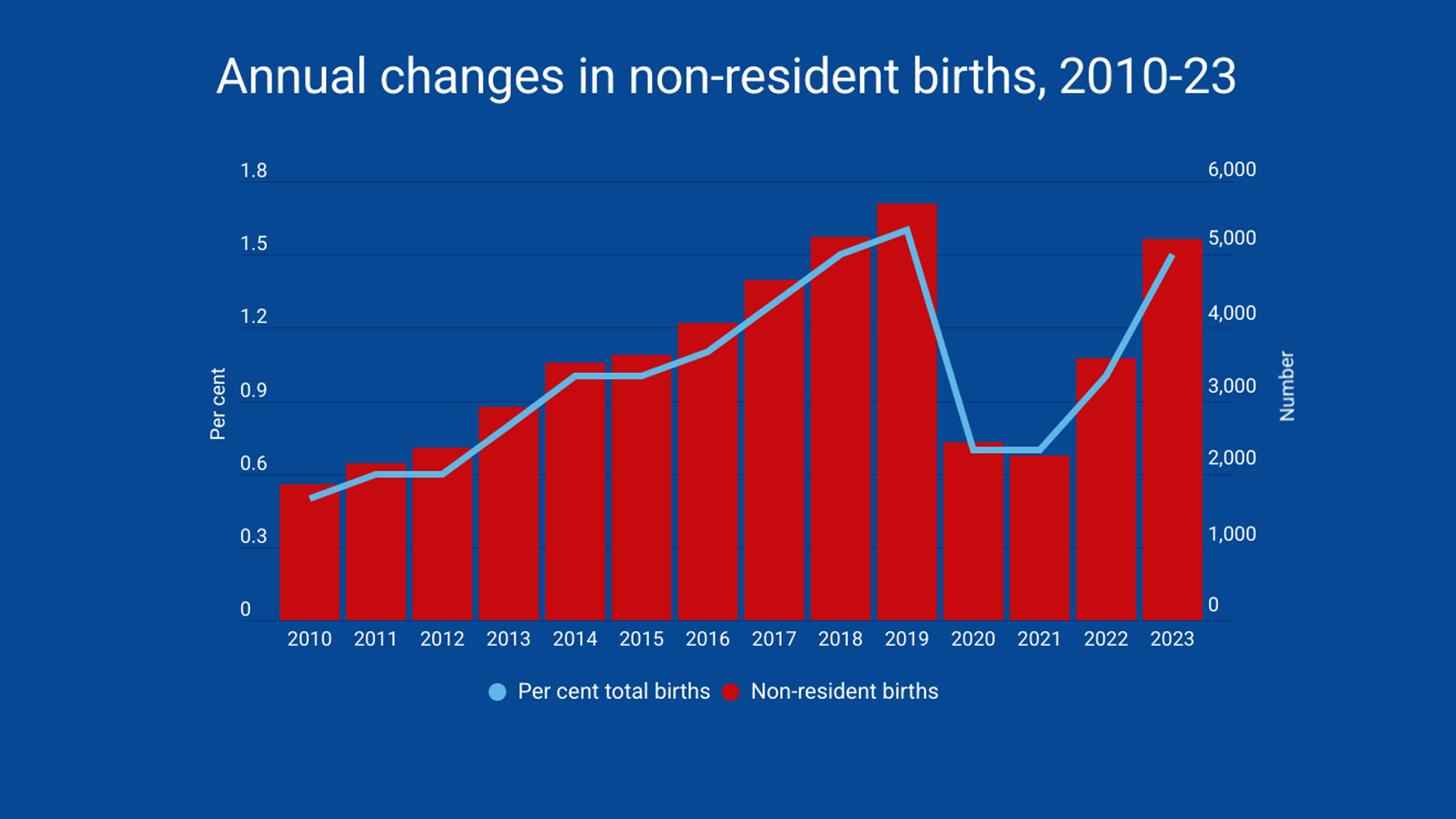
Birth tourism has risen to pre-pandemic levels after it dropped in half during the shutdowns of COVID-19. In the U.S., Donald Trump has set about trying to end birthright citizenship. What impact his plan might here have remains to be seen. But birth tourism is an issue the next federal government may need to re-examine….

Source: Le tourisme de naissance a doublé depuis la fin de la pandémie, Birth tourism has doubled since the pandemic lull

Trump bump: U.S. citizenship renunciation inquiries surge in Canada, lawyers say

Of note:

…Alexander Marino, director of U.S. tax law at Moodys Tax Law in Calgary, said that most people renounce U.S. citizenship for tax reasons — the U.S. is one of the few countries that imposes tax based on citizenship, not residency.

This often involves expensive reporting and filing obligations that include estate and gift taxes, even after death.

Marino is also expecting a Trump bump in business.

“I can’t deny that most U.S. expats, in my experience, tend to be more left-leaning than right-leaning. For a lot of people, the election results are a bit of the straw that broke the camel’s back,” Marino said.

“We’re seeing a bump due to the election results.”

Marino said he has seen year-over-year demand increase since specializing in renunciation 12 years ago.

He said the spike in interest now is greater than in 2017 after Trump’s first presidential win, and he expected 2025 to see a record number of people try to give up U.S. citizenship.

Moodys typically offers five to seven renunciation information webinars each year for U.S. citizens living in Canada; this year, they may schedule up to 12, Marino said.

Anyone giving up U.S. citizenship shouldn’t expect the matter to be secret — the U.S. Federal Register publishes quarterly lists of everyone who has surrendered their citizenship. In May 2014, the list named singer Tina Turner, and in February 2017, future British prime minister Boris Johnson.

There were only a few hundred names on the lists in 2005, but numbers have risen sharply since 2014, when the Foreign Account Tax Compliance Act went into full effect. It requires that foreign financial institutions report on the foreign assets held by U.S. account holders.

In 2016, about 4,100 names were listed, but the next year, in Trump’s first year in the White House, numbers jumped by more than 50 per cent to about 6,900 names….

Source: Trump bump: U.S. citizenship renunciation inquiries surge in Canada, lawyers say

HESA: Taking Donald Trump Seriously and What it Means for Canadian Higher Education

The article on Indian H1-B workers and family concerns regarding their children born in the USA could provide an example of a Canadian advantage along with a more accessible immigration system but uncertain:

…It would of course be nice if we could run the clock back to 2017. Back then, we talked bravely about how Canada might benefit from Trump, what with all the people clamoring to get out because of racism, interference in science, etc. There was, in short, an upside to chaos south of the border. But none of that is going to happen this time. The combination of an underpowered economy, overheated housing markets, and a general disinterest in funding science and education mean that there is little public license to seek a rise in immigration even for the most highly skilled. This is the price we pay for our generalized political complacency: when lemons strike, we can’t make lemonade.

That said, there should be opportunities, mainly research-based, in the maelstrom of change to come. The question is: which universities will be nimble enough to take advantage of them?

Source: Taking Donald Trump Seriously and What it Means for Canadian Higher Education

Akkad: Biden was a failure. Trump will be a catastrophe

Remarkably simplistic analysis, assessing Biden only by his action and inaction with respect to Israel and Gaza. No mention of Ukraine, no mention investments in the American economy etc. Also telling is his silence on Hamas and the October 7 killings and hostage taking, which affected both white and brown Israelis:

…But a deranged right-wing capitalizing on the empty dissociation of neo-liberal politics is not some uniquely American phenomenon. It is coming for Canada, it is coming for Germany, it will fester everywhere the performance of great virtue accompanies the absence of substance. There is immense cruelty on the way, and given how quickly the CEO class has positioned itself in total fealty to the Trump administration, there will be little institutional resistance. If only as an act of pre-emptive penance to future generations’ history books, it will be important to document this cruelty, to not become desensitized. Just as it is important to document the cruelty that has led us here.

Joe Biden spent his much of his final few days as President trying to frame his administration as a successful one. It’s what Presidents do. There’s nothing interesting or novel about it, and anyway many of his predecessors have presided over the killing of faraway brown people in much greater numbers before retiring comfortably into the role of respected elder statesman. What is perhaps most fascinating about this particular bit of reputation massage is that it may well mark the last time any such administration is able to even pretend its success isn’t dependent on ignoring the suffering of distant others. Because distance is a relative thing. Today the town that burns is by chance someone else’s, but not for long. Today the crops fail elsewhere, but not for long. Today the drone executes a child in another part of the world, but not for long.

Today, America loves you back.

Source: Biden was a failure. Trump will be a catastrophe

Aydintasbas: Trump will overplay his hand. Be ready for when he does. 

As a friend noted, also litigate, litigate, litigate, as is being done with birthright citizenship and the 14th Amendment:

American democracy is about to undergo a serious stress test. I know how it feels, in part because I lived through the slow and steady march of state capture as a journalist working in Recep Tayyip Erdoğan’s Turkey.

Over a decade as a high-profile journalist, I covered Turkey’s descent into illiberalism, having to engage in the daily push and pull with the government. I know how self-censorship starts in small ways but then creeps into operations on a daily basis. I am familiar with the rhythms of the battle to reshape the media, state institutions and the judiciary.

Having lived through it, and having gathered some lessons in hindsight, I believe that there are strategies that can help Democrats and Trump critics not only survive the coming four years, but come out stronger. Here are six of them.

  • Don’t Panic — Autocracy Takes Time
  • Don’t Disengage — Stay Connected
  • Don’t Fear the Infighting
  • Charismatic Leadership Is a Non-Negotiable
  • Skip the Protests and Identity Politics
  • Have Hope

Source: Trump will overplay his hand. Be ready for when he does.