Trump Pushes Dark View of Islam to Center of U.S. Policy-Making – The New York Times

Yet another test for the institutional checks and balances:

It was at a campaign rally in August that President Trump most fully unveiled the dark vision of an America under siege by “radical Islam” that is now radically reshaping the policies of the United States.

On a stage lined with American flags in Youngstown, Ohio, Mr. Trump, who months before had called for a “total and complete shutdown” of Muslim immigration, argued that the United States faced a threat on par with the greatest evils of the 20th century. The Islamic State was brutalizing the Middle East, and Muslim immigrants in the West were killing innocents at nightclubs, offices and churches, he said. Extreme measures were needed.

“The hateful ideology of radical Islam,” he told supporters, must not be “allowed to reside or spread within our own communities.”

Mr. Trump was echoing a strain of anti-Islamic theorizing familiar to anyone who has been immersed in security and counterterrorism debates over the last 20 years. He has embraced a deeply suspicious view of Islam that several of his aides have promoted, notably retired Lt. Gen. Michael T. Flynn, now his national security adviser, and Stephen K. Bannon, the president’s top strategist.

This worldview borrows from the “clash of civilizations” thesis of the political scientist Samuel P. Huntington, and combines straightforward warnings about extremist violence with broad-brush critiques of Islam. It sometimes conflates terrorist groups like Al Qaeda and the Islamic State with largely nonviolent groups such as the Muslim Brotherhood and its offshoots and, at times, with the 1.7 billion Muslims around the world. In its more extreme forms, this view promotes conspiracies about government infiltration and the danger that Shariah, the legal code of Islam, may take over in the United States.

Those espousing such views present Islam as an inherently hostile ideology whose adherents are enemies of Christianity and Judaism and seek to conquer nonbelievers either by violence or through a sort of stealthy brainwashing.

The executive order on immigration that Mr. Trump signed on Friday might be viewed as the first major victory for this geopolitical school. And a second action, which would designate the Muslim Brotherhood, the Islamist political movement in the Middle East, as a terrorist organization, is now under discussion at the White House, administration officials say.

Beyond the restrictions the order imposed on refugees and visitors from seven predominantly Muslim countries, it declared that the United States should keep out those with “hostile attitudes toward it and its founding principles” and “those who would place violent ideologies over American law,” clearly a reference to Shariah.

Rejected by most serious scholars of religion and shunned by Presidents George W. Bush and Barack Obama, this dark view of Islam has nonetheless flourished on the fringes of the American right since before the Sept. 11, 2001, terrorist attacks. With Mr. Trump’s election, it has now moved to the center of American decision-making on security and law, alarming many Muslims.

Trudeau must match words with action in Trump era, say critics, rights groups

Government is wise to wait and monitor before changing such a fundamental policy as safe third country. In the end, should the Trump administration continue with such policies, it will likely become harder to resist such calls, on both policy and political grounds:

Justin Trudeau’s invitation on Twitter to “those fleeing persecution, terror & war” attracted global attention as a subtle response to President Donald Trump’s order temporarily banning refugees and immigrants from seven Muslim-majority countries, but now Canadian opposition politicians and human rights groups want Mr. Trudeau to match his words with action.

Mr. Trump’s executive order banned refugees from resettling in the United States for 120 days and nationals from Iran, Iraq, Libya, Syria, Somalia, Sudan, and Yemen from entering the U.S. for 90 days. Thousands of people gathered outside of the U.S. embassy in Washington and consulate in Toronto to protest the decision Monday.

The prime minister’s “diversity is our strength” tweet sent the message that “regardless of [their] faith,” those seeking refuge will find an open door to Canada as the one in the U.S. temporarily closes.

The New Democratic and Green parties, along with Amnesty International’s Canadian and U.S. sections, in turn have called on the federal government to remove the U.S. as a “safe third country” for refugee determination under Canada’s Immigration and Refugee Protection Act.

A 2004 order-in-council giving the U.S. that designation, which was briefly overturned by the Federal Court and later reinstituted by the Federal Court of Appeal, requires most refugees travelling through the U.S. to Canada to make a claim for protection in the U.S.

Amnesty wants Immigration, Refugees, and Citizenship Minister Ahmed Hussen (York-South Weston, Ont.) to immediately rescind the U.S. as a safe country and allow refugees to cross the border and seek asylum in Canada. “The risk of not doing this is going to deny an avenue of protection for people who are going to need it in the days, weeks, and months to come,” said Alex Neve, secretary general of Amnesty International Canada, who believes that Mr. Trump might support the U.S.’s removal as a safe haven.

“It would mean more refugee claimants turning to Canada for protection rather than the United States, which seems to be what he wants,” said Mr. Neve. “Canada doesn’t have to issue a press release loudly and angrily denouncing the U.S.’s refugee-protection record. It’s something that can be done quietly and quickly through an order-in-council.”

Source: Trudeau must match words with action in Trump era, say critics, rights groups – The Hill Times – The Hill Times

No plans to change refugee target in wake of U.S. travel ban: immigration minister

Calibrated response:

As MPs debate U.S. President Donald Trump’s travel ban in the House of Commons, Canada has already confirmed it will not hike its refugee intake target in the wake of a contentious immigration and travel crackdown in the U.S., says Immigration Minister Ahmed Hussen.

Under pressure by the NDP, human rights groups and refugee lawyers to bring more asylum-seekers to Canada, the minister said Canada’s plan will not change in response to an executive order by Trump that suspends the U.S. refugee program and bars entry to nationals from seven Muslim-majority countries.

“Our immigration levels plan has an allocation that is historically high for refugees,” Hussen said. “We intend to maintain that plan.”

Canada’s 2017 immigration plan is set to accommodate 40,000 refugees.

Hussen also rejected calls to suspend the Safe Third Country Agreement, a pact which considers asylum-seekers safe in both Canada and the U.S.

“All the parameters of that agreement are in place and there is no change at this time,” he said.

MPs held an emergency debate Tuesday evening, which concluded around midnight, on the U.S. immigration and travel directives,.

Noting that the U.S. has now agreed to allow in 872 refugees who were already screened and in transit, and were previously denied entry, Hussen said that’s a sign the situation is evolving fast. He added that Canada will closely monitor developments.

“The responsible thing to do is to maintain contact, to continue to engage and make sure we monitor the situation closely to make sure we provide information to Canadians,” he said.

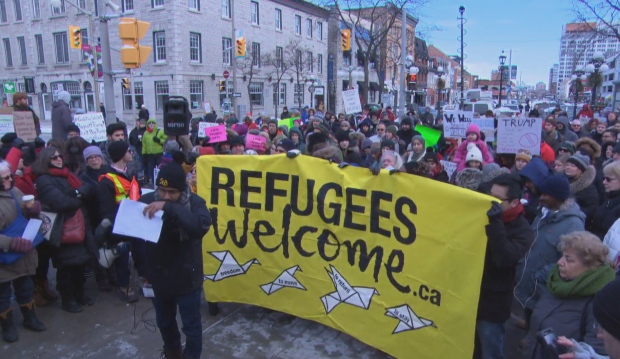
Ottawa U.S. Embassy Trump protest travel ban Jan 30 2017

People gathered outside the U.S. Embassy in Ottawa Monday afternoon to protest an executive order signed by President Donald Trump banning citizens of seven Muslim-majority countries from entering the United States. (CBC)

Call for ‘special measures’

NDP immigration critic Jenny Kwan, who requested the emergency debate, held a news conference Tuesday morning urging the government to lift a cap on privately sponsored refugees and to fast-track refugee claims.

The B.C. MP laid out a number of proposed “special measures” ahead of the debate.

“There is no question that this ban promotes hate and intolerance,” she said. “This ban will have a disastrous effect for thousands of innocent travellers and refugees.”

Calling it “absolutely shocking,” Kwan said the Trump travel ban will have a huge negative impact on the economy, as well as cultural and academic development.

…Conservative immigration critic Michelle Rempel used the debate to launch into an examination of whether Canada was effectively managing its own immigration file.

She questioned whether there was adequate funding to help refugees integrate into Canadian society, and whether it was wise to lift the visa restrictions on Mexicans coming to Canada.

“To respond to the immigration policies of other nations, we must first get our own house in order, and then through those actions, show the world what immigration policy best practice looks like,” Rempel said.

Fasten your seatbelt, Peter Thiel, it’s going to be bumpy for Trump in Silicon Valley! – Recode

More strong commentary by Kara Swisher on Silicon Valley finding its spine and its contrarian, Peter Thiel:

So I thought my column this week would be a fun one, focused on the what-the-f&#k article last week in the New Yorker about some deeply narcissistic tech titans — are there any other kind? — who are “prepping” for the apocalypse by hoarding gold, stashing weapons and even buying spreads in remote places to hide.

Aside from commenting on their base inanity and deep selfishness, I even had the best joke to impart that one techie told me:

In the event of doomsday, I have some good news and some bad news. The good news is I have a bunker in New Zealand. The bad news? Peter Thiel is my neighbor.

Ahahaha. Imagining the end times spent with the quirky tech investor — who does, in fact, have one of those Kiwi escape pods — is certainly surreal. But it’s not much more bizarre than Thiel’s response this weekend as he tried mightily to spin an epic fib he told last year about President Donald J. Trump.

It took place in the question-and-answer part of a speech in D.C. that Thiel delivered in late October about his support of Trump, after a reporter asked him about the Muslim ban threat the candidate had clearly made.

As I reported then:

“The media is always taking Trump literally,” says Peter Thiel, while his supporters take him “seriously.” Well, thank goodness Peter Thiel is here to translate words that are said by someone who may be running the most powerful country in the world. He’s just kidding! Sort of! Not really again, but another nice pivot.

Dear Peter Thiel: Words. Matter. A. Lot. Look at me writing them down here on my keyboard.

I was being quite sarcastic then, because at the time I thought that Trump very much meant to do exactly as he said and that Thiel was either very stupid or very disingenuous for pretending otherwise.

Let me state for the record, I do not think Peter Thiel is very stupid.

But a fabulist? Well, let’s fast-forward to this weekend, when Thiel tried to launch another whopper in a pathetic attempt to defend Trump’s appalling executive order to bar the entry of refugees and also travelers from seven Muslim nations into the U.S.

A Thiel spokesman told the Wall Street Journal that “Peter doesn’t support a religious test, and the administration has not imposed one.”

Oh. Peter. Words. Still. Matter. A. Lot.

So please, for the love of Facebook, stop manipulating those words when everyone can see the real-life actions and consequences they have resulted in.

More to the point, every time you open your mouth, you look more and more like you got played by Steve Bannon and his army of hobgoblins to the detriment of tech leaders whom you somehow got to bow and scrape to the new administration.

It was bad enough that you pulled off that frightful kumbaya by trooping the most powerful people in Silicon Valley into Trump Tower for what amounted to a photo op for Trump and managed to get them to do so without uttering a word about key issues at the core of tech, like immigration. I called them “sheeple” at the time for doing that and staying silent, with you as their unlikely shepherd.

Now worse, you have dragged your pals, like tech icon Elon Musk and Uber’s Travis Kalanick, onto the president’s advisory council, with the promise that engagement with Trump will give them the chance to change his mind.

Not so, as it turns out, since they now look like quislings in the wake of the immigration disaster. After asking for suggestions on Twitter this weekend of how to approach Trump later this week on the ban, they are getting pilloried on social media for even being affiliated with the whole sorry mess.

…As for the vast majority of tech leadership and pretty much all of their employees, they are now making a break for the wall-free border with the government’s capricious and ill-conceived crackdown on immigrants and refugees.

The burn started slowly on Friday, with muted opposition largely focused on the impact on their workforces. Only a few strong voices, such as the very brave Reed Hastings of Netflix, made powerful moral statements about the Trump order.

Hastings’s this-shall-not-stand tone was infectious, as it turned out. By the end of the weekend, techies were ratcheting up the volume by the hour with increasingly more emotional, moral-high-ground statements, as well as offers of gobs of money (Google, Lyft, Uber and high-profile techies like Chris Sacca and Tony Faddell), food (DoorDash) and even homes (Airbnb).

Google founder Sergey Brin’s appearance at San Francisco International Airport was a heartening visual of that. While he said he was there as a refugee and not as a rep for the search giant, his presence spoke volumes about the way this was headed.

I knew that would be the case after I tweeted this note below late Friday night and it quickly started to garner a plethora of responses, including from some prominent techies, all of whom wanted in.

That included Laszlo Bock, former head of Google People Ops, who wrote: “former tech leader here, but still 100 percent against excluding people from our nation based on religion, origin, etc.”

It went on like that as opposition to the Trump immigration order has grown and I expect it to do so even more, as those very rich and very powerful and very influential tech companies start to act like they actually have money, power and influence. And, thank goodness, some of the loudest people on earth finally realize they have a very loud voice.

Behind the scenes, where all the real stuff happens, I am told the political arm-twisting has commenced and that there are a number of joint efforts that are under way. We’ll see how effective and long lasting they are, especially since there are many things tech wants from the Trump administration, as I have outlined before.

But given Trump has literally made good on several of his more heinous campaign promises that everyone thought he would not, I think cooperation between tech and Trump is going to be rarer than more opposition.

For example, what of Trump’s hard-line stance in the campaign on encryption or his appointment of very anti-net neutrality FCC chairman Ajit Pai? Neither will be easy to find common ground on.

And just today, Bloomberg is reporting another executive order being drafted focused on work visas that tech companies depend on, which will have a big impact on how critical talent is recruited. According to the report, “companies would have to try to hire American first and if they recruit foreign workers, priority would be given to the most highly paid.”

Well, that’s not going to go over well at Coupa Cafe in Palo Alto. No, no. no. (Fly-on-the-wall dream: I’d love to be in the boardroom at Facebook, where Peter Thiel is a director, to hear him explaining this one away.)

More: I was at a chock-full event in Palo Alto last week, as tech types planned their attack on the defunding of Planned Parenthood and the reinstatement of the global gag rule by Trump and the GOP that restricts foreign aid to those organizations that reference abortions in family planning. It was a move that Facebook COO Sheryl Sandberg spoke out against last week. “We don’t have to guess,” she wrote, noting that the move is a disaster for women globally. “We know what this will do.”

What else? Well, now there are rumors that Trump could sign another executive order aimed at restricting advances in rights made by gays and lesbians, such as allowing people to refuse to do business with them due to religious objections (expect federal legislation here too). And, earlier this week, press secretary Sean Spicer said, “I don’t know,” when asked if Trump would rescind a Barack Obama executive order banning anti-LGBT discrimination by federal contractors.

Given tech leaders have been very vocal in their support of gay issues, which are important to their employees, if Trump does any of this, it should go off like a Roman candle in Silicon Valley.

I’ll be curious what Thiel, who is now famously gay after his speech at the Republican National Convention this summer, will say about it if that comes to pass. I am guessing declaring that “Peter doesn’t support anti-gay orders, and the administration has not imposed one” will not work quite as well the second time around.

And neither will Silicon Valley not taking Trump both seriously and literally anymore. Because these are serious times and we need serious people who will literally be compelled to act and speak out on all this and more. (And if you think I am going to stop nagging you all, you should ask my kids how that goes.)

It’s probably a bummer for many of tech’s leaders that car execs or finance types or Hollywood moguls are not held to this high standard. In fact, the New York Times’ Mike Isaac tweeted about that yesterday.
Donald Trump’s Immigration Order Is Horrifying | Time.com

Hopefully, the Trump administration will learn from this and ensure proper vetting of all future policy decisions.

But I am not hopeful given their tendency to dig in rather than listen (the Holocaust Day press release not mentioning Jewish victims being a case in point):

The malevolence of President Trump’s Executive Order on visas and refugees is mitigated chiefly—and perhaps only—by the astonishing incompetence of its drafting and construction.

NBC is reporting that the document was not reviewed by DHS, the Justice Department, the State Department, or the Department of Defense, and that National Security Council lawyers were prevented from evaluating it. Moreover, the New York Times writes that Customs and Border Protection and U.S. Citizen and Immigration Services, the agencies tasked with carrying out the policy, were only given a briefing call while Trump was actually signing the order itself. Yesterday, the Department of Justice gave a “no comment” when asked whether the Office of Legal Counsel had reviewed Trump’s executive orders—including the order at hand. (OLC normally reviews every executive order.)

This order reads to me, frankly, as though it was not reviewed by competent counsel at all.

CNN offers extraordinary details:

Administration officials weren’t immediately sure which countries’ citizens would be barred from entering the United States. The Department of Homeland Security was left making a legal analysis on the order after Trump signed it. A Border Patrol agent, confronted with arriving refugees, referred questions only to the President himself, according to court filings.

. . .It wasn’t until Friday — the day Trump signed the order banning travel from seven Muslim-majority countries for 90 days and suspending all refugee admission for 120 days — that career homeland security staff were allowed to see the final details of the order, a person with the familiar the matter said.

. . .The policy team at the White House developed the executive order on refugees and visas, and largely avoided the traditional interagency process that would have allowed the Justice Department and homeland security agencies to provide operational guidance, according to numerous officials who spoke to CNN on Saturday.

Homeland Security Secretary John Kelly and Department of Homeland Security leadership saw the final details shortly before the order was finalized, government officials said.

Friday night, DHS arrived at the legal interpretation that the executive order restrictions applying to seven countries — Iran, Iraq, Libya, Somalia, Syria, Sudan and Yemen — did not apply to people who with lawful permanent residence, generally referred to as green card holders.

The White House overruled that guidance overnight, according to officials familiar with the rollout. That order came from the President’s inner circle, led by Stephen Miller and Steve Bannon. Their decision held that, on a case by case basis, DHS could allow green card holders to enter the US.

As I shall explain, in the short term, the incompetence is actually good news for people who believe in visa and refugee policies based on criteria other than—let’s not be coy about this—bigotry and religious discrimination. The President has created a target-rich environment for litigation that will make his policies, I suspect, less effective than they would have been had he subjected his order to vetting one percent as extreme as the vetting to which he proposes to subject refugees from Bashar al-Assad and the bombing raids of Vladimir Putin.

Source: Donald Trump’s Immigration Order Is Horrifying | Time.com

Candice Malcolm in the Sun highlights issues pertaining to dual nationals, of particular concern given her husband’s Iranian ancestry, but finds little fault with the other aspects of the executive order:

There is a lot to unpack in Trump’s EO, and while trying to understand the law and its impact, it’s important to separate the facts from the hysteria.

First, and despite the rhetoric, this is not a Muslim Ban.

The vast majority of the world’s Muslims, including all American Muslims, will not be directly affected by this order.

The EO includes a four-month pause on all refugees, and a three-month ban on all citizens of Iran, Iraq, Syria, Libya, Yemen, Somalia and Sudan. The ban includes all citizens of these seven countries, including Muslims, Christians, Jews, and athiests. The order does not list any religion, nor does it ban people from the world’s most populous Muslim countries.

Second, it is untrue that no nationals of the countries on Trump ban list have perpetrated an act of Islamic terrorism on US soil.

Both the 2016 mall attack in St. Cloud, Minnesota and the attack at Ohio State University were carried out by Somali nationals. The Islamic State claimed responsibility for both attacks.

Senators Jeff Sessions and Ted Cruz released a report highlighting the 580 individuals who have been convicted on terrorism charges in the U.S. since the September 11th 2001 terrorist attacks. Of the 380 foreign-born terrorists, 21 were from Somalia, 20 were from Yemen and 19 were from Iraq.

Curiously, the largest terrorists-producing countries, including Pakistan, Lebanon and the Palestinian territories are not included in the blanket ban. Likewise, the 9/11 hijackers were mostly from Saudi Arabia, another country not included in the ban.

That Trump didn’t include these countries is puzzling, and undermines the national security rationale behind this order.

The most troubling aspect of this order is the blanket ban on nationals from seven countries. The wording is clunky – simply saying the US will “suspend entry” for these nationals.

There is a difference between increased screening and a flat-out ban. This is a ban that will turn away lawful residents at the border.

There have been contradictory reports and messages from different government offices, but it seems that the ban applies to legal residents, green-card holders and even dual citizens travelling with Canadian passports.

There have been reports of green-card holders being handcuffed and detained at U.S. airports. This is reckless and wrong.

Trump immigration EO needs major changes 

The job-creating, anti-extremist Canadian Conservative with a maple leaf tattoo now banned from the U.S. | National Post

National Post profile of the staffer Jason Kenney mentioned in his tweets (dealt with him during my time at CIC/IRCC, sharp guy, pleasant to deal with. Married to Candice Malcolm, another former staffer and current Sun columnist who is also extremely conservative and, IMO, overly partisan in her critiques):

Canadian Kasra Nejatian renounced his Iranian citizenship at 17, got a maple leaf tattoo and has been such an outspoken critic of the Islamic republic that he believes he would be immediately arrested if he ever returned.

He owns a tech company, Kash, with more than a dozen employees in the United States.

He’s also extremely Conservative. He spent years as a staffer for former Tory immigration minister Jason Kenney, who has described him as “one of the most hawkish people I know on national security and integration.”

But according to a bluntly worded executive order from U.S. President Donald Trump, Nejatian’s Iranian birthplace now makes him “detrimental to the interests of the United States.”

“This is virtue-signalling security theatre,” Nejatian told the National Post by phone from San Francisco.

On Friday, Trump issued an executive order that banned U.S. entry to nationals from seven Muslim-majority countries: Iran, Iraq, Syria, Sudan, Libya, Yemen and Somalia, for 90 days.

The suddenness of the ban meant that any nationals from the affected countries who were already airborne at the time of the order were detained upon landing.

The order does not make exceptions for nationals with valid U.S. visas.

Nejatian — who helped form Canada’s own protocol for screening would-be terrorists — said the new order “almost certainly makes the U.S. less safe.”

For one thing, the ban is so blunt that it excludes foreign-born nationals regardless of their loyalty to the United States, he noted.

Source: The job-creating, anti-extremist Canadian Conservative with a maple leaf tattoo now banned from the U.S. | National Post

In Iran, Shock and Bewilderment Over Trump Visa Crackdown – The New York Times

Laying out the impact on people and families (article was written before the weekend chaos):

TEHRAN — Families, businesspeople, athletes and tourists from seven countries in the Middle East and Africa found their travel plans — and even their futures — in a state of suspension on Friday after President Trump signed an executive order temporarily barring thousands from obtaining visas to travel to the United States.

The order is expected to freeze almost all travel to the United States by citizens from the Muslim-majority countries of Iran, Iraq, Libya, Somalia, Sudan, Syria and Yemen for at least 90 days. Three of those countries are considered sponsors of terrorism (Iran, Sudan and Syria), and three are designated countries of concern (Libya, Somalia and Yemen).

Passport-holders from those countries, who have American visas but are outside the United States, will not be permitted to return.

“We only want to admit those who will support our country and love deeply our people,” Mr. Trump said on Friday before signing the order at the Pentagon. “We will never forget the lessons of 9/11, nor the heroes who lost their lives at the Pentagon.”

(The 19 hijackers implicated in the Sept. 11, 2001, terrorist attack came from Egypt, Lebanon, Saudi Arabia and the United Arab Emirates. None of those countries will be subject to what Mr. Trump described as “new vetting measures.”)

During the 90-day period, the Trump administration will assess if the foreign governments on the list are providing enough information about citizens seeking visas to enable the United States to assess whether they pose a terrorism risk. If the governments do not comply, they will be given 60 days to do so; failing that, their citizens will be barred from entering the United States.

Government reaction to the order has been cautious. But there is little doubt that the demand for information will be a challenge for Iran, which sends far more people to the United States each year, around 35,000, than any other country on the list.

While Iran willingly allows its citizens to travel to the United States, it is ideologically opposed to sharing information with Washington. But if it does not, many of its citizens will be cut off from visiting relatives who are among the estimated one million Iranian-Americans living in America.

The visa ban will provide an early indication of where relations between Tehran and the Trump administration are headed, one analyst said.

Photo

The Iranian actress Taraneh Alidoosti in “The Salesman.” She canceled her trip to the Academy Awards on Feb. 26 on news of President Trump’s visa crackdown.CreditHabib Majidi/Cohen Media Group, via Amazon Studios, via Associated Press 

“Trump will regard the Iranian reaction as a test,” said Farshad Ghorbanpour, who is close to the government of President Hassan Rouhani. “If Iran doesn’t comply, they won’t do so either on other issues. We will see in 30 days.”

Another analyst doubted the government would comply with the order.

“We are not obliged to give information about our citizens to the Trump administration,” said Hamidreza Taraghi, considered a hard-liner. “Such a move would be unjustifiable.”

In the United States, Americans of Iranian descent expressed shock and dismay at news of Mr. Trump’s impending policy change, and were particularly concerned about their relatives and friends in Iran.

Trita Parsi, president of the National Iranian American Council, a Washington-based advocacy group, said many Iranian citizens with valid green cards and American visas were distraught. Those outside the United States are fretting they will not be allowed in, and those already in the country fear they will not be able to leave, even temporarily, because they will be barred from returning.

“There is a sense of bewilderment, as well as a sense of injustice,” over why Iran was even included on the list of targeted countries, Mr. Parsi said. No Iranian has been accused of an attack on the American homeland. By contrast, he said, the Sept. 11 attackers included citizens from countries which are not on the list — and “the United States has produced more ISIS fighters than Iran has.”

Iran’s most popular actress, Taraneh Alidoosti, announced on Twitterthat she was canceling her trip to the Academy Awards ceremony in Los Angeles on Feb. 26, after reports that Mr. Trump was about to sign the sweeping executive order.

Ms. Alidoosti plays a leading role in ‘‘The Salesman,’’ directed by the acclaimed Iranian director Asghar Farhadi and nominated for best foreign film. She almost certainly could have obtained a visa as a ‘‘culturally unique artist,’’ but said she no longer felt like making the trip.

“This is not about me or the Academy Awards, it’s about having a discussion about this decision,” Ms. Alidoosti said. “This is such a bizarre ban, it is uprooting people’s lives in ways not imaginable.”

In 2015, according to the Department of Homeland Security, a total of 35,266 nonimmigrant visas were granted to Iranians to enter the United States, compared with 21,381 for Iraq; 16,010 for Syria; 5,549 for Yemen; 4,792 for Sudan; 2,879 for Libya and 359 for Somalia.

GRAPHIC

How Trump’s Executive Order Will Affect the U.S. Refugee Program

The order cuts the number of refugees to the U.S. in half and bars those from Syria.

 OPEN GRAPHIC 

As there is no American embassy or consulate in Iran, Iranians must travel to Ankara, Turkey, Dushanbe in Tajikistan or to Dubai, in the United Arab Emirates, to apply for a visa. The State Department says that more than 40 percent of all applications are rejected. There are numerous agencies in Iran and other countries that mediate and assist Iranians seeking appointments.

Refugee advocates urge Canada to keep borders open amid Trump directives

Yet another aspect of Canada that will be affected by decisions of the Trump administration:

Refugee advocates are urging Canada to keep its borders open to the world’s most vulnerable people as U.S. President Donald Trump orders the construction of a wall with Mexico and cracks down on illegal immigration.

As promised during the election campaign, Mr. Trump signed executive orders Wednesday to build a wall along the U.S.-Mexico border and strip federal grant money from “sanctuary” states and cities that shield illegal immigrants. Canadian refugee advocates say it’s critical that Canada continue to welcome newcomers, especially amid an unprecedented global refugee crisis that has displaced more than 65 million people.

“It’s absolutely devastating news for refugees around the world,” said Janet Dench, executive director of the Canadian Council for Refugees. “What is happening in the U.S. makes even more important Canada’s openness to refugees because the options are significantly smaller when the U.S. closes its doors.”

Without mentioning Mr. Trump or his policies, Immigration Minister Ahmed Hussen’s office said Wednesday that Canada has “always been welcoming of newcomers and will continue to do so.”

Experts say Canada could see an increase in the number of Mexican immigrants and refugees as a result of Mr. Trump’s anti-immigration sentiments and a recent Canadian policy change. Mexicans who feel unwelcome in the United States may now be looking a little further north to Canada, where the Liberal government lifted a visa requirement for Mexican travellers just last month. The visa requirement had been in place since 2009 when the Conservatives imposed it after a rise in invalid refugee claims from Mexico.

“The spike in Mexican immigration in general, but particularly refugee claims, is definitely going to happen in Canada,” said Toronto-based immigration lawyer Chantal Desloges. “You couldn’t imagine worse timing. We just lifted the visa requirement and now to have things shut down in the U.S., that’s going to be a definite driver.”

The government is prepared to reinstate the visa requirement if the number of Mexican asylum seekers surpasses 3,500 within any 12-month period.

Conservative immigration critic Michelle Rempel said the Mexican visa issue could backfire on the Liberals, especially given the fact that they were warned against it. Immigration department officials opposed the decision last year, arguing that Mexico’s poor human-rights record, high crime rates and low standard of living would drive Mexican refugee claimants to Canada.

“When the government lifted this visa requirement against the advice of bureaucrats and public servants without a formal review, I think Canadians started thinking, ‘Why are they doing that?’” Ms. Rempel said.

Chris Friesen, director of settlement services at Immigrant Services Society of B.C., said his organization is developing contingency plans for a possible influx of Mexican arrivals, including the preparation of housing and legal services.

However, Mexican refugee claimants hoping to flee Mr. Trump’s America and claim status in Canada won’t be able to do so, due to a special arrangement between Canada and the United States. Under the Safe Third Country Agreement, refugee claimants are required to request protection in the first safe country they arrive in and since the United States is considered a safe country by Ottawa, they are not allowed to make a claim in Canada after doing so in the U.S. A few exceptions are made for some refugee claimants, such as unaccompanied minors.

Mexicans aren’t Mr. Trump’s only target. The President is expected to sign executive orders in the coming days blocking the issuing of visas to people from seven Muslim-majority countries in the Middle East and North Africa: Syria, Sudan, Somalia, Iraq, Iran, Libya and Yemen.

NDP immigration critic Jenny Kwan called on Mr. Hussen to present a plan to Canadians outlining how the government will address the implications of Mr. Trump’s immigration policies.

Source: Refugee advocates urge Canada to keep borders open amid Trump directives – The Globe and Mail

Trump’s order to ban refugees and immigrants triggers fears across the globe – The Washington Post

And so it begins:

President Trump’s executive order to tighten the vetting of potential immigrants and visitors to the United States, as well as to ban some refugees seeking to resettle in the country, will shatter countless dreams and divide families, would-be immigrants and human rights activists warned.

The draft order, expected to be signed as early as Thursday, calls for the immediate cessation of ongoing resettlement of Syrian refugees in the United States, rejecting visas for visitors and immigrant hopefuls based partly on their ideology and opinions.

A copy of the draft orders was leaked Wednesday to civil rights groups and obtained by The Washington Post.

“I feel devastated,” said Ibrahim Abu Ghanem, 37, a father of three in the Yemeni capital, Sanaa, whose father and two brothers live in the United States. “This means all my plans are going to go down the drain.”

If the order is enacted, among those immediately affected would be potential immigrants and visitors from seven Muslim countries — Yemen, Iraq, Syria, Somalia, Iran, Libya and Sudan — that are considered by the Trump administration as nations whose citizens “would be detrimental to the interests of the United States.” For the next 30 days, they will not be allowed entry into the United States, even if they have visas and relatives who are U.S. citizens.

Activists protest Trump’s orders to crack down on refugees and undocumented immigrants

The order also calls for halting all admission and resettlement of refugees for 120 days pending the review of vetting procedures. For Syrian refugees, the ban will remain in place until further notice.

Once restarted, annual refugee admissions from all nations would be halved, from a current level of 100,000 to 50,000.

For those affected, the fear is that the order will be a harbinger for even greater restrictions on the horizon for Muslim immigrants, refugees and visitors — fulfilling Trump’s campaign promises of “extreme vetting” of foreigners seeking entry into the United States and installing “a Muslim ban.” Somalia, Syria, Iraq and Iran are among the leading countries of origin of recent refugees to the United States.

“It’s going to be devastating,” said Denise Bell, senior campaigner for refugee and migrant rights for the watchdog group Amnesty International. “Refugees are not a threat. They are the ones fleeing horrific violence. They are trying to rebuild their lives. They want the same safety and opportunities that any of us would want.”

“And so we are scapegoating them in the guise of national security. Instead, we are betraying our own values. We are violating international law,” she said.

Since Wednesday, as news of the impending order spread, lives were quickly affected across the world, particularly among the citizens of the countries immediately targeted. For them, it’s already difficult to get visas or immigrate to the United States. Vetting has been stringent since the Sept. 11, 2001, terrorist attacks, say human rights activists. Even so, many potential Muslim immigrants went through long screening processes, often lasting years, to gain entry to the United States. Now, many find themselves in an emotional and bureaucratic limbo.