The unknowns of US immigration policy are increasing anxiety among first-generation Latinx teens

Not surprising:

Despite the fast-moving news cycle nowadays, shifting immigration policies and policy guidelines make headlines every week. At the end of one dizzying week that included a serious discussion on the decriminalization of border crossings and a Supreme Court ruling againstadding a citizenship question on the 2020 U.S. Census, the Supreme Court announced it would hear the Trump administration’s appeal to end Deferred Action for Childhood Arrivals (DACA) next fall, just in time to issue their ruling the summer before the election. And that was just one week in June.

Dreamers have faced uncertainty about their immigration status since September 2017 when the Trump administration moved to terminate the program and the federal courts took up several lawsuits challenging these actions. Now, new research shows that immigration policy concerns are taking mental tolls on first-generation Latinx (Latino/Latina) adolescents.

Using data from a long-term study of primarily Mexican families living in California’s Salinas Valley region, researchers surveyed 397 sixteen-year-olds with at least one immigrant parent. In the year following the 2016 presidential election, nearly half of the teens reported that they worried about how immigration policies could affect themselves and their families. Compared to before the 2016 election, the teens who worried more about immigration policy also reported an increase in symptoms of anxiety. Particularly among teenage boys, higher anxiety was correlated with poor sleep quality.

As we debate changes to U.S. immigration policy, many immigrant families are having difficult conversations about planning for the worst-case scenario. This research shows that the uncertainty regarding immigration status has effects on mental health in children as well as adults. More studies need to be done to address the long-term health consequences of these policies on immigrant families, both directly and indirectly through their access to healthcare services.

Source: The unknowns of US immigration policy are increasing anxiety among first-generation Latinx teens

Analysis: Why the 2020 census doesn’t need a citizenship question to count the undocumented

Good in depth analysis for data nerds:

It is now clear that there will be no question about citizenship on the 2020 U.S. Census.

After the Supreme Court ruled against the Trump administration, President Trump vowed to find a way to include the question. But with no legal path forward and time running out, the administration ultimately backed down.

Opponents of the citizenship question remain concerned about the census, though hopeful that more immigrant households will respond to the census now that the question has been removed.

But others worry that it will be much harder to keep track of undocumented immigrants. President Trump argued that a citizenship question was needed, saying: “I think it is very important to find out if somebody is a citizen as opposed to an illegal.”

However, a citizenship question wouldn’t actually help the government distinguish between who is an undocumented immigrant and who is not. The question distinguishes only between citizens and noncitizens, and noncitizens are not the same as undocumented immigrants. For example, three out of five noncitizens are in the country legally.

Even more importantly, demographers have figured out a simple and effective way to estimate the number of unauthorized immigrants – even without information on citizenship. In the last five years, my colleagues Frank D. Bean, James D. Bachmeier and I have conducted a series of studies that evaluate this method and its assumptions.

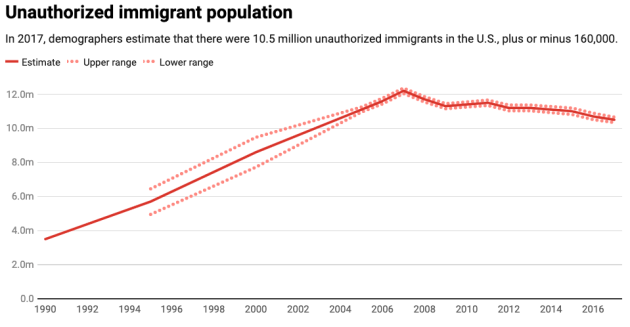
Our research on the methods used to estimate the size of the group indicates that existing estimates – putting the undocumented population at about 11 million – are reasonably accurate.

Here’s how it works.

What’s the formula?

Beginning in the late 1970s, a group of demographers consisting primarily of Jeffrey Passel, Robert Warren, Jacob Siegel, Gregory Robinson and Karen Woodrow introduced the “residual method” for estimating the number of unauthorized immigrants living in the country.

At the time, Passel and his collaborators were affiliated with the U.S. Bureau of the Census and Warren with the Office of Immigration Statistics of the Immigration and Naturalization Service. Much of this work was published in the form of internal reports, but some of it appeared in major journals.

The residual method uses an estimate of the total foreign-born population in the country, based on U.S. Census data. Researchers then subtract from it the number of legal immigrants residing here, estimated from government records of legal immigrants who receive “green cards” minus the number that died or left the country. The result is an estimate of the unauthorized population.

Various adjustments are typically made to this formula. Most adjustments are minor, but a particularly important one adjusts for what researchers call “coverage error” among the unauthorized foreign-born. Coverage error occurs when the census data underestimate the size of a group. This can occur when people live in nonresidential or unconventional locations – such as on the streets or in a neighbor’s basement – or when they fail to respond to the census.

Coverage error could be particularly high among unauthorized immigrants because they may be trying to avoid detection. The Census Bureau’s own research suggests that asking about citizenship would likely aggravate this issue.

Currently, the Department of Homeland Security, the Pew Hispanic Center and the Center for Migration Studies are the major producers of estimates of the unauthorized foreign-born population.

Chart by The Conversation, CC-BY-ND. Data source: <a href="https://www.pewhispanic.org/2019/06/03/facts-on-u-s-immigrants/" rel="nofollow noopener noreferrer" target="_blank" >Pew Research Center</a>

Chart by The Conversation, CC-BY-ND. Data source: Pew Research Center

How accurate are the estimates?

The residual method has been widely used and accepted since the late 1970s. Within a reasonable margin of error, it predicted the number of unauthorized immigrants to legalize under the Immigration Reform and Control Act of 1986, which, among other things, granted permanent residency status to unauthorized immigrants who had been living in the country since 1982. The residual method predicted that about 2.2 millionmet the residency requirement; the actual number to come forward was about 1.7 million.

Both Department of Homeland Security and Pew have used the residual method to estimate the unauthorized population since 2005. Despite using slightly different data and assumptions, Pew’s, Department of Homeland Security’s, and the Center for Migration Studies’s estimates have never differed by more than 1 million people, less than 10% of the total unauthorized population.

Nevertheless, skeptics question a key assumption of the residual method, which is that unauthorized immigrants participate in census surveys. All three organizations listed above inflate their estimates to account for the possibility that some unauthorized immigrants are missing from census data. For example, Pew inflates by about 13%. But is this enough?

My colleagues and I estimated coverage error among Mexican immigrants, a group that composes 60% of all unauthorized immigrants.

Even if they are not counted in a census, populations leave “footprints” of their presence in the form of deaths and births. Because people give birth and die with known regularity, regardless of their legal status, we were able to use birth and death records of all Mexican-born persons to determine the number of Mexican-born persons living in the U.S. We also looked at changes in Mexican census data between 1990 and 2010 to gauge the size of Mexico’s “missing” population, most of whom moved to the U.S.

We then compared these estimates with the estimated number of Mexican immigrants in census data. We found that the census missed as many as 26% of unauthorized immigrants in the early 2000s.

We speculated that this could have been due to the large numbers of temporary Mexican labor migrants who were living in the U.S. at the time. Because many worked in construction during the housing boom and lived in temporary housing arrangements, it may have been particularly difficult to accurately account for them in census surveys.

However, when the Great Recession and housing crisis hit, many of these temporary workers went home or stopped coming to the U.S. in the first place, and coverage error declined. By 2010, the coverage error may have been as low as 6% and does not appear to have changed much since then.

If current levels of coverage error for all unauthorized immigrants were as high as 26%, then the number living in the country could be as high as 13 million. But if coverage error were as low as 6%, then the figure could be as low as 10.3 million. The true number likely falls within that narrow range.

What this boils down to is that demographers already have a pretty good idea of the number of unauthorized immigrants living in the U.S., even without relying on citizenship data. If coverage error has declined as much as we think it has, then the truth is at the lower end of this range.

Will administrative records improve the estimates?

Looking ahead, methods could change as new data become available.

In the wake of its Supreme Court loss, the Trump administration issued an executive order directing government agencies to share administrative data on citizenship.

They want to link information on citizenship and immigration status in administrative records to everyone’s census responses. For example, the executive order requests the Department of Homeland Security’s records on refugee and asylum visas, as well as Master Beneficiary Records from the Social Security Administration. They want to use this information to estimate the undocumented population at very detailed levels of geography for purposes of redistricting, reapportionment and the allocation of public funds.

(It is worth noting that the Census Bureau is a fortress when it comes to protecting your data. Under federal law, the Census Bureau cannot share your personal information with anyone, including other government agencies such as ICE.)

Regardless of how anyone feels about these policy proposals, administrative data may not be up to the task. In my view, administrative records are complicated to use. They can provide inconsistent information about the same person depending on which agency’s records are used.

Additionally, the records will be of limited value for describing those who fall outside of the administrative records system, which can happen for all kinds of reasons. Even if the Trump administration uses administrative records to estimate the undocumented population, researchers will still need to make assumptions about coverage error, just like they do for the residual method.

Overall, I suspect that administrative records could help answer some narrowly defined questions about immigrants and improve national estimates. The jury is still out about their ability to provide definitive answers about the precise numbers of undocumented immigrants, particularly at detailed levels of geography.

Source: Analysis: Why the 2020 census doesn’t need a citizenship question to count the undocumented

Trump’s ‘blatantly illegal’ immigration rules end asylum protections

One of the better summaries:

The Trump administration has announced new immigration rules ending asylum protections for almost all migrants who arrive at the US-Mexico border, in violation of both US and international law.

According to the new rules, any asylum seekers who pass through another country before arriving at the southern border – including children traveling on their own – will not be eligible for asylum if they failed to apply first in their country of transit. They would only be eligible for US asylum if their application was turned down elsewhere.

The change would affect the vast majority of migrants arriving through Mexico. Most of those currently come from Guatemala, Honduras and El Salvador, but an increasing number are from Haiti, Cuba and countries further afield in Africa and Asia.

The new rules were placed on the federal register on Monday and due to take effect on Tuesday, though they will be immediately challenged in court for contraventions of the US refugee act and the UN refugee convention guaranteeing the right to seek asylum to those fleeing persecution from around the world.

Source: Trump’s ‘blatantly illegal’ immigration rules end asylum protections

Top Trump officials headline conference focusing on the ‘new #antiSemitism’

Worth reading for the last pointed question posed to the three, which all deflected:

U.S. Attorney General William Barr called anti-Semitism a “cancer” at a Department of Justice summit on the topic notable for its focus on anti-Israel activity and for speeches by the top leaders of the departments of Education, the Treasury and the FBI.

Monday’s Summit on Combating Anti-Semitism, held at the DOJ headquarters here, featured panel discussions and an audience of about 150, mostly men representing various Jewish organizations and government agencies that deal with some aspect of hate crimes and civil rights.

The conference was bracketed by speeches by Barr and three other top officials of the Trump administration: Secretary of Education Betsy DeVos, Secretary of the Treasury Steve Mnuchin and FBI Director Christopher Wray.

Elan Carr, the State Department’s Special Envoy for Monitoring and Combating anti-Semitism, said the lineup was a sign of how seriously the administration is taking what he called a “time of striking growth in anti-Semitism around the globe.” He said that growth extends from Europe to the United States, “where vandalism in New York and other cities, according to the Anti-Defamation League, occurs on a fairly regular basis, and campuses have become hostile places for Jewish and pro-Israel students.”

Anti-Israel activity — at colleges and by the Boycott, Divestment and Sanctions movement targeting Israel — was perhaps the major theme of the summit, with two of the four panels largely devoted to aspects of the topic: “Anti-Semitism on Campus” and “Combating Anti-Semitism While Respecting the First Amendment.”

Carr noted at least three sources of present-day anti-Semitism: the “white supremacist far right,” the “anti-Zionist far left” and “radical Islam.”

But he drew particular attention to what he called “the new anti-Semitism,” which he said “attempts to disguise its Jew hatred as hatred for the state of Israel and the anti-Zionist endeavor.”

DeVos said that “BDS stands for anti-Semitism.” She described her department’s investigations into incidents of alleged discrimination aimed at pro-Israel students at Williams College in Massachusetts and at a pro-Palestinian event sponsored by departments at Duke University and University of North Carolina.

She also invoked President Donald Trump’s decision to move the U.S. Embassy in Israel from Tel Aviv to Jerusalem, as did Mnuchin, as a sign of U.S. support for Israel.

In his remarks, Barr referred to the wide landscape of anti-Semitism, including a rise in reported hate crimes, the deadly shootings at synagogues in Pittsburgh and southern California, conspiracy theories and cemetery vandalism.

Describing anti-Semitism as a “cancer,” he said he wants to “assure the Jewish community that the Department of Justice and the entire federal government stands with you and will not tolerate these attacks.”

The conference, scheduled for weeks, was held following a news cycle dominated by accusations that President Donald Trump had himself courted bigotry, first in hosting a meeting at the White House for right-wing social media figures and then saying in a tweet that four Democratic members of Congress, all women of color, should “go back” to their countries of origin.

Josh Rogin, a columnist for the Washington Post who moderated a panel on “Prosecuting Hate Crimes,” referred to this tumult in a question to the three law enforcement officials on the panel. Asked to what they attributed the rise in hate crimes, and if they considered Trump’s often polarizing behavior as one of the causes, all three — representing the Attorney General’s civil rights division, the FBI’s criminal investigation division and the U.S. Attorney for the District of Columbia — declined to offer any reasons.

All three focused their answers instead on their efforts to prosecute purveyors of hate crimes and their work with local communities on prevention.

Source: Top Trump officials headline conference focusing on the ‘new anti-Semitism’

In killing citizenship question, Trump adopts Census Bureau’s preferred solution to a thorny problem

After all the sound and fury, after all the lies and pretence:

President Donald Trump’s decision this afternoon to abandon plans to add a citizenship question to the 2020 census and instead rely on existing government records to generate citizenship statistics matches the Census Bureau’s preferred option for dealing with the politically explosive issue. It’s also a win for those who have wanted to keep such a charged question off the decennial headcount.

“This is Option C,” says former Census Director John Thompson, referring to a March 2018 memo in which Commerce Secretary Wilbur Ross spelled out several options for developing a citizenship tally, and gave his rationale for deciding to include the question on the count that will begin on 1 April. Option C “is what the Census Bureau proposed to Secretary Ross,” adds Thompson, who stepped down in June 2017, a few months after Ross began his clandestine efforts to get the Department of Justice to request the question. Ross eventually chose what he called Option D, a combination of using information already in government agency files, known as administrative records, along with a yes/no question about citizenship on the census questionnaire sent to U.S. households.

The Supreme Court, however, blocked Ross’s decision, saying he had violated administrative law by providing a “contrived” rather than a “genuine” explanation for why he wanted to add the question. Critics of the question say it would have prompted many people living in the United States to decline to answer the census, leading to an undercount of the population, and was motivated by a desire to reduce the political power of regions that tend to support Democratic candidates.

Today, speaking at a hastily arranged one-way press conference in which he took no questions, Trump said he will issue an executive order telling every federal agency to “immediately” provide the Commerce Department with “all requested records regarding the number of citizens and non-citizens in our country.” He said the goal is to generate “an accurate count of how many citizens, non-citizens, and illegal aliens are in the United States of America. Not too much to ask.”

Census experts say that the agency should be able to satisfy the president’s request to develop data on the first two categories – citizens and non-citizens. And the Census Bureau already has agreements with a number of federal and state agencies that allow it to access administrative records that include some citizenship information, according to this 2018 analysis by bureau researchers. But using administrative records to determine the number of undocumented immigrants living in the U.S. is not possible, the experts say. And that’s a good thing, believes Robert Santos, vice president and chief methodologist at the Urban Institute in Washington, D.C.

“What this administration really wanted was a tally of those who are undocumented,” says Santos, who is also president-elect of the American Statistical Association. “But that’s not going to happen. They will fly under the radar.” As a result, he says, “now they can participate in the census without fear” of political repercussions.

It’s also good news for Census Bureau, he adds. Extracting the agency from the bitterly partisan national debate over immigration should allow it to do its job of carrying out a complete and accurate census, he says.

Civil rights groups opposing the question also hailed the president’s decision as a victory but said they hadn’t given up their fight against the administration’s policies. “This is a welcome reprieve of his partisan agenda, and a win for all communities,” says Vanita Gupta, president of the Leadership Conference Education Fund in Washington, D.C. “[But] we remain on guard to combat any attempts to sabotage a fair and accurate count.”

Source: In killing citizenship question, Trump adopts Census Bureau’s preferred solution to a thorny problem

And further commentary:

Donald Trump pretended he was doing something meaningful on Thursday after he was forced to cave in on adding a citizenship question to the 2020 census.

But his post-cave bait-and-switch to push an executive order is also going up in flames almost immediately after it was issued.

Page said:

“So just saying it’s not a cave does not make it not a cave. Just the attorney general saying congratulations, Mr. President, does not make it a congratulatory moment. And the executive order, it is not at all clear that it’s necessary to have a new executive order to give publicly available data from federal agencies to the Commerce Department. That would seem to be something that would be easy to do. And in fact, as you noted, the government already calculates the number of illegal immigrants and the number of non-citizens who live in this country, and they’ve done that for some time.”

Trump is pulling out all the distractions after his census cave-in

Donald Trump’s executive order stunt that he announced on Thursday isn’t the only distraction he’s pulling out following his census loss.

It was also reported today that the administration would move forward with its raids on thousands of undocumented migrant families. According to The New York Times, “Nationwide raids to arrest thousands of members of undocumented families have been scheduled to begin Sunday, according to two current and one former homeland security officials.”

The raids, which had been delayed last month due to widespread backlash, will likely separate more families. Even the president’s acting DHS secretary has admitted as much.

Of course, none of these steps are being taken because they are sound policy solutions. They are just the latest in a two-year string of distractions meant to paper over an endless string of policy and political failures from this White House.

Source: Trump’s Citizenship Executive Order Is Already Going Up In Flames

ICYMI: As immigration policy changes, so does work of Catholic organizations

Of note:

Welcoming the stranger,” said Bill Canny, executive director of the U.S. Conference of Catholic Bishops’ Migration and Refugee Services (MRS), who participated in a webinar June 18 addressing the findings of the survey.

One of the changes for institutions such as MRS, Canny said, came about with the Trump administration’s drastic reduction of refugees allowed into the country. Since Congress passed the Refugee Act in 1980, the U.S. had admitted on average 95,000 refugees annually, and faith-based agencies, including many Catholic organizations, had since then stepped in to help with resettlement.

The number of refugees allowed into the country was capped at 45,000 after Donald Trump became president in 2017 and was scaled back to 30,000 refugees for fiscal year 2019. However, the cap does not reflect the actual number of those allowed to enter, it’s simply a limit.

“This had a relatively dramatic effect on the infrastructure that had developed over the last 30 years,” which was a well-oiled network dedicated to helping refugees and their families integrate into the country, Canny said. “There were some 320 affiliates across the U.S. in all states who were receiving refugees, and the Catholic Church, primarily Catholic Charities, represented about 90 of those.”

These days, 45 of those Catholic affiliates remain, Canny said, adding that at the same time that the refugee cap was shrinking, the number of asylum seekers was rising at the southern border.

“Nine resettlement agencies including our own, interestingly, began to turn their attention and resources toward those asylum seekers,” he said.

More funds started being raised for asylum seekers, more staff dedicated to helping them.

“You had a bit of an awakening,” Canny said.

Last year, MRS, which had focused on resettlement, instead mobilized to reunite families separated by a government policy that took children away from parents or guardians if they had entered at the U.S. southern border without documents. After great backlash and public outcry, the government sought the help of Catholic organizations as well as Lutheran Immigration and Refugee Service to help after U.S. courts stepped in to stop the separations and demanded that families who had been separated be reunited by a particular date.

Donald Kerwin, executive director of the Center for Migration Studies, and one of the authors of the survey, said Catholic organizations have been making “extraordinary efforts to adapt and to serve immigrants despite all these various issues.”

The Catholic Legal Immigration Network (CLINIC), for example, has dispatched staff to provide legal help along the U.S.-Mexico border and support for those helping immigrants forced to wait in Mexico until their asylum cases are heard, a new requirement of a policy announced by the Trump administration in late 2018. The “Remain in Mexico” policy requires those seeking asylum to petition at ports of entry and then wait for legal proceedings in Mexico until U.S. courts can hear their case.

Even as Catholic organizations have stepped up efforts to help, the fear some immigrant communities are experiencing is getting in the way of that help. Many are afraid of attending legal consultations that might help with their immigration status, accessing food, and even applying for a public service they’re eligible for, because of fear of deportation or that it might affect chances at citizenship in the future, Kerwin said.

The Trump administration has discussed instituting a “public charge” policy that would hurt immigrants’ chances at permanent residency, citizenship and even threatened deportation for those who sign up for public benefits. Some immigrants can’t tell what kind of help could harm them.

“These are obviously kind of very serious problems, most of all for immigrants, but also for Catholic agencies who are doing extraordinary work in trying to work around these problems,” Kerwin said.

Brian Corwin, executive vice president for Member Services of Catholic Charities USA, who also participated in the webinar, said clients are afraid to ask for help at food pantries and soup kitchens and don’t want to sign up for Supplemental Nutrition Assistance Program (SNAP) benefits for their U.S.-born children, who are eligible, because they are afraid it will affect another family member’s immigration situation.

“People are afraid to come forward, to get help,” Corwin said, recalling that a session to get families to sign up for the SNAP program, also known as food stamps, resulted in people not wanting to take the application and even the few who did, said they likely weren’t going to fill it out “because of fear that it might affect their immigration case and fear that their greencard (a residency card) might be revoked.”

Rampant misinformation, mistrust and “fear of the current rhetoric” are reasons people aren’t seeking help, said staff at one California Catholic Charities, he said.

“We haven’t even begun to do research on (housing) and the issue of mixed family status,” Corwin said.

But there are “bright lights” as agencies push to keep helping by working with dioceses and parishes, saying “we’re going to do something regardless of the climate,” Corwin said.

In places such as Minnesota, when attendance at Mass and other parish events waned after immigrants were apprehended and deported, church workers vowed to think differently. Sensing the fear parishioners had of leaving the house, one priest decided to take Mass to them – to an apartment complex.

“It was a great success,” said Estela Villagran Manancero, director of Latino ministry for the Archdiocese of Saint Paul and Minneapolis, who participated in the webinar.

During major events, some parishes rented large buses to pick up parishioners who were afraid to drive lest they be detained, she said.

“It’s a little more expensive, but then we all can have security that they will not be detained,” said Villagran.

Parishioners in Minnesota also have organized so they can tag along, or drive those who are afraid, to doctor’s appointments, court dates, to take their children to school, Villagran said.

“I think people that are serving are very much committed,” she said.

The survey mirrors what a lot of the organizations and parishes such as the ones in Minnesota are experiencing, Kerwin said, that “here’s more accompaniment … more services designed and geared to the moment that we’re living in. I think charities and parishes are very much focused on this issue.”
Source: As immigration policy changes, so does work of Catholic organizations

They Know That America Isn’t Great

Sharp commentary on the ongoing and deepening citizenship census question scandal:

The president may be a fool, but that doesn’t make him an ineffective racist. That would presuppose that it takes great talent to be good at hating people and furthering that hatred through policy. Donald Trump is quite adept at finding America’s weaknesses, a trait he shares with the Russians who helped him win the election. Both his White House and the Kremlin know just where to look first: America’s persistent racism. It is always easier to find holes in the boat and to punch new ones, than to devise methods for plugging them and keeping everything afloat.

One such weakness is the Census, which this administration has sought to weaponize as an undocumented immigrant address book for ICE and, as a consequence, a way to erode Hispanic and Latinx influence at the ballot box. We knew that the Trump administration’s proposed citizenship question for the 2020 Census was racist. But the ACLU revealed Thursday new proof that the question, which the group is now challenging before the Supreme Court, was explicitly crafted with the purpose of helping white people become more politically powerful.

Most everything Republicans do is to protect their power these days, and virtually all of them are white, so this isn’t a difficult calculus. Intent isn’t required for a racist act, but there still was plenty here. Thomas Hofeller — the late Republican strategist with a special talent for shaping racially discriminatory districts in places like North Carolina — “played a significant role in orchestrating the addition of the citizenship question to the 2020 Decennial Census” before his death last summer and intended to shape the citizenship question “in order to create a structural electoral advantage for, in his own words, ‘Republicans and Non-Hispanic Whites.’” Hofeller also added that it “would clearly be a disadvantage for the Democrats” and successfully predicted that implementing the question would “provoke a high degree of resistance from Democrats and the major minority groups in the nation.”

The administration also had the nerve to offer false justification for the citizenship question. In testimony before Congress in the spring of 2018, Ross insisted that the question’s intent was to enforce the 1965 Voting Rights Act — which, of course, prohibits racial discrimination in voting. It says a lot that the Trump administration sees these ramparts of our civil-rights infrastructure as devices to exploit.

The mechanism for diluting that power is simple: intimidation. A citizenship question introduces chaos into the Census, which counts everyone in the nation regardless of naturalization or immigration status. Since its possibility first arose in late 2017, experts have speculated that such a question would discourage participation in Hispanic and Latinx communities, so much so that people may not even open the door for Census takers. Why not? Why would they when they have every right to suspect that the Trump administration has weaponized the survey to use as an address book for ICE, allowing them to review the Census as a collection list for any and all undocumented people with the gumption to respond?

So, the administration appears to think it can erase people unlikely to vote Republican either by deporting them or by discouraging their responses. That includes the folks who may be citizens or are otherwise here legally, but may have mixed-status families and don’t feel that in this political climate, they can even open the door for a U.S. Census taker. They’re erased, too

Thirteen Democratic Senators, including five of their current presidential contenders, sent a letter Friday requesting the inspectors general of the Justice and Commerce Departments to investigate the ACLU’s findings. They want to know why the administration hid Hofeller’s participation from the public, thereby obscuring the rather obvious “impermissible racial and partisan motivations” for adding the question in the first place.

As if to put an exclamation point upon this, Trump imposed a 5-percent tariff effective June 10 upon all goods imported from Mexico that he plans to escalate until authorities in that country stop migrants from crossing our southern border (even, presumably, if they are not Mexican and are doing so to engage in the legal process of seeking asylum). To boil down the stupidity of this: the president, by fiat and without the approval of Congress, said he will impose a tax on the American people so as to discourage them from from buying products imported from Mexico. He will double this tax to 10 percent on July 1 unless the migration flow “is alleviated through effective actions taken by Mexico.”

This speaks to a more inherent American flaw that the ACLU is trying to correct with their challenge before the highest court. “I think this is bigger than voting rights or the Census,” Ho tells me. “It goes to whether, in the Trump era, we will have a federal government that is accountable to the courts, and ultimately, to the public. The administration is saying it’s doing something for one reason, while we all know that it’s doing it for the exact opposite reason — and if we are powerless to stop it, then we really have reached an Orwellian moment.”

Americans would do well to understand that, especially right now. Democrats, in particular. They have a primary frontrunner in Joe Biden who is campaigning (to the extent that he is at all) as if he has a flux capacitor in his DeLorean, promising to take voters back to a time before Trump, when apparently Republicans confirmed Merrick Garland and weren’t birthers and all was well. I hope he takes a cue from some of his competitors—folks like Kamala Harris, who proposed an abortion-rights law based upon that same Voting Rights Act, including federal preclearance for states who restrict reproductive access; or Elizabeth Warren, who called for Congress to pass a measure allowing for a president to be indictable.

Whoever is planning to replace this president has to not just plan for the considerable triage ahead. They have to fully understand that the America they want to lead into the future has a lot of structural weaknesses that are due purely to the consistent refusal of its powerbrokers to rid it of the identity-based inequities that have provided white men unearned advantages since day one of the republic.

Democrats, no matter how much they wish to sell the halcyon days of the Obama years or wish away the trauma of the present, cannot ignore the horror of that reality. Trump is showing it to them unvarnished. He is exposing every hole in the boat and punching out new ones every day. Any true patriot would understand that the kind of racism like what we see at work in the Census citizenship question is not what makes America great. It is sabotage.

Source: They Know That America Isn’t Great

Republican operative was behind U.S. census citizenship question: filing

Why I am not surprised:

The Trump administration concealed evidence that its proposal to add a question about citizenship to the 2020 U.S. census was intended to help Republicans draw favorable electoral maps, according to immigrant advocacy groups that sued the administration over the question last year.

In a filing in Manhattan federal court on Thursday, the groups said that the administration hid the fact during the course of the lawsuit that went to trial last year that Thomas Hofeller, a longtime Republican specialist on drawing electoral districts, played a “significant role” in planning the citizenship question.

The conservative-majority Supreme Court is due to issue a final ruling by the end of June on whether the question can be added in time for next year’s census.

The challengers notified the high court about the new documents in a letter filed at the court on Thursday afternoon. They did not ask the Supreme Court to take any specific action.

The plaintiffs, which include the Arab-American Anti-Discrimination Committee and Make The Road New York, learned of Hofeller’s role after his files came to light in separate litigation in North Carolina in which Republican-drawn electoral districts are being challenged.

A Justice Department representative said the allegations were a “last-ditch effort to derail the Supreme Court’s consideration of this case.”

“The Department looks forward to responding in greater detail to these baseless accusations in its filing on Monday,” the person said.

Manhattan-based U.S. District Judge Jesse Furman blocked the question’s inclusion following the trial, but the Supreme Court appeared poised to overturn that ruling at April’s oral argument.

According to Thursday’s filing, Hofeller concluded in a 2015 study that asking census respondents whether they are U.S. citizens “would clearly be a disadvantage to the Democrats” and “advantageous to Republicans and Non-Hispanic Whites” in redistricting.

Hofeller went on to ghostwrite a draft letter from the U.S. Department of Justice to the Department of Commerce, asking for a citizenship question on the grounds it would help enforce voting rights, according to the plaintiffs.

The plaintiffs, represented by the American Civil Liberties Union, said that administration officials gave false testimony about the origin of the question during the lawsuit, and have asked Furman to consider imposing unspecified sanctions against them.

Furman has scheduled a hearing on the request for June 5.

Reuters reported in April that the Trump administration believed its citizenship question could help Republicans in elections by enabling states to draw electoral maps based only on citizen population, rather than total population.

Opponents have said a citizenship question would cause a sizeable undercount by deterring immigrant households and Latinos from filling out the census forms, out of fear the information would be shared with law enforcement. That would, they argue, cost Democratic-leaning areas electoral representation in Congress and federal aid, benefiting President Donald Trump’s fellow Republicans and Republican-leaning parts of the country.

Source: Republican operative was behind U.S. census citizenship question: filing

New Details And Problems Emerge With Trump Immigration Plan

More commentary:

News coverage of the Trump administration’s immigration plan has focused on the introduction of a point system to the U.S. legal immigration system. However, a closer look and new details from the White House reveal major immigration policy changes many have overlooked. Most important is a set of policies that will not change at all, despite the plan’s focus on “high-skilled” immigrants.

On May 16, 2019, Donald Trump discussed his proposal for a new legal immigration system in a White House speech. The plan, which has yet to be turned into legislation, would replace all current family and employment-based immigration preference categories with a system that awards points based primarily on age and education.

Under current law, a U.S. citizen may sponsor for immigration a spouse, parent, minor or adult child or a sibling. Lawful permanent residents (green card holders) can sponsor a spouse, minor child or unmarried adult child. Employers can sponsor individual employees for immigration, often after undergoing labor certification (i.e., showing no U.S. workers were available for the position). Certain individuals may qualify to self-petition in the employment-based preferences without an employer sponsor. Most employer-sponsored immigrants are already working in the United States in H-1B temporary status.

The Trump speech and an additional document from the White House reveal and confirm four important policies.

The Administration Intends To Eliminate the Applications of More Than 4 Million People Waiting in the Current Family and Employment Backlogs. (See article here.) “Immigrants in the green card backlog would lose their place in line and would need to apply under the new point-based system,” according to an analysis from Berry Appleman & Leiden. “The White House has said people who are currently waiting for green cards will receive additional points, but no specifics have been released.” Donald Trump confirmed this in his May 16, 2019, speech, stating, “We will replace the existing green card categories with a new visa, the Build America visa.”

Individuals whose applications are eliminated must compete with each other and anyone else in the world who wants to apply in a given year for a green card in the United States, as discussed here. If 2 million or 3 million people apply in a year under the point system, those whose applications would be eliminated may not garner enough “points” to receive permanent residence under the new law, if the plan is approved by Congress. Needless to say, it is controversial to tell millions of people who have waited years in immigration backlogs that they have wasted their time.

Individuals Must Pass English Language and Civics Exams BeforeBecoming Permanent Residents. Under Section 312 of the Immigration and Nationality Act, to become a U.S. citizen, after living as a permanent resident for at least five years (three years for spouses of U.S. citizens), a person must demonstrate “1) an understanding of the English language, including an ability to read, write and speak words in ordinary usage . . . [and] 2) a knowledge and understanding of the fundamentals of the history, and of the principles and form of government, of the United States.”

The administration’s proposal takes a different approach. A documentreleased after the Trump speech states, “Before being able to apply, green card applicants must pass a U.S. civics exam and to demonstrate English proficiency.”

This new requirement would throw a wild card into the immigration process and, critics would note, seems designed to favor people from English-speaking countries at the expense of people from Latin America. And there may be other objections. “This proposal cheapens the value of citizenship,” said attorney Greg Siskind, a founding partner of Siskind Susser, in an interview. “If you require the English/civics knowledge just to get a green card and all you have left for citizenship is proving you’re not a criminal and have been in the U.S. for enough years, achieving that status is no longer really special.” Siskind thinks the requirement is a method to admit fewer immigrants to the United States. It remains unclear whether spouses of the principal applicants will need to pass an English and civics test as well.

From a practical business perspective, this new requirement would likely make it much more difficult to recruit someone who exhibits great talent and promise in a field but currently has weak English language skills. The requirement would remove from employers the ability to judge whether English language ability is important for the job. But the entire proposal could be read as indifferent to the needs of employers, since the plan ends employer sponsorship and companies are unlikely to know when the bill passes which, if any, current or future employees will gain enough points to remain with a business long-term in the United States.

A Lawful Permanent Resident Would No Longer Be Allowed To Sponsor a Spouse. Given that workers are human beings with emotions and personal lives, eliminating the ability of lawful permanent residents to sponsor a spouse (and not allowing U.S. citizens to sponsor their parents, under the proposal) would seem to many cruel and short-sighted. Under the administration’s plan if a single person gains permanent residence and then gets married, he or she cannot sponsor a spouse for immigration until after becoming a U.S. citizen. That could mean a couple being separated for 5 to 7 years, a major disincentive for highly skilled people to immigrate to or remain in the United States.

The Administration’s Crackdown on High-Skilled Immigration, Particularly H-1B Visa Holders and International Students, Will Continue. It seems ironic for the president to announce a proposal to attract more high-skilled foreign nationals to America when the focus of U.S. Citizenship and Immigration Services under the Trump administration has been to admit as few highly skilled people as possible. “Denial rates for new H-1B petitions have increased significantly, rising from 6% in FY 2015 to 32% in the first quarter of FY 2019” under the Trump administration, according to a National Foundation for American Policy (NFAP) analysis.

During his May 16, 2019, speech, Donald Trump said, “Companies are moving offices to other countries because our immigration rules prevent them from retaining highly skilled and even, if I might, totally brilliant people.” But the reason companies are moving to other countries is the Trump administration’s restrictive policies on H-1B temporary visas, which the president did not disavow in his speech. Adding more employment-based green cards and eliminating the per-country limit would help but it is primarily the low annual level of H-1B visas and administration policies that are driving more companies to Canada and elsewhere.

In its just announced Spring 2019 regulatory agenda, the administration stated it would soon propose to eliminate the ability of the spouses of H-1B visa holders to work and tighten the rules still further on who qualifies for an H-1B visa. The administration also plans to propose regulations to make it more difficult for international students to stay in the United States and complete their programs. Higher fees for international students and employers of H-1B visa holders are also coming. If given a choice, rather than a new legislative plan, companies would prefer the administration simply stop doing what it has been doing on business immigration.

The White House immigration plan proposes to continue preventing many high-skilled foreign nationals from working in the United States on H-1B visas, eliminate the immigration applications of more than 4 million people waiting in family and employment backlogs, introduce extraneous green card requirements for workers and tell professionals who gain permanent residence they may need to wait 5 to 7 years before their spouse can live with them in America.

The White House argues, “A random unfair entry process hurts everyone.” Some may look at the president’s plan and agree.

Source: New Details And Problems Emerge With Trump Immigration Plan

Trump’s Worthwhile Canadian Initiative vs New Trump administration policy is eugenics for immigrants

Two very contrasting views of the Trump administration’s immigration proposals, starting with the National Review in favour:

Donald Trump has associated himself with the radical idea that the United States should have a legal-immigration system like that of Canada.

He unveiled an immigration plan on Thursday that would emphasize skills, moving us closer to the Canadian model from our current, foolishly monomaniacal focus on family reunification.

The problem with letting immigrants bring in all sort of relatives is that it makes the immigration system random, and effectively takes control over picking and choosing who will come here out of our hands. The Trump plan would limit family immigration to immediate family — spouses and minor children — and eliminate the visa lottery, which is just as arbitrary as it sounds.

Instead, the emphasis would be on a point system and higher-skilled immigrants with extraordinary talents, professional vocations, and academic accomplishments.

The plan also includes an array of welcome enforcement measures, although it’s not clear yet if it includes the most important of all, an E-Verify system for employers that would do much to turn off the jobs magnet drawing illegal immigrants here.

There is a lot to commend in the plan. It would be a significant step toward making our immigration system more rational. With so many people around the world desperate to come here, it is insane that we aren’t choosing the immigrants who best serve our interests. Under the plan, we would favor the immigrants best-suited to thriving in a 21st-century economy, and English and civics tests would select for immigrants with the best chance of easily assimilating.

It is something of a breakthrough to have an administration that considers the interests of American workers in formulating immigration policy and doesn’t want to continue to flood the lower end of the labor market with greater numbers of low-skilled immigrants, a persistent feature of so-called comprehensive immigration reforms.

Our complaint is that the plan doesn’t call for lower numbers of legal immigrants given the historic wave of immigration that has continued unabated for decades now. But the enforcement measures, especially if they include e-Verify, should reduce the flow of new illegal immigrants and diminish the current illegal population, reducing the level of immigration overall.

Also, it would have been better if Trump had come into office with a plan along these lines ready to be immediately written into legislation when Republicans controlled Congress. If so, with the right horse-trading and a deft touch, it might have been possible to get important reforms written and signed into law.

As it is, this is largely a campaign document, and a commendable one.

Source: Trump’s Worthwhile Canadian Initiative

Michael Sean Winters in the National Catholic Reporter takes a strong stand, excessively so IMO, on “merit-based” approaches. Labelling it as “eugenics” is so over the top that it undermines a more reasonable approach that has a blended approach between economic, family and refugee immigrants (as in Canada):

Last week, the estuary where politics and religion mingle was dominated by discussions about abortion, and I will have more to say on that later this week. But, today, I would like to focus on President Donald Trump’s rollout of a new approach to immigration policy. One of the central objectives of the policy proposal will be to implement a “merit-based” system for admitting immigrants legally, rather than the current system which prioritizes family members of those already here.

Ironically, Trump entrusted the policy rollout on Capitol Hill to a member of his own family, Jared Kushner, who met with Senators May 16 and left them with the impression he is clueless when it comes to the issue. The Washington Post cited an individual “familiar with the meeting” who said: “He’s in his own little world. He didn’t give many details about what was in [his plan]. … And there were a number of instances where people had to step in and answer questions because he couldn’t.” Maybe young Kushner should go back to making peace in the Mideast.

The idea of turning to a “merit-based” system that prioritizes migrants with special skills and high levels of education is already supported by some hardline Republican senators. Sens. Tom Cotton, of Arkansas, David Perdue of Georgia, and Josh Hawley of Missouri introduced the RAISE Act last month. Their proposal also reduced legal immigration over time, something Trump apparently does not want to do at this time. But, the core idea is the same.

“Our current immigration system is broken and is not meeting the needs of our growing economy,” said Perdue in a press release announcing the introduction of the legislation. “If we want to continue to be the global economic leader, we have to welcome the best and brightest from around the world who wish to come to the United States legally to work and make a better life for themselves. This will require a skills-based immigration system that is pro-growth and pro-worker. The RAISE Act is proven to work and is still the only plan that responds to the needs of our economy, while preserving quality jobs and wages for American workers.”

See, the needs of the “the economy” are more important than the needs of any families that might wish to be reunited. Or, so say these “pro-family” senators, two of whom garnered a 100 percent rating from the Family Research Council last year. Hawley was not yet a senator, but I would be willing to bet he will earn a 100 percent rating this session.

One of the cornerstones of Catholic social doctrine is that the family and its rights precede the state and its rights. Indeed, all four pillars of Catholic social doctrine — human dignity, the common good, solidarity and subsidiarity — rise or fall based on how a society fosters family life.

There is no constitutional requirement that a public policy cohere with Catholic moral teaching, to be sure. But, let’s call this “merit-based” system what it is: Eugenics for immigrants. In its earlier iteration, eugenics aimed to prevent those deemed to lack “merit” from procreating. “Three generations of imbeciles are enough,” thundered Supreme Court Justice Oliver Wendell Holmes, Jr., in 1927, before eugenics got a bad name at Auschwitz.

Now, corporate America gets to play the part of deciding who does and does not get to be treated with that equal human dignity both the Gospel and the Constitution take as their most basic premise. Corporate America tells the government what kind of foreign workers it needs, and the government lets those workers move to the front of the line. Why should the needs of the impersonal “economy,” or the needs of the corporate titans who hide behind economic theories, take precedence over our moral values? Christian moral theology recognizes that the people with the greatest claim on society and government are those in need, not those with special skills. An immigrant is a human person. Is the president and his party saying that the proper assessment of “merit” is an economic assessment, not a moral one? What about an unborn immigrant child? Do they lack the “merit” human dignity confers?

The U.S. bishops were quick to put out a letter, signed by four relevant committee chairmen, voicing their opposition to a bill that would confer equal rights to members of the LGBT community. The statement they did issue is totally inadequate.

“While we appreciate that the President is looking to address problems in our immigration system, we oppose proposals that seek to curtail family-based immigration and create a largely ‘merit-based’ immigration system,” said Cardinal Daniel DiNardo, president of the bishops’ conference. “Families are the foundation of our faith, our society, our history, and our immigration system. As Pope Francis notes: ‘Family is the place in which we are formed as persons. Each family is a brick that builds society.’ ”

I do not recall them acknowledging the good faith of those who support the Equality Act. And, really, what is there to “appreciate” about this president’s attempts “to address problems in our immigration system”? After all, it is heavy with racism and, in the event, likely to affect mostly our coreligionists from Central America. Many Catholics come to Washington every January to protest Roe v. Wade. Will they come to Washington in similar numbers to protest this social Darwinism?

One expects this kind of morally asinine behavior from the president, but I confess I am surprised that so many conservative members of Congress support this kind of “merit-based” immigration system. They are not stupid people. They are not immoral people. They are people for whom a commitment to Christian faith, and the values that flow therefrom, has been wildly distorted by its entanglement with the Republican Party. They are equally a threat to what is best about our American experiment and most precious about our Christian heritage. This embrace of eugenics for immigrants is only the latest evidence of how great that threat is.

Source: New Trump administration policy is eugenics for immigrants