Slim majority of Canadians found reduced immigration levels still too high: government polling

Not that surprising as echoes other public opinion research:

Shortly after cutting immigration levels, the federal immigration department heard through government-funded polling that a slight majority of Canadians still found this year’s number too high.

Immigration, Refugees and Citizenship Canada commissioned the survey as part of its annual tracking of public sentiment towards immigration and reported it publicly as part of the government’s disclosures on its public opinion research.

The survey, which was done last November, followed the federal government’s announcement that it would reduce the number of permanent residents by nearly 100,000 in 2025. The target was set at 395,000, down from 485,000 in 2024.

The survey found that 54 per cent of Canadians said they “felt there are too many immigrants coming to Canada.” Another 34 per cent said they felt the number was fine, according to the report.

“When informed that Canada plans to admit 395,000 immigrants as permanent residents in 2025, 52 per cent said that it is too many, 37 per cent that this is about the right number and five per cent that this is too few,” it read.

“When informed that 395,000 immigrants is roughly 20 per cent fewer than Canada planned to admit in 2024, 44 per cent feel this is too many, 39 per cent that this number is about right and 13 per cent that it is too few.”

A spokesperson for Immigration Minister Lena Metlege Diab said in a statement that work has begun on setting immigration levels for the next two years, with that plan scheduled to be tabled in the fall, as it has in years past.

“(Immigration, Refugee and Citizenship Canada) will continue work together with partners to establish the best paths forward to ensure that Canada is in position to attract the best talent in the world, while ensuring that overall immigration levels are more sustainable, and that the integrity of the system’s programs remain in tact,” wrote Renée LeBlanc Proctor, the minister’s press secretary. 

“We won’t speculate about specific future policy decisions at this time, but note that work on the 2026-2028 levels plan is already underway.”

Determining how many more permanent and temporary residents Canada will allow into the country has been challenged by changing public sentiments around immigration, connected to concerns regarding housing affordability, the availability of doctors and other social supports.

While federal officials say immigration accounted for nearly 98 per cent of Canada’s population growth in 2023, helping to offset an aging population and bringing the country’s population to 41 people million last year, housing experts, economists, and the Bank of Canada all warned that it has contributed to the country’s housing shortage.

Keith Neuman, senior associate at the Environics Institute, a non-profit that has been conducting public opinion research on attitudes around immigration for the past four decades, says Canadians’ perspectives have changed in terms of people thinking about how many immigrants the country could handle.

He says that represents a shift from what research has shown in the past, where Canadians previously focused on who immigrants were and where they were coming from.

“The capacity issue has never really been something that Canadians have thought about, up to this point. And so that’s where the real shift has happened,” he said in an interview.

“It is now become a public issue and a political issue.”…

Source: Slim majority of Canadians found reduced immigration levels still too high: government polling

The longer someone lives in Canada, the more critical they may be of immigration: federal survey

Interesting poll and findings that presents new data on immigrant views (from time of arrival, the number question has been asked in other surveys). In many ways, it shows how immigrants integrate over time:

The longer an individual or their family have lived in Canada, the more critical their views may be towards immigration.

However, roughly half of Canadians are still broadly in favour, regardless of whether they’re newcomers or more established.
That appears to be one of the indications from a survey conducted for federal immigration officials, tracking Canadians’ views on immigrants and ultimately helping shape federal policy on the matter. It asked 2,800 Canadians for their views on immigration in August and September 2018 via landline and cellphone, and claims a margin of error of +/- 1.9 per cent, 19 times out of 20.

The 2018-19 Annual Tracking Survey conducted for Immigration, Refugees and Citizenship Canada asked respondents a number of questions, including whether “in your opinion, do you feel that there are too many, too few or about the right amount of immigrants coming to Canada?”

Twenty-seven per cent of immigrants in Canada for more than 20 years said they feel there are too many immigrants here.

That’s compared with 19 per cent of immigrants who have been here between five and 19 years, and 16 per cent of those here for less than five years.
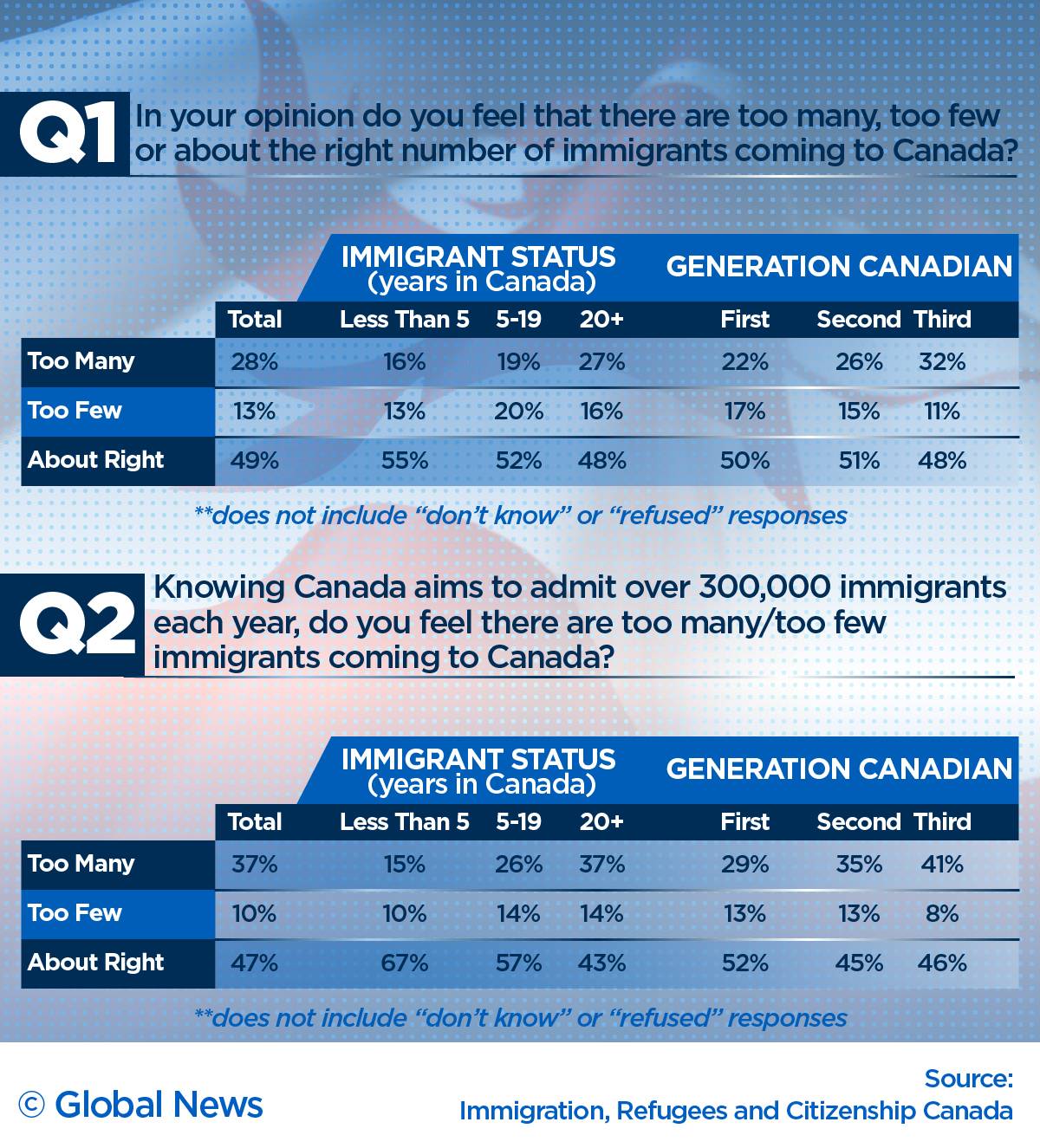
Among those who identified as first, second or third-generation Canadian, there were also differences.

Thirty-two per cent of those who identified as third-generation Canadians said there are too many immigrants.

That compares to 26 per cent of those who identified as second-generation and 22 per cent of those who identified as first-generation who said the same.

Roughly half of respondents across all of those categories said the immigration levels in Canada right now are “about the right number.”

“It’s clearly a pattern that shows up pretty repeatedly, for a couple of fairly obvious reasons, but also some more subtle things. The obvious thing is the more salient the immigration experience is for you, the more sort of open to immigrants you will tend to be,”said Michael Donnelly, an assistant professor of political studies at the University of Toronto’s Munk School of Global Affairs.

“It’s also harder to stereotype immigrants if you are yourself a recent immigrant,” he continued, noting the effect of being more closely linked to immigration may also be reflected in the changes in views among those who said their families have been here longer.

“If your parents were immigrants, there’s at least some sort of family lore of that experience and it’s going to have some influence on you.”

Donnelly noted that while studies done in other countries have yielded similar results, he has seen suggestions of a link between how long someone has lived in Canada and their views on immigration in only “one or two” studies in Canada over the years.

Disapproval appeared to increase in all but one demographic category when respondents were asked specifically about their views on immigration in the context of the government’s plan to bring in 300,000 immigrants per year.

“Knowing Canada aims to admit over 300,000 immigrants each year, do you feel there are too many/too few immigrants coming to Canada?” the questionnaire conducted for the report asked.

The percentage of immigrants here more than 20 years who said they feel there are too many immigrants coming to Canada increased from 27 to 37 per cent when asked that question with reference to the specific number.

The same was true for immigrants here between five and 19 years, with the number who responded in kind increasing from 19 per cent to 26 per cent.

Among those born in Canada, disapproval of immigration levels rose roughly 10 per cent when asked about the specific plan.

Forty-one per cent of those who identified as third-generation Canadian and 35 per cent of second-generation Canadians said so, compared to 32 and 26 per cent when asked the same question without the reference to the number of immigrants planned.

Christina Clark-Kazak, an associate professor in the Graduate School of Public and International Affairs at the University of Ottawa, and President of the International Association for the Study of Forced Migration, offered an explanation as to why that appears to be the case.

“I think that as an abstract idea, people are not necessarily against immigration,” she said, noting 300,000 is not a large amount of immigration given Canada’s size and existing population.

“But I think that people are concerned about ‘too many’ people coming in, so as soon as you get any kind of number, it becomes real, it becomes concrete, and then consequently there is a discussion of whether or not it is too many.”

The survey also asked respondents for their views on the influx of irregular border crossers coming into Canada from the United States.

Clark-Kazak said she was surprised by the results.

“There’s been actually a lot of negative press and political pressure around the Safe Third Country Agreement and irregular border crossers and that doesn’t seem to be born out in the public opinion that’s expressed, at least in this,” she said.

The survey asked respondents to rate on a 10-point scale whether they agree or disagree with the following statements: first, that they are confident in the government’s handling of irregular migration; and second, that it is not the responsibility of Canada to accept asylum claims from those coming from the U.S.

But neither question yielded any marked differences among respondents.

A slightly higher percentage said they strongly disagreed with the first statement than strongly agreed (16 per cent versus 11 per cent).

The same was true for the second statement, with 19 per cent overall saying they strongly agree and 16 per cent saying they strongly disagreed.

The vast majority of respondents from all backgrounds fell in between.

Donnelly said that isn’t surprising given the way the question was asked.

“There’s a real temptation to self-moderate and put yourself in the middle unless you have a real sort of goal,” he said.

“We don’t often see huge numbers at either extreme on longer scales unless the scales are sort of concrete.”

Roughly 35,000 migrants have crossed the border from the United States into Canada at irregular points of entry since early 2017.

Under the terms of the Safe Third Country Agreement, asylum seekers who arrive in either country must make their claim in the first country they first arrived.

That means migrants who arrive in the United States but do not make their claim will be turned around at the border if they try to do so in Canada.

But that only applies if they try crossing the border at an official checkpoint.

Those that cross at unofficial points of entry along the border can make their claim due to a loophole in the agreement.

That has led to calls from the Conservatives over recent years for the government to close the loophole and reduce the incentive for people to cross the border irregularly. Federal immigration officials have also acknowledged that the Safe Third Country Agreement is “no longer working as intended.”

Patti Lenard, an associate professor at the University of Ottawa focusing on immigration and immigration policies, said she doesn’t think the data shows strong feelings or differences in opinion about immigration among any particular subsets of the Canadian population.

Specifically, she questioned whether the average Canadian is as caught up in concerns about irregular migration as politicians have been in recent years.

“These numbers don’t suggest people are very exercised about irregular migrants coming in or irregular asylum seekers coming in through the United States. Mostly, it suggests people don’t really care about it at all,” she said.

“If I were the government, I would think that this is a sign that unless the Conservatives decide to go after them, they wouldn’t have to worry about a population that was going to turn against them on immigration.”

Lenard says while she recognizes immigration is expected to form a significant part of the Conservative campaign in the fall election, she is skeptical that it will bring the results Conservative Leader Andrew Scheer may be chasing.

“I don’t expect him to get a lot of purchase on it.”

Source: The longer someone lives in Canada, the more critical they may be of immigration: federal survey

John Ivison: Liberals braced for another ’huge wave’ of illegal asylum seekers from U.S.

Good analysis by Ivison of some of the issues involved but no easy solutions.

Comes out at same time as IRCC annual tracking survey, showing a small but significant increase in those believing immigration levels too high (27 percent vs 23 percent a year earlier) and a small increase, but within the margin of error, of those who believed too many refugees were coming to Canada (32 percent vs 30 percent) – see Federal government immigration poll suggests hardening attitudes:

You have to feel sorry for the 300,000 Central Americans and Haitians in the United States covered by temporary protected status, who look likely to be deported in the next year or so.

The Trump Administration said Tuesday Nicaraguan nationals must leave by January 2019, and that it is seeking additional information on whether to end TPS designation for Hondurans.

The writing would also appear to be on the wall for 50,000 Haitians, who see their protected status end in January, and 200,000 El Salvadoreans, who lose their status next March.

The situation demands compassion – some of the affected people had been allowed to live and work in the U.S. for 20 years.

But it does not mean Canada should step up and offer social assistance, education, health services, emergency housing and legal aid to any asylum seekers who feel like wandering across the border within sight of an official port of entry.

The Liberal government looks set to be swept up by a second wave of illegal asylum seekers along the Quebec border – the direct result of meek acquiescence to U.S. policy.

Both Canada and the U.S. signed the Safe Third Country Agreement that means refugees claim asylum at the first point of entry. If that happens to be in the U.S., then they can’t claim asylum in Canada, unless they have a blood relative here or are an unaccompanied minor.

But the agreement does not apply to claimants who enter Canada at a location that is not a point of entry.

That is why over the summer, 13,000 mainly Haitian refugees crossed illegally near the Saint Bernard-de-Lacolle border station and promptly gave themselves up to the RCMP.

The numbers slowed down from around 200 people a day to 60-70, according to Jean-Pierre Fortin, president of the Customs and Immigration Union. But he says the processing system is already “plugged” – and now the U.S. Administration has signalled its intentions, he expects a “huge wave”.

“We’re talking about a major crisis,” he said.

Jason Kenney, the leader of the United Conservative Party in Alberta and a former federal Immigration minister, said he pushed the Obama Administration to close the loophole that allows asylum seekers to flaunt the Safe Third Country agreement.

The request was refused, in part Kenney believes because the U.S. sees it an avenue for illegal aliens to deport themselves.

Michelle Rempel, the Conservative immigration critic, raised the issue with Ahmed Hussen, the Immigration minister, at committee last month. She asked if Hussen had broached the subject with his U.S. counterpart.

“We haven’t done that,” Hussen conceded.

But if Canada doesn’t challenge a loophole that undermines the spirit of the agreement, we might as well hang out the bunting for the flood of asylum seekers we can expect over the next 12 months.

Canada remains an attractive destination because the system is absurdly generous and completely overwhelmed.

The government has attempted to spread the word that there is no advantage to arriving in the country irregularly. MPs Pablo Rodriguez and Emmanuel Dubourg were dispatched to explain to Latino and Haitian communities in the U.S. that claiming asylum in Canada is not a free ticket into the country – and that half of all claims in 2016 were rejected.

Rodriguez is about to go back on the road, heading to Texas and New York to advise the Latino populations there not to quit their jobs and take their kids out of school until they understand the situation. “I tell them that if they are returned, it may be to their country of origin, not the United States,” he said.

But it remains to be seen whether that message percolates to all potential asylum seekers.

Canada remains an attractive destination because the system is absurdly generous and completely overwhelmed. Only a tiny proportion of asylum seekers have had their claims processed, beyond a cursory health and criminal check.

After a health and security screening, individuals deemed eligible are able to claim a range of social benefits and get a work permit.

Under the Immigration and Refugee Protection Act, asylum seekers have to show they are in need of protection from torture, death or “cruel and unusual treatment or punishment” in their home country.

But if a claim is rejected, they can appeal to the Refugee Appeals division of the Immigration department or ask the Federal Court to review the decision.

Needless to say with a backlog running into the tens of thousands this process takes years.

Taxpayers will be relieved to know that failed refugee claimants under a removal order MAY NOT be eligible for social assistance.

The government says it has a national operations plan that will be used by federal departments in the event of a significant increase in the number of irregular border crossings.

The first evidence of this plan is the delivery of winterized trailers for up to 200 people at the Lacolle border crossing.

But Rempel is concerned the government the integrity of the system is falling apart.

“Our options shouldn’t be limited to putting a winterized trailer at the border. Departmental officials have already warned that this is only going to get worse and worse,” she said. “A long stretch of the Quebec-Vermont border should be designated an official port of entry by law.”

It is not a problem of the Liberal government’s making – the tired, the poor and the huddled masses are being driven from the U.S. by an overtly anti-immigrant president.

But Justin Trudeau’s message that Canada will welcome anyone fleeing persecution, terror and war has made this country sound an attractive proposition to many who just want to increase their standard of living.

The Prime Minister needs to be unequivocal in his messaging – to economic migrants and to the Americans.

via John Ivison: Liberals braced for another ’huge wave’ of illegal asylum seekers from U.S. | National Post

Canadians have different attitudes on immigrants versus refugees: poll

Two contrasting polls released: the annual IRCC tracking survey and a SOM poll of attitudes in Quebec  (methodologies and questions vary).

Canada-wide results show 52 percent believe the current levels are about right, down from 58 percent a year earlier. The Quebec poll asks this question differently, showing 55 percent are opposed to an increase in immigration levels while 36 percent support an increase.

Starting with the tracking survey:

A newly released federal survey on attitudes towards immigration suggests Canadians are somewhat more enthusiastic about accepting economic migrants than they are about refugees.

While 52 per cent of those polled in the Immigration Department’s annual tracking study felt the right number of immigrants were coming to Canada, 23 per cent thought it was too high.

Meanwhile, 40 per cent felt the right number of refugees was being admitted and 30 per cent thought that figure was too high.

The 2016 survey was done long before immigration and refugee policy became a centrepiece of the U.S. presidential campaign and the eventual new administration of Donald Trump, and before the question of what values immigrants to Canada ought to hold became a centrepiece of Conservative leadership politics here.

So while the data might not reflect how attitudes have shifted since those developments, it’s telling for what it was probing for in the first place, suggested Jack Jedwab, the executive vice president of the Association for Canadian Studies and co-chairman of an upcoming conference on integration and immigration.

“I think what the government is trying to get at is the issue of the extent to which people are more preoccupied by the increase in refugees that’s happening in a lot other places in the world,” he said.

While the survey did suggest some differences in viewpoints on refugees versus other classes of immigrants, Jedwab said they aren’t substantial.

“Right now, we’re seeing globally an effort on the part of elected officials to try to make those distinctions – refugees bad, economic migrants good, that’s the distinction that’s being made in the States to some extent,” he said.

“And I don’t think, based on what we’re seeing now in this poll, that we’re seeing that idea take effect here.”

Pollsters were in field between August 11 to 31, 2016, asking 1,598 Canadians for their opinions on immigration. The survey has a margin of error of 2.45 per cent, 19 times out of 20.

The survey was done ahead of the release of the immigration levels plan, published in October, and also before the federal government received a report from its economic advisory council that would recommend a massive increase in the number of immigrants to Canada, from what had been about 260,000 a year to 450,000.

The survey did probe Canadians’ appetite for an increase. Respondents were asked to what extent they’d support boosting levels of economic immigration by 100,000 people over the next five years and 42 per cent exhibited some level of support for the idea. If the number ratcheted up further to 200,000 over five years, support fell to 38 per cent.

The Liberals eventually nixed any major increase, going instead with a modest uptake in admissions to around 300,000.

While the survey is done annually, not all the questions are repeated each year, making it difficult to compare attitudes over time unless the questions are exactly the same.

There was some crossover between this year and last year’s study.

Fifty-two per cent of those polled in 2016 thought the government is accepting the right number of immigrants, down from 58 per cent of those polled in 2015.

Meanwhile, about 46 per cent of those polled in 2016 felt that refugees have a positive impact on the Canadian economy, up from the 41 per cent who felt that way in the survey done last year.

Source: Canadians have different attitudes on immigrants versus refugees: poll – The Globe and Mail

The Quebec poll:

Une majorité de Québécois est défavorable à l’idée d’accueillir davantage d’immigrants au Canada à la suite des mesures anti-immigration du président américain Donald Trump.

Un sondage SOM publié mercredi par Cogeco Nouvelles précise que 55 % des répondants croient que le Canada ne devrait pas accueillir davantage d’immigrants à la suite des mesures anti-immigration du président américain.

En revanche, 36 % des gens approuvent l’idée d’en accueillir davantage, alors que 9 % se disent indécis.

Les catégories de personnes qui sont les plus favorables à l’idée d’accueillir davantage d’immigrants à la suite des mesures adoptées par l’administration Trump sont les 18-24 ans, dans une proportion de 55 %, ceux qui ont une langue maternelle autre que le français, dans une proportion de 49 %, et ceux qui ont une scolarité de niveau universitaire, dans une proportion de 49 %.

De même, 75 % des personnes interrogées se disent d’accord avec l’idée de resserrer la surveillance aux frontières pour empêcher l’arrivée d’immigrants illégaux.

Les personnes ayant le français comme langue maternelle sont encore plus nombreuses à le penser, soit 79 %.

Seulement 19 % s’opposent à l’idée.

De plus, moins du tiers des Québécois interrogés jugent que le premier ministre du Canada, Justin Trudeau, gère correctement le dossier de l’arrivée au pays des immigrants illégaux, soit 29 % d’entre eux.

La majorité des Québécois dit non à plus de migrants, selon un sondage