Shakespeare and religion: Shakespeare’s complex views of the Islamic world | The Economist

Another part of the richness and insight of Shakespeare:

Shakespeare, as proven time and again in other fields, was ahead of his time in his sensitivity to the Islamic world and its inhabitants. Of course, his plays reveal his own set of prejudices, fascinations and contradictions, but over the course of his career the myth of the bloodthirsty Muslim is eclipsed by a more sensitive depiction in Othello—a change possibly influenced by the visit of Morocco’s ambassador to London in 1600. In our present day, where skewed misconceptions about Islam in Europe is the norm, there is much Shakespeare can teach us about who and what we identify with.

Source: Shakespeare and religion: Shakespeare’s complex views of the Islamic world | The Economist

Of two minds [the advantages of a second language] | The Economist

More on the advantages of thinking in a second language:

MORE and more of the world is working in English. Multinational companies (even those based in places such as Switzerland or Japan) are making it their corporate language. And international bodies like the European Union and the United Nations are doing an ever-greater share of business in the world’s new default language. At the office, it’s English’s world, and every other language is just living in it.

Is this to the English-speaker’s advantage? Working in a foreign language is certainly hard. It is easier to argue fluently or to make a point subtly when not trying to call up rarely used vocabulary or construct sentences correctly. English-speakers can try to bulldoze opposing arguments through sheer verbiage, hold the floor to prevent anyone else from getting a word in or lighten the mood with a joke. All of these things are far harder in a foreign language. Non-natives have not one hand, but perhaps a bit of their brains, tied behind their backs. A recent column by Michael Skapinker in the Financial Times says that it’s important for native English-speakers to learn the skills of talking with non-natives successfully.

People working in a language not their own report other perks. Asking for a clarification can buy valuable time or be a useful distraction, says a Russian working at The Economist. Speaking slowly allows a non-native to choose just the right word—something most people don’t do when they are excited and emotional. There is a lot to be said for thinking faster than you can speak, rather than the other way round.

Most intriguingly, there may be a feedback loop from speech back into thought. Ingenious researchers have found that sometimes decision-making in a foreign language is actually better. Researchers at the University of Chicago gave subjects a test with certain traps—easy-looking “right” answers that turned out to be wrong. Those taking it in a second language were more likely to avoid the trap and choose the right answer. Fluid thinking, in other words, has its down-side, and deliberateness an advantage. And one of the same researchers found that even in moral decision-making—such as whether it would be acceptable to kill someone with your own hands to save a larger number of lives—people thought in a more utilitarian, less emotional way when tested in a foreign language. An American working in Denmark says he insisted on having salary negotiations in Danish—asking for more in English was excruciating to him.

All this applies regardless of the first language. But in the modern world it is English monoglots in particular who work in their own language, joined by non-native polyglots working in English too. Those non-native speakers can always go away and speak their languages privately before rejoining the English conversation. Hopping from language to language is a constant reminder of how others might see things differently, notes a Dutch official at the European Commission. (One study found that bilingual children were better at guessing what was in other people’s heads, perhaps because they were constantly monitoring who in their world spoke what language.) It was said that Ginger Rogers had to do every step Fred Astaire did, but “backwards, and in high heels”. This, unsurprisingly, made her an outstanding dancer.

Indeed, those working in foreign languages are keen to talk about these advantages and disadvantages. Alas, monoglots will never have that chance. Pity those struggling in a second language—but also spare a thought for those many monoglots who have no way of knowing what they are missing.

Source: Of two minds | The Economist

ICYMI – Islam, Europe and Belgium: Belgium’s dilemmas over Islam are common to Europe | The Economist

Hobson’s choice:

The problem of which partners to choose for co-operation (and how to avoid killing them with kindness) is especially acute in Belgium, which has a tradition, reflecting its Catholic heritage, of offering generous state help to religious institutions—above all, religious education. As explained in a recent article by Caroline Sagesser, of the Free University of Brussels, the Belgian state officially recognised Islam as one of the country’s religions, eligible for help, back in 1974. Ever since it has been trying to find a reliable Muslim body that can help certify mosques and schools (as deserving of official help) and is also genuinely representative of the community.

Only in 2007 did an “Executive of Belgian Muslims” start playing that role effectively, and it has been paralysed by internal quarrels, or by quarrels with the government, quite a lot of the time since then. The government’s need for a Muslim partner has grown more acute in the past couple of years since young zealots, mostly of Moroccan origin, began leaving for Syria. It recently earmarked €3.3m ($3.8m) to pay the salaries for 80 new imams; it still needs advice on where to find suitably moderate recipients of that money. (As of now, the country has around 300 imams, of whom about 160 are on the state payroll.)

The Executive has in recent weeks undergone some internal upheavals. An imam who had been president since March 2014, and complained that he was being undermined and threatened by hardline conservatives, stood down in favour of one who enjoys the formal backing of Belgium’s Moroccan community. The new president, Salah Echallaoui, has been serving as head of an association of Moroccans in Belgium which is also supported by the Moroccan state. In a sense, the Belgian and Moroccan governments are now co-managing Belgian Islam; that marks a big change from the Executive’s earlier days, when it was boycotted by Moroccans. Mr Echallaoui has been much in the news in recent days, condemning the terrorist attacks and insisting they had nothing whatever to do with the true message of Islam.

The emergence, and the government’s acceptance, of a leader with official Moroccan backing reflects a wider European trend. A decade ago, the talk in many countries was of fostering a “European Islam” which would put down local roots and gradually reduce the influence of migrant-sending countries like Algeria, Turkey and Morocco. But in the current situation, European governments are concluding that they need all the help they can get in keeping extremism under control; and if the governments of other countries can assist, so much the better. The Belgian government used to compete with Turkey’s religious affairs directorate, the diyanet, for influence over Muslim newcomers; more recently it has welcomed the diyanet‘s help in preparing imams to work in Europe. The situation in other European countries with Turkish minorities has shifted in a similar way.

Another strong Muslim institution in Belgium, much heard in condemnation of the terrorist attacks, is the Ligue des Musulmans de Belgique (League of Muslims of Belgium) which in recent years has organised a high-profile exhibition of all things Islamic in Brussels. But the government is under international pressure to keep it at arm’s length. The United Arab Emirates, as part of its broader campaign against the global Muslim Brotherhood, has denounced the League as a “terrorist” organisation under Brotherhood influence. The League rejects that allegation, calling itself a peaceful organisation of mainly Moroccan-born Belgians which has no connection with Egypt (the homeland of the Brotherhood) or the Gulf. But the government keeps a careful eye on the speakers invited to the exhibition and it has banned at least one.

The problem is that any Muslim who wields enough clout to be a useful partner to the government is probably getting backing from somewhere, be it the governments of Morocco or Turkey, the Brotherhood or some other international network. And whenever the government starts grooming its own favourite Muslims, whose distinguishing feature is impeccable moderation, they can rapidly come to be seen as stooges by their own community. Many European countries, including Britain, face just that dilemma. But governments will keep trying to find the right partners because they feel they have no choice.

Source: Islam, Europe and Belgium: Belgium’s dilemmas over Islam are common to Europe | The Economist

The great melting [less segregation, more diverse communities]| The Economist

Good piece on how racial segregation may be being replaced by economic segregation in the UK and USA:

OAK PARK, just outside Chicago, is known to architecture aficionados as the home of Frank Lloyd Wright, who built some fine houses there. This small suburban village also has another distinction: it is racially mixed. In the 1970s it vigorously enforced anti-segregation laws; today the “People’s Republic of Oak Park”, as it is sardonically known, is 64% white, 21% black and 7% Hispanic. “Oak Park stands out so much,” says Maria Krysan at the University of Illinois at Chicago. But it does not stand out quite as much as it used to.

America remains a racially divided country, and Chicago is one of its most segregated cities. The south side is almost entirely black; northern districts such as Lincoln Park are golf-ball white; a western slice is heavily Hispanic. Yet the Chicago metropolis as a whole—the city plus suburban burghs like Oak Park—is gradually blending. For several reasons, that trend is almost certainly unstoppable.

When it comes to race, appearances often deceive. Streets can appear black or Asian when they are actually full of black or Asian shoppers who live somewhere else. Statistics are more reliable, and the best measure is known as the dissimilarity index. This reflects the proportion of people of a given race who would have to move out of their census tract—an area of a few thousand inhabitants—and into another one in order to spread themselves evenly. In 1970 the black-white dissimilarity index for Chicago was above 90, meaning that more than 90% of blacks would have had to move in order to become integrated with whites. By 2000 the figure had fallen to 81. William Frey, a demographer at the Brookings Institution, a think-tank, calculates that it now stands at 76.

In 45 of 52 big American metropolises with sizeable black populations, black-white segregation has fallen since 2000, according to Mr Frey. Southern cities, which many blacks fled in the first half of the 20th century, are now less segregated than northern ones such as Chicago and New York; sunbelt cities such as Las Vegas and Phoenix are more mixed still. In 1980 the average black urbanite lived in a district that was 61% black. Now he or she lives in a place that is 45% black (see chart). Asians and Hispanics are neither more nor less segregated than they were, probably because two trends are cancelling each other out: as some members of those fast-growing groups move out of ethnic enclaves, they are replaced by new immigrants. Still, both groups are far more integrated than blacks: the Hispanic-white index of dissimilarity was 44 in 2010, and the Asian-white score just 40.

America is unusual, both for its obsession with race and for its superb statistics. Poor countries lack the means to collect precise data, and many rich ones choose not to. Some, like France, are so high-minded that they hold race to be irrelevant; in others racial censuses smell uncomfortably like fascism. A few countries distinguish foreigners from natives, though, and there the trend is mostly the same as in America.

In Sweden migrants from outside Europe have become less segregated since the 1990s, calculate Bo Malmberg and others at the University of Stockholm. By one measure, desegregation is happening fastest in Malmo, a city with lots of immigrants. In the Netherlands Sako Musterd, a geographer, calculates that foreigners have become less segregated from the native Dutch in Rotterdam. Amsterdam grew more segregated until the late 2000s, but now seems to be going the other way.

The European country that stands out is Britain. Like America, Britain collects excellent data on race and ethnicity; also like America, it is becoming steadily more mixed. Gemma Catney at the University of Liverpool has shown that every ethnic minority became less segregated between 2001 and 2011 (the two most recent British census years). Black Africans, who had been among the most clustered, are spreading out especially quickly.

…Perhaps Britain and America will become more segregated over time, with ghettos in new places. Perhaps many cities in countries that refuse to collect race data are quietly dividing. Perhaps—but probably not, because the forces driving integration are both powerful and widespread.

The first is the drift of non-whites from city centres to suburbs and commuter towns. British and American suburbs are still mostly white, but less so than before. In 1990 just 47% of American Hispanics and 37% of blacks lived in suburbia; by 2010, 59% of Hispanics and 51% of blacks did. Cook County, which includes the city of Chicago, has lost 140,000 black inhabitants since 2000, while the surrounding rural and suburban counties all gained them. Whites are moving into some cities, including Chicago, though rarely as quickly as blacks are leaving.

Some old suburbs have become heavily black or Hispanic—or, in Britain, south Asian. But for the most part suburbanisation leads to mixing. Ethnic minorities who leave city centres tend to be better-off and neither need nor want to live in enclaves. If they choose to move to a newly built suburb, as they often do in America, they will be blocked neither by racist housing laws, which have been abolished, nor by bigoted assumptions about the character of the neighbourhood. That is why the swelling, sprawling cities of the American south and west are so mixed.

A second force for integration is immigration. In Newham the churn caused by immigrants arriving and then moving to better districts has thoroughly dissolved old colour lines. The same is true of parts of America, too. John Logan of Brown University says that whites often stay when Latinos and Asians move in to a district. After a while blacks move in too, taking advantage of the path paved by the Latinos and Asians—and whites mostly continue to stay. Logan Square, a handsome district in north Chicago with wide boulevards and big, stylish houses, seems set to become such a “global neighbourhood”. Its population is 42% white and 46% Hispanic.

A powerful third force is love, which integrates families as well as places. In London whites and black Caribbeans marry or cohabit in such numbers that there are now more children under five who are a mixture of those two groups than there are black Caribbean children. Marriages between whites and Asians are growing, too. America is mixing just as quickly. In 2014, Mr Frey calculates, 19% of new American marriages involving whites and 31% involving blacks were mixed-race. The share for both Hispanics and Asians was 46%. The children of such unions can be hard to deal with statistically. So in the future the numbers will probably underestimate the speed of desegregation.

All this is most welcome. But there is a fourth driver of racial and ethnic integration in cities, which is not so benign. Because big cities are such desirable places to live, and have failed to build enough new homes, they are now so expensive that people can barely afford to segregate themselves. In London property prices have risen so steeply that the average first-time buyer needs to raise a deposit equivalent to about 120% of annual income, according to Neal Hudson of Savills, an estate agent. In the 1980s it was enough to raise just 20-30%.

Increasingly, people just buy property where they can. And along with the great weight of evidence showing that countries are becoming less segregated by race and ethnicity, there is also growing proof that they are becoming more segregated by income. One kind of separation might be replaced by another.
Source: The great melting | The Economist

Islam and extremism: Looking within | The Economist

Good piece in The Economist on some of the challenges within Islam regarding radicalization and extremism:

Complicating attempts to shore up traditional sources of authority is the fact that the establishment is precisely what many extremists reject. Salafists (devout Muslims who seek to emulate the times of the Prophet), both of the quietist and the violently jihadist sort, see much of the centuries-old tradition of Islamic jurisprudence as distorting the true religion. When denounced by the emir of Kano, a former central banker who is now Nigeria’s second-most-important Muslim leader, Boko Haram retorted: “We do not practise the religion of Lamido Sanusi…but the religion of Allah.”

And Muslim-majority populations that have risen up against dictators are less willing to trust religious authorities—especially those they regard as captured by political or government interests. Egypt’s government appoints the head of al-Azhar. Members of Dar al-Ifta, Lebanon’s official body for teachings and fatwas (rulings on Islamic law), come from its two main political groupings. Middle Eastern rulers have a history of alternately backing religious groups and denouncing them as terrorists for short-term political gain.

The internet, social media and improving literacy in the region make other sources easier to find. “I think about religion myself by searching and seeing the different opinions,” says Muhammad Gamal, a chemistry teacher at Cairo University. Alternatives are often better packaged and more appealing to young people, too. A region-wide joke says that Mr Baghdadi, in his 30s, is the youngest person to head an Arab organisation.

“You see ISIS videos, all slick Hollywood style, and what a stark contrast with the turbans and robes of the sheikhs of Al-Azhar,” says Raphaël Lefèvre, a French scholar who studies Lebanon’s Sunnis. “Radical groups seem closer to the people. Institutions are seen as bourgeois, stuffy and speaking a language people don’t understand.” Some Muslim scholars compare the appeal of jihadism to that of fundamentalist Christianity: the message is clear and certain.

Firm government action against those who preach violence is probably worthwhile. And traditional centres of Islamic authority could surely do more to explain their interpretations of Islam, and in more appealing ways. But the result of the debate within Islam about the roots of extremism may not be entirely to the taste of liberal Muslims—or Western politicians.

Imposing state-sanctioned creeds has in the past pushed jihadists underground. And these versions of Islam are by no means sure to be more liberal: the Saudi regime uses harsh sharia punishments such as beheading and last year al-Azhar launched a campaign to rid Egypt of unbelief after a survey claimed the country held precisely 866 atheists. But the alternative, attempting to promote liberal doctrines in a free market of religious ideas, has dangers, too. Georges Fahmi, an Egyptian scholar, detects a conservative mood among Muslims: “What is shocking is how many people support IS’s actions even if they would not do them themselves.”

via Islam and extremism: Looking within | The Economist.

Islam and Catholicism: Beyond reason versus faith | The Economist

The Economist’s commentary on faith, reason, Islam and Catholicism:

These are choppy seas for any theologian or historian of religion to navigate.  In every faith that believes in divine revelation—the idea that at certain moments, God discloses essential truths about Himself or the universe—there is bound to be a tension between revelation and reason as methods of understanding the world. Christians and Muslims have found many different answers to that dilemma.  It’s probably true, on balance, that after much internal debate, Islamic thought from the Middle Ages onwards put more emphasis on divine revelation, while Christianity as it emerged in western Europe put more stress on reason. But that did not make the west Europeans behave more peacefully.

Over the centuries, Muslim thinkers have had a lot to say about reason, including the reasonableness of God; and many Christian texts—including the New Testament—stress the fact that God can utterly trump and render meaningless whatever passes for intelligent reason among unaided human minds.

Ironically, this is exactly the sort of thing that Christian and Muslim thinkers could and should talk about in a civilised way. They cant and wont agree on the question of when and to whom God definitively revealed himself—unless one or the other religion ceases to exist. But they do face common intellectual dilemmas, and they can interact constructively as well as destructively. Not all the exchanges between Christianity and Islam in the medieval era were as abrasive as the Byzantine emperors dialogue quoted by Benedict.

His big failure of tact, perhaps, lay in making generalisations about Islam which relied on Christian commentaries, instead of letting Islamic sources speak for themselves. To any Muslim listener, his tone sounded “Orientalist” and condescending. But an indirect result of the furore was the “Common Word” initiative launched in 2007 by 138 Muslim scholars who invited their Christian counterparts to a debate on the subject of “love of neighbour and love of God”—and the resulting debate continues in universities like Yale and Cambridge.

None of that is much help, you might say, to people threatened by the nihilist fury of al-Qaeda or Islamic State fighters in Iraq and Syria. But ill-judged pronouncements in the world of academia can certainly have a negative effect on the streets. It would be nice to think that the opposite is also the case: that jaw-jaw is not merely better than war-war but at least a partial antidote.

Islam and Catholicism: Beyond reason versus faith | The Economist.

Muslim America: Islamic, yet integrated | The Economist

The Economist’s survey of Muslim Americans and the contrast with European Muslims. Same general pattern with Canadian Muslims (about 3 percent of Canada’s population) in terms of the diversity of communities and outcomes, although overall have a higher low-income percentage.

And like the US, we also have that small number of those who radicalize and go off to fight in Syria, Iraq or elsewhere:

America’s Muslims differ from Europe’s in both quantity and origin. The census does not ask about faith, but estimates put the number of Muslims in the country at around 1% of the population, compared with 4.5% in Britain and 5% in Germany.

Moreover, American Islam is not dominated by a single sect or ethnicity. When the Pew Research Centre last tried to count, in 2011, it found Muslims from 77 countries in America. Most western European countries, by contrast, have one or two dominant groups—Algerians in France, Moroccans and Turks in Holland. This matters because the jumble of groups in America makes it harder for Muslim immigrants and their descendants to lead a life apart.

Different traditions get squashed together. When building mosques, says Chris McCoy, a Kentucky native who is a prolific architect of Islamic buildings, “the question is usually not whether we should have an Indian- or a Saudi-style dome but, can we afford a dome?”

Mixing breeds tolerance: Pew found that most American Muslims think that their faith is open to multiple interpretations, making them the Episcopalians of the Islamic world.

America’s Muslims are better off than their European co-religionists. They are almost as likely as other Americans to report a household income of $100,000 or more. The same cannot be said of the Pakistanis who came to work in the now-defunct textile mills of northern England or the Turks who became guest workers in West Germany. Many American Muslims arrived in the 1970s to complete their higher education and ended up staying. Muzammil Siddiqi, chairman of the Fiqh Council of North America, which issues fatwas, or religious opinions, to guide the behaviour of the country’s Muslims, is typical: he was born in India and holds a Harvard PhD in comparative religion.

There is a stark contrast between this group and some of the more recent immigrants from Somalia, who have fewer qualifications and lower wages as do African-American Muslims, who make up about an eighth of the total. This divide, if anything, makes America’s Muslims look more like the nation as a whole.

Muslim America: Islamic, yet integrated | The Economist.

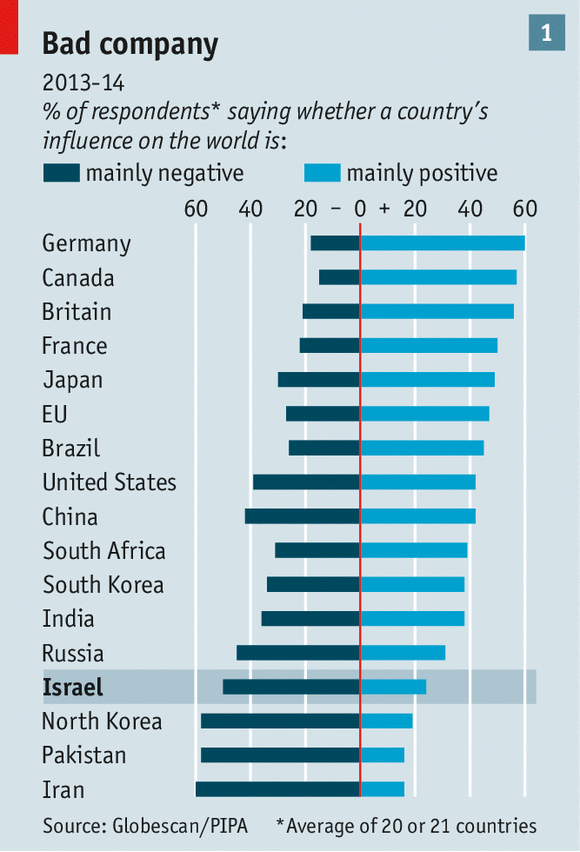
Israel and the world: Us and them | The Economist

Israel in World
Not encouraging:

Daphna Kaufman of Reut wonders whether Israel is also moving away from Europe. The secular and social-democratic leanings of Israel’s early decades dovetailed with western Europe’s. But the 1m migrants from the former Soviet Union, who arrived in the 1990s, have scant democratic tradition; many seek salvation in a strongman, a Jewish Putin, to rescue Israel from its enemies.

A similar number of national-religious Jews, heavily represented in government, see Israel as part of the divine plan for the Messiah’s coming, and worry that democracy might get in the way. More often now, Israel finds it easier to deal with non-democratic regimes, in the region or in the Asia-Pacific, where politics intrudes less on business. All of that bodes ill for co-operation with the country’s European critics and perhaps its American ones too.

Some hope that the common threat of a jihadist menace will yet induce Europe to treat Israel as its frontline bulwark and to overlook the plight of the Palestinians. “Ours is the fight of the free world,” says Mr Steinitz. But others see only greater divergence ahead. “Within 50 years, Europe’s lingua franca will be Arabic, and Britain will have a Muslim majority,” Moshe Feiglin, a hardline member of Mr Netanyahu’s party, Likud, tells a nodding audience in Bet Shemesh, a commuter town between Jerusalem and Tel Aviv. His listeners see a future in which Israel is increasingly forced to rely on its own devices—and its own might.

Haven’t seen any recent Canadian polling on attitudes with respect to Israel and Palestine.

Israel and the world: Us and them | The Economist.

Islam in Egypt: Manipulating the minarets | The Economist

The Economist on the clampdown in the mosques in Egypt:

The Muslim Brotherhood has called the government’s expanding control a “war on Islam”. But in the current climate of repression, and at a time when the Muslim Brotherhood is loathed by the army, the civil service and many ordinary Egyptians, there has been little protest. Secular opponents who have been outspoken against restrictions on activists in the past have been silent. Some Salafists, who tend not to speak out against the government, have grumbled, but most abide by the curbs.

Human-rights groups see good reason for all to be worried by the new restrictions. “This in effect kills the idea of religious freedom, since Egyptians can’t opt for any religious practice not approved of by the authorities,” says Mr Ezzat. It may be counter-productive, too. In the past, clamping down on the mosques has bred anger and forced hardliners underground. That is not what Egypt needs.

Islam in Egypt: Manipulating the minarets | The Economist.

Judicial activism in Canada: Charter fights | The Economist

The Economist’s take on the judicial difficulties of the Government:

Yet the government itself, not meddling judges, may be more to blame. Edgar Schmidt, a former lawyer in the justice department, is suing the government for not subjecting proposed legislation to sufficiently rigorous scrutiny to see if it conforms to the constitution prior to presenting it to parliament. Simon Potter, a former head of the Canadian Bar Association, cited Mr Schmidt’s points in a speech to the association last month in which he accused the government of not doing enough to defend the charter and of fostering disrespect for the judiciary. If Mr Schmidt’s allegations are correct, says Mr Potter, “the executive has decided to take as many freedoms away from us as possible, rather than as few as possible”. He is dismayed that there is more legislation in the pipeline that looks ripe for charter challenges.

One step this government is not prepared to take is to revoke the charter itself. It would involve lengthy, arduous and potentially inconclusive constitutional negotiations with the provinces. More importantly, even the government’s own surveys show the charter is hugely popular with the majority of Canadians. When it asked Canadians to suggest the people and feats they want celebrated in 2017, the country’s 150th birthday, Medicare, peacekeeping and the charter of rights and freedoms were the top three accomplishments. Pierre Trudeau, the former Liberal prime minister who brought in the charter, was the most inspiring Canadian.

Judicial activism in Canada: Charter fights | The Economist.