The rich world revolts against sky-high immigration

The Economist’s take but ignores likely impact of AI and automation in many sectors:

Immigrants are increasingly unwelcome. Over half of Americans favour “deporting all immigrants living in the us illegally back to their home country”, up from a third in 2016. Just 10% of Australians favour more immigration, a sharp fall from a few years ago. Sir Keir Starmer, Britain’s new centre-left prime minister, wants Britain to be “less reliant on migration by training more uk workers”. Anthony Albanese, Australia’s slightly longer-serving centre-left prime minister, recently said his country’s migration system “wasn’t working properly” and wants to cut net migration in half. And that is before you get to Donald Trump, who pledges mass deportations if he wins America’s presidential election—an example populist parties across Europe hope to follow.

It is not just words either. Australia, Britain and Canada are cracking down on “degree mill” universities offering courses that allow in people whose true intention is to work. This year Canada hopes to reduce the number of study permits by a third. Other countries are making it harder for migrants to bring family with them. Last month President Joe Biden announced measures to bar those who unlawfully cross America’s southern border from receiving asylum. In France President Emmanuel Macron wants to expedite deportations; Germany is enacting similar plans. More extreme restrictions could be on their way. After all, Mr Trump’s plans imply the removal of perhaps 7.5m people. What will this crackdown mean for economies across the rich world?

chart: the economist

The change of approach follows a period of sky-high immigration. In the past three years 15m people have moved to rich countries, the biggest surge in modern history (see chart 1). Last year more than 3m people migrated to America on net, 1.3m went to Canada and about 700,000 turned up in Britain. The arrivals are from all over, including hundreds of thousands of Ukrainians fleeing war and also millions from India and sub-Saharan Africa.

Now there are signs the boom may be coming to an end. Net migration to Canada has nearly halved from its recent peak, while in New Zealand it is falling sharply. The rich world has fewer job vacancies than before, giving potential migrants less incentive to move, and the flood of refugees from Ukraine has slowed to a trickle. New anti-migrant measures are also starting to play a part. In the eu the number of third-country nationals who were returned to their home country, following an order to leave, has risen by 50% over the past two years. In the first quarter of 2024 “enforced returns” from Britain rose by 50% year on year. Illegal crossings at America’s southern border recently fell to a three-year low.

Some anti-immigration measures, especially large-scale deportations, could prove immensely damaging to economies. When Canada ramped up deportations during the Depression, it came at a large fiscal cost and clogged the ports. In 1972 the Ugandan government expelled thousands of people of Asian descent, whom it accused of profiteering. “There are virtually no African entrepreneurs left to take over the commerce,” a confidential cia memo reported in 1972, which also noted that it had become impossible to get a haircut in Kampala as all the barbers had shut.

Those close to Mr Trump argue that “Operation Wetback”—Dwight Eisenhower’s derogatorily named policy in the 1950s which expelled thousands of undocumented Mexicans—shows mass deportations can work without ill effect. True, the period was one of strong economic growth, and inflation remained low. Yet the comparison is misleading. During the 1950s legal Mexican immigration to America sharply rose, rather than fell. There is little doubt that Mr Trump’s proposal would cause economic chaos, as entire industries would be forced to find new staff. Warwick McKibbin of the Peterson Institute for International Economics, a think-tank, reckons that in the unlikely event that Mr Trump successfully deported 7.5m people, American gdp would fall by 12% cumulatively over three years.

There is greater uncertainty about the effects of more moderate anti-immigration policies, even if they are still likely to be damaging. In the short term, efforts to bring down sky-high migration would probably reduce inflation in the housing market. Research by Goldman Sachs, a bank, suggests that in Australia each 100,000 decline in annual net migration reduces rents by about 1%. As migration to Britain has slowed in recent months, so has the pace of rent rises (other factors are playing a role, too). In time, though, falling migration would probably push up other inflation. As labour supply declined, wages might grow faster than otherwise, raising the price of services such as hospitality.

A clampdown would also benefit gdp per person—the yardstick by which economists usually assess living standards. As immigration surged in 2022 and 2023, gdp per person in Britain fell. It has tumbled in Germany. In Canada it remains nearly 4% off its high in 2022. This has happened in part because the latest arrivals are on average less skilled than the resident population, meaning that they cannot command high salaries. Although this is a mechanical effect, rather than an actual hit to natives’ living standards, reducing immigration could stop the slide in the short term.

But it would do so with long-term costs. The new arrivals are finding jobs. Although for decades immigrants to Britain were less likely than natives to work, for the first time ever this is no longer true (see chart 2). The employment rate of migrants in Europe is the same as that for natives. Immigrants in America have long been likelier to work than people born in the country, and in recent months the gap has widened. Cracking down on migration risks provoking the re-emergence of labour shortages that plagued rich economies in 2021 and 2022, and which drag on gdp per person by creating inefficiencies. In the long term, immigration also allows for more specialisation in the labour force.

chart: the economist

Crucially, the new arrivals often work in unglamorous, poorly paid but nonetheless vital industries, including construction and health care. From 2019 to 2023 the number of foreign-born people in America’s construction workforce rose sharply, even as the number of native builders fell. In Norway the number of foreign workers employed in health care has jumped by 20% since the covid-19 pandemic. The number of doctors working in Ireland but who trained elsewhere is up by 28%. During the same period the number of Chinese staff in Britain’s struggling National Health Service has doubled, while the number of Kenyans tripled.

Over time rich countries, which have ageing populations, will need more workers who are young and keen to work. This is because few politicians are talking about measures such as drastically raising the retirement age or how to make health care much more efficient. Although cracking down on new arrivals may buy politicians support for now, economic logic means the stance will be a nightmare to maintain. 

Source: The rich world revolts against sky-high immigration

Immigration is surging, with big economic consequences

From the Economist, with some good comparative stats:

…There is one context in which averages matter: the provision of public services. If gdp per person falls, their quality might deteriorate. For this reason, Milton Friedman once remarked that “you cannot simultaneously have free immigration and a welfare state”. The state is under pressure in much of the rich world. Roads are congested and in countries with public health care, hospital waiting lists are long. “Those are not externalities, those are direct effects of new market participants affecting supply and demand,” says Mikal Skuterud of the University of Waterloo.

The crucial question is whether new arrivals on net contribute to or drain from the public coffers. High-skilled types make enormous net fiscal contributions. But for low-skilled workers the question is harder to answer. In immigrants’ favour is the fact that, because they typically arrive as adults, they do not require public schooling, which is expensive. And they may even prop up public services directly. The largest increase in British work-visa issuance last year, of 157%, was for desperately needed health and care workers.

Potential trouble comes later. Immigrants age and retire. Social-security systems are often progressive, redistributing from rich to poor. Thus a low-earning migrant who claims a government pension—not to mention uses government-provided health care—could end up as a fiscal drag overall. They are most likely to have a positive lifetime effect on the public purse if they leave before they get old.

Quite how this shakes out depends on the country and immigrants in question. A review by America’s National Academies of Sciences, Engineering and Medicine in 2016 estimated that the 75-year fiscal impact of an immigrant with less than a high-school education, at all levels of government and excluding public goods like national defence, was a negative $115,000 in 2012 dollars. By contrast, a study by Oxford Economics in 2018 found that in Britain about one-third of migrants had left the country ten years after arrival, although it did not distinguish them by skill level.

If the fiscal impact is positive, it will not be felt unless the government invests accordingly. A windfall is no good if public services are allowed to deteriorate anyway, as in Britain, where the government is cutting taxes ahead of an election. Similarly, if regulations stop infrastructure from expanding to accommodate arrivals, migration risks provoking a backlash. Nowhere is this more obvious than in the case of housing, where supply is strictly curtailed by excessive regulation in many of the same places now experiencing a migration surge. Migrants, like natives, need places to live, which increases the imperative to build. Welcoming new arrivals means a lot more than just letting them in. 

Source: Immigration is surging, with big economic consequences

The Economist: Germany strikes a brave new deal on immigration

Significant change:

Germany’s debate over migration sometimes seems divorced from reality. The country’s low birth rate and shrinking workforce imply a pressing need to import manpower. Much political talk, however, is concerned with how to keep immigrants away. The anti-immigration right is surging in opinion polls, and even otherwise liberal folk are increasingly prone to saying that “certain kinds” of immigrants are alien to the national Leitkultur, a fuzzy concept of Germanness.

Yet the past week has seen a turn. Earlier this month German media exposed the proceedings of a private conclave of hard-right politicians at a posh hotel near Berlin in November, where the participants discussed expelling millions of aliens. That scandal woke up the dormant left, which has organised a series of big “anti-fascist” demonstrations in cities across the country. On January 20th some 250,000 Germans took to the streets in one of their biggest mass protests this century.

Meanwhile, the governing centre-left coalition, made up of the Social Democrats, the Greens and the liberal Free Democrats, has injected some good sense into the immigration debate. On January 18th and 19th it passed two immigration bills in the Bundestag. The first, pleasing to conservatives, will make it easier to expel asylum-seekers with dubious cases, whose numbers have soared since the end of the pandemic. The second, more significant law will make it easier for legitimate immigrants to gain German nationality.

The reasons for the latter law are obvious, though German media has devoted strangely little space to discussing them. An extraordinary 13.4m of Germany’s 84m residents do not hold citizenship. More than 5m of these have lived in the country longer than ten years. In some cities the proportion is far higher: 45% of the population of Offenbach, a big satellite of Frankfurt, are foreigners, as well as a third of Munich’s and a quarter of Berlin’s. This number has swollen rapidly in the past decade, partly because more immigrants have arrived, but also because Germany has failed to naturalise those already here.

Germany’s “naturalisation rate”—the percentage of resident foreigners granted nationality every year—was just 1.2% in 2021, well behind the European average of 2.2%. Sweden did far better at 10%. The number Germany naturalised rose from 130,000 in 2021 to 168,000 in 2022, the highest in two decades. But the backlog still grew, because of a range of obstacles: restrictions on dual nationality, long residency requirements, tough tests to prove language skills and gainful employment, and a clogged bureaucracy.

On average, Turkish immigrants who acquire German citizenship have already been in the country for 24 years. Small wonder that nearly half of Germany’s 3m immigrants of Turkish background—the largest immigrant group—remain non-citizens. Their case is special. Among the hundreds of thousands of Turkish Gastarbeiter (guest workers) who arrived in the 1960s and 1970s, many assumed they would return to Turkey and so did not apply to become German. Yet with hard-right pundits wagging fingers at the alleged failure of Turkish immigrants to integrate, Germany’s failure to welcome them deserved scrutiny too.

The new law should help address the citizenship backlog. It shortens the residency requirement for most applicants from eight to five years, which is in line with other countries that compete with Germany to attract talent, such as France and America. In special cases the wait can now be as short as three years. Children who are born in Germany with at least one parent who has lived in Germany for five years will automatically become citizens. Dual citizenship is now generally allowed. New citizens will have to promise to uphold democratic freedoms and to accept Germany’s “special historical responsibility” for Nazism and the need to protect Jewish life.

Some 5m resident non-Germans are eu citizens who already enjoy nearly all the rights of natives, and so may not see the need to add another nationality. Of the remaining 8m foreigners, including around 1m Ukrainian refugees, it is unclear how many will now rush to acquire a German passport. It is also unclear how capably the understaffed and underfunded bureaucracy that handles naturalisation, much of it managed by local governments, will adapt to the new rules.

Some estimates suggest that 2m or more Germans could be added to electoral rolls in the next few years. There will probably not be enough of them to strongly affect the next national election in autumn 2025. Nevertheless, the far-right Alternative for Germany party attacked the new law as a “coup d’état through a forced restructuring of voter demographics”. Whomever newly minted Germans vote for, it is hard to argue with two points. Without immigration, Germany’s population would already be in steep decline and its economy in jeopardy. And if Germans fail to make immigrants welcome, they risk creating precisely what the hard right fears: a huge pool of disenfranchised, disgruntled aliens in their midst. ■

Source: Germany strikes a brave new deal on immigration

And in related German news, consideration being given to allowing foreign citizens to serve in the army:

A proposal to allow foreign citizens to serve in the German army, known as the Bundeswehr, could be extended to Europeans in countries outside of the EU.

German Defense Minister Boris Pistorius had initially put forward the idea of welcoming non-Germans to enlist in order to combat a drastic shortage of personnel.

In addition to Pistorius from the Social Democrats, the idea has also received support from lawmakers belonging to one of its two coalition partners, the FDP, plus the opposition Christian Democratic Union (CDU).

However, questions remain about how such a plan would be implemented.

Free Democratic Party (FDP) member Marie-Agnes Strack-Zimmermann, who chairs the German parliament’s defense committee, told DW that she can envision opening up the German army to candidates from across the continent.

She said candidates could initially come from the EU as well as countries like the United Kingdom, a former EU member, as well as neutral Switzerland. But there is also scope beyond these countries.

“I think that Europe also needs to be considered further, namely those who may live in European states but which do not yet belong to the European Union, but which may well be in accession negotiations,” Strack-Zimmermann said in an interview with DW’s Nina Haase.

“I don’t want to tie it down like that, because it has to be legally scrutinized,” she added.

Source: Germany weighs allowing foreign citizens into the army – DW – 01/22/2024 – DW (English)

The Economist: A new wave of mass migration has begun

In contrast to their earlier long-term prognosis (with a shout-out to Newfoundland and Labrador):

Last year 1.2m people moved to Britain—almost certainly the most ever. Net migration (ie, immigrants minus emigrants) to Australia is twice the rate before covid-19. Spain’s equivalent figure recently hit an all-time high. Nearly 1.4m people on net are expected to move to America this year, one-third more than before the pandemic. In 2022 net migration to Canada was more than double the previous record and in Germany it was even higher than during the “migration crisis” of 2015. Listen to this story.

The rich world is in the middle of an immigration boom, with its foreign-born population rising faster than at any point in history (see chart 1). What does this mean for the global economy? 

Not long ago it seemed as if many wealthy countries had turned decisively against mass migration. In 2016 Britons voted for Brexit and then Americans for Donald Trump, political projects with strong anti-migrant streaks. In the global wave of populism that followed, politicians from Australia to Hungary promised to crack down on migration. Then covid closed borders. Migration came to a standstill, or even went into reverse, as people decided to return home. Between 2019 and 2021 the populations of Kuwait and Singapore, countries that typically receive lots of migrants, fell by 4%. In 2021 the number of emigrants from Australia exceeded the number of immigrants to the country for the first time since the 1940s.

The surge in migration has brought back a sense of normality to some places. Singapore’s foreign workforce recently returned to its pre-pandemic level. In other places it feels like a drastic change. Consider Newfoundland and Labrador, Canada’s second-smallest province by population. Long home to people of Irish-Catholic descent—with accents to match—net migration to the province is running at more than 20 times the pre-pandemic norm. St John’s, the capital, feels more like Toronto every time you visit. Heart’s Delight, a small rural settlement, now has a Ukrainian bakery, Borsch. The provincial government is setting up an office in Bangalore to help recruit nurses. 

The new arrivals in Newfoundland are a microcosm of those elsewhere in the rich world. Many hundreds of Ukrainians have arrived on the island—a tiny share of the millions who have left the country since Russia invaded. Indians and Nigerians also appear to be on the move in large numbers. Many speak English. And many already have family connections in richer countries, in particular Britain and Canada. 

Some of the surge in migration is because people are making up for lost time. Many migrants acquired visas in 2020 or 2021, but only made the trip once covid restrictions loosened. Yet the rich world’s foreign-born population—at well over 100m—is now above its pre-crisis trend, suggesting something else is going on. 

The nature of the post-pandemic economy is a big part of the explanation. Unemployment in the rich world, at 4.8%, has not been so low in decades. Bosses are desperate for staff, with vacancies near an all-time high. People from abroad thus have good reason to travel. Currency movements may be another factor. A British pound buys more than 100 Indian rupees, compared with 90 in 2019. Since the beginning of 2021 the average emerging-market currency has depreciated by about 4% against the dollar. This enables migrants to send more money home than before. 

Many governments are also trying to attract more people. Canada has a target to welcome 1.5m new residents in 2023-25. Germany and India recently signed an agreement to allow more Indians to work and study in Germany. Australia is increasing the time period some students can work for after graduating from two to four years. Britain has welcomed Hong Kongers fleeing Chinese oppression—well over 100,000 have arrived. Many countries have made it easy for Ukrainians to enter. Even those countries hitherto hostile to migration, including Japan and South Korea, are now looking more favourably on outsiders as they seek to counteract the impact of ageing populations.

Economies that welcome lots of migrants tend to benefit in the long run. Just look at America. Foreign folk bring new ideas with them. In America immigrants are about 80% likelier than native-born folk to found a firm, according to a recent paper by Pierre Azoulay of the Massachusetts Institute of Technology and colleagues. Research suggests that migrants help to build trading and investment links between their home country and the receiving one. A slug of young workers also helps generate more tax revenue. 

Some economists hope that the wave of migration will have more immediate benefits. “High immigration is helpful for the Fed as it tries to cool down the labour market and slow down inflation,” says Torsten Slok of Apollo Global Management, an asset manager, expressing a common view. Such arguments may be a little too optimistic. Having more people does increase the supply of labour, which, all else being equal, reduces wage growth. But the effect is pretty small. There is little sign that the countries receiving the most migrants have the loosest labour markets. In Canada, for instance, pay is still rising by about 5% year on year (see chart 2). 

Your people shall be my people

Migrants also lift demand for goods and services, which can raise inflation. In Britain new arrivals appear to be pushing up rents in London, which already had a constrained supply of housing. A similar effect is apparent in Australia. Estimates by Goldman Sachs, a bank, imply that Australia’s current annualised net migration rate of 500,000 people is raising rents by around 5%. Higher rents feed into a higher overall consumer-price index. Demand from migrants may also explain why, despite higher mortgage rates, house prices in many rich countries have not fallen by much. 

Over the next year or so migration may come down a bit. The post-pandemic “catch-up” will end; rich-world labour markets are slowly loosening. In the very long term, a global slump in fertility rates means there may be a shortage of migrants. Yet there is reason to believe that high levels of new arrivals will remain raised for some time. More welcoming government policy is one factor. And migration today begets migration tomorrow, as new arrivals bring over children and partners. Before long the rich world’s anti-immigrant turn of the late 2010s will seem like an aberration. 

Source: A new wave of mass migration has begun

Global fertility has collapsed, with profound economic consequences

Useful reminder that expanded immigration is unlikely to be a viable long-term strategy:

In the roughly 250 years since the Industrial Revolution the world’s population, like its wealth, has exploded. Before the end of this century, however, the number of people on the planet could shrink for the first time since the Black Death. The root cause is not a surge in deaths, but a slump in births. Across much of the world the fertility rate, the average number of births per woman, is collapsing. Although the trend may be familiar, its extent and its consequences are not. Even as artificial intelligence (ai) leads to surging optimism in some quarters, the baby bust hangs over the future of the world economy.Listen to this story.

In 2000 the world’s fertility rate was 2.7 births per woman, comfortably above the “replacement rate” of 2.1, at which a population is stable. Today it is 2.3 and falling. The largest 15 countries by gdp all have a fertility rate below the replacement rate. That includes America and much of the rich world, but also China and India, neither of which is rich but which together account for more than a third of the global population.

The result is that in much of the world the patter of tiny feet is being drowned out by the clatter of walking sticks. The prime examples of ageing countries are no longer just Japan and Italy but also include Brazil, Mexico and Thailand. By 2030 more than half the inhabitants of East and South-East Asia will be over 40. As the old die and are not fully replaced, populations are likely to shrink. Outside Africa, the world’s population is forecast to peak in the 2050s and end the century smaller than it is today. Even in Africa, the fertility rate is falling fast.

Whatever some environmentalists say, a shrinking population creates problems. The world is not close to full and the economic difficulties resulting from fewer young people are many. The obvious one is that it is getting harder to support the world’s pensioners. Retired folk draw on the output of the working-aged, either through the state, which levies taxes on workers to pay public pensions, or by cashing in savings to buy goods and services or because relatives provide care unpaid. But whereas the rich world currently has around three people between 20 and 64 years old for everyone over 65, by 2050 it will have less than two. The implications are higher taxes, later retirements, lower real returns for savers and, possibly, government budget crises. 

Low ratios of workers to pensioners are only one problem stemming from collapsing fertility. As we explain this week, younger people have more of what psychologists call “fluid intelligence”, the ability to think creatively so as to solve problems in entirely new ways . 

This youthful dynamism complements the accumulated knowledge of older workers. It also brings change. Patents filed by the youngest inventors are much more likely to cover breakthrough innovations. Older countries—and, it turns out, their young people—are less enterprising and less comfortable taking risks. Elderly electorates ossify politics, too. Because the old benefit less than the young when economies grow, they have proved less keen on pro-growth policies, especially housebuilding. Creative destruction is likely to be rarer in ageing societies, suppressing productivity growth in ways that compound into an enormous missed opportunity. 

All things considered, it is tempting to cast low fertility rates as a crisis to be solved. Many of its underlying causes, though, are in themselves welcome. As people have become richer they have tended to have fewer children. Today they face different trade-offs between work and family, and these are mostly better ones. The populist conservatives who claim low fertility is a sign of society’s failure and call for a return to traditional family values are wrong. More choice is a good thing, and no one owes it to others to bring up children. 

Liberals’ impulse to encourage more immigration is more noble. But it, too, is a misdiagnosis. Immigration in the rich world today is at a record high, helping individual countries tackle worker shortages. But the global nature of the fertility slump means that, by the middle of the century, the world is likely to face a dearth of young educated workers unless something changes.

What might that be? People often tell pollsters they want more children than they have. This gap between aspiration and reality could be in part because would-be parents—who, in effect, subsidise future childless pensioners—cannot afford to have more children, or because of other policy failures, such as housing shortages or inadequate fertility treatment. Yet even if these are fixed, economic development is still likely to lead to a fall in fertility below the replacement rate. Pro-family policies have a disappointing record. Singapore offers lavish grants, tax rebates and child-care subsidies—but has a fertility rate of 1.0. 

Unleashing the potential of the world’s poor would ease the shortage of educated young workers without more births. Two-thirds of Chinese children live in the countryside and attend mostly dreadful schools; the same fraction of 25- to 34-year-olds in India have not completed upper secondary education. Africa’s pool of young people will continue to grow for decades. Boosting their skills is desirable in itself, and might also cast more young migrants as innovators in otherwise-stagnant economies. Yet encouraging development is hard—and the sooner places get rich, the sooner they get old. 

Eventually, therefore, the world will have to make do with fewer youngsters—and perhaps with a shrinking population. With that in mind, recent advances in ai could not have come at a better time. An über-productive ai-infused economy might find it easy to support a greater number of retired people. Eventually ai may be able to generate ideas by itself, reducing the need for human intelligence. Combined with robotics, ai may also make caring for the elderly less labour-intensive. Such innovations will certainly be in high demand.

If technology does allow humanity to overcome the baby bust, it will fit the historical pattern. Unexpected productivity advances meant that demographic time-bombs, such as the mass starvation predicted by Thomas Malthus in the 18th century, failed to detonate. Fewer babies means less human genius. But that might be a problem human genius can fix. 

Source: Global fertility has collapsed, with profound economic consequences

ICYMI: British voters want more immigrants but less immigration

From the Economist (many countries and issues have similar contradictions):

The biggest lie in British politics is that voters want honest debate. Whenever a policy problem emerges, sensible types call for the trade-offs to be laid out before an informed voting public who will carefully weigh the options. Anyone who has sat through a focus group or gone canvassing with a politician knows this is nonsense. When faced with an either/or question, British voters usually give a decisive answer: “yes”. Listen to this story.

Nowhere is this more true than immigration. A majority of voters think migration is too high, according to most polls. Almost nine out of ten Conservative voters think this; a plurality of Labour voters agree. At the same time, British voters say they want more nurses, doctors and fruit-pickers. Carers, academics, computer whizzes and students are welcome, too. Big-hearted Britons thought the country was completely right to let swathes of refugees from Ukraine and Hong Kong into the country. Britons may not much like immigration, but they are keen on immigrants. 

If so, then the Tories have come up with an impeccably botched policy response. A Conservative government that has pledged to cut immigration at the past four elections has instead overseen an increase to a record level. Net migration hit 606,000 in Britain last year, according to figures published on May 25th, as people took advantage of a more liberal post-Brexit immigration regime. The British government has thrown open the country’s doors while complaining about the people who walk through them. It is utterly incoherent. But when it comes to immigration, so are voters. 

Public opinion on immigration was not always so confused. Attitudes used to move in lockstep with numbers. In the 1940s and 1950s Britain accepted workers from across the Commonwealth, who could enter the country as they pleased. By the 1960s eight out of ten people wanted lower immigration; hard-nosed and rather racist legislation followed. Likewise, when immigration increased during the 1990s and 2000s, so did concern. This trend reached its apex in 2016, when, with just a month to go until the Brexit referendum, the government announced a then-record net influx of 330,000 people. Britain voted to leave the eu, with immigration cited as one of the main reasons. 

This tidy relationship has broken down. Immigration has increased sharply since the Brexit vote but concern about it has, if anything, gone down in the past decade. In 2012 a quarter of voters thought immigrants boosted Britain’s economy; half thought immigrants harmed it, according to British Future, a think-tank. Now those proportions have reversed. The number of people who cite immigration as the number-one problem facing the country has plunged, while issues such as lousy health care and high inflation top the worry-list. 

Attacking immigration was once an easy win for politicians. In 2015 almost 70% of voters wanted immigration reduced. Now, only 42% do. At the same time, a hard-core minority of people now want migration to increase. In 2015 only one in ten wanted this. Now about a quarter do. James Dennison and Alexander Kustov, a pair of academics, label this phenomenon a “reverse backlash”. Politicians have tried to placate voters tempted by anti-immigrant populist parties and ignored others in the process. Once-silent liberal voters have started demanding to be heard. (Intriguingly, about half of people think the British public has become less tolerant overall, even though most polling points to the opposite; when discussing immigration, Britons think in irregular verbs: “I am tolerant; you are prejudiced; he is a complete bigot.”)

Conservatives are split on how to deal with this change. For some, the increasingly liberal views of British voters when it comes to immigration should be seized on. Dominic Cummings, the architect of the Vote Leave campaign in 2016, argued that voters would be happy with high levels of immigration as long as it was controlled. Judging by the positive shift in attitudes on immigrants, he was right. If the government can stop people crossing the English Channel in small boats (some 45,000 arrived last year in this manner) voters will not care about the larger numbers of migrants arriving through official channels. There are few benefits of Brexit. But Britain’s immigration policy could be one. 

For other Conservative advisers—including those currently in Downing Street—immigration simply must come down if the government is to have any chance of surviving. In their view, the liberal turn is a mirage. When voters eventually notice that immigration has, in fact, hit an all-time high they will be furious. People have mistaken a drop in salience with an increase in liberalism. This hypothesis is about to be tested in real life: if voters want control rather than reductions, what if more than half a million arrive every year? Rishi Sunak, the prime minister, thinks he knows the answer to that question, and has pledged to reduce the numbers. 

Welcome. Now get out

Taking numbers down a little is easy. Unless another war breaks out in Europe, there will be fewer refugees next year. Bringing them down a lot is harder. If the British government wants fewer people to come, it can change the law and suffer the consequences. Suella Braverman, the home secretary, has already tightened rules on the number of international students who can bring dependents, even though voters are broadly comfortable with people coming to Britain to study and universities rely on their fees. The government could crack down on fruit-pickers, but farmers in Lincolnshire would scream. Few voters would thank a government that turns away nurses. Cutting immigration comes at a cost that voters show no willingness to pay. 

Rolling out the welcome mat and then shouting at anyone who wipes their feet on it may be an imperfect approach. But from the government’s point of view, it will have to do. Voters do not want to live with the consequences of their opinions. When voters are hypocrites, politicians must be too. 

Source: British voters want more immigrants but less immigration

America’s states are drifting apart over illegal immigration

As in so many areas:

Congressional dysfunction can cause chaos in America. Look at illegal immigration, where the law strands 10.5m unauthorised migrants in limbo, with little chance of deportation or the legal status that confers the right to work. In the absence of legislation, presidents oscillate wildly. Barack Obama sought to declare almost half of the unauthorised population exempt from deportation and eligible to work. Donald Trump turned the screws the other way, and tried deterring migrants by heartlessly separating parents from children. President Joe Biden is facing dissent from Democrats fearful of Republican attacks if, as planned, he ends a pandemic-response measure called Title 42 on May 23rd. This lets American border police expel asylum-seekers and other migrants on public-health grounds.

America’s federalist system wisely leaves much room to the states to act as laboratories. But state experimentation on immigration has gravitated to the extremes. In some Republican states the aim seems to be cruelty for its own sake. Greg Abbott, the governor of Texas, has suggested that the Supreme Court should reverse precedent and remove the obligation to educate illegal children, as if that would do anybody any good.

Democratic states, by contrast, have opted to spend money. They are expanding welfare benefits for their illicit residents. New York, which in 2019 began issuing driving licences to residents in the state illegally, set up a $2.1bn fund to provide unemployment benefits and pandemic relief. Three years ago California expanded Medicaid, the government health-insurance programme for the poor, to include young irregular residents. Its governor, Gavin Newsom, wishes to offer the programme to all, regardless of immigration status.

America is an outlier. In Europe and elsewhere access to benefits is limited to citizens or legal immigrants—who often have to wait for several years to be eligible. You would not expect Bavaria to sponsor Syrian migrants that the German interior ministry had turned away, or councils in London to offer housing benefits to adults who are in Britain illegally. It is Congress’s lack of will to deal with illegal immigration in America that explains the urge in California and New York to do something about their permanent shadow-class. Despite vigorous efforts, one-tenth of California’s non-elderly population lacks health insurance. Of that group, the illegal immigrants account for 40%.

Alas, these efforts are likely to be yet another stop-start measure. Because most federal laws ban spending on illegal residents, states must fund the expanded services without federal subsidies. At present, their budgets are swollen by a strong recovery and overgenerous federal funding during the pandemic. In a recession, when budgets are squeezed, such spending is likely to come under political attack. Democrats have long maintained, correctly, that unlawful immigrants by and large work hard and pay taxes, but receive few benefits. That line will be harder to sustain as these programmes grow—to the relish of the nativist right, who will deem their warnings vindicated.

Only Congress can sort out the confusion of half-built border walls, seesawing presidential decrees and contradictory state regimes. Immigration reform, with an orderly path to legal residency for those who pay taxes and do not commit crimes, was once a bipartisan pursuit. It has been forgotten amid the Trumpian takeover of the Republican Party. Some Democratic senators, like Bob Menendez and Catherine Cortez Masto, remain committed to the idea of trading a route to citizenship for stronger border security and faster immigration courts, which today are overwhelmed. The party’s left has turned instead to daydreaming about abolishing America’s immigration authority. The pity is that a labour shortage makes this an especially propitious time for mending the system.

Source: America’s states are drifting apart over illegal immigration

The invasion of Ukraine is making life difficult for right-wing populists

Reality dawns, hopefully marking a permanent shift:

It was the sort of crowd you might expect on Amsterdam’s Leidseplein, around the corner from the Bulldog Palace marijuana café. Several dozen demonstrators—awkward young men, middle-aged couples and ageing hippies—turned out on March 13th to support Forum for Democracy (fvd), a far-right populist party that thinks covid is a hoax and blames Russia’s invasion of Ukraine on the West. A DJ played electronic dance music atop a trailer festooned with posters of Thierry Baudet, the fvd’s leader, a dandyish Eurosceptic with a phd in legal philosophy. The party has five seats in the Netherlands’ 150-seat parliament.

Soon Mr Baudet’s ally, Willem Engel, a dreadlocked salsa-dance instructor and covid-sceptic internet influencer, took the stage. “We cannot let ourselves get dragged into a war,” said Mr Engel, denouncing Dutch shipments of anti-tank and anti-aircraft missiles to Ukraine’s defenders. The media, he said, was whipping up hatred towards Russians just as the Nazis had towards Jews. (“Ach, the media”, tutted a woman in the crowd.)

Source: The invasion of Ukraine is making life difficult for right-wing populists

How America’s talent wars are reshaping business

In Canada, by contrast, immigration is relied upon to meet labour force requirements. One of the consequences, unforeseen or not, was reduced pressure to improve productivity and innovation:

Dcl logistics, like so many American firms, had a problem last year. Its business, fulfilling orders of goods sold online, faced surging demand. But competition for warehouse workers was fierce, wages were rising and staff turnover was high. So dcl made two changes. It bought robots to pick items off shelves and place them in boxes. And it reduced its reliance on part-time workers by hiring more full-time staff. “What we save in having temp employees, we lose in productivity,” explains Dave Tu, dcl’s president. Full-time payroll has doubled in the past year, to 280.Listen to this story

As American companies enter another year of uncertainty, the workforce has become bosses’ principal concern. Chief executives cite worker shortages as the greatest threat to their businesses in 2022, according to a survey by the Conference Board, a research organisation. On January 28th the Labour Department reported that firms had spent 4% more on wages and benefits in the fourth quarter, year on year, a rise not seen in 20 years. Paycheques of everyone from McDonald’s burger-flippers to Citi group bankers are growing fatter. This goes some way to explaining why profit margins in the s&p 500 index of large companies, which have defied gravity in the pandemic, are starting to decline. On February 2nd Meta spooked investors by reporting a dip in profits, due in part to a rise in employee-related costs as it moves from Facebook and its sister social networks into the virtual-reality metaverse.

At the same time, firms of all sizes and sectors are testing new ways to recruit, train and deploy staff. Some of these strategies will be temporary. Others may reshape American business.

The current jobs market looks extra ordinary by historical standards. December saw 10.9m job openings, up by more than 60% from December 2019. Just six workers were available for every ten open jobs (see chart 1). Predictably, many seem comfortable abandoning old positions to seek better ones. This is evident among those who clean bedsheets and stock shelves, as well as those building spreadsheets and selling stocks. In November 4.5m workers quit their jobs, a record. Even if rising wages and an ebbing pandemic lure some of them back to work, the fight for staff may endure.

For decades American firms slurped from a deepening pool of labour, as more women entered the workforce and globalisation greatly expanded the ranks of potential hires. That expansion has now mostly run its course, says Andrew Schwedel of Bain, a consultancy. Simultaneously, other trends have conspired to make the labour pool shallower than it might have been. Men continue to slump out of the job market: the share of men aged 25 to 54 either working or looking for work was 88% at the end of last year, down from 97% in the 1950s. Immigration, which plunged during Donald Trump’s nativist presidency, has sunk further, to less than a quarter of the level in 2016. And covid-19 may have prompted more than 2.4m baby boomers into early retirement, according to the Federal Reserve Bank of St Louis.

These trends will not reverse quickly. Boomers won’t sprint back to work en masse. With Republicans hostile to outsiders and Democrats squabbling over visas for skilled ones, a surge in immigration looks unlikely. Some men have returned to the workforce since the depths of the covid recession in 2020, but the male participation rate has plateaued below pre-pandemic levels. A tight labour market may persist.

But base pay is rising, too. Bank of America says it will raise its minimum wage to $25 by 2025. In September Walmart, America’s largest private employer, set its minimum wage at $12 an hour, below many states’ requirement of $13-14 but well above the federal minimum wage of $7.25. Amazon has lifted average wages in its warehouses to $18. The average hourly wage for production and nonsupervisory employees in December was 5.8% above the level a year earlier; compared with a 4.7% jump for all private-sector workers. Firms face pressure to lift them higher still. High inflation ensured that only workers in leisure and hospitality saw a real increase in hourly pay last year (see chart 2).

Raising compensation may not, on its own, be sufficient for companies to overcome the labour squeeze, however. This is where the other strategies come in, starting with changes to recruitment. To deal with the fact that, for some types of job, there simply are not enough qualified candidates to fill vacancies, many businesses are loosening hiring criteria previously deemed a prerequisite.

The share of job postings that list “no experience required” more than doubled from January 2020 to September 2021, reckons Burning Glass, an analytics firm. Easing rigid preconditions may be sensible, even without a labour shortage. A four-year degree, argues Joseph Fuller of Harvard Business School, is an unreliable guarantor of a worker’s worth. The Business Roundtable and the us Chamber of Commerce, two business groups, have urged companies to ease requirements that job applicants have a four-year university degree, advising them to value workers’ skills instead.

Another way to deal with a shortage of qualified staff is for firms to impart the qualifications themselves. In September, the most recent month for which Burning Glass has data, the share of job postings that offer training was more than 30% higher than in January 2020. New providers of training are proliferating, from university-run “bootcamps” to short-term programmes by specialists such as General Assembly and big employers themselves. Employers in Buffalo have hired General Assembly to run data-training schemes for local workers who are broadly able but who lack specific tech skills. Google, a technology giant, says it will consider workers who earn its online certificate in data analytics, for example, to be equivalent to a worker with a four-year degree.

Besides revamping recruitment and training, companies are modifying how their workers work. Some positions are objectively bad, with low pay, unpredictable scheduling and little opportunity for growth. Zeynep Ton of the mit Sloan School of Management contends that making low-wage jobs more appealing improves retention and productivity, which supports profits in the long term. As interesting as Walmart’s pay increases, she argues, are the retail behemoth’s management changes. Last year it said that two-thirds of the more than 565,000 hourly workers in its stores would work full time, up from about half in 2016. They would have predictable schedules week to week and more structured mentorship. Other companies may take note. Many of the complaints raised by labour organisers at Starbucks and Amazon have as much to do with safety and stress on the job as they do wages or benefits.

Companies that cannot find enough workers are trying to do with fewer of them. Sometimes that means trimming services. Many hotel chains, including Hilton, have made daily housekeeping optional. “We’ve been very thoughtful and cautious about what positions we fill,” Darren Woods, boss of ExxonMobil, told the oil giant’s investors on February 1st.

Increasingly, this also involves investments in automation. Orders of robots last year surpassed the pre-pandemic high in both volume and value, according to the Association for Advancing Automation. ups, a shipping firm, is boosting productivity with more automated bagging and labelling; new electronic tags will eliminate millions of manual scans each day.

New business models are pushing things along. Consider McEntire Produce in Columbia, South Carolina. Each year more than 45,000 tonnes of sliced lettuce, tomatoes and onions move through its factory. Workers pack them in bags, place bags in boxes and stack boxes on pallets destined for fast-food restaurants. McEntire has raised wages, but staff turnover remains high. Even as worker costs have climbed, the upfront expense of automation has sunk. So the firm plans to install new robots to box and stack. It will lease these from a new company called Formic, which offers robots at an hourly rate that is less than half the cost of a McEntire worker doing the same job. By 2025 McEntire wants to automate 60% of its volume, with robots handling the back-breaking work and workers performing tasks that require more skill. One new position, introduced in the past year, looks permanent: a manager whose sole job is to listen to and support staff so they do not quit. 

Both workers and employers are adapting. For the most part, they are doing so outside the construct of collective bargaining. Despite a flurry of activity—Starbucks baristas in Buffalo and Amazon workers in Alabama will hold union votes in February—unions remain weak. Last year 10.3% of American workers were unionised, matching the record low of 2019. Within the private sector, the unionisation rate is just 6.1%. Strikes and pickets will be a headache for some bosses. But it is quits that could cause them sleepless nights.

Pay as they go

Companies’ most straightforward tactic to deal with worker shortages is to raise pay. If firms are to part with cash, they prefer the inducements to be one-off rather than recurring and sticky, as with higher wages. That explains a proliferation of fat bonuses. Before the Christmas rush Amazon began offering workers a $3,000 sign-on sweetener. Compensation for lawyers at America’s top 50 firms rose by 16.5% last year, in part thanks to bonuses, according to a survey by Citigroup and Hildebrandt, a consultancy. In January Bank of America said it would give staff $1bn in restricted stock, which vests over time.

Source: How America’s talent wars are reshaping business

#COVID-19: Comparing provinces with other countries 6 July Update, Economist Normality Index

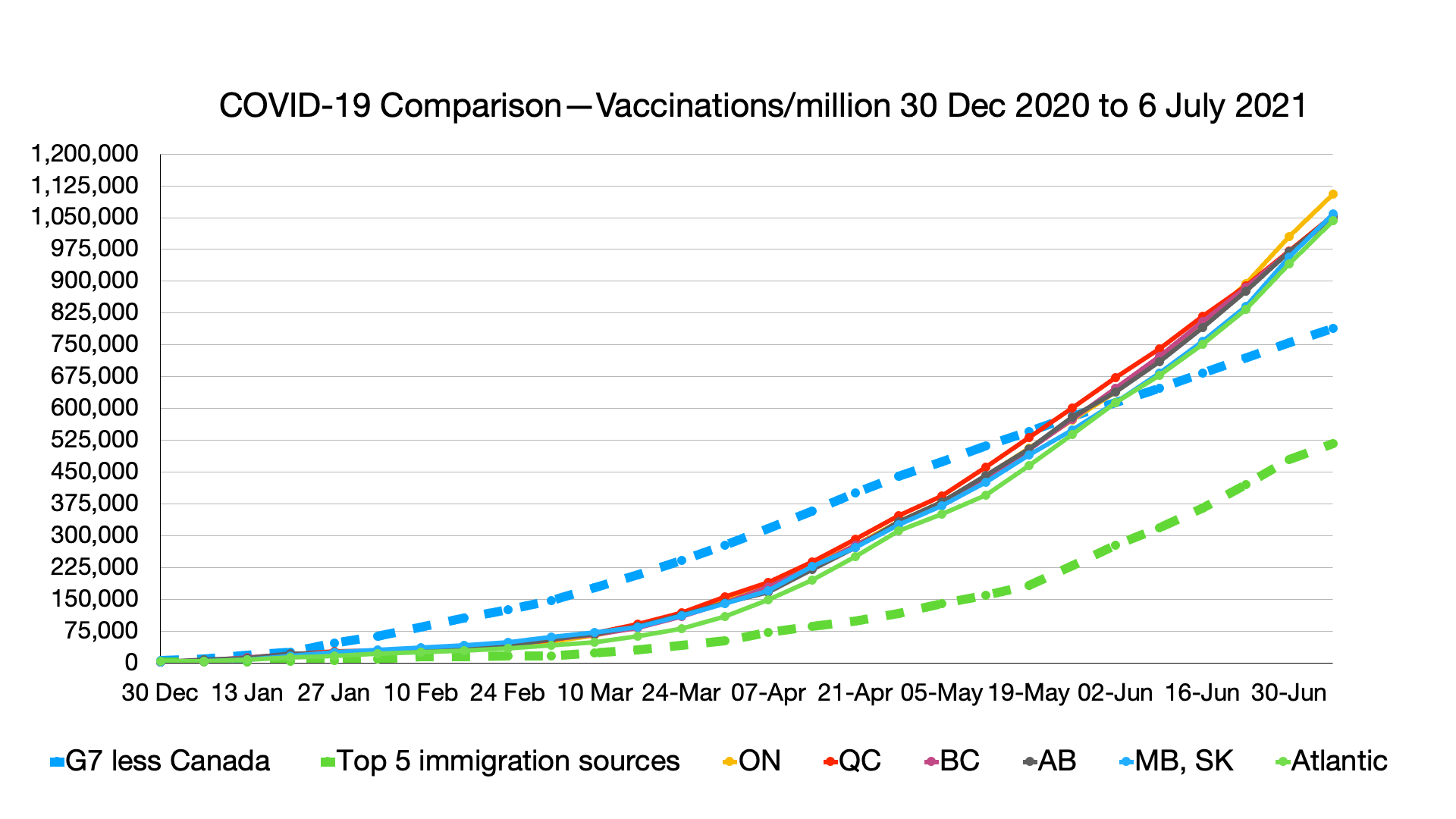
The latest charts, compiled 6 July as overall rates in Canada continue to decline along with increased vaccinations (still largely first dose, Canadians fully vaccinated 36.6 percent, comparable to or higher than most EU countries). Steep upward trend as per Globe chart below suggests gap between USA and UK fully-vaccinated will continue to narrow.

Vaccinations: All Canadian provinces ahead of USA, China now ahead of Germany and other EU countries.

Trendline charts

Infections: No significant change

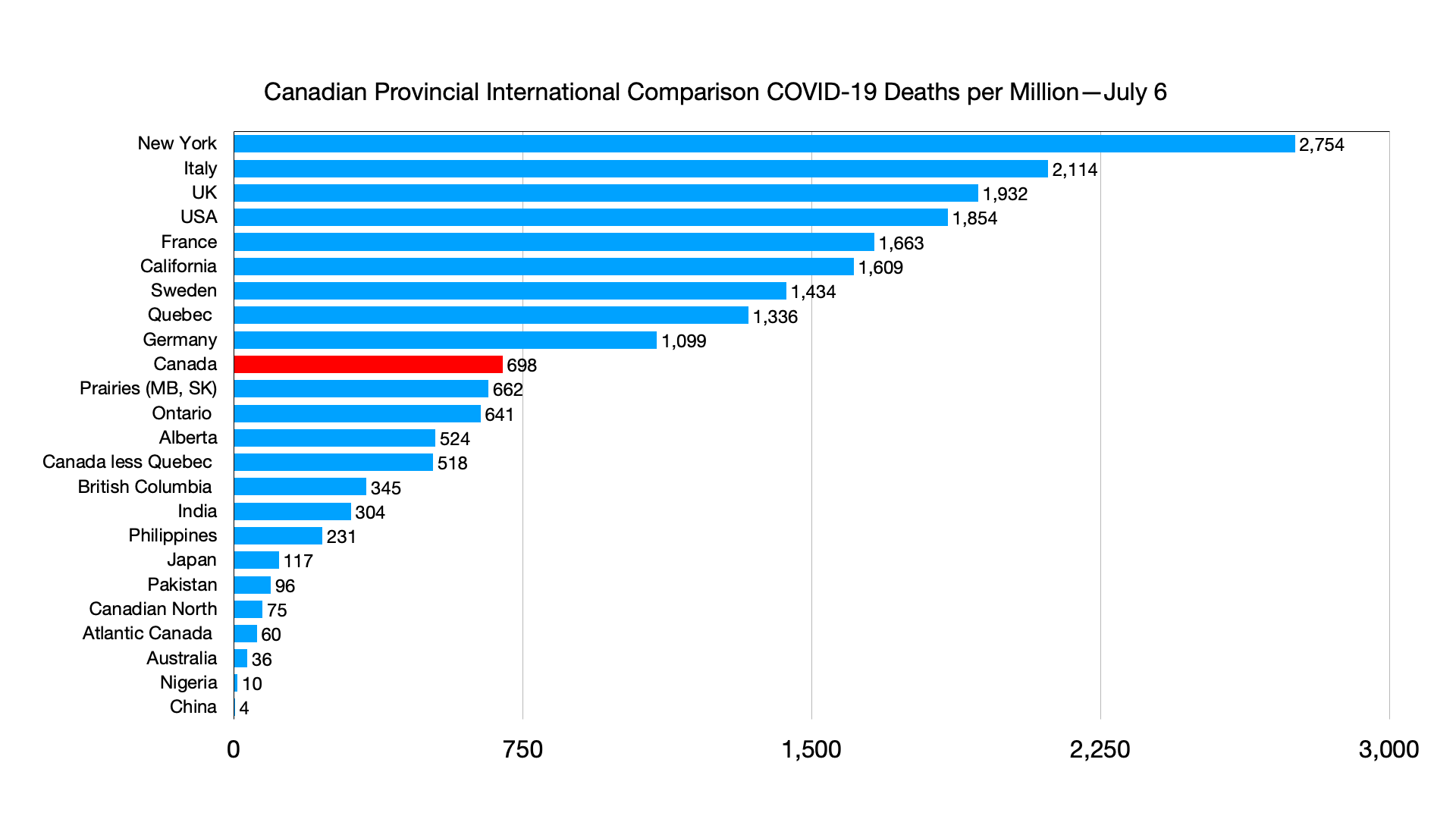
Deaths: No significant change.

Vaccinations: Captured above.

Weekly

Infections: No relative change.

Deaths per million: No significant change.

Interesting integration of various data sources to develop a normality index (Canada is 63.4, slightly below the number for all countries, ranking 35, just ahead of UK):

Since the onset of the coronavirus pandemic in early 2020 many have wondered when the world will return to “normal”. But whether things will ever go back to the way they were is unclear: remote working looks set to continue, for example, and going to the movies may never be as popular as it used to be. 

The Economist has devised a “normalcy index” to track how behaviour has changed, and continues to change, because of the pandemic. Our index comprises eight indicators, split into three domains. The first grouping is transport and travel: public transport in big cities; the amount of traffic congestion in those same cities; and the number of international and domestic flights. The second looks at recreation and entertainment: how much time is spent outside the home; cinema box-office revenues (a proxy measure for cinema attendance); and attendance at professional sports events. The third is retailing and work: footfall in shops; and occupancy of offices (measured by workplace footfall in big cities). 

Our index covers 50 of the world’s largest economies that together account for 90% of global GDP and 76% of the world’s population. Our aggregate measure is the population-weighted average of each country’s score. The pre-pandemic level of activity is set at 100 for ease of comparison. The tracker is updated with new data once a week. 

Overall activity

The global normalcy index plummeted in March 2020 as many countries imposed draconian restrictions on their citizens. It fell to just 35 in April 2020, before improving gradually over the following months. Today it stands at 66, suggesting that the world has travelled roughly half of the way back to pre-pandemic life. Some indicators, such as traffic congestion and time spent outside, have recovered faster than others, particularly sports attendance and flights. The global average masks a lot of variation across countries. Click on the drop-down box to explore how behaviour has changed in each one.

Source: