Why race and immigration are a gathering storm in Canadian politics: Glavin; Could all the parties just cool the rhetoric on racism and immigration? Cardozo

Two good columns on the politics and perils of immigration as an election battleground. Starting with Terry Glavin dissecting some of the recent polling data along with some good thoughtful commentary by Frank Graves of Ekos:

Going by quite a few headlines, commentaries and social media hot-takes making the rounds these days, you’d never know it, but Canadians are not working themselves up into a lather about immigrants or people of colour. We’re not suddenly becoming mean to refugees. There is no surge in bloody-minded racial bigotry arising among ordinary Canadians, and there’s no evidence for any dramatic spike in the numbers of Canadians who don’t like non-whites coming to this country.

That’s the good news.

Some politicians continue to blow their vulgar anti-immigrant dog-whistles, and some make partisan mischief by whatever means seem plausible enough to make their adversaries look bad. But when it comes to immigrants and refugees, Canadians in general tend to be a lot less excitable or inclined to racism than is convenient to certain strangely popular narratives at the moment.

It’s true that having once exerted themselves to out-compete the Opposition in their efforts to show mercy to Syrian refugees, Justin Trudeau’s Liberals are pulling off a complete U-turn on the alleged “asylum-shopping” of refugee claimants. They’ve tucked away a series of amendments to the Immigration and Refugee Protection Act in an omnibus budget implementation bill that would seriously impair the access of some refugees to a full and fair hearing of their claims. Ontario Premier Doug Ford has moved to eliminate funding for refugee and immigration aid law services.

At the fringes, hate crimes are up, and white-nationalist delirium is becoming fashionable among a creepy subset of far-right and friendless unemployable young men. It would be easy to misread the public mood. But the public mood is not taking any dramatic turns for the worse.

Nonetheless, something new and alarming is definitely happening in Canadian public opinion, says Frank Graves, president of EKOS Research Associates. EKOS has been annually tracking Canadian attitudes about immigration since the 1990s, and you don’t have to drill down very deep into the latest EKOS data to see it. It’s right there in the fine tuning of the findings the firm released last week.

The bad news is that for the first time since EKOS began its tracking in the 1990s, dyspepsia about the pace of immigration has coalesced with resentments about the rate of non-white newcomers to Canada. And that bloc of public opinion is consolidating for the first time behind a single political party—Andrew Scheer’s Conservatives.

This is happening whether Scheer’s Conservatives want it or not. Whether or not voters with unfavourable and in some cases decidedly unseemly views about Canada’s current immigration policies are being actively drawn to the Conservatives, or are simply being repelled by the annoying, not-racist-like-you histrionics of the Liberals, something unprecedented is happening.

The EKOS poll finds that roughly 40 per cent of Canadians harbour an unfavourable view of both the pace of immigration and the proportion of “visible minority” people among immigrants. Among the EKOS poll respondents who said there were too many non-whites among Canada’s newly-arrived immigrants, 69 per cent identified as Conservatives, while only 15 percent identified as Liberals. As NDP and Green voters, 27 percent and 28 percent, respectively, said the same.

The reason this is so dangerous is that the conflation of immigration policy with race is threatening to determine the way Canadians vote. It doesn’t matter which party benefits from this in the short run. It’s bad news all round. It’s the marker of what could be a descent into the same debilitating authoritarian-populist abyss into which the United States and much of Europe has fallen, Graves told me. “The inevitable result is a partisan polarization into two irreconcilable camps.”

It’s bad enough that the Scheer’s Conservatives have allowed these tendencies to become normalized among the party’s supporters, Graves said. What’s just as bad is a tendency among Liberals and the liberal-left generally to conflate genuine concerns people might have about refugees, or about how Canada’s demographics are changing, with the crudest xenophobia and the lowest types of racism.

“It doesn’t help. The moral critique, calling people out as Nazis or racists, and painting large portions of the population with this kind of inflammatory language, it’s really not helping. It makes things worse,” Graves said. That’s the way things went in the United States, and the result was the last thing either liberals or traditional conservatives wanted—the election of Donald Trump as president of the United States. “The Americans don’t have anything to teach us,” Graves said.

“We have largely been inoculated from the vicious debates that have torn the United States and a lot of Europe apart. That’s why I’m so troubled to see this informing voters’ choice in Canada.”

It’s perfectly reasonable to conclude, for instance, that Trudeau was dead wrong to insist that there was no “crisis” involved his government’s handling of the roughly 40,000 irregular refugee claimants who have walked across the border since early 2017. By last August, two-thirds of Canadians in an Angus Reid poll said “crisis” was a perfectly suitable description. More than half the respondents who said so were Liberals.

Team Trudeau found itself in a similar predicament two years ago during the fractious House of Commons debates surrounding M-103, the Liberals’ proposed resolution to establish a committee inquiry into the spectre of “more than one million Canadians who suffer because of Islamophobia, who are victimized on a daily basis.” Awkardly, a CBC-Environics poll and a CBC-Angus Reid Institute poll were in hand that painted quite a different picture. While 68 per cent of Canadians said minorities should work harder to “fit in” to Canadian culture, the same view was offered by 57 per cent of Muslim respondents. Only nine per cent of the Muslims surveyed identified discrimination as a factor that made them uncomfortable living in Canada—a third said the worst thing was all the snow. A follow-up Angus Reid poll found that 33 per cent of respondents who opposed the Islamophobia motion were Liberal supporters.

Neither is there anything louche in the proposition that Trudeau was just the tiniest bit hypocritical to dispatch Border Security Minister Bill Blair with instructions to attempt a renegotiation of the Safe Third Country Agreement with the United States in hopes of shutting down the border-crossing upsurge—after making ugly accusations about xenophobia and hysterics among the Conservatives who’d been urging him to do that very thing, all along.

Still, Trudeau is dead right to say, as he has been saying quite a lot at his round of town halls lately, that Canadians remain mostly “positively inclined” towards immigration and towards Canada’s immigration policies. More importantly, Trudeau has pointed out that Canadians must have confidence that they are in control of immigration, that immigration is managed. It’s the loss of control, a sense of a lost sovereignty, that has fuelled far-right populism from Brexit in the United Kingdom to the Make America Great Again hyperventilation in the United States.

The EKOS poll finding that roughly 40 per cent of Canadians think too many immigrants are allowed into the country every year isn’t even especially newsworthy. Last December, an Ipsos poll found nearly half of its respondents agreed, at least somewhat, that immigration is changing Canada in ways they didn’t like, and at least four in ten agreed “too many” immigrants were coming to Canada. In the EKOS poll trend lines over time, the proportion of Canadians who hold that view is not growing. It’s shrinking. More than 60 per cent of the annual EKOS poll respondents held to a “too many immigrants” view in the 1990s. The percentage wobbled on a downward trajectory to 2005, then wavered up towards 50 percent, and dropped down to 40 per cent again this year.

Canadians who say there are “too many visible minorities” among immigrants have always been fewer in number than the “too many immigrants” respondents, and the trajectory of that opinion bloc has similarly tracked downward over the years. But from a low of 30 per cent in 2005, the EKOS poll respondents who say there are “too many visible minorities” among immigrants has climbed back up to meet the “too many immigrants” response, at 39.9 per cent in the latest EKOS poll.

This is dangerous. Opposition to immigration is no longer driven by more easily remediable anxieties, ill-informed or not, that Canada’s high pace of immigration is bad for jobs, or housing costs, or community stability, or stresses on public services. About 300,000 people settle in Canada every year, and Ottawa wants to see the number rise to 350,000 by 2021. That’s a small number compared to Canada’s population of nearly 38 million. But roughly one in five Canadians is foreign-born—the highest proportion of any G7 country—and most immigrants since 2001 have not been “white.” They come mainly from Asia and the Middle East. About one in five Canadian citizens now falls into the Census Canada “visible minority” category.

Still, the EKOS poll does not tell anything like a straightforward story of white people with an attitude problem about non-white newcomers. Non-white Canadians appear even more likely than most Canadians to say there are too many non-white immigrants coming to Canada. While 39.9 percent of respondents overall said there were too many “visible minorities” among Canada’s newly arriving immigrants, the percentage of “visible minority” respondents who agreed with the statement in the EKOS poll was 42.8 per cent.

Xenophobia, racism and divisive rhetoric about immigration is something that Canada’s political leaders should take extremely seriously. But the Liberal government has occasionally and quite casually attributed those lurid motives to Conservative and popular alarms over the rapid rise since 2017 in the number of “irregular” border-crossing by asylum claimants. About half the claimants have been from Nigeria and Haiti, and the overall number of border-crossers is now declining. Racists shouted as loudly as they ever do about this, but as for widespread public concerns that the border-crossers were not genuine refugees, that wasn’t necessarily a judgment rooted in racism or xenophobia. It turns out that less than half the border-crossers’ claims that have been finalized so far have been accepted; about 40 per cent were rejected and the balance were abandoned or withdrawn.

As is necessary in any deep dive into an opinion poll’s findings, it’s worthwhile to look closely at its margins of error. The EKOS poll random sample of 1,045 Canadians comes with an error margin of plus or minus three per cent, 19 times out of 20. And when you get down into the weeds of respondent subcategories—Conservative voters, Liberal voters, visible-minority respondents and so on—the margin of error can increase quite dramatically.

But when you weigh the data statistically across the board to reflect the composition of Canada’s population, as EKOS does, you get a pretty clear picture of what people think. And because “visible minority” is becoming an increasingly obtuse category as Canada’s population grows more ethnically and racially diverse, EKOS conducted some experimental testing, and it showed that the term “non-white” produces the same results.

But getting back to some good news that similarly upsets the usual “narrative” apple carts, last month another opinion poll, this one a global survey by the Pew Research Center in Washington, D.C., found that ordinary Canadians have the most favourable view of immigrants among the world’s 18 highest immigrant-taking countries. Canadian respondents were more likely than anyone else to say immigration is a public good. Canadians were the least likely to identify immigration as a burden, or a source of crime, or a risk of terrorism.

Importantly, Canada turns out to be less polarized on the issue of immigration than any of the other countries surveyed, too, the Pew Center concluded. Canada’s conservatives are more upbeat about immigration than “left-wing” opinion in several of the other countries surveyed. Only 27 per cent of Canadian respondents said immigrants were a liability or that immigrants took away jobs, and on the bright side, 68 per cent of Canadian respondents said immigrants make Canada stronger.

Meanwhile, the federal government’s own annual tracking survey, carried out last August and September, produced results fairly similar to the EKOS poll. The federal survey benefited from a much larger sample size—2,800 respondents, with an error margin of plus or minus 1.9 per cent, 19 times out of 20. And it adds a couple of insights consistent with the EKOS findings.

Canadians who say immigration rates are too high do not appear to hold that disfavourable view solely on account of some mistaken belief that immigration rates are higher than they actually are. When told that the actual number of immigrants coming to Canada every year was 300,000, the proportion of respondents who said there were “too many” immigrants jumped from 28 per cent to 37 per cent—a figure close to the 39.9 per cent in the EKOS findings.

While the EKOS poll found that visible-minority Canadians are oddly more likely than Canadians in general to say there are “too many” visible-minority immigrants coming to Canada, the federal tracking survey found a similar irony. Forty-one percent of third-generation Canadians said that 300,000 immigrants a year was too many, but 15 per cent of recently-arrived Canadians, even—immigrants who have lived in Canada for less than five years—said they felt the same way. But overall, roughly half of the federal tracking survey respondents said Canada’s immigration levels were just about right.

Andrew Griffith, former director general of the Citizenship and Immigration Canada’s Citizenship and Multiculturalism Branch, and the author of Multiculturalism in Canada: Evidence and Anecdote, says that for all the uproars and controversies, Canada is still doing well as an experiment in multiculturalism.

The country maintains a generous immigration policy and a reasonably generous refugee policy, and that should not be expected to change without an enormous upheaval. Canadian public opinion on these matters is a fairly steady-state phenomenon. About a third are enthusiasts, about a third are sufficiently content, and a final third have serious reservations.

But that last third is not a homogeneous constituency of irredeemable bigots. If you want the surprisingly successful Canadian experiment to continue, you can’t corral that constituency into the same roped-off quarantine area where actually-existing racists and alarmists properly belong. They’ll all just stew in their own juices.

“People are far too quick to whip out the racism card when it serves their interests,” Griffth said. “But you can’t write off a third of the population. Those people are the people you have to engage with.”

Source: Why race and immigration are a gathering storm in Canadian politics

Andrew Cardozo, of the Pearson Centre, offers some good advice to both sides:

White supremacists. Islamophobia. Systemic racism. Racialized people. Irregular entrants.

These are hot words on Parliament Hill these days. These are all terms that identify problems facing Canadian social cohesion and are often discussed without a common understanding.

Discussion around race and racism are delicate at the best of times, but when they get hotter and more serious it gets harder to have a discussion. Add politics and it’s just not a good mix.

It is fair to say that today the activists who work to combat racism are getting further and further from those who have concerns about the changing nature of our society and the changing power balances.

Critical race theory is an area that has been attracting increased analysis and debate. To put it very generally it is the academic field of research that examines racism. This field has developed exponentially in the last few decades, and with each passing phase of advancement, there is a new terminology; where the old terminology can be seen as both inaccurate and often offensive. An example is the change in terminology to describe African Americans or First Nations peoples.

And as this has grown, so has the resistance to it.

Research on racism in recent years has found that four groups are particularly affected by hardcore racists—a phenomenon that is both uniquely Canadian, in some ways, and universal in others.

The four groups are Indigenous peoples, African-Canadians, Jews, and Muslims. Many others face discrimination to varying degrees too.

Indigenous peoples are coming into a new reality and self-awareness. The First Peoples of this land are finally being recognized for their rights in a manner that has always been enshrined in the Canadian Constitution but was never taught in school or practised by governments. So today when pipelines are delayed or halted, there is a new conflict of values which was just ignored in the past.

But the racism they have faced covers everything from state-imposed colonialism, on-reserve housing, and residential schools, to troubled police relations, and child welfare systems that are hugely inappropriate. They also face simple old-fashioned racism from some members of the public, going from ill-informed stereotypes to name calling and occasional violence.

All this while the Indigenous population is the fastest growing group in Canada with more than 50 per cent of the population under 25 years old, and a growing sense of confidence and assertion of their rightful and constitutional place in Canada.

The movement of peoples in the world has been growing significantly in recent decades, and a large part of this is non-white people moving to predominantly white countries (although there are significant movements among non-white people too, think of the Syrian and the Rohingya refugees and their neighbouring countries).

The black community is both very old, dating back to the Loyalists on the East Coast to new arrivals from the Caribbean and Africa. The racism faced here is both of the everyday name-calling variety, to job discrimination and troubled relations with police that has an uncanny resemblance to that faced by African Americans south of the border.

Their contributions are significant in many sectors including medicine and nursing, education, small business and labour, and increasingly in politics. For example, Rawlson King was the most recent addition to Ottawa City Council through a byelection (making him the city’s first-ever black councillor), adding to the more than 50 African Canadians who have served at all levels of government.

Anti-semitism goes back to the time of Jesus Christ if not before, and while there is little questioning of the contribution of Jews to our society, this racism is of a variety that either has its strength in neo-Nazi movements, which are growing and becoming more strident and open, or to politics of the Middle East, where opposition to Israel can get conflated with anti-Jewish sentiment and certainly anti-Jewish movements. Anti-Semitic violence at synagogues for example is prevalent and threatening.

Muslim immigration to Canada has increased significantly and they are among the fastest growing religious groups in Canada. This is happening in a geopolitical context where there are significant terrorist movements who proclaim their work to be in the name of Islam. While Canadian Muslims have little or nothing to do with those groups and condemn the violence, it is a dark cloud that bhangs over their heads. The coincidental growing traditionalism, most evident in head coverings of some Muslim women, is a movement which is separate, but not unrelated, as some feel increasingly isolated and/or need to assert their cultural particularities. Some Canadians feel threatened or uncomfortable with this as there is opposition to traditional or religious garments of Jews, Sikhs, and Indigenous peoples. The contribution of Muslims in Canada tells an interesting story, as their numbers grow in major professions including medicine, law, politics, business, academia, entertainment, and even the NHL.

So we have a third Quebec government trying to bring in a law that limits religious symbols, a project that can never be trouble free.

A new Ekos poll which finds that 42 per cent of Canadians feel there are too many non-white immigrants to Canada is noteworthy, and more significant is that that number is at 71 per cent among Conservative voters, 34 per cent among Greens, 28 per cent among New Democrats and 19 per cent among Liberals. The high numbers on resistance to non-white immigration is worrisome, but also explains why Conservative Leader Andrew Scheer and Liberal Prime Minister Justin Trudeau pursue their particular lines of argument these days.

It would be terribly facile and unhelpful for Conservative opponents to brand them all negatively. Even 19 per cent is high, as is the 42 per cent average for Canadians.

On the one hand, the Conservatives should consider toning down their messaging—it usually doesn’t work well for any one, not even electorally. And for any progressive purists—don’t allow a “basket of deplorables” moment in Canada. It didn’t work out well for Hillary Clinton and it won’t work out well for Liberals here either.

Rather than finger-pointing and name-calling, it would be better for the country, as a whole, to calm the rhetoric on all sides.

And to the anti-racism activists, it is important to make the movement more accessible rather than less. Terminology needs to be easier to use and less exclusive. Every community, whether they be environmentalists, stock brokers or doctors, have a constantly evolving set of terms and acronyms that have the effect of excluding others. Now is not the time to insist the exact right and latest jargon, but rather to tone down the rhetoric.

All sides have a choice: politicize and drive wedges or lower the temperature and bring people together. Weaponize the debate or bring more people on to the side of combating division, supremacy, and phobias. It’s that simple.

Terry Glavin: There are more crucial issues than the colour of Vancouver’s council

I agree more with Tolley (see Lack of council diversity puts municipalities at risk) than Glavin here (perhaps not surprisingly). The thought experiment I often use is how would I feel if I could not see myself reflected in political leadership and institutions? Would I be comfortable or not? Could I completely divorce feelings about my identity from the more intellectual choices in public policy? And could the abysmally low turn-out be tied to lack of representation or not?

And the other question to ask, where Terry has a point, would more diverse municipal councils address more or less effectively the issues facing the municipalities? In general, more diverse voices ensure better consideration of different perspectives, but not automatically so:

You might think it would be bad enough to show up again this year near the top of Demographia’s listings of cities with the least affordable housing markets in the world, and a rental vacancy rate of less than one per cent, and to have been reduced to ground zero of Canada’s fentanyl crisis, with a worldwide reputation as the epicentre of a global money-laundering system run by organized crime networks in China.

You might also think it is a bit disturbing that Vancouverites are apparently so dispirited by all this, and perhaps even convinced beyond doubt that there is nothing that can be done about any of it, that voter turnout in Vancouver’s recent civic election was about 40 per cent.

On the bright side, it’s a good thing that mayor Gregor “Happy Planet” Robertson and his Vision Vancouver team, after having presided over Vancouver’s transformation from Lotusland’s Metropolis to a seedy gangland paradise of drug-money laundering and shady real estate swindles, is now in history’s dustbin. On the downside, Robertson’s successor, Kennedy Stewart, won the race for the mayor’s office backed by only about 12 per cent of the city’s eligible voters.

Vancouver mayor-elect Kennedy Stewart celebrates with his wife, Dr. Jeanette Ashe, after addressing supporters in Vancouver on Oct. 21, 2018.

Whatever might be said about all that, the post-election thing to get worked up about, judging by reports in the Toronto Star, the local CBC news, various city webzines and the Twitter hashtag #councilsowhite, is the noticeably pale complexion of the new city council members, save one. Pete Fry. His Trinidad-born mother is the Vancouver Liberal fixture Hedy Fry, the long-serving MP for Vancouver-Centre.

To be fair, the statistical dearth of successful non-white candidates is something worth noticing, and even worrying about. Perhaps not so fervently as Globe and Mail Vancouver reporter Sunny Dhillon did, mind you. Owing to his bureau chief’s decision that the historic surfeit of women on Vancouver’s new city council was perhaps more newsworthy than the colour factor, Dhillon quit this week, quite publicly. Eight of the Vancouver’s 10 council members, as of the Oct. 20 elections, are women. This is, after all, quite a big deal.

The whiteness of recently elected municipal councils is being noticed right across Canada at the moment, though, and so it was helpful that the Institute for Research on Public Policy published a brief paper in its Policy Options journal this week, under the headline: “Elections in some of Canada’s most diverse cities still produced extremely homogenous councils. This threatens the legitimacy of their decisions.”

But just hold on a minute. If voters engage in a civic election, and the ethnic or racial diversity of the winners, in the aggregate, does not end up replicating the ethnic or racial diversity of the people who voted them into office, isn’t it a bit of a stretch to say the result “threatens the legitimacy of their decisions”?

Not a stretch at all, according to the article’s author, Erin Tolley. An assistant professor at the University of Toronto and “co-investigator” with the Canadian Municipal Election Study, a project of the Social Sciences and Humanities Research Council of Canada, Tolley writes: “All else being equal, we know that voters gravitate toward candidates with whom they share an ethnic or racial background.”

Maybe so. But “all things being equal” is a rather basket-sized caveat, and in any case, the examples she cites — recent elections in Vancouver, Mississauga, Ont., and Toronto — could be held up as evidence against her claim just as easily as Tolley cites them as evidence in favour of it. Voters in Vancouver, Mississauga and Toronto do not appear to have followed the pattern of ethnic gravitational pull at all.

British Columbia NDP MLA Leonard Krog is recorded as a reporter interviews him while awaiting the municipal election results for Nanaimo, B.C., on Oct. 20, 2018. Krog was elected mayor.

In Mississauga, 57 per cent of the voters identify as members of a “visible minority” but only one “racialized” councillor got elected. In a city where slightly more than half the people identify as members of “visible minority” groups, Toronto’s 25-member city council can boast only four people of colour. Statistics Canada’s recent data shows the same sort of ratio for Vancouver — slightly more than half of Vancouverites identify as members of “visible minority” groups.

So what’s with all the white people on city councils?

It’s a question worth asking, and although the answers are likely to differ from city to city, Tolley’s remedial prescription, an interim measure consisting of diversity and inclusion advisory committees to provide councils with advice about ethno-cultural relations and diversity, is perfectly reasonable, so far as it goes. An approach like that might also give “racialized” participants some public exposure, access to networks and degrees of civic exposure “that might serve them well if they choose to enter electoral politics,” Tolley writes.

But isn’t this just a bureaucratic solution in search of a problem? Does the ubiquity of white people in civic politics really mean “many voices are excluded from the decision-making process,” and that this state of affairs “puts municipalities at risk”?

In Vancouver, Kennedy Stewart, backed by Metro Vancouver’s labour unions, won the race for the mayor’s office only by squeaking past the Non-Partisan Association’s Ken Sim, who happens to be Chinese-Canadian. The result was 49,812 votes to Sim’s 48,828. Sim can hardly complain that he wasn’t taken seriously, so I asked three unsuccessful Vancouver civic candidates, people of colour, all with the outside-chance upstart ProVancouver slate, what they thought about all the fuss about whiteness.

Women cross the street at the intersection of East Pender Street and Gore Avenue in Vancouver on Dec. 5, 2016.

ProVancouver council candidate Rohana Rezel, born in Sri Lanka, had to put up with some nasty and widely publicized online racist harassment. “People from all ethnic communities came and rallied around me every time somebody tried to attack me. There was nothing that made me less privileged than other candidates, based on my ethnic background,” he said. “I just don’t buy the argument that white people just vote for white candidates.”

Rezel’s running mate, Raza Mirza, a Punjabi Muslim, said: “I just don’t understand this obsession with the idea that overall, council must look like the overall general population.” ProVancouver mayoral candidate David Chen, whose background is Taiwanese: “You have to be careful with that, or you’re going to risk forcing bad people into the system.”

All three said there are far bigger “process” issues that require attention. Like the abysmally low voter turnout. And Vancouver’s antiquated at-large voting system.

Source: Terry Glavin: There are more crucial issues than the colour of Vancouver’s council

Andy Yan, the analyst who exposed Vancouver’s real estate disaster: Terry Glavin

Nowadays he’s the director of the City Program at Simon Fraser University, and while he’s too modest to boast about it, along the way he’s picked up a couple of exceedingly rare civic distinctions.

The first is the enduring enmity of all the politicians, real estate speculators, white-collar currency pirates and money launderers who have turned Vancouver into a global swindler’s paradise for real estate racketeering, a city that is now also one of the world’s most hopelessly pathetic urban landscapes of housing affordability. The second thing Yan has earned is an unfettered and unimpeachable right to say “I told you so.”

Three years ago, Yan was anxious to get a handle on the role foreign capital was playing in Vancouver’s weirdly convulsing real estate market. At the time, Yan’s main gig was his work as an urban planner with Bing Thom Architects, on contract as an urban planner. When Yan published the results of his research in November, 2015, it came as a shock, for two main reasons. It seemed to conclusively prove what everybody knew but nobody was supposed to say out loud. And it broke a taboo that was enforced so absurdly that Vancouver mayor Gregor Robertson resorted to dismissing Yan’s research as racist.

Yan found that buyers with “non-Anglicised Chinese names” had picked up two-thirds of 172 houses sold over a six-month period beginning in September 2014 in Vancouver’s posh west side neighbourhoods. Contrary to public perception, however, the buyers weren’t just showing up with “bags of cash” to make their buys. Some of Canada’s biggest banks were in on it. Roughly 80 per cent of the deals involved a mortgage, and half of the mortgages were held by two banks – CIBC and HSBC.

Canada’s banks have mastered the manipulation of clandestine back channels around China’s currency control regulations—the same routes that well-connected Chinese multi-millionaires have been using to shift up to a trillion dollars’ worth of yuan out of China every year. What wasn’t clear about what was happening on Vancouver’ s west side, however, was who the real buyers were, exactly. The new homeowners’ most commonly stated occupation: housewife or homemaker.

Fast forward three years. The weirdness that Yan documented in Point Grey, Dunbar, Kerrisdale and Shaughnessy has rapidly spread southward and eastward, decoupling the bonds linking incomes with housing values across Burnaby, Richmond, Coquitlam, all the way out to Surrey and White Rock on the Canada-U.S. border. Metro Vancouver’s real estate market is now a dystopian tableau of panic buying, tax fraud, property flipping, overseas pre-construction condominium sales, stone cold speculation and elaborate, multiple-account money transfer rigmaroles that are the conduit of choice for drug cartel tycoons. Not even the heaviest regulatory hands at the controls of the Chinese Communist Party’s surveillance state seem capable of shutting the networks down.

It’s not just about shady Chinese money—not by a long shot. Vancouver’s old establishment property developers and real-estate companies fed the frenzies and made a killing. Along the way, they greased the skids by pouring buckets of money into Gregor Robertson’s now-dying Vision Vancouver civic party and Christy Clark’s Liberal Party. Robertson is now a sad figure, his legacy a shambles, his term up in October, and even his celebrated relationship with his glamorous girlfriend, the Chinese pop star Wanting Qu, fell apart last year. Qu’s mother, a Communist Party official in Harbin, remains on trial on charges of embezzling $70 million in a land swindle. Christy Clark is history, too. Her government was toppled last year by John Horgan’s New Democrats. With at least 60,000 Chinese immigrant investors sloshing their money around Metro Vancouver real estate over the past few years, federal politicians, too—Liberals, mainly—have been more than happy to rake it in at cash-for-access soirees and in generous donations to election campaign war chests.

In these ways, in Vancouver’s political circles, and in polite company, one simply didn’t mention the way the city’s housing market was being restructured to serve as an offshore investment bolthole for billions of dollars’ worth of shadow currency being spirited out of China, Iran, Russia and other such kleptocracies. But back in 2015, when the profoundly caucasian Mayor Robertson attempted to dismiss Yan’s findings—“I’m very concerned with the racist tones that are implied here,” Robertson said—it was a smear too far.

Yan’s great-grandfather was allowed into Canada only after being obliged to pay the infamously racist head tax Ottawa put in effect to keep out working-class Chinese immigrants. Students, merchants and diplomats were exempt. The head tax was in place until 1923. Yan wasn’t going to put up with Robertson’s backchat, and by that time, Vancouver’s ethnic Chinese community leaders had similarly lost their patience. White real estate moguls and politicians like Robertson persisted in proclaiming their anti-racist bona fides and purporting to be the champions of Vancouver’s Chinese community by shutting down public debates about the region’s housing catastrophe. Brandon Yan, a civic activist and volunteer on Vancouver’s planning commission, put it best: “Let’s leave it to the rich white dudes to decide what’s racist, right?”

Vancouver’s “condo king” Bob Rennie—a primary financial backer of Robertson’s NDP-tilting Vision Vancouver team and also the chief fundraiser for the NDP’s adversaries in Christy Clark’s Liberals—had cultivated a particularly brazen habit of it. “So you had these whispers about racism being used to shut down a dialogue about affordability and the kind of city we want to build here,” Andy Yan explained. “It’s a kind of moral signalling to camouflage immoral actions. It’s opportunism, and it’s a cover for the tremendous injustices that are emerging in the City of Vancouver and across the region. It’s a weird Vancouver thing. It’s very annoying. It’s kale in the smoothies or something.”

While the politicians and their friends in the property industry were making speeches about diversity and the importance of having sensitive feelings, foreign ownership grew to account for more than $45 billion dollars’ worth of Metro Vancouver residential property. Within Vancouver city limits, 7.6 per cent of all residential properties are now owned directly by individuals “whose principal residence is outside of Canada,” by the definition of the Canada Mortgage and Housing Corporation. Roughly one in ten Vancouver condos are owned by non-residents. And that’s just the owners we know about.

Transparency International reckons that perhaps half of Vancouver’s most expensive properties are owned by shell companies or trusts, with the nominal owners commonly listed as student, housewife, or homemaker. Roughly 99 per cent of the single detached houses within Vancouver’s city limits are now valued in excess of $1 million. More than 20,000 Vancouver homes are vacant, year round. Vancouver’s rental vacancy rate is hovering just below one per cent.

“I’m always careful about using biomedical analogies,” Yan told me the other day, “but what was like a little skin ailment, if you will, over the last 10 or 15 years, has become a full fledged cancer.” Over just the past four years, throughout Metro Vancouver, homes worth $1 million or more have risen from 23 per cent of the housing market in 2014 to 73 per cent of the market now. Yan has been putting together a series of maps that show how the $1 million “red line” has been moving inexorably across the region, deep into the suburbs. “But what those maps don’t do is they don’t factor in transportation costs,” Yan said. “The top two expenditures of any Canadian household is shelter and transportation. God help you if you factor in child care. The whole map might as well be red. A number of factors have all come together to produce this catastrophic situation, but what was a small concentrated pattern in the west side of Vancouver has now metastasized to hit every single part of the region, and it’s similarly metastasized into the rest of the economy.”

As for where things are headed, Horgan’s NDP government has raised expectations, mainly because of Attorney-General David Eby’s avowed determination to chase dirty money out of Vancouver’s housing market and bust up the gangland playground B.C.’s provincially-licenced casinos have become—money laundered through casinos has also been pouring into residential property acquisitions. In Tuesday’s throne speech,  delivered by Lt.-Gov. Judith Guichon, Horgan’s government directly addressed tax fraud, tax evasion and money laundering in the real estate market, hinting that a speculation tax is in the works. Next week, the New Democrats release their first full budget. The housing file, however, falls mainly to the more timid Carole James, former NDP leader and now deputy premier and finance minister. Preliminary indications aren’t particularly promising.

With short-term AirBnB rentals swallowing up long-term rental inventory, Yan was less than impressed with James’ solution, announced last week: short-term rental outfits will now pay the eight per cent provincial sales tax, and two or three per cent in municipal taxes. “That’s like taxing cigarettes to pay for lung cancer treatments,” Yan said.

Developing appropriately punitive taxes to discourage property-flipping and offshore pre-construction sales – those are obvious fixes. But knowing how to fix things requires a clear understanding of what’s wrong, Yan says, and closing the “bare trust loophole” that allows property owners to hide their holdings is a must-do. Ontario closed the loophole back in the 1980s. Clark’s Liberals promised to close it, but they never did.

In the meantime, Yan is focusing on converting hidden-away data into publicly comprehensible information. Some key information Yan has drawn from a trove recently released by Statistics Canada’s Canadian Housing Statistics Program, for instance, shows that simply building more condominiums won’t do. A condo building boom in Metro Vancouver has kept the property developers happy, but there’s no evidence that the boost in supply has lessened demand or beaten back prices. Nearly one in five condos built in Vancouver since 2016 were snapped up by non-residents.

To a certain extent, there’s nothing new here,” Yan said, pointing to the Guinness family’s financing of the Lion’s Gate Bridge in the 1920s, and the opening up of the British Properties on Burrard Inlet’s north shore. “But what is new is the hyper-commodification of residential real estate, mixed in with an intensification of global flows of people and capital. It’s just a statement in fact. We’re talking about the globalization of the Chinese economy and its impacts.”

Yan says there may be some solution—a mix of remedies, new laws, purpose-built rental housing, tax adjustments and so on—that does not mean a collapse in Metro Vancouver’s real estate prices. Channelling foreign investment in such a way as to serve the public interest might be possible. “But whether this comes out as a bubble-popping isn’t the point. That’s a secondary concern to the kind of society we want to build. “We need to go back to civic virtues.

“We need to talk about the sacrifices we are willing and we need to make for the greater good of the community. We need to have a discussion about what the public good is, and what we are willing to sacrifice to make it happen.”

Source: Andy Yan, the analyst who exposed Vancouver’s real estate disaster

Are white Canadians becoming conscious of their whiteness? – Terry Glavin

Good long read by Glavin.

While the survey results are interesting, how the questions are posed changes the response. Statistics Canada has grappled over the years with how to formulate its ethnic origin question, with the current version being: “What were the ethnic or cultural origins of this person’s ancestors?” with the following examples and clarification provided:

An ancestor is usually more distant than a grandparent [ordered by frequency of last Census/NHS].

For example, Canadian, English, Chinese, French, East Indian, Italian, German, Scottish, Cree, Mi’kmaq, Salish, Métis, Inuit, Filipino, Irish, Dutch, Ukrainian, Polish, Portuguese, Vietnamese, Korean, Jamaican, Greek, Iranian, Lebanese, Mexican, Somali, Colombian, etc.

The “race” question is the visible minority one, where Glavin is correct that non-visible minorities are by definition white (and very useful in comparing outcomes by minority groups and the “white” majority (which of course are composed of a variety of European ancestries). So in practice, the Census allows people to identify themselves within the majority European origins (the earlier waves of immigrants) and visible minority origins (the last 40 years or so).

Both ethnic ancestry and visible minority can be used to indicate variation in economic and social outcomes (e.g., those of South European ethnic origin have poorer economic outcomes than North European origins).

But his fundamental questions regarding a strengthening “white” identity and its implications are worthy as is his point that debating over terminology (e.g., visible minority, people of colour, radicalized communities) will not address underlying inequality issues (and may, IMO, divert attention to these more substantive issues):

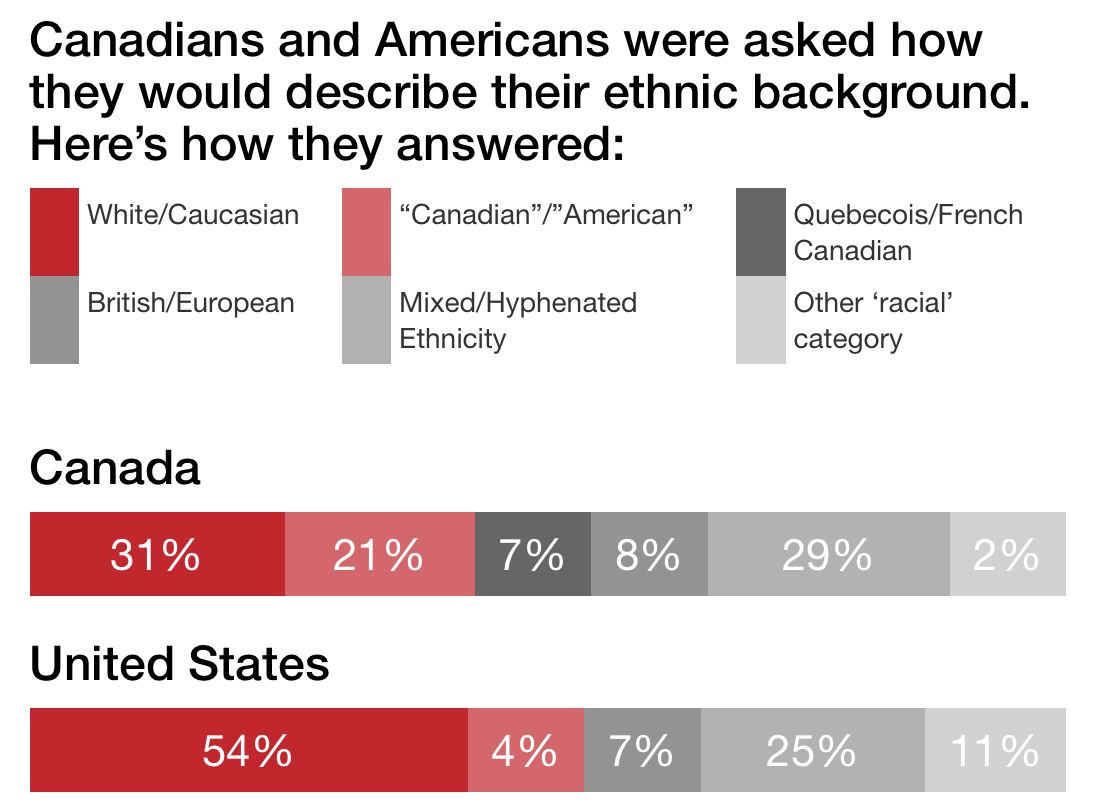
In a McAllister Opinion Research survey of Americans and Canadians carried out this month, Americans are twice as willing—41 per cent of them—to identify “white” as their ethnicity. If you include the response “Caucasian,” a peculiar 18th Century term that also means “white,” the proportion of Americans who identify their ethnicity by these terms rises to 54 per cent (the U.S. Census Bureau estimates that “Non Hispanic whites” made up 64 per cent of the American population in 2010).

In the McAllister survey, only 20 per cent of Canadians identified “white” as their ethnicity, and if you add in “Caucasian,” only 30 per cent of us identify in that way. Contrast that with Statistics Canada’s 2011 National Household Survey, which identifies 80 per cent of us as white people (more precisely, StatsCan identified 26,587,570 of Canada’s 32,852,325 non-Indigenous people as “Not a Visible Minority”).

So where did all the white people go?

“It is weird,” Angus McAllister, the survey firm’s director, told me. “What it shows for sure is that Americans are way more obsessed with race than Canadians are.”

The McAllister survey was undertaken from August 13 to August 20—the immediate aftermath of the white-supremacist outrage in Charlottesville, Virginia. The ugly spectacle of marching Nazis and hooded Ku Klux Klansmen sent a great many Americans into paroxysms of alarm. Their despair was compounded by the gleeful allegiance the worst of Charlottesville’s racists pledged to President Trump, and by Trump giving every impression of being content with it. Canadians responded in unanimous revulsion.

McAllister polled a sample of 1,025 Canadians, leaving an error margin of plus or minus 3.1 per cent, 19 times out of 20. The American sample of 835 Americans falls within an error margin of plus of minus 3.5 per cent, 19 times out of 20.

A couple of other points: McAllister, 56, is a good friend. He’s also Japanese, or “mixed,” or whatever the circumstances demand of him, as he puts it. He’s no stranger to the nuances and ambiguities that tend to get papered over in fashionable uproars about race and identity.

What worries McAllister is something in the survey results’ granular details that is only hinted at in copycat Canadian iterations of far-right American pseudo-journalism, and in the mimicry at work in transgressive Canadian school-renaming and statue-toppling shouting matches. Over time, we’re becoming more like Americans. Or at least some of us are.

Older, well-educated Canadian respondents in McAllister’s survey were the least likely to claim “white” as an ethnic identity. Among Canadians older than 65 with only a university education, only eight per cent identified as white. Among Canadians in that same age bracket with only a high school education, 28 per cent identified as white.

Among Canadians under the age of 45 with a university education, 19 per cent identified as white—the national average. Among Canadians in that age group with only a high school education, 38 per cent claimed a white ethnicity —a proportion that tracks closest to the overall American average.

It’s not as though there’s a large bloc of Canadians who are becoming racists, McAllister cautions. The pull of the American cultural orbit and the mania for “identity politics” have a lot to do with it. An overweening preoccupation with race and ethnicity as identity markers can only exacerbate an unhealthy trend that over time will inevitably expand the number of Canadians who identify as “white.”

Before we were Canadians, the colonial settlers of British North America were British and French. “White” only rarely came into the conversation, and the emancipation of “multiculturalism” allowed the rest of us to find a way to identify with the Canadian mainstream.

We all became used to identifying ourselves as “hyphenated” Canadians, or just Canadians. But unlike people lumped into the Visible Minority category, European immigrants lose their hyphenated old-country identities more easily as each generation supplants its predecessor. Eventually, people who fall within Statistics Canada’s cumbersome Not a Visible Minority category are gradually left with only “white” as an ethnic identity.

In the United States, where “whiteness” makes most sense in the context of slavery, the generational pattern appears to have stalled. To be “white” in America – a political category that began mainly with Englishmen and gradually enveloped other groups, like the Irish, the Italians and the Jews – is to be “not Black.” It is to perpetually hover above the status of the slave, sometimes to the point of perpetuating black slavery by other means.

Among McAllister’s American survey respondents under the age of 45, roughly 45 per cent identified themselves as white. Among Americans 45 years old or older, 60 per cent identified as white.

North of the border, Statistics Canada’s awkward Not a Visible Minority Category works well enough as a signifier for people with comparatively pale complexions, but practically nothing else. It unhelpfully tends to associate “white” privileges and advantages with people whose only commonality is low skin pigmentation.

In small-town Canada, for instance, second and third-generation “white” boys tend to education and income levels far below the prospects for urban, first-generation immigrants in the Visible Minority category. Those rural white boys will all tend to enter the Canadian group in McAllister’s survey who are most likely to identify their ethnicity as “white.”

Even more absurdly, the Not a Visible Minority category is the just the flipside of a classification the United Nations’ Committee on the Elimination of Racial Discrimination considers to be quite possibly racist. Intended to protect and advance disadvantaged ethnic and racial minorities along with women, Indigenous people and disabled people, it isn’t working out that way.

For one thing, the term Visible Minority “seemed to somehow indicate that ‘whiteness’ was the standard, all others differing from that being visible,” as the UN Committee’s Patrick Thornbury puts it. For another, the category’s sweeping imprecision is liable to erect more systemic barriers against genuinely marginalized minority groups.

Canadians who have been getting shoehorned into Visible Minority status since the 1980s are by no means uniformly disadvantaged. They never were. East Asians tend towards income and education levels that exceed the Canadian average, for instance, while African-Canadian men face severe disadvantages and marginalization across the board.

The UN’s Committee on the Elimination of Racial Discrimination first pointed out these contradictions in an assessment of Canada’s Employment Equity Act a decade ago. In the attempt to bring Canada in line with the UN Committee’s criticisms, Stephen Harper’s Conservative government worked itself into a tizzy of professor-quizzing, workshop-convening and province-consulting, but ended up deciding to leave things as they were. It’s only now that Ottawa is revisiting the matter.

Statistics Canada is taking a lead role in the effort, examining ways to disaggregate data on visible-minority equality indicators like employment rates and income levels. This is long overdue, and mimicking the American custom by simply amending the nomenclature from “visible minority” to “people of colour” or “racialized communities” won’t do.

Over the past decade, in the language of common speech, the term “Indigenous” has almost thoroughly displaced “Aboriginal” to describe Canada’s constitutionally-described Indians, Metis and Inuit peoples. But these same peoples continue to suffer the most vicious extremes of poverty, outrageously high incarceration rates, the most disgraceful levels child suicide, joblessness, and drug and alcohol addiction.

Thinking and speaking more carefully about racism is vital to the purposes of basic civic hygiene in Canada. Mimicking the most dysfunctional American cultural habits will not heal any wounds, and neither will flattering ourselves with proverbs about the strengths to be found in diversity. Being “white,” out of either pride or shame, either as a boast or as a confession, will only wound us all.

Source: Are white Canadians becoming conscious of their whiteness? – Macleans.ca

Canada supports a ‘values’ test. But not the values of the far right. – Terry Glavin

Glavin’s take on the Macleans’ poll and what it says about Canadian values:

It is a delicious paradox and it’s wholly counterintuitive. What’s one of the strongest feelings expressed by the otherwise liberal, laid-back and largely contented people revealed by our poll? It’s in the survey respondents’ support for a proposition most closely associated, fairly or not, with Canada’s disgruntled, anti-immigrant, Islamophobic fringe.

A whopping 84 per cent of respondents agreed with the statement, “New immigrants to Canada should be screened to ensure they share Canadian values.” Almost 50 per cent “strongly” agreed. That’s a higher register of strong feeling than the survey elicited in any other policy-related question.

Peculiar to the far-right edges of the Conservative party, the specific proposal to subject prospective immigrants to a “Canadian values” assessment in face-to-face interviews was a major plank in party leadership candidate Kellie Leitch’s campaign. Opposed by several other candidates and derided by Liberals and New Democrats as a dog whistle to bigots, Canadians, it would seem, are for it, with gusto. Only five per cent of survey respondents “strongly” disagreed with the proposition. That’s a slam dunk.

But here’s the paradox: It turns out that the “Canadian values” revealed in our poll are dramatically at odds with the values espoused by the loudest proponents of an immigrant “values” test. In other words, Canada’s rednecks should be careful what they wish for.

Almost all of the 17 primary values questions put to poll respondents elicited enthusiasm in varying degrees for “progressive” values and ambivalence about almost everything else. If it’s “Canadian values” you want embraced by the roughly 300,000 people who emigrate to Canada every year, you’ll have to screen out almost everybody except for liberals.

Source: Canada supports a ‘values’ test. But not the values of the far right. – Macleans.ca

Terry Glavin: Sorry, Canada, when it comes to political leadership it turns out you’re not uniquely feminist

Interesting study by Environics Institute, underlying the importance of data and analysis in challenging assumptions:

Sorry to disappoint you, Canada, but it turns out you’re nowhere near as uniquely feminist in your ideas about political leadership as you seem to think you are. With Prime Minister Justin Trudeau’s inaugural gender-parity cabinet, and his Jan. 10 shuffle which the majority of cabinet posts to women, Canada is better than the average, sure.

But when asked whether women are just as qualified to lead their country as men, Canadians are less likely to agree than respondents in such stereotypically macho countries as Spain, Portugal, Italy and Venezuela. Going strictly by the numbers, Canadians are less likely to agree with the proposition than Kenyans.

That’s just one of the surprising findings in a groundbreaking international survey undertaken late last year by the Toronto-based Environics Institute, made available exclusively to the National Post. Involving 62,918 respondents in 60 countries, the Environics survey is the most ambitious of its kind that the institute has ever undertaken.

Here’s another one of its surprises: age and education levels play no clear role in whether people will agree that women are as qualified as men to serve in political leadership positions. In some countries, the older and less educated you are, the more likely you’ll be content with women holding political power.

The Swedes, whose government boasts that it’s “the first feminist government in the world,” are not statistically different than Chileans or Mexicans, or Canadians for that matter. And the rigidly theocratic Saudis, who are notorious for requiring women to cover themselves from head to toe in niqabs and won’t even allow women to drive, come in only slightly below the thoroughly democratic Japanese, who are only barely likely to agree that women are as capable as men in political leadership.

In most countries, there’s not much difference between what women and men say on the subject, either. Here’s a shocker: people who are most emphatic that women are as capable in national leadership positions as men are more likely to cleave simultaneously to the “patriarchal” notion that a man should be the head of the family.

Of the United Nations’ 193 member states, only 19 heads of state or heads of government are women. If this isn’t mainly because of institutional barriers or differences in political systems, and if it doesn’t simply reflect what men want, or what old people want, or what people without much schooling want, then what’s going on?

“It looks like it’s mainly culture,” says Keith Neuman, the Environics Institute’s executive director. Another lesson from the study is that the assumptions Canadians tend to make about certain cultures, and the implications for the status of women, might also be more than just a bit wonky.

“Nobody’s ever asked these questions of all these countries so we didn’t have clear expectations, but what surprised me I guess was the level of support in a number of patriarchal societies. I was surprised by the level of support, for instance, in Latin America,” Neuman told me. “Part of me assumed that it would be the western progressive feminist countries, the countries with the strongest feminist leanings, that would be the counties where people would be be inclined to say, yes, absolutely, women of course are just as qualified as men. That didn’t come out the way I’d expected.”

Globally, nearly eight in ten people are pretty much like Canadians, at least mildly agreeing with the statement: “Women are just as qualified as men to lead our country.” Respondents were given a ‘totally agree’ or ‘totally disagree’ option, to identify responses that were emphatic and not merely indications of a ‘Yeah, sure, whatever’ attitude. Latin America comes in with a higher “totally agree” score than any region in the world, at 85 per cent, exceeding even Western Europe’s 77 per cent average.

But in that same “totally agree” category, Canada comes in at 62 per cent, below Spain (72 per cent), Portugal (71 per cent), Italy (65 per cent), and Kenya (66 per cent).

Cold comfort: at least Canadians score higher than Americans. Only 43 per cent of American respondents “totally” agree. Canada gets to rub it in, too: the United States scores lower than Pakistan, where 48 per cent of respondents “totally” agree.

Unsurprisingly, the Arab countries come in low in the total-agreement category, at 38 per cent of Syrians, for instance, 22 per cent of Algerians, and 24 per cent of the Saudis — roughly half of whom, surprisingly, at least basically agree that women are as qualified to lead as men. Respondents in the East Asian countries came in generally low in “total agreement” with the idea that women are as qualified in politics as men. But the Japanese come in close to the Saudis. While 63 per cent at least agree, only 27 per cent totally agree.

Undertaken in collaboration with Environics Communications and Environics Analytics — two commercial firms in the Environics group — roughly 1,000 people were surveyed in each of the 60 countries in the study. The surveys relied on technology pioneered by Toronto’s RIWI Corp., which gets around the usual recruited online panels by teasing out random samples of country populations through cellular phones and laptop computers. (RIWI has racked up quite a few predictive bullseyes lately, pinpointing the tipping point in Egypt’s popular uprising against dictator Hosni Mubarak in 2011 and correctly forecasting Donald Trump’s electoral college win despite Hillary Clinton’s popular-vote lead in the U.S. presidential elections. RIWI also called the margin of defeat in Italy’s constitutional referendum within a single percentage point last December.)

Source: Terry Glavin: Sorry, Canada, when it comes to political leadership it turns out you’re not uniquely feminist | National Post

The Tories approach a point of no return and other commentary on M-103

Terry Glavin’s usual trenchant commentary:

During the debate on the motion in the House, Khalid said she defines Islamophobia as “the irrational hate of Muslims that leads to discrimination.” That’s perfectly fine, too, but what makes no sense was Khalid’s statement that she refused Conservative MP (and party leadership hopeful) Erin O’Toole’s offer to help win unanimous consent for her motion by tightening it up, because that would have meant “watering it down.”

In a parallel topsy-turviness, Joly has objected to David Anderson’s alternative motion, which replicates Khalid’s motion except for the ambiguous term Islamophobia, because it’s a “weakened and watered down version.”

It’s true to say, as Scott Reid does, that seemingly benign injunctions against “Islamophobia” have been put to the squalid purpose of placing the Muslim religion and the practices of authoritarian Islamic regimes off limits to criticism. But it’s also fair to say that “anti-Muslim bigotry” doesn’t sufficiently capture the full-throated paranoid lunacy animating the nutcase wing of the Conservative support base these days.

“Racism” doesn’t quite cover it. “Hatred” doesn’t quite get at it. Whatever term you like, it’s more than merely ironic that those who make the most hysterical claims about clandestine Islamic conspiracies at the centre of Justin Trudeau’s government are also the ones shouting the loudest that an irrational fear of Islam isn’t even a thing.

It’s not as though the Liberals are blameless in all this. They could have welcomed O’Toole’s efforts at reaching out to find a compromise, but they didn’t. And the Liberals do seem quite content to have the Conservatives squirming and chafing against the appearance that the reason they object to the term Islamophobia is that they themselves are Islamophobic, whatever that might mean. It is not as though it bothers the Liberals that the Conservatives are stuck with the crazy talk coming from several of the leadership candidates these days.

Trudeau may have given away more than he intended last week when he was confronted at a community meeting in Iqaluit about why he reneged on his electoral reform promises. Raising the spectre of proportional representation opening the door to “fringe” parties, Trudeau asked, rhetorically: “Do you think that Kellie Leitch should have her own party?”

Clearly, Trudeau doesn’t want that. For starters, it would mean decent Conservatives couldn’t be tarred so easily with the indecencies committed by the party’s fringe factions. It would mean bigot-baiting the Conservative Party would be that much harder to do. In the meantime, it’s up to the Conservatives to get themselves sorted, and after the sordid events of the past few days, their options are limited:

Isolate, quarantine, amputate or purge.

Source: The Tories approach a point of no return – Macleans.ca

Campbell Clark in the Globe:

It’s one thing for MPs to say they oppose the motion. But it’s another to accept the bogus reasoning.

One is the slippery-slope argument. Mr. Levant is telling Canadians that once a Commons committee starts studying the vague notion of Islamophobia and what to do about it, they’re going to propose laws that make it illegal to criticize Islam, and restrict free speech.

The obvious weakness in that is that Motion M-103 doesn’t even ask the committee to propose laws, nor could it force them – let alone the kind that stifle free speech. If they ever did, MPs could vote against it then. And it still could not violate constitutional guarantees on free speech.

If Conservative objections really were about a vague term, some deal-making would be in order. There are arguments that in some countries the term has been used to refer to any criticism of Islam.

Of course, this motion calls for MPs to study it, so they could define it.

But Liberals were unwilling to compromise when the Conservatives asked them to change “Islamophobia” to “hatred for Muslims.”

But it’s not about the word. Ironically, it’s about fear.

All this began when Montreal-area MP Frank Baylis started a petition last year to assert that all Muslims should not be equated with a few extremists. NDP Leader Tom Mulcair later asked for unanimous consent for a motion condemning Islamophobia – and got it on his second attempt on Oct. 26.

Conservative House Leader Candice Bergen responded to Mr. Mulcair’s motion with her own, condemning religious discrimination.

Both were adopted. The word Islamophobia was fine for Conservatives then, before they got scared.

Source:  Conservative MPs are afraid of Motion 103, and things it can’t do 

The contrary view, and the conflation of Islamophobia/anti-Muslim hate with free speech concerns, comes from Farzana Hassan in the Sun, who appears not to have understood what the motion covers and what it does not:

When we challenge a certain Islamic practice, we are careful to exclude the moderate majority and focus our attention on a small segment of the Muslim community. Yet some claim that even such discussion conflates the radicals with the moderates.

If Khalid believes such discussions include all Muslims, she is unwittingly admitting that all Muslims are indeed like the fundamentalists.

Khalid is mistaken if she believes any rational discussion on Islamic practice castigates all Muslims. She must understand that any well-intentioned and constructive discussion on a religious practice or ideology is a fundamental right of every Canadian.

There is no phobia of Islam in Canada. There is genuine resentment toward orthodox Islam. But it has little to do with the usual public discourse.

Some practices, whether we discuss them in public or not, are commonly known to be associated with orthodox Islam, such as polygamy, wife battery and ostracism of religious minorities.

It is up to moderate Muslims to distance themselves from these outrages as much as possible. So far no robust public challenge to such practices has emerged from moderate segments of the community.

Without such a grassroots challenge any social observer, professional or amateur, can form any opinion on orthodox Islam, whether positive or negative.

We know some Muslims are working to institute gender equality, and others are partners with the government in fighting terror. However, these efforts need to become the norm rather than the exception. Once this takes place, the world will automatically begin to see Muslims in positive light.

Prime Minister Justin Trudeau has talked about finding the right balance between protecting a religious minority and also protecting our Charter rights.

The answer to his dilemma is simple: Do not put the slightest dent in our right to free speech.

To balance this, the prime minister can take more measures to protect the security of all minorities with tighter law enforcement and stricter punishments for alleged offenders like Alexandre Bissonnette.

Source: I’m a liberal Muslim and I reject M-103

Lastly, an article on Iqra Khalid’s reading out the hateful emails and tweets she has received, providing proof of the validity of M-103 and its specific reference:

The Liberal MP who tabled an anti-Islamophobia motion says she has been inundated with hate mail and death threats.

Mississauga, Ont. MP Iqra Khalid told the House of Commons today she received more than 50,000 emails in response to M-103, many of them with overt discrimination or direct threats.

“I have asked my staff to lock the office behind me as I now fear for their safety,” she said. “I have asked them not to answer all phone calls so they don’t hear the threats, insults and unbelievable amount of hate shouted at them and myself.”

She described a “chilling” video posted on YouTube that called her a terrorist sympathizer and disgusting human being.

“‘I’m not going to help them shoot you, I’m going to be there to film you on the ground crying. Yeah, I’ll be there writing my story with a big fat smile on my face. Ha ha ha. The Member got shot by a Canadian patriot,'” she read, quoting from the video.

And that, she said, was just tip of the iceberg. Here are some other messages she received and read in the House:

  • “Kill her and be done with it. I agree she is here to kill us. She is sick and she needs to be deported.”
  • “We will burn down your mosques, draper head Muslim.”
  • “Why did Canadians let her in? Ship her back.”
  • “Why don’t you get out of my country? You’re a disgusting piece of trash and you are definitely not wanted here by the majority of actual Canadians.”

Khalid said she has also received many messages of support.

Source: ‘Kill her and be done with it’: MP behind anti-Islamophobia motion reads out hate mail

Terry Glavin: Democracy is a shambles, and you’re a citizen. Get out of your echo chamber

Good advice by Glavin:

A healthy distrust of “experts,” the media, government and the business class is not a bad thing, but democracy is in a shambles the world round, and it’s not going to get better by heading for the hills, or by retreating into some safe space, or by listening only to people you agree with, or by ignoring information that challenges your opinions. You’re a citizen. Act like one. Get out of your echo chamber.

You might be surprised by what you find out there.

Source: Terry Glavin: Democracy is a shambles, and you’re a citizen. Get out of your echo chamber | National Post

We need to understand what ‘Islamophobia’ really means : Glavin

Good piece by Terry Glavin:

Getting it wrong can do great harm, because the slipperiness of language occurs in tandem with the slovenliness of ideas. The Southern Poverty Law Center, for instance, recently sustained a nasty self-inflicted wound to its reputation in this way. Long a turn-to organization for research on political extremism, the SPLC published a list of what it described as 15 “anti-Muslim extremists ” that included the unambiguously bigoted American hothead Pamela Geller and the notorious paranoid Frank Gaffney along with the impeccably credentialed Maajid Nawaz, a high-profile reformist Muslim. Nawaz works with the Quilliam Foundation, a British anti-extremism think tank named after the founder of Britain’s first mosque.

The imprecision of the term Islamophobia is almost invariably bound up in dead-end arguments that allow both “counter-jihad” activists and jihadists alike to conflate Islam, the religion as it is practiced by the overwhelming majority of Muslims, with Islamism, the totalitarian ideology that has produced several virulent strains, including the ghastly fanaticism of Daesh, otherwise known as Islamic State.

…The conflation of Islam with Islamism allows anti-Muslim bigotry to flourish. Bigots and lunatics routinely conflate passages from the Quran with the faith of innocently devout Muslims. It’s easy work to find all sorts of bloodcurdling passages in the Quran that can be lifted and rigged to slander Muslims of all kinds. Like these: “When you meet the unbelievers, smite their necks. . . Oh believers, take not Jews and Christians as friends. . . Oh believers, fight the unbelievers who are near to you; and let them find in you a harshness.”

Taking that to mean that Muslims are just waiting for the chance to embark upon rampages of neck-smiting and wickedness is to surrender to racism and dementia. Even more unpleasant, this one’s about Jews: “I shall give you my sincere advice: First to set fire to their synagogues or schools and to bury and cover with dirt whatever will not burn, so that no man will ever again see a stone or cinder of them. . . Second, I advise that their houses also be razed and destroyed.”

That one’s from a lurid 16th Century tract composed by the prophet of Protestantism, Martin Luther. Shall we all start freaking out about Lutherans now?

The “left” has happily entertained its own hysterical conspiracy theories: the United Nations reconstruction of Afghanistan was really an American imperialist war for oil (Afghanistan, alas, is rich mainly in sand) is one. “Al Qaeda was created by the CIA” is another. Sometimes, the idiocies of the “left” and “the” right are indistinguishable or interchangeable, even in the arguments about President’s Trump’s vulgar excesses.

Who said this? “If they want to build a wall that’s up to them. If they want to throw out illegal immigrants or keep out Muslims that’s up to them. It’s their business.” It could have been the execrable Trump-admiring Brexit rabblerouser Nigel Farage. But it was the disgraced British MP and “anti-war” loudmouth George Galloway, who not long ago was a frequent celebrity guest on fashionable CBC chat shows and a darling of Toronto Star columnists.

During Tuesday’s emergency House of Commons debates on how Canada should respond to Trump’s anti-Muslim executive order, the wisest counsel came not from NDP leader Thomas Mulcair, who did a splendid job attempting to wrest something useful from the government benches, nor from rookie Immigration, Refugees and Citizenship Minister Ahmed Hussen, who had nothing to offer in response.

It came from Conservative immigration critic Michelle Rempel, who is not what you would call a popular person at the Conservative Party’s fringe, where shouting about Muslims is the loudest.

“It is facile for us to believe that there are not others on this planet who disagree with our way of life. There are those who hold views so extreme that they kill in the name of their God. They rape in the name of their God. They subjugate and bring terror in the name of their God. No religion and no nation is immune to this,” Rempel told the House.

“Yet there are those who seek to bring light and beauty to the world. They seek to bring peace, prosperity, and tolerance. Every religion and every nation has these people. They are Muslim and they are Christian. They are Sikh and they are Hindu.”

By closing our arms around the grieving widows and the children and the loved ones of those six martyrs in Sainte-Foy this week, we Canadians might just have allowed some light and beauty to emerge from this horrible thing. Yet there remains an unspeakable hatred of Muslims, and hysteria about Muslims, abroad in the land.

We need to get this right. We owe it to the dead, and we owe it to the living, to face this scourge with decency, with compassion and with honesty, to muster what is right and good about Canada to the cause of seeing to it that those six men did not die in vain.

Source: We need to understand what ‘Islamophobia’ really means – Macleans.ca

Trudeau will pay the price if he wavers on Trump: Martin, Hébert, Glavin – The Globe and Mail

Tricky balance for the government to navigate, one that will likely only become more challenging:

Exaggerators, overreactors, alarmists, wolf criers. They make up the ascendant, paranoid right in politics. Canadians, by contrast, show an opposite lean. We’re more inclined to equanimity, seeing things in the round.

It’s one of our finer qualities and it was manifest following Donald Trump’s action against Muslims and refugees, as well as the Quebec murders allegedly perpetrated by a lone-wolf screwball.

Justin Trudeau was out before other world leaders with the message that the excluded were welcome here. Many Conservatives, Jason Kenney included, took issue with the Trump edict as well.

Following the horror in Sainte-Foy, there were no overheated calls from Mr. Trudeau or opposition leaders for a security crackdown on freedoms. Instead, there was this statement by the Prime Minister: “We will not meet violence with more violence. We will meet fear and hatred with love and compassion. Always.”

That, of course, runs directly counter to the Archie Bunkerish proclivities of the new U.S. President and his Visigothic sidekick, Stephen Bannon. Mr. Trump has just come to power and already cross-border relations are rocky. We should get used to it. A long run of bilateral warfare is likely in the offing.

The initial idea, a reasonable one, was to wait before jumping to conclusions about where Mr. Trump was headed. Maybe a lot of his campaign demagoguery was just P.T. Barnum bluster. But it took only a week of announcements – Mexican wall, Muslim wall – to show that he was fully intent on implementing his agenda.

We’re in completely new territory with this U.S. administration. There has never been one like it – and never one so unlike our own. The John Diefenbaker and John Kennedy fissure was based on less. So was the split between Richard Nixon and Pierre Trudeau. The divide today extends to trade, immigration, climate change, social justice, foreign policy and much else. It also extends to temperament, world view and philosophy.

Some say we should bury our differences because relations with Washington are simply too important to let sour. Others say you can suck up to power or you can stand on principle. The Trudeau government would like to find a middle ground. It may be able to work out an accommodation on trade issues. But events are dictating – and likely will continue to dictate – a wide divide.

Global protests greeted Mr. Trump’s actions, with Mr. Trudeau being saluted for his initial statement. Many see Canada as playing a leading role in countering “America First” naiveté.

The country is well-equipped to take on such a challenge. Our unity has rarely, if ever, been stronger than it is today. Regional discontent is at one of its all-time lows. The spirit of positivism that Justin Trudeau has ushered in to contrast the bunker mentality of the Conservative decade has weakened somewhat owing to his recent stumbles.

But to get the measure of how well, comparatively speaking, this country is doing, one need only look at what have been seen as the big controversies stirring in Ottawa. There was the Prime Minister’s Christmas holidaying with the Aga Khan. Horrors. There was his self-admitted slip-up in answering a question in French instead of English. A barn burner, to be sure. There’s been the endless, tedious debate over the issue that most Canadians could not care a fig about. Electoral reform.

Many times in the past our government has had to stake out positions running directly counter to Washington’s. Jean Chrétien’s run-ins with George W. Bush are one example. Pierre Trudeau’s handling of Mr. Nixon constituted another. On neither occasion did we pay too big a price. As for Mr. Trump, he can’t put up walls everywhere. He can’t go about alienating every economic partner.

Mr. Trudeau should make it clear in his coming meeting with him that there will be no relenting on Canada’s contrary beliefs. He and the President are going to have to agree to very much disagree.

If he sells out to Mr. Trump, Canadians will make him pay. And so they should.

Source: Trudeau will pay the price if he wavers on Trump – The Globe and Mail

Chantal Hébert in the Star:

Canada would not even beg to differ in public with Trump’s outlandish assertion that keeping out refugees, visitors and immigrants including green card holders from some Muslim-majority countries was necessary to keep the U.S. safe from attacks.

Given that we share the same continent, it is hard to think of a government leader better placed to offer a rebuttal of that narrative than Canada’s.

But while Trudeau and many others in his government spent the past weekend reaffirming their attachment to Canada’s diversity and their determination to continue to enrich it, they all steered well clear of rebutting the premises of the U.S. ban.

That task fell to non-Liberals such as former Conservative immigration minister Jason Kenney. In a series of tweets on Saturday, he described Trump’s executive order as “a brutal ham-fisted act of demagogic political theatre” and called on Republicans in the American congress to challenge it.

In a statement issued on behalf of all Canadian universities on Sunday and calling for the ban to be ended immediately, their association pointedly noted that this was an issue “that was too important to stay quiet on.”

Asked point blank to address the ban issue in question period on Monday, the prime minister skirted NDP Leader Thomas Mulcair’s question and stuck to touting Canada’s diversity.

The problem with Canada’s tongue-biting approach is that some actions speak louder than others, especially when they are those of a U.S. administration that is using the office of president as a bullhorn to equate Muslims with security threats.

The refusal to engage beyond the very narrow scope of securing Canadian exemptions from measures that have negative planet-wide implications leaves the field wide open to those — starting with the new administration — who are only too eager to distort facts for their own purposes.

Surely Trudeau did not see the White House’s appropriation of the Quebec City tragedy as fodder for its controversial entry ban coming. Chances are this will not be the last time he is blindsided by his U.S. vis-à-vis.

It was always a given that there would be limits to the lengths the Trudeau government could go to in its quest for a transactional relationship with the Trump administration. But few expected those limits to be reached over a matter of little more than a single week. And yet they have.

In wake of mosque shootings, Trudeau silent on Trump’s ban on Muslims: Hébert

And Glavin calls for action on Syrian refugees turned away by Trump:

This is just one small, brave thing that Canadians can do that would be rather more useful than being entertained by their politicians composing tweets about what a nice country Canada is. We could take in at least some of those refugees that Trump has turned away.

Over the Christmas holidays, Hussen’s predecessor, John McCallum, quietly capped the 2017 quota of privately sponsored Syrian refugees at 1,000—this after Canadians privately sponsored nearly 14,000 Syrian refugees in 2016. There are about 25,000 Syrian refugees still in the backlog for resettlement in Canada in 2017. Hussen could lift McCallum’s cap on private refugee sponsorships. This is more or less what the Canadian Council for Refugees proposed on Sunday.

According to the Migration Policy Institute, roughly 18,000 Syrian refugees were resettled in the United States during Barack Obama’s presidency. Canada has taken in more than 40,000 since November 2015. The United States was set to take in 3,566 Syrian refugees during the first three months of this year. According to the State Department’s Bureau of Population, Refugees and Migration, 1,318 Syrian refugees were resettled in the United States between Jan. 1 and last Friday, when the American door slammed shut. That leaves 2,248 innocent Syrian refugees immediately “stranded,” indefinitely, by Trump’s idiocy. We could take them, at a minimum. We could do this.

Either Canadians are the big-hearted and welcoming people our politicians claim we are, or we’re not. Either diversity is our strength, or it is not.

Piety is one thing. Brave policy is quite another.

It’s time for Justin Trudeau to do brave things