Canada sees surge in temporary foreign workers applying to escape abusive employers

The positive news is that this pathway appears to be responding to the unfortunate need:

The number of temporary foreign workers applying for open work permits to escape abusive employers has jumped more than 800 per cent year over year, a surge advocates say highlights a growing crisis of abuse as immigration cuts and economic uncertainty deepen migrant workers’ vulnerability.

To address exploitation, the federal government in 2019 introduced the Vulnerable Worker Open Work Permit, allowing temporary foreign workers — whose status in Canada is tied to a single employer — to leave abusive jobs and apply for an open permit.

To qualify for one of these permits, migrant workers must show evidence of abuse.

In Ontario, open work permits for vulnerable workers soared to 435 in the first quarter of 2025, up from just 45 during the same period last year, according to the most recent data from Immigration, Refugees and Citizenship Canada — an 867 per cent increase.

In British Columbia, 650 permits were issued in the first quarter of 2025, a sharp rise from just 40 during the same period in 2024. Quebec and Alberta each saw 465 permits issued in early 2025, up from 65 and 30, respectively, during the same period last year.

As Canada increasingly relies on migrant workers to fill gaps in key sectors like agriculture, construction and health care, the surge in vulnerable worker open work permits underscores how the temporary foreign worker program leaves workers open to exploitation. Tied to a single employer, many are afraid to speak out for fear of losing their status or being deported.

Advocates say a looming recession and government efforts to cut immigration levels are exacerbating that precarity, and while more migrant workers are now seeking help, they warn the true scale of abuse is likely far greater than what’s being reported….

Source: Canada sees surge in temporary foreign workers applying to escape abusive employers

Canada increasingly dependent on low-wage migrant workers, says report

Confirmation what many have been noting (chart below highlights shift before more recent reversal_:

The share of native-born Canadians in the labour force has dropped nearly 10 percentage points since 2006, according to a new Bank of Canada report documenting how the country’s economy is becoming increasingly reliant on low-wage migrant workers.

“Not only has Canada experienced an unprecedented surge in immigration, but the composition of recent newcomers has been markedly different than in the past,” reads a discussion paper published May 9 by the bank’s Economic Analysis Department.

The paper found that, driven largely by a surge in temporary migration, the average Canadian immigrant has now become younger, lower-skilled and more likely to hail from poorer regions such as India, sub-Saharan Africa or the Middle East.

They’re also paid less. Particularly among Canada’s surging ranks of temporary migrant workers, wages have “reduced significantly relative to Canadian-born workers,” reads the paper.

Since 2015, “the average nominal wage gap between temporary and Canadian-born workers has more than doubled,” it read.

The authors calculated that the average migrant worker in Canada is now paid more than one fifth (22.6 per cent) less than a comparable Canadian-born worker. Prior to 2014, that gap was only 9.5 per cent.

The paper, entitled The Shift in Canadian Immigration Composition and its Effect on Wages, is one of the most definitive official documents as to the massive surge of migrant workers brought to Canada in the immediate wake of the COVID-19 pandemic.

Starting in 2022, Canada began accepting more than one million newcomers per year, mostly in “non-permanent” categories of immigrants ranging from international students, who are among those admitted under the international mobility program, to temporary foreign workers.

The Bank of Canada document shows that this wasn’t just unprecedented for Canada, but it went well beyond the pale of any comparable advanced economy.

Between 2019 and 2023, Canada charted population growth of more than six per cent. This was triple the rate seen in the United States, and double the rate seen in Switzerland, the only other developed economy analyzed by the paper whose demographic shift came anywhere close to those of Canada’s….

Source: Canada increasingly dependent on low-wage migrant workers, says report

$4.1 million fines for violations of Canada’s temporary foreign worker program a ‘drop in the bucket’

Of note, an increase but still small number:

The federal government issued more than $4.1 million in penalties to employers violating the rules of the temporary foreign worker program in 2024, according to data from Immigration, Refugee and Citizenship Canada. This is a 55 per cent increase from the $2.67 million handed out in 2023.

Ottawa levied 154 fines against non-compliant companies over the last calendar year, averaging $26,917 per decision, according to the Star’s analysis of the data — almost double the $13,917 average in 2023.

Use of the temporary foreign worker program by Canadian businesses has surged in recent years, particularly in low-wage sectors like construction and hospitality. Along with the increase, there have also been growing allegations of worker exploitation and abuse.

A Toronto Star investigation into the program’s application process found that in January 2022, the government directed staff to implement “streamlining measures” when evaluating the legitimacy of applications by employers seeking temporary foreign workers. Routine checks meant to ensure the system is not abused by unscrupulous employers were suspended in an effort to process applications faster.

“Workers in Canada deserve and expect to feel safe and protected in the workplace. That’s why we’re taking steps to further protect temporary foreign workers and hold bad actors accountable,” said Labour Minister Steven MacKinnon in a statement last week.

From April to September, Employment and Social Development Canada (ESDC) — responsible for processing applications for temporary foreign workers — said it conducted 649 employer compliance inspections. Of these, 11 per cent were found to be non-compliant. 

Inspections in this six month period also resulted in 20 employers being banned from the temporary foreign worker program, a fivefold increase compared to the same time the previous year, ESDC said.

“Eleven per cent — one in 10 companies misusing the program — is extremely high,” said Catherine Connelly, a professor at McMaster University’s DeGroote School of Business, and an expert on the temporary foreign worker program.

The government’s data underscores the need for stronger oversight of the program and for more investigations and greater deterrents than current fines, Connelly says, noting that several employers remain listed as having an “unpaid monetary penalty.”

Source: $4.1 million fines for violations of Canada’s temporary foreign worker program a ‘drop in the bucket’

Canada tightens immigration point system to curb fraud tied to job selling

Further tightening:

Temporary foreign workers who apply to become permanent residents through Canada’s immigration system will no longer get additional points if they have a job offer that’s supported by a Labour Market Impact Assessment (LMIA), Immigration minister Marc Miller said Tuesday.

The move will reduce fraudulent activities in Canada’s Express Entry System, which is an online platform that manages Canada’s skilled immigration programs, the minister said at a press conference.

“We are implementing further measures that will reinforce program integrity and reduce potential LMIA fraud, such as removing additional points that candidates receive under Express Entry for having a job offer,” he said. “This measure is expected to remove the incentive for candidates to purchase an LMIA resulting in increased fairness and integrity in the system.”

The latest move seems to be a continuation of the steps taken by the federal government to reduce the number of newcomers entering the country amidst rising unemployment and a housing crisis. The move was announced on the same day that Statistics Canada reported the country’s slowest quarterly population growth estimate since the first quarter of 2022.

Employers can use Canada’s temporary foreign worker program to hire foreign workers, but they often need to prove that they aren’t able to find a worker for that specific position in Canada. In order to do that, they must receive a federal government document called the Labour Market Impact Assessment (LMIA).

About 71,300 LMIAs were approved by the government in the first quarter of this year, compared to 63,300 during the same period last year. Most applications were for farm workers, cooks, food-counter attendants, truck drivers and construction labourers.

Some groups, however, illegally sell LMIA-approved jobs at extremely high rates to foreigners who are either outside the country or are already in Canada and are looking for ways to boost their immigration score in order to transition from temporary to permanent resident status…

Source: Canada tightens immigration point system to curb fraud tied to job selling

Colby Cosh: Lululemon’s sweetheart deal for temporary foreign workers

Of note. The vast majority of those hired under the TFWP are low-wage workers:

…It is easy to imagine that the decision to approve the permits was a no-brainer for B.C., Ottawa, and the federal ministers who quarterbacked the exemption. And, yes, Lululemon is a brand Canadians surely feel positive about, leaving aside that little blip with the terrible Olympics outfits.

But, you know, those positive feelings are surely strained just a tad when you hear about those jobs Lululemon couldn’t fill from the vast reservoir of educated and enterprising humanity that is the Lower Mainland of B.C. The company’s TFW exemption is allowing it to hire people for positions that no Canadian could conceivably fill, to wit: “graphic designers, advertising and marketing managers, computer systems managers, retail wholesale buyers, pattern-makers and industrial engineers.” This list includes some jobs I’ve seen friends move to Vancouver to do! Either things have changed a lot human-capital-wise out on the coast, or Lululemon just wanted a backdoor subsidy in exchange for maintaining its visible connection with Canada.

To be sure, companies have to fight their corner ferociously against the perpetual efforts of governments to drink their blood, but Vescera’s story observes that Lululemon also battled his team’s efforts to obtain documents about the exemption through the province’s freedom of information law. The company half-successfully tried to invoke the “harmful to third-party business interests” provision that is present in B.C.’s FOI law, along with those of most provinces. This, to me, is genuinely irksome practice—made worse because, although the Investigative Journalism Foundation received redacted documents, nobody will explain what third party’s interests are being protected, or why.

Indeed, I cannot fathom a reason for any “business interests” provision in any FOI law at all. The inherent danger in all dealings between businesses and governments are an overwhelmingly important reason for freedom of information law to exist. Allowing suppression of information on the grounds that some teat-sucking client of the state might be embarrassed or compromised is simply a license for the concept of FOI to be nerfed to death

Source: Colby Cosh: Lululemon’s sweetheart deal for temporary foreign workers

Angus-Reid – Temporary Foreign Workers: Canadians support reduced program; few want workers to have path to citizenship

Although not covered in the summary, the data tables highlight that non-white are more critical than white (I would have preferred an immigrant, born in Canada comparisons):

Part One: Views of Temporary Foreign Workers program

  • Canadians say they hear more negative things than positive ones
  • Most say number of workers too high
  • Plurality say program should continue with changes

Part Two: Who benefits and loses from TFW program

  • Most see a boon for business at the cost of labour market and housing
  • Liberal supporters most positive, cross-partisan concern about impact on housing

Part Three: Concerns about treatment of workers, but little support for citizenship

  • Majority say businesses that can’t afford to pay wages Canadians will take should close
  • Many also say Canadians don’t want to do the jobs TFWs perform
  • Majority say businesses treat TFWs unfairly; half say government exploits them
  • Citizenship for TFWs not supported by many

Source: Temporary Foreign Workers: Canadians support reduced program; few want workers to have path to citizenship

Kelly: Fix, don’t gut, the temporary foreign worker program

The CFIB view. Like Century Initiative and others, having to adjust to the new public opinion environment that their previously successful lobbying and pressures helped create.

It will be interesting to see how far a future Conservative government would restrict access to low-wage temporary workers given their sympathies with SMEs (large companies not so much):

…Canada needs to have an adult conversation about the labour market and admit that there are many jobs and locations where there aren’t enough Canadians to fill the gaps. TFWs can help supplement the Canadian labour force and protect Canadian jobs. I’ve spoken to several restaurant owners who have said they can find Canadian young people willing to work as servers in the front of house, but can find no one willing to staff in the kitchen. Hiring a couple of experienced cooks from overseas helps them ensure there is work for their Canadian crew.  

As for taking jobs away from students, we need a big reality check. While students may be available for work during July and August, how does the business owner staff a day shift in September or October without people available for work year-round? 

There are legitimate criticisms of the program. Temporary workers are often hired by employers who really need permanent staff. But this is where there is large agreement between employers and migrant groups—and even the United Nations report. Creating greater pathways between the TFW program and permanent residency is a way to fix many of the programs’ defects. For years, the CFIB has lobbied government to shift elements of the TFW program to an Introduction to Canada program where TFWs can shift to permanent status after one-to-two years in Canada. This would allow the worker to learn the job, put down some roots in an area of Canada they may not have otherwise, and then have full labour-market mobility at the end. We see this as a way to balance the relationship between workers and employers. 

The vast majority of employers use the TFW program as a last resort in their hiring process and treat their workers—both Canadian and foreign—well. I’ve spoken to many employers who have built fantastic relationships with their foreign workers, and provided help to give them a great start in Canada. Shrinking the program is unlikely to help any Canadian looking for work, but will certainly add to the immense pressures already facing many of Canada’s small businesses.

Dan Kelly is the president of the Canadian Federation of Independent Business.

Source: Kelly: Fix, don’t gut, the temporary foreign worker program

TFWP: Setting the baseline to evaluate government changes

Just as the impact of the caps on international students is becoming apparent through monthly and quarterly numbers for post-secondary study permits, one can expect the government’s restrictions on low-wage temporary workers to start have an impact in the October-December quarter.

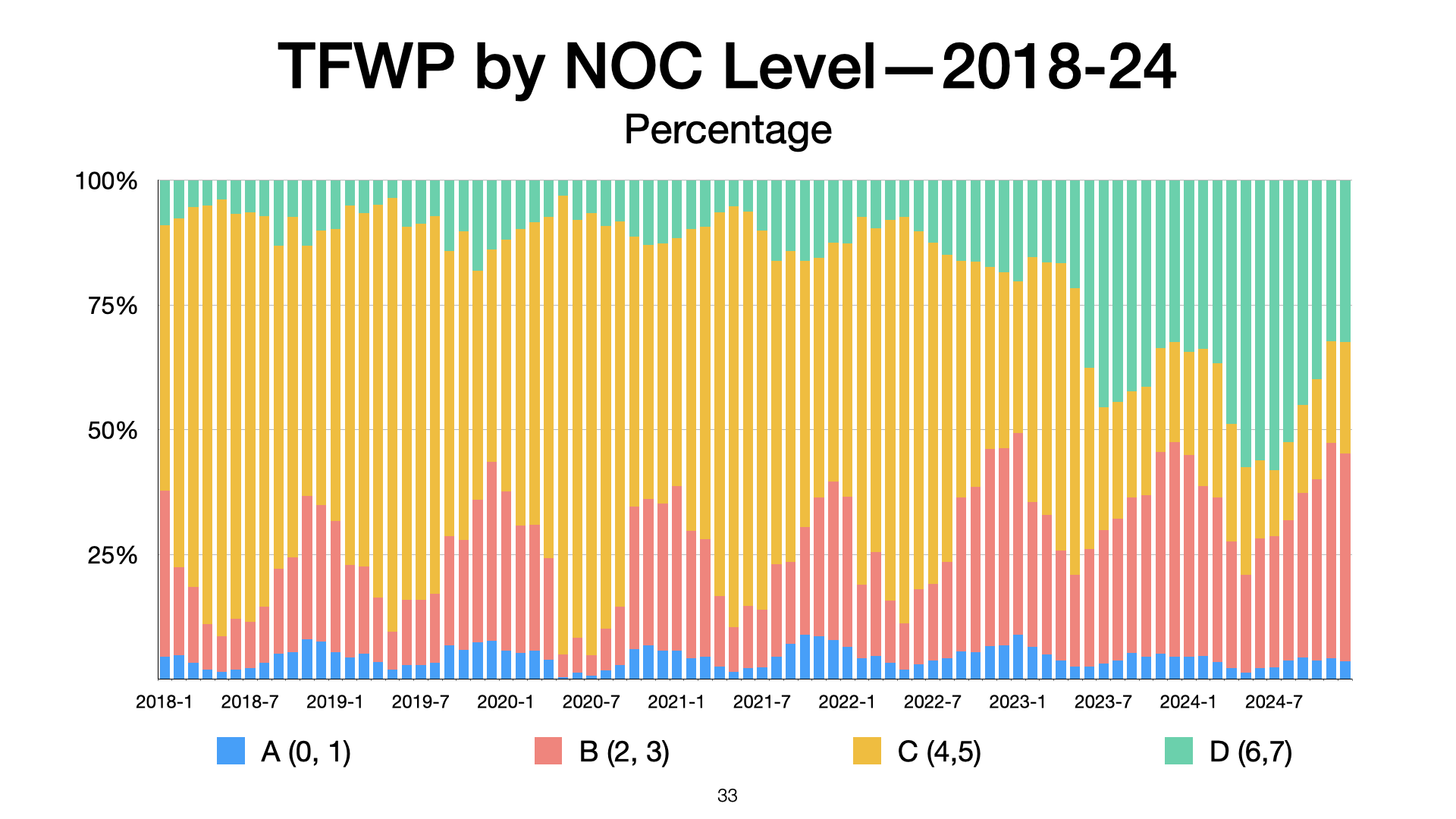
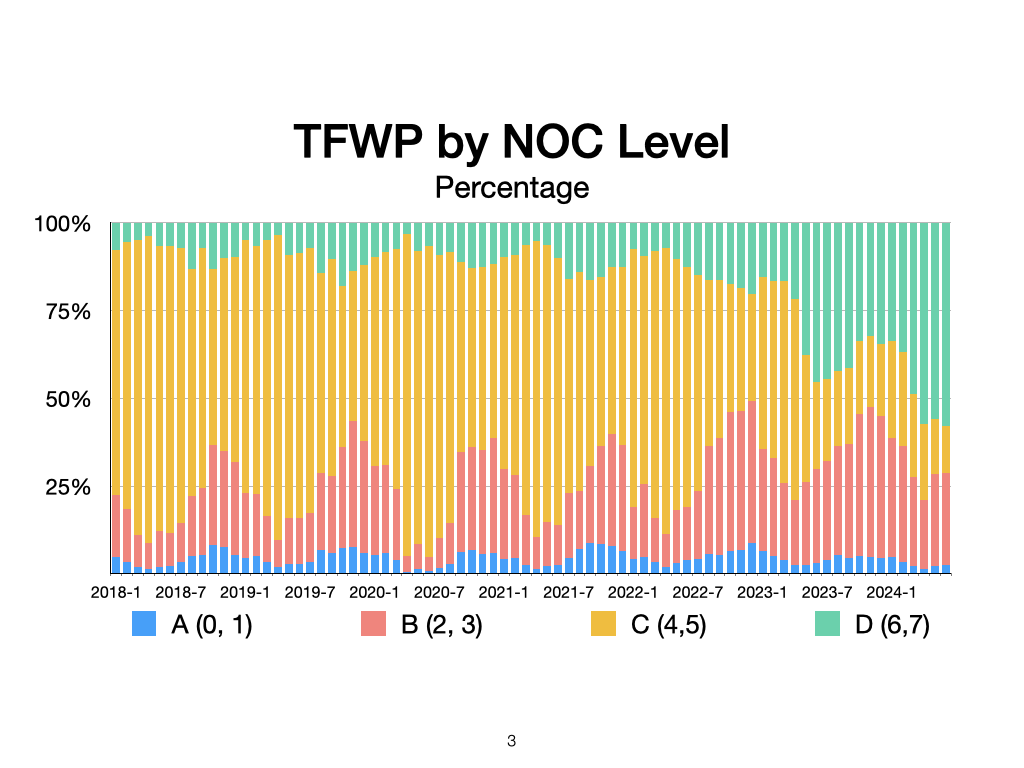
To better monitor and assess the impact, I prepared some charts on Temporary Foreign Workers by NOC Code. For those unfamiliar with the codes A 0 or 1: university degree, B 2 or 3: community college, apprenticeship, more than 2 years on the job, occupations with supervisory responsibilities or significant health and safety responsibilities, C 4 or 5: some secondary education, up to two years on-the-job training or equivalent, D 6 or 7: on-the-job training.

The following slides highlight the shift over the past five years. This provides a good overview and the context for articles like The sudden rise of temporary foreign workers in entry-level office jobs.

Starting with two views by NOC level, the numbers and the percentage shares which show the dramatic increase, both absolute and in percentage, of the low wage and low skilled temporary workers. Interestingly, there has been a squeezing of level C workers:

The next two slides provide the breakdown by NOC sector where sales & service and natural resources & agriculture have increased the most:

And lastly, looking at June year-over-year change and two year change, as well as from pre-pandemic 2018, showing again the greatest increase in level D occupations and, in terms of sectors, Business & Administration and Health, the latter from a low base:

Note to media: avoid year-to-date analysis in drawing conclusions as happened with Postmedia and other publications and focus on quarterly year-over-year changes.

Kenney dubs Ottawa’s immigration policies as “gross mismanagement”

Funny enough, neither Kenney nor the “true” North reporter mention that Kenney also made the same mistake re temporary foreign workers before stories emerged over Canadians losing shifts in fast food outlets and replacement of computer programmers. To his credit, he quickly overhauled the program, imposing restrictions along with creating the IMP program. And of course, he was criticized sharply by then MP Justin Trudeau, who also seems to have forgotten this history:

Former Alberta premier and Conservative immigration minister Jason Kenney is attacking the federal government’s handling of immigration, with particular ire for its foreign labour policies.

While serving as the immigration and employment minister in 2012-13 under then-Prime Minister Stephen Harper, Kenney overhauled the Temporary Foreign Worker Program resulting in an 80% decline in low-skilled foreign workers.

Those numbers have exploded under Prime Minister Justin Trudeau, and Statistics Canada is now reporting a 30-month high in unemployment which is particularly impacting youth who are competing with an influx of foreign labour. 

Kenney says he is “perplexed” by the federal government’s “gross mismanagement” of the immigration system, and especially the foreign worker program.

“And then the current government reversed these reforms, on top of massive increases in other streams of both permanent and temporary resident migration, in the midst of a housing crisis,” he wrote on X. “Why???”

Trudeau announced that his government would be reducing the number of foreign, low-wage workers after Canada’s unemployment hit a 30-month high of 6.4% in July. 

“The labour market has changed,” Trudeau said. “Now is the time for our businesses to invest in Canadian workers and youth.”

Temporary foreign workers do labour ranging from picking fruit, to pouring coffee, to cleaning hotel rooms. Healthcare, construction, and food security sectors won’t be impacted by the cuts. 

The prime minister’s announcement follows Statistics Canada’s July data which revealed that unemployment is highest among young Canadians, and increasingly among core-aged men.

“There’s record-high unemployment for youths, there’s record-high unemployment for, basically, very young workers,” said Chetan Dave, professor of economics at the University of Alberta.

“So having this surge or temporary foreign workers cut against Canadian workers who were looking for positions as well.”

During the pandemic, the federal government bolstered the program resulting in more than 183,000 permits effective last year – an 88% jump from 2019.

Kenney said changes he made over 10 years ago were criticised by the business community but were “ the right thing to do.”

“As I said repeatedly at the time, if there are real labour shortages, then the market response must be for employers to offer higher wages, better benefits, more training, accommodations for underemployed cohorts of the labour force, and more investment to enhance productivity,” he said. 

Source: Kenney dubs Ottawa’s immigration policies as “gross mismanagement”

Les exigences en français pour les travailleurs temporaires se font attendre, Requirements in French for temporary workers are long overdue

A noter. Another government having implementation issues:

Le gouvernement de François Legault, qui avait annoncé en novembre 2023 ses intentions d’exiger une connaissance minimale du français chez les travailleurs temporaires, n’a toujours pas déposé le règlement qui le lui permettra.

Le cabinet de la ministre de l’Immigration, de la Francisation et de l’Intégration, Christine Fréchette, a confirmé mardi au Devoir ne pas avoir encore déposé les modifications réglementaires nécessaires à l’imposition de nouvelles exigences en français pour les quelque 60 000 immigrants du Programme des travailleurs étrangers temporaires (PTET) actuellement sur le territoire québécois. Un projet de règlement sera déposé « cet automne », a-t-on assuré.

Sur son site Web, vendredi, la Coalition avenir Québec (CAQ) s’était pourtant félicitée d’avoir posé « de nombreuses actions importantes […] pour mieux réguler l’immigration temporaire » depuis son arrivée au pouvoir. Parmi celles-ci : avoir « exigé la connaissance du français pour renouveler les permis de travail temporaires ».

Cela fait près de dix mois que le premier ministre, François Legault, a officialisé, en conférence de presse à Québec, ses intentions de rendre le renouvellement d’un permis de travail conditionnel à la maîtrise de la langue française.

À l’époque, la ministre Fréchette avait affirmé que les travailleurs du PTET — à l’exception de ceux qui travaillent dans les champs — devraient bientôt démontrer une connaissance de la langue de niveau quatre, c’est-à-dire être capables de « discuter avec leur entourage » de « sujets familiers ». Le gouvernement de Justin Trudeau a depuis emboîté le pas à Québec, en promettant d’appliquer les mêmes exigences aux immigrants inscrits au programme fédéral de mobilité internationale (PMI).

Après plusieurs questions du Devoir, mardi, le cabinet de la ministre de l’Immigration a finalement indiqué qu’il procéderait à la « prépublication du règlement cet automne », avec pour objectif que celui-ci entre en vigueur au cours de l’année 2025. Aucune explication n’a été fournie pour les retards constatés depuis près d’un an.

« Improvisation »

En entrevue, le porte-parole du Parti libéral du Québec (PLQ) en matière d’immigration, André A. Morin, a cependant accusé le gouvernement d’avoir « improvisé » dans le dossier. « C’est toujours le même problème avec la CAQ : des grosses annonces, puis après ça, il n’arrive rien », a-t-il déploré à l’autre bout du fil. « Pour moi, c’est un autre exemple du manque de planification et du manque de contrôle de la CAQ, que ce soit dans le domaine de l’immigration, de la francisation ou de l’intégration. »

Quoiqu’exaspéré, M. Morin se dit peu surpris d’apprendre que la mesure caquiste n’a toujours pas été mise en application. Il se permet d’ailleurs une hypothèse pour l’expliquer : « En matière de francisation, le gouvernement, actuellement, est incapable de répondre à la demande », a-t-il observé, mardi. « Il y a des gens que je connais qui veulent suivre des cours, mais qui ne sont pas appelés. »

Dans son rapport annuel déposé en mai, le commissaire à la langue française, Benoît Dubreuil, avait constaté d’importants retards dans l’offre de service chez Francisation Québec. À l’époque, la moitié des demandeurs attendaient toujours de suivre leur premier cours.

Interrogé mardi, le député de Québec solidaire Guillaume Cliche-Rivard a lui aussi raillé les retards du gouvernement en la matière. « Les bottines de la CAQ ne suivent pas les babines pour la protection du français », a-t-il affirmé dans une déclaration écrite.

« Ça fait des mois que les échecs de Francisation Québec font la manchette et que les travailleurs immigrants font la file pour apprendre le français. Protéger le français, ça ne passe pas seulement par des exigences, mais aussi par des résultats positifs en francisation », a-t-il lancé.

« La CAQ se vante d’être le parti qui en a le plus fait pour l’immigration francophone. Déjà qu’elle n’imposait qu’un niveau 4 aux travailleurs du PTET, on apprend que le règlement qui devait mettre cela en oeuvre n’a pas encore été déposé », a pour sa part dénoncé le porte-parole du Parti québécois en matière de langue française, Pascal Bérubé.

Son parti, a-t-il rappelé, doit déposer cet automne « un plan de réduction des immigrants temporaires afin de diminuer la pression sur le français, notamment ».

Source: Les exigences en français pour les travailleurs temporaires se font attendre

Computer translation

The government of François Legault, which had announced in November 2023 its intentions to require a minimum knowledge of French among temporary workers, has still not filed the regulation that will allow it.

The office of the Minister of Immigration, Francisation and Integration, Christine Fréchette, confirmed Tuesday to Le Devoir that she had not yet filed the regulatory amendments necessary to impose new requirements in French for the approximately 60,000 immigrants of the Temporary Foreign Worker Program (PTET) currently in Quebec territory. A draft regulation will be tabled “this fall,” it was assured.

On its website on Friday, the Coalition avenir Québec (CAQ) was pleased to have taken “many important actions […] to better regulate temporary immigration” since it came to power. Among these: having “required knowledge of French to renew temporary work permits”.

It has been almost ten months since the Prime Minister, François Legault, formalized, at a press conference in Quebec City, his intentions to renew a conditional work permit to master the French language.

At the time, Minister Fréchette had said that PTET workers – with the exception of those who work in the fields – should soon demonstrate a knowledge of the language of level four, that is, be able to “discuss with those around them” about “familiar subjects”. Justin Trudeau’s government has since followed in the footsteps of Quebec City, promising to apply the same requirements to immigrants enrolled in the federal International Mobility Program (PMI).

After several questions of the Duty, on Tuesday, the office of the Minister of Immigration finally indicated that it would proceed with the “pre-publication of the regulation this fall”, with the aim of it entering into force during the year 2025. No explanation has been provided for the delays noted for almost a year.

“Improvisation”

In an interview, the spokesperson for the Parti libéral du Québec (PLQ) on immigration, André A. Morin, however, accused the government of having “improvised” in the file. “It’s always the same problem with the CAQ: big announcements, then after that, nothing happens,” he lamented on the other end of the line. “For me, this is another example of the lack of planning and lack of control of the CAQ, whether in the field of immigration, francization or integration. ”

Although exasperated, Mr. Morin says he is not surprised to learn that the Caquist measure has still not been implemented. He also allows himself a hypothesis to explain it: “In terms of francization, the government is currently unable to respond to demand,” he observed on Tuesday. “There are people I know who want to take classes, but who are not called. ”

In his annual report submitted in May, the Commissioner for the French Language, Benoît Dubreuil, noted significant delays in the service offer at Francisation Québec. At the time, half of the applicants were still waiting to take their first course.

Asked on Tuesday, Québec solidaire MP Guillaume Cliche-Rivard also mocked the government’s delays in this regard. “The boots of the CAQ do not follow the babines for the protection of French,” he said in a written statement.

“The failures of Francisation Québec have been making headlines for months and immigrant workers have been queueing to learn French. Protecting French requires not only requirements, but also positive results in francization, “he said.

“The CAQ boasts of being the party that has done the most for Francophone immigration. Already that it imposed only level 4 on PTET workers, we learn that the regulation that was supposed to implement this has not yet been tabled, “denounced the spokesman for the French-language Party of the Quebec Party, Pascal Bérubé.

His party, he recalled, must submit this fall “a plan to reduce temporary immigrants in order to reduce the pressure on French, in particular”.