Foreign workers issue delays trade deals

The higher-end of Temporary Foreign Workers. But given that one of the original cases was in relation to foreign IT workers displacing Canadian IT workers at the Royal Bank, not an easy issue for the Government. Particularly given that in contrast to NAFTA and the upcoming CETA, India is a low-cost supplier of IT services:

While discussions have also been delayed in part because of India’s lengthy election cycle, the fact that foreign workers have emerged as a potential stumbling block has implications for other lucrative trade agreements that Canada hopes to realize. It remains to be seen whether the resounding victory by Narendra Modi, a pro-business Hindu nationalist who heads the Bharatiya Janata Party, will help Canada overcome the impasse.

Rentala Chandrashekhar, the president of the National Association of Software and Service Companies (NASSCOM), which represents India’s IT community, recently visited Ottawa to stress the negative impact Canada’s reforms are having on trade and the potential that further changes could make things worse for both economies.

Mr. Chandrashekhar, a former senior public servant with the Indian government, met with Immigration Minister Chris Alexander, senior officials with Employment Minister Jason Kenney’s department and Don Stephenson, the chief trade negotiator for the Canada-India talks.

“Most important is perception, the perception that the Canadian economy is becoming more closed,” Mr. Chandrashekhar told the Globe. “The perception that walls are being put up … [This] is not something that is very conductive to the kind of environment that you need for pushing forward the idea of a freer trade regime.”

Foreign workers issue delays trade deals – The Globe and Mail.

TFW’s are just one piece of immigration puzzle – New Canadian Media


TFWs

My piece on Temporary Foreign Workers and the linkages to permanent residency and citizenship:

Over the past 10 years, permanent immigration levels and citizenship applications have largely remained stable. The only major growth that has occurred is for Temporary Foreign Workers, many at lower skill levels, most of whom do not have a pathway to permanent residency. Moreover, the pathway from permanent resident to citizen has also become harder, and will become even more so, undermining the overall Canadian model of immigration and citizenship.

Over reliance on anecdote and weakness in the evidence base have contributed to a number of these policy changes. Policy change is complex and the effects are only known after a number of years. It took four years before the flaws in the redesign of Temporary Foreign Workers became apparent. It will likely take that long to know whether the new “Express Entry” immigration approach works as intended. The full effect of changes to the Citizenship Act will only be known in about 10 years, given the increased residency and related requirements.

TFW’s are just one piece of immigration puzzle – New Canadian Media – NCM.

Kenney defends job bank despite outdated postings

Yet another headache for the government in the context of Temporary Foreign Workers and the introduction of the “Express Entry” new immigration approach which will also use the Job Bank. To be fair, keeping such sites up-to-date is always a challenge:

The federal government will soon make enhancements to its online job bank amid revelations that hundreds of positions posted on the site have long since been filled, Employment Minister Jason Kenney said Monday.

“We are making improvements to the Canada Job Bank … we will be using new technological developments in the near future to ensure an even better matching of unemployed Canadians with available jobs,” Kenney said in the House of Commons.

The government will work with “private-sector web platforms” when provinces fail to send their own postings to the job bank, he added. Currently, most provinces and territories do so automatically.

The job bank is a critical component of Ottawa’s controversial temporary foreign worker program. Employers are required to post ads on the site seeking Canadian workers for four weeks before they’re able to apply to hire temporary foreign workers.

The government also relies in part on job bank data to determine what regions of the country are clamouring for labour.

But from customer service representatives in New Brunswick to food service supervisors in B.C. and RCMP clerks in Saskatchewan, many of the 110,000 jobs listed on the job bank are no longer available. A litany of postings are several months old; some have been on the site for more than a year.

Kenney defends job bank despite outdated postings.

In related Temporary Foreign Workers news, Minister Kenney’s refuses Quebec’s request for an exemption for the moratorium, and Minister Alexander makes one of his few public comments:

Kenney told the Commons the moratorium was imposed to protect Canadians who are looking for work.

The federal minister pointed out that 14 per cent of Quebec youth are unemployed as are 20 per cent of new arrivals to the province.

Ottawa announced the moratorium in late April after reports suggested the program was being abused by the food-service industry.

A spokesman for Quebec Immigration Minister Kathleen Weil said on the weekend the province has no problem with the program and that restaurants need temporary foreign workers to keep operating, especially in summer.

The moratorium has been widely criticized by industry groups, with Quebec’s restaurant association calling it “exaggerated and unreasonable.”

Earlier on Monday, federal Citizenship and Immigration Minister Chris Alexander said the moratorium was imposed for “very good reasons.”

“There was abuse and we are absolutely committed to completing the review and the reform we have underway,” he said at an unrelated event in Montreal.

“And I can assure you and her (Weil) and Canadians across the country that when this program is relaunched, it will not be subject to abuse.”

He said the hiring of foreign temporary workers should be a “last resort.”

“There are young people across Canada…who are looking for permanent jobs and summer jobs and our first obligation as employers is to look to the domestic market.”

Temporary foreign worker ban: Kenney tells Quebec to hire unemployed youth

Lastly, commentary by Matt Gurney on the irony of the Quebec request:

But restaurant workers? It’s harder to make that case. If Canadians aren’t taking those jobs, the jobs probably aren’t paying enough. I’m sympathetic to the restaurant owners — the restaurant business is highly competitive, with razor-thin margins — but this is how capitalism works. Long-term jobs won’t adjust their prices to appropriate market-driven levels if there’s a gigantic foreign-worker-fed short circuit built into the process. Foreign workers when necessary to sustain and grow the economy, sure, but not foreign workers handing out the dessert menus as the default option.

Quebec is in an odd position here, and an ironic one. Despite the recent election of the Liberal party, and the attendant crushing defeat of the oft-xenophobic Parti Quebecois, the province still has a warranted reputation of being one of the less welcoming places in Canada with which to move. Even Canadian citizens, of the generically white ethnic background, can run into trouble for what language they speak. There are recent signs that this sad trend may slowly be moderating, but there’s still a very long way to go.

And while Quebec sorts out its discomfort with outsiders, it’s also insisting that it wants to retain access to a vast pool of foreigners to work in an industry in which they probably ought not to be working in the first place. “Send us some foreigners so we can hire them for service-sector jobs!” isn’t really something anyone would have expected to hear coming out of the province that was recently in an uproar about what civil servants could wear on their head or around their necks without getting binned, but here we are.

Quebec government really wants more foreigners. OK, then

Jayson Myers: Building a better foreign workers program | National Post

From Jason Myers, CEO of the Canadian Manufacturers and Exporters (CME) on Temporary Foreign Workers and some sensible recommendations (these are not fast food workers) to improve the program, including pathways to residency and implicitly citizenship:

We recommend that a new foreign skilled worker program be introduced, incorporating:

  • an improved national jobs bank that includes employment insurance claimants;

  • a broadly defined classification of skilled workers that’s based on industry needs, rather than on pre-specified qualifications;

  • an “above normal” wage threshold for temporary employment;

  • streamlined and consistently administered application and approval processes;

  • additional flexibility for employers located outside major urban centres, or in regions of rapid economic growth; and

  • improved pathways to residency, in order to give temporary foreign skilled workers better opportunities to become permanent contributors to the Canadian economy.

Jayson Myers: Building a better foreign workers program | National Post.

Meanwhile, Quebec wants an exemption from the federal moratorium.

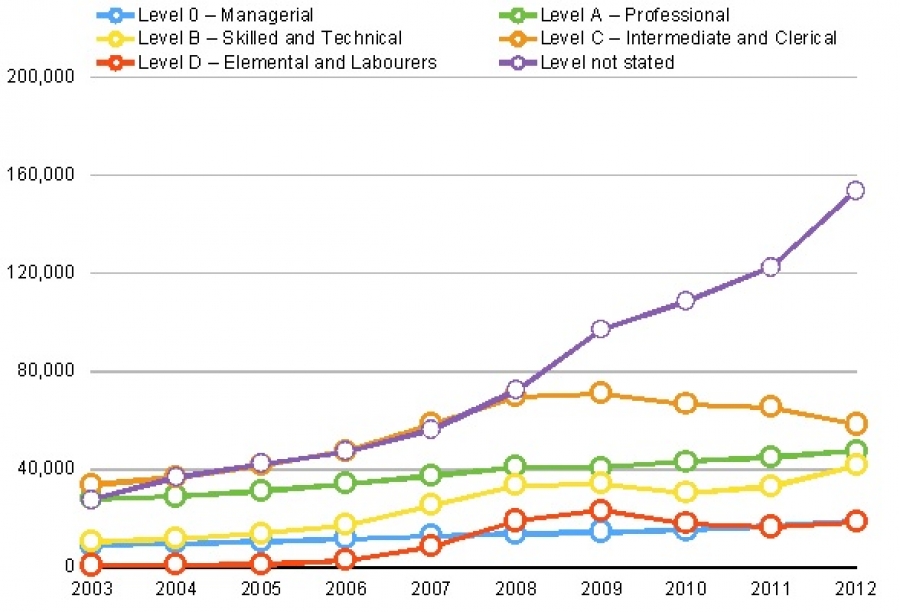
Interesting that no cases of abuse or concern about Temporary Foreign Workers in food service industries, given Quebec’s overall higher unemployment rate. Quebec had about 44,000 foreign workers in 2012, about 13 percent of the Canadian total (Quebec’s percentage of Canada’s population is almost 24 percent):

“We are a bit worried about the impact of the moratorium on our restaurants and on our small and medium-sized businesses,” he said Sunday.

“We are ready to work with the federal government to tighten the rules of the program if need be.”

Weil is also planning to make the same case to Employment Minister Jason Kenney, who oversees the temporary foreign workers program, McMahon said.

A spokeswoman for Kenney said there are no immediate plans to lift the ban, in Quebec or anywhere else.

“Abuse of the temporary foreign worker program will not be tolerated,” Alexandra Fortier said in an email.

“Allegations of misuse will continue to be investigated and any employer found to have violated the rules will face serious consequences.”

Quebec wants exemption from temporary foreign worker moratorium on restaurants – The Globe and Mail.

Québec réclame la levée du moratoire sur l’embauche de travailleurs étrangers | Le Devoir

Why Canada has a serious data deficit

More on the importance of good data by Barrie McKenna in the Globe’s Report on Business:

Prof. Gross [the C.D. Howe Institute researcher responsible for their study on Temporary Foreign Workers and their effect on increasing unemployment in AB and BC] acknowledged that perfect data is “very costly.”

So is bad data.

Employment Minister Jason Kenney recently imposed a moratorium on the use of temporary foreign workers in the restaurant industry, following embarrassing allegations of misuse by some McDonald’s franchise and other employers. And he has promised more reforms to come.

But who is to say that restaurants need imported foreign labour any less than hotels or coal mines, which are unaffected by the moratorium? And without better information, Mr. Kenney may compound his earlier decision to expand the program with an equally ill-considered move to shrink it.

The government’s troubles with the temporary foreign workers program is a classic case of bad data leading to dubious decision-making. Until recently, the government has relied on inflated Finance department job vacancy data, compiled in part by tracking job postings on Kijiji, a free classified-ad website. Statscan, meanwhile, was reporting that the national job vacancy rate was much smaller, and falling.

The problem goes way beyond temporary foreign workers. And it’s a data problem of the government’s own making. Ottawa has cut funds from important labour market research, slashed Statscan’s budget more savagely than many other departments, and scrapped a mandatory national census in favour of a less-accurate voluntary survey.

The Canadian government has demonstrated “a lack of commitment” to evidence-based decision-making and producing high-quality data, according to a global report on governance released last week by the Bertelsmann Foundation, a leading German think tank. The report ranked Canada in the middle of the pack and sliding on key measures of good governance compared with 40 other developed countries

One of the disadvantages of being in government for almost 10 years is that decisions which may have appeared to be cost-free can come back and haunt you.

Why Canada has a serious data deficit – The Globe and Mail.

Website maps businesses using temporary foreign workers in B.C. and Alberta

Interesting and innovative way to analyze and communicate Temporary Foreign Workers and their impact through mapping:

Of 511 Metro Vancouver businesses that received government authorization to recruit temporary foreign workers over a one-year period, 107 were restaurants, pubs or fast-food outlets — almost 21 per cent of the total. Everything from Megabite Pizza and Waves Coffee to Dead Frog Brewery and Doolin’s Irish Pub received approvals.

In Calgary, 299 of the 718 business that received authorizations in the same period were restaurants, pubs and fast-food outlets — 41 per cent. Those included a slew of Subway, Dairy Queen and many other franchises, as well as several mom-and-pop eateries.

“The majority of the people in those programs are not skilled workers working on construction projects where there’s a labour shortage,” Jim Sinclair, president of the B.C. Federation of Labour, said Wednesday.

“They’re simply being used as cheap labour in large urban areas where there’s already tens of thousands of people unemployed.”

Website maps businesses using temporary foreign workers in B.C. and Alberta.

The link to the map application:

NTFW Map

Feds walking fine line on temporary foreign workers, say diaspora groups

One of the few articles I have seen with reactions from some community groups:

Several industry lobby groups, including Farmers of North America and the Canadian Restaurants and Foodservices Association, have publicly defended the program.

However, leaders of two community organizations serving target constituencies for the Conservative Party opposed widespread use of the program.

The expansion of the program under the Harper government is creating a two-tiered society in Canada, whereby foreigners are brought in but not afforded the same rights as other immigrants or citizens, said Jagdeep Perhar, president of the India Canada Association, in a phone interview.

“I think this is a fundamentally wrong approach,” he said.

“The government should adapt their policy to maybe bring less immigrants to the country, that is fine. But once the immigrants are in, then we should not discriminate,” he said.

Diaspora youth, like all Canadians, are facing trouble with unemployment, while temporary foreign workers continue to stream in, said Victor Wong, executive director of the Chinese Canadian National Council, in a phone interview.

“I think in the end when the government puts its jobs record on the line, I think people will see that it’s failed,” he said.

The government has alienated business owners and employees alike in the Chinese and other communities with its management of the program, he said.

“They’ve been trying to talk out of both sides of their mouth for six years now, and to just kind of get away with it, and now it’s blown up in their face,” he said.

Feds walking fine line on temporary foreign workers, say diaspora groups | Embassy – Canada’s Foreign Policy Newspaper.

Temporary Foreign Workers Taking Jobs Where Canadians Available: HRSDC

Full-Time-EmploymentIf correct, this is not good news for the Government in its handling of the Temporary Foreign Workers program:

A cabinet minister in the Harper government was warned two years ago that jobs were going to temporary foreign workers even in areas where there were Canadians available to do them, according to internal documents.

In notes prepared for then-Human Resources Minister Diane Finley, HRSDC warned of a “disconnect between the Temporary Foreign Worker program” and Employment Insurance payouts.

“Evidence suggests that, in some instances, employers are hiring temporary foreign workers in the same occupation and location as Canadians who are collecting EI regular benefits,” the document stated.

It was evidently prepared by HRSDC ahead of a meeting between Finley and P.E.I. Innovation Minister Allan Roach in May, 2012.

Temporary Foreign Workers Taking Jobs Where Canadians Available: HRSDC.

Dec-1-TFWsFor a further illustration, an interesting analysis in Canadian Business on southwestern Ontario unemployment rates and foreign workers, contrasting youth and general unemployment rates and Temporary Foreign Workers:

The temporary foreign workers issue is just another example of why Canada needs to keep better labour market data. There may be very good economic reasons why the number of TFWs has doubled in Southwestern Ontario in the last decade, but without proper data there is no real way of knowing.

Next Why are so many temporary foreign workers in Southwestern Ontario

More on Temporary Foreign Workers

Some of the more interesting commentary on the TFW program from both the right and left following Minister Kenney’s suspension of the program for the fast food sector pending review (I suspect officials and staffers are scrambling). McDonald’s has also suspended the program given the damage to its brand and has its own internal review.

Starting with Martin Collacott:

One solution that has been suggested to reduce their vulnerability is to provide them with a clear path to permanent residency, so they do not have to worry about losing their status in this country. This, however, is not a solution that is in the interests of Canadians. Allowing low-skilled workers to remain here on a permanent basis is what immigration experts have described as “importing poverty” — because these workers can then bring in family members who will consume far more in public services than they pay in taxes. They would be likely to form a new underclass of impoverished Canadians.

Yet another factor that has to be considered in connection with the TFW program is that many who come here would like to stay permanently because of the much higher wages available in Canada than in their home countries. There is a distinct possibility, therefore, that many will choose to stay here illegally when their contracts expire — which would create another series of problems for Canada.

Canadians are well aware that there are already large numbers of people in the country who are unemployed and prepared to work for reasonable wages. These include unemployed youth, aboriginals, recent immigrants and people laid off from the manufacturing industry. Public opinion is, therefore, increasingly in favour of a drastic reduction in the temporary foreign worker program. The sooner the government takes action on this, the better.

Martin Collacott: Time to end Canada’s temporary foreign worker program | National Post.

The more left-wing approach, by Rick Salutin of the Star:

In an especially misanthropic Globe column, Margaret Wente rejects that model because “it amounts to importing poverty.” Sorry but that’s what built Canada. “We” imported poverty and gave it a chance to mutate. What does she think the poor are? They’re human, for starters. They have dreams and motivation — with a little encouragement. And energy, often far beyond the rest of us. Without it, many would never have survived.

She says, “Canada’s immigration policy is the most successful in the world because we select people with a lot of skills and education — not ditchdiggers and hotel maids.” But that’s exactly who we brought in: ditchdiggers and hotel maids. Their kids, with the benefits of decent schools, are now teachers, artists, bankers, hockey players. She’s ticked about letting Filipina nannies apply for citizenship because they don’t “move up the income ladder.” Well, uptitle nanny to early childhood educator, improve the pay, include benefits and see what follows. And by the way, who says ditchdiggers and nannies aren’t skilled? You try it.

And what’s preventing people like nannies from doing better? Temporary foreign workers, that’s who. They have no stake in the country and are insecure, so they work for less. If they were immigrants and not TFWs, they wouldn’t do that. This policy isn’t a law of nature that you can’t repeal, or an innate instinct among “true” Canadians. Come to think of it, that’s what I meant to write about before I got exasperated by Wente’s column.

Temporary foreign workers a global phenomenon: Salutin

Tim Harper focuses on the International Experience Canada program, one that encourages Canadian youth to work abroad:

Less than a decade ago, 21,656 Canadian youth travelled abroad while 30,467 foreign youth worked here. Today, fewer than 18,000 Canadians are working abroad, but there are more than 58,000 foreign workers here.
Cape Breton Liberal MP Rodger Cuzner told the Commons this week that, under the program, there were 753 Polish workers in this country and four Canadians in Poland. There are more than 300 Croatian workers here, but there are two Canadians working in Croatia.

For Conservatives, cheap foreign labour trumps Canadian youth: Tim Harper

Doug Saunders similarly argues for more immigrants, less temporary workers:

But, as an important new study of temporary-worker caregivers by the Institute for Research on Public Policy shows, its temporary nature has also created a huge social and economic problem. Between this and the other temporary programs, there are now hundreds of thousands of people who live full-time in Canada and have deepening ties here, but are unable to form any legal connection to our country’s economy or society.

In at least one respect, the caregivers are better off than the 65,000 skilled, unskilled and agricultural workers who come in “temporarily” each year (and now number more than 300,000): Since 2010, the nannies have been allowed to apply for permanent residence after completing 24 months of work over a period of up to four years.

That, at a minimum, needs to be done for all temporary workers. If there is one lesson from the world’s half-century experience with “guest” immigration, it is that nothing is worse for a country than having a large number of unaccompanied individuals living in its borders with no ability to form family, educational or economic ties – and thus to invest in their communities and help build their new country. Whereas permanent immigrants are a net gain, temporary ones do nothing for our development and often harm their lives.

Foreign workers won’t be temporary if we make them permanent

Temporary Foreign Workers Commentary

Terry Glavin’s well-placed rant in the Citizen on the temporary workers program. The government in its efforts to please its small business and franchisee base is surprised that the program has encouraged hiring foreign workers, as it would appear, at the expense of Canadians:

But harder still is the work of believing all those things we are told in order to dissuade us from the reasonable conclusion that the entire edifice of the Temporary Foreign Workers program has been subverted to the purpose of a racket, and the whole point of it is to defraud the Canadian public, suppress the wages of the people and distort the national labour markets to the unearned advantage of some employers.

You will be expected to believe that the stagnation of real median wages since the 2008-09 recession is by some voodoo mechanism wholly unrelated to the roaring trade in easily-exploitable foreign temps that has been underway, simultaneously, as documented by the Labour Market Assessment 2014 report the Parliamentary Budget Office released last month.

You will be asked to take it as normal that there are nearly a half million foreign workers in Canada, and that a quarter of all the new jobs filled across Canada last year were taken by these vulnerable migrants, and similarly there is somehow nothing especially worrisome about the rate of temporary foreign workers in Canada exceeding the number of permanent residents being admitted into this country as prospective citizens.

You will be further obliged to agree that the routine eruption of all those scandals is merely a matter of an otherwise proper system being gamed and foully abused, spoiled by a few grifters and bad apples, and that in actuality the program is unfair to employers owing to its burdensome encumbrances by way of inordinate fee-paying and form-filling and application-submitting, and Employment Minister Jason Kenney is just being mean.

You need not be more than a run-of-the-mill moron to believe such propositions, but you would have to be uniquely possessed of a special type of gall to actually traffic in them, and whatever name you want to give that rare quality it is in no short supply around the offices of the Canadian Federation of Independent Business.

How to fix the foreign-workers program.

Campbell Clark has a more reasoned approach in the Globe, but essentially comes to the same conclusion:

The number of people in Canada under those labour-market opinions grew from 82,210 people in 2005, before the Conservatives took power, to 202,510 in 2012, according to statistics from Mr. Kenney’s department, Employment and Social Development Canada.

The number one occupation group isn’t engineers, it’s” food counter attendants, kitchen helpers, and related occupations,” with 17,755 people. Waiters, cooks, and cashiers are all in the top 20.

Immigration policy does play a role in the labour markets, by determining the number who come and the qualifications they need to come. But the government should have a good public-policy reason before it intervenes to tinker with supply and demand at employers’ request.

There could be a gap in a highly-specialized or highly-skilled profession that Canadians just can’t fill for the time being. There’s always been a separate stream for agricultural workers, and that’s perhaps justified because it’s back-breaking seasonal work and the farm sector can’t risk a labour-shortage at harvest….

But there’s no compelling public-policy reason to help a fast-food franchise find workers at the wage they want to pay. Can a McDonald’s in Victoria really claim no Canadian will take a job there, no matter what the wage?

Yes, some employers like this program. Dan Kelly, of the Canadian Federation of Independent Business, said a lot of employers say it’s increasingly difficult to “find people who are available to work and will show up with a smile on their face, and not be on their phone for half the shift.” But the government can’t justify guest-worker programs because some employers think these kids today have the wrong attitude.

Politically, it’s not going to be easy to justify the expansion of temporary foreign workers. Most Canadians thought it was a program to fill temporary skills shortages, not to have the government micro-manage the labour pool in jobs Canadians can do. Each case of alleged abuse underlines not simply that the program is open to abuse, but that it’s gone off the rails.

Foreign worker abuses expose Harper’s hollow commitment to free markets

Terrence Corcoran in the Financial Post notes the CD Howe study showing that the program led to an increase in unemployment:

And now comes a heavy-duty economic analysis from the C.D. Howe Institute claiming that the TFWP caused increased unemployment in Alberta and British Columbia. The paper could put a serious crimp in the federal government’s program that has proven wildly successful. As of December, an estimated 338,000 temporary foreign workers held jobs in Canada.

The increase in unemployment in Alberta and B.C. is said to have occurred between 2007 and 2010 when the program was relaxed and a pilot project introduced to allow “cheaper access to foreign workers because of purportedly deep shortages of labour in some occupations.” The program worked, but maybe too well.

The author of the C.D. Howe report does not condemn the TFWP as a whole. Dominique Gross, a professor at the School of Public Policy at Simon Fraser University, says in her study, Temporary Foreign Workers in Canada: Are They Really Filling Labour Shortages, the idea is economically sound but only if the program is well designed. In an interview, Ms. Gross said the unemployment rates in B.C. and Alberta were on average 1% higher per year over the 2007-10 period than they would have been had the government not relaxed the rules of the TFWP.

To fix the problem, Ms. Gross calls for a number of reforms, including collecting much better data on whether shortages actually exist, increasing the corporate cost-per-worker of a TFW permit (now $275 each compared with $2,500 in the United States) and imposing tougher rules that would force companies to prove the labour shortages are real.

Pending reforms, Ms. Gross says Ottawa should impose a “temporary quota” on the total number of temporary workers allowed into Canada.

Ms. Gross’s reforms may be hard to implement without gutting much of the initiative. Temporary worker programs are a relative success in Europe, she says, in part because labour supply and demand is vigorously monitored through detailed employment vacancy surveys. Europe also makes use of expensive government-run “local labour offices” that serve as matchmakers between workers and employers. Canada has never been hospitable to greater state involvement in day-to-day management of the labour market, whether provincial or federal.

Bit odd however that Corcoran should be citing temporary worker programs in Europe as a relative success given some of the longer-term integration challenges resulting from these programs.

Terence Corcoran: How Canada’s temporary foreign workers program became a victim of its own success