Half of the most highly valued tech companies in the U.S. were founded by immigrants – Recode

Speaks for itself:

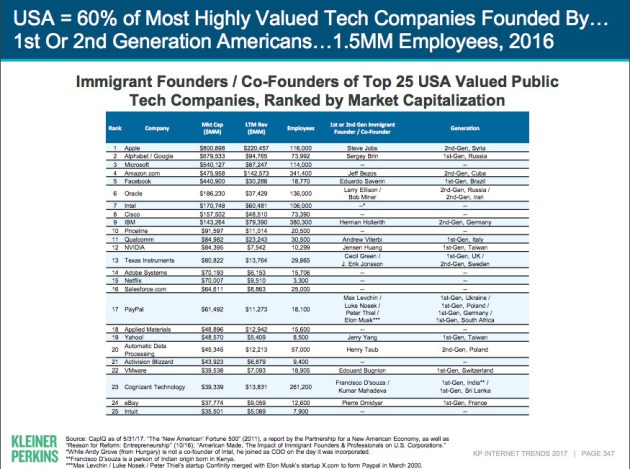
It turns out immigration is a boon for innovation in the United States. Sixty percent of the highest-valued tech companies were co-founded by first- or second-generation immigrants, according to Kleiner Perkins Caufield & Byers partner Mary Meeker’s annual internet trends report, which she presented at the Code Conference at Terranea Resort today.

Mary Meeker internet trends report

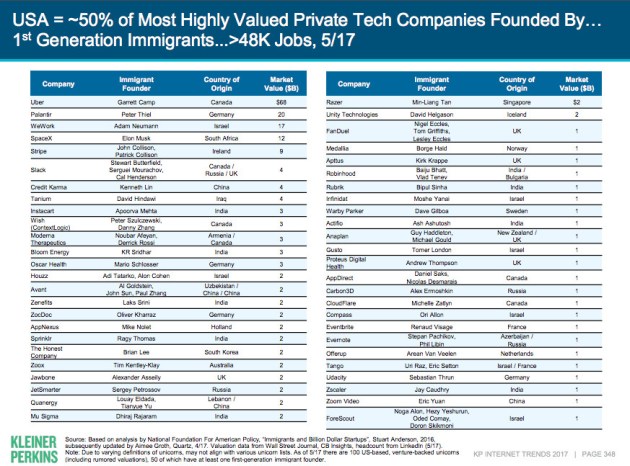
That number is still pretty high even if you count just first-generation Americans. Half of all of the most valuable private tech companies in the United Sates were co-founded by immigrants — including Uber, SpaceX, Instacart, AppNexus and FanDuel.

Mary Meeker internet trends report

Source: Half of the most highly valued tech companies in the U.S. were founded by immigrants – Recode

America’s immigration policies are hurting startups, Stripe CEO Patrick Collison says – Recode

Worth noting and reflecting on how best Canada can benefit:

How America welcomes — or doesn’t — outsiders who want to work for American companies is “an even bigger deal than we think,” Stripe CEO Patrick Collison says.

Speaking on the latest episode of Recode Decode, hosted by Kara Swisher, he declaimed against the “needless barriers in the way” of the U.S. remaining a destination for immigrants. Collison and his brother/co-founder John were born in Ireland, but founded Stripe, an online payments platform now valued at more than $9 billion, while they were students at MIT and Harvard, respectively.

“The insane, crazy benefit — the tailwind that the U.S. has, for decades and decades, gained from — is the fact that we are the preeminent destination for high-potential people all around the world,” Collison said. “It’s at multiple stages in their careers: The universities are the best in the world, so people want to study here and come here for that, and then the companies are among the most innovative companies in the world, and they want to hire the best people in the world.”

“Broadly speaking, the U.S. has not quite done its best to undermine that, but all but,” he added. “To the extent that universities can help students come here, or that companies can enable the best and brightest to move here, it is ‘despite’ rather than ‘because of’ U.S. immigration policy.”

Source: America’s immigration policies are hurting startups, Stripe CEO Patrick Collison says – Recode

Doug Todd: “Techno-immigrants” fuel Vancouver’s high-tech sector

Interesting study, which recalls an earlier Globe article, Microsoft reminds us that Canada is still a branch-plant economy, on how Microsoft (and likely others) strategically use Canadian immigration as a way to bring talent to their US headquarters:

In light of the political manoeuvring in B.C. over local high-tech jobs and training, the study by Froschauer and Wong quotes the president of a large B.C. high-tech association who says a key reason “Microsoft chose to open a Vancouver office was because of the easier immigration rules.”

The unidentified high-tech CEO told the researchers there’s a crucial reason Microsoft did not simply open its computer development “campus” in Redmond, Washington, which is headquarters for the global tech giant.

“It’s like two hours away, so why would they open up this campus in Vancouver?” said the CEO.

“It’s much easier to bring in (migrants from India) and others, and that’s the reason they came. And their intention is not to recruit people away from other companies in the Lower Mainland but to bring fresh people in, and that’s what the larger companies do. Small ones don’t have the means.”

High-tech companies in B.C. and Alberta also often cross the U.S. border to recruit Chinese and other foreign students, say the authors, because international students in the U.S. are generally not allowed to remain in the country after they graduate, whereas they can stay after graduation in Canada.

The sociologists do not estimate the proportion of Metro Vancouver’s high-tech sector that is made up of immigrants, international students or temporary foreign workers, but they quote the CEO in confirming migrants are “very, very useful. I don’t think we could evolve our sector without” them.

Many of the techno-migrants interviewed in the study say it’s often an advantage to be a migrant in Canada’s high-tech sector.

But others said being born outside the country can be a disadvantage, particularly because of difficulties with language.

Some people from China told the researchers that migrants from India don’t have as many problems with language, since many in the former British colony were educated in English from their childhoods.

Some high-tech executives in Metro Vancouver and Calgary favour temporary foreign workers over immigrants, add Froschauer and Wong, whose article appears in the new book, Trans-Pacific Mobilities: The Chinese and Canada(UBC Press), edited by Wong.

The sociologists learned some corporations prefer “to bring employees to British Columbia on a temporary work permit” because they can be retained longer than immigrants, who have more freedom regarding where to work.

Provincial and federal immigration programs “do not tie employees to the company, whereas the temporary work permit does,” the authors say.

The number of high-tech migrants to Canada, especially from China, is likely to continue to grow in the future, say the authors.

Source: Doug Todd: “Techno-immigrants” fuel Vancouver’s high-tech sector | Vancouver Sun

Snubbed by Trump, Silicon Valley talent is looking to Canada

The “diversity dividend” to use The Pluralism Project phrase and a major opportunity for Canada.

But it will take a number of years to know whether this is anecdotal or more widespread in impact:

Like many Canadian tech executives, Roy Pereira, CEO and founder of Zoom.ai Inc., struggles to hire and hold on to highly skilled engineers, code writers and seasoned managers. Canadian software engineering grads often head directly to tech hubs like Silicon Valley and San Francisco, or use an entry-level position at the Canadian arms of giants like Google or Facebook as launching pads for U.S. gigs. And who could blame them? The pay is better; the career horizons, wider.

So when Pereira’s small but fast-growing software firm began recruiting for engineers earlier this month, using the usual online channels, he noticed something odd: the number of inquiries from the U.S. and overseas was significantly outpacing those from Canadians. “These were American citizens and sometimes foreign nationals, including a lot of South Asians. They were wanting to come to Toronto.”

He interviewed one woman working for Twitter in Silicon Valley. A member of a visible minority, “she wants to move to Toronto because she doesn’t want to deal with the situation down there,” says the 49-year-old serial entrepreneur, alluding to simmering racial and political tensions, as well as the Bay Area’s soaring living costs. “I’ve never seen that before and I’ve been doing this for a while.”

What’s driving these off-shore inquiries, according to Pereira and other executives in southern Ontario’s tech corridor, are the anti-immigrant signals emanating from Trump administration—not just the notorious travel ban on six Middle Eastern countries, but also uncertainty over potential travel headaches for American residents with family in those regions, stepped-up border scrutiny and, in particular, the fate of specialized H-1B work visas.

Washington issues 85,000 H-1B visas annually through a heavily subscribed lottery, including 20,000 to foreign nationals who obtained graduate degrees from U.S. institutions, many of them engineers and software developers. Trump recently signed an executive order directing federal agencies to review the H-1B program and, presumably, recommend toughening the rules—a change that has significant potential to close off positions for highly skilled professionals from around the world who want to work in the roiling American tech sector. “It’s a top-of-mind issue [for U.S. firms],” says Jeff Loeb, an American who recently jumped to Kitchener, Ont.-based Vidyard as chief marketing officer after 25 years in Boston’s tech industry.

So, amid all the tales about the fraught state of the U.S.-Canada border—north-bound asylum-seekers, cancelled southbound trips by Girl Guides—as well as these potential rule changes, Canadian firms have found themselves in the happy position of transforming all that stateside nationalist/protectionist fervour into a brain gain.

According to a recent Bloomberg report, U.S. universities have seen a decline in applications from Indian students who, sources said, are concerned about visa restrictions and racially motivated attacks, and who increasingly look to countries like Canada, Ireland and New Zealand for higher education and career opportunities. In the past few months, in fact, this unexpected opening has become a point of eager discussion at recruiting and tech-industry conferences, with panelists urging audience members to seize the day. “There’s never been a better time to attract global talent and capital to Canada,” Janet Bannister, a general partner at Real Ventures, a Toronto finance firm, said at one such gathering, alluding specifically to the political situation in the U.S.

At a biotech industry conference last month, Bradly Wouters, a top Toronto University Health Network researcher, observed that “it’s no secret that success in the U.S. has depended on ability to attract talent from around world.” That appeal, he added, is “threatened by the winds of change” and described the moment as “extremely opportunistic” for Canadian companies looking for highly skilled people.

Some tech-industry groups and firms have gone so far as to launch advertising campaigns or open letters aimed at attracting skilled foreign workers. CityLab reported recently that a Vancouver entrepreneur and some counterparts in the San Francisco area have set up a company, True North, that will help foreign nationals find positions in the sprawling tech sector in B.C.’s Lower Mainland. Even Prime Minister Justin Trudeau has gotten in on the act in a guest post on Quora earlier this month, pitching to international students and high-skill workers on Canada’s universities, tech firms and ethnocultural diversity. He offered carrots such as a significantly reduced permit process. “We want to help high-growth companies bring in the talent they need quickly by slashing the processing time for a Canada visa application from six months to just 10 business days,” wrote Trudeau, who didn’t mention Trump by name but slipped in a not-so-veiled dig at the president’s climate change denialism by noting that “our government is committed to evidence-based policy and respecting academic freedom.”

Yet some Canadian tech players say the spike in applications they’re seeing isn’t coming from international engineers so much as the aforementioned Canadian tech graduates who followed their careers to high-paying careers south of the border. “I’ve seen a lot of engineers [from the Universities of Waterloo or Toronto] who went to the U.S. during the 2009-2010 tech boom…who are saying, ‘Hey, we’re thinking of moving back,’” says Derrick Fung, CEO of Drop, a Toronto start-up whose app allows users to earn rewards on top of what their existing card reward programs provide. “We’re attracting people who’ve worked at Facebook and Snapchat.”

Not everyone agrees. Derek Ting, the 29-year-old founder TextNow, a cloud-based, low-cost mobile phone service based in Waterloo, Ont., and with an office in San Francisco, says highly skilled younger people will continue to follow their careers and seek out firms that have a strong culture and a sense of mission, regardless of the ambient political mood.

But Mike Silagadze, founder of the Toronto education software start-up Top Hat, predicts the combination of the high-tension politics, travel headaches and ramped-up protectionism in the U.S. will prompt more of Canada’s young engineers and researchers to pursue careers here. Noting that 80 per cent of Waterloo’s engineering grads go south, he mentions Canadian-born tech superstars such as Stewart Butterfield, who founded Flickr and now runs Slack, or Tesla founder Elon Musk, a South African immigrant who moved to Canada and studied at Queen’s University. “Imagine Elon Musk staying in Canada and starting Tesla here,” muses Silagadze. “That’s transformational.”
Source: Snubbed by Trump, Silicon Valley talent is looking to Canada – Macleans.ca

This is what you get wrong when you talk about diversity in the workplace – Recode

Just one more approach to help people understand and appreciate diversity issues:

A lot of tech companies say they want to make progress on diversity and inclusion. Code2040, a nonprofit that gets its name from the year people of color are projected to be the majority of the U.S. population, argues that just saying that isn’t enough. Businesses need to act.

“It’s often positioned as an add-on,” Code2040 CEO Laura Weidman Powers said on the latest episode of Recode Decode, hosted by Kara Swisher. “What really needs to be the case is to change the core of what you’re doing. We’re not saying, ‘Keep hiring the way you’re hiring and also do this diversity thing on the side.’ [We are saying,] ‘You need to change the way you hire in order to be more inclusive.’”

You can listen to Recode Decode on iTunes, Google Play Music, TuneIn, Stitcherand SoundCloud.

Code2040 focuses specifically on “underrepresented minorities” — black and Latino/Latina students who have 18 percent of computer science degrees but only three percent to five percent of the jobs in Silicon Valley.

Powers said that since the nonprofit launched in 2012, Code2040 has found more and more support for its annual “fellows program,” which charges companies to connect them with talented minorities whom they might otherwise overlook. This summer, it will place more than 100 black and Latino students in tech offices.

But there’s still a long way to go. She said managers and employees, even the ones who mean well, often fall into traps that set everyone back — for example: “unconscious bias” training that doesn’t give attendees the ability to apply anything they learn.

“Talking about unconscious or implicit bias can seem to let people off the hook,” Powers said. “It’s been shown if you do unconscious bias training and it’s like, ‘Hey, everybody’s got bias,’ then the takeaway is, ‘Oh, phew, it’s not me! It’s just humans because we need to learn how to be scared of snakes so you make assumptions!’ You can get farther away from making progress.”

“Folks go to our trainings, they go back to their desks, and there’s half a dozen black and Latino interns who are working there,” she added. “They actually get a chance to see: ‘How inclusive is my culture? What is the experience of these individuals coming through?’ That makes a big difference, putting a face to the work and actually having a chance to build those skills.”

Source: This is what you get wrong when you talk about diversity in the workplace – Recode

Program helps new immigrants find their footing in Canadian tech sector

Appears to be a good and successful program:

When Rohum Azarmgin immigrated to Canada in April, 2015, he wasn’t fully prepared for the job hunt he would encounter. As an established and educated IT professional in Iran, he never had an issue finding work. But his new home was different, and he didn’t fully understand how the recruitment process worked.

“I didn’t have trouble landing interviews, but I wasn’t able to secure a job,” says Mr. Azarmgin. That’s despite having both an IT degree and an MBA as well as 12 years’ experience as a project manager in his home country. It was a tough time, he recalls, and focusing all his attention on finding a job meant burning through much of his savings.

Mr. Azarmgin’s experience is one common to many immigrant tech workers, who come to Canada with expertise and education, but struggle to find their footing amid a hiring process and work environment vastly different from that in their home country. A program funded by the Ontario government called Integrated Work Experience Strategy (IWES) aims to help newcomers with technical experience like Mr. Azarmgin continue their careers in Canada.

Offered by the not-for-profit Information and Communications Technology Council (ICTC), the program involves three weeks of in-class training in Scarborough, Ont., followed by three months of one-on-one coaching for a fee of $399 plus HST. Over 85 per cent of graduates of the IWES program have landed jobs within six months of completing the program, with average salaries starting at $50,000. Since the pilot in 2009, approximately 450 professionals have been through the program.

It’s a win-win situation, says ICTC program manager Maureen Ford. “Information and communications technology professionals connect to the labour market, securing opportunities commensurate with their education and experience, and employers find skilled talent to meet their increasing digital skill needs.”

The need for technical talent in Canada is massive, and many tech leaders say the shortage is impeding the growth of their firms. Andrea Gilbrook, director of talent programs at the tech organization Communitech in the Kitchener-Waterloo, Ont., region, has witnessed it first-hand. According to Communitech’s estimates, there are currently around 3,000 open positions in tech companies as well as tech positions in non-tech companies in the region. That number, she says, is expected to exceed 5,000 in five years.

“We need more students and new grads, but we also need more experienced hires,” she says.

Many in the sector are hoping for an increased chance to bring in tech-savvy newcomers due to tightening immigration rules in the United States. Ms. Gilbrook sees the value in programs that help integrate skilled newcomers, and says Communitech has launched its own three-month pilot program targeted at skilled immigrants and career changers.

In the IWES program, guest speakers and visiting recruiters introduce the participants to the norms of Canadian workplace culture. Participants learn how to conduct job searches and interviews, and improve their resumes and social media presence. But it’s the one-on-one coaching portion that many participants, like Mr. Azarmgin, find the most helpful.

After four months of struggling to find work in his field, he enrolled in the IWES program. He was paired with volunteer coach Chris Hamoen, formerly director of growth at Toronto-based software company Hubba. Mr. Hamoen since moved on to create his own startup and hopes to use the IWES program as a resource for talent.

Together, they revised Mr. Azarmgin’s resume, ran through mock interviews, and helped formulate a job search strategy. Mr. Azarmgin says having Mr. Hamoen on his team made him much better prepared for the job hunt.

By December, 2015, Mr. Azarmgin successfully landed a position in Halifax with NTT Data, a systems integration company. Today, he’s moved on to a more senior position as a project manager at CGI.

“A lot of their [participants] end up at IWES when they’re giving up almost,” says Mr. Hamoen. “They’re far into their time in Canada and aren’t using their skills and are just finding a way to pay the bills.”

Source: Program helps new immigrants find their footing in Canadian tech sector – The Globe and Mail

A black woman in tech makes $79,000 for every $100,000 a white man makes – Recode

Impressive large-scale data analysis that show the extent of bias in the hiring process:

It’s no secret that the technology field can be brutal to anyone who isn’t a white male. New data shows just how those inequalities play out in today’s tech workers’ paychecks.

Nearly two in three women receive lower salary offers than men for the same job at the same company, according to Hired, a job website that focuses on placing people in tech jobs such as software engineer, product manager or data scientist. That’s slightly better than last year, when 69 percent of women received lower offers.

Women, on average, were paid 4 percent less than men for the same kind of job, the study found.

For the study, Hired mined data from 120,000 salary offers to 27,000 candidates at 4,000 companies. In general, applicants to these tech fields skew male (75 percent), but that doesn’t account for the disparity in who gets interviewed.

Companies interviewed only men for a position 53 percent of the time; 6 percent of the time, they interviewed only women.

“Not only are women getting lower offers when they actually get offers, but a large amount of time, companies have openings and they’re not interviewing women at all,” said Jessica Kirkpatrick, Hired’s data scientist.

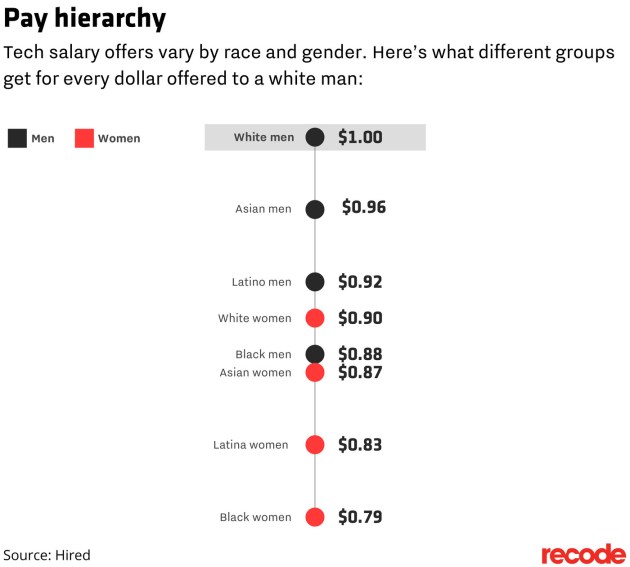
Hired’s data also breaks down offer salaries by race, compared with a white man in the same job. The effects of race are even more dramatic:

  • Black women are offered 79 cents to every dollar offered to a white man.
  • Black men make 88 cents.
  • Latina women make 83 cents.
  • White women make 90 cents.

Additionally, LGBTQ women and men are offered less money than their non-LGBTQ counterparts.

There are numerous reasons for this pay inequity. Part of the problem is that women, minorities and LGBTQ people ask for less than white males for the same position.

According to Kirkpatrick, these groups ask for less because people base their salary expectations on what they’re already making. For these groups, their lower pay often reflects a lot of historical inequities accrued over their careers, like being denied raises or promotions.

By not offering people comparable wages, Kirkpatrick said that companies are jeopardizing their job retention. “When people figure out what their teammates are making, it’s ultimately not good for maintaining talent and creating a collegial environment,” she said.

It also makes Silicon Valley’s already tight talent pool even smaller.

Source: A black woman in tech makes $79,000 for every $100,000 a white man makes – Recode

The Trump administration is weighing what to do about the spouses of high-skilled immigrants [H-1B] – Recode

Recruitment opportunities and advantages for tech companies operating in Canada:

The Trump administration’s next immigration target could be a program that allows the spouses of some high-skilled engineers to work in the United States.

Under former President Barack Obama, the government tried to help tech companies and other firms who employed H-1B visa holders by allowing their spouses to seek jobs here. The policy specifically focused on the families of H-1B workers who pursue green cards to become permanent U.S. residents.

Under Trump, however, the government has sought to rethink federal immigration programs. And in court documents quietly filed this week, the Trump administration indicated that it is reconsidering spouses’ rights, too.

Without much fanfare, the Justice Department’s lawyers asked a federal appeals court on Monday to pause consideration of a case challenging the Obama-era policy’s legality. The DOJ sought 180 days so the administration can decide “whether to revise” its rules.

The move drew sharp criticism from immigration reform advocacy groups, including the Mark Zuckerberg-backed FWD.us, which feared that the Trump administration had essentially paved the way to abandon the aid Obama extended to spouses.

“We strongly feel they should keep this regulation in place, and they should not deny a quarter million people” the ability to work, said Todd Schulte, the president of FWD.us, in an interview Tuesday.

The DOJ’s court move, however, raised additional alarm in light of previous comments made by Jeff Sessions, now the country’s attorney general. While serving in the U.S. Senate, the Republican lawmaker had been especially critical of the H-1B program. And Sessions sharply rebuked the Obama administration in 2015 after it issued its rules to permit the spouses of some H-1B holders to seek employment.

Fearing that the DOJ might ultimately choose not to defend the case, an immigration rights organization called Immigration Action sought to intervene“on behalf of thousands of its members who currently possess employment authorization as spouses of H-1B visa holders,” it said in a statement in March.

Earlier this week, the Trump administration promised greater scrutiny of the H-1B program. It pledged more targeted “site checks” to ensure that the program has been administered properly, along with greater scrutiny for computer programmers who apply for those visas. Both measures are viewed as early attempts to crack down on outsourcing firms like Infosys — and not on tech giants like Google, which told employees late Monday that they likely would not be affected.

Source: The Trump administration is weighing what to do about the spouses of high-skilled immigrants – Recode

Trump is cracking down on the H-1B visa program that Silicon Valley loves – Recode

More opportunity for Canada:

On the campaign trail, Donald Trump pledged to crack down on companies that hire foreigners over Americans.

Now that he’s in the Oval Office, his administration is taking aim at some of the high-skilled visas that Silicon Valley seeks so it can hire foreign engineers.

Beginning Monday, the Department of Homeland Security promised greater scrutiny of the H-1B program, which began accepting applications for a lottery that will award visas in 2018. The government’s immigration enforcers plan to heighten their “site visits,” they said, to “determine whether H-1B dependent employers are evading their obligation to make a good faith effort to recruit U.S. workers.”

The Justice Department, meanwhile, issued its own stern warning Monday. “The Justice Department will not tolerate employers misusing the H-1B visa process to discriminate against U.S. workers,” said Tom Wheeler, the acting assistant attorney general at the DOJ’s civil rights division.

Both swipes at the program come days after U.S. Citizenship and Immigration Services issued a policy that rethinks the way the government awards H-1B visas to computer programmers. Now, companies must prove that the programmers they’re hoping to hire are doing special, complex jobs requiring unique technical expertise.

Taken together, the steps seem to point most directly and immediately at outsourcing companies like Infosys and Tata Consultancy Services. But it’s still sure to send a major chill down Silicon Valley’s spine, after an election season in which Trump and his allies took aim at the industry’s hiring practices.

In March 2016, Trump specifically promised to “end forever the use of the H-1B as a cheap labor program, and institute an absolute requirement to hire American workers first for every visa and immigration program.” Others, like then-Senator Jeff Sessions — since tapped as the country’s attorney general — criticized the likes of Facebook CEO Mark Zuckerberg for seeking to expand the program.

Many in the tech industry later expected Trump to issue an executive order clamping down on the H-1B program, a draft of which began circulating earlier this year. He never issued the directive, but DHS did suspend expedited processing for those visas, it announced in March.

“The Trump administration will be enforcing laws protecting American workers from discriminating hiring factors,” said press secretary Sean Spicer at his briefing Monday.

Source: Trump is cracking down on the H-1B visa program that Silicon Valley loves – Recode

Immigration: Donald Trump Pushes Silicon Valley to Toronto | Time.com

Smugness alert for Canadians. Nevertheless there is some merit in Salim Teja, EVP of Ventures at MaRS’s arguments and narrative:

 Without immigrants, Silicon Valley would look very different. There would be no Amazon, no eBay. No Reddit, no Intel. Google, Tesla, and Yahoo? Gone. And you can say goodbye to your iPhone.

These are just a few of the biggest names, but half of all billion-dollar U.S. startups were founded by immigrants. Silicon Valley would simply not exist, and the United States’ position as a global tech leader might never have come to fruition.

Under President Donald Trump, we are not far from this hypothetical. Trump’s immigration ban and H-1B visa restrictions will significantly harm the U.S. technology industry, diverting the steady, decades-old stream of foreign tech talent to international competitors.

And there’s no country better positioned to welcome this diverse group of innovators than Trump’s northern neighbor: Oh, Canada. At the center of the country’s identity is Toronto — the fourth-largest city in North America. Boasting a diverse community, booming tech scene, and forward-thinking government, this city is the leading contender to welcome tech talent and become the next epicenter of innovation.

A Culture of Inclusion

It’s easy to talk in generalities when it comes to diversity and inclusion — but I’m actually a product of Canada’s welcoming stance on immigration. My family emigrated to Canada from Tanzania, East Africa. We fled political turmoil and settled in Canada to build a better life. It would also become the place where I eventually began to flourish as an entrepreneur.

 Forty years later, Canada is still a beacon of hope for immigrants, an open society that is welcoming refugees in unprecedented numbers. Toronto was recently named the most diverse city in the world, and has become a cultural haven in which foreign entrepreneurs can pursue innovative ideas. In fact, it’s easier than ever for immigrants to work up north — capitalizing on Trump’s decision to delay H-1 B visas, Canada recently announced an expedited work permit process, allowing foreign talent to be approved for work in a short ten days.

Toronto recognizes that diversity both breedsinnovation and is good for business. As the EVP of Venture Services at a Toronto innovation hub, I’ve seen the power of diversity on the startup teams we are advising. Of the roughly 1,000 startups within our ecosystem, 54% have at least one foreign-born founder – a higher percentage than Silicon Valley.

So, as America tightens its borders and retreats inward, diversity in cities like Toronto will flourish.

Infrastructure for Innovation

Toronto’s diverse community has fostered a rapidly growing startup scene. Recently named one of the world’s most innovative cities, Toronto is home to between 2,500 and 4,100 active tech startups, the world’s largest innovation hub, and world-class academic and research institutions.

And with 150,000 full-time students enrolled in universities in the Greater Toronto Area — many focused on science and engineering fields — the region benefits from a robust pool of entrepreneurial and tech talent. Of course, this hasn’t always been the case: while Canada has historically been victim to a “brain drain” of academic talent emigrating to the U.S., Trump’s policies will undoubtedly lead to more talent staying in Toronto; and we may start seeing the reverse as Silicon Valley talent leaves to head north. University of Toronto has already seen a 70%increase in applications from American students following Trump’s win.

As always, tech follows the money — Toronto’s rapidly developing venture capital community is setting record investment numbers. VC in Canada hit a 15-year high in 2016, with a total of $3.7 billion invested— a whopping 36% increase over 2015. I haven’t seen Canadian VC excel at this rate since the dot-com boom, and every day speak with investors from around the world looking to cash in on Canadian ventures. With names like Shopify and Hootsuite rivaling Silicon Valley successes, I can understand why they’re hedging their bets.

The New Wave of Global Entrepreneurship

Where investors see the most potential, however, is in ventures that scale — ventures that tackle tough problems and provide global solutions.

And as someone who works with fellow immigrants every day, I believe that foreign entrepreneurs are more likely to develop these types of solutions, with the broadened worldview necessary to take on global issues. In fact, amongst our ventures with foreign-born founders — over 70% have some social purpose in mind, developing solutions in areas like healthcare and clean energy. A Syrian refugee creating an open approach to drug discovery.

A Mexican immigrant developing digital solutionsfor mobility impairments. These are the breakthroughs I see from global entrepreneurs in Toronto every single day.

While I believe that Silicon Valley once fostered this type of innovation, somewhere along the way it got stuck in a “move fast and break things” mentality, promoting innovation for innovation’s sake. They stopped caring about true progress and started caring about VC dollars — today, you’re more likely to see the Valley pump out a new photo editing app or subscription box before a clean energy solution or drug therapy. And with Trump’s new restrictive policies, fewer entrepreneurs will be able to come to the U.S. to build the globally impactful ventures that society truly needs.

But as America shuts them out, Canada welcomes them in. Global entrepreneurs can find a home in Toronto — a city that sees beyond borders, and whose tech community leads the world with solutions in cleantech, biotech, and more. For all of Trump’s talk about bringing back jobs to America, he may actually be helping to send them to Canada. And just as it once did for my family,

Toronto welcomes this talent with open arms.