After years of controversy, TDSB ends lottery system for specialty schools and programs, drawing praise, criticism

Of note. When I attended school in Toronto in the 60s and 70s, the then enriched program switched from English language testing to symbolic graphic testing, with the result that diversity of participants increased:

Toronto’s public school board is scrapping the controversial process that handed out spots in coveted specialty programs through a lottery, returning to one based on merit.

The move — made by the provincial supervisor now in charge of the Toronto District School Board — marks another major shift in how students gain entry to the city’s most sought-after schools and programs focused on the arts, athletics, math and science.

The lottery-based admissions had prioritized bringing under-represented racial groups into the programs, but caused an uproar among some families who said it failed to accomplish that while at the same time weakening program quality. Others, however, had argued the lottery was a fairer system. …

Source: After years of controversy, TDSB ends lottery system for specialty schools and programs, drawing praise, criticism

Dundas, Ryerson and Macdonald schools to be renamed in Toronto: TDSB

Silly move, dumbing down history:

…Sean Carleton, a historian and Indigenous studies scholar at the University of Manitoba, argues that the purpose of history is to learn from the past, and not simply lionize those from our history.

“In this moment, what people are doing (is), with new information reevaluating the symbols that we choose in society to, convey our values,” said Carleton in an interview. “Many people are saying, ‘Can we not do better than naming a school after someone who advocated for a system of genocidal schooling?’”

If Canadians have these debates, Carleton argued, it could be something we could be proud of.

“The process of having that debate is actually healthy, as long as the people engaged in it are learning from the past and engaging meaningfully in that dialogue, rather than just trying to push the politics of like, you know, ‘Macdonald is a monster,’ or ‘Macdonald is a saint,’” Carleton said.

Renaming, however, has been criticized by some historians.

Margaret MacMillan, an emeritus professor of history at the University of Toronto, has argued that the past cannot be changed by removing names.

“The past is something you can debate about, you can have different opinions about but, if we remove all traces of it, then we’re not even going to have those debates,” MacMillan said, as quoted by the Canadian Institute for Historical Education.

Several other school boards have previously removed names from schools. In 2021, the York Region District School Board voted to change the name of an elementary school in Markham, Ont., that was named after Macdonald. It’s now called Nokiidaa Public School. Nokiidaa is the Ojibwe word meaning “let’s work” or “let’s all work together.”

In addition to Ryerson University changing its name, the legacy of Ryerson was also removed from a Brantford, Ont., elementary school. That school is now named after Edith Monture, the first Indigenous woman to become a nurse in Canada and the first Canadian Indigenous woman to serve in the U.S. military.

In Ottawa, the National Capital Commission, which oversees federal lands in the National Capital Region, renamed the Sir John A. Macdonald Parkway to Kichi Zībī Mīkan, which means “Ottawa River path.”

Multiple other schools around the country — and other public institutions and spaces — have also had their names changed, sometimes with controversy. In Alberta, some schools bearing the name of Jean Vanier, a Catholic philosopher, were renamed after revelations that Vanier was a sexual predator. An LRT station in Edmonton named after Vital-Justin Grandin, another architect of the residential school system, was also changed.

Source: Dundas, Ryerson and Macdonald schools to be renamed in Toronto: TDSB

Gee: Toronto District School Board should reconsider the decision to rename three schools

Agree:

…None of this seems to have made the slightest impression on the TDSB, Canada’s biggest school board. A report that went to the board’s governance and policy committee on Jan. 27 noted that, under a section of the “Revised Naming Schools, Teams and Special-Purpose Area Procedure,” the TDSB was undertaking a “proactive critical review of school names.” Dundas, Ryerson and Macdonald are the first three to be sentenced to deletion.

The report says that for some students, the names might act as “a potentially harmful microaggression.” It goes on: “Having to enter school buildings commemorating such individuals may even contribute to mental-health triggers which negatively impact students, staff or families’ ability to effectively participate in the school environment.”

It may not occur to the kids rushing to gym class in Dundas Junior Public that they are the victims of microaggression (if they even know who Dundas was), but the TDSB is going to protect them from it all the same.

As for the cost of making new signs, plaques and team jerseys with whatever name is chosen to replace the three forbidden ones, well, not to worry. The report says that the changes “will be implemented within the existing budget framework.”

What the board seems to have missed is that the climate on historical erasure is changing. Most people don’t much like being called settlers in their own country, even if they accept that great crimes were committed against its original inhabitants in the process of settlement.

A reaction against all this is one reason that Pierre Poilievre of the Conservatives has been leading in the opinion polls and that the abysmal Donald Trump is in the White House again.

Decent countries acknowledge their past sins while also celebrating their virtues. It is a balancing act, hard to get right. Schools are a good place to learn it. They should be teaching students about residential schools and slavery, Expo 67 and Terry Fox. They should be showing them that history is more than a simple story of heroes and villains. They should be asking them to debate the record of names like Dundas, Ryerson and Macdonald, gathering all the evidence and weighing the good against the bad.

What they should not be doing is stripping those names from their front doors.

Source: Toronto District School Board should reconsider the decision to rename three schools

Coalition of Black communities concerned anti-racism measures under unfair scrutiny after death of former TDSB principal

Understandable. But similarly need to be mindful of counterproductive approaches as this case illustrates:

A coalition of Black community organizations in Ontario is expressing concern that a government review of the circumstances that led to the death of a former Toronto District School Board principal will put anti-racism and equity measures under unfair scrutiny.

Speaking in front of the provincial legislature in Queen’s Park on Wednesday, representatives of the organizations said the death of the principal, Richard Bilkszto, is being used to dismantle these diversity measures at school boards and to discredit Kike Ojo-Thompson, an anti-racism trainer who led a workshop the former principal attended two years ago.

Mr. Bilkszto retired from the school board in 2019 after more than two decades in education, but continued to work on a contract basis. His lawyer, Lisa Bildy, has said he died in July by suicide. He had filed a lawsuit against the school board, alleging it had failed to protect him after a confrontation with Ms. Ojo-Thompson during the workshop.

Ontario Education Minister Stephen Lecce characterized Mr. Bilkszto’s allegations as “serious and disturbing” in a statement last month. He said that his government would review the circumstances that led to the educator’s death.

It is not clear if the workshop played any role in the death. Even so, the incident has galvanized right-wing commentators, who have been critical of equity, diversity, and inclusion training at school boards. The government has said it will investigate what happened during the workshop as part of its probe.

The group outside the Ontario legislature on Wednesday called for transparency in the government’s review.

“Any attempt to remove or restrict anti-racism education in this province will have severe and detrimental consequences perpetuating inequities and hindering the progress we have collectively made in fostering an inclusive and compassionate learning environment,” Amanuel Melles, executive director of the Network for the Advancement of Black Communities, told reporters.

“Any attempt to remove and restrict anti-racism education in this province, based on the death of one individual, is an intentional appropriation of the death for political gains,” he added. “This will not happen under our watch.”

Idris Orughu, a community organizer, told reporters there is an “active campaign to villainize and undermine anti-racism work in this province.”

The organizations are calling for the province to meet with them, reaffirm its commitment to anti-racism work and “denounce the scapegoating” of the trainer and her consulting firm, which is called the KOJO Institute.

In a statement on Wednesday, Grace Lee, a spokesperson for Mr. Lecce, said that while the review “into these disturbing allegations will occur, we remain firm that professional anti-racism and anti-discrimination training will continue.”

Before his death, Mr. Bilkszto was outspoken about diversity and equity issues. Last year, his name appeared on the conference agenda for New Blue, a newly created right-wing political party in Ontario. He was scheduled to speak on critical race theory in schools.

In his lawsuit, Mr. Bilkszto alleged that Ms. Ojo-Thompson “implicitly referred” to him as a racist and a white supremacist during the workshop, which was a professional-development course for administrators. Mr. Bilkszto alleged that senior school staff did not stop the harassment. He said this was contrary to the school board’s policy of protecting the well-being and safety of its employees.

None of the allegations have been proven in court.

A statement of claim provided by Mr. Bilkszto’s lawyer said that, during a session, Mr. Bilkszto expressed an opinion that challenged a claim by Ms. Ojo-Thompson that Canada was more racist than the United States and had “never reckoned with its anti-Black history.”

Mr. Bilkszto, who had previously taught in Buffalo, N.Y., disagreed and referred to Canada’s education and health care system. He said it would have been an “incredible disservice to our learners” to suggest Canada lagged the U.S. in this way.

In a session the following week, Ms. Ojo-Thompson emphasized the previous interaction with Mr. Bilkszto “as being a ‘real-life’ example of ‘resistance’ in support of white supremacy,” the statement of claim said.

Mr. Bilkszto said he was berated in front of his peers and felt humiliated, according to the claim.

In May, 2021, Mr. Bilkszto filed a mental stress injury claim with the Workplace Safety and Insurance Board over the training. The WSIB decision, which was provided to The Globe and Mail by his lawyer, was in his favour. He was awarded almost two months of lost earnings in a ruling that described Ms. Ojo-Thompson’s behaviour during the training sessions as “abusive, egregious and vexatious.”

His lawyer, Ms. Bildy, said in a statement that the incidents caused her client “severe mental distress” and that he “succumbed to this distress.”

In a statement on the KOJO Institute’s website last week, Ms. Ojo-Thompson said her company would co-operate with the government review. She said allegations made by Mr. Bilkszto were false. The incident, she said, is “being weaponized to discredit” anti-racism work.

Source: Coalition of Black communities concerned anti-racism measures under unfair scrutiny after death of former TDSB principal

Lederman: What a former principal’s suicide tells us about what our workplaces owe us

Good balanced take on the Bilkszto/TDSB/Kojo Institute case.

So many bad things can happen at work. Among the worst is being subjected to racist treatment. Harassment of any sort is up there too. The workplace should be a safe space. The lucky among us think of our jobs as a vocation, and our place of employment as a sort of second home.

Another one of the worst things that can happen at work is being wrongly accused of being a racist. Such an accusation – even if it is challenged, disproved, dismissed – is a scarlet R that can be career-ending. Perhaps even life-ending, as we have learned with the tragic case of former Toronto District School Board principal Richard Bilkszto.

Mr. Bilkszto, according to a statement released by his lawyer, died by suicide this month at the age of 60. Earlier this year, he had filed a lawsuit against the TDSB (which has not been tested in court) alleging he was bullied and harassed during anti-racism training sessions in the spring of 2021 conducted by an outside consultant, KOJO Institute founder Kike Ojo-Thompson. This happened after Mr. Bilkszto – who used to teach in Buffalo – challenged the workshop leader’s statement that Canada was more racist than the U.S., according to the statement of claim.

Mr. Bilkszto said it would have done “an incredible disservice to our learners” to return to the classroom the next day and teach that Canada “was just as bad as the United States.”

The Toronto Star reports that this comparison was not initiated by Ms. Ojo-Thompson, but by other participants. And that her comment was a personal one about the racism she had experienced in Canada versus her time in the U.S.

Mr. Bilkszto’s lawsuit alleges that he was implicitly referred to as a racist and white supremacist, and that senior TDSB staff did not stop the harassment.

The Minister of Education is now investigating. Ontario’s Workplace Safety and Insurance Board previously found that the facilitator’s conduct was “abusive, egregious and vexatious, and rises to the level of workplace harassment and bullying.”

Of course, suicide is a complex matter. It is impossible for an observer to know exactly why Mr. Bilkszto ended his life. We don’t know about other possible factors, or whether this incident was directly responsible.

His lawyer, Lisa Bildy, says it was. “Unfortunately, the stress and effects of these incidents continued to plague Richard,” her July 20 statement read. “Last week he succumbed to this distress.”

The Ontario Principals’ Council said it was “deeply saddened and disturbed” by Mr. Bilkszto’s death: “Employers have an obligation to provide a safe working environment and to protect their staff from bullying and harassment.” That did not appear to happen for Mr. Bilkszto. And you can bet that it’s not happening for other people wrongly accused in other workplaces, in organizations that are themselves terrified to be labelled as racist.

Employers have an obligation to fairly investigate, to not make an example of someone without evidence, and to offer support for people who have suffered as victims of discrimination or harassment, as well as those accused. Rather than being automatically shunned by their peers and bosses, the accused should also be considered during this difficult process; they may require mental health support. Charged with being racist bullies, they themselves might be victims of bullying.

Mr. Bilkszto appears to have done the right thing: he spoke up, informed by his many years as an educator and what he had seen with his own eyes. I believe he had an obligation to express this view, for the learners, as he put it.

His experience is not encouraging for others with something to contribute in a workshop, particularly on the understandably sensitive issue of race.

Beyond the absolute tragedy of Richard Bilkszto, there is another potential victim here: diversity, equity and inclusion (DEI) training. You can already see the outrage brewing: not only are these sessions not worthwhile, they could be dangerous, detractors are saying, using this heartbreaking story as evidence.

This week, Ms. Bildy tweeted: “Many people have silently endured woke struggle sessions in the workplace, and it has felt like an assault on their conscience and humanity. It’s certainly not helping race relations in this country. Time to stop walking on eggshells and find a more unifying approach.”

I sat in briefly on a DEI workshop this week, one focused on Indigenous issues. It was run by a facilitator who was smart, sensitive and serious. The information was hard to take at times, as it should be. And it was eye-opening, as it should be.

DEI training, when done right, is essential. As for Ms. Bildy’s “woke struggle sessions” charge: We need to be awake to the struggles that Black, Indigenous and people of colour people face – experiences that some of us white people have the privilege of not having personally endured.

What’s not okay is if participants are shamed, especially well-meaning people who are doing their best. And trying to make a sincere point – a valid one, according to the lawsuit.

Richard Bilkszto deserved better. We all do.

Source: What a former principal’s suicide tells us about what our workplaces owe us

A Toronto principal’s suicide was wrongly linked to anti-racism training. Here’s what was really said

The alternative reflexive perspective but one that discounts the assessment by the WSIB (Workplace Safety and Insurance Board). And just as Paradkar can state “government organizations are often given credulity even when not merited,” the same can often be said for DEI consultants and activists:

One man’s fatal mental health crisis has been co-opted by political opportunists and turned into an attack on anti-racism training while also, chillingly, targeting one Black woman.

Former Toronto school principal Richard Bilkszto, 60, ended his life July 13. Suicide is a horrendous loss, no ifs, no buts. It’s terrible to contemplate the mental torture that leads to that decision and terrible to experience its crushing aftermath.

While experts say suicides are rarely caused by single factors, the man’s lawyer linked his death to a 10-minute interaction two years ago at a mandatory Toronto school board training run by the highly respected Kike Ojo-Thompson of the KOJO Institute, and her subsequent reference to that interaction.

His lawyer, Lisa Bildy, said in a tweet, “He experienced an affront to that stellar reputation” at that workshop and “succumbed to his distress.”

The predictable backlash from the right rested its moral might on two claims:

  • a statement of claim after Bilkszto filed a civil lawsuit against the TDSB in April for not defending him in that workshop; and
  • the opinion of an insurance case manager at the WSIB (Workplace Safety and Insurance Board) that allowed Bilkszto to file a claim for mental stress injury in August 2021. The case manager wrote that Ojo-Thompson’s conduct “was abusive, egregious and vexatious, and rises to the level of workplace harassment and bullying.”

This was not a finding based on a credible investigation, but government organizations are often given credulity even when not merited. In a statement on the KOJO website Thursday evening, Ojo-Thompson, who has done training at the Star previously, said she only heard about the lawsuit through media enquiries. “Additionally, KOJO was not part of the Workplace Safety and Insurance Board (WSIB) insurance claim adjudication.”

At issue, based on news reports, were two statements. One, Ojo-Thompson challenging a beloved Canadian myth by stating “Canada is more racist than the United States” and, two, “reacting with vitriol” when the former principal objected as well as “humiliating” him by calling him a “white supremacist” and a “resistor.”

The Star obtained a copy of the recording of the two sessions in question from a source who was present at the meetings. Based on it:

Ojo-Thompson never said: “Canada is more racist than the United States.”

She never called Bilkszto a “white supremacist and resistor.”

The recordings reveal for the first time a fuller picture of the conversation and disagreement that has been cherry-picked, shorn off context and nuance, and presented by those with an agenda to villainize diversity initiatives.

They show that the Canada-U.S. comparisons — although perfectly legitimate — were not initiated by Ojo-Thompson but were repeatedly brought up by participants in the “questions, comments, aha-s” that she invites.

For instance, one white TDSB leader says reflectively: “We as Canadians like to say we’re not as bad as our neighbours to the south and we need to stop.” Another leader brings up an example of a Black person from the U.S. moving to Canada “in hopes of a better future for her two sons,” and says “she was furious with me. She said, ‘I thought it was better up here. … I cannot believe it’s worse.’”

In response, Ojo-Thompson leans on her personal experience as a Black woman to say: “I felt more normalized as a Black woman there than I do here. We’re invisibilized from the cultural fabric of this nation. Canada has never reckoned with its anti-Black history,” and, “I lived in the South. And I’m saying this factually without any hiccup. The racism we experience is far worse here than there.”

There is a vast difference between a Black woman comparing her personal experiences of racism in two countries and a blanket statement that one is worse than the other.

About 10 minutes before the session ends, Bilkszto speaks for the first time. He says he spent a lot of time in the U.S. and, “I invite everyone here to do some research and look at things like education and look how you think about a system we have in Ontario where every student is funded equally. But go to United States, they’re funded based on their tax base.”

Ojo-Thompson replies: “What you’re saying is not untrue, but … all I’m saying is that the Jane and Finch kids are not having the same experience as the Forest Hill kids. They’re just not. And that’s despite our equal laws.”

Bilkszto responds by adding: “We have a health-care system here where everyone has access to health care. It is not the same way in the United States. So to sit here and say, in all honesty, we’re talking about facts and figures and to walk into the classroom tomorrow and say Canada is just as bad as the United States, I think we’re doing an incredible disservice to our learners.”

That’s not a help-me-understand question typically posed by workshop participants to trainers. That’s a man saying to a woman, an expert on anti-racism, at the end of a session that is replete with history, data, experience and nuance, that she’s flat-out wrong.

Ojo-Thompson points out a fallacy in his argument. “What I’m finding interesting is that this is in the middle of this COVID disaster, where the inequities in this fair and equal health care system have been properly shown to all of us.”

She then pivots to the principle of the point behind his original challenge of her experience of racism as a Black woman in Canada versus the U.S.

“So we’re here to talk about anti-Black racism, but you in your whiteness think that you can tell me what’s really going on for Black people? Like, is that what you’re doing? Because I think that’s what you’re doing, but I’m not sure. So I’m going to leave you space to tell me what you’re doing right now.”

Anti-racism training sessions are by definition challenging discussions. In every session, Ojo-Thompson references the normalcy of emotions coming up and the importance of accepting them rather than going into flight or freeze defensive postures.

At in-person sessions, defensiveness comes across in the body language, in whether an attendee is participating or avoiding engaging, in whether they choose to cry (you’ll be surprised). You can also tell by the tone of the questions.

Since this was a Zoom session, Ojo-Thompson made a note about that last point. She noted that there were people in the session who were Black, well-informed, well-educated. “Part of this work is listening to Black people,” she says. “Remember, as white people. There’s a whole bunch going on that isn’t your personal experience. … You will never know it to be so. So your job in this work as white people is to believe. And if what you want is clarification, ask for that. Truly. Not with a foot in the: ‘Yeah, but I’m going to tell you how you’re wrong.’ It’s the: ‘Help me understand further, please, because I actually don’t know.’”

She concludes by calling it “a profound and an appropriate teachable moment.”

That was 10 minutes done. Disagreement? Yes. Bullying and harassment? Not seeing it.

At a subsequent meeting the next week, Ojo-Thompson began by revisiting the concept of resistance that she mentioned even before the interaction with Bilkszto and how resistance upholds white supremacy. “I want to open by going back to the concept of resistance,” which “is going to be the most transformational, because we don’t talk enough about the many, many responses to the work, what they look like.”

Soon after she says, “One of the ways that white supremacy is upheld, protected, reproduced, upkept, defended is through resistance.”

Then she references the interaction with Bilkszto from the previous week, saying, “who would have thought my luck would show up so well last week that we got perfect evidence of a wonderful example of resistance that you all got to bear witness to. So we’re going to talk about it, because it doesn’t get better than this.”

This is Ojo-Thompson, doing the hard job of managing a zoom session with 199 people, training leaders on not just the presumptions that lead to discriminations but also how to recognize the resistance to it. This cannot be considered shaming Bilkszto by calling him “a resistor.” Nor is suggesting upholding white supremacy the same as calling someone a white supremacist.

In the previous session, before Bilkszto spoke, Ojo-Thompson had pointed out how one doesn’t even having to be white to uphold white supremacy, that there are “all kinds of kickbacks and rewards” for upholding white supremacy and “you see all kinds of non-white people, for example, attempting to uphold the values of white supremacy, even among Indigenous people, Black people.”

The far-right media ecosystem — organizations and commentators — quickly plumbed the depths of opportunism after Bilkszto ended his life and turned it into an international firestorm.

They martyred Bilkszto to their cause of villainizing diversity, equity and inclusion work and made a target of Ojo-Thompson not just by framing her as a bully but by suggesting her words drove him to suicide. They splashed her face across stories, sometimes multiple times in one story.

The malice spread, and in short order Ontario announced a review of these allegations with a view to “reform professional training.”

On Thursday, the TDSB said it launched an investigation into the circumstances surrounding Bilksztoszto’s death.

Consider this: On the one hand, reams of data that show racism maims and kills. That the system of white supremacy has caused an epidemic of suicides among Indigenous peoples. That the risk of suicide among LGBTQ2+ people is rising.

On the other hand, an isolated tragedy, contentiously linked to a conversation the anti-anti-racists don’t want to have.

Guess which of the two the system comes down on.

If Canadians want to do nothing about our racism, then let’s be open about it. Otherwise, we better believe Black women. Protect Black women.

Source: A Toronto principal’s suicide was wrongly linked to anti-racism training. Here’s what was really said

Stephen Lecce reviewing TDSB anti-racism training in wake of former principal’s suicide

Of note:

Ontario’s Education Minister Stephen Lecce says he has asked his staff to review the circumstances surrounding a series of anti-racism training sessions held by the Toronto District School Board in the spring of 2021 following the recent suicide of a former principal who said he was bullied and harassed during the sessions.

“These are serious and disturbing allegations,” Lecce said in a written statement. “No staff member should ever be subject to harassment while in their place of work.”

Richard Bilkszto, a 60-year-old retired principal, sued the TDSB earlier this year, alleging that his reputation was “systemically demolished” during two anti-Black racism training sessions in the spring of 2021 when, after he had challenged some of the speaker’s comments, he was singled out and accused of supporting white supremacy.

The Workplace Safety and Insurance Board allowed Bilkszto’s claim for a “mental stress injury” in 2021 and awarded him compensation for two months of lost earnings. The adjudicator of his case found that the facilitator of the training sessions was “abusive, egregious and vexatious” in their conduct and that it rose “to the level of workplace harassment and bullying.”

Bilkszto, who alleged in his lawsuit that he suffered “severe emotional distress” as a result of what happened in the sessions, died by suicide earlier this month, according to a statement his lawyer posted to Twitter last week.

A member of Bilkszto’s family confirmed his death to the Star, but declined further comment.

In his statement, Lecce offered condolences to Bilkszto’s family and friends, adding that the tragedy “underscores the need for greater accountability of school boards and the necessity to ensure professional training is free from harassment and intimidation.”

He said he has asked his staff “to review what happened in this instance in the TDSB and bring me options to reform professional training and strengthen accountability on school boards so this never happens again.”

The school board released its own statement, jointly signed by Director of Education Colleen Russell-Rawlins and associate directors Audley Salmon and Louise Sirisko, saying they “share the Ministry of Education’s desire to learn what happened” and they will work with the ministry as part of any review.

“We recognize that many are grieving the loss of Richard, who was a colleague, mentor and friend,” the statement reads. “TDSB is in the process of gathering information to better understand the events that occurred.”

KOJO Institute, the company that facilitated the training sessions, said Tuesday that it also “welcomes” a ministry review into the matter and “will co-operate fully” with ministry officials.

The association representing TDSB principals and vice-principals is also calling for an independent review of the training sessions.

The Toronto School Administrators Association said Bilkszto had contacted the association in the aftermath of the sessions saying he had been “bullied, intimidated and harassed” by the facilitators. The association says it asked the school board at that point to investigate Bilkszto’s concerns. “To our knowledge, an investigation was never undertaken.”

According to Bilkszto’s lawsuit, the conflict arose when, during the second of four virtual training sessions, the facilitator, Kike Ojo-Thompson, suggested Canada was more racist than the U.S., in part because it had not reckoned with its racist history in the same way the U.S. had.

When Bilkszto disagreed it led to a brief, but tense exchange. Later in the session and in the following week’s session, Ojo-Thompson is alleged to have implicitly referred to the exchange as an example of “resistance” in support of white supremacy.

The allegations in Bilkszto’s lawsuit have not been proven. The TDSB has not filed a statement of defence.

In a statement provided to the Star prior to Bilkszto’s death, the KOJO institute said it disputes many of the allegations in Bilkszto’s lawsuit against the TDSB, “including the descriptions of interactions with KOJO Institute staff which paint an inaccurate and incomplete picture” of what happened in the sessions.

The company, which has provided anti-racism training to dozens of organizations in the public, private and charitable sectors (including the Toronto Star), is not a party to Bilkszto’s lawsuit. They said it would be “inappropriate” to comment further since the matter was before the courts.

Following Bilkszto’s death, the company provided an additional statement offering condolences to Bilkszto’s loved ones. They added that any interaction with individual TDSB employees during the sessions was “brief” and that they had “no involvement” in any investigation by the school board or the WSIB following the sessions.

In recent months, Bilkszto had become outspoken in his opposition to various school board initiatives aimed at reducing inequity in education. The statement announcing his death, released by his lawyer, says that after his “troubling experience with the (TDSB)’s equity agenda, Richard began advocating to bring people together through a more equality-focused, pro-human approach.”

In May, Bilkszto appeared on The Agenda with Steve Paikin and criticized the school board’s new lottery system for specialized schools, arguing that it was anti-meritocratic. He was also the Toronto chapter president for the Foundation Against Intolerance and Racism, a U.S.-based, free-speech advocacy group.

Source: Stephen Lecce reviewing TDSB anti-racism training in wake of former principal’s suicide

Tasha Kheiriddin: Principal’s death shows that schools are focusing on the wrong things

While I wouldn’t make the same generalizations about all DEI courses and programs, this case highlights the risk of an overly aggressive and ideological approach, one that the Board and administrators failed to address. No need to “throw the baby out with the bathwater” but clear need to vet and monitor consultants to ensure respectful and balanced approaches:

By now, you have probably heard the tragic story of former Toronto District School Board (TDSB) principal Richard Bilkszto, an esteemed educator with 24 years’ experience. In 2021, he attended two TDSB-mandated diversity, equity and inclusion (DEI) sessions, led by the KOJO Institute, during which the facilitator, Kike Ojo-Thompson, berated him for challenging her statement that Canada was a more racist place than the United States.

“We are here to talk about anti-Black racism, but you in your whiteness think that you can tell me what’s really going on for Black people,” she allegedly said, and then reportedly proceeded to berate him in a second session as a “real life” example of someone supporting white supremacy.

Bilkszto, who himself had spoken out against racism during his career, was devastated. Bilkszto went on stress leave and sought support from Ontario’s Workplace Safety and Insurance Board, which found he had been subject to workplace harassment. When he got back from leave, the board refused to reinstate his contract. He then filed a civil suit against the TDSB, seeking additional damages and an apology.

But Bilkszto never fully recovered from the pain caused by the damage to his reputation and his soul. On July 13, he ended his life. According to a statement authorized by his family, “The stress and effects of these incidents continued to plague Richard. Last week he succumbed to this distress.”

Bilkszto’s heart-rending story made headlines across Canada and around the globe. A petition has been started, demanding an inquiry into his death. The Toronto School Administrators’ Association also requested a review. And on Monday night, Ontario Education Minister Stephen Lecce asked officials to “bring me options to reform professional training and strengthen accountability on school boards so this never happens again.”

Bilkszto’s story resonates so deeply because it is an indictment of the failure of DEI training to achieve one of its stated goals: inclusion. Instead of making space for all voices, Bilkszto was shut down because of his race. Worse yet, in our schools, this type of “training” is now competing for scarce resources with priorities such as safety and academic performance.

Recently in Winnipeg, a school administrator defended his district’s annual spending of nearly $850,000 on DEI programs , saying, “We want our children to be anti-racist because you’re either a racist, or you’re an anti-racist.” In British Columbia, a government official stated that the province’s anti-racism plan for K-12 “is an important part of our work to decolonize our institutions and build a better B.C. for everyone.”

But is this “decolonization” and anti-racism education improving interpersonal relations between teachers and students? In B.C., nine in 10 teachers report experiencing violence or bullying on the job. The aforementioned school district in Manitoba, Louis Riel, saw a 263 per cent increase in unsafe behaviour by students last year.

In Nova Scotia, 87 per cent of teachers say that school violence has increased since 2018 and over half have been victims of violence or threats. And in Toronto, the TDSB is projected to have its most violent year since it started collecting data in 2000.

Meanwhile, student performance is declining. While Canada continues to perform well compared to other OECD countries, between 2000 and 2018, Canada recorded a 14-point decline in standardized reading scores, as well as declines in math and science scores classified as “steadily negative.”

Inequity is rooted in poverty, which has many factors, including race. But correcting for it comes down to resources, not words, applied in the right places.

Instead of hosting DEI sessions to berate their staff, school boards should redirect funds to tutoring low-income students who need extra help. They should fund food programs for kids who are hungry so they can concentrate and learn. Physical education, which has been directly correlated with improving educational scores, should increase. Self-esteem is rooted in achievement, and that should be the goal for every student.

Telling a principal that his whiteness is the problem does not help a single Black kid graduate. What it does do is divide, bully and shame. And sometimes, worse.

Source: Tasha Kheiriddin: Principal’s death shows that schools are focusing on the wrong things

RIP, Richard Bilkszto, a Toronto Educator Who Stood up to Woke Bullying—and Paid the Price

Of note, an egregious example of DEI training run amok and a cautionary tale regarding engaging American DEI consultants:

In late April, 2021, a Diversity, Equity, and Inclusion (DEI) trainer named Kike Ojo-Thompson presented a lecture to senior Toronto public-school administrators, instructing them on the virulent racism that (Ojo-Thompson believes) afflicts Canadian society. Canada, she said, is a bastion of “white supremacy and colonialism,” in which the horrors unleashed by capitalism and sexism regularly lay waste to the lives of non-white and female Canadians.

Anyone who lives in Canada knows this to be a preposterous claim. But in the wake of the George Floyd protests, which opportunistic DEI entrepreneurs in Canada treated as a gold rush, such lies have been treated as unfalsifiable. The same is true of the (equally preposterous) claim that Canada’s experience with anti-black racism directly mirrors that of the United States. And so it was expected that Ojo-Thompson’s audience would simply nod politely and keep their mouths shut until her jeremiad had concluded.

But one audience member refused to submit: Richard Bilkszto, a long-time principal at the Toronto District School Board who’d also once taught at an inner-city school in upstate New York. Having worked on both sides of the Canada-U.S. border, he told Ojo-Thompson that her generalizations about the two countries seemed misguided; and that denouncing Canada in such a vicious manner would do “an incredible disservice to our learners.”

RIP, Richard Bilkszto, a Toronto Educator Who Stood up to Woke Bullying—and Paid the Price

Bilkszto’s descriptions of Ojo-Thompson’s presentation (a recording of which was verified by at least one Canadian journalist) suggest that she is indeed quite ignorant of both American and Canadian history. Her claim that Canada’s monarchist tradition marks it as more racist than the United States is particularly absurd, given that the British outlawed slavery decades before both Canada’s creation and the U.S. Civil War.

National Post columnist Jamie Sarkonak describes what happened after Bilkszto began speaking up:

“Ojo-Thompson is described to have reacted with vitriol: ‘We are here to talk about anti-Black racism, but you in your whiteness think that you can tell me what’s really going on for Black people?’ Bilkszto replied that racism is very real, and that there’s plenty of room for improvement—but that the facts still show Canada is a fairer place. Another KOJO training facilitator [KOJO Institute is the name of Ojo-Thompson’s company] jumped in, telling Bilkszto that ‘if you want to be an apologist for the U.S. or Canada, this is really not the forum for that.’ Ojo-Thompson concluded the exchange by telling the class that ‘your job in this work as white people is to believe’—not to question—claims of racism.”

This is not a unique story. I have reported for Quillette on other instances in which audience members have been smacked down for raising their voices when confronted with this kind of diatribe. It is part of the pattern of hypocrisy that surrounds the DEI industry more generally: While these consciousness-raising sessions are typically conducted on the conceit of teaching participants to be “brave” and ”disruptive,” the well-paid corporate trainers who lead them often demand a climate of craven subservience.

Ojo-Thompson didn’t confine herself to rebuking Bilkszto in that moment. She also allegedly attacked Bilkszto in a subsequent lecture as exemplifying the forces of white supremacist “resistance.” In Ojo-Thompson’s view, her original treatment of Bilkszto had presented everyone with a valuable template for how they should respond when “accosted by white supremacy.”

For his part, Bilkszto responded by suing the Toronto District School Board (TDSB) for harassment. He also sought a TDSB investigation of Ojo-Thompson’s actions, which the school board refused to conduct. But Ontario’s Workplace Safety and Insurance Board (WSIB) took the incident more seriously, determining that Bilkszto was owed seven weeks of lost pay due to the mental stress he’d endured.

The WSIB judgment, later obtained by the National Post, concluded that Ojo-Thompson’s behaviour “was abusive, egregious and vexatious, and rises to the level of workplace harassment and bullying,” and that she’d intended to “cause reputational damage and to ‘make an example’” of Bilkszto.

I spoke with Bilkszto several times over the last two years, and he would often email me stories about other Canadians who’d been targeted as heretics. He took a leading role in a group of Toronto educators looking to address the problem of ideological extremism, and brought me in once as a guest speaker in late 2021.

Although Bilkszto and I never met (this was still the COVID era, when almost every meet-up was done over Zoom), we quickly bonded over our shared principles, both of us being traditional urban liberals who’d become concerned by the social-justice fanaticism that now suffused the TDSB.

Yet nothing in my own experience allowed me to fully comprehend the pain that Bilkszto was experiencing. A political progressive who’d devoted more than two decades of his life to the TDSB, Bilkszto never fully recovered from being falsely smeared as a supporter of white supremacy in front of his peers.

This month, Bilkszto, aged 60, committed suicide. I don’t know if he left a note. But according to his family, his suicide related to the false accusations of racism he’d endured in April 2021.

Bilkszto was particularly devastated by the fact that some of his TDSB bosses, whom he’d naively expected to defend him (or at least have the courtesy to say nothing at all), eagerly piled on with the public shaming meted out by their external DEI consultant.

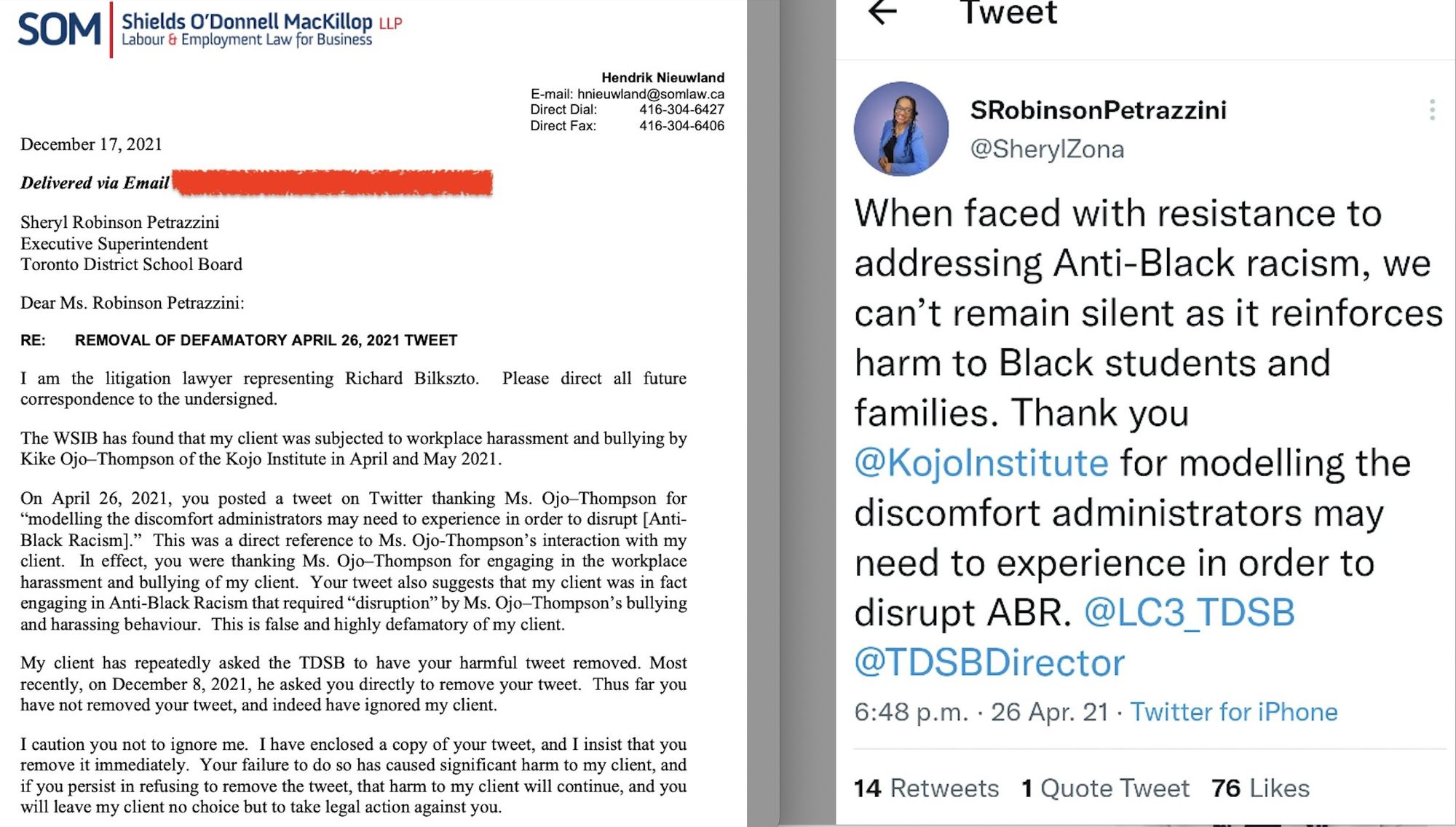
On Twitter, Sheryl Robinson Petrazzini, then the TDSB’s Executive Superintendent, thanked Ojo-Thompson and her KOJO colleague for “modelling the discomfort [that] administrators”—i.e., Bilkszto—“may need to experience in order to disrupt ABR [anti-Black racism].”

For good measure, Robinson Petrazzini also suggested that Bilkszto (whom she did not name, but was the obvious subject of her Tweet) was allied with the forces of “resistance” to anti-racism, and so was abetting “harm to Black students and families.”

Bilkszto personally asked Robinson Petrazzini to delete the Tweet. She did so only eight months later, and only after receiving a letter from Bilkszto’s lawyer warning her that she’d be sued unless she did so.

RIP, Richard Bilkszto, a Toronto Educator Who Stood up to Woke Bullying—and Paid the Price

According to Bilkszto, his other bosses also refused to support him, instead attacking him for his “male white privilege.” And yet, once Bilkszto filed a lawsuit against the TDSB, seeking $785,000 damages for the emotional and reputational harm he’d endured, those same administrators now began claiming that it was Ojo-Thompson who’d gone rogue.

While they’d been perfectly happy to throw Bilkszto under the bus when the stakes were confined to emotional “discomfort,” the TDSB suddenly decided to sue Ojo-Thompson for negligence and breach of contract, demanding that she effectively indemnify the school board for any payout that might become due to Bilkszto. (The TDSB later claimed that it planned to discontinue this suit. But Sakornak reported that it was still a going concern as of June 6.)

I live in Toronto, where my own children have all passed through TDSB schools. Their experience has been a positive one, and I’m happy with the education they’ve received, notwithstanding the sometimes excessive pedagogical focus on race and genderwang. In fact, I have come to sympathize with the teachers—most of them smart hard-working people who find themselves being pressured by their own unions and administrators to adopt militant social-justice postures in their classrooms.

In some school boards, moreover, professional advancement is limited to those who explicitly embrace “anti-racist, high anti-oppressive” leadership principles. So while social-justice puritans comprise a small minority at most schools, they are able to exert disproportionate power in their bid to censure, humiliate, or even oust colleagues, such as Bilkszto, who speak up for the silent majority. In some cases, these ideological enforcers work closely with local race activists and their media allies, so as to harass or censor educators and parents accused of wrongthink.

While the work of anti-racism careerists such as Ojo-Thompson and TDSB Director of Education Colleen Russell-Rawlins is often justified as a righteous crusade against the forces of privilege, it would be difficult to find a more privileged clique of professionals in the field of Canadian public education.

Prior to getting her $300K-per-year TDSB gig, for instance, Russell-Rawlins served as the anti-racism czar at the (even more dysfunctional) neighboring Peel District School Board. Since coming to the TDSB, she’s presided over a series of embarrassing scandals, including an aborted student census that was discovered to be full of overt social-justice propaganda, a revamping of specialty schooling that was found to have been based on a plagiarized research report, and the cancellation of a speaking event by a Nobel-winning ISIS survivor on the grounds that it might be seen as Islamophobic. She’s blithely sailed through all of this without suffering any career repercussions.

The same is true of Robinson Petrazzini, the former $200K/year TDSB superintendent who went on Twitter to spike the football when Bilkszto was humiliated by Ojo-Thompson. Shortly after Bilkszto lawyered up, Robinson Petrazzini became Director of Education at the neighbouring Hamilton-Wentworth District School Board.

As for Ojo-Thompson, she continues to be feted by numerous Canadian organizations and media outlets. In 2022, she served on the board of directors of Parents of Black Children, a Toronto-area lobby group that’s made a name for itself largely by urging school boards to implement the same anti-racism instructional modules that constitute Ojo-Thompson’s own stock-in-trade. (Her partner Rohan served until recently as Workplace Equity Manager with the Peel District School Board, and the two would appear together on stage to talk about “the Impact of Systemic Racism on K-12 Workplace Well-Being.”) The market for the sort of militant anti-racist diatribes that Ojo-Thompson peddles seems inexhaustible within Canada’s corner offices, and I seriously doubt whether even the negative attention resulting from Bilkszto’s death will dent her income.

And in any case, she’s been through this before—for this was not the first time that Ojo-Thompson has encountered “resistance”: A 2021 diversity training session that she delivered to councilors of Sarnia, a small Ontario city on the shores of Lake Huron, reportedly sparked a revolt among some audience members, causing Ojo-Thompson to quit that gig in a huff.

“The undisputed, uncorrected, and unabated hostility demonstrated by some members of Council toward our Principal Consultant Kike Ojo-Thompson was wholly inappropriate,” declaimed the KOJO Institute’s director of client services, Craig Peters. “There were things that were said in that meeting—that we won’t divulge—that led us to believe that it wasn’t in the organization’s best interest to continue.”

When contacted by The Sarnia Journal, Ojo-Thompson added that the comments she’d heard had made her feel unsafe.

“Safety isn’t always physical,” said Ojo-Thompson. “There is emotional and mental harm that can be done.”

No doubt, Richard Bilkszto (1963-2023) would agree.

Source: RIP, Richard Bilkszto, a Toronto Educator Who Stood up to Woke Bullying—and Paid the Price

Shunned in India, shunned in Canada. What it’s really like to face casteism

Of note:

Segregated. Landless. Unpaid. Shunned. Shamed. Bonded in perpetuity. While these conditions may well describe the enslaved people of the Antebellum South, they are but some of the markers of another brutal system that is the world’s oldest surviving structure of discrimination.

A Canadian scholar argues in an upcoming book that the caste system of the Indian subcontinent, which established Brahminical supremacy there, was a template for the racial caste system that established white supremacy here.

“Caste is a template for race,” says Chinnaiah Jangam, a historian at Carleton University.

One week after the Toronto District School Board’s historic vote in March that marked the first time that caste as a basis of discrimination was formally recognized in Canada, a human rights tribunal awarded a B.C. man more than $9,000 after finding that he had been a victim of casteism. 

Meanwhile, Seattle became the first U.S. city to ban casteism by incorporating caste into its anti-discrimination laws in February. In the two years prior, Harvard University added caste as a category to its anti-bias policies. The California State University System has joined it in making caste a protected status in its anti-discrimination policy.

Casteism, vaguely understood in the West as a backward South Asian cultural phenomenon, is finally beginning to be reckoned with in Canada, thanks to decades of advocacy by caste-oppressed people. But caste-based discrimination, which manifests in myriad ways, should not be understood or dismissed as an internal South Asian matter. 

Oppressions such as casteism and racism “need to be seen as interconnected, as part of the global empire,” says Jangam, who is one of the first Dalit scholars in the country.

“To put it simply, caste equity is a human rights issue,” says Anita Lal, a B.C. Dalit activist and founder of the advocacy group Poetic Justice Foundation.

What is caste?

Some 3,000 years ago, a system named “Chaturvarna,” or four occupation-based categories, came into being in Hinduism. It would morph into a caste system laced with harmful associations of spiritual purity and pollution. As with chattel slavery, the system decreed that the caste one was born into was fixed and passed on through family in perpetuity.

https://misc.thestar.com/interactivegraphic/2023/04-april/03-caste/index.html

The “highest” in this caste order was the Brahmin, or the priestly class; the “lowest” was the Shudra, tasked with doing menial work. 

Outside of this four-class social framework existed humans deemed beneath even being categorized. They were the Dalits, formerly “untouchables,” and Adivasis, literally meaning Original Inhabitants, the Indigenous forest dwellers on traditional lands.

“Dalit,” or “broken but resilient,” is the cultural and political identity adopted by people from more than 1,000 oppressed castes, many of whom prefer it to the legal category of “Scheduled Caste.”

The term rose in popularity in the 1970s alongside the Dalit Panthers, who fashioned themselves after the Black Panthers. “They adopted the same form of radical protest, rejecting Brahminism, talking about abolition of caste, abolition of class and working-class solidarity,” says Jangam.

But unlike Black resistance heroes such as Malcolm X, they rejected all forms of religion, he says.

This is not surprising. Hinduism is not a centralized religion and caste as a concept seeped across the Indian subcontinent and beyond, crossing religious lines and shape-shifting to fit regional traditions.

Yalini Rajakulasingam, the TDSB trustee who brought forward the motion to ban caste discrimination, says, “If food and culture and language can travel through diasporas, of course, privileges and power can as well. No one’s going to want to let go of something that gives them privilege.”

The origins of caste may be ancient but the discriminatory effects in Canada, where the Dalit population is loosely estimated to comprise about 15 per cent of South Asians, are contemporary.

“There are many narratives within the community that have been silenced,” says Lal.

“It’s time to give voice to those stories.” 

The story of Vijay Puli 

GTA resident Vijay Puli was born to a Mala Dalit community in the southern Indian state of Andhra Pradesh in the 1970s. 

“I don’t say I was born in the village,” he says. “I was born in the Dalit ghetto.” 

His community was segregated from the nearby village by dominant castes who practised the crime of untouchability. Dalits were forced to walk on separate paths. They were not allowed to drink water from the village well, not allowed to enter temples. Dalits were considered so polluted that the slightest touch, even being touched by a shadow cast by a Dalit, was considered to defile an “upper caste” person.

While India banned untouchability in 1950, stories of exclusions, beatings, assaults, rapes and lynchings of people from the “Scheduled Caste” form part of its daily news landscape. According to its National Crime Records Bureau, more than 180,000 criminal cases targeting Dalit communities were registered in the four-year period from 2018 to 2021.

When Rajakulasingam, the Toronto school board trustee, who identifies as a caste-oppressed Tamil, visited India in 2010, she says, “There were times when I would go to people’s homes and they would give me different (separate) utensils to use.”

Puli went to a dilapidated school in his colony in the 1970s. (Years later, Human Rights Watch researchers who visited schools in Dalit neighbourhoods in 2014 found they still lacked clean drinking water, toilets and adequate classrooms or teachers.)

Then it came time in the 1980s to go to a high school that was located in the village. 

Puli says he and his friends were very nervous about being around dominant-caste students and staff, and they sat at the back of the class. Teachers mocked them with casteist slurs if they didn’t answer questions correctly. Puli would hear slurs during playground fights, even when they were between dominant-caste kids. “Forgive me for using words like these,” he says, “but they would say ‘your mom should be f—ed by a Mala person.’ That means it’s very, very dirty.” Sometimes he would get into fights over this, he says.

This manifestation of casteism in the form of contemptuously flinging the name of a Dalit caste as a slur is a common experience in Canada. In the case that was brought forward to the B.C. tribunal, complainant Manoj Bhangu was able to prove the slur, Chamaar — the name of his Dalit caste, which is historically associated with leatherwork — was uttered by Inderjit and Avninder Dhillon during a brawl in 2018.

When Puli went to a small town for his undergraduate degree, it offered segregated hostels for students. Rather than staying in the “backward caste” hostel, his father got a room in one for the dominant castes, thinking he might learn to fit in better that way.

Fitting in or trying to “pass” as non-Dalit is a common coping strategy. In “Coming Out as Dalit,” the award-winning journalist Yashica Dutt writes how her Dalitness weighed heavily on her as she worked hard to hide it. “I dragged its carcass behind me through my childhood and adulthood,” she writes.

Cows, considered holy for Hindus, and beef — considered taboo — are an unholy symbol of caste injustice. If a cow died, it would be the job of a Dalit to carry the cow off and skin it for leather, the products of which the dominant castes had no problem using. Given that the Dalits lived in grinding poverty, the meat of the cow represented survival, and they ate it.

While Dalits remained historically downtrodden under governments led by all Indian political parties, in the current reign of Hindutva-fuelled governance, even the mere accusation of slaughtering a cow risks mob violence for Dalits (and Muslims).

Puli’s parents had stopped the family practice of eating beef when he was young as it would have marked Puli as Dalit. But his attempt to “pass” at the hostel ended quickly. When his roommate — a young man Puli considered a friend — found out Puli was Dalit, he changed rooms right away.

When Puli went to the state capital, Hyderabad, for his post-graduation, he had to switch from learning in his native Telugu language to English. “On the first day they (students) started laughing at me,” he says. They jeered at his English-language skills and treated him like he was the village idiot.

Whether in a village, a town or a city, casteism manifested as denigration and mocking, Puli said. No amount of education or worldliness changed those attitudes. 

Decades later, after the birth of his first child, Puli decided to move to Canada to escape from the relentless casteist violence. He assumed the lack of casteism in the founding of institutions here would mean there would be no casteism here.

“I knew that there is this racial discrimination here, and definitely, we are ready to face it like other South Asians, you know?”

He says he thought the South Asians, having faced discrimination, would stick together as a minority community. “Once I came here, it was completely opposite.”

Casteism in Canada

While casteist practices may not be as brutally explicit in Canada, anti-caste abolitionists and grassroots activists say this predatory system stigmatizes and profoundly affects people’s livelihoods, romantic lives, education and social self-worth. People of privileged castes who dominate the diasporic culture influence language, music, films and daily practices.

For instance, the larger-than-life Bollywood-influenced Indian weddings where a flower-bedecked groom shows up on a horse is a popular cultural image. But it is an “upper caste” symbol of revelry. A Dalit groom who gets on a horse in India may be stoned or otherwise humiliated and forced down.

Similarly, the practice of yoga is deeply linked to “upper caste” practices of vegetarianism (associated with spiritual purity), use of Sanskrit (language of the gods, not taught to “lower castes”) and the concept of karma (paying for — balancing out — sins of past lives). Karma enforced caste; according to this philosophy, “lower castes,” as sinners in past lives, had only themselves to blame for their plight.

In language, the commonly used word “pariah,” for instance, is a casteist slur. “Pariyar” is a Tamil Dalit caste. During British colonization, the word was anglicized to pariah — and its meaning expanded to include all oppressed castes to mean “outcaste.”

When Puli arrived in Canada, he lived in a Mississauga basement. In his first month, a Sikh neighbour, assuming he was of dominant caste, conversationally pointed to another family in the neighbourhood saying, they were from the Chamaar caste.

“She said that they are lower-caste people. ‘We don’t go to them and we don’t associate with them. They don’t come to our temple. We don’t go to their temple. We never go to their house.’ So, yeah, that was the first incident me and my wife encountered in Canada. We thought that, wow, it is here, too.”

Although caste hierarchy does not exist in Sikh religion and scriptures, the practice of untouchability and discrimination still exists, says Lal, the B.C. activist, who identifies as a Punjabi Sikh Canadian born into a Dalit family. She is of the Chamaar caste.

Caste among Sikhs does not rely on a purity-pollution binary. Rather, power rests on ownership of land, Lal and co-author Sasha Sabherwal write in a chapter in “A Social History of South Asians in British Columbia.” This makes Jats a large and powerful caste group in Punjab and the diaspora.

“In Canada, for instance, it is predominantly Jats who step into organized state and federal politics,” they write.

It’s common to see images of men on Tinder or other dating apps with handles including caste names such as Jat. Inter-caste marriages with an oppressed-caste member remain highly stigmatized in Canada among diasporic communities, including those from the Caribbean and Africa.

Lal’s own family is inextricably linked to the history of caste-based oppression in Canada.

Her great-grandfather, Maiya Ram Mahmi, who came to Canada in 1906, is considered one of the first Dalits to come to North America. “It’s understandable that the first story of caste discrimination would be his, because caste, a system of exclusion based on purity, follows you wherever you go,” she writes in an email.

Mahmi worked in a sawmill in Paldi, B.C., where men worked during the day and ate in the cookhouses in the evening. Mahmi, “along with one other fellow Chamaar, were not allowed to eat in the cookhouse with the rest of the workers and were forced to eat their meals in their rooms,” Lal says. Only after an “upper caste” supervisor intervened and threatened the other workers with job loss did they relent.

“At a time when they were facing harsh racism from the white man, learning to live in a whole new country which was so different than their own, without their family and loved ones, building community with the other South Asians, they still practised untouchability and continued to exclude and do more harm,” Lal says.

More recently, in Toronto, Puli co-founded the South Asian Dalit Adivasi Network Canada with fellow caste-oppressed people. They mark April as Dalit History Month to honour the births and deaths of Dalit rights leaders that fall this month, including B.R. Ambedkar, the principal architect of the Indian constitution, a renowned visionary and intellectual, who is revered as an icon of resistance.

When Puli’s own daughter was cruelly subjugated to casteism by fellow students, he had had enough. He went about mobilizing support to get the Toronto school board to recognize caste as a basis of discrimination. He got in touch with Rajakulasingam, who he says “got it” at once, and the rest is — historic.

The deep roots and widespread reach of casteism in Canada make it imperative for social and political organizations to create tools to address caste-based discrimination in their own spaces. 

When organizations such as the TDSB take this step, “it allows people who face casteist discrimination to come forward, and with some legal protection in place, to feel safe to do so,” says Jangam, the Carleton historian. “This is one of the ways that Canada as a liberal society makes a path for people to be who they are.

“No human being deserves to live in fear.”

Source: Shunned in India, shunned in Canada. What it’s really like to face casteism