Maple Leafs Tavares Fight Over Tax Issue Raises Immigration Questions

Not a problem for most of us!

In the realm of professional sports, where contracts are inked with extravagance and fortunes are amassed overnight, taxation emerges as a critical factor influencing immigration patterns. A case in point is the ongoing legal saga involving Toronto Maple Leafs’ captain, John Tavares, and a $20 million signing bonus he received from the Maple Leafs in 2018.

The Heart Of The Issue

At the heart of the issue lies the structuring of Tavares’ compensation. The Canada Revenue Agency contends that his entire bonus should be categorized as salary, subjecting it to a higher tax rate, rather than being considered a lower-taxed inducement under the Canada-U.S. taxation treaty.

This legal battle spotlights a broader challenge facing Canadian professional sports teams. Over the years, they have grappled with attracting top-tier talent, especially when compared to their U.S. counterparts situated in jurisdictions with lower tax rates. This tax disparity puts Canadian teams at a disadvantage, hampering their ability to secure star players to bring them to Canada and compete on an equal footing.

Broad Implications For This Precedent

As the legal showdown unfolds, its implications extend beyond Tavares’ personal finances to the very core of Canadian competitiveness. The outcome of this case could establish a precedent for future contract negotiations in professional sports, influencing decisions on where elite athletes choose to pursue their careers and the financial viability of Canadian franchises.

Source: Maple Leafs Tavares Fight Over Tax Issue Raises Immigration Questions

The Limits Of Nudging: Why Can’t California Get People To Take Free Money?

Interesting study and analysis. Wasn’t able to find comparable take up data to the Canadian equivalent (Working Income Tax Benefit rebranded as the Canada Workers Benefit) but about 5 percent of tax filers claim the benefit.

Given the number of benefits delivered through the tax system, expect Canada has a higher filing rate than the US:

The Earned Income Tax Credit supplements incomes through the tax code, awarding thousands of dollars each year primarily to low-wage workers with kids. But there’s a problem: a huge population of eligible workers fails to file their taxes and get the money each year.

Several years ago, the state of California established their own state EITC (CalEITC) on top of the federal one. Depending on how many kids they have and how much they earn, a Californian who files for both the state and federal credit can get upwards of $6,000. For the poorest households with kids, those tax credits could almost double their household income. There’s a lot of money on the table to help the most at-risk families in the state, and California policymakers have grown concerned about the large number of eligible workers failing to file taxes and claim their credits.

In 2018, the state of California and the California Policy Lab, an interdisciplinary think tank of scholars from various University of California schools, started trying to solve this problem, and they commissioned one of the most fascinating experiments in “nudging” we’ve seen in a while.

Nudge Experiments

Nudges are simple, low-cost interventions aimed at gently guiding people to make better decisions. For example, making retirement plans the default option when you join a job, which has been shown to significantly increase the likelihood you save more for retirement. The California Policy Lab and its partners decided it would try and nudge workers to claim the EITC by sending them letters and text messages. The solution seemed like a no brainer: inform people how they can get free money, and they’ll get that free money! If only it were that simple.

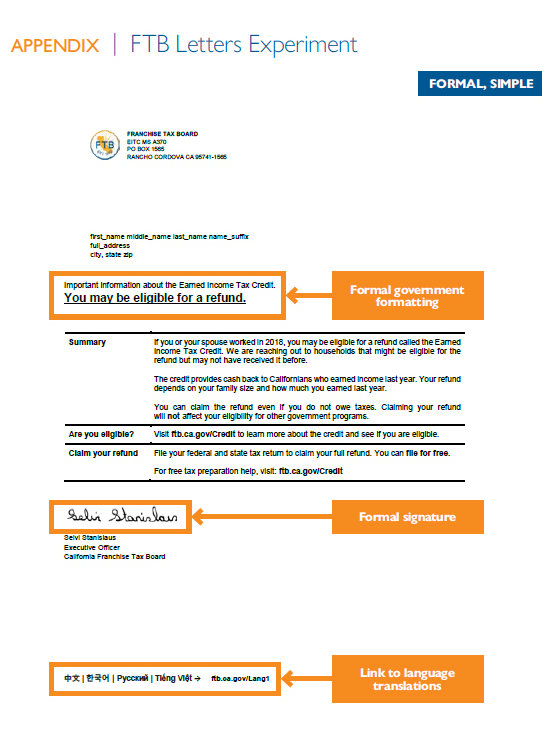
The researchers conducted field experiments for two years on over a million Californians. They randomly divided them into treatment groups, which received various types of messages, and a control group, which received no message. “We were trying lots of different ways of reaching people, lots of different messages you could give people, but to try to test what would be most effective,” says Jesse Rothstein, a labor economist at UC Berkeley who co-directs the California Policy Lab. The researchers tried to make sure these letters and text messages didn’t look like a scam. Below is an example of one letter they sent:

An example of a letter sent in the EITC experiment

California Policy Lab

“We found a very precise zero effect,” says Elizabeth Linos, a behavioral scientist at UC Berkeley who was also behind the study. Many of those who received the messages, she says, did visit the website advertised in the messages to help them sign up for the EITC. But in the end, they didn’t fill out the forms to receive their credit. They turned down free money. “We weren’t able to increase the rate at which people file for taxes and we weren’t able to increase the number of households that claim the EITC,” Linos says.

This experiment might seem like a gigantic failure for behavioral economics and the theory of nudging. But both researchers believe their findings support the broader idea that people aren’t the perfectly calculating, error-free creatures of traditional economic models. They’re turning down free money — even after they’re informed they can get free money.

The researchers don’t have a solid answer for why the nudges failed. They believe, however, a big part of the problem has to do with tax forms. “Those of us who file taxes know that it’s not so easy to file taxes,” Rothstein says. “And so we’ve gotten people to understand that it’s there and to want it. But we haven’t really given them the tools that it would take to make it easy for them to claim it.”

Linos and Rothstein believe our tax system is too complicated, and that we should make claiming the EITC, and filing for taxes more generally, much simpler. Linos says the good news is that other countries provide examples of systems that don’t require mind-numbing paperwork to file for taxes or receive government benefits. “In a lot of countries, the government uses information they already have on you to pre-populate your tax forms,” she says. In other words, they tell you what you owe. Or are owed. Then you can just look it over and click send.

But we’re not other countries. We’re the USA, where filing for taxes is still stupidly hard. The IRS estimates that about 20 percent of eligible taxpayers fail to file and claim the EITC. Rothstein believes the solution to getting more people signed up for the EITC has to be a mixture of nudging them to sign up and “structural changes that make it easier to file taxes.” This could include an expansion of programs aimed at giving people assistance with taxes, including software designed to make filing easier.

A dark view of the findings might write off this population as doomed to poverty because of bad decision-making and self-destructive behavior. But psychologist Eldar Shafir and economist Sendhil Mullainathan suggest a more charitable lens, which they call the “psychology of scarcity .” Their research suggests the poor bear a unique cognitive burden that hurts their decision-making. They work long hours. They have higher stress. They’re consumed with thinking about paying their rent, getting their kids medical care, and putting food on the table. Shafir and Mullainathan find these stresses lower their “mental bandwidth,” and it might help explain why so many low-income Californians are turning down free money.

Source: The Limits Of Nudging: Why Can’t California Get People To Take Free Money?

India: Economic Survey Quotes Hinduism, Islam, Christianity to Deter Tax Evasion

Of interest:

The Economic Survey, tabled in Parliament on Thursday, suggests invoking the doctrine of “pious obligation” as well as blend principles of behavioural economics with spiritual norm to tackle tax evasion and wilful defaults.

Bringing in a sense of novelty into the Economic Survey, that provides a detailed picture of the economy in 2018-19 and the way ahead, tenets of Hinduism, Islam and Christianity have been cited extensively to tackle debt woes and tax evasion.

Such suggestions find a place the chapter titled ‘Policy for Homo Sapiens, Not 02 Homo Economicus: Leveraging the Behavioural Economics of “Nudge”‘.

The Economic Survey said that decisions made by real people often deviate from the impractical robots theorised in classical economics.

Drawing on the psychology of human behaviour, it said that behavioural economics provides insights to nudge people towards desirable behaviour.

The “doctrine of pious obligations” could be invoked to encourage people to clear their debts and also pay taxes, the survey, prepared by a team led by Chief Economic Adviser KV Subramanian said.

“Given the importance of religion in Indian culture, the principles of behavioural economics need to be combined with this spiritual / religious norm to reduce tax evasion and wilful default in the country,” it noted.

In Hinduism, non-payment of debts is a sin and also a crime. The scriptures ordain that if a person’s debts are not paid and he dies in a state of indebtedness, his soul may have to face evil consequences, according to the survey.

Therefore, it is the duty of his children to save him from such evil consequences. This duty or obligation of a child to repay the debts of the deceased parent is rested upon a special doctrine, known as the doctrine of pious obligation, it said.

In Islam, Prophet Muhammad advocated, “Allaahummainnia’oodhibika min al-ma’thamwa’lmaghram (O Allaah, I seek refuge with you from sin and heavy debt)”. A person cannot enter paradise unless his/her debt was paid off, as per the survey.

All of his/her wealth could be used to pay the debt and if it is insufficient then one or more heirs of the deceased could voluntarily pay for him, it stated.

Quoting Bible, the survey said, “Let no debt remain outstanding except the continuing debt to love one another – Romans 13:8” and “The wicked borrows and does not repay, but the righteous shows mercy and gives – Psalm 37:21”.

The Economic Survey notes that in India, where social and religious norms play such a dominant role in influencing behaviour, behavioural economics can therefore provide a valuable instrument for change.

“So, beneficial social norms can be furthered by drawing attention to positive influencers, especially friends/neighbours that represent role models with which people can identify,” it said.

Also, as people are given to tremendous inertia when making a choice, they prefer sticking to the default option. By the nearly costless act of changing the default to overcome this inertia, desired behaviour can be encouraged without affecting people’s choices.

Further, as people find it difficult to sustain good habits, repeated reinforcements and reminders of successful past actions can help sustain changed behaviour, the survey said.

According to the survey, insights from behavioural economics can be strategically utilised to create an aspirational agenda for social change — from BBBP (Beti Bachao Beti Padhao) to BADLAV (Beti Aapki Dhan Lakshmi Aur Vijay Lakshmi); from Swachh Bharat to Sundar Bharat; from “Give It Up” for the LPG subsidy to “Think about the Subsidy” and from tax evasion to tax compliance.

The survey has used ‘MARD‘ as an acronym for ‘Men Against Rape and Discrimination’ and suggested a campaign underlining the sacrifice of the male ego in a patriarchal society for the larger good of gender equality.

Mard is a Hindi word for man.

Source: Economic Survey Quotes Hinduism, Islam, Christianity to Deter Tax Evasion

Why won’t Trudeau stop real estate scammers? Gary Mason

Builds on earlier article by Douglas Todd (Todd: Tax avoidance behind Metro’s disconnect between housing, income):

Prime Minister Justin Trudeau is getting a rough ride for going after doctors and small-business types allegedly exploiting the tax system to their benefit.

Perhaps Mr. Trudeau would get more brownie points pursuing those gaming the real estate sector, people who are leaving a far more critical problem in their wake than anyone sprinkling income to pay a few less dollars in tax.

The latest census information underscored once again the inexplicable divide that exists between average incomes in certain parts of the country and house prices. The median total income for households in Metro Vancouver, for instance, was $72,662 in 2015 – 15th in the country. In the city of Vancouver, it falls to $65,327 – an area in which the average house price is $1.4-million. In neighbouring Richmond, B.C., the average house price is over $1-million and the median total income is a paltry $65,241.

Only when you go further out into the burbs, where house prices are lower, do incomes begin to rise. In Surrey, for instance, the average home price is $764,000 and median total income was $77,494 in 2015, according to the recent census.

In a place such as Calgary, median household income was just under $100,000 and average house price around $460,000 – so there isn’t nearly the disconnect that you see in Vancouver or Greater Toronto, where the average home costs just over $750,000 and median household income was $78,373.

In Metro Vancouver, some of the most expensive areas for housing – Vancouver, Burnaby and Richmond – claim some of the highest poverty rates.

Richard Wozny, a real estate analyst with Site Economics, has delved into the numbers in Metro Vancouver. He says that in the world of economics there is something called the median multiple, which is the ratio of income to average house price. So, if you earn $100,000 and the average house price in the city in which you live is $200,000, than the ratio is two to one, or simply two.

A median multiple of three or under is considered affordable; five and over is considered seriously unaffordable. Hong Kong, one of the most expensive housing markets in the world, had a multiple of 19 in 2015, according to a Demographia study. Australia’s Sydney, another city with extreme house prices, had a multiple of 12.

Metro Vancouver’s median multiple exceeds 20, with some municipalities such as the city of Vancouver and West Vancouver in the high 30s. And yet, the median household incomes in some of those same ultra-expensive neighbourhoods fall below the regional average. How do you explain that?

Mr. Wozny says even factoring in the likely percentage of retirees in some of these areas, the numbers make no sense. More likely, some of those buying homes for $1-million, $2-million or $3-million are not reporting their full incomes. We know that, in some cases, wealthy offshore investors are using trusts and numbered companies as well as spouses and children to buy homes while reporting little annual income.

Meantime, people in the “outer burbs” living in homes of less value are reporting more. In other words, there are people of moderate income living in Metro Vancouver who are, through their taxes, paying a greater share of the costs of the regional services and infrastructure that others, making far more income, also enjoy.

Canada has become an Eden for money launderers and tax evaders, allowing many to freeload off of others who can ill afford it. It was disclosed this weekthat since 2015, the Canada Revenue Agency has identified hundreds of millions in taxes owing in real estate transactions. Yet only three cases nationwide have been referred for criminal prosecution.

Mr. Wozny looks at a city like Seattle that has a higher median household income than Vancouver and lower average house prices. He believes part of the reason for that is because the United States has tougher regulations, including taxing worldwide incomes. This helps prevent offshore opportunists from scamming the tax system and pillaging the real estate market to the detriment of honest, hard-working Americans.

It’s ironic that the proposed tax changes that are causing Mr. Trudeau so much grief are supposed to benefit the middle class, that fuzzy demographic the Prime Minister loves to defend.

Yet, that same middle class in parts of this country are getting absolutely hosed by some who are helping to drive up housing prices, reaping the financial rewards from it, but not paying the same costs as everyone else.

It’s not fair. And the government needs to do something about it.
Source: Why won’t Trudeau stop real estate scammers? – The Globe and Mail

Political activity audits of charities suspended by Liberals

A significant roll-back of the previous government’s approach:

The Liberal government is suspending the few remaining political activity audits of charities after an expert panel report recommended removing a political gag order imposed on them by the Conservatives five years ago.

As an immediate first step to respond to the panel’s recommendations, National Revenue Minister Diane Lebouthillier “has asked the CRA to suspend all action in relation to the remaining audits and objections that were part of the Political Activities Audit Program, initiated in 2012,” a release Thursday said.

The panel report, also released Thursday, and the suspension together appear to end a long chill for charities that began in 2012, when the Conservative government launched 60 political activity audits, starting with environmental groups that had criticized federal energy and pipeline policies.

A spokesperson for the minister, Chloe Luciani-Girouard, said Thursday’s suspension affects 12 audits, of which seven have resulted in an intention to revoke charitable status.

The program cost environmental, anti-poverty, human-rights and religious charities significant staff resources and legal fees, and brought an “advocacy chill” to the sector, with many groups self-censoring lest they be caught in the Canada Revenue Agency’s net or annoy their auditors.

The Liberal Party campaigned in the 2015 election to end the “political harassment” of charities, but once elected did not quite end the program. Instead, the new government cancelled six of the political activity audits that were yet to be launched, but allowed audits already underway to continue.

That left groups such as Environmental Defence and Canada Without Poverty, which were deemed too political by CRA, still under immediate threat of losing their charitable status. Thursday’s announcement lifts that threat, at least until the government responds to the panel recommendations.

The five-member panel, chaired by Marlene Deboisbriand on the board of Imagine Canada, says Canada’s charity law and regulations are too restrictive and vague. It calls for changes to the Income Tax Act to delete any reference to “political activities” with regard to charities.

Would change enforcement

The change would be “to explicitly allow charities to fully engage, without limitation, in non-partisan public policy dialogue and development, provided that it is subordinate to and furthers their charitable purposes.” The CRA would also dramatically change its enforcement activities.

The panel report, based on wide consultations last fall, also said there was broad consensus in the charity sector that partisan activities — endorsing particular candidates or parties — should remain forbidden.

The panel recommended that a charity’s political activities, whether pressing for a change in government policy or buttonholing a politician, be judged on whether they further the group’s charitable purpose.

The proposed changes would eliminate current rules that restrict a charity’s political activities to 10 per cent of their resources. Critics have argued the rules are unclear on definitions of what constitutes a political act.

Source: Political activity audits of charities suspended by Liberals – Politics – CBC News

‘Can I get a tax receipt?’: Tax confusion muddles Syrian refugee sponsorship efforts

Interesting wrinkle and will be interesting to see how it is resolved:

As the Toronto office of Lifeline Syria scrambles to accommodate thousands of refugees, the question the charity’s chair Ratna Omidvar and her team hears most often is: “Can I get a tax receipt?”

In many cases, the answer is no.

Canada has so far welcomed more than 13,500 refugees since the Liberal government’s program began last November. Of that total, close to 5,000 have been supported by private sponsors.

Refugee support initiatives such as Lifeline Syria say allowing donors to receive a tax receipt when they are donating to a registered charity and suggesting a particular family to receive support would encourage more donations, ease the government’s burden and make integration easier. Currently, charities can issue tax receipts to donors who indicate they’d like their donation applied to a specific area of interest, such as refugees, but not when the donation is directed to a particular family.

“The more Canadians step up and promote charities, the less the government is going to have to do these things,” says Estelle Duez, a tax lawyer at LaBarge Weinstein in Ottawa.

“As Canadians, we are used to the notion that when we make a charitable donation, (we) will get some kind of tax relief,” says Paul Clarke, executive director of Action Réfugiés Montréal. He says despite the extraordinary support Canadians have shown for Syrian refugees to date, questions around tax deductibility dissuade some people from sponsorship.

Mark Blumberg, a Toronto lawyer who specializes in non-profit and charity law, says the Canada Revenue Agency could make donating and sponsoring easier by clarifying the rules. Although money given to a registered refugee charity is normally tax deductible, Blumberg says the situation becomes more tricky when a donor instructs the money should go to a specific person or family, sometimes referred to as a “general direction” or “directed gift.”

The CRA’s position is that “All decisions regarding use of the donation must rest with the charity.” In other words: it cannot issue a tax receipt if a donor wants the charity to give the funds to a specified person or family, because “such a gift is made to the person or family and not to the charity.”

Exceptions add to the confusion. For example, a “general direction” to use the gift for a “particular program” is acceptable, provided “no benefit accrues to the donor” and the gift “does not benefit any person not dealing at arms’ length with the donor.”

If the CRA provided greater leeway, “there’d be more people making donations,” says Blumberg. He cites the partial receipting of tuition costs at religious day schools.

Source: ‘Can I get a tax receipt?’: Tax confusion muddles Syrian refugee sponsorship efforts