Canada is accepting a higher proportion of asylum seekers than it has at any time in nearly three decades, a CBC News investigation has found.
CBC obtained almost 90,000 asylum claim decisions made by the Immigration and Refugee Board of Canada between January 2013 and September 2017.
The decisions indicate where each asylum seeker comes from, why they said they had to flee their homeland and whether their bid to stay in Canada was successful.
Download the raw data and see CBC’s full analysis here
The acceptance rate increased significantly in the past five years, to 70 per cent in the first nine months of 2017, up from 44 per cent in 2013.
The last time acceptance rates were this high was in 1991.
When asked what’s behind the increase, IRB spokeswoman Melissa Anderson said each refugee claim is reviewed on its own merits and decided on the basis of the facts and evidence presented.
Many asylum seekers say they were forced to flee criminals or gangs.
Most immigration experts who spoke with CBC News agree an important factor was likely changes to the IRB system introduced at the end of 2012.
The result was that, in most cases, a claim had to be heard within 60 days of being accepted by the IRB. Before that, cases wouldn’t be heard for about 18 months, said Vancouver refugee lawyer Douglas Cannon.
Because lawyers had so much lead time, board members expected to see considerable evidence in order to approve a claim, he said.
But with the drastically shortened timelines, those expectations became unreasonable, he said, and board members had to make a call based on the evidence that could be gathered within two months.
Before the changes, for example, it may have been possible to get a police statement from Colombia documenting a reported assault, but likely not within 60 days.
 Because refugee law requires board members to give the claimant the benefit of the doubt, acceptance rates went up, Cannon said.
“It’s not a judgment of the board lowering its expectations in order to render a positive. It’s a board doing the job that it needs to do in a much more efficient manner. And that is a good thing.”
Catherine Dauvergne, dean of the University of British Columbia’s Allard Law School, said it’s also possible a new training program for board members introduced in 2013 contributed to the bump in approvals.
The more comprehensive program gave board members a better understanding of all the factors that go into deciding a refugee claim and the obstacles the claimants face, she said.
Dauvergne said another factor could be an infusion of new board members replacing old ones who may have been suffering from “compassion fatigue.” A rule change in late 2012 scrapped the appointment system to allow any qualified federal civil servant the opportunity to apply for a spot with the IRB.
Reasons for fleeing
The data obtained by CBC also showed the top reason for seeking asylum was to flee criminals or gangs, but individuals who made such claims were among the least likely to be approved by the IRB.
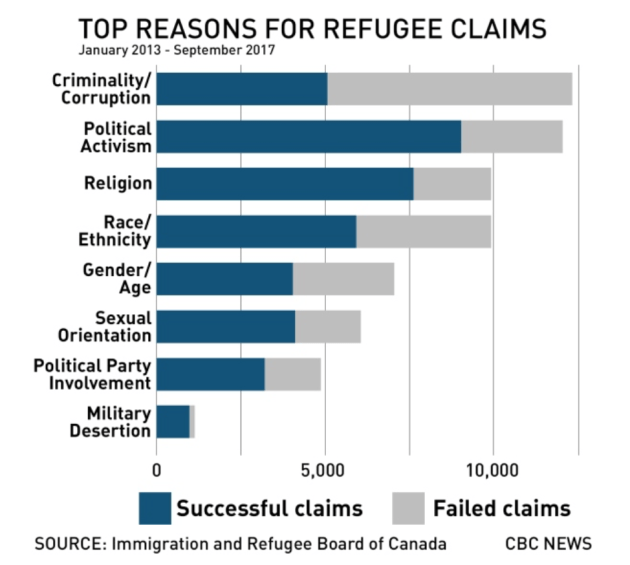 One of the criteria for a successful refugee claim is to what degree a claimant fits the United Nations definition of a convention refugee: Having a well-founded fear of persecution for reasons of race, religion, nationality, political opinion or membership in a particular social group.
Those fleeing criminals or gangs often do not meet these criteria.
Political and religious refugees were the most likely to be accepted.
Source countries
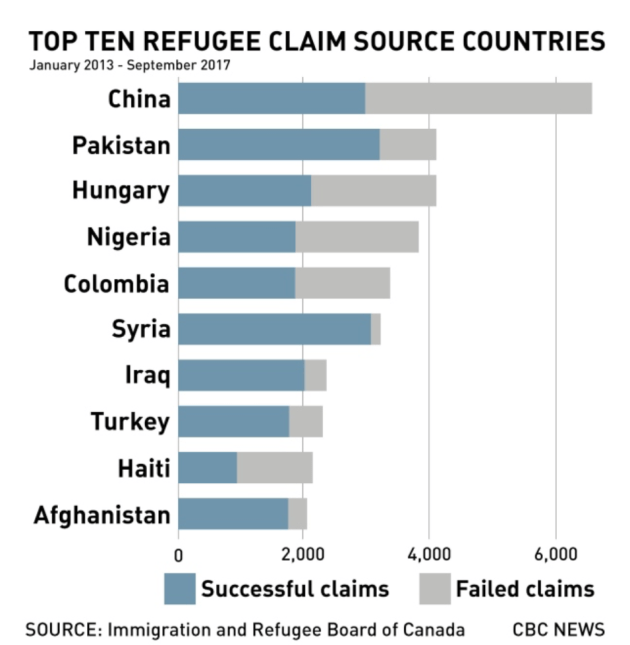
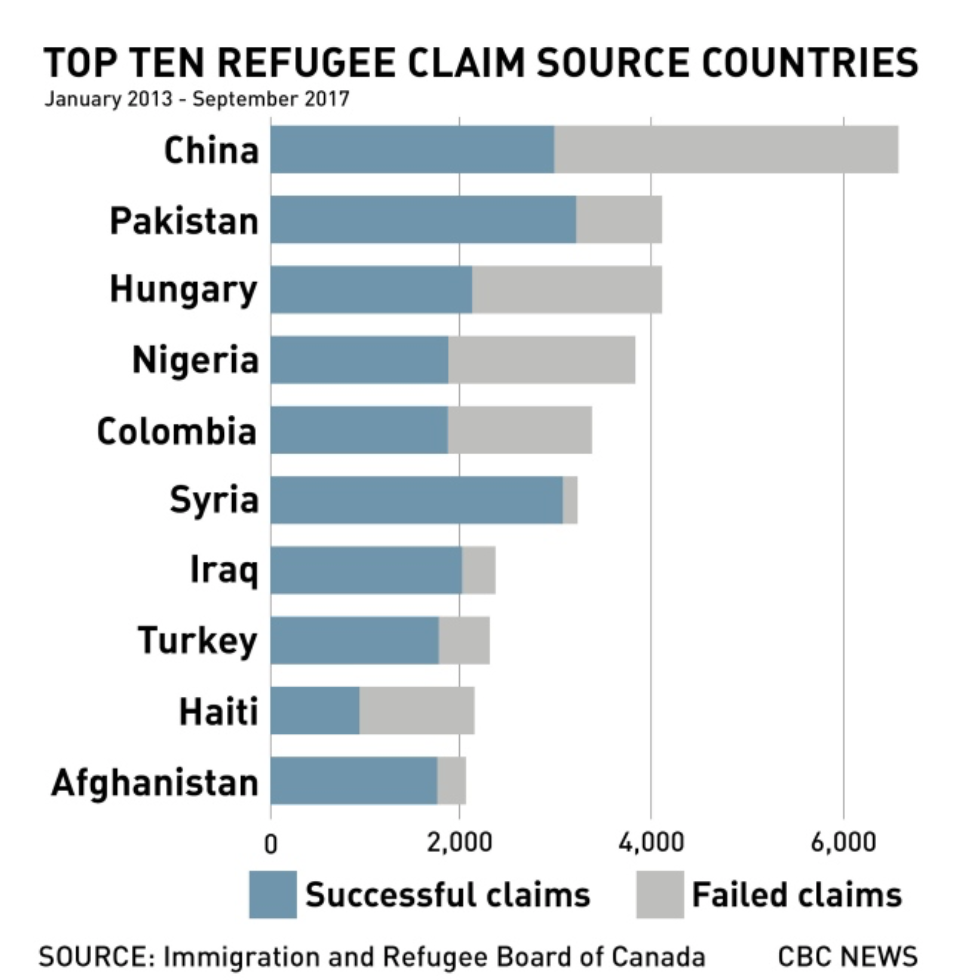
Another key finding was that asylum seekers from China had the highest number of refugee claim decisions over the five-year period, but that number began dropping significantly in 2015.
The drop was attributable to two factors unique to that country: fewer claims from the Falun Gong spiritual group and the end of the one-child policy in 2016.
Decisions on claims from Hungary also dropped from almost 2,000 in 2013 to about 400 in the first nine months of 2017. This was due to substantially fewer claims from members of the Roma ethnic group.
Meanwhile, Nigeria surpassed China as the country with the most refugee claim decisions in Canada last year. Many of the claims from Nigerians relate to sexual orientation and gender persecution.
Claims from Turkey have also increased significantly, making that country Canada’s second-largest source of asylum seekers. These claims were mostly political in nature, or from members of the Kurdish ethnic group.
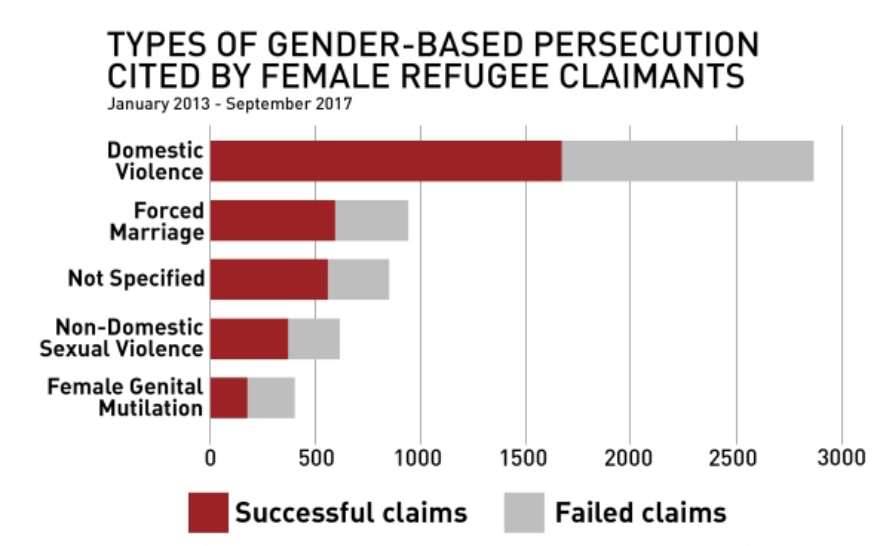
Claims based on domestic violence are, like all refugee claims, assessed based on two elements: the risk an individual faces and to what degree they can be protected in their home country, said Catherine Dauvergne, dean of the University of British Columbia’s Peter A. Allard Law School and an expert in refugee and migration law.
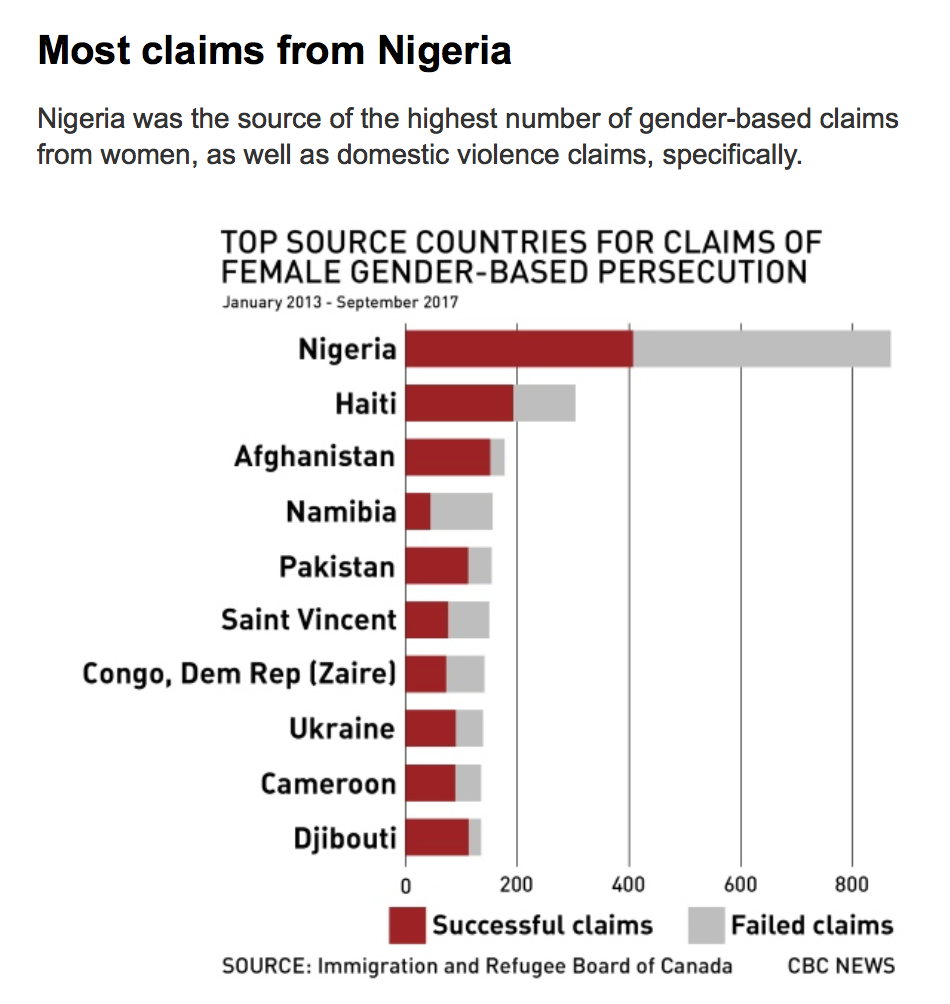
Nigeria was the source of the highest number of gender-based claims from women, as well as domestic violence claims, specifically.


 Multicultural Meanderings