Government uses Access to Information Act as ‘shield’ against openness: czar – Politics – CBC New

Some things appear not to change although I recognize the complexities involved:

Prime Minister Justin Trudeau is failing to deliver on his promise of a government that’s open by default, the federal information czar says.

The law that’s intended to give Canadians access to government files is being used instead as a shield against transparency, information commissioner Suzanne Legault said in her annual report tabled Thursday.

Legault said her investigations reveal the Access to Information Act is failing to foster accountability and trust.

The act allows people who pay $5 to ask for everything from expense reports and audits to correspondence and briefing notes. Requests are supposed to be answered within 30 days and agencies must have legitimate reasons for taking longer.

However, the system has been widely criticized as slow, antiquated and riddled with loopholes that allow agencies to withhold information rather than release it.

A number of key institutions that possess valuable information for Canadians showed declines in performance, said Legault, an ombudsman for users of the law.

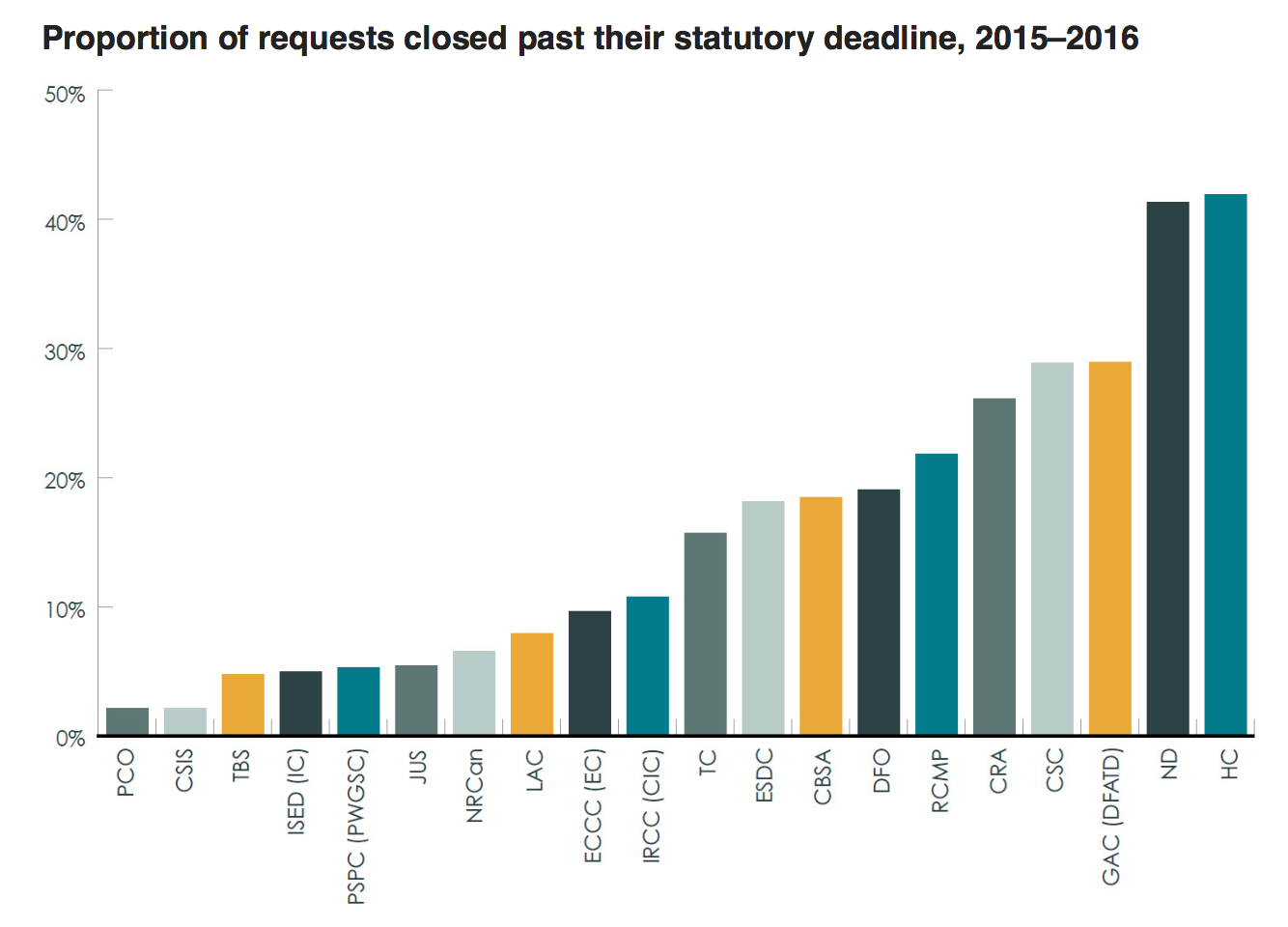
In terms of timeliness, the RCMP, the Canada Revenue Agency, the Correctional Service and Global Affairs received F grades, while National Defence and Health Canada were branded with the even more serious Red Alert status.

Legault’s report says she referred one case to the attorney general last month after uncovering apparent improper deletion of emails by an employee of Shared Services Canada.

Culture change needed on government openness1:21

The latest federal budget contained no funding for transparency measures and there has been no direction from the head of the public service on increasing transparency, Legault said.

Trudeau’s promises of making the government more open and accountable must be accompanied by action, she told a news conference. “I think he needs to do more. And I think he needs to make sure that the bureaucracy does more. It’s not enough to say it.”

The Liberal government recently acknowledged it is delaying planned reforms to the 34-year-old law due to the complexities of the task — changes Legault maintains are essential and long overdue.

The promised amendments include giving the information commissioner the power to order the release of government records and ensuring the access law applies to the offices of the prime minister, cabinet members and administrative institutions that support Parliament and the courts.

Action, not talk, needed

Treasury Board President Scott Brison said Thursday that reforms are coming, though he did not say exactly when. “We agree, actually, with the commissioner about the need to modernize the act.”

New Democrat MP Daniel Blaikie, who sat on a Commons committee that recommended a sweeping overhaul of the law, said Thursday it’s clear what needs to be done. “It’s just a real disappointment for people who took the government at its word in terms of openness and transparency and all the rest.”

Brison did take a first step last year, issuing a ministerial directive to enshrine the principle that federal agencies should be “open by default.”

Legault said the move, on its own, is not sufficient.

“If you want to truly change a whole culture in a very large bureaucracy, you’re going to have to make a concerted effort. There are going to have to be clear messages from the prime minister, the responsible ministers, the clerk of the Privy Council,” she said.

“Sadly, champions for transparency are absent.”

Source: Government uses Access to Information Act as ‘shield’ against openness: czar – Politics – CBC News

Improving public access to information will make government better, Trudeau says

Something to watch:

During the election campaign, the Liberals said government data and information should be open by default, in formats that are modern and easy to use.

Trudeau has asked Treasury Board President Scott Brison to work with Justice Minister Jody Wilson-Raybould on a review of the access law to ensure the information commissioner is empowered to order government files to be released — something she cannot do now.

He also wants Canadians to have easier access to their own personal information and says the law should be extended to ministerial offices — including his own — as well as to the administrative institutions that support Parliament and the courts.

In addition, Trudeau has directed Brison to accelerate and expand open-data initiatives and make government data available digitally.

In the interview, the prime minister made it clear he was not wedded to those changes alone.

“Access to information is about better governance, and it’s about ensuring that the decisions we take are thoroughly justifiable on a broad level,” he said. “And that’s not always easy, but it is certainly what’s going to lead to better outcomes.”

In a broad sense, the federal government must dispense with the notion that secrecy is necessary for decision-making behind the doors of cabinet, caucus and the bureaucracy, said Sean Holman, an assistant professor of journalism at Mount Royal University in Calgary.

“That’s really the test of openness for any kind of access-to-information reform in this country.”

Certain classes of records, such as audits and ministerial calendars, should be released as a matter of course so “we get used to the idea that government should be operating in the sunlight, not in these darkened, private spaces,” he said.

Legault tabled a report earlier this year recommending dozens of changes to the access law — the latest in a long line of calls for reform. She welcomes the prospect of a federal review, but hopes it happens “in a timely manner.”

Holman said history suggests the Trudeau government’s planned study will lead nowhere.

“The fact that this isn’t something the government appears to be doing immediately is concerning in and of itself,” he said.

“The longer governments stay in power the more seductive secrecy becomes.”

Source: Improving public access to information will make government better, Trudeau says

Information commissioner pleads poverty, Tory MPs say raise fees

The debate over Access to Info fees:

But Legault said charging fees is contrary to the governments touted open government policy, which calls for free access to government information, such as the 200,000 data sets it has now posted online.

She also said it often costs the government more to process fees than they are worth, and that any two-tier or three-tier fee system would simply add complications to the system. It would also require public servants to inquire about the motivation of requesters and the use to which they would put the information, both anathema to modern freedom of information principles.

Conservative MP Joan Crockatt asked Legault to be more open-minded about how fees might help solve the budget crunch. “The solution is in plain sight,” she said, referring to higher fees. “You have a garden growing outside your window.… You can look at cuts or grow your pie.”

Money from access to information fees currently goes into general revenues, not to the information commissioners office, and there is no fee charged to file a complaint with Legault’s office. She recently reported to Parliament that she no longer has any room to manoeuvre in her budget, and that a simple computer-server failure could halt operations for lack of funds to replace it.

I do not have a problem with a doubling of fees and indexing them to inflation (i.e., from $5 to $10).

But given that fees go into general revenues, not the Information Commissioner, this would have to be matched with an increase in her budget.

With hopefully more fulsome government compliance …

Information commissioner pleads poverty, Tory MPs say raise fees – Politics – CBC News.

Information watchdog says cash crunch endangers Canadians access rights

All too true. My experience with CIC ATIP confirms the delays and obfuscation:

“This growth in workload occurs in the context of significant financial restraint measures that have had a large impact on my budget,” Legault says in the report.

“With the incoming complaints volume showing no sign of abating, and with no financial flexibility, it is increasingly difficult, if not impossible, to keep ahead of demand and respond to complainants in as timely a manner as possible.”

It means a gap of about six months between the time a complaint about lack of access to records is received and the time it is assigned to an investigator.

The commissioners budget must absorb salary increases next year, leaving her concerned “we have been stretched to the limit.”

“It is my responsibility to alert the government and Parliament to the risks that the organization is facing,” Legault adds in the report.

“Without additional funding, I will no longer be able to carry out my mandate responsibly and ensure full respect of Canadians rights of access to information. As such, I intend to seek the support of the Treasury Board to obtain the necessary financing.”

Information watchdog says cash crunch endangers Canadians access rights – Politics – CBC News.

Globe editorial in favour of more resources and better compliance with ATIP:

Response times have dropped disastrously as a consequence. Ms. Legault, in going public this week about the impact of the cutbacks, said the wait time between the filing of a complaint and the assigning of an investigator has reached six months. Her next move will be to make a formal request to the Treasury Board for more money. Treasury Board President Tony Clement has had no comment, so far.

Mr. Clement should give the Information Commissioner the resources she needs. Since taking power, the Harper government has focused on putting more information online and on launching its Open Government web portal. But those efforts, however worthwhile, will mean little if the government simultaneously makes it harder for Canadians to get information that has been classified or held back for political reasons – arguably the most important information of all in a free society. The Conservatives knew this in 2006; why don’t they know it now?

 Harper government cutbacks hurting access to info 

Peter MacKay suggests anti-terror laws don’t need major overhaul – Politics – CBC News

As the Government continues to consider what further changes, if any, are required to current legislation, some mixed signals:

… former public safety minister Stockwell Day warned hes hearing the government may try to eliminate the requirement that a judge sign off on such orders, giving discretion solely to the minister of public safety.

“One of the provisions Im hearing about, I don’t know if its accurate yet, is there may be a provision for a minister like myself to sign for [preventive] arrest, and not having it countersigned by a judge,” he said in an interview on CBC Radio’s The Current.

“I’ r always appreciated the balance [of both judge and minister signing] for preventive arrest and wiretaps … I would take a close look at that if a judge’s [signature] is no longer required,” Day added.

Without getting into specifics, MacKay seemed to dismiss that idea, “We’re not going to upset that balance that requires police to make that very important evidentiary determination.”

“I always would come down on the side of judicial oversight before you would make any interventions,” MacKay added.

MacKay also said the government is looking for ways to crack down on those who encourage terrorist acts online. “There’s no question that the type of material that is used often to recruit, to incite, and the word I don’t particularly like … but, glorification,” he said, adding he’s looking closely at legislation in the United Kingdom on this topic.

Day believes the legislation will “talk about things like, those who support calls on terrorists to attack Canadians or to kill Canadians, those who support groups who are calling for attacks on Canadians.’”

Peter MacKay suggests anti-terror laws dont need major overhaul – Politics – CBC News.

And the information and privacy czars pick up on the point that any increased powers should be matched by increased review and oversight.

If you step up police powers to fight terrorism, make watchdogs more powerful, privacy czar tells Tories

Similarly, a note of caution not to rush things from former judges, Frank Iacobucci, John Major and Dennis O’Connor:

Panel of judges urges caution in passing new anti-terror laws

Adam Chapnick has a thoughtful piece on the challenge of managing our reactions to terror:

As a professor of defence studies, I know all too well that it’s impossible to stop every ‘lone wolf’ with a gun or a bomb. No measure enacted by any government can guarantee our safety.

It follows that the national conversation led by our parliamentarians over the next few weeks cannot be about terrorism. It must be about managing the terror that Canadians feel.

We need calm reassurance, not more calls to be fearful. We need to see unity of effort and purpose among all of our MPs — not the divisive, fearmongering partisanship to which we have grown far too accustomed.

The debate must last as long as is necessary to enable all interested Canadians — not just supporters of the government — to understand what new measures are being exacted, and why.

It must shape a degree of consensus over the extent to which we are willing to surrender the freedoms we hold so dear in order to feel more comfortable on our streets and in our homes.

Terrorism is a state-level problem — but terror itself is personal. Let us hope that our elected representatives understand the difference as we move forward.

The real problem isn’t terrorism. It’s terror (pay wall)


Among the Harper governments list of secrets: Soldiers on Viagra

Not exactly in keeping with the spirit of the Accountability Act:

There were 61 complaints last year to Suzanne Legault, the country’s information commissioner, about the cabinet confidence clause, almost twice the number in 2012. Figures from the commissioner’s office show it used the exclusion 2,117 times in 2012-13, a 20 per cent increase over the year before.

More recent data won’t be available until end of 2014, Legault told The Canadian Press in an interview.

She is concerned, however, about how wide-ranging the definition of a cabinet secret has become, especially since once the exclusion is declared, not even she can see the documents in question.

“When you look at the scope of the exclusion, it is extremely broad,” Legault said.

“It’s very, very broad. It basically catches anything that mentions a record that’s a cabinet confidence. In my view, the actual scope of this does not respect fundamental tenets of freedom of information.”

Media outlets aren’t the only ones for whom the flow of information in Ottawa has slowed to a trickle. Watchdog agencies like the auditor general, the military ombudsman and the parliamentary budget officer are also complaining.

Auditor general Michael Ferguson said last spring that his attempts to audit the long-term health of public pension plans had been stymied by bureaucrats at Finance and Treasury Board.

Ferguson said he was “surprised” at the scope of information officials refused to disclose.

Kevin Page, who took the Harper government to federal court when he was parliamentary budget officer, said the law needs a major overhaul.

“Under my time as the budget officer we were told on numerous occasions — from crime bills to elements of the government’s economic forecast to departmental spending restraint plans post budget 2012 — that Parliament and the PBO could not get access to information because it was a cabinet confidence,” Page said.

“The stakes were high. The government was asking Parliament to vote on bills without relevant financial information and were hiding behind the veil of cabinet confidence. This undermined accountability for Parliament and the accountability of the public service.”

Among the Harper governments list of secrets: Soldiers on Viagra.

Suzanne Legault warns of growing federal government secrecy

Information Commissioner Suzanne Legault confirming what we all know: that ATIP is broken and many departments are not in compliance with the principles and requirements of ATIP.

Not surprised to see CIC on the list of one of the worst departments in this regard as my experience indicates (still have an outstanding request for over a year for information that should have been released a long-time ago).

But Legault omits to mention the Government’s complicity for a culture of secrecy and lack of openness, and how this affects the public service role:

Legault blamed a lack of leadership toward transparency at the political level and within the senior ranks of some departments and agencies for creating an environment where the tendency is to try to keep information under lock and key.

“The main reason why the system is fragile and volatile is because for some reason, leadership in the institutions varies,” she said.

“When there is not very strong leadership at all levels of an institution in favour of timely transparency, we see institutions falter on releasing information. When we have strong leadership within the institutions, usually institutions perform well.”

Among the worst performers last year were Citizenship and Immigration Canada, the RCMP, Transport Canada and the Department of National Defence.

The federal Access to Information Act was introduced in 1985 and has remained largely unchanged since then despite frequent criticisms that the system is broken.

Legault writes in her report that real improvement to the access system will only come by modernizing the law, which she described as “a long-overdue step that is crucial to advancing the cause of transparency and accountability in Canada.

”In the House of Commons, Treasury Board President Tony Clement defended the government’s record on access to information Thursday, saying it had responded to more requests than previous governments combined.

“The total number of access to information requests that have been replied to since 1983, 50 per cent of them have been replied to by this government. We have replied to more access to information requests than the Trudeau, Mulroney, Turner, Campbell, Chrétien and Martin governments combined. That is our record on access to information and we are darn proud of it.”

Suzanne Legault warns of growing federal government secrecy | Ottawa Citizen.

Access to information at ‘serious risk,’ watchdog warns – Politics – CBC News

More on just how broken our access to information system is. While the basic issue of not enough resources to process requests predates the current government, the delays and inability to respond to requests has gotten worse under the current government. Given that one of the reasons they were elected in the first place was for  accountability, ironic that one of the cornerstones of accountability, transparency, has been undermined.

Access to information at ‘serious risk,’ watchdog warns – Politics – CBC News.

I have still not received any documents from my current ATIP request, submitted 24 April. My last communication with ATIP dates from 12 August, saying still waiting for feedback from CIC and other departments.

Canada’s info czar warns against federal government’s new obstructive tactics – The Globe and Mail

More on just how broken Canada’s Access to Information system is. So much for government accountability.

Canada’s info czar warns against federal government’s new obstructive tactics – The Globe and Mail.

The access-to-information system is busting: information czar – National | Globalnews.ca

A systemic issue for the government, one that undermines government accountability to citizens.

My own experience under the Access to Information Act only confirms that the system is broken and unable to meet its statutory obligations. Will post a log shortly on the delays, obfuscation and excuses used in not fulfilling a legitimate ATIP request.

Not a high point for the government.

The access-to-information system is busting: information czar – National | Globalnews.ca.