Trudeau faces diversity challenge in Supreme Court judge selection

Interesting comment about the small ‘pipeline’ of potential visible minority and Indigenous judges bequeathed by the previous government (for my analysis of judicial and other diversity, see my free download in iPad/Mac version (iBooks) and Windows (pdf) Version)::

In Prime Minister Justin Trudeau’s first chance to name a judge to the Supreme Court of Canada, the search for diversity is bumping up against the reality of limited choices – raising the odds that a government that chose just three white males in its first 15 judicial appointments will pick one for the country’s most powerful court.

Mr. Trudeau has an opportunity to make a historic mark. If he names a woman for the job that comes open in September, he would give the court the first female majority in its 141-year history. If he names a member of a visible minority or an indigenous judge, that, too, would be a first for the court.

His Liberal government has left little doubt that it would like to find a well-qualified candidate from one of those groups.

“If it’s possible, they’re going to give it to a female, bilingual, visible minority – if they can find that person,” a Liberal party insider said.

But the search is proving to be a challenge. The opening comes with the upcoming retirement of Justice Thomas Cromwell of Nova Scotia and convention dictates that his successor must come from Atlantic Canada. The Prime Minister’s insistence that new appointees to the country’s highest court be functionally bilingual limits his choices further.

And there are no obvious bilingual stars among women on the region’s appeal courts (the most frequent source of Supreme Court judges) and in its law firms, more than a dozen legal observers in Atlantic Canada said in interviews. As for visible minority or indigenous judges, the pipeline was left largely empty by the former Conservative government.

And so Mr. Trudeau’s attention may yet turn to white males. Among the leading candidates in that category are Justice Marc Richard of the New Brunswick Court of Appeal and Chief Justice Michael MacDonald of the Nova Scotia Court of Appeal.

Source: Trudeau faces diversity challenge in Supreme Court judge selection – The Globe and Mail

Time to name an Aboriginal justice to the Supreme Court: Hassan and Siddiqui

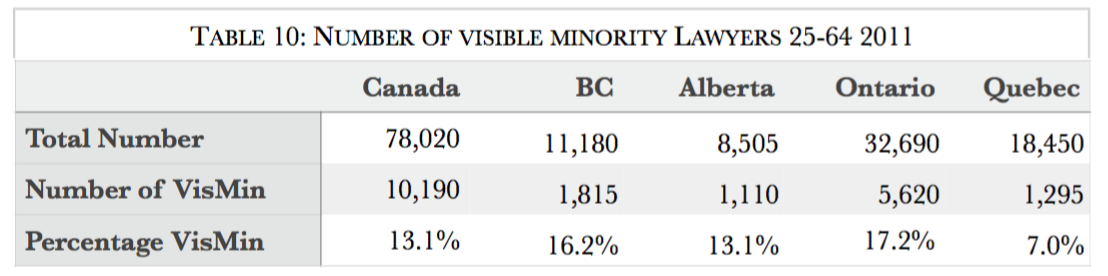
 Visible Minority LawyersNader Hassan and Fahad Siddiqui make the argument (the number of visible minority lawyers is higher than their article, based upon NHS data that I used in my book, Multiculturalism in Canada: Evidence and Anecdote):

These criteria narrow the field considerably [member of provincial superior court, bilingual, Maritime], and risk obscuring another important fact: our high court does not look like the rest of Canada. No Aboriginal or visible minority has ever been appointed to the Supreme Court. Regional representation — which convention so assiduously protects — is important, but in an increasingly ethnically and religiously diverse country, it is only one of many indicia of diversity.

Since the Abella Equality in Employment Royal Commission Report in 1984, a consensus has emerged among judges, lawyers and academics that judicial diversity matters. A diverse judiciary results in a broader range of perspectives, which is crucial to judicial decision-making. And greater judicial diversity fosters public confidence in the administration of justice.

Little progress has been made so far. Professor Rosemary Cairns Way of the University of Ottawa reports that Aboriginal and visible minority members account for roughly 23 per cent of the population, and yet from 2009 to 2014, only 1.04 per cent of appointees to the provincial superior courts were Aboriginal, and only 0.5 per cent were members of a visible minority group.

The same appears to be true of the senior reaches of the legal profession. The body that regulates lawyers in Ontario, the Law Society of Upper Canada, does not regularly collect comprehensive demographic data. But a Society report, released in 2010, shows that only 5 per cent of lawyers in Ontario between the ages of 45 and 64 are Aboriginals or visible minorities even though those two groups make up more than a fifth of that segment of the population.

It is sometimes argued that as Canada’s population diversifies, the legal profession will too. Problem solved — some years or decades down the line.

The statistics we have don’t bear out that claim though. Even among younger generations, Aboriginals and visible minorities are under-represented at the bar. And those who have managed to gain a foothold in the profession face unique challenges. The society reports that a majority of Aboriginal and visible minority lawyers believe that having a different cultural background has disadvantaged their careers. In that sense, the legal profession reflects trends in the broader job market. According to a recently released study led by University of Toronto researchers, black job applicants are 25.5 per cent more likely to land a job interview when they scrub their resumé of clues of their race.

The time has come for change. And this change requires leadership from the top. We need out-of-the box thinking, such as Trudeau’s laudable decision to name women to half his cabinet positions — including Canada’s first Aboriginal justice minister. The prime minister will have to take a similarly bold approach to fill the high court vacancy. An Aboriginal candidate should take priority. It’s an absolute shame that Canada’s highest court has never had representation from among our First Nations.

US Supreme Court Takes On Racial Discrimination In Jury Selection

Interesting, and symptomatic of the situation in so many areas:

The U.S. Supreme Court wrestles Monday with a problem that has long plagued the criminal justice system: race discrimination in the selection of jurors.

“Numerous studies demonstrate that prosecutors use peremptory strikes to remove black jurors at significantly higher rates than white jurors.”

Those are not the words of the defense in the case. They come from a group of highly regarded prosecutors, Republican and Democrat, conservative and liberal, who have filed a friend-of-the-court brief siding with Timothy Foster, who was convicted and sentenced to death in the killing of an elderly white woman in Georgia.

It has been nearly 30 years since the Supreme Court sought to toughen the rules against racial discrimination in jury selection. But Foster’s lawyers argue that black jurors were systematically excluded from the jury at his trial in 1987, while judges at all levels looked the other way for nearly three decades thereafter.

Jury selection is done according to a set of rules. Prospective jurors are usually questioned by both prosecution and defense lawyers and then winnowed down in two different ways. First, the judge removes, “for cause,” those jurors deemed incapable of being impartial. Next, each side, prosecution and defense, has a set number of peremptory strikes, meaning that a certain number of prospective jurors can be eliminated without a stated reason, or for no reason at all.

In 1986, the Supreme Court added a third step in a case called Batson v. Kentucky. Under the Batson rules, if the defense could show a racial pattern in prosecution peremptory strikes, the prosecutor would have to justify each one by demonstrating a non-racial reason for eliminating the juror.

Still, prosecutors found ways to get around this new rule, as demonstrated by an infamous training video made in Philadelphia in the late 1980s after the court’s decision in Batson. The video features then Assistant District Attorney Jack McMahon advising trainees that “young black women are very bad, maybe because they’re downtrodden on two respects … they’re women and they’re blacks.”

He goes on to recommend avoiding older black women too, as well as young black men, and all smart, and well educated prospective jurors.

But, McMahon reminded the trainees that they had to come up with a non-racial reason for their strikes: “When you do have a black juror, you question them at length and on this little sheet that you have, mark something down that you can articulate at a later time if something happens,” he says.

Studies have shown that these proffered reasons are often a mere pretext for racial discrimination. A North Carolina study of jury selection in 173 death penalty cases found that black prospective jurors were more than twice as likely to be struck by the prosecution as similarly situated white jurors. A 2003 study of 390 felony jury trials prosecuted in Jefferson Parish, La. found that black prospective jurors were struck at three times the rate of whites. And in Houston County, Ala., prosecutors between 2005 and 2009 used their peremptory strikes to eliminate 80 percent of the blacks qualified for jury service in death penalty cases. The result was that half of these juries were all white, and the remainder had only a single black member, even though the county is 27 percent black.

Source: Supreme Court Takes On Racial Discrimination In Jury Selection : NPR

U.S. Supreme Court affirms religious rights in Abercrombie & Fitch case

Reasonable accommodation example. Will see how the lower court rules in terms of the specifics but at least the general principle has been confirmed:

The U.S. Supreme Court strengthened civil rights protections Monday for employees and job applicants who need special treatment in the workplace because of their religious beliefs.

The justices sided with a Muslim woman who did not get hired after she showed up to a job interview with clothing retailer Abercrombie & Fitch wearing a black headscarf.

The headscarf, or hijab, violated the company’s strict dress code, since changed, for employees who work in its retail stores.

Employers generally have to accommodate job applicants and employees with religious needs if the employer at least has an idea that such accommodation is necessary, Justice Antonin Scalia said in his opinion for the court.

Job applicant Samantha Elauf did not tell her interviewer she was Muslim. But Scalia said that Abercrombie “at least suspected” that Elauf wore a headscarf for religious reasons. “That is enough,” Scalia said in an opinion for seven justices.

U.S. federal civil rights law gives religious practices “favoured treatment” that forbids employers from firing or not hiring people based on their observance of religion, Scalia said. The federal civil rights law known as Title VII requires employers to make accommodations for employees’ religious beliefs in most instances. Elauf’s case turned on how employers are supposed to know when someone has a religious need to be accommodated.

The decision does not, by itself, resolve her case. Instead, it will return to the Tenth Circuit Court of Appeals in Denver, which earlier ruled against her.

“While the Supreme Court reversed the Tenth Circuit decision, it did not determine that [Abercrombie & Fitch] discriminated against Ms. Elauf. We will determine our next steps in the litigation,” company spokeswoman Carlene Benz said in an email.

Some business groups said Monday’s ruling will force employers to make assumptions about applicants’ religious beliefs.

“Shifting this burden to employers sets an unclear and confusing standard making business owners extremely vulnerable to inevitable discrimination lawsuits,” said Karen Harned, a top lawyer at the National Federation of Independent Business. “Whether employers ask an applicant about religious needs or not, there is a good chance they will be sued.”

Jenny Yang, chairwoman of the federal Equal Employment Opportunity Commission, praised the court for “affirming that employers may not make an applicant’s religious practice a factor in employment decisions.” The commission had sued on Elauf’s behalf.

As to the protestations of the National Federation of Independent Business, it does not appear to me too difficult to make the assumption that someone wearing a cross, a kippa, a turban or a hijab is likely doing so for religious reasons.

U.S. Supreme Court affirms religious rights in Abercrombie & Fitch case – World – CBC News.

Quebec infringed on religious freedom by forcing Catholic school to teach secular course: Supreme Court

On the recent Supreme Court ruling:

Loyola told the Supreme Court it wasn’t challenging the constitutionality of any legislation. But it was invoking a regulatory provision that allows private schools to teach their own version of a course where their program is equivalent, the school said in its factum. However, Quebec’s Education Department doesn’t consider Loyola’s substitute course an equivalent one. One reason is that the approach recommended by the ERC course is non-denominational, while Loyola’s version aims to transmit the Catholic faith, the Quebec government argues.

Loyola has said it would teach all the same content at the ERC course Loyola’s former principal Paul Donovan told the Montreal Gazette on Wednesday.

“We just didn’t want to have to suppress or hold back the Catholic nature of the school,” Donovan said.

Private religious schools in Quebec can teach their own faiths, but separately from the ERC course.

It’s the second time the Supreme Court has weighed in on the course taught in Quebec’s schools since the 2008-2009 school year. A Drummondville couple, who are Catholics, had argued that refusing to exempt their sons from the compulsory course violated their freedom of conscience and religion. But in a unanimous decision, the Supreme Court dismissed their appeal in 2012. The couple hadn’t proved that the ERC course interfered with their ability to pass their own faith onto their children, the decision said.

Quebec infringed on religious freedom by forcing Catholic school to teach secular course: Supreme Court.

Graeme Hamilton’s commentary on the fears of religious fundamentalism in Quebec:

Listening to politicians, it can feel as if Quebec is under assault from religious fundamentalists. The opposition Parti Québécois wants an observer to report annually to the National Assembly on “manifestations of religious fundamentalism.” The Liberal government has a working group to combat radicalism. The Coalition Avenir Québec proposes banning preaching that runs counter to Quebec values.

But those same legislators have no quarrel with a secular fundamentalism that has taken root in the province at the expense of religious rights. On Thursday, the Supreme Court of Canada sent a message to Quebec that its state-sanctioned secularism can go too far.

In a ruling affirming the right of Montreal’s Loyola High School, a private Catholic boys school, to teach its own version of a provincially mandated course on ethics and religion, the court offered a timely reminder to politicians.

“The pursuit of secular values means respecting the right to hold and manifest different religious beliefs,” Justice Rosalie Abella wrote for the majority. “A secular state respects religious differences, it does not seek to extinguish them.”

The pursuit of secular values means respecting the right to hold and manifest different religious beliefs

The ruling specifically applies to a small number of private religious schools in Quebec, but it resonates more widely at a time when governments contend with questions involving religious rights. Recently in Quebec, mosques have run up against obstacles over fears of religious extremism, and a Muslim woman was told she could not appear before a Quebec Court wearing her hijab. The federal government has taken a stand against the face-covering niqab, saying women cannot wear the garments during citizenship ceremonies.

Interference with a religious group’s beliefs or practices is justified only if they “conflict with or harm overriding public interests,” Justice Abella wrote.

… In a partially concurring opinion that argued for less restriction on Loyola, Chief Justice Beverley McLachlin and Justice Michael Moldaver wrote that it is enough for Loyola teachers to treat other religious viewpoints with respect; it does not have to treat them as equally legitimate.

“Indeed, presenting fundamentally incompatible religious doctrines as equally legitimate and equally credible could imply that both are equally false,” they wrote. “Surely this cannot be a perspective that a religious school can be compelled to adopt.”

John Zucchi, whose son was a student at Loyola when the ERC program was introduced and who was a plaintiff in the initial court case, said Thursday’s ruling provides crucial guidance. “This is helping the country to come to what I would call a sane form of secularism,” he said. “We don’t need to shut down one voice in the name of diversity and pluralism, but rather diversity and pluralism mean that all perspectives can be heard and be out in the public square.”

Graeme Hamilton: A secular fundamentalism has taken root in Quebec
Oath of allegiance to Queen stays as requirement to obtain citizenship

No surprise that the ruling was upheld by the Supreme Court. Oath should be changed, but should be through political process, not the courts.

Would-be Canadians will have to keep taking an oath to the Queen after the Supreme Court of Canada on Thursday refused to hear a challenge to the citizenship requirement.

The decision by the top court leaves intact an Ontario Court of Appeal ruling that upheld the “symbolic” oath.

At issue is a provision in the Citizenship Act that requires would-be citizens to swear to be “faithful and bear true allegiance to Queen Elizabeth the Second, Queen of Canada, her heirs and successors.”

Oath of allegiance to Queen stays as requirement to obtain citizenship – Politics – CBC News.

Sikh student who won kirpan case now considers leaving Quebec

A good update on the person who prompted one of the more significant reasonable accommodation cases before the Supreme Court, Gurbaj Multani, who insisted on his right to wear the ceremonial kirpan to school. The Court ruled in his favour, but imposed conditions (i.e., it had to be  sewn into clothing). Needless to say, the proposed Quebec Charter sends a signal to citizens like Multani that they are not fully welcome or accepted.

Sikh student who won kirpan case now considers leaving Quebec