I am a great fan of Dan Hiebert’s work and Todd’s article only whets my appetite to check out the interactive website:
Chinese and Filipino immigrants come to Canada with equally solid levels of education — but beyond that they’re remarkably different.
A revealing new “super-diversity” website created by a University of B.C. geographer, Daniel Hiebert, shows nine of 10 recent Chinese immigrants arrive in Metro Vancouver with enough money to immediately buy homes. But only half hold down jobs during their first five years in Canada, while four of 10 report they’re surviving on low incomes.
In sharp contrast, as Hiebert points out while showing his data-rich charts and maps on his interactive website, nine of 10 Filipino immigrants have jobs within five years of arriving in Metro Vancouver. Less than 10 per cent of Filipinos say they are on low incomes, and just four in 10 own their homes.
This is just a sample of the almost endless array of demographic insights about Canadian immigration, refugees, ethnicity, economic class and religion that can be readily discovered on the website, www.superdiv.mmg.mpg.de.
With a team of international scholars, Hiebert has been designing the site to help Canadian policy-makers, academics, journalists and the public “get a factual sense of how the world is changing. So that they can make their own interpretations.”
The website’s graphics quickly reveal nuggets about “super-diversity” in Canada, including that Metro Vancouver Muslims come from an astonishing 117 different ethnic backgrounds, and that initially disadvantaged refugees eventually do well in terms of education, income and housing after about two decades in Canada.
The super-diversity website democratizes immense pools of data from 1980 on, which have long been difficult or impossible for most Canadians to tap. The site provides the basis for an informed Canadian debate on immigration, which has so far been held back by exaggerated claims by both skeptics and advocates.
The website, created in collaboration with German and other scholars (thus the country code “.de” in the domain name), includes interactive maps that break Metro Vancouver down into 3,400 small chunks. Viewers can analyze each for such things as ethnicity, income, mobility, language and education levels.
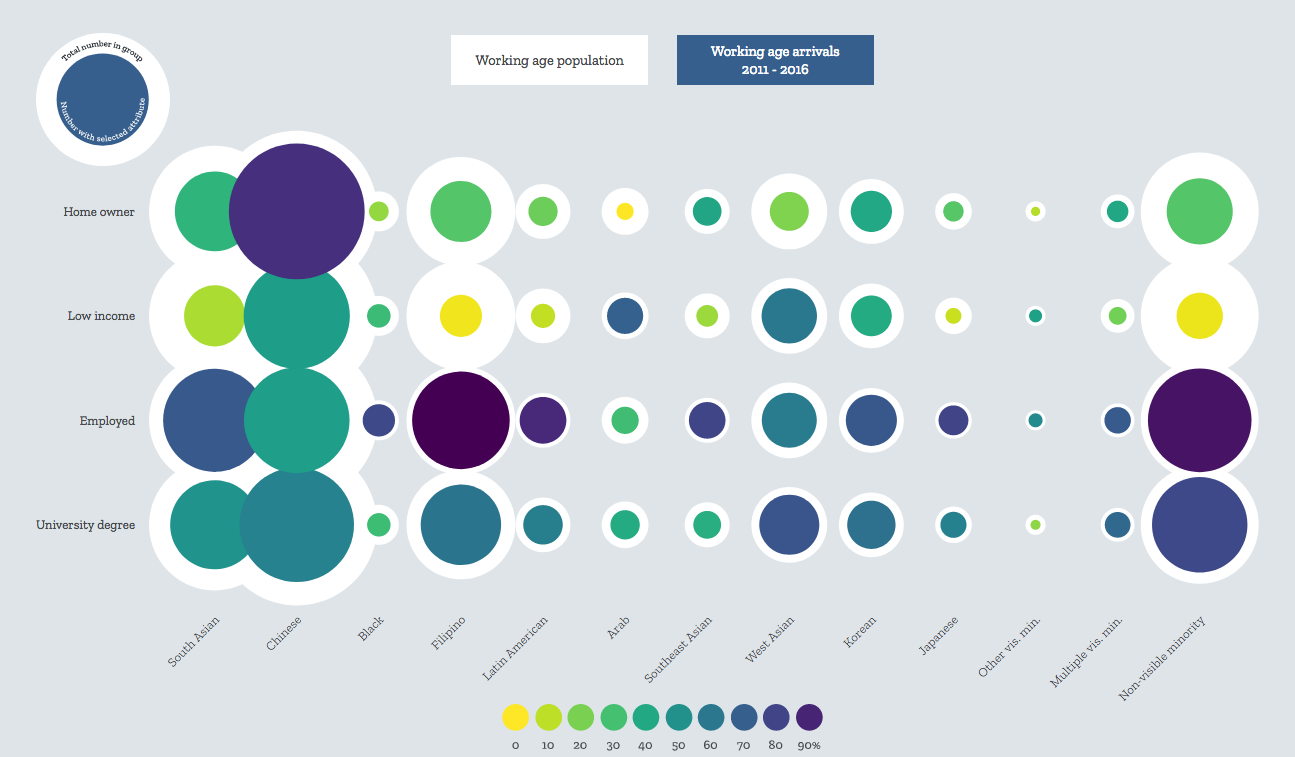
This snapshot of a chart created by Prof. Daniel Hiebert shows the economic and housing outcomes of recent adult immigrants, those who arrived in Metro Vancouver between 2011 and 2016. It shows an amazing 90 per cent of new ethnic Chinese immigrants bring enough wealth to quickly buy a home in Metro Vancouver, in contrast to patterns in Sydney and Auckland. (Source: http://www.superdiv.mmg.mpg.de)
Since Hiebert’s Canadian research for the first time correlates 2016 census information with “landing data” provided by the federal immigration department, he was able to discover that immigrants in general, but ethnic Chinese in particular, move unusually quickly into Metro Vancouver’s housing market.
“The Chinese story is one of a great transfer of wealth” into Canada from offshore, he said. “Home ownership rates reflect that wealth transfer.”
The interactive online charts show the overall rate of home ownership by ethnicity — with nine in 10 ethnic Chinese owning their homes in Metro Vancouver, compared to eight in 10 South Asians, seven in 10 Caucasians and Koreans, six in 10 Filipinos and just four in 10 blacks, Arabs and Latin Americans.
The maps and charts created by Hiebert, Steven Vertovec, Alan Gamlen and Paul Spoonley also show the most “mobile” regions of Metro,the neighbourhoods in which people are more likely to move frequently. They tend to be in the north end of the City of Vancouver (from Kitsilano to Strathcona), New Westminster, parts of North Vancouver and around the City of Langley.
Hiebert’s maps also reveal which neighbourhoods come with the widest range of incomes, which he considers healthy. “You get more vibrancy in neighbourhoods in which you get to know people from other income levels. Gated communities are the worst. Nobody understands each other’s lives.”
While the west side of Vancouver tends to have a high ethnic mix, it has low diversity of incomes. In contrast, residents of the east side of Vancouver and south Burnaby have a range of incomes. “There’s a kind of upstairs-downstairs phenomenon” in the latter neighbourhoods, Hiebert said, with reasonably well-off homeowners serving as landlords to renters in basement suites.
Even though the amount of data on display in the “super-diversity” website is immense, Hiebert’s task in the next couple of months is to add more user-friendly statistics — this time on the often-ignored number of temporary residents and international students in Canada.
Their numbers have doubled in a decade to almost one million, with almost 200,000 in B.C., mostly Metro Vancouver. Hiebert, who is often asked to advise politicians and civil servants, acknowledged policy-makers rarely take into account this significant cohort of newcomers, who some say add to the intense pressure on the city’s rental market and transit system.
One of the aims of the super-diversity website is to compare migration issues in Canada with those in Australia and New Zealand. They are three of the five English-language countries (the others are Britain and the U.S.), that Hiebert says are magnets for “millions of millions of people around the world who want to learn English.”
Asked to compare migration to Sydney and Auckland with that to Metro Vancouver, Hiebert said each has large populations of Chinese immigrants. But Metro Vancouver receives the most educated ethnic Chinese, he said, and far more who are ready to buy homes.
While the rate of home ownership among recent Chinese immigrants to Metro Vancouver is about 90 per cent, the rate is only about 50 per cent in Sydney and just 20 per cent in Auckland.

 Multicultural Meanderings