Canadian government employees’ productivity dropped 4 percent below private sector workers in last decade: Study

Worrisome, timing perfect in context of expected public service cuts. Really find the observation in the CSPS study on various program reviews is asking the right question:

“Technological developments during the past 80 years, if not the past 30 years, should have reduced the labour requirement. Computers, digital automation, and internet communications have made direct services easier to provide to Canadians. Forms and databases automate many tasks with higher accuracy, e.g. security checks, benefit applications, tax returns. Yet, the same number of Canadians is served by each public servant after decades of efficiency measures in spending restraint. Why is this? An un-nuanced early result appears to be that programs are more complex, as is the work to deliver them, even while the inflation-adjusted value delivered to each Canadian has not changed much in the last fifty years. However, some of this complexity may be unnecessary.”

The productivity of Canadian public sector workers declined over the last decade at a loss of 0.3 percent annually, while private sector employees’ productivity grew by 0.5 percent per year on average, according to a new research paper published by the Macdonald-Laurier Institute (MLI).

The study also found that if the productivity of government workers (federal and provincial) matched that of the private sector, Canada’s GDP in 2024 would have been $32 billion more or 1.5 percent higher.

“Essentially what we’re seeing through the data is that the size of government is growing, but a variety of different measures that you look at, for its overall performance and outputs and efficiency, [they’ve] been going down over time,” said Stephen Tapp, the author of the MLI study—“The Growing Government Gap”—and chief economist at the Centre for the Study of Living Standards. “So [public sector productivity is] obviously lagging behind and dragging [GDP] down.”

Tapp found that public sector worker productivity went from being slightly higher on average than private sector counterparts in 2015, then dropped 4 percentage points lower by 2024.

Despite this marked dip in productivity, government workers still earn an average of 27 percent more per hour worked than Canadians in the private sector. The MLI study mirrors a recent Fraser Institute study, which showed government employees in Canada make an average of 4.8 percent more, as well as receive more generous pensions and retire two years earlier on average….

Tapp found that for 88 percent of government subsectors, job growth outpaced the private sector; the same was true in eight of 10 provinces, and 78 percent of federal government organizations. He believes the Carney government’s reported plan to cut 15 percent across all government departments may be the wrong approach because some outlier government departments actually have a higher productivity rate….
Source: Canadian government employees’ productivity dropped 4 percent below private sector workers in last decade: Study

What Kevin Page gets wrong in his new book: Tapp

Stephen Tapp, a former senior economist at the PBO, on the weaknesses in Page’s book:

Regrettably, Page’s repeated demands for transparency merely become slogans. Critical questions go unaddressed about the fully transparent government he so desires, such as:

  • What are the pros—and cons—of an open approach to government in a time of ubiquitous social media, 24/7 news and political commentary, when information (and any misinformation and missteps) can quickly go viral?
  • Should the media have open access to public servants, and if so, how would the civil service convey the facts as well as the context of complex, competing factors that cabinet weighs in its decision-making?
  • Should senior civil servants speak out publicly when they disagree with the political choices of a democratically elected government—which is at odds with the Westminster system?
  • Which countries should Canada be following to improve our public service?

Likely – and hopefully – this will prompt a reply from Page and thus continue an important conversation.

Source: What Kevin Page gets wrong in his new book – Macleans.ca

The ideologies of Canadian economists, according to Twitter – Macleans.ca

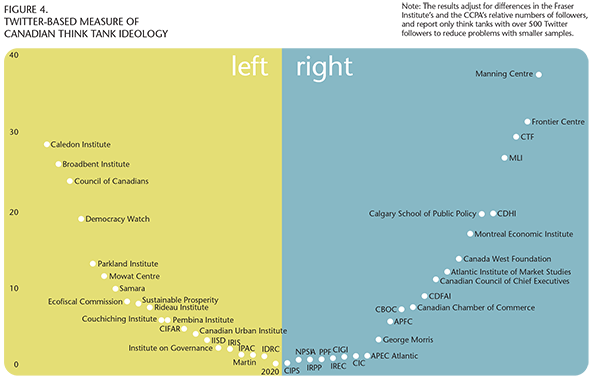
Think tanksInteresting analysis of Twitter use and followers to indicate ideological leanings by Stephen Tapp:

Four additional results are worth highlighting. First, there are indeed many Canadian think tanks: these results include 44. Having such a crowded playing field may explain much of the general public’s confusion about which think tank fits in where ideologically.

Second, according to my ideology measure, Canadian think tanks seem to be about evenly split on the left-right continuum: there are 21 think tanks to the left of centre and 23 to the right.

Third, the smile isn’t exactly symmetric. In this sample, and with this measure, the average “right-wing” think tank appears to be a bit more “ideological” than the average “left-wing” think tank. That said, the difference is not that large and may simply reflect what Halberstam and Knight found in the US: that conservatives are actually more tightly connected on social media than liberals.

Fourth, my preliminary analysis did not suggest any systematic relationship between ideology and Twitter followers. In other words, it does not appear that more extreme ideologies on their own are associated with a larger Twitter following.

… That said, we should always be careful when reducing a complex issue to a single number along a single dimension. The concept of ideology is inevitably problematic. Moreover, think tank ideologies are not uniform within a given organization and they change over time. Finally, of course, readers should not use these results to prejudge, discredit or approve of research by any of these organizations without a thorough reading of that research. I emphasize that these simple results are preliminary and just a first step; much more work is needed to better understand these complex issues.

The ideologies of Canadian economists, according to Twitter – Macleans.ca.

Better data alone won’t fix Canada’s economy – The Globe and Mail

Good piece on the need for a broader and more thoughtful approach to the use of data in a “big data” environment:

The bottom line is that being data-dependent doesn’t mean responding to every wiggle in data. Nor does it mean basing our decisions solely on data or models and nothing else.Yes, we need better data.

But that’s only a start. We also need to ask precise and well-posed questions – of ourselves in our analysis and of our policy makers in their choices – particularly as “big data” increases the availability of non-conventional data sources. In addition, we need to bring new approaches to bare on data, and clearly explain the results to non-specialists.

After concerns about jobs estimates during the Ontario election, let’s hope that the lesson learned by our politicians is not to withhold economic analysis in future campaigns. Instead, let’s hope it causes them to raise their game by presenting more credible analyses.

At the same time, let’s be realistic about what better data can accomplish. This means acknowledging that data give us imprecise measurements of reality, but when used responsibly and creatively, they help us make better choices and hold governments to account for their policy decisions.

Better data alone won’t fix Canada’s economy – The Globe and Mail.