Canada’s overhaul of immigration must include a dedicated program for high-skilled workers 

Dose of reality:

…Some business leaders are dubious that the U.S. overhaul of the H-1B visa program is creating an opportunity for Canada.

“The United States uses immigration and visa policies to strengthen its economic and work-force advantage,” said Jim Balsillie, the former chair and co-chief executive of Research In Motion, which is now known as BlackBerry.

Mr. Balsillie, speaking at The Globe and Mail’s Building Canada’s Workforce event on Wednesday afternoon, noted that Mr. Trump’s “strategic use of visas” includes the TN category for trade professionals and the O-1 tier for individuals with extraordinary abilities and achievements.

“I can make a case that the recent H-1B changes actually hurt Canada because TN and O-1 visas are more attractive for many reasons,” he said.

He argued that America’s H-1B changes could exacerbate Canada’s brain drain if the U.S. looks north to fill the gap by seeking new talent in sectors such as artificial intelligence, life sciences and quantum computing.

Here’s another hard truth. If high-skilled immigrants treat our country as a way station to the U.S., it’s our own fault.

Ottawa has known for years that preferred candidates are getting lost in the immigration queue because they are competing with international students for a limited number of permanent-resident spots, said Stephen Green, managing partner at immigration law firm Green and Spiegel LLP.

As he points out, those foreign students have a Canadian education but minimal work experience. Trouble is, our immigration system skews heavily toward younger people….

Source: Canada’s overhaul of immigration must include a dedicated program for high-skilled workers

Canada is curbing immigration — but this lawyer says newcomers still drive our economy – Toronto Star

I rely more on labour economists like Mikal Skuterud than immigration lawyers for assessing impact of immigration on the economy, particularly productivity and GDP per capita growth:

The engine driving Canada’s economic growth isn’t cars, crude or softwood lumber — it’s immigration. In spite of lagging productivity compared with other economic superpowers, like the United States or China, Canada has propped up its aging labour force with newcomers.

Last year, Canada’s population grew by nearly one million people, according to Statistics Canada. Almost all of them were newcomers: refugees fleeing persecution, post-secondary students in pursuit of a Canadian diploma and job experience, farm workers with the country’s agricultural temporary foreign worker program.

Just last summer, months after U.S. tech giants like Meta and Amazon were laying off thousands of qualified tech professionals, then-immigration minister Sean Fraser launched a program to give U.S. H1-B visa holders a shot at Canadian work permits. Within 48 hours, 10,000 applications had been submitted.

But Ottawa appears to be tapping the brakes on its ambitious immigration targets. Earlier this month, the federal government announced it would “stabilize” immigration levels at 500,000 per year starting in 2026, despite years of continually raising its target. Meanwhile, Northern College, an Ontario post-secondary institution, has revoked around 700 acceptance letters from international students over the past year due to what it described as a lack of local jobs and housing.

These decisions come in the face of stubbornly high housing and food costs affecting everyone living on Canadian soil: permanent residents, citizens and undocumented alike. Stephen Green, managing partner at immigration law firm Green and Spiegel, spoke to the Star about the current economic — and educational — landscape for immigrants from his Toronto office earlier this week:

There is an argument that amid competition for housing and jobs in Canada, immigration at our current level is unsustainable. Do you buy this argument?

I don’t buy that at all. First, unlike some countries like the U.S., where they have a lottery system based on country of origin, we have a really rigorous and thought-out selection system based on “human capital.” They look at a newcomer’s age, their education, whether they’ve worked or studied in Canada, whether they have family in Canada, whether they can speak English and French — that sort of stuff. We’re selecting immigrants based on a model that economists and various policy experts have said are considered very important factors.

I think the only major issue is that a lot of people in their forties have a very difficult time immigrating to Canada because of the point system. An applicant’s age is about 30 per cent of it. So if you are 45 years old, you run a really successful business outside of Canada and you want to come here, you’re going to have a tough time. But I don’t buy the notion about jobs. Even at my firm, we’ve been trying to find some skilled workers for over two years. We can’t find people. And I’m hearing from the construction industry that there are no workers. We have a really serious problem finding carpenters and plumbers — and these are the people who are supposedly going to help us with our housing crisis.

So how do those folks fare in Canada’s immigration system?

It’s very difficult for them under the point system. A lot of those skilled workers don’t speak great English and don’t have a great education. The trades have a very difficult time immigrating, and the government has always known that, and they’ve struggled to try to make the system better. But the real problem is that the provinces are responsible for licensing, and the feds are responsible for bringing people in. There are situations where you may have a carpenter that will make it through the immigration system, but then they can’t get their licence as a carpenter.

Look at doctors. Look at nurses. We make it so difficult for these people to get the proper licence. You can’t tell me that a doctor that’s graduated from Harvard and wants to practise in Canada — or a pharmacist from Europe — has to go through a horrendous licensing process. It’s wrong, and that was really holding up the ability of individuals that immigrate to our country to really perform their professions.

During the first years of the pandemic, there was some talk about getting more doctors from abroad into Canada’s health-care system. It sounds like the issues haven’t improved.

It’s a little better. They’re moving way too slow. It’s interesting, on the medical side — it costs the province more money to license more doctors. And the doctors want to protect their turf a bit. But I think Canadians have had it. You have people that can’t find family doctors, that can’t find specialists, and they’re saying there’s no reason why doctors should go through such craziness to get licensed.

International students have gotten a lot of attention from the federal government recently. First there was last summer’s acceptance letter scam, then Northern College’s recent revocation of 700 international student acceptances. Can you explain what’s going on?

Former immigration minister Jason Kenney once said foreign students were the best future immigrants to Canada. Why? They pay for their own education. It’s a funny word — but they become Canadianized much easier than other immigrants. Our foreign students fund my kids. They pay $40,000 to $50,000 a year to go to the University of Toronto, when Canadian-born students pay $7,000 to $8,000. But the federal government only let foreign students go to schools that have been designated “learning institutions” — by provinces. And the provinces have failed Canadians by designating far too many that don’t deserve it.

As for the fraudulent letters — the issue is that post-secondary institutions have asked for help finding students in foreign countries, and there is no compliance on them. I was in Chandigarh in India recently. It would blow your mind. Massive billboards by immigration consultants promising to get students into schools. The problem is that the Canadian government knows about it, but they can’t enforce anything because it’s happening in a foreign country. The foreign country can’t do anything.

What’s made it worse is that the Canadian government lifted a requirement that immigration consultants be permanent residents or citizens. Now, if I’m living in India, I can take an online course to become an immigration consultant and the college regulating immigration consultants can’t go after me.

Do you think more institutions will start reneging on international student acceptances, as Northern College has done?

I don’t know. But I hope the provinces will look at those institutions and make them understand what they did to these students. You have to understand that in places like Chandigarh, the parents of these students are selling everything possible to make their child’s life better than theirs. If you get accepted to this college that you mentioned and you’ve got your plane ticket, you’ve booked everything — and they say sorry, you can’t come? I mean, that’s bad.

Have you noticed an increasing reluctance by international students to come to Canada?

Our government has made some statements against certain countries in the Parliament of Canada, and I think it has tremendously affected the way they look at Canada now. So we’ll have to see how the government is going to manage that. I think, regardless of whatever India may or may not have done, I think there were different ways to handle that.

We depend on immigration for economic growth. If Canada decided to flatten or even lower immigration targets, what kind of effect do you think that would have on our economy?

It would be disastrous. Here’s something that most Canadians don’t have a clue about. Do you know what a fellow in a hospital is?

No, I don’t.

That’s someone who is an expert in their area of medicine from abroad, or even in Canada. Our medical system relies so heavily on these doctors from abroad, but we pay them 70 per cent less than what a doctor in Canada makes. Five years ago, the Saudi government pulled 800 fellows home after a dispute with us, and the Canadian government worried the medical system would crash.

Immigration is so important to Canada. It is a very emotional area of the law because, a lot of the time, people don’t understand the effects. They make decisions based on what they think is happening — that an immigrant is taking their job, or that temporary agriculture workers get paid less than Canadians. They aren’t.

Temporary foreign workers are tied to specific employers, and it can be very difficult for them to report labour violations. Is the federal government trying to change that?

On the one hand, the government has a compliance regime that puts a lot of stress on workers — on the other hand, they have to ensure there is an employer-employee relationship, and ensure there are parameters on what workers will do. It’s a difficult balance, and the government is aware of that. They’ve heard those concerns. Like all of us, they want to make the system better. But some people take advantage of it, and we have to look at how to prevent abuses. Maybe, for now, a restricted work permit is the best way to prevent the abuses in our system.

Source: Canada is curbing immigration — but this lawyer says newcomers still drive our economy – Toronto Star

Green: Canada should revive the investor immigrant program and fix its past failures

Not aware of any studies that show meaningful benefits from investor immigration programs in OECD countries. Green is notably vague with respect to how he proposes to “fix its past failures” beyond increasing the investment threshold. The IRCC evaluation was devastating (https://www.google.com/url?sa=t&rct=j&q=&esrc=s&source=web&cd=&cad=rja&uact=8&ved=2ahUKEwjN2Z6D2qDtAhX8GFkFHWXyCD4QFjAAegQIAxAC&url=https%3A%2F%2Fwww.canada.ca%2Fcontent%2Fdam%2Fircc%2Fmigration%2Fircc%2Fenglish%2Fpdf%2Fpub%2Fe2-2013_fbip.pdf&usg=AOvVaw2KiDUWqxbDR2xBXtujZnYm) and census data indicates the median incomes based on tax data to be minimal and lower than refugees. Quebec’s comparable program largely serves as a backdoor entry to other parts of the country:

From the earliest days of Confederation, immigration has been essential to Canada’s evolution and identity as a country. The labour – and tax dollars – of successive waves of people from around the world have supported universal health care, pension plans, education, national infrastructure, and the creation of small businesses and employment.

The economic stress caused by a global pandemic, on top of the dual realities of an aging population and a slow-growing population, make immigration more important than ever. It is also an opportune time for Canada to revive the investor immigrant program that was terminated in 2014, with a view to integrating it into our long-term economic strategy.

The federal government has clearly flagged that expediting immigration to Canada is a priority over the next several years.

In addition to setting a target to welcome 401,000 permanent residents in 2021, Ottawa recently made it easier for Hong Kong students and youth to quickly come to Canada on work and study permits, as well as offering new ways to stay permanently. The new permanent residence rules will also benefit people from Hong Kong already in Canada under existing work and study permits.

Then there’s the 300,000 Canadian citizens living in Hong Kong, many of whom, in light of recent political developments there, may be contemplating a return.

Also consider that although many applications were delayed by COVID-19, most are already well down the approval pipe and will proceed quickly once embassies and visa agencies fully reopen. Ottawa has already flagged that it will work to fast-track increased admission to Canada in 2021.

For all of that, there is much more that can be done for both prospective immigrants and Canada. At the top of that list is a practical reassessment of the investor immigrant class.

In 2020, the practical benefits of reviving the program far outweigh any misplaced concern about those “buying” Canadian citizenship.

Let’s not be hypocritical: Those of us already fortunate enough to live here stand to benefit as much as anyone who is new to the country.

The key to making it work this time around is to be clear-eyed about past failures, to refine the tax structure and better manage the five-year deposits required by these immigrant investors. It does not seem excessive to increase the $800,000 fee that was required before the Harper government cancelled the program. But in the past, those deposits were directed to provinces to foster the growth of small and medium-sized enterprises – a well-intentioned initiative that never took shape.

By learning from that disappointing experience, Canada can win on several counts.

It can seize opportunity to create a COVID-19 fund to help offset the economic cost of the coronavirus and attract immigrants who have the means to make a big difference in short order.

It can also attract a group of educated and financially secure immigrants who, along with their families, will make a lasting contribution to our economy. It is also an opportunity to bring regional and local governments into the process to ensure the funds are put to the best use.

Nowhere would that difference be felt more immediately than in the stabilization of the domestic residential real estate market, small business and employment, something of great importance to all Canadians and their families.

For some time now, there have been claims that housing markets, especially condominiums in urban centres, are threatened by an imbalance of supply and demand.

That’s a tough prospect for municipalities and provinces that have already been economically ravaged by the effect of the coronavirus.

Higher immigration levels – especially in the economic class – address this on a number of levels.

Furthermore, while much has been made of the pandemic-driven urban exodus, new Canadians tend to gravitate to and revitalize our cities.

Immigration is an important way for Canada to build long-term economic, social and cultural bridges around the world. Does anyone think it will be anything but beneficial to our relations with Washington that vice-president-elect Kamala Harris had such a positive experience as a student in Montreal?

We have always been justifiably proud of being a country of immigrants. Clearing the 2020 backlog, expediting new permanent residency applications and reinstating the investor immigrant class is both timely and strategic at a time when we need to reinforce our country as seldom before, and to ensure the long-term prosperity of all Canadians.

Green is a Managing Partner at Green and Spiegel and past chair of the Canadian Bar Association, National Section, Citizenship and Immigration

Source: https://www.theglobeandmail.com/business/commentary/article-canada-should-revive-the-investor-immigrant-program-and-fix-its-past/

Canadian citizenship applications decline after processing fees triple

citizenship-metropolis-2017-017

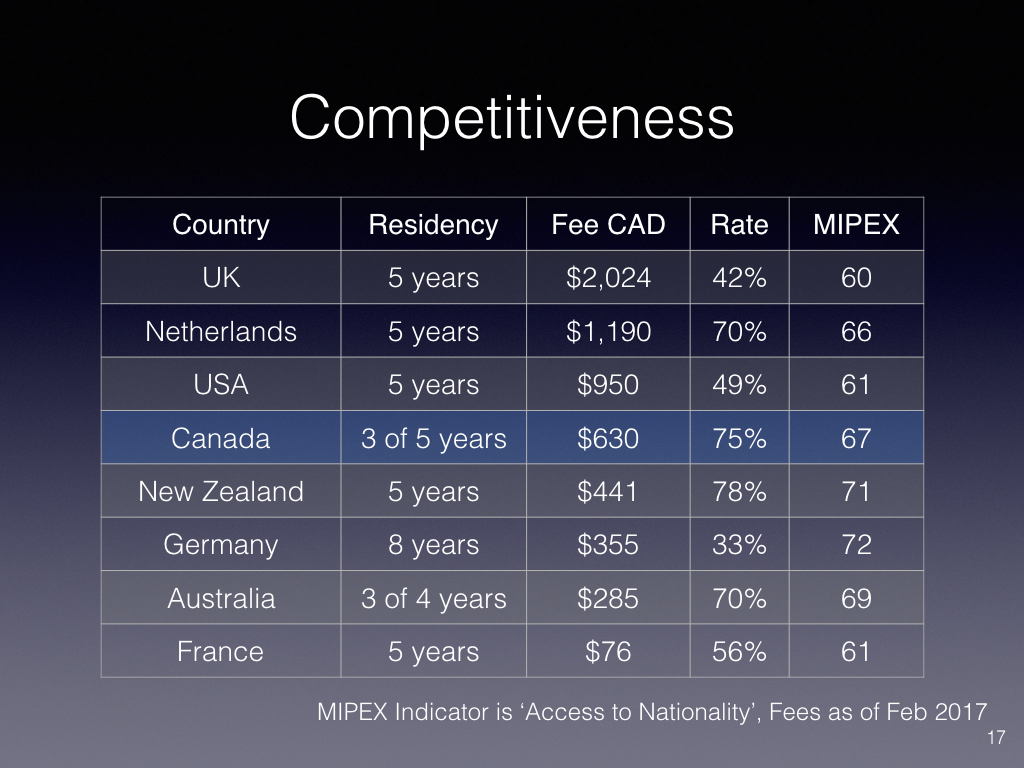
Citizenship Country Comparisons

Article based in part on my brief, C-6 Senate Hearings: Expected Impact on the Naturalization Rate.

The IRCC comment that the government has no plan to reduce fees is notable and surprising, given its diversity and inclusion agenda and expanded Immigration levels.

Equally notable that the IRCC spokesperson is incorrect on the level of Australia’s citizenship fee, our most appropriate comparator country (above comparison chart). He also cites that the increase in citizenship fees was not raised in recent consultations on immigration levels despite there being no questions in the consultation document on citizenship (IRCC Discussion guide on immigration: What about citizenship?):

A sharp fee increase has helped fuel a dramatic drop in the number of immigrants applying to become Canadian citizens, according to immigration advocates.

In the first nine months of 2016, there were 56,446 applications filed for citizenship, a decrease of nearly 50 per cent from the same period a year earlier, when 111,993 applications were submitted.

The figures are included in a briefing by former Immigration and Citizenship director general Andrew Griffith prepared for the Senate social affairs, science and technology committee, which begins hearings this week on Bill C-6, a law to amend the Citizenship Act.

Griffith, an author on immigration issues and fellow at the Canadian Global Affairs Institute, calls it an “alarming” trend that can be linked directly to a steep increase in fees.

The processing fee jumped from $100 to $530 in 2014-2015, which amounts to a tripled price tag when the additional $100 “right of citizenship” fee is added.

“If you’re a professional doing reasonably well, you may not like it, but you pay it. It’s important to you,” Griffith told CBC News. “But if you are a struggling immigrant or refugee, suddenly $630 may become prohibitive, and especially if you’re talking about a family of four or more.”

Newcomers face other costs associated with the citizenship process, including language testing, he said. He recommends cutting the processing fee to $300, abolishing the right-of-citizenship fee, and considering a waiver for refugees and low-income immigrants.

Financial and other barriers

Griffith’s brief points to a broader pattern of declining naturalization rates. He warns that a growing part of the population may not fully integrate by becoming citizens due to financial or other barriers and that could lead to marginalization.

“We’ve always prided ourselves where we have a model where we don’t just encourage immigration, but we encourage immigrants to become citizens so they be fully part of society. They can take part in political discussions, they can vote and do all the things that are part of it,” he said.

Bill C-6 reverses reforms brought in by the previous Conservative government and takes steps to streamline and strengthen the integrity of the citizenship process. Those include reducing the time permanent residents have to live in Canada to become eligible for citizenship, counting time for work or study in residency requirements, and reducing the language proficiency requirements for younger and older immigrants.

Oath

A man raises his hand while taking the Oath of Citizenship at a ceremony in Mississauga, Ont. (Jonathan Castell/CBC)

But the government does not appear prepared to reverse the fee hike brought in by the Conservatives.

Bernie Derible, a spokesman for Immigration Minister Ahmed Hussen, said citizenship fees in Canada are “significantly less” than other comparable countries such as the U.K., Australia and New Zealand. Throughout the cross-country consultations last summer, there was little discussion or concern raised about the fee, he added.

Dory Jade, CEO of the Canadian Association of Professional Immigration Consultants, said he has heard from plenty of clients who are delaying citizenship because they can’t afford the fees.

Make process ‘accessible and easy’

“If we want to bring immigrants, especially under a Liberal government which believes in nation builders, making it accessible and easy to become members of your society is a big, big issue,” he said.

Jade has met with officials from Immigration, Refugees and Citizenship Canada to propose a way to address the financial burden.

He said he was told by officials that the current fees are not cost-recovery, which means they are still financed in part by the tax base despite the increase. [Note: IRCC costing study indicated processing cost $555, about the same as the current fee of $530.] But he suggested the government could ease the cost barrier by adopting a tax-like formula based on income, developing a loan program, or capping the total fee for a family.

Stephen Green, a Toronto-based immigration lawyer, said he has not heard of the fee being a significant factor in seeking citizenship. He said many of his firm’s clients who don’t currently qualify under the existing law are anxiously awaiting C-6 to become law so they can apply for citizenship.

The Senate social affairs committee hearings will be held Wednesday and Thursday this week, with a number of immigration and refugee lawyers and academics scheduled to testify.