Matthew Lau: Education, not racism, drives the difference in earnings between races

What Lau fails to consider are the barriers that affect education levels and enrolment in STEM disciplines. The numbers are correct but the analysis is overly simplistic:

Significant federal program spending is premised on the idea that visible minorities in Canada are systemically disadvantaged.

Take the latest: Earlier this fall, the federal government released a 45-page anti-racism strategy for 2024-2028, which “aims to tackle systemic racism and make our communities more inclusive and prosperous.” Such a strategy is necessary, according to the government, because systemic racism exists throughout our institutions and “[perpetuates] a position of relative disadvantage for racialized persons.”

But where is the evidence for this premise? Not in the income statistics.

Directly contradicting the idea that visible minorities are systemically oppressed, a new Statistics Canada study shows many Canadians from minority backgrounds thrive and even do better on average than their white counterparts.

The StatCan study started with 1996 and 2001 census data, used T1 and T4 tax files and other data to measure cumulative earnings over 20 years among Canadian-born men and women from four racial cohorts — white, South Asian, Chinese, and Black — and found minorities outperforming the majority population.

Specifically, among Canadian-born men, cumulative earnings over 20 years were highest on average among Chinese men ($1.58 million in 2019 dollars), followed by South Asian men ($1.51 million). Only Black men ($1.06 million) earned less than white men ($1.31 million).

Clearly, if Chinese and South Asian men have higher earnings power than white men, it is difficult to conclude Canada is systemically racist against minorities.

What about the inverse? Does the data suggest Canada is systemically racist against white men? No. “The fact that Chinese and South Asian men have higher education levels than white men and are more likely to be in STEM fields is the single most important factor explaining why these two groups have higher cumulative earnings than white men,” the StatCan report found.

In other words: education, not racism, drives the difference in earnings.

So what happens when we control for education and other factors like employer size, industry, and geography? The earnings gap between white and Black men remains. As well, while Chinese and South Asian men out-earned white men, after controlling for education and other factors, white men actually earned more.

Alas, have we found evidence of systemic racism? Is this evidence that the country is systemically racist because these employers paid minorities less than their white counterparts with similar educational backgrounds?

There’s no hard evidence of this. First, discrimination by employers against visible minorities has been illegal for decades. Second, as the study itself even suggests, many factors affect earnings besides the ones researchers can observe and control for, including differences in social networks, job search methods, and preferences for certain working conditions, so automatically blaming racism doesn’t make much sense. Third, if Canada is systemically racist against minorities, how did Chinese and South Asian men find themselves overrepresented in the higher-paying STEM fields to begin with?

And if racism against Black Canadians is to blame for the earnings gap among men, what explains the fact that Black women earned more than white women? Among Canadian-born women, before controlling for education and other factors, the cohort that earned the least over two decades was white women ($0.80 million). Chinese women had the highest cumulative earnings ($1.14 million), followed by South Asian women ($1.06 million), and then Black women ($0.82 million). Is Canada full of racists who only discriminate against Black men but not Black women?

Another outcome of the StatCan analysis is that after controlling for the same factors (e.g. education), Chinese women out-earned white women — by $38,000, on average. So, do racist employers systematically favour white men over Chinese men, while also disfavouring white women relative to Chinese women?

The narrative that Canadians from visible minority backgrounds are systemically disadvantaged just doesn’t hold up to the data.

Moreover, this latest StatCan study only considered four groups (Chinese, South Asian, white, and Black) of Canadian-born individuals, but other StatCan research provides similar evidence against systemic racism. Weekly earnings data from 2016 show that in addition to Chinese and South Asian men, Canadian-born Japanese and Korean men had higher earnings than their white counterparts. Among women, seven of ten minority groups (Korean, Chinese, South Asian, Japanese, Filipino, “other visible minorities,” and Arab or West Asian) had higher average weekly earnings than the white population.

Simply, the earnings data do not provide evidence that Canada is a society that systemically disadvantages minorities. Rather, the data show the exact opposite. Politicians and bureaucrats might want to consider these facts before wasting large sums of taxpayer dollars drawing up lengthy “anti-racism” plans.

Source: Matthew Lau: Education, not racism, drives the difference in earnings between races
StatsCan: Recent immigrants report greater difficulty making ends meet and are less satisfied with their amount of free time

Of note (albeit not surprising):

According to the most recent data from the Survey Series on People and their Communities (SSPC), in April 2024, slightly over 3 in 10 Canadians (31%) found it difficult to meet their financial needs in terms of transportation, housing, food, clothing and other necessary expenses in the past 12 months. During this period of higher living costs, Canadians may also need to work more hours to make ends meet. Indeed, about one-third (31%) of Canadians reported having a high level of satisfaction with the amount of free time they had to do the things they like.

Not all individuals are experiencing this period of economic contraction equally. Recent immigrants, for example, often report experiencing income-related challenges, which may affect their level of satisfaction with free time. Canada has admitted record numbers of immigrants in recent years, and to better understand the experiences of recent immigrants, this release presents an analysis using the April 2024 wave of the SSPC: Social Cohesion and Experiences with Discrimination.

Recent immigrants report having greater difficulty meeting their financial needs during the past 12 months

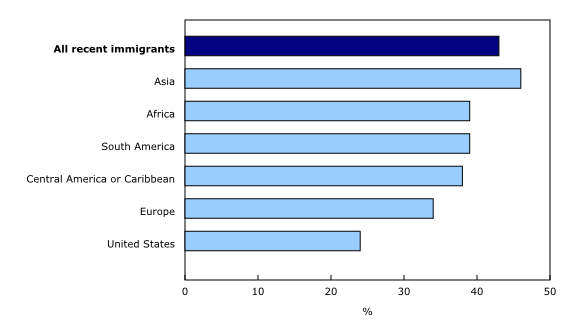
Recent immigrants (defined in this release as those admitted in 2005 or after) often face unique economic challenges in adapting to a new country and were more likely to report having greater difficulty in making ends meet. Specifically, in April 2024, a larger proportion of recent immigrants (43%) reported finding it difficult or very difficult to meet their financial needs over the past 12 months, compared with more established immigrants (29%) and non-immigrants (29%). Similarly, non-permanent residents were more likely to report finding it difficult or very difficult to make ends meet (37%) than non-immigrants.

Not all immigrants share the same economic experiences when arriving in Canada. In April 2024, while newcomers from the United States (24%) and Europe (34%) were the least likely to report experiencing financial difficulty in the past 12 months, newcomers from other regions were more likely to experience hardship during this transition. In general, newcomers arriving from Asia (46%) reported having the highest level of difficulty making ends meet. Some of these differences may be related to category of admission, which was not considered in this study.

Chart 1 
Percentage of recent immigrants (arriving since 2005) who reported having difficulty meeting financial needs over the past 12 months, by region or country of birth, Canada, April 2024

Chart 1: Percentage of recent immigrants (arriving since 2005) who reported having difficulty meeting financial needs over the past 12 months, by region or country of birth, Canada, April 2024

Racialized Canadians, especially racialized immigrants, are more likely to report experiencing financial difficulty 

Previous studies have shown that racialized Canadians may face greater economic uncertainty and, therefore, may have a more difficult time meeting their financial needs than non-racialized Canadians. In April 2024, West Asian (48%), South Asian (43%), Latin American (42%), Black (40%), Arab (38%) and Filipino (35%) Canadians were more likely to report having difficulty meeting their financial needs in the past 12 months than the non-racialized, non-Indigenous population (28%). In contrast, Chinese Canadians (22%) were the least likely to report experiencing financial difficulty in the past 12 months. 

Most of these observed differences are related to also being an immigrant. In April 2024, most Canadian-born racialized people reported having a similar experience as Canadian-born non-racialized people in Canada. For example, 28% of South Asian people born in Canada reported having difficulty making ends meet, the same proportion as the non-racialized, non-Indigenous population. However, nearly half (47%) of South Asian immigrants reported having difficulty making ends meet in the past 12 months. These results highlight the importance of understanding financial difficulty through a lens of intersectional identities, including experiences of immigration. 

Recent immigrants are less likely to report having satisfaction with their amount of free time

Economic challenges may lead to work-life balance conflicts, if workers need to work more hours, and potentially reduced satisfaction with the amount of free time available. As of spring 2024, 40% of Canadians who did not report having difficulty making ends meet also reported having a high level of satisfaction with their amount of free time. However, 12% of people who experienced difficulty making ends meet in the past 12 months reported having a similar level of satisfaction. 

In April 2024, more recent immigrants to Canada reported having lower satisfaction with their amount of free time than immigrants who had arrived earlier and non-immigrants. In fact, 23% of recent immigrants said that that they had a high level of satisfaction with their amount of free time, compared with 33% of more established immigrants and 32% of non-immigrants. About 27% of non-permanent residents reported having high satisfaction with their amount of free time.

Not all newcomer groups experienced similar levels of satisfaction with their amount of free time. For instance, in April 2024, newcomers from Asia were the most likely to report having financial difficulty and were one of the least likely to report having satisfaction with their free time (22%). In contrast, despite being the least likely to report experiencing financial difficulty, recent immigrants from Europe were among the least likely to report having a high level of satisfaction with their free time, at 20%. 

Further, in April 2024, recent immigrants from the United States (32%) were as likely to report having high satisfaction with their amount of free time as non-immigrants. These results indicate that satisfaction with amount of free time may depend on many other factors that were not measured by this study, including work-life balance, cultural perception of free time, family structure and supports, and personal outlook. 

Source: Recent immigrants report greater difficulty making ends meet and are less satisfied with their amount of free time

Is the ‘market value of becoming Canadian’ dropping? Fewer immigrants are becoming citizens

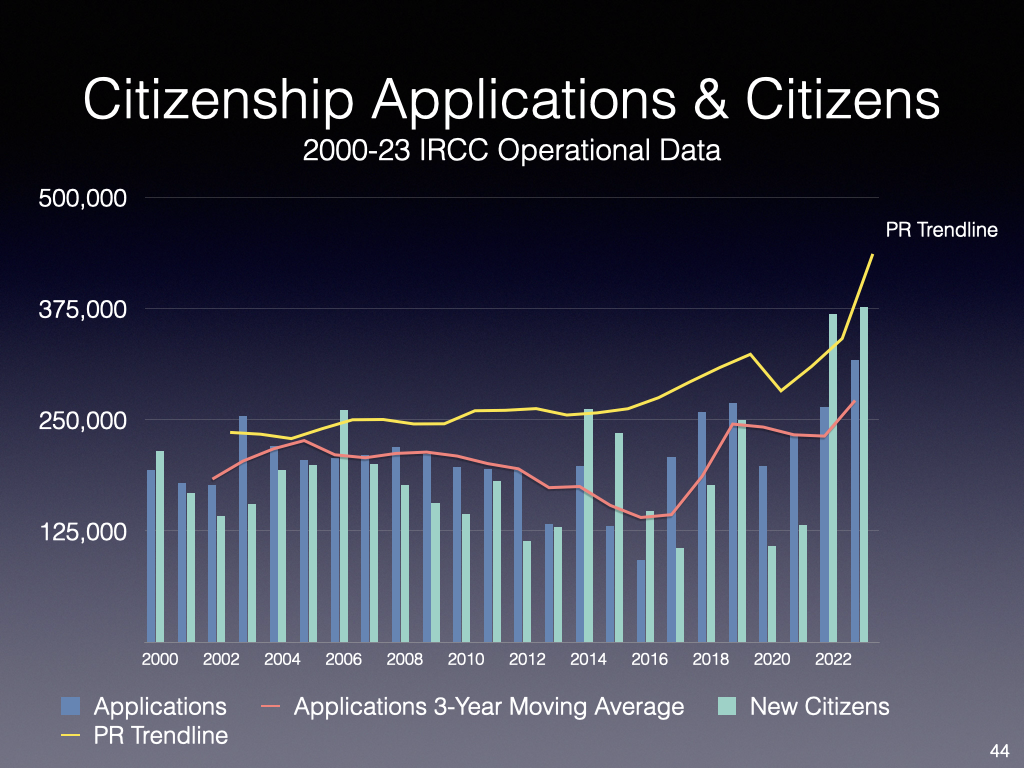
One discussion point that has arisen in social media is the extent that Harper-era changes, making citizenship “harder to get and easier to lose,” are responsible for the decline.

The 2021 study is based upon the 2011-15 period, when all immigrants have met the residency requirements (5-9 years since landing). So while the Conservative government changes to language and knowledge were implemented in 2010-11, increased residency requirements and fees were not implemented until 2015, thus not impacting this study.

One area that needs to be considered is for the settlement sector to provide citizenship test preparation courses, given that the study confirms that lower levels of language fluency and education attainment correlate with lower naturalization.

It is unlikely that the current government will implement its 2019 and 2021 election commitment to eliminate citizenship fees (virtue signalling) but there is a case to waive these fees, at least partially, for lower income applicants.

… The findings confirm the worrisome trends identified by the research of the Institute for Canadian Citizenship that found a strong decline in the “market value of becoming Canadian.”

“This study shows that some of the people who are most likely to naturalize are the wealthiest and best educated,” said the institute’s CEO, Daniel Bernhard. “But we saw just a few weeks ago from Statistics Canada that the (recent) immigrants who are most likely to leave the country are exactly those.

“No matter which way you look at it, it’s clear that Canada’s appeal in the eyes of immigrants is fading. And if our growth strategy continues to be dependent on immigrants, that’s a real problem for our future viability.” 

Although office lockdowns and public health restrictions have caused backlogs and contributed to the disruptions of citizenship application processing, Statistics Canada said that only accounted for 40 per cent of the decline between 2016 and 2021.

The study compared the citizenship takeup among recent immigrants who arrived in Canada five to nine years before each census. It found that 75.4 per cent did so in 1996 and it gradually declined from 2006, when the Conservatives took power.

In the decade with the Tories at the helm, the “knowledge of Canada” test was strengthened, language requirements increased, citizenship application fees rose and the physical presence requirements for citizenship were changed from three of four years preceding application to four of six years. The naturalization rate subsequently dropped to 60 per cent.

After Prime Minister Justin Trudeau’s Liberals came into power, the federal government restored the residency requirement to three of five years, and moved the upper age limit for the exemption to the language and knowledge test from 64 back to 54, the report notes. The citizenship fee for minors was also reduced in 2018.

However, these changes have failed to reverse the trends, with the citizenship naturalization rate falling a further 14.7 per cent between 2016 and 2021, said Statistics Canada, which, in an earlier report, also found a significant number of immigrants are leaving the country after initial arrival.

“Other more global events also likely play a role,” said the report. “Significant economic development in some source countries, such as China and India, could encourage immigrants from these regions to maintain their source-country passports and reduce their motivation to become Canadian citizens.”

The study also found the fall in citizenship rates over the past 25 years varied by demographics:

•Families with household income between $10,000 and $30,000 annual saw a 35.9-percentage-point drop, compared to a 13.5-point decline among those making over $100,000 a year;

•Those who did not complete high school saw a 39-percentage-point drop compared to 29 points for those with a university degree;•Newcomers whose mother tongue was not an official language registered a 32-percentage-point decline in naturalization rate versus just a 19-point fall among those with English or French as first language;

•Before 2006, StatCan calculated that the group of immigrants with all three characteristics of low income, education and language skills was more likely to acquire Canadian citizenship than the most advantaged group, but the pattern reversed after that; in 2021, the citizenship rate was 1.5 times higher among the most advantaged group than among the disadvantaged. 

•Immigrants from some non-western countries who traditionally were more likely to acquire Canadian citizenship now more closely resembled their counterparts from developed nations in citizenship uptake.

Bernhard said the report speaks to the need for greater policy intervention to address the question of why people want to become Canadian, as well as their experience here and commitment to the country, and what they’re getting from and giving to Canada.

Some advantages that used to be reserved for citizens such as jobs in the federal government and military are now open to permanent residents, which removes the incentive for some to acquiring citizenship, said Bernhard, adding that immigrants need to have positive experiences and strong connections to feel belonged.

“That’s the difference between residency and citizenship,” he said. “That’s the difference between, you know, Dubai and Canada, both of which have large foreign-born populations. Only one of them allows you to be an owner of the society.

“That’s Canada, where citizenship remains very accessible. And if that ownership is no longer desirable, that’s a really shocking signal to the rest of us that we have deeper issues to reflect upon and resolve.”

Source: Is the ‘market value of becoming Canadian’ dropping? Fewer immigrants are becoming citizens

The decline in the citizenship rate among recent immigrants to Canada: Update to 2021

A valuable update to the earlier Statistics Canada study of 2019.

As someone who raised concerns over a declining naturalization rate since 2015, having these detailed studies confirming the trend with detailed breakdowns and analysis provides a basis to assess whether this simply reflects a global trend, given changing economic opportunities changing its value proposition, and/or, are there specific Canadian policies that had an impact (beyond the pandemic period).

There has always been a balance between the meaningfulness of citizenship, as seen through language and knowledge requirements, the Discover Canada study guide, the oath, and citizenship ceremonies, and facilitating citizenship through the same instruments (harder or easier language assessment, harder or easier citizenship test, a more or less rigorous citizenship study guide, in-person or virtual citizenship ceremonies).

The former Conservative government emphasized meaningfulness, the current Liberal government less so, as seen in its virtue signalling 2019 and 2021 election commitments to eliminate citizenship fees, its failure to issue a revised citizenship study guide announced four ministers ago, its proposal to allow self-affirmation of the citizenship oath (“on a click”) and the less meaningful virtual ceremonies for about 80 percent of new citizens. The government did, however, revise the oath to include reference to Indigenous peoples.

However, compared to most other countries, the current requirements compare favourably in terms of access to citizenship. But proposals like self-affirmation of the citizenship oath or the massive shift to virtual ceremonies undermine one of the few celebratory moments for immigrants, and arguably reduce their sense of being welcomed to the “Canadian family.”

Having experienced in-person ceremonies, both in my former official capacity, as well as celebrating with friends and family as they became citizens, their impact on new citizens and existing citizens is significant.

Citizenship should not be viewed simply as a government service (although it needs to ensure a quality service experience) but in the more fundamental sense of welcoming and belonging new citizens and assisting their integration journey.

One last detail. This Statistics Canada study will force IRCC to address its current performance standard of 85 percent of all immigrants, no matter their period of immigration, become Canadian citizens, given that the rate in 2021 was only 81.7 percent. While the pandemic shutdown clearly had an impact, IRCC should revised its performance standard to refer only to recent immigrants, five to nine years after landing (90 percent of immigrants do so within that period), as it is the recent immigrant rate that is the meaningful benchmark, not those immigrants who arrived many years ago.

This article examines the trends in citizenship rates among recent immigrants who have been in Canada for five to nine years, based on census data from 1991 to 2021. The citizenship rate among recent immigrants has decreased significantly, dropping from 75.4% in 1996 to 45.7% in 2021, a decline of 29.7 percentage points. Almost half of this decline occurred from 2016 to 2021, with approximately 40% of the most recent decrease possibly related to COVID-19 pandemic restrictions. However, even after accounting for the pandemic effect, the citizenship rate declined at a faster rate from 2016 to 2021 than during any other five-year intercensal period since 1996. The decline in citizenship rates among recent immigrants from 1996 to 2021 was larger among those with lower levels of education, lower family income and lower official language skills. The decrease was also more substantial among recent immigrants from East Asia, Southeast Asia and West Asia than among their counterparts from the United States, Western Europe and Southern Europe. This article discusses possible explanations for these trends.

Source: The decline in the citizenship rate among recent immigrants to Canada: Update to 2021

Participation in Canadian society through sport and work

Some interesting gender and population group differences. Male participation in sports higher than female, and considerable differences among different groups. Cost of participation is a greater issue among visible minorities.

Overall, most felt that cultural differences were appreciated in the workforce, with significant lower numbers of Black, Korean and Chinese persons. Black and Korean persons also reported higher levels of discrimination and racism:

With more than 450 ethnic or cultural origins reported in the 2021 Census, the rich diversity is reflected in all spheres of Canadian life, where people in Canada live, play and work. New data from the Survey Series on People and their Communities (SSPC), collected from May 5th to July 25th 2023, provide insight into this diversity, with information on sport and political engagement, as well as workplace cultures and shared values.

This release focuses on participation in sport and experiences at work, which are key indicators in Canada’s Quality of Life Framework and the Social Inclusion Framework. Together with information on the experiences of different population groups, these data help provide a valuable understanding of social inclusion, equity and diversity within different aspects of Canadian society.

About half of Canadians participate in sport

Involvement in sport is just one example of participating in Canadian society, and represents a key well-being indicator in the Quality of Life Framework. While playing a sport is consistently ranked as the most common form of civic engagement, the prevalence, motivations to play, and barriers to participate vary by gender, racialized group, and immigration status.

Throughout Canada, people from all walks of life participated in some type of sport in the 12 months preceding the survey, with slightly more than half (55%) of people aged 15 years of age and older reporting participating in sports such as soccer, ice hockey, swimming and running. Overall, men (62%) were more likely to participate in sports than women (49%).

Across the majority of all population groups, the participation rates of men were higher than those of women, but the difference was most pronounced among Filipino (55% of men versus 29% of women) and Black (66% of men versus 42% of women) populations where men were much more likely to play sports than women. The Arab population also showed discrepancy between men and women’s sports participation, with high rates for men. Indeed, 7 in 10 Arab men played a sport compared with just under one-half of Arab women (48%).

Overall, for both women and men, the Korean (62%) and Chinese (62%) populations were among the most likely to have played sports, and this remained true for men and women in these groups (69% for both Korean and Chinese men, and 55% for both Korean and Chinese women). Meanwhile, the least likely groups to report sport participation were South Asian (46%) and Filipino (41%) populations.

What is the most popular sport? It varies!

Among those who participated in some type of sport over the previous 12 months, swimming was the most common, reported by over one-third (35%) of people. This was closely followed by cycling (33%) and running (27%).

The popularity of specific sports varied across racialized groups. Swimming topped the list overall but was the leading sport for only the non-racialized population (37%), West Asians (36%) and Koreans (36%). Running was the favourite sport among the greatest number of racialized groups. Chinese (40%), Japanese (35%), Southeast Asian (35%), South Asian (33%) and Black (32%) populations participated in running, more than any other sport, as well as people belonging to two or more racial or cultural groups (i.e., multiple racialized groups) (37%).

Soccer was another popular sport among racialized groups. It was most common among the Arab population (40%) and was the second most common sport for Black respondents (31%).

In general, the Canadian-born population was more likely to have participated in winter sports such as ice hockey, skating, skiing and snowboarding, compared with immigrants, who were more likely to have played soccer, tennis or basketball.

Most people play sports for health and fitness

Playing sports can be done recreationally or competitively, though most people played recreationally over the previous 12 months. Overall, 83% of sports players reported playing sports recreationally, outside of a club or league. This was sometimes done in combination with more structured recreational programs, through a club or league, such as group fitness, intramural sports, or sport clubs. Almost one-quarter (24%) played recreational sports, while a smaller share (11%) said they were registered in a competitive sport.

When asked what motivates them to participate in sports, 82% of people who took part in sports cited physical health and fitness, followed by fun, recreation or relaxation (70%), mental health benefits (65%) and doing activities with friends (54%.)

Cost of participating is a common barrier to sport participation for racialized groups

Overall, a lack of interest (35%) was the most often cited by respondents as a reason for not playing sports over the previous 12 months. This was the case for both men and women, and was seen across all racialized groups. Two other commonly cited reasons for not playing sports were lack of time (33%) and age (24%).

The cost of participating was reported as a barrier by 11% of people who did not play sports. This was more often cited by Koreans (20%), West Asians (20%) and Latin Americans (17%), who were nearly twice as likely as non-racialized Canadians (10%) to cite this barrier.

Immigrants were more likely than their Canadian-born counterparts to indicate lack of time (37% for immigrants versus 30% for Canadian-born people) and age (28% versus 24%) as barriers to participating in sports.

Women more likely to say cultural differences enrich their workplace

Work constitutes a significant domain of life, characterized by connections that can profoundly impact health, economic well-being, job satisfaction, and career advancement. Just as engaging in physical activity can positively influence overall well-being, experiences at work play a pivotal role in fostering feelings of inclusion and respect within the workplace.

Just under half of those who worked over the previous 12 months stated they felt that cultural differences enrich their workplace (46%). Women (49%) were more likely than men (44%) to say they felt that cultural differences enriched their workplace.

For nearly all racialized groups, more than half felt that cultural differences enrich the workplace (ranging from 41% to 65%). While 43% of those not belonging to a racialized group indicated that they felt cultural differences enriched the workplace, this group was the most likely to indicate that there were no cultural differences in their workplace (16%).

More than half (54%) of immigrants said they felt that cultural differences enrich their workplace, compared with 43% of the Canadian-born population. Additionally, immigrants (10%) were less likely than Canadian-born respondents (15%) to indicate that there were no cultural differences in their workplace.

Around 85% of Canadians feel cultural differences are respected in the workplace

Around 85% of Canadians who have worked at a job or business in the previous 12 months felt that cultural differences were respected in their workplace. Racialized groups (81%) were less likely than non-racialized Canadians (86%) to feel that cultural differences were respected in their workplaces. Japanese (87%), Latin American (86%) and Arab (86%) people, in addition to those who do not belong to a racialized group, were most likely to say that they felt that cultural differences were respected. However, Black (74%), Korean (74%) and Chinese (81%) people in Canada were least likely to believe that diversity was valued in their workplace. Immigrants (82%) were less likely to indicate that cultural differences were respected in their workplace than the Canadian-born respondents (86%).

More than one-fifth of Black and Korean people in Canada report having experienced unfair treatment, racism or discrimination while at work

Around 12% of those who worked in the previous 12 months indicated that they had experienced unfair treatment, racism or discrimination while at work. Women (15%) were more likely than men (10%) to report having experienced some type of unfair treatment.

Among those reporting experiences of some type of unfair treatment in the workplace, race or skin colour was the most common reason (29%), followed by sex (27%) and age (23%). Among women, the top basis of unfair treatment in the workplace was sex (37%), followed by race or skin colour (25%). For men, race or skin colour was the top reason (35%) followed by ethnicity or culture (27%).

All racialized groups were more likely than the non-racialized group (10%) to report having been subjected to some type of unfair treatment in the workplace. However, Black (26%) and Korean (20%) people in Canada were most likely to experience some type of unfair treatment. Immigrants (15%) were also more likely than the Canadian-born (11%) to experience some type of unfair treatment while at work.

Race and skin colour was one of the top reasons for reporting some type of unfair treatment at work for those belonging to racialized groups, ranging from a high of 78% among Black people to 28% for Latin American people. Ethnicity or culture was another common reason, especially for South Asian (50%) and Arab (48%) groups. Another commonly reported reason for some type of unfair treatment among Arab people in Canada was religion (45%). Having an accent was a top reason cited by Latin American people, which was as common for this group as ethnicity or culture (40% for both reasons). 

For immigrants in Canada, the main reasons reported for experiencing some type of unfair treatment while at work was race or skin colour (46%), and ethnicity or culture (38%), followed by accent and language (28% each).

The analysis of sports and cultural diversity in the workplace only covers two of the many facets of Canadian society that can be examined. Future analysis using the SSPC on topics such as shared values and political engagement will continue the contribution to a greater understanding of the experiences of different groups of Canadians.

Source: Participation in Canadian society through sport and work

Canada’s population sees biggest one-year increase on record, StatCan reports

Quoted on need for annual levels plan to include temporary residents and political will to curb growth:

Canada’s population is growing at its fastest pace since the distant days of the baby boom.

According to the latest Statistics Canada report, the population last year grew by more than a million — a 2.9 per cent rate, the highest since the late 1950s and one that outstrips, by a wide margin, every other G7 country.

At that rate, observed StatCan’s Patrick Charbonneau, the population, now at slightly over 40 million, would double in just 25 years.

The question those figures and that projection raise is this: Is Canada — famously in the midst of both a housing crisis and a health-care crisis — ready to deal with that many more people?

The growth — 98 per cent of it — has been driven by immigration, both permanent and temporary, and particularly by the numbers of non-permanent residents coming to Canada. Those include refugees, temporary foreign workers and international students.

In 2022-23, Canada took in some 1.13 million immigrants, the highest such figure on record, and almost half a million more than the previous year. Over the same period, the number of non-permanent residents increased by 697,701.

As of June 2023, the number of non-permanent residents stood at nearly 2.2 million, about 5.5 per cent of Canada’s population.

“Temporary immigration has surpassed permanent immigration for the first time last year in a context where permanent immigration was already close to a record high,” said Charbonneau.

Andrew Griffith, a former director general at the federal Immigration Department, said Ottawa has a well-managed immigration system of permanent residents, but the exponential growth of the temporary resident admission has made the population growth unsustainable.

Ottawa has an annual plan that sets admission targets for different classes of permanent resident, but the entry of temporary residents is uncapped.

“We have to have an integrated immigration plan that actually looks at both the permanent residents and the temporary residents, given that the temporary residence is largely uncontrolled and has been increasing at a very high rate,” Griffith said.

“If you look at its explosive growth over the past few years, the past 20 years, that obviously contributes to all the pressures on housing, health care, infrastructure and the like.”

He said the government’s immigration plan is developed in silos and doesn’t address infrastructure capacity issues when it comes to health care, housing, education and transportation.

Although public sentiment still largely favours the continued immigration boost and its economic and workforce benefits, many regions are already struggling to manage housing and health-care shortages.

Across Canada, rising prices and limited supply create difficulties for those seeking home rental and ownership. The Canada Mortgage and Housing Corp. said in a Sept. 13 report that Canada needs 3.5 million more units, on top of those already being built, to restore affordability. Sixty per cent of the demand for housing is in Ontario and B.C., largely due to supply lagging behind demand for 20 years.

On the health side, about six million people across Canada lack access to a family doctor, according to Canadian Medical Association data. Of those who have a family doctor, about a third experience overly long wait times to access them.

It’s a system already under strain, with doctors and nurses increasingly reporting stress and burnout, and some quitting.

An increasing population doesn’t necessarily dictate a health-care calamity, said Ruth Lavergne, a Canada Research Chair in Primary Care at Dalhousie University.

But she said the segment of the population supporting and working in health care needs to grow proportionately to the population. And we need to “rethink the organization of health care, to make it more efficient and better use the capacity that we have.”

Some of that capacity exists within the ranks of the newcomers, in the guise of foreign-trained health professionals. The problem is Canada doesn’t have a great record in helping them work here.

But streamlining the credentialing process can’t be the only fix, said Canadian Medical Association president Kathleen Ross.

She said the country will have to reconsider health-care delivery.

And that, to her mind, means reconsidering who’s doing what, where and when in the health system, and how to plug gaps without opening up new ones.

It also means changing how primary care works, reducing the administrative burdens on health professionals and better retaining them.

“We’re in a really unique time. Our emergency rooms, which are sort of the backstop, if you will, for a primary care system that’s not functioning well, are already over capacity and struggling with closures relating to our human health resource challenges.”

“These are all things we need to take into consideration, whether or not our population increases by a half a million or one-and-a-half million this year. It still behooves us to get back to the big discussion about how we are going to deliver access to care for all residents in Canada, whether they’re temporary or permanent.”

On the housing shortage side, the responsibility falls on provincial and federal governments to ensure Canada can withstand rising demand, said John Pasalis, president of Toronto brokerage Realosophy Realty. Over the past decade, he feels that has broken down as governments failed to scale investments in vital services in line with population growth.

Although immigrants often feel the brunt of the blame for these pressures, Pasalis said culpability lies with leaders who set ambitious immigration targets and allow universities to accept significant numbers of international students without investing in upgrading capacity.

“The people who are moving here are the ones that are kind of paying the biggest price in many, many cases.”

If governments don’t step up, all Canadians will eventually feel the squeeze, said Mike Moffatt, assistant professor in business and economics at Western University.

“We certainly either need to increase the amount of infrastructure built and housing built or slow down population growth,” Moffatt said. “If we continue to have this disconnect, we’re just going to have more housing shortages, less affordability and more homelessness.”

Instead of looking at newcomers as the source of housing strain, Moffatt says leaders should impose stronger restrictions on investors taking advantage of scarcity to drive up prices.

But it’s not just the supply of houses; it’s the type of supply. Those stronger regulations will need to be aimed at developers, too, said Marc Lee, a senior economist for the Canadian Centre for Policy Alternatives. The housing in highest demand — for low- and middle-income families — is not as profitable to build.

David Hulchanski, a University of Toronto professor of housing and community development, noted that Airbnb has also taken up available housing across the country, something he said could be curbed through stronger regulation.

“There’s this effort to blame our housing problem on an increase in population,” said Hulchanski. “It isn’t just supply, it’s the type of supply.”

Against this backdrop, Immigration Minister Marc Miller has talked about the need to rein in admissions of international students — around 900,000 this year — by developing a “trusted system” to enhance the integrity of the international student program.

Griffith said that’s not enough — Canada needs to impose a hard cap, though that will take a strong political nerve.

“The business sector will squawk about the fewer temporary workers. Education institutions will go bankrupt if they don’t have their international students. The provincial governments will get in the way because they have to actually pay for university (education) rather than allowing the universities to be subsidized by foreign students.”

Shutting down the international student program and the temporary foreign worker program, or making major reductions to those programs, seems unlikely, he said, but freezing at current levels and gradually reducing those numbers might be viable.

“It would be very contentious,” he said. “It boils down to a lot of political will.”

Source: Canada’s population sees biggest one-year increase on record, StatCan reports

Ottawa to refine way it counts non-permanent residents, to factor in visa processing delays 

Of note. An improvement, even if likely incomplete:

Ottawa will revise the way it counts non-permanent residents this month and take into account delays by the immigration authorities in processing the paperwork of international students, foreign workers and others who want to extend their stay in Canada.

Rather than presuming they have left the country 30 days after their permits and visas expire, Statistics Canada will stretch the hiatus period, counting them as still in the country for around four months while their paperwork is being processed.

The changes to its methodology follow warnings from economists that there may be around one million more non-permanent residents living in Canada than official figures suggest.

Benjamin Tal, deputy chief economist at CIBC Capital Markets, said Statscan’s system assumes that temporary resident visa holders leave the country 30 days after the expiration of their visas, even though many of them remain longer and apply to extend their stays.

Mr. Tal estimates that about 750,000 of the non-permanent residents absent from the official numbers were missed this way. Another 250,000 – mostly international students – were missed by the census, he says.

Statscan said on Thursday it has been counting non-permanent residents as having left the country 30 days after their visas expired but it believed Mr. Tal’s estimate of those missed from the figures was too high.

But it said later this month it would revise its methodology, and count non-permanent residents as having left the country at around 120 days after their visas expired. This would take into account the amount of time it is actually taking Immigration, Refugees and Citizenship Canada to process visas.

Laurent Martel, director, demography, at Statistics Canada, said because there is no exit data on the number of non-permanent residents leaving the country, it has to rely on the date at which permits to stay in Canada expire as an indication of when non-permanent residents are no longer here.

He said the processing times for people wanting to renew or extend their visas and permits fluctuate. But he said Statscan has been in close contact with IRCC and had adjusted its assumptions to accurately reflect the time it is taking officials to process the paperwork.

“For those who are in the process of renewing their permits, we have to rely on assumptions. Up to now the assumption, designed in partnership with the IRCC … it was 30 days,” he said in an interview. “What we have done recently is that we have adjusted the processing time so now we’re changing that assumption.

“It will go from 30 days to 120 days because right now it’s a better reflection of the reality currently with IRCC in terms of processing times.”

He said Statistics Canada would continue to monitor the situation and may revise its assumptions again if IRCC’s processing times change. He said the publication of the revised figures was timely and came against a backdrop of a very large increase in the number of non-permanent residents in Canada.

Mr. Tal welcomed the revised methodology, which Statistics Canada described in background briefings on Thursday.

The federal government has boosted its immigration targets in recent years, and is now aiming to admit about 500,000 new permanent residents a year by 2025. But that doesn’t include foreign students on visas or people on temporary work permits.

Statscan said it believed its figures were robust and revised figures to be produced later this month would not show an enormous difference. Mr. Martel said because it was working closely with IRCC, “we truly believe that our assumptions do make sense actually.”

He said non-permanent residents whose visas and permits had expired but had not applied to renew or extend them, and were still in Canada, were not counted in the official statistics.

A former federal economist, Henry Lotin, who is the founder of the consulting firm Integrative Trade and Economics, said he began telling Statistics Canada six years ago that its population forecasts for non-permanent residents fall short.

Like Mr. Tal, Mr. Lotin has estimated that at least one million more non-permanent residents are living in Canada than are captured in official numbers.

“They know they had to change and I appreciate they have responded to re-examine how they count non-permanent residents,” Mr. Lotin said.

But he said that there were still huge backlogs at IRCC and many non-permanent residents have waited far longer than four months to have their papers extended or renewed.

He said if 120 days is the average time non-permanent residents have to wait for the paperwork to extend their stays to be processed, many waiting far longer would still not be counted as in the country.

Mr. Lotin added that non-permanent residents waiting for extensions after the expiration of their visas and permits were legally in Canada.

Source: Ottawa to refine way it counts non-permanent residents, to factor in visa processing delays

An Exploration of Methods to Estimate the Number of Immigrant Girls and Women at Risk of Female Genital Mutilation or Cutting in Canada

Of note:

Executive summary: It is estimated that at least 200 million girls and women around the world have experienced female genital mutilation or cutting (FGM/C). The World Health Organization defines FGM/C as “all procedures involving partial or total removal of the external female genitalia or injury to the female genital organs for non-medical reasons” (World Health Organization 2008). The practice of FGM/C is concentrated in Africa, the Middle East, and parts of Asia. However, estimates of FGM/C prevalence vary greatly by country and even by region within countries, and FGM/C has been documented in as many as 92 countries (End FGM European Network, U.S. End FGM/C Network, Equality Now 2020). 

This report explores different approaches used in previous research to estimate the number of girls and women currently living in Canada who may be at riskNote  for FGM/C based on their (and their parents’) country of birth. Information on FGM/C in Canada may help to inform health care providers, community service providers, and policy makers interested in women, health care, and immigration about this issue in Canada. Additionally, this information may inform intervention strategies focusing on women’s human rights, gender equality, and women’s health (Ortensi and Menonna 2017).

In Canada, FGM/C is considered a form of aggravated assault under the Criminal Code (Department of Justice 2017). However, there is a lack of information on the prevalence of FGM/C in Canada. This information gap was highlighted on the International Day for Zero Tolerance for FGM/C in 2021, when Prime Minister Trudeau issued a statement indicating a need for improved data to address FGM/C within Canada (Government of Canada 2021). Monitoring FGM/C in Canada is important for addressing Sustainable Development Goal indicator 5.3.2, which is focused on determining the proportion of girls and women aged 15 to 49 years who have undergone FGM/C, by age (United Nations n.d.). Currently, there are no available data on this issue for Canada. 

While other nations, such as Australia and the United States, have estimated the number of immigrant girls and women at risk for FGM/C in their countries (Australia Institute of Health and Welfare 2019; Population Reference Bureau 2016), previous research examining FGM/C in Canada has largely been qualitative and focused on specific immigrant groups (e.g., Chalmers and Omer Hashi, 2000; 2002; Jacobson et al., 2018; Omorodian, 2020; Perovic et al., 2021). Therefore, an understanding of the number of women and girls in Canada who may be at risk for having experienced FGM/C is lacking. This information would be especially valuable for Canadian health care providers, because a recent study indicated that less than 10 percent of Canadian health care providers felt “very prepared” to care for FGM/C patients, and 90 percent indicated they would benefit from more information and training related to FGM/C (Deane et al., 2022). Additionally, FGM/C patients have reported negative experiences with health care providers in Canada including stigmatization, shame, judgment, inappropriate care, and disregard for health care preferences (e.g., method of delivery), with many indicating that they had delayed seeking health care during pregnancy because of these issues (Chalmers and Omer Hashi, 2000; Jacobson et al., 2022).

Since no national surveys directly collect information on FGM/C, estimates of FGM/C are derived through indirect measures, an approach consistent with other countries (e.g., the United States and Australia). Similar to FGM/C research in other nations, country- and age-specific prevalence rates from international surveys are used (Australian Institute of Health and Welfare 2019; Population Reference Bureau 2016). Data on the country-specific estimated prevalence rates of FGM/C were obtained from the Demographic and Health Surveys (DHS) and the Multiple Indicator Cluster Surveys (MICS) (UNICEF 2017). These estimates were applied to the 2016 Census Canadian population counts of women living in Canada who were born in one of the 29 countries for which nationally representative data on FGM/C prevalence were available at the time of this analysis. 

Four different methods were used to estimate the number of girls and women living in Canada who may be at risk for FGM/C. In approach A, the estimated number of at-risk women in Canada was based on the 2016 Census immigration counts multiplied by 2017 UNICEF estimates for in-country prevalence of FGM/C. Approach B slightly refined this method by using age-specific estimates of FGM/C prevalence. Approach C added first-generation immigrant girls aged 0 to 14 years, as well as women aged 50 and older. Finally, approach D included second-generation immigrants—that is, those who were born in Canada and have at least one parent who was born outside of Canada. Since the rate of FGM/C among second-generation immigrants living in Canada is unclear, approach D estimated a range of risk for FGM/C, varying from no risk among the second generation (i.e., no cases of FGM/C if born in Canada) to the same risk as first-generation immigrants (high-end or upper-bound estimate).  

Among the approximately 125,000 reproductive-aged girls and women (aged 15 to 49) who were currently living in Canada, but had immigrated from one of the 29 countries where the practice of FGM/C was documented (UNICEF 2017), about 58,000 were estimated to be at risk for having experienced FGM/C. When the other first-generation immigrant girls and women (i.e., those aged 0 to 14 years and 50 and older) as well as second-generation girls and women aged 0 to 49 years were included, approximately 95,000 to 161,000 girls and women currently residing in Canada were estimated to be at risk of experiencing or having experienced FGM/C. 

Canada is home to a significant number of first- and second-generation immigrant girls and women who may be at risk for FGM/C, which may have implications for public policy related to health care, immigration, and public safety. However, several limitations warrant consideration. First, selective migration was not considered—that is, women who are more highly educated, who have higher incomes, and who are from urban areas are more likely to immigrate to Canada than their counterparts, and they (and their daughters) may be less at risk of having undergone or undergoing FGM/C (UNICEF 2013; Ortensi, Farina and Menonna 2015; Farina, Ortensi and Menonna 2016). Additionally, there is some evidence that women who migrate may be less likely to have undergone FGM/C, in particular if they are from countries with moderate or low prevalence of FGM/C (UNICEF 2013). Second, acculturation in Canada may mean that second-generation girls and women are less likely to undergo FGM/C. Third, the FGM/C estimates used in this analysis may be limited—rates in many countries are declining over time, and there may be variation in the rate of FGM/C within a country depending on the time of measurement. Moreover, since prevalence rates were only available for 29 countries, there may be women and girls in Canada from other countries of origin where FGM/C is practised that are not included in the calculations. Because of these factors, the estimates could over- or under-estimate the number of girls and women in Canada who are at risk for FGM/C and should not be interpreted as official estimates of FGM/C in Canada. 

Future work may include a qualitative exploration of the experiences of women from countries that practise FGM/C who now live in Canada. A qualitative approach is necessary to understand topics that are difficult to address through surveys, especially when the topics are sensitive and the terms used to describe and understand FGM/C vary. Additionally, qualitative research may better capture differing perspectives and cultural traditions associated with the practice of FGM/C. Future work is needed to inform regional variations within a country, as well as the applicability of country-specific rates of FGM/C to second-generation girls and women. Other research methods could also be explored to better understand the health implications and to address policies, programs, and interventions geared toward this group of women.

Source: An Exploration of Methods to Estimate the Number of Immigrant Girls and Women at Risk of Female Genital Mutilation or Cutting in Canada

Education and earnings of Canadian-born Black populations

Striking the differences between Canadian-born and African and to a lesser extent Caribbean born groups, along with the education differences. Helps explain part of the higher prevalence of Blacks in administrative positions compared to professional positions.

This study uses the 2021 Census to describe the educational attainment and earnings of the Canadian-born Black population, focusing on three groups: 1) those with at least one African-born parent (African-origin); 2) those with at least one Caribbean-born parent (Caribbean-origin) and 3) those whose parents were both born in Canada (Canadian-origin). Comparisons are drawn with the non-racialized, non-Indigenous population, both second generation and third generation or more. The study provides a descriptive analysis of the demographic and educational characteristics of the three Canadian-born Black populations, followed by a regression analysis examining factors affecting earnings, including educational attainment, job characteristics, and other factors.

  • The educational attainment of Canadian-born Black populations differs considerably between groups. For example, the share with a bachelor’s degree or higher is 46% among the African-origin Black population, 27% among the Caribbean-origin Black population, and 16% among the Canadian-origin Black population. 
  • After taking age into account, all groups of Black men earn less than non-racialized third-generation or more men, with the largest earnings gap among Canadian-origin Black men (-$16,300) and the smallest among African-origin Black men (-$8,500). Canadian-origin (-$9,500) and Caribbean-origin (-$1,300) Black women likewise earn less than non-racialized third-generation or more women, while African-origin Black women earn more (+$3,100). 
  • For both women and men, differences in educational attainment are associated with approximately $8,000 in earnings difference between the African-origin and Canadian-origin Black populations, after controlling for other factors.
  • Differences in educational attainment are associated with higher earnings among African-origin Black women (+$4,500) and men (+3,500), who have high educational attainment, and lower earnings among Canadian-origin Black women (-$3,800) and men (-$4,500), who have low educational attainment, relative to non-racialized third-generation or more populations of the same genders. Earnings differences related to educational attainment are smaller for Caribbean-origin Black women (+1,200) and men (-$400), whose educational attainment is more similar to that of the non-racialized third-generation or more population. 
  • Despite their diversity in terms of educational attainment and other characteristics, all Black groups experienced earnings gaps (ranging from $1,400 to $4,100) associated with working in lower-level occupations relative to their education and being less likely to have full time full year work, compared to the non-racialized third-generation or more population. Among African-origin men and Caribbean-origin women, the negative wage effect from these differences was larger than the positive effect from higher educational attainment.
  • All Black groups also had earnings gaps (ranging from $2,900 to $8,300) that were not explained by any factors associated in the regression. Differences in pay between Black and non-racialized workers in the same occupations may be one factor in these differences. The unexplained effects were larger for Black men than Black women, across all three Black groups.

Source: Education and earnings of Canadian-born Black populations

StatCan: A portrait of citizenship in Canada from the 2021 Census

An informative and useful update from their earlier study based on previous censa (Trends in the Citizenship Rate Among New Immigrants to Canada).

Of particular interest to me were the following elements:

Numbers of Canadian citizens born abroad: 322,530. This number quantifies those who will be impacted by the first generation cut-off introduced by the Conservative government in 2009 and thus not able to pass on their Canadian citizenship to their children. This is currently being challenged in court with profiles of families affected. IMO, the previous retention provisions were virtually impossible to administer consistently and efficiently, and the first generation cut-off is preferable.

Naturalization rate:

“Among all eligible immigrants admitted to Canada at least four years before a census year, 83.1% or just over 6.0 million immigrants reported Canadian citizenship in the 2021 census, while a larger proportion of the immigrant population reported Canadian citizenship in 2016 (85.8%) and 2011 (87.8%).”

Yet IRCC continues to use, in its annual reporting, the percentage of all immigrants, no matter whether they arrived five or 50 years ago, as its benchmark. Totally irrelevant to measuring IRCC’s performance. As I continue to argue, IRCC needs to set performance standards with respect to recent immigrants, based on the previous census period (essentially the approach StatCan uses).

Improved data on dual citizenship: The change from a simple question regarding dual citizenship to a more complex two-step set of questions has resulted in an increase in the number reporting dual citizenship. The results of this change:

“In 2021, 11.2% or 3.7 million Canadian citizens reported more than one country of citizenship. This was over double the number reported in 2016, when 4.5% or 1.4 million of all Canadian citizens identified as having more than one citizenship.”

I will be doing a more comprehensive analysis of 2021 Census citizenship data over the coming months, updating my analysis of the 2016 Census (What the census tells us about citizenship):

Source: A portrait of citizenship in Canada from the 2021 Census