USA: A more equitable distribution of the positive fiscal benefits of immigration

Interesting suggested approach to compensate states for the associated costs. Unlikely to change the politics, however. Quebec has a case with respect to Roxham Road arrivals but given the lop-sided nature of the Quebec grant, hard to have much sympathy:

The economic benefits of immigration are well documented. Immigrants boost economic activity, promote innovation, and improve the productivity of native-born workers. Increases in immigration raise both tax revenues and fiscal costs. The mix of revenue types and benefits provided across the federal, state, and local levels mean that tax revenues increase the most at the federal level and costs increase the most at the subnational level. The result is a net fiscal benefit to expanded immigration at the federal level and a net fiscal cost at the state and local levels for the average immigrant.

THE CHALLENGE

Immigrants have a direct positive fiscal impact to the extent that they pay taxes and an indirect one if the increase in economic activity they create generates government revenue. The federal government provides a relatively small share of the public services that immigrants receive while accruing much of the revenue. The fiscal costs to immigration are disproportionately paid for by state and local governments, largely owing to the top two state and local expenditure categories: education and health care. Children of immigrants have access to public schools regardless of their own or their parents’ immigration statuses, and schools are mainly financed at the state and local levels. In addition, health-care benefits for immigrants are partially financed by states or localities.

THE PATH FORWARD

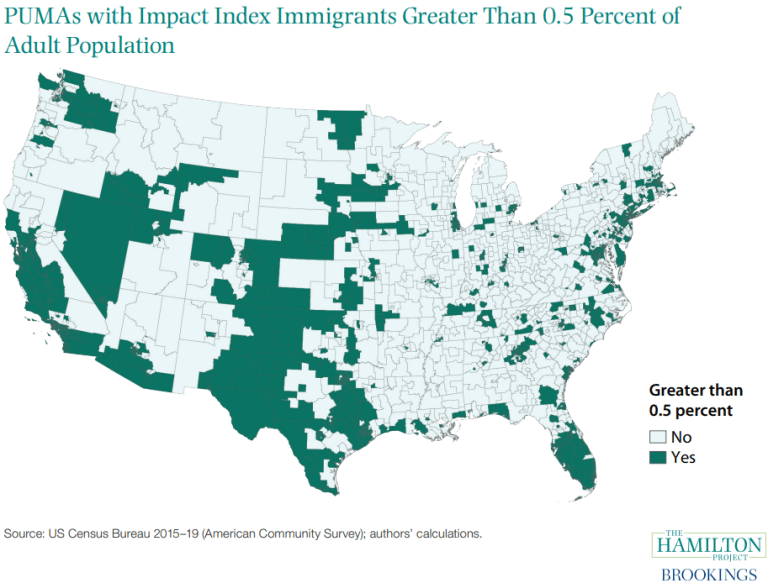
To ensure that the local communities affected by federal immigration policy receive more of immigration’s fiscal benefits, the authors propose to redistribute some of the fiscal gains of immigration to defray the immediate net fiscal costs that arise from welcoming newly arrived, less-educated immigrants. This proposal creates a method for determining the communities that qualify for funds, the Immigration Impact Index, and justifies an evidence-based dollar value per immigrant ($2,500) to be remitted to Immigration Impact Index communities by the federal government. These funds would visibly and transparently flow through education- and health-based federal funding channels: namely Impact Aid (education) and Federally Qualified Health Centers (health).

Figure showing PUMAs with Impact Immigration Immigrants Greater than 0.5% of Population

Source: A more equitable distribution of the positive fiscal benefits of immigration

America’s states are drifting apart over illegal immigration

As in so many areas:

Congressional dysfunction can cause chaos in America. Look at illegal immigration, where the law strands 10.5m unauthorised migrants in limbo, with little chance of deportation or the legal status that confers the right to work. In the absence of legislation, presidents oscillate wildly. Barack Obama sought to declare almost half of the unauthorised population exempt from deportation and eligible to work. Donald Trump turned the screws the other way, and tried deterring migrants by heartlessly separating parents from children. President Joe Biden is facing dissent from Democrats fearful of Republican attacks if, as planned, he ends a pandemic-response measure called Title 42 on May 23rd. This lets American border police expel asylum-seekers and other migrants on public-health grounds.

America’s federalist system wisely leaves much room to the states to act as laboratories. But state experimentation on immigration has gravitated to the extremes. In some Republican states the aim seems to be cruelty for its own sake. Greg Abbott, the governor of Texas, has suggested that the Supreme Court should reverse precedent and remove the obligation to educate illegal children, as if that would do anybody any good.

Democratic states, by contrast, have opted to spend money. They are expanding welfare benefits for their illicit residents. New York, which in 2019 began issuing driving licences to residents in the state illegally, set up a $2.1bn fund to provide unemployment benefits and pandemic relief. Three years ago California expanded Medicaid, the government health-insurance programme for the poor, to include young irregular residents. Its governor, Gavin Newsom, wishes to offer the programme to all, regardless of immigration status.

America is an outlier. In Europe and elsewhere access to benefits is limited to citizens or legal immigrants—who often have to wait for several years to be eligible. You would not expect Bavaria to sponsor Syrian migrants that the German interior ministry had turned away, or councils in London to offer housing benefits to adults who are in Britain illegally. It is Congress’s lack of will to deal with illegal immigration in America that explains the urge in California and New York to do something about their permanent shadow-class. Despite vigorous efforts, one-tenth of California’s non-elderly population lacks health insurance. Of that group, the illegal immigrants account for 40%.

Alas, these efforts are likely to be yet another stop-start measure. Because most federal laws ban spending on illegal residents, states must fund the expanded services without federal subsidies. At present, their budgets are swollen by a strong recovery and overgenerous federal funding during the pandemic. In a recession, when budgets are squeezed, such spending is likely to come under political attack. Democrats have long maintained, correctly, that unlawful immigrants by and large work hard and pay taxes, but receive few benefits. That line will be harder to sustain as these programmes grow—to the relish of the nativist right, who will deem their warnings vindicated.

Only Congress can sort out the confusion of half-built border walls, seesawing presidential decrees and contradictory state regimes. Immigration reform, with an orderly path to legal residency for those who pay taxes and do not commit crimes, was once a bipartisan pursuit. It has been forgotten amid the Trumpian takeover of the Republican Party. Some Democratic senators, like Bob Menendez and Catherine Cortez Masto, remain committed to the idea of trading a route to citizenship for stronger border security and faster immigration courts, which today are overwhelmed. The party’s left has turned instead to daydreaming about abolishing America’s immigration authority. The pity is that a labour shortage makes this an especially propitious time for mending the system.

Source: America’s states are drifting apart over illegal immigration

Congress Can’t Solve Immigration. Maybe the States Can.

Seeing more arguments in US media regarding providing a role for states in selecting immigrants, citing Canada’s Provincial Nominee Program as a model. Given the political dynamics, hard to see this getting much traction as presume there would need to be legislative authority for such a change:

“A moral failing and a national shame.” During his 2020 campaign, that was how Joe Biden characterized America’s immigration policies in the Trump era. On his first day in office, the new president announced an ambitious reform. The U.S. Citizenship Act of 2021 would include a pathway to citizenship for undocumented immigrants. It would raise caps on legal immigration. It would increase aid for Central America. It touched all the progressive erogenous zones.

And it was dead on arrival. “It’s such a progressive wish list that it’s almost counterproductive,” a pro-immigration lobbyist told me. By summer, the reform effort had stalled, migrants were flooding the border, the Democrats were divided, and the Republicans were demagoguing. Just like always.

For the country, as well as for immigrants and their families and employers, the cost of our never-ending immigration crisis has been very high. Among its consequences was the presidency of Donald Trump, who could not have reached the White House without the disruptive energy that immigration unleashed. In fact, if you had to pick a date when America launched itself toward Trumpism, June 28, 2007, would be a good choice.

Immigration was on the floor of the Senate. A bipartisan coalition had revived what was then—and still is—the logical compromise: stricter controls at the borders and at job sites, more legal immigration (especially of skilled workers), and a path to citizenship. Had the compromise passed, “it would have changed the politics,” Jim Kolbe, who was then a House Republican representing an Arizona border district, recently told me. “It would have been seen as putting the immigration issue behind us.”

Instead, the bill failed, badly. A disappointed Mitch McConnell, then the Senate minority leader, said, “I had hoped for a bipartisan accomplishment, and what we got was a bipartisan defeat.”

Before 2007, immigration had been a controversial issue but also a normal one—susceptible to bargaining and compromise. Congress had passed major reform under President Ronald Reagan in 1986, and then a series of tune-ups in the ’90s. After 2007, paralysis set in. For conservatives, the stalemate became emblematic of the country’s inability to secure its borders and enforce its laws. For liberals, it was emblematic of the country’s inability to deal humanely with millions of immigrants. And for moderates, it was a symbol of congressional incompetence. According to the Pew Research Center, two-thirds of the public wants a pathway to citizenship and better border control. “Everyone knows what has to be done,” Kolbe told me, “but no one has the will to do it.”

This dispute has now inflamed our whole body politic. “I think the immigration debate is a bigger problem for the country than any of the failures of the immigration system,” Yuval Levin of the American Enterprise Institute told me. In other words, the country needs a resolution to the political crisis around immigration at least as much as it needs a solution to the policy mess. As long as voters believe Washington is too incompetent and venal to handle immigration, they will not trust it to do anything else, and the door will stay open to demagogues and nihilists.

So now what? Plan A, comprehensive progressive reform, will not work. Plan B, comprehensive conservative reform, will not work. Plan C, compromise, should work but has failed time and again. That leaves Plans D, E, and F: piecemeal reforms for groups such as “Dreamers” and farmworkers, and the kinds of patchwork changes that congressional Democrats were seeking to include in their budget-reconciliation package this fall. They may be the best we can do.

But there is one piecemeal proposal that deserves special attention. I think of it as Plan Z, because it reframes the whole problem.

In 2019, representative John Curtis, a Republican from Utah, introduced what he called the State-Sponsored Visa Pilot Program Act. It would have allowed a new avenue for immigration by authorizing states to sponsor people for three-year, renewable work visas. The bill found no co-sponsors and never came up for debate, but Curtis told me he intends to reintroduce it in the current Congress.

Delegating immigration authority to the states is not a new concept; Senator Ron Johnson, a Republican from Wisconsin, introduced a similar plan in 2017. According to Alex Nowrasteh of the Cato Institute, a libertarian think tank, bills seeking authority to issue work visas have been introduced in 11 state legislatures since 2008, and three such bills have been voted into law. But the federal government has ignored them.

One problem is that people just can’t get their mind around letting someone other than the federal government decide who comes and stays. You can’t have individual states picking immigrants for the whole country! What about security? What about fairness? Could a conservative state discriminate on the grounds of, say, race or religion?

But the idea is not really that dramatic. This proposal wouldn’t encroach on the existing federal systems for visas, refugees, or family reunification. Any state-sponsored work permits would be in addition to the current number. The federal government would still vet the applications and control permanent residency and citizenship. Federal law and the Constitution would still forbid discrimination.

When I asked Mitch Daniels, the president of Purdue University, in Indiana, and a former Republican governor of the state, whether policy makers there would participate in such a program, he replied with a prompt yes. “The one thing” keeping Indiana from economic competitiveness, he said, “is that we don’t have enough people with the right skills.” Besides, he added, universities and businesses can already sponsor immigrants for visas; why shouldn’t states have the same authority?

how would state-sponsored visas work? In Curtis’s 2019 version, every state would have the option of sponsoring 5,000 work visas a year, plus an additional allotment based on its population, up to a nationwide total of 500,000. No state would be obligated to sponsor anyone, so states could shut their doors if they chose to. They could favor tech workers, farmworkers, family members; they could even use their visas to temporarily legalize undocumented workers already living there. The only requirements would be that the visas couldn’t be employer-specific (so bosses couldn’t use them to blackmail workers with deportation threats) and that the immigrants holding them live and work in the state that sponsored them.

How would the plan prevent immigrants from moving out of state? Each state would be required to report where its visa holders live and work, and if it couldn’t account for them, it would lose visas the next year. States that administered their programs well would be rewarded with more visas.

In any case, immigrants who settle into jobs and communities are not all that inclined to move. In Canada, which has allowed its provinces to sponsor immigrants since 1996 and which does not restrict where visa holders reside, more than 80 percent of them stay put for more than 10 years. “The vast majority,” a government report on the program said in 2017, “have become established economically, with high employment rates and earnings that increase over time.”

Even if this system isn’t perfect, the politics would be healthier than at present, when the federal government is making decisions, or nondecisions, and the states have no voice. “We’ve been so wrapped around the axle on immigration law and policy for so long that it might be very constructive to look at it through a different lens,” Janet Napolitano, a former governor of Arizona and secretary of homeland security in the Obama administration, told me. “Maybe it avoids some of the hard lines that both sides have drawn.”

State-sponsored immigration is not a cure-all. It would not remedy Congress’s deficiencies or resolve difficult questions about border control, asylum, or citizenship. What it would do is make American communities feel that they have some influence. It might dispel the rancid air that has suffocated reform. And it might begin to free our national politics from the curse of immigration gridlock.

Jonathan Rauch is a contributing writer at The Atlantic and a senior fellow at the Brookings Institution. He is the author of The Constitution of Knowledge: A Defense of Truth.
Source: Congress Can’t Solve Immigration. Maybe the States Can.

State GOP lawmakers try to limit teaching about race, racism

Of note (and of course, the states are preserving existing indoctrination):

Teachers and professors in Idaho will be prevented from “indoctrinating” students on race. Oklahoma teachers will be prohibited from saying certain people are inherently racist or oppressive, whether consciously or unconsciously. Tennessee schools will risk losing state aid if their lessons include particular concepts about race and racism.

Governors and legislatures in Republican-controlled states across the country are moving to define what race-related ideas can be taught in public schools and colleges, a reaction to the nation’s racial reckoning after last year’s police killing of George Floyd. The measures have been signed into law in at least three states and are being considered in many more.

Educators and education groups are concerned that the proposals will have a chilling effect in the classroom and that students could be given a whitewashed version of the nation’s history. Teachers are also worried about possible repercussions if a student or parent complains.

“Once we remove the option of teachers incorporating all parts of history, we’re basically silencing the voices of those who already feel oppressed,” said Lakeisha Patterson, a third-grade English and social studies teacher who lives in Houston and worries about a bill under consideration in Texas.

At least 16 states are considering or have signed into law bills that would limit the teaching of certain ideas linked to “critical race theory,” which seeks to reframe the narrative of American history. Its proponents argue that federal law has preserved the unequal treatment of people on the basis of race and that the country was founded on the theft of land and labor.

Those states include Arizona, Arkansas, Idaho, Iowa, Louisiana, Mississippi, Missouri, New Hampshire, North Carolina, Ohio, Oklahoma, Rhode Island, South Carolina, Tennessee, Texas and West Virginia.

The latest state to implement a law is Tennessee, where the governor this past week signed a bill to ban the teaching of critical race theory in schools.

The legislative debate over that bill caused a stir earlier this month when a Republican lawmaker who supports it, state Rep. Justin Lafferty, wrongly declared that the Constitution’s original provision designating a slave as three-fifths of a person was adopted for “the purpose of ending slavery.” Historians largely agree that the compromise gave slaveholding states more political power.

Some other states have taken steps that fall short of legislative change.

After Utah’s Republican governor blocked a vote on a set of similar bills, the GOP-controlled Legislature passed a symbolic resolution recommending that the state review any curriculum that examines the ways in which race and racism influence American politics, culture and the law.

Georgia Gov. Brian Kemp wrote in a letter to state education board members that they should “take immediate steps to ensure that Critical Race Theory and its dangerous ideology do not take root in our state standards or curriculum.”

Montana’s attorney general issued a binding decision Thursday declaring that certain teachings violate the U.S. and state constitutions and that schools, local governments and public workplaces could lose state funding and be on the hook for damages stemming from lawsuits if they provide critical race theory training or activities.

The National Education Association and the National Council for the Social Studies oppose legislation to limit what ideas can be presented inside a classroom.

“It creates a very chilling atmosphere of distrust, educators not being able to be the professionals they are not only hired to be but are trained to be,” said Lawrence Paska, a former middle school social studies teacher in New York and executive director of the council.

Republicans have said concepts suggesting that people are inherently racist or that America was founded on racial oppression are divisive and have no place in the classroom.

Earlier this month, Republicans in the North Carolina House moved to prohibit teachers from promoting seven concepts that critically examine race and racism, including the belief that a person’s race or sex determines their moral character, that people bear responsibility for actions committed in the past by other members of the same race or sex, and that they should feel guilty because of those two characteristics.

Rep. John Torbett, a Republican who leads North Carolina’s House education committee, said the legislation was intended to promote equality, not rewrite history.

“It ensures equity,” Torbett said during a hearing this month. “It ensures that all people in society are equitable. It has no mention of history.”

Kimberlé Crenshaw, executive director of the African American Policy Forum, was among those who helped popularize critical race theory in the 1970s and 1980s as a response to what she and others felt was a lack of progress following passage of civil rights legislation in the 1960s.

She said Republicans are twisting the concept to inflame racial tensions and motivate their base of mostly white supporters.

“This is a 2022 strategy to weaponize white insecurity, to mobilize ideas that have been mobilized again and again throughout history, using a concept or set of ideas that they can convince people is the new boogeyman,” Crenshaw said.

The boundary between teaching ideas and promoting them has stirred concern among teachers and racial justice scholars.

Uncertainty about that boundary could cause teachers to avoid difficult conversations about American history, said Cheryl Harris, a UCLA Law School professor who teaches a course on critical race theory.

“For anybody who’s ever taught in a classroom, the idea is to get the conversation flowing, and you can’t do that if you’re preoccupied with which side of the line are you going to be on,” Harris said. “That is a chilling effect, and that is every bit as offensive to the First Amendment as a direct ban.”

Opponents of the North Carolina bill say it’s a solution in search of a problem. Tamika Walker Kelly, president of the North Carolina Association of Educators, said the bill’s promoters could not point to any school in the state where students were being indoctrinated in certain racial concepts.

That’s just one reason the bill faces an uphill climb. The press secretary for Democratic Gov. Roy Cooper said the governor believes instruction should be honest and accurate, and that students need to be taught to think critically.

The legislation also faces skepticism from the Republican leader of the state Senate, where it will be considered next.

“I don’t like making it illegal to teach a certain doctrine, as wrong as that doctrine may be, while saying the reason for that ban is freedom of thought,” Sen. Phil Berger said in a statement. “That strikes me as a contradiction.”

Source: State GOP lawmakers try to limit teaching about race, racism