Budget 2024: Statement on Gender, Diversity, and Inclusion, varia

Definitely worth a look, for the richness of the data as well the insights into the government’s diversity and inclusion priorities and how it stitches the narrative together with political and Canadian public priorities.

Intro has the key messages:

  • “Early Learning and Child Care, which is supporting better economic outcomes for women, by making it possible for more women to participate in the workforce, while securing access to quality child care and learning, thus contributing to positive childhood development and the future well-being of children.
  • The interim Canada Dental Benefit has helped hundreds of thousands of children get the oral health care they need, and once fully implemented in 2025, the new Canadian Dental Care Plan will improve the long-term health of 9 million Canadians, who may have previously been unable to visit an oral health professional due to the cost.
  • The National Action Plan to End Gender-Based Violence provides targeted action to protect Canadians who experience or are at risk of experiencing violence because of their sex, gender, gender identity, gender expression, or perceived gender.
  • The Federal 2SLGBTQI+ Action Plan advances the rights and equality for Two-Spirit, lesbian, gay, bisexual, transgender, queer, intersex, and other sexually and gender diverse people in Canada.
  • The Implementation of the National Action Plan to End the Tragedy of Missing and Murdered Indigenous Women and Girls is providing targeted, culturally-appropriate supports to Indigenous women, girls, and 2SLGBTQQIA people, while working to address the root causes of the violence they face.

In Budget 2024, the government is making investments to close the divide between generations. For younger Canadians, the government is taking new action to reduce tax advantages that benefit the wealthy, is investing to build more homes, faster, is strengthening Canada’s social safety net, and is boosting productivity and innovation to grow an economy with better-paying opportunities.

These efforts will improve the lives of all younger Canadians, and their impacts will be greatest for lower-income and marginalized younger Canadians, who will benefit from new pathways to unlock a fair chance at building a good middle class life.

This starts with a focus on housing. Resolving Canada’s housing crisis is critical for every generation and the most vulnerable Canadians. The government is building more community housing to make rent more affordable for lower-income Canadians, including through:

  • The $618.2 million Federal Community Housing Initiative;
  • The $15 billion Affordable Housing Fund, including a $1 billion top-up in Budget 2024;
  • The $1.5 billion Co-Operative Housing Development Program; and,
  • The $4.4 billion Housing Accelerator Fund, including a $400 million top-up in

These investments provide Canadians and younger generations with opportunity ––finding an affordable home to buy or rent; having access to recreational spaces, amenities, and schools to raise families.

Having a place to call home creates a broad range of benefits. When survivors of domestic partner violence can find affordable housing, this creates a safe home base for their children to break cycles of violence and poverty. When Indigenous people can find affordable housing that meets their specific needs that means they can access culturalsupports to help heal from the legacy of colonialism. When persons with disabilities are able to find low-barrier or barrier-free housing, this enables them to utilize the entirety of their homes.

To ensure that young people and future generations benefit from continued actions for sustained and equitable prosperity for all, this budget makes key investments to guarantee access to safe and affordable housing, help Canadians have a good quality of life while dealing with rising costs, and  provide economic stability through good-paying jobs and opportunities for upskilling.”

Interestingly, no mention of the employment equity task force and its recommendations, although it is mentioned in the Budget.

Immigration aspects are limited to “continued funding for immigration and refugee legal aid” (but the Budget has significant funding for immigration and reflects the government’s pivot away from unlimited temporary workers and international students and post 2015 ending annual increases).

The Budget also has a reference to “Permit the Financial Transactions and Reports Analysis Centre of Canada (FINTRAC) to disclose financial intelligence to provincial and territorial civil forfeiture offices to support efforts to seize property linked to unlawful activity; and, Immigration, Refugees and Citizenship Canada to strengthen the integrity of Canada’s citizenship process (with little to no detail).”

No surprise, but the 2019 and 2021 election platform commitments to eliminate citizenship fees remain unmet.

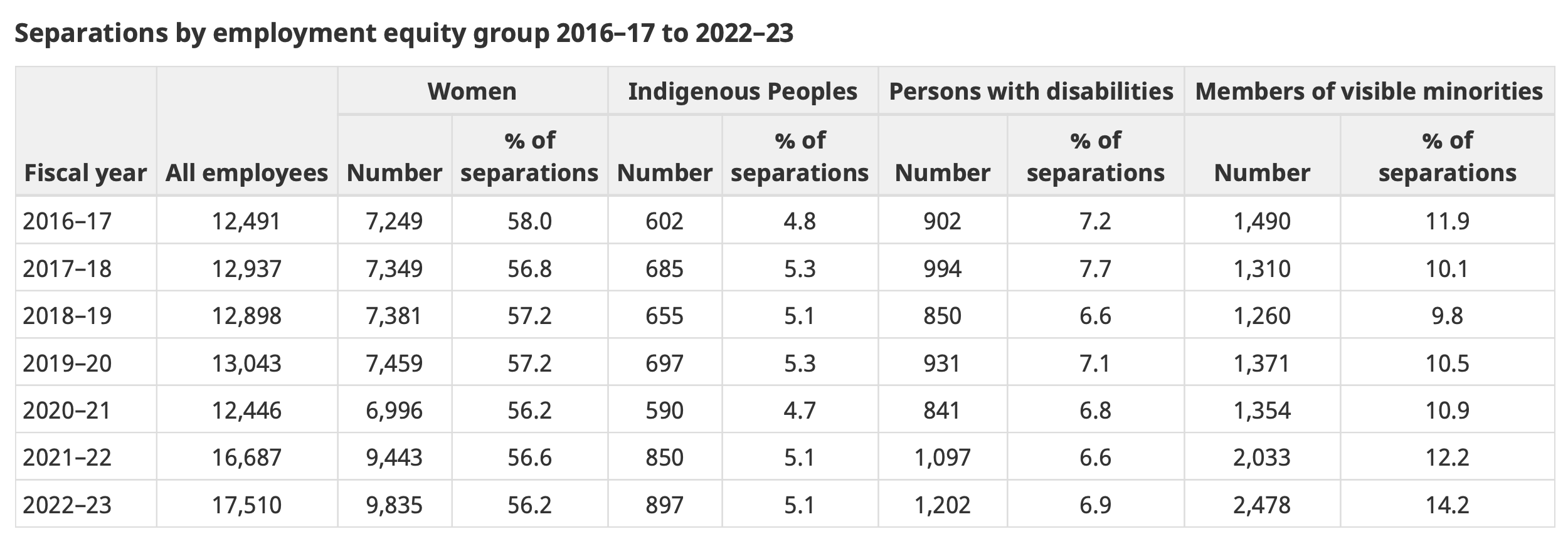
The Government’s proposed reduction in the public service by 5,000 public servants over four years (1,250 per year) is meaningless as the 2022-22 EE report shows annual separations more than 10 times that:
One thought that crossed my mind while browsing this close to 40 page document is whether this level of detail and effort would survive a change in government. Unlikely IMO, given the pressure to reduce spending and the CPC general aversion to excessive employment equity reporting and measures.

Source: Budget 2024, Statement on Gender Equality, Diversity, and Inclusion

Statement on the 50th Anniversary of the Multiculturalism Policy

PM statement. No statement by Conservatives (not surprising given silence in platform) or NDP (more surprising given extensive section in platform):

The Prime Minister, Justin Trudeau, today issued the following statement on the 50th anniversary of Canada’s multiculturalism policy:

“On this day in 1971, Prime Minister Pierre Elliott Trudeau announced multiculturalism as an official government policy – the first of its kind in the world – to recognize the contribution of cultural diversity and multicultural citizenship to the Canadian social fabric.

“The diversity of Canadians is a fundamental characteristic of our heritage and identity. For generations, newcomers from all over the world, of all backgrounds, ethnicities, faiths, cultures, and languages, have been coming to Canada with the hopes of making it their home. Today, in addition to First Nations, Métis, and Inuit peoples, people from more than 250 ethnic groups call Canada home and celebrate their cultural heritage with pride – they are at the heart of our success as a vibrant, prosperous, and progressive country.

“Canada’s multiculturalism policy was implemented based on the recommendations of the Royal Commission on Bilingualism and Biculturalism. These recommendations were made upon the urging of diverse ethnocultural groups throughout Canada, a reminder of the lengthy and ongoing struggle for equality in this country. The policy promotes respect for cultural diversity, acknowledges the freedom of all members of Canadian society to preserve, enhance, and share their own cultural heritage, and considers their cultural contributions throughout the country as essential to Canada. The policy received constitutional sanction in 1982, with an explicit recognition that the Canadian Charter of Rights and Freedoms should be interpreted in a manner consistent with the multicultural heritage of Canadians. Multiculturalism was then further enshrined into law in 1988 through the passing of the Canadian Multiculturalism Act,which was adopted unanimously by Parliament. This was an important step toward promoting the full and equitable participation of individuals of all backgrounds in shaping a strong, diverse, and inclusive society.

“While the policy continues to give vitality to Canadian society, reflect its multicultural reality, and inspire people and countries around the world, we still have work to do to make Canada inclusive, fair, and equitable for all. This year, several disturbing and divisive incidents motivated by hate have reminded us that prejudice, systemic racism, and discrimination continue to be a lived reality for many Indigenous and Black peoples, religious minorities, and racialized communities. Many also continue to face barriers to social and economic participation, which have only gotten worse during the COVID-19 pandemic.

“Today, Canada strives to be a respectful, prosperous, and compassionate country thanks to the tremendous contributions of people of all backgrounds who call it home. As we continue to build a more inclusive and open country, we recognize that a multicultural society is a work in progress. We must continue to promote the values of respect and inclusion that the Canadian Multiculturalism Act, the Charter, human rights legislation, and many other commitments have sought to promote. Along with Canada’s strong multiculturalism policy, we must also recognize the rich cultures of First Nations, Inuit, and Métis peoples, and our commitments to respecting their Aboriginal, treaty, and human rights and advancing reconciliation. This requires us to confront painful truths about our history and society, learn from them, and take meaningful action together to address systemic discrimination and ensure everyone is treated with respect and able to participate equitably in economic, social, cultural, and political life in Canada.

“On behalf of the Government of Canada, I invite all Canadians to find out more about multiculturalism in Canada, celebrate the cultural diversity that makes us who we are, and continue to learn from one another. By appreciating our differences as the source of our strength and resilience, we can build a truly inclusive, vibrant, and multicultural society.”

Source: https://pm.gc.ca/en/news/statements/2021/10/08/statement-prime-minister-50th-anniversary-canadas-multiculturalism

Statement by the Prime Minister on Canadian Multiculturalism Day

For those interested in the government political messaging, largely the same as last year:

The Prime Minister, Justin Trudeau, today issued the following statement on Canadian Multiculturalism Day:

“Today, we celebrate a pillar of our national character, and recognize the many contributions that people of all backgrounds have made, and continue to make, to our society.

Canada’s commitment to multiculturalism is an example to the world, and at the heart of our success as a country. For generations, Canadians have known we are stronger when we recognize and honour our differences and diverse roots, and work together to build a more inclusive future for all.

“This year, we mark an important anniversary. Fifty years ago this fall, Canada became the first country in the world to adopt a policy of multiculturalism, which was later enshrined in law through the Canadian Multiculturalism Act. While we have made important progress toward a more inclusive and equitable society since then, much work remains to be done. Every day, far too many racialized Canadians, Indigenous peoples, and religious minorities continue to face systemic racism, discrimination, and a lack of resources and opportunity.

“Sadly, over the last year and a half, the COVID-19 pandemic has revealed and deepened social, health, and economic disparities, and seen a rise in threats and violence against many of these communities. The tragic events of the past several weeks are painful reminders that Canada has not always lived up to its ideals, and that many Canadians continue to feel fear and insecurity simply because of the colour of their skin, their background, or their faith.

“This is unacceptable and must change. That is why the Government of Canada must and will continue to take meaningful action to right past wrongs, fight racism and discrimination, and foster a fairer, more equitable society.

“As individuals, we all have a role to play in building a more inclusive and resilient country. The values of openness, compassion, and respect have the power to bring us together, but they are only meaningful if we embody them. When we choose to put them into practice, we choose to shape a better tomorrow for everyone.

“On behalf of the Government of Canada, I invite Canadians to celebrate Canadian Multiculturalism Day by taking part in online events and in-person activities, and recognizing the invaluable contributions that Canadians of all backgrounds continue to make to our country. Together, we can make Canada a stronger, more welcoming, and inclusive place.”

Source: Statement by the Prime Minister on Canadian Multiculturalism Day

No statement by Conservative leader Erin O’Toole but this tweet:

Multiculturalism and inclusion are pillars of Canada. Canada’s Conservatives will always fight to protect our diversity and ensure equal treatment for all that respects and celebrates that diversity. Today we are wishing all Canadians a happy Multiculturalism Day.
Nothing from NDP leader Singh, Green leader Paul or Bloc leader Blanchet.