Skuterud et al: How We Subverted our Skills Based Immigration System

Valid critique:

In 2023, with little fanfare and no political opposition, the federal government gave itself the power to subvert Canada’s world-renowned skilled immigration system.

That system was formerly centred on the “points system,” called the Comprehensive Ranking System (CRS) in its most recent incarnation. 

Under the CRS, applicants for permanent residency were evaluated on their education, work experience, and language proficiency and the highest scoring applicants were admitted. The result was a continuous inflow of top talent chosen without political influence that benefited the Canadian economy and was admired by many countries (and emulated by some).   

But in 2023, the government created a new category-based feature in the system. That feature gave the immigration minister the power to prioritize categories of immigrants and move them to the front of the line. A rules-based system was replaced with a discretion-based system. 

The result is an opaque system that is exposed to political lobbying, looks like a lottery to prospective migrants, and squeezes out highly skilled candidates. In 2025, the leading category of immigrants under the new category-based system are francophones applying to live outside Quebec. 

Contributing to Canada’s patchwork immigration system, provincial nominee programs, which give provinces the ability to prioritize groups unable to meet the standard of the points system, account for an ever-increasing share of immigrant admissions. 

Admitting fewer skilled immigrants reduces our country’s productivity and tax revenue making it harder to fund social programs. It also affects Canada’s ability to attract the world’s best and brightest students to our post-secondary institutions, which are collectively reeling from plummeting international enrolment. 

Under the Canadian Experience Class (CEC) program, former international students with a Canadian postsecondary credential and one year of work experience in a skilled occupation are eligible to transition to permanent resident status without leaving the country. 

The CEC program’s intention is a good one – we attract whiz kids from around the world and provide them with an education that Canadian employers can easily evaluate. When this path works, it works well. International students pay high fees, lowering tuition costs for Canadians, and those who stay end up doing well in Canada’s labour markets. 

However, this approach can be abused when postsecondary institutions use immigration, not education, to lure foreign students. This has contributed to the growth of low-quality programs and distorted incentives on all sides. The problem lies in policy design.

In response to unsustainable growth in Canada’s non-permanent resident population and worries about housing, healthcare and labour market effects, the government has cut international student admissions for 2026 by 50 percent. 

The reduction is facing criticism from the postsecondary sector, but critics are overlooking that universities and colleges are not even reaching the quotas they have been given under the already reduced caps. New foreign student arrivals are on track to reach less than 160,000 in 2025, far below the government’s cap of 305,900. 

Foreign student applications to Canada’s universities and colleges have declined dramatically because prospective students no longer see a clear path to staying in Canada. Graduate students in computer science who want to stay are being told that learning French is their best option. And they fear that when they graduate, a different arbitrary category will be the priority. The current system discourages the best foreign students from applying to Canadian postsecondary institutions and blocks many of those who graduate from remaining in Canada.  

What should be done?

First, turn back the clock. Return to the immigration system that existed as recently as 2019 when immigrants were admitted through a single selection system that prioritized candidates with the highest future Canadian earnings. That system was transparent, predictable, and not easy for lobbyists to manipulate.  

Second, send a clear message that Canada welcomes foreign students. At a time when our goods exporting industries face major challenges, we should promote one of our most valuable services exports – educating international students. Education is an export that is uniquely dependent on trust, as students must live in Canada to consume the product.

Third, refine the points system to better target international graduates with the best earnings prospects. This would lead to increased demand by international students for programs with high post-graduate earnings and benefit our immigration program. Demand for programs that offer low earnings returns would moderate attracting only those international students who are coming solely for the education, since these programs would provide no realistic pathway to PR status.  

Canada needs immigration reform now. What we have now is a bungled system that prioritizes lobbying effort over the very real contribution that immigration can make to the Canadian economy.

David Green is a professor at the Vancouver School of Economics, Philip Oreopoulos is distinguished professor in economics at the University of Toronto. Craig Riddell is emeritus professor at the Vancouver School of Economics. Mikal Skuterud is economics professor at the University of Waterloo, and the Rogers Phillips Scholar of Social Policy at the C.D. Howe Institute and Christopher Worswick is professor of economics at Carleton University and a research fellow at the C.D. Howe Institute.

Source: How We Subverted our Skills Based Immigration System
RBC Proof Point: Canada is failing to put immigrant skills to work

Bit strange that given the main barrier cited is foreign credential recognition that the authors do not mention or address that this is largely under provincial jurisdiction. And striking that a note from Canada’s largest bank is silent on GDP per capita and productivity:

  • Canada leads the G7 in attracting immigrants, with newcomers now driving 90% of population growth.
  • Immigrants to Canada are better educated and younger than the domestic workforce.
  • But they are much more likely to work in jobs requiring less education.
  • Better utilization of immigrant skills will be key to economic prosperity, as immigration continues to drive Canadian workforce growth.
  • The bottom line: Poor recognition of foreign credentials is the primary obstacle to better utilization of immigrant skills. Eliminating this barrier will be critical to ensuring the Canadian workforce is not only larger—but more productive.

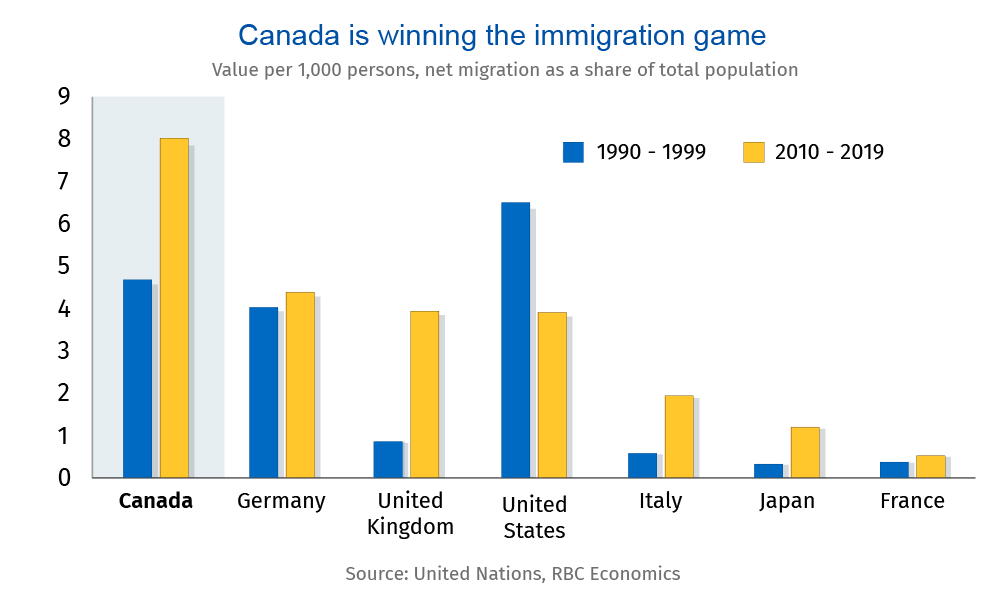
Canada is leading peers in the race to attract immigrants

Few countries are doing a better job of attracting immigrants than Canada. On average, for every thousand people in Canada there were ~8 migrants (when emigration is accounted for) between 2010 and 2019. That’s the highest level among G7 countries—and considerably higher than the U.S., which held the top rate for net migration a couple of decades ago.

Canadian immigration slowed sharply in 2020 due to a variety of COVID-related drawbacks. But its post-pandemic rebound has been powerful. In 2021, nearly 90% of all population growth was driven by higher immigration. And Statistics Canada expects that to reach 100% by 2050. Immigration alone will offset declines from lower birth rates and population aging.

Amid persistent labour shortages, these immigrants are bringing valuable skills. Indeed, of the 1.5 million newcomers that the federal government will target in the next three years, over half will be economic immigrants. That share is considerably higher than in the U.S. or the U.K. (where it sits at about a quarter).

These skilled newcomers (and the stronger workforce growth they’ll bring) are also the main reason we expect Canada’s GDP growth to outpace that of other advanced economies in the coming years thanks to stronger workforce growth.

Breaking barriers to immigrant skills recognition will bear fruit

Higher levels of immigration alone won’t ‘fix’ longer-run structural labour supply issues—but they’ll help. They could help even more if immigrant skillsets were better utilized.

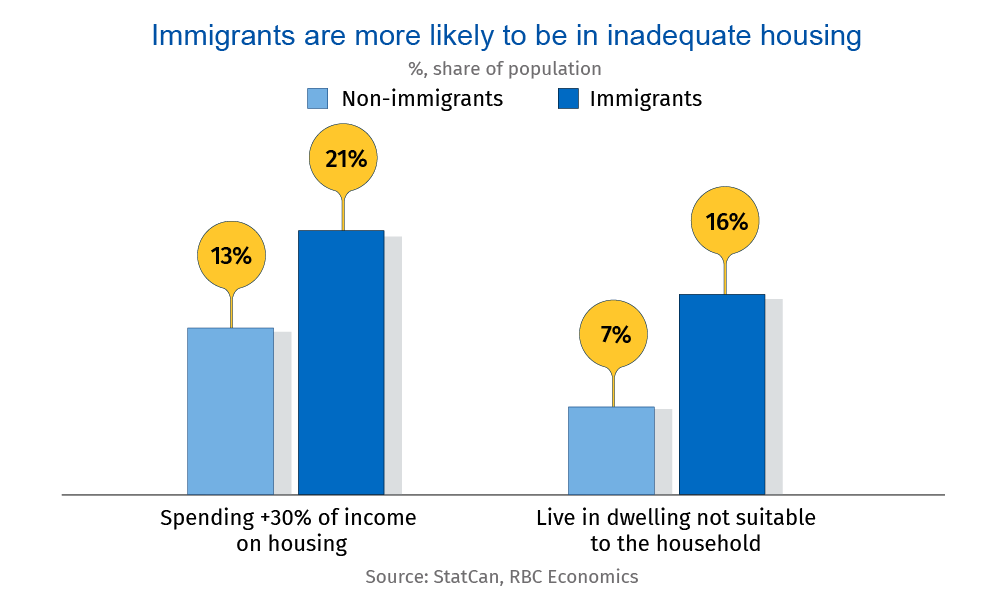
And there are a range of reasons to put them to use. Indeed, new immigrants can fill open positions, but they also increase demand for housing and consumer goods which in turn raises demand for labour. They’re also more likely to live in homes that are not suitable to the size or composition of their household. Better use of skills can offset all of those pressures by making the economy more productive.

As the economy enters a mild downturn due to aggressive interest rate increases and higher inflation, some easing of the labour squeeze is likely in 2023. Job vacancies in Canada have dropped since last summer. And more Canadian businesses were expecting a weaker outlook in Q4 2022, according to the Bank of Canada’s Business Outlook Survey. As a result, concerns about insufficient consumer spending have risen sharply and intentions for investment and hiring have moved lower.

But labour shortages will return as the population continues to age. Those issues are structural rather than cyclical. Having a younger, better educated inflow of immigrant workers could help immensely.

New Canadians don’t fare as well in the jobs market

Immigrants tend to be younger. The share of the “working age” population – or those that are aged between 25 to 64 years old – is 5% higher among immigrants compared to non-immigrants. That should help partially turn back the clock of an aging work force.

New Canadians also tend to be better educated. Over one third have advanced degrees, i.e. a bachelor’s degree or higher, compared to just over a fifth for non-immigrants. Immigrants with higher educations are also more likely to have majored in STEM-related fields (science, technology, engineering and math) than their non-immigrant peers.

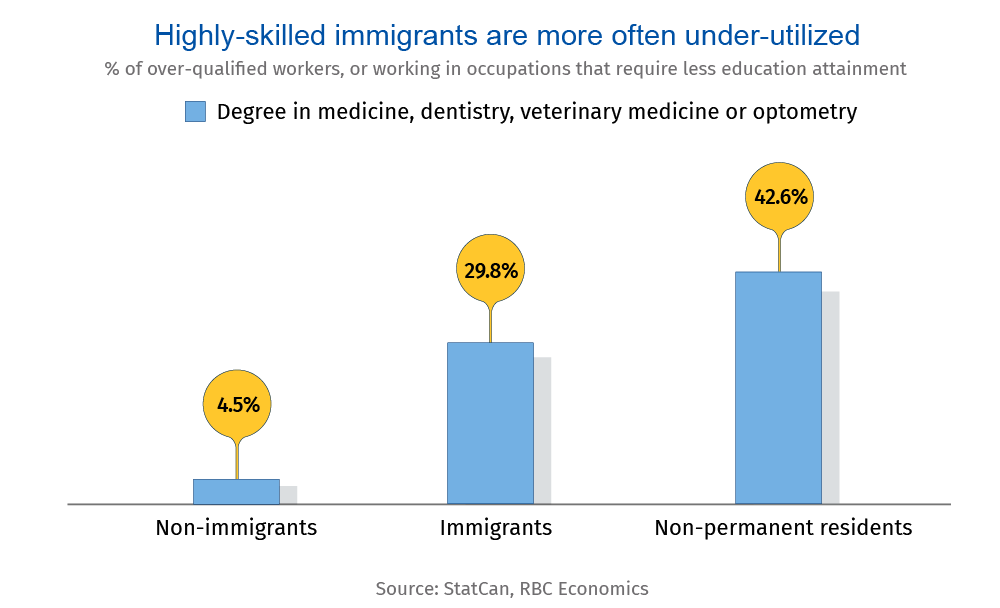
Yet despite being younger and more academically accomplished, immigrants tend to do worse when it comes to finding a suitable job. In other words, more of them tend to work in occupations that require education that’s below their current level.

This challenge, present in all sectors, is particularly daunting for those with degrees in medicine, dentistry, veterinary medicine or optometry. By our count, immigrants with a degree in those fields are six times more likely to work in jobs that do not require related training. Their skills are thus “under-utilized” compared to non-immigrants with similar degrees.

That gap however, goes away completely when the location of study is controlled for. Immigrants that trained to be doctors, veterinarians and optometrists within Canada are equally as likely to work in related fields as their non-immigrant peers.

In other words, poor recognition of foreign credentials is the primary obstacle to better utilization of immigrant skills. Moving forward, eliminating those barriers will be critical to ensuring Canada’s success in attracting immigrants continues. Proper integration of their skills could help address worker shortages, add to a more productive labour force and offset increased pressure on inflation and housing.


Nathan Janzen is an Assistant Chief Economist, leading the macroeconomic analysis group”. His focus is on analysis and forecasting macroeconomic developments in Canada and the United States.

Claire Fan is an economist at RBC. She focuses on macroeconomic trends and is responsible for projecting key indicators on GDP, labour markets as well as inflation for both Canada and the US.

Source: RBC Proof Point: Canada is failing to put immigrant skills to work