FIRST READING: Canada’s massive (and easily fixed) birth tourism problem

Second article in the National Post in a week. Hopper forgot to mention that the Conservative government did make a push to end birth tourism in 2012 (see my What the previous government learned about birth tourism):

Last week, Macleans’ published an interview with Simrit Brar, a Calgary OB-GYN who is one of Canada’s few medical researchers to actually look into the issue of birth tourism.

It’s something that’s long been an accepted fact within Canadian birthing hospitals: Hundreds of non-resident women each year are coming to Canada in the final weeks of pregnancy, having their baby in a Canadian hospital and then immediately returning home. The purpose of the excursion being to ensure that the child has Canadian citizenship by virtue of the country’s jus soli laws.

There are companies openly advertising their services as “birth hotels.” Online forums include questions as to the “cheapest” Canadian hospital for a non-resident to give birth. In the last full year before the COVID-19 pandemic, a single hospital in Richmond, B.C. had 502 non-resident births — nearly one quarter of total babies born.

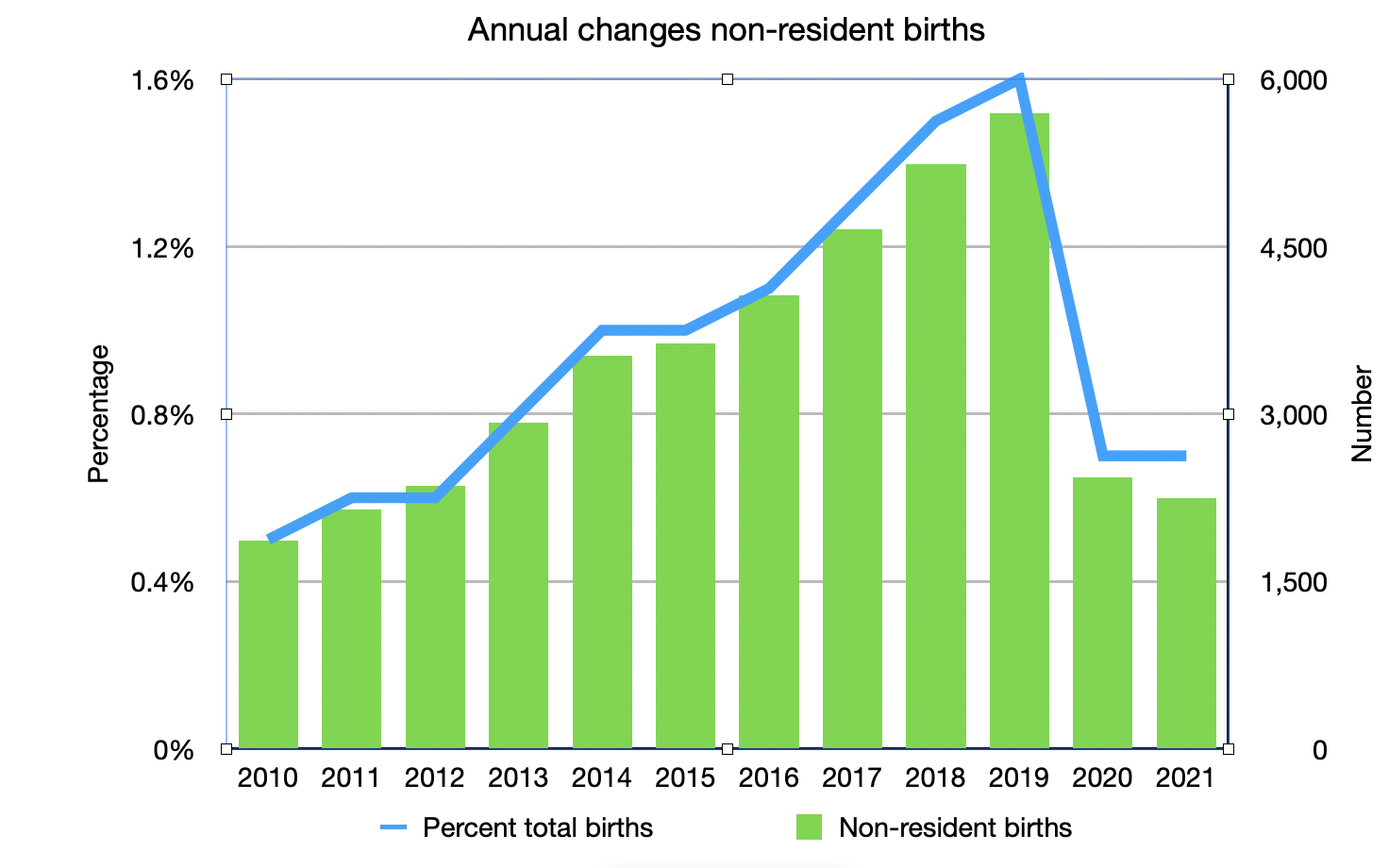
Figures from the Canadian Institute for Health Information show that Canada hosted a record 4,400 foreign births in 2019 — up from 1,354 just nine years prior.

Vancouver’s first baby of 2023, in fact, was born to a birth tourist: Mother Salma Gasser had only recently arrived from Cairo, Egypt, on her first-ever trip to Canada, and told local reporters she did it to secure a Canadian passport for her baby girl.

There’s nothing illegal about birth tourism and birth tourists are all paying handsomely for the service (it costs between $6,000 and $10,000 for an uninsured non-resident to give birth at a Canadian hospital). But for a Canadian health-care system that is constantly on the verge of crisis, the phenomenon is having an impact.

In a two-tier system like Australia, the U.K. or the U.S., an influx of non-residents seeking health-care beds could safely exist on the sidelines without affecting overall health-care access: The system could simply grow organically to accommodate the increased demand.

But Canada rations its supply of doctors and health-care workers, meaning that any extra patient is going to be adding to wait times.

“So even if a birth tourist does pay their bill, if we allow people who have the opportunity to pay to preferentially access beds … that displaces people here,” Brar told Maclean’s.

She added that birth tourism is a “social structure issue.” Ultimately, wealthy people from abroad are able to supplant scarce Canadian health-care resources, with negative results for “disadvantaged” Canadians.

“The system is too strained for us to ignore these questions,” she said.

Brar’s research examined 102 cases of birth tourists who had their babies in Calgary between July 2019 and November 2020. A plurality (24.5 per cent) were Nigerian and all told, the 102 paid $694,000 to Alberta Health Services in hospital fees.

Notably, most of Canada’s birth tourists are coming from countries that do not offer birthright citizenship. Almost all of North and South America grants automatic citizenship based on birthplace — a principle known as “jus soli,” or “right of the soil.”

In most of the rest of the world, citizenship is determined based on the nationality of one’s parents — known as “jus sanguinis,” or “right of the blood.” If a visiting tourist gave birth in Nigeria, for instance, that child would not be considered Nigerian unless they had a Nigerian parent or grandparent.

It would be remarkably easy for Canada to ban birth tourism, or at least make it less easy.

Provincial health-care systems could dramatically raise fees on “other country” birth services in order to discourage patients not insured under the Canadian system.

Some minor tweaks to the Citizenship Act could nullify instant citizenship if a baby is born to a parent temporarily visiting Canada on a tourist visa.

Refugees, asylum-seekers and other newcomers would still have guaranteed full, automatic citizenship for their Canadian-born children.

Or, Canada could simply begin denying visas to foreign nationals booking short trips to Canada at the tail end of a pregnancy. This is what the United States did in order to curb its own rising rates of birth tourism.

In early 2020, the U.S. Department of State issued an order to deny certain classes of recreational visas to foreign nationals if a consular official believed they were doing it just to give birth.

“The Department does not believe that visiting the United States for the primary purpose of obtaining U.S. citizenship for a child, by giving birth in the United States — an activity commonly referred to as “birth tourism” — is a legitimate activity for pleasure or of a recreational nature,” reads a statement from the time.

U.S. officials have also prosecuted California-based “birthing houses” for counselling foreign nationals to misrepresent their intentions on visa forms in order to enter the U.S. for the purpose of giving birth. Similar charges are feasibly possible in Canada, given that it is illegal under Canadian law to misrepresent one’s intentions for visiting.

Although birth tourism is not addressed or even acknowledged at the federal level, it’s long been deeply controversial in the immigrant-heavy Vancouver communities where it’s most visible.

Jas Johal, MLA for Richmond, has repeatedly denounced birth tourism for turning local hospitals into “passport mills.” Longtime Richmond city councillor Chak Au has often gone on record saying that his constituency — the most Chinese-Canadian in Canada — supports a legislated end to birth tourism.

In 2018, Richmond’s Liberal MP Joe Peschisolido tabled a petition in the House of Commons calling birth tourism an “abuse of Canada’s immigration and citizenship system.”

“The government should say birth tourism is bad. Let’s quantify it and let’s fix it,” he said at the time.

As recently as 2016, Vancouver-area Conservative MPs Alice Wong and Kenny Chiu even led a drive to overturn Canada’s system of birthright citizenship altogether in order to combat birth tourism — although both had reversed course by 2019, when the Conservatives prepared for that year’s election with a platform that mostly side-stepped immigration policy.

Source: FIRST READING: Canada’s massive (and easily fixed) birth tourism problem
A No-Nonsense View of Birth Tourism

National Post picks up on this useful Alberta study:

Last week, Maclean’s magazine published an interesting little one-interview piece featuring Simrit Brar, an OB-GYN physician at Calgary’s Foothills Hospital. Author Liza Agrba had caught wind of an interesting and overlooked study, published in January 2022, on the contentious topic of “birth tourism” — i.e., pregnant foreigners who visit Canada for the purpose of having their babies be born with Canadian citizenship. Past attempts to count birth tourists required some statistical inference, but Dr. Brar led a groundbreaking local effort to enumerate them directly and learn whatever could be discovered about their health outcomes and their effects on Calgary hospital capacity. 

This opportunity was provided through what the economists might call a “natural experiment.” In July 2019, the Calgary health region, which was not quite sure how much birth tourism the region was actually seeing, created a “Central Triage” office designed to capture all prenatal referrals for uninsured maternity patients. 

As Brar et al. describe it, this administrative creature was instituted with a number of goals. It allowed hospitals to distinguish situationally uninsured patients — refugees, persons with expired visas and undocumented residents — from intentional tourists. It established a process for getting full consent from the uninsured, who might have had a nebulous legal status otherwise, and it allowed Alberta Health Services to impose some order on chaotic physician-service pricing. And patients placed in the “birth tourist” category were given pamphlets explaining, basically, “We don’t want you here, although we can’t chase you away,” and were required to hand over a refundable deposit of $15,000. 

The study describes the traffic experienced by this unique Central Triage (CT) system. Of 227 pregnant patients sent to CT without Canadian health insurance over a period of 15½ months, 102 were labelled tourists and 125 were uninsured residents. A few of the birth tourists were lost to follow-up for various reasons (a few went home or gave birth outside Calgary, perhaps as a way of evading the cash deposit), but 83 were treated in Calgary hospitals. About a quarter of the tourists were from Nigeria, 18 per cent were from the Middle East and 11 per cent were from China. 

Calgary has about 15,000 childbirths in a typical year, so those 83 patients represent an added burden on maternity services of about half a percentage point — all other things being equal. But the first thing to note is that the study period ran up to Nov. 1, 2020. About two-thirds of it thus coincided with the COVID pandemic, and doctors did observe a decline in tourism visits when world air travel basically shut down. 

Moreover, Calgary was the only place in Canada where birth tourists were, and are, being discouraged by means of a deposit. (Dr. Brar told Maclean’sshe is concerned that the Central Triage system may be diverting tourism patients to suburban and rural hospitals that are even more overmatched than the city’s.) 

Most of the birth tourists ended up using less than the $15,000 deposit and received refunds, but the study reveals that even in a city determined to address birth tourism consciously, it might create external problems. Birth tourists often arrive in Canada late in pregnancy, when air travel is risky, and some arrive with health problems from the Third World. One tourist was diagnosed with HIV in Calgary and three needed to have cervical cerclagesremoved. Since uninsured patients are on the meter while in an Alberta hospital, they may leave against medical advice. Nine birth-tourist babies required time in the neonatal intensive care unit, including a pair of twins who were in the NICU for 50 and 63 days at the worst conceivable time. 

The kicker is that collecting hospital fees from birth tourists can be tricky if the cost of their care goes over the deposit. During the 15½ months of the study, the tourists ran up about $700,000 in Alberta health bills that are still unpaid. Brar takes a surprisingly unsentimental view of the birth-tourism phenomenon in her Maclean’s interview, emphasizing the “finite” nature of Canadian health care and the affluent nature of the tourists. Her team’s paper suggests making the Central Triage setup province-wide, and perhaps it ought to be imitated even more widely.

Source: A No-Nonsense View of Birth Tourism

Canadian doctors say birth tourism is on the rise. It could hurt the health care system. [Alberta study]

Interesting Alberta study that broadens awareness of the issue with some qualitative analysis (Alberta has some of the most active medical academics working on birth tourism and I haven’t seen much from the other large provinces). Medical professionals are much more realistic than some social scientists and lawyers on the issues and implications:

Every few years, the phrase “birth tourism” seems to re-emerge in the news cycle. It refers to non-residents giving birth outside of their home country to gain citizenship and, occasionally, health care for their newborns. Birth tourism isn’t illegal in Canada, but it’s a fraught issue that tends to kick up discussions about who deserves access to the country’s health care system, especially in times of low bandwidth. Like now.

Simrit Brar, an OB-GYN at Calgary’s Foothills Medical Centre, is one of many Canadian doctors who claim to have noticed a recent spike in the number of birth tourists arriving out west. But because that data isn’t routinely collected by hospitals, it’s been impossible to understand the real scope of the issue. Last year, Brar was part of a research team that conducted the country’s first in-depth study on birth tourism in Alberta, and this year—for the first time—the Society of Obstetricians and Gynecologists of Canada is forming a working group to study its impact country-wide. Here, Brar reveals what we know so far.

What prompted you to study birth tourism?

Anecdotally, my colleagues and I noticed an increase in the number of cases we were seeing in Calgary hospitals over the past decade or so, but it’s been difficult to draw any real conclusions about the motivations, health outcomes or financial situations of birth tourists. We know they don’t have Canadian health coverage, but sometimes they have their own private insurance plans that reimburse their care costs. Canadian doctors were struggling to provide timely care for our baseline population even before the pandemic. Birth tourism is far from the only factor straining the health care system, but we knew it was an additional cost, and that we didn’t have the data to understand it. We saw an opportunity.

So how do birth tourists differ from other uninsured pre-natal patients in Canada?

Based on our research, birth tourists are typically middle to upper-middle class, with the means to support themselves while in Canada. The people we looked at weren’t necessarily disadvantaged. I want to be clear: refugees, asylum seekers, undocumented migrants and those in similarly precarious situations—like patients whose provincial health insurance has lapsed, for whatever reason—are not birth tourists. A birth tourist makes the conscious decision to travel and give birth here, and generally they have no intention to stay. Piling everyone under the same umbrella misses those crucial nuances and prevents us from making informed decisions, both at the policy level and in day-to-day care.

If you’re right that there’s been an uptick in birth tourism, what do you think is causing it?

It’s hard to say. We saw it slow a bit during the pandemic, given travel restrictions, and now it seems to be picking up again. I think the availability of information via social media is one factor; that spreads awareness that this is even an option. There are also companies that specialize in facilitating the birth-tourism process. They seem to market themselves online and through word-of-mouth.

What did your study reveal about why birth tourists are coming to Alberta? And where are they typically coming from?

About a quarter came from Nigeria, probably because there’s an established Nigerian community in the Calgary region. Birth tourists tend to go where they have friends or family. Smaller portions came from the Middle East, China, India and Mexico. The vast majority arrived with tourist visas, and based on our interviews, they weren’t facing particularly precarious situations back home. Again, I can only speak to the population we studied, but in general, these are women with resources.

What were they seeking?

That majority said their goal was to get Canadian citizenship for their newborns. Many saw it as an easier route to citizenship for their kids than applying through the typical process. Others either wouldn’t tell us their motivations or said they wanted to somehow benefit from quality Canadian health care.

When birth tourists get off their flights, what is the extent of their health needs?

Many travel here late in their pregnancies and arrive close to 38 weeks, which can lead to complications. I’ve seen patients with pre-existing high blood pressure get off a plane with numbers that are through the roof. Often, they’ll show up at a family doctor’s office, who sends an urgent hospital referral. I’ve also seen patients with pre-term twins literally get off a plane and go straight to an emergency room to deliver. Even somebody who might be otherwise low risk but shows up with no medical imaging or other records of pre-natal testing can have adverse birth outcomes, like unchecked pre-eclampsia and gestational diabetes. These aren’t isolated incidents, either.

When you crunched the numbers, what was the total cost incurred by the province to take care of these people?

For the 102 people we studied, the total amount owed to Alberta’s health care system was $649,000. That may not sound like a lot, but this is just one small study. If you were to add up the costs across Canada, you would end up with a significant amount. I also want to emphasize that this is not just about money. Canada’s health care system isn’t like the States’, which is not only fee-for-service but has a much larger population—and accordingly a larger number of health care providers. Our public system has a finite number of doctors, nurses, and anesthetists. Every province has a lengthy surgical waitlist, and we’re struggling to care for insured patients. So even if a birth tourist does pay their bill, if we allow people who have the opportunity to pay to preferentially access beds (and finite human resources), that displaces people here.

Have any solutions been proposed? If birth tourism isn’t illegal, but it is draining resources, how do we move forward?

We’ve discussed developing a standard charge and different systems for collecting it. In Calgary, we’ve established a central triage system, where patients identified as birth tourists are charged an upfront deposit of $15,000 to cover physicians’ fees. They’re refunded whatever part of that doesn’t end up being used. It’s the only measure of its kind in Canada. Transparently, that number is meant to be a deterrent.

Conversations on this topic occasionally lean toward a xenophobic—and even racist—lens, particularly in the States. Media coverage can sometimes paint pregnant women of colour as a national security threat. What are the biggest misconceptions about this issue?

I say this as a woman of colour: in my opinion, this is not a race issue. It’s a social-structure issue. It’s about access to care. When you have money and you have the ability to get on a plane and choose where to go, your options are different. The issue here is the use of a limited public health care resource. It’s about what it means for patients in disadvantaged communities here. Birth tourists have the ability to choose where they want to go, whereas somebody in a marginalized community may not have that ability. If we open the floodgates, we are further limiting people with very limited options.

Birth tourism highlights some really interesting philosophical tension around the Canadian health care system, the spirit of which is to make sure everyone is taken care of. Here, we see the limits of that thinking. Has studying birth tourism changed your perspective?

You hit the nail on the head. I would love nothing more than to have unlimited resources and help anyone and everyone. That would be dreamland. I would love to not have to fight to get things done. And to be clear, I would never deny care to a patient. But the reality is that we operate within a finite system, and even though the conversations around the allocation of those resources are difficult and complex, we have to have them. I would identify wanting to help as many people as possible, and in the best way possible, as a fundamentally Canadian value. But the system is too strained for us to ignore these questions.

Source: Canadian doctors say birth tourism is on the rise. It could hurt the health care system.