Ling: We’re terrible at talking about the Israel-Hamas conflict. I tried to figure out why. [the need for criteria]

Good on Ling for having these conversations.

The most recent example is that of Capital Pride provides an example of the kinds of questions that need to be raised. How should organizations like Capital Pride assess which issues to promote or protest? What should the criteria be? How should one distinguish between different atrocities and abuses? Why Israel/Hamas and not Chinese repression of Uighurs, killings in the Sudan civil war, Russian war crimes in Ukraine, Uganda’s anti-homosexuality act, etc?

So, to encourage some discussion, here are some initial suggestions of possible criteria:

  • Is the protest and actions primarily about LGBTQ rights?
  • If not, how does a country’s or organization’s human rights abuse compare to other human rights abuse?
  • How divisive will the issue/protest be among LGBTQ communities and more broadly?
  • How does the treatment of LGBTQ differ between parties to a conflict?

These have been written for the Israel/Hamas protests and thus reflect my preferences and biases. But the need for criteria, rather than event and particular group driven protests, would reduce the likelihood that some LGBTQ members and allies would feel excluded:

…At least Fogel was willing to be introspective. I suggested to him that Haaretz — the liberal Israeli paper, a fierce critic of Netanyahu, which has relentlessly covered allegations of Israeli war crimes  — could not publish in Canada without being deluged with complaints and criticism. “I don’t think you’re entirely wrong,” he says. “What passes for the norm in Israel is sometimes seen by the Jewish community here as crossing the line.”

How can we have a serious discourse with all these invisible lines? Fogel gave me a fatalistic answer: “I’m not sure you can.”

It’s a variation of an idea I heard from Toney, and Kaplan-Myrth, and a host of other people in recent months: we’re too far gone, too polarized, too emotional to be able to talk about this crisis. Many say they respect the positions of the other side, and are keen to figure out points of agreement, yet often caricature their ideological opposites as inflexible, radical, impossible to reason with.

Mediating this conflict through the body politic doesn’t necessarily mean striving for compromise or capitulation, and it doesn’t entail a return to an age of elite gatekeepers. But it has to mean engaging in discussion, debate and argument without immediately calling it all off. Enabling genuine discourse doesn’t fuel hate, and may act as a pressure release valve to actually prevent it. At the same time, we can’t accept hateful language, online or in the street, just because the author insists their side has a monopoly on morality and justice.

There’s nothing naive about this idea: It is literally the foundation of our society. It is deeply cynical to say that our ideological opposites must be silenced, boycotted, or shouted down because they are dangerous or immoral.

Polarization is not a thing that other people do to us. It is a thing we do to each other. In the same way, mediation is not something that will be done for us, but something we have to commit to and work on, every day, ourselves.

Source: We’re terrible at talking about the Israel-Hamas conflict. I tried to figure out why.
The Canadian government must do more to combat hate crimes in Canada: Fogal, Godoy and Ansong

Surprising – or perhaps not – that this commentary by Shimon Fogel of the Centre for Israel and Jewish Affairs, Carlos A. Godoy of Ga’ava, a Quebec-based LGBTQ organization and Tobin Ansong is of the Ghanaian Canadian Association of Ontario is virtually silent on hate directed at Muslim Canadians.

They propose strengthened measures against hate crimes: two general in nature that apply to all groups, one specific to radicalization, targeted largely at Muslim Canadians.

While I have no general issue with measures that focus on specific communities where needed (as is the case with respect to Al-Qaeda/ISIS inspired radicalization), it would have been a stronger statement had it more explicitly acknowledged anti-Muslim sentiment and had been a joint statement with a Canadian Muslim group:

In this same vein, federal officials should consider three more initiatives that could have significant impact in countering hate crime.

First, every MP should support Bill C-305 proposed by Nepean MP Chandra Arya. Currently, vandalism targeting a religious site—such as a church, synagogue, mosque, temple, or cemetery—is a specific offence with substantial penalties. But this designation does not apply to schools or community centres associated with an identifiable minority group. C-305 is an essential, common sense bill to close this clear gap in the Criminal Code.

Second, there is a need for greater federal leadership to aid local police in enforcing hate crime provisions of the Criminal Code by offering more training, uniform guidelines, and resources. This is especially crucial given that this is an issue far beyond Canada’s largest cities. In 2013, the four most frequently affected cities per capita were Thunder Bay, Hamilton, Moncton, and Peterborough. Federal authorities can play a central role in identifying and sharing best practices. British Columbia, for example, is in many ways a model for a successful approach, with police agencies maintaining dedicated hate crime units providing experience and systems required to respond effectively to such incidents.

Third, as the federal government implements its counter-radicalization program, we must recognize the link between radicalization and hateful views toward minorities, whether they manifest as antisemitism, homophobia, or racism. There is ample research and tragic evidence—whether at a kosher supermarket in Paris, or an LGBTQ nightclub in Orlando, or a church in Charleston—these forms of hatred often go together with violent extremism.

Identifying early warning signs, in the form of hate and propaganda against these communities, must be an integral part of the government’s overall anti-terrorism strategy. Likewise, countering these hateful ideologies is essential in reclaiming a psychologically vulnerable person from the path of radicalization.

While these suggestions are relatively modest, taken together, they would represent a significant step forward in the effort to ensure Canada remains a safe home for all minorities.

Source: The Canadian government must do more to combat hate crimes in Canada – The Hill Times – The Hill Times

UK backs stripping citizenship over terrorism

Interesting amendment in light of the Canadian hearings on Bill C-24 Citizenship Act on the revocation provisions.

Shimon Fogel of CIJA took great pains in his testimony to state that Israel’s law of return only granted the right to citizenship; people still have to apply formally for citizenship. Under the UK approach, the law of return would mean that revocation in the case of Jews would not require them to formally take up Israeli citizenship – just having the right would be enough.

The proposed Canadian approach is that one has to have dual citizenship, not potentially have dual citizenship, plus a court process rather than Ministerial discretion. But the onus of proof is on the person the government proposes to revoke his or her citizenship:

In April, the upper house of the British parliament had rejected the measure proposed by Theresa May, the UK’s interior minister, but passed the law on Monday after a government amendment.

Members of the house voted 286 to 193 in favour of the amended legislation, peers from the opposition Labour party voted against.

The lords reversed course after May accepted the addition of a clause that would only allow citizenship to be taken away if there were “reasonable grounds” to believe suspects could acquire another nationality.

UK backs stripping citizenship over terrorism – Europe – Al Jazeera English.

The NY Times also covers this:

Britain has been one of the few Western countries that can revoke citizenship and its associated rights from dual citizens, even native-born Britons, if they are suspected or convicted of acts of terrorism or disloyalty. The government has stepped up its use of this tactic in recent years. In two cases, suspects have subsequently been killed in American drone strikes.

The new rules will broaden these so-called deprivation powers to include Britons who have no second nationality, provided that they were naturalized as adults. If the home secretary deems that their citizenship is “seriously prejudicial to the vital interests of the United Kingdom,” it can be taken away, effective immediately, without a public hearing. A suspect whose citizenship rights have been stripped has 28 days to appeal to a special immigration court.

 Britain Expands Power to Strip Citizenship From Terrorism Suspects

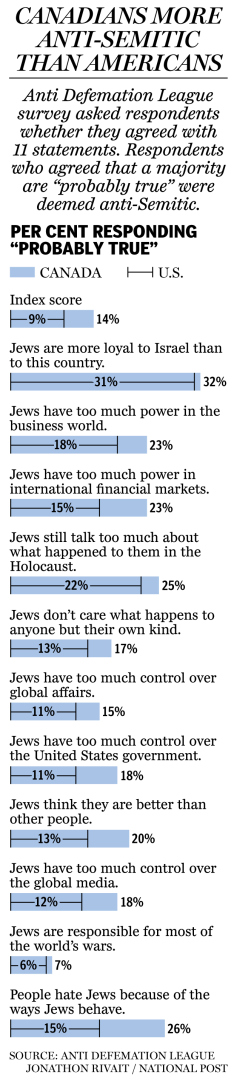
Canadians more likely to be anti-Semitic than Americans, ADL, and commentary

NP_antisemitism_c_jrFrom the recent ADL worldwide study on antisemitism, the Canadian data showing Canada slightly worse that the US but comparatively better than most other countries:

I’m a little bit surprised that the figures aren’t greater in the United States but I’m not surprised at the 14% in Canada,” said Frank Dimant, chief executive officer of B’nai Brith Canada. “We have always surmised that it is in that range — that range of ‘hardcore.’”

….

“We’re talking about 4.8 million people. That’s a lot of people who harbour this kind of hatred in their hearts.”

….

“Once, we had certain pre-conceived notions as to the stereotypic image of an anti-Semite as an illiterate boor. Today, that is simply not the case,” he said.

“We see the penetration of this disease of anti-Semitism in many new components of society… much of it is in the guise of anti-Israel.

“The coalition of hate is widespread so it ranges from academics to neo-Nazis to Islamic jihadists to radical feminists to trade unionists.”Shimon Koffler Fogel, head of the Centre for Israel & Jewish Affairs (CJIA), said the survey should provide the catalyst for a national discussion.

“For us, the real take-away is that issues like anti-Semitism and racism in general have not diminished to the point where as a society we can say we don’t have to address these concerns,” he said.

Canadians more likely to be anti-Semitic than Americans, poll finds | National Post.

And the two contrasting takes on the worldwide results, starting with Commentary on the right:

Anti-Semitism has survived the death of European theocracies, Nazism, and Communism and metastasized into a belief system embraced by Muslims and Arabs, and remains a deadly force. Though some might claim that the existence of Israel and allegations about its behavior has become the single greatest motivating factor for anti-Semitism (judging by the survey, the Palestinians are the most anti-Semitic people on Earth), that assertion must be placed up against the fact that the attitudes that indicate hostility to Jews long predate the birth of the Jewish state or its coming into possession of the West Bank in 1967. Seen in that perspective, it’s clear that Israel is just the latest, albeit a vicious, excuse for Jew hatred. If not all those who hate Israel also embrace the full roster of anti-Semitic stereotypes, their willingness to embrace the war against the Jewish state demonstrates the way Jews remain the planet’s boogeyman and the objects of unthinking bias and potential violence.

Many Jews will look at these numbers and, no doubt, wonder how they can change the minds of the haters or adopt behaviors that will undercut the stereotypes. But whatever else it tells us, the survey is a reminder that anti-Semitism is about the minds of the anti-Semites and their desire to seek out a small group for hostility, not what the Jews do. Those who will seek to blame Israel or Jewish power for these numbers are deceiving both themselves and others. Anti-Semitism is an ancient belief system that can adapt itself to any set of circumstances or locale.

Israel and the Reality of Anti-Semitism

From Haaretz on the left:

4. Iran, on the other hand, not only emerges unscathed from the survey but actually stands out for the positive. It has the lowest “Anti-Semitic Index” (56%) of all Middle East countries. It is a finding sure to confound hasbara people and one that can be attributed, among other things, to the relative sophistication of the Iranian people, to the continued existence of the local Jewish community – unlike in most Arab countries – and to the Iranian leadership’s ongoing protection, for its own reasons, of Iranian Jews.

5. In fact, the ADL poll more or less upsets the apple cart altogether in disestablishing the causal connection between anti-Jewish and what are widely perceived as anti-Israeli sentiments. Sweden – Sweden, for God’s sake – a hotbed of anti-Israeli agitation that is routinely labeled as anti-Semitic is the LEAST anti-Semitic country in Western Europe, according to this survey, along with its Nordic neighbors – Iceland, Finland, Norway and Denmark.

On the other hand, Eastern European countries such as Poland, Bulgaria and Ukraine, whose governments are rock solid supporters of Israel, harbor large segments of anti-Semitic feelings. The outliers are the Czechs, god bless them, who have always felt themselves more Western than Eastern European anyway. And what can you say about South Korea, a country with excellent diplomatic and commercial ties to Israel whose population – 53%, by ADL’s standards – has very questionable views of Jews.

….

7. The worst anti-Semitism, by ADL’s definition, was measured in the Middle East and North Africa, from the West Bank and Gaza (93%) and Iraq (92%) to Saudi Arabia (74%) Turkey (69%) and Iran (56%). No surprise there, really, given that in most Middle Eastern countries the media freely engages in anti-Jewish agitation, with governments either sitting idly by or actively taking part.

Nonetheless, it is an open question whether anti-Jewish sentiment in a region in which a. there are hardly any Jews and b. sees itself at war with the Jewish state and/or as the usurpers and oppressors of the Palestinians should really be included in the same rankings as all the rest, or whether Muslim anti-Semitism isn’t a category all to itself.

Ten comments on ADL’s global survey of anti-Semitism (It’s not all bad)

Of course, while dispiriting, in most developed countries Jews are more favourably viewed than other minorities such as Sikhs and Muslims (see as an What Europe Thinks of Jews, Muslims and Roma – Pew).

The link to the ADL study:


ADL Global 100