Lynch and Mitchell: Instead of adding new programs, Ottawa should focus on proper delivery of the ones it has

Likely a perennial refrain among officials having to respond to political-level demands but valid nevertheless as capacity limits of the public service in areas such as passports, immigration and others have become painfully apparent post-pandemic.

Of course, one of the ironies of former DMs and ADMs raising these issues is that the vast majority rose up through the policy ranks, helping governments introduce new programs, rather than in service or delivery!

And one should not underestimate the difficulty of briefing the political level against a particular initiative or program based on service delivery grounds:

Most Canadians expect value for money in their spending, especially in these uncertain and inflationary times. With worker shortages, empty offices, supply chain woes, high energy prices, soaring inflation and painful accommodation costs, Canadian consumers are worried about their financial health.

But what about governments? Are they delivering value for Canadians’ hard-earned tax dollars? For anyone seeking a passport or visa, lining up for airport security screening, trying to get a Nexus card, waiting for a routine medical procedure or watching government procurement systems that cannot deliver payroll, the answer is unambiguously negative.

Core government services are not being delivered well today, and this not only erodes confidence in government as an institution – it also undermines productivity and competitiveness in the Canadian economy.

What are the causes? While there is no single answer, it is clearly not due to a shortage of spending, public servants, consultants or debt. At the federal level from 2015 to 2022, the size of the public service grew by 30 per cent, the use of consultants shot up 40 per cent, government spending skyrocketed by 66 per cent and government debt almost doubled. In short, the size of government expanded, considerably, while the efficiency of government declined, noticeably – not a good combination.

In fact, the stratospheric and scattered spending is one root cause of the delivery problem.

Before, during and since the pandemic, the federal government has unleashed a vast array of new programs. New program delivery is complex and time-consuming work, requiring highly capable, experienced and empowered public servants. Indeed, “delivery” is the nuts and bolts of policy implementation and program operations – it encompasses the design of new programs, the stress testing of the design to avoid unintended consequences, ensuring robust IT and data systems to support the program, the hiring and training of staff, establishing quality control and compliance systems, and communicating to the intended beneficiaries how the program works.

There is a risk of moral hazard here – as governments try to do more and more, they may end up achieving less and less. The problem arises from the scale, scope and speed of new spending. Too many new programs, with too little prioritization, that are too quickly rushed to the “press release stage” is a recipe for delivery problems, not only of the new programs but also related existing programs on common platforms.

Today’s reality of government not being particularly good at actually delivering things – both core services and new programs – should be a matter of concern well beyond the Ottawa bubble. If you believe what government does matters to Canadian society and the economy, as we do, then less-than-stellar delivery of government services neither serves the public interest nor bolsters the public’s trust in our institutions of government.

What can be done? Like any complex problem, there is no single solution, but four possible actions deserve serious consideration.

First, pause the proliferation of new spending and new programs. This is needed to restore operational integrity and program delivery capacity as well as to support fiscal sustainability in a period of high inflation, high interest rates and high debt. And yet, the risk today is a proliferation of new government programs and the scaling up of existing ones ranging from new industrial policies to new energy transition programs, national dental care and pharmacare, new health transfers, increases in defence spending and expanded immigration. Whatever the policy merits of these proposed initiatives, this is simply not the time to expand government. Rather, it’s the time to refocus on meeting the expectations of Canadians for quality and timely delivery of government services.

Second, reverse the extreme centralization of decision-making within government. This is necessary for better governance as well as better program delivery. Too much decision making has been vested in the Prime Minister’s Office at the expense of ministers, cabinet and Parliament. Ministerial accountability and collective decision making, with fearless advice from an empowered, non-partisan public service, are central to our Westminster system of government. The sad fact is we have strayed far from that guiding ideal.

Third, modernize the architecture of compliance and oversight within government. This requires a profound shift from an operating culture of control and risk avoidance to one of innovation, risk taking and delegation. In the name of protecting the taxpayer, there is a compliance morass pervading government today, with overlapping oversight bodies, excessive red tape and needless reporting – all of which impedes getting things done and delivered.

Fourth, invest in the public service. This is not a call for a larger public service but a better equipped one. The public service needs the IT and data systems that allowed the banks to develop online banking and companies like Amazon to revolutionize delivery. It needs the skill sets for a digital world not an analog one, and should engage consultants as the exception not the rule. The public service should be an exciting place to work, empowering public servants to make a difference and attracting the best and brightest – and public servants are up to the challenge.

Better service delivery is in everyone’s interest. These changes would result in a higher-performing, more productive public sector. That should be part of Canada’s competitive advantage in a challenging world.

Kevin Lynch was clerk of the Privy Council and vice-chair of BMO. Jim Mitchell is an adjunct professor at Carleton University and a former assistant secretary to the cabinet.

Source: Instead of adding new programs, Ottawa should focus on proper delivery of the ones it has
Head: Focus on service delivery, not where bureaucrats’ work is done

Good column as service delivery is the poor cousin to policy and program development. And the TBS office return policy seems driven more by bureaucratic and political concerns than service delivery and outcomes:

I continue to be intrigued by the ongoing debate about the in-office work regime going on between the Treasury Board and federal public service unions. I want to say up front that both sides are entitled to their views and perspectives about what is required, and there are some legitimate arguments to be made on both sides. However, neither the Treasury Board nor the unions have focused on the needs of Canadians.

Most Canadians continue to be concerned about the access, quality, timeliness, and cost of services that are provided by the federal public service. There is no question that these elements have become more important since the onset of the pandemic. Consequently, where a public service employee performs their work is the least important issue for the public as opposed to the quality of the services received in an easily accessible and timely manner that does not create any additional costs to taxpayers.

There have been many examples in the media where the level of access and the quality of services have been at a standard that is unacceptable to Canadians and does not reflect experiences in previous years. While certain departments have established service delivery standards, those standards are not being met on a regular basis or are being changed to reflect the reality that has developed since 2020. One just has to phone some of the federal service agencies today only to be put on hold for lengthy periods of time. If you are lucky enough to get through to a service agent, you are likely to experience frustration because the quality of the phone connection is poor for a multitude of reasons, or the agent is not versed enough to deal with the issue being raised and you have to be put on hold again for a lengthy period time while being transferred to a more senior agent.

It is clear that some of these issues are directly related to federal public service employees working from home. The equipment they are using is not appropriate for providing the quality of service Canadians expect. As well, many service agents sound like they are working in a tin can. It is also not uncommon to be distracted by the background noise at the home of the service agent. In addition, public service employees do not have ready access to their expert network to assist with more complicated issues being raised by Canadians. These are not isolated issues as they are recurring examples of Canadians’ experiences dealing with the Canada Revenue Agency, the passport office, Service Canada agents, Veterans’ Affairs Canada, etc.

While these issues are real and significant, they are not insurmountable. Addressing these and other issues related to access, quality, and timeliness of services will truly make the discussion about where the services are provided a moot point. While this will require strong, effective leadership from the Treasury Board and all government departments, it also requires the unions to recognize that while the needs of employees are important, they do not trump the needs of Canadians.

Moving forward, there needs to be a major reformulation of the delivery of services to Canadians which reflects emerging and evolving societal needs, and how and when taxpayers access government services. While federal public service employees’ needs have evolved, so have the needs of Canadians. Accessing services between Monday and Friday, 8 a.m. to 4 p.m., with no access on federal statutory holidays or weekends, is a construct of the past. The evolving work-life balance needs of Canadian families must drive a new vision for service delivery in the federal public sector. This requires developing a service delivery model that is responsive, flexible, and adaptive to the evolving and changing dynamics of Canadian families.

Where these services are delivered from is a factor for consideration, but it is not the primary decision-making point. Any decisions regarding in-office hybrid models must be seen as an interim solution until a new, reformulated service delivery model is defined by the needs of Canadians and developed in a collaborative manner. Tinkering with one element of the terms and conditions of employment of public service employees while ignoring the need to evolve the basic service delivery model for Canadians will only lead to greater deterioration of support and confidence in the federal public service overall.

There is no question the Treasury Board and the unions must work together in moving forward on the larger agenda with constant and direct input from citizens. Tackling the service delivery model will truly instill greater confidence in Canadians that government services are accessible, timely, cost efficient, and of the highest quality. The definition of a new model will then logically lead to the development of meaningful dialogue and solutions between the Treasury Board and unions in relation to the needs of public service employees including their work locations, hours of work, compensation, and overall work-life balance.

There is no question that the pandemic and its effect on Canadians and the federal public service have actually created a unique opportunity. The time is now for reformulating, revitalizing, and reinvigorating the federal public service delivery model for the next decade and beyond—but it will only occur with determined commitment, dedicated collaboration, and effective leadership.

Don Head had a 40-year career in the public service, beginning in 1978. From 2008 until he retired in 2018, Head was the commissioner of the Correctional Service Canada and served on various deputy minister-level committees that were actively involved in various aspects of public service delivery. Head currently assists the Aleph Institute, which is a non-profit Jewish organization dedicated to assisting and caring for the well-being of members of specific populations that are isolated from the regular community.

Source: Focus on service delivery, not where bureaucrats’ work is done

Crise des passeports: Jusqu’à deux fois moins d’employés en 2022

Of note. See my earlier op-ed Passport delays risk undermining our trust in government on the complexity of linkages between IRCC, responsible for passport policy, and Service Canada, responsible for delivery, and the failure of both to anticipate demand even if official planning documents expected a surge once travel restrictions lifted:

Ottawa a réduit considérablement les effectifs affectés au traitement des demandes de passeport entre 2018 et 2021. Résultat : ils étaient presque deux fois moins au début de 2022 pour répondre aux nombreuses demandes des Canadiens désireux de voyager après la levée des principales mesures de restriction pour les déplacements à l’étranger.

Selon des données obtenues par La Presse en vertu de la Loi sur l’accès à l’information auprès d’Immigration, Réfugiés et Citoyenneté Canada, 1512 fonctionnaires étaient chargés de répondre aux demandes de passeport au début de l’année 2018. On n’en comptait plus que 893 en 2021, un nombre qui est passé à 1161 au cours de l’année suivante.

Cette baisse substantielle des effectifs a nui considérablement à la capacité de Passeport Canada de traiter le flot de demandes au cours de l’été 2022, signale Yvon Barrière, vice-président exécutif régional Québec à l’Alliance de la fonction publique du Canada (AFPC). « On avait entre 40 et 50 % de personnel en moins », précise-t-il.

Où sont allés tous ces employés ? Un très grand nombre ont été affectés à d’autres services au plus fort de la pandémie, alors que des mesures de restriction limitaient de façon importante les voyages à l’étranger. De nombreux fonctionnaires de Passeport Canada ont notamment travaillé au traitement des demandes de prestation canadienne d’urgence (PCU) au moment où la COVID-19 forçait l’arrêt de nombreux secteurs d’activité économique.

« Chaque fois qu’il y avait un nouveau programme d’aide aux citoyens, le gouvernement avait tendance à aller chercher du personnel à l’Agence du revenu, à l’Immigration et aux passeports. »

– Yvon Barrière, vice-président exécutif régional Québec à l’Alliance de la fonction publique du Canada

UN AN ET DEMI DE RETARD

Mais selon M. Barrière, la diminution des effectifs n’est pas la seule cause de la crise des passeports qui a fait les manchettes au cours de l’été 2022. Un retard important dans le traitement des demandes au plus fort de la pandémie a aussi aggravé la situation.

« Les demandes de passeport, alors que les gens ne peuvent pas voyager, ils peuvent patienter. Laissez-les de côté, disaient les gestionnaires », indique M. Barrière, qui estime qu’on a ainsi cumulé jusqu’à un an et demi de retard dans le traitement des demandes.

« Tous les ingrédients étaient là pour ce qu’on a connu [à l’été 2022] », soutient-il. Au moment où il n’y avait plus de restrictions pour voyager à l’étranger, les employés se sont donc retrouvés à traiter une hausse considérable de demandes de nouveaux passeports ou de renouvellement. Tout cela avec un retard important cumulé dans les deux années précédentes.

« Ils n’ont pas vu venir la crise », plaide Yvon Barrière. Il estime pourtant que celle-ci était parfaitement prévisible. « Si les gestionnaires avaient prévu le coup, on n’aurait pas eu les files d’attente qu’on a connues », soutient-il.

Quand Ottawa a entrepris d’embaucher du personnel face au flot de demandes, la situation ne s’est pas nécessairement améliorée, du moins pas à court terme. « Il fallait former les employés et souvent, on prenait les meilleurs pour les former. Ils n’avaient pas le temps de traiter les demandes. »

Le représentant syndical rejette par ailleurs l’argument voulant que le grand nombre d’employés en télétravail au cours des trois dernières années ait pu ralentir le traitement des demandes de passeport.

Selon les données obtenues par La Presse, au moins 80 % du personnel traitant les demandes de passeport a travaillé à distance en 2020, 2021 et 2022. « Les gens ont des quotas, ils doivent traiter un certain nombre de demandes chaque jour, qu’ils soient à la maison ou au bureau », explique Yvon Barrière.

« ILS ONT EU LEUR LEÇON »

La majorité des employés prêtés à d’autres services ont été rapatriés, estime-t-il, jugeant que le retard dans le traitement des demandes a été comblé.

« Ils ont eu leur leçon. Ils sont en train de reprendre le contrôle. On ne devrait pas vivre de nouvelle crise », conclut-il.

Immigration, Réfugiés et Citoyenneté Canada n’a pas donné suite aux questions de La Presse, nous invitant à écrire à Emploi et Développement social Canada (EDSC). En réponse à notre courriel, EDSC a précisé ne pas être en mesure de répondre à nos questions vendredi.

Source: Crise des passeports: Jusqu’à deux fois moins d’employés en 2022

Clerk Report to PM 2022 – Service Delivery Language [more candour required]

Like all government reports (save audits and evaluations), the Clerk report focuses on successes, not failures. Certainly, COVID financial support and vaccine procurement are right to be highlighted as overall successes, as are ongoing efforts to increase diversity and representation, as highlighted in the report and data tables.

But its characterization of how the government responded to Afghan refugees following the Taliban takeover presents a far more positive picture than warranted, to be diplomatic.

But looking ahead, curious to see how the recent failures of government service delivery (i.e., passports and immigration) will be treated in the 2023 report, given this 2022 commitment:

Deliver results for Canadians.

We have clearly shown the Public Service’s ability to step up and overcome every obstacle to get things done and deliver real results for Canadians. We have proven what we can do during times of crisis and we have learned much from this. But this has also disrupted our usual lines of work. Now, we must apply what we have learned to how we approach everything —from delivering core programs and services to responding to unexpected challenges. We must build on our enhanced capacity to deliver digitally while holding true to the importance of providing in-person support, to ensure every Canadian gets the service and results they need in a timely manner. Public servants should feel empowered to ask how things could be done better, and they should be supported in taking thoughtful risks in how we implement to achieve results for Canadians. The lessons we learned from the pandemic will help us get there.

Certainly, some honesty regarding the public service service delivery failings will be needed for the 2023 report’s (and Clerk’s) credibility.

To be mischievous, I redrafted this paragraph for the 2023 report to encourage drafters of next year’s report to be more candid regarding areas where the government had significant policy and program failures (“challenges” in bureaucratese):

Deliver results for Canadians – Lessons learned from program failures

We have clearly shown the Public Service’s (in) ability to step up and overcome every obstacle to get things done and (fail to) deliver real results for Canadians. We have proven what we can do during times of crisis (and what we cannot do) and we have learned much from this (particularly from failures in passport and immigration service delivery). But this has also disrupted our usual lines of work. Now, we must apply what we have learned (from successes and failures) to how we approach everything —from delivering core programs and services to responding to unexpected challenges. We must renew focus on service delivery in order to restore trust. We must build on our enhanced capacity to deliver digitally, including real time status updates and greater transparency, while holding true to the importance of providing in-person support (including reducing waiting times and lines), to ensure every Canadian gets the service and results they need in a timely manner. Public servants should feel empowered to ask how things could be done better (without penalty), and they should be supported in taking thoughtful (to be defined) risks in how we implement to achieve results for Canadians. The lessons we learned from the pandemic (service failures) will help us get there.

Source: 29th Annual Report to the Prime Minister on the Public Service of Canada

Noël: Quand les gouvernements trébuchent [call for policy and program modestly]

Echoes the calls by others but nevertheless important.

Money quote: “le gouvernement fédéral devrait probablement modérer ses ambitions dans ses propres sphères de compétence, en adoptant des objectifs plus réalistes en immigration par exemple, afin d’éviter les échecs récurrents de gestion.”

Je n’étais pas en avance, c’est vrai, mais au début juillet, tard en soirée, je faisais des réservations pour un séjour de camping à Terre-Neuve et en Nouvelle-Écosse. Les réservations pour le traversier entre les deux provinces, opéré par Marine Atlantique, une société d’État fédérale, se sont avérées plutôt simples, tout comme celles pour des parcs provinciaux dans chaque province. Mais pour réserver des sites au parc national du Gros-Morne et à celui des Hautes-Terres-du-Cap-Breton, c’était un peu plus stressant. Avant de pouvoir réserver, il fallait créer une « CléGC (Service de gestion des justificatifs du gouvernement du Canada) », avec un nom d’utilisateur (toutes les variantes de mon nom ont été refusées), un mot de passe, et des réponses à une panoplie de questions. Pas un obstacle majeur, mais un processus un peu lourd pour une si petite tâche. À Ottawa, les missions les plus simples semblent souvent devenir complexes.

Tout ne va pas mal au Canada. Une étude parue à la fin juin dans le Canadian Medical Association Journal montre que, pour les deux premières années de la pandémie, le pays s’est classé parmi les meilleurs pour le nombre de cas, le taux de vaccination et la mortalité excédentaire, avec un bilan économique somme toute satisfaisant. Au Canada, ce sont les provinces atlantiques et le Québec qui ont connu les plus faibles taux de mortalité excédentaire.

Mais quelque part sur l’interminable voie de sortie de la pandémie, le bilan du gouvernement fédéral s’est détérioré. Cafouillage dans l’émission des visas et des passeports, congestion dans les aéroports, délais inacceptables à l’assurance-emploi, accueil difficile des réfugiés, traitement déficient des dossiers d’immigration, les échecs semblent s’accumuler.

Tout ne va pas nécessairement mieux dans les provinces. Il y a même des domaines où les ratés sont habituels, voire pérennes. La gestion des soins de santé constitue un cas patent. Mais dans ce cas, c’est largement une question de ressources. En 2019-2020, les soins de santé représentaient 41,4 % des dépenses de portefeuilles des provinces, comparativement à 31 % en 1981-1982. La même année, la contribution fédérale, par le biais du Transfert canadien en matière de santé, était tombée à 22,4 %. Si les provinces ne font pas mieux en santé, c’est largement parce que d’une année à l’autre elles doivent faire plus avec moins.

Dans d’autres domaines, comme en environnement, il s’agit plus clairement d’un manque de volonté politique. Si le ministre de l’Environnement du Québec « avait les convictions, la volonté, le courage et l’autorité morale nécessaires pour relever le défi de l’urgence climatique », écrivait récemment le chroniqueur Michel David, François Legault ne l’aurait pas choisi pour ce poste.

Mais émettre des visas et des passeports, acheminer des prestations d’assurance-emploi, traiter des demandes à l’immigration ? Le gouvernement fédéral a sûrement les ressources pour accomplir ces tâches et il devrait même être capable de marquer des points dans des secteurs qu’il contrôle depuis toujours, qui sont visibles et significatifs pour les citoyens et ne demandent pas des ressources faramineuses. « Il ne fallait pas être un génie », déplorait récemment l’ancien greffier du Bureau du Conseil privé Paul Tellier, « pour prédire qu’il y aurait une hausse des demandes de passeport » au sortir de la pandémie.

M. Tellier attribue les difficultés du gouvernement Trudeau à la centralisation excessive de la gestion autour du premier ministre et à la méfiance qui en découle entre élus et fonctionnaires. D’autres auteurs blâment le jeu politique, qui amène les élus à négliger les conseils et les actions des fonctionnaires.

Plus plausible, à mon avis, est le constat de l’ancien haut fonctionnaire Ralph Heintzman selon lequel le gouvernement fédéral se désintéresse des services aux citoyens depuis au moins trente ans. Dans la fonction publique fédérale, le prestige est associé aux conseils et à la stratégie, pas à la gestion compétente des programmes en place. Une carrière ascendante se caractérise par des sauts rapides d’un ministère à l’autre, pour appliquer à des niveaux supérieurs des méthodes de gestion largement indifférenciées. Consacrer trop d’années à maîtriser un domaine d’intervention gouvernementale semble manifester un manque d’ambition. Les hauts fonctionnaires voient ainsi les choses de haut. Quant aux élus, ils préfèrent annoncer des programmes plutôt que de veiller à leur bon cheminement.

Mais pourquoi ces travers semblent-ils plus prononcés à Ottawa ? Pour le comprendre, il faut considérer le fonctionnement de la fédération canadienne. Un rapport récent de l’Institut sur la gouvernance rapporte les propos d’un haut fonctionnaire qui note que « nous ne sommes pas un pays cohésif. Nous sommes une grande fédération ». On pourrait interpréter ce constat comme un appel de plus à davantage de collaboration entre les ordres de gouvernement. Mais il semble plus juste d’y voir une caractéristique structurelle, une condition d’existence du Canada.

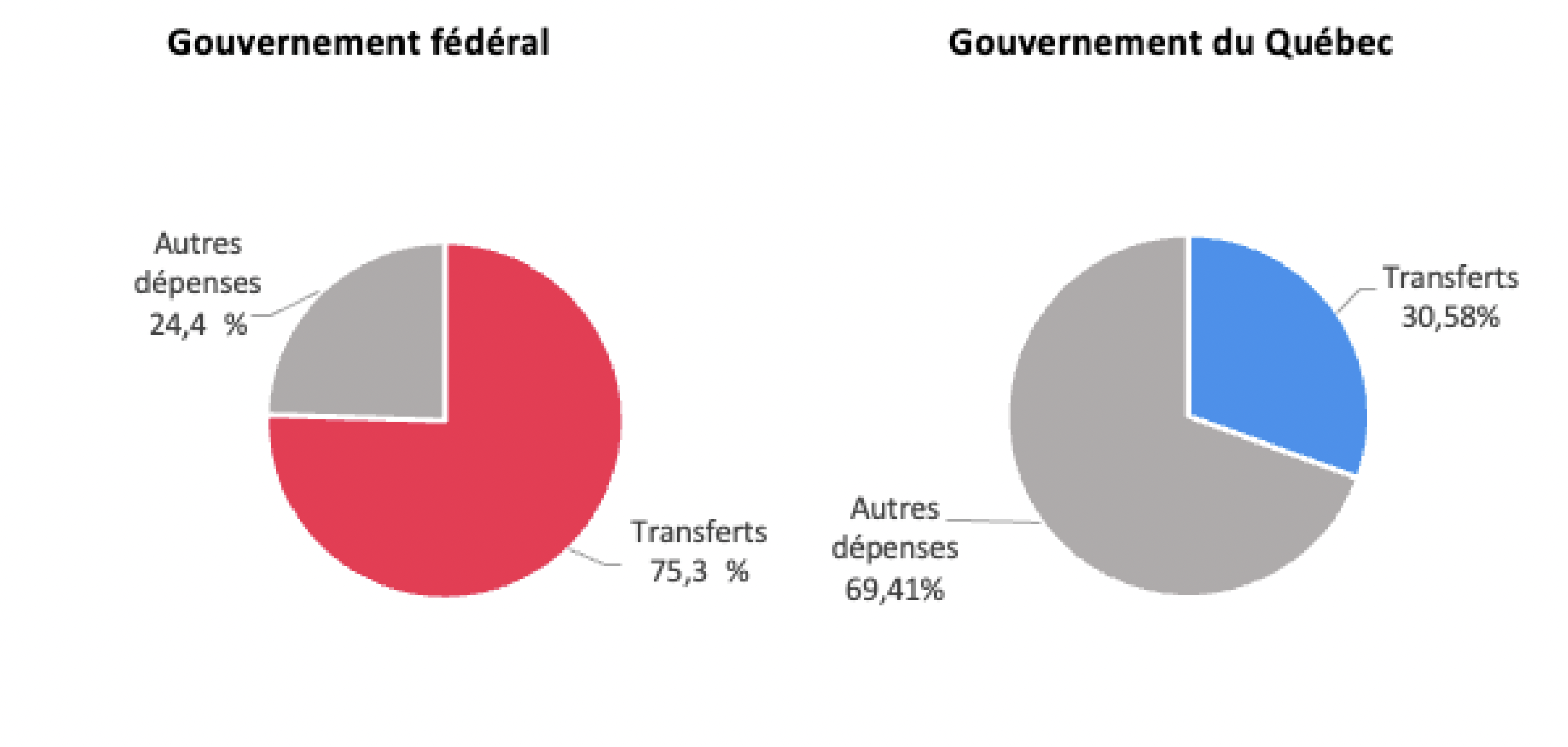
La figure 1 ci-dessous montre bien pourquoi la gestion quotidienne de services aux citoyens n’est pas le fort du gouvernement fédéral.

Figure 1 : Dépenses du gouvernement fédéral et du gouvernement du Québec, 2021Sources : Comptes publics du Canada ; Comptes publics du Québec

Le gouvernement fédéral est un animal particulier, plus habitué à émettre des transferts aux individus, aux entreprises et aux gouvernements, et à énoncer des normes associées à ces transferts, qu’à livrer des services à la population. L’année 2021 exagère un peu le trait, puisque la pandémie a engendré son lot de transferts exceptionnels. Mais la logique générale ne change pas. Il y a plus de vingt ans, le rapport de la Commission sur le déséquilibre fiscal faisait état de proportions assez semblables.

Les difficultés actuelles du gouvernement Trudeau ne sont donc pas si exceptionnelles. Le gouvernement fédéral demeure principalement une machine à récolter et à distribuer des ressources fiscales et il a tendance à se perdre quand il s’agit de gérer des programmes concrets.

La solution réside donc moins dans une réforme additionnelle de la fonction publique fédérale que dans une meilleure compréhension du fonctionnement de la fédération. En premier lieu, il faudrait améliorer l’équilibre fiscal en laissant davantage de ressources propres aux gouvernements provinciaux, dont la tâche principale consiste justement à livrer des services à la population.

Ensuite, pour des raisons évidentes, il conviendrait de prendre avec un grain de sel les volontés de leadership fédérales sur des questions de compétence provinciale. Notant dans une formulation bien à lui qu’en santé « ce n’est pas juste pitcher de l’argent vers le problème qui va le résoudre », M. Trudeau invitait récemment les provinces à des « conversations » afin de réduire les délais d’attente. Compte tenu de l’état de ses services, il devrait se garder une petite gêne.

En fait, le gouvernement fédéral devrait probablement modérer ses ambitions dans ses propres sphères de compétence, en adoptant des objectifs plus réalistes en immigration par exemple, afin d’éviter les échecs récurrents de gestion.

Mais les difficultés actuelles ne sont pas nouvelles, et elles ne se résorberont pas facilement.

Source: Quand les gouvernements trébuchent

Smart tech is key to solving Canada’s service failures and ending passport seekers’ woes

All true and necessary, but government has mixed record on such large and complex IT projects.

Even harder is the necessary simplification and streamlining of programs and processes that would facilitate IT and related modernization:

Canadians are missing flights, cancelling trips and even camping out overnight at government offices as the passport application process has utterly failed to keep up with post-pandemic demand.

With anger and frustration over the delays flaring into a national issue, Prime Minister Justin Trudeau named a task force of ten cabinet members to try to address the problem and figure out how to end the backlogs on passports and immigration processing.

This comes not long after Auditor General Karen Hogan found veterans seeking disability benefits also face unacceptable delays in the processing of their applications by Veteran Affairs Canada.

Hogan found veterans applying for disability benefits waiting almost 40 weeks for a decision on their first application compared to the 16-week average processing time for other benefits packages. And she reported that the department’s inability to meet timely delivery standards has been going on for seven years.

As governments struggle to fix these problems, it has to be pointed out that a simple automated solution is readily at hand. It’s just a question of the government’s ability to take advantage of it.

Better data management

In fact, the current backlogs on passports, immigration paperwork and veterans’ applications are nothing less than case studies in the need for digital innovation to enable government departments to quickly and efficiently upgrade service delivery and deliver a better experience for Canadians.

Organizations around the world are increasingly leveraging intelligent automation, particularly Robotic Process Automation (RPA), to tackle business challenges, including the need for greater efficiency, reduced processing time and better data.

Addressing shortcomings in data operations is one of the hallmarks of RPA, a software technology that uses digital workers for repetitive tasks like data entry and validation. RPA reliably captures and handles data faster and more accurately, while streamlining the client experience. As importantly, RPA frees employees from repetitive, mundane work, allowing them to be more productive and focus on better solutions.

Solutions seen globally

For example, the United States Department of Veterans Affairs (VA) has adopted RPA solutions to address persistent service problems similar to those faced by Veterans Affairs Canada. Among other improvements, the U.S. VA has saved over 500,000 hours by leveraging RPA in its mailroom. It has successfully automated the review and classification of more than 8,000 physical mail packets on a daily basis, representing 277 unique document types.

Such examples of positive RPA implementation are myriad. For instance, ATB Financial, Alberta’s Crown-owned bank, has used RPA to achieve a 99 per cent improvement in turnaround time for end-to-end processes, as well as other upgrades. Other sectors worldwide have successfully implemented RPA technology, including in accounting, retail trade, government, professional services and manufacturing.

The Canadian government is, of course, well aware of the game-changing potential for service delivery through intelligent automation, and is committed to digital transformation in its 46 departments and agencies. But it started this process from a weak position, with officials informing Prime Minister Trudeau that critical federal computer systems and applications were “rusting out and at risk of failure.”

The federal government has committed billions of dollars to new digital operations, and Shared Services Canada has been mandated to modernize these systems, but accomplishing overall change in such a massive, traditionally-siloed organization has proven challenging. Despite its efforts, the government acknowledges that some of its services are still hard to access and use.

Changing expectations

The demand for processing improvements is on the rise. The pandemic has produced a transformation in services and online access across the socio-economic landscape, and Canadians increasingly expect governments to meet this standard.

“We’re at a point where digital matters so much … we saw that amplified in the last two years,” Catherine Luelo, who was appointed the federal chief information officer last year, recently told CIO.com. In Budget 2022, the government promised legislation allowing it to expand availability of its digital platform services, including in other jurisdictions in Canada, and Luelo is working on ways to accelerate the institution-wide transformation away from legacy technology at the federal level.

Indeed, as thousands of frustrated would-be travellers can attest, the opportunities for RPA-based improvements have never been greater as the government tries to reopen services in the face of post-COVID demand. RPA is able to be procured by individual government departments and could quickly assist in speeding up passport and immigration processing. Intelligent automation could also provide solutions to the service problems now causing long wait times at airports in Toronto, Montreal and Calgary.

When service providers modernize their administration processes using RPA, they are not only able to realize solutions to specific needs but also make their operations scalable. This scalability through intelligent automation is the key tool needed to respond effectively to the surge in demand that has been so badly tying up the country’s passport offices and airports, with no end in sight.

Michael McGeehan is the North American Intelligent Automation Leader at SS&C Blue Prism.

Source: Smart tech is key to solving Canada’s service failures and ending passport seekers’ woes

May: The Achilles heel of the federal public service gives out again with passport fiasco

Agree. Service delivery unfortunately the poor cousin compared to policy and program development. Previous governments missed opportunity with Service Canada to transform government around service delivery.

Valid risk concerns yet here we are again with service failures, driven in part by governments more interested in new policy and program initiatives, as our senior public servants most who rose through the ranks on their policy work:

Delivering services to Canadians has been an Achilles heel of the federal government for 30 years because of political disinterest and a senior management of “travelling salesmen,” who hop from job to job and barely know the business of the departments they lead, says the former senior bureaucrat who proposed the creation of Service Canada.

“You have deputy ministers and senior executives … who very rarely have deep experience and knowledge of departments, operations and services for which they’re responsible. They haven’t worked their way up in that department and are flying blind to a significant degree,” said Ralph Heintzman, who also launched the Institute for Citizen-Centred Service and the Public Sector Service Delivery Council.

This constant churn of executives moving in and out of jobs has created a public service with “little learning experience, no constancy of purpose or corporate memory.”  That makes it very hard for the government to “maintain a focus on service improvement or anything for a long period of time,” he said.

But Heintzman says those are foundational reasons for why service has never been given the attention it deserves. Then come all the operational problems: underfunding, old technology systems that never get replaced, poorly trained and disengaged employees, lack of planning and little accountability for poor service.

Passport and immigration backlogs with long lineups of frustrated and fuming Canadians at Service Canada offices across the country in recent weeks prompted the government to create a new ministerial task force to find ways to improve service.

The 10-member task force is expected to make recommendations outlining short and longer-term solutions that would reduce wait times, clear backlogs and improve the overall quality of services provided.

Big barriers to improving service are investment in technology and recruiting the right people. That’s money and, notably, the minister of finance is not a member of the task force. The task force also comes as the government is launching a strategic review to find $6 billion in savings.

“They now have two conflicting objectives and can’t have it both ways. Which objective will trump the other? If they want to improve service, they will have to spend some money on technology, training and staffing levels,” said Michael Wernick, a former clerk of the Privy Council and the new Jarislowsky Chairin Public Sector Management at the University of Ottawa.

But Heintzman says many of the problems with service delivery are the same as in 1998 when he first presented Treasury Board ministers with a plan for Service Canada, a single one-stop agency to focus on delivery and citizen satisfaction. When the plan was rolled out in 2005, it was billed as the single biggest operational reform in federal history.

And it was all built on putting citizens first, or what he calls serving Canadians “outside in” rather than “inside out.”

“The whole idea of Service Canada was to help increase the standard of service and citizens’ satisfaction with government service.  So, when I see those photos of people lined up around Service Canada offices, there’s a pang in my heart,” said Heintzman.

But what’s different now is trust in government is falling like a stone and a wave of populism is exploiting those backlogs to drive the message that government isn’t working.

Heintzman says the research is clear. The satisfaction of Canadians with service is directly tied to citizens’ trust in government.

“One of the reasons why governments should invest in and pay attention to the quality of service is citizen trust,” said Heintzman.

“It makes me even more anxious now, when there are people eager and willing to seize upon the failures of the government to use them as an excuse for attacks on democracy and on the public sector.”

Public servants have two jobs. They offer policy advice and deliver programs and services to Canadians.

Service delivery has long been the poor cousin to policy. The way services are designed and delivered is often dictated by the internal needs of public servants and all the processes and rules they must follow. That means users and frontline workers — who know the ins and outs of how programs work — aren’t always heard.

Frontline managers also rarely make it to the top and ambitious public servants opt for the policy jobs. Executives typically manage up and into ministers’ offices and the Privy Council Office, rather than “manage down to line operations and out to citizens,” said Heintzman.

Prime ministers, ministers, even deputy ministers, pay little attention to operations or service delivery until there’s a crisis. The focus is all policy and “announceables,” not execution.

Knowing politicians aren’t that interested, senior bureaucrats are reluctant to bring up operational problems or push for technology projects to help improve services – especially after the disastrous Phoenix pay system.

“Three-quarters of the responsibility for performance in service delivery rests with the public service,” said Heintzman. “It has to be a public service issue, not only for execution, but in making it a political issue by including it in their priorities to ministers and for funding.”

The government has pinned its efforts to improve services and trust on digital technology. But Heintzman worries the emphasis on technology loses sight of citizens and how to improve service. In many departments, service is rolled into the responsibilities of the Chief Information Officer where the focus is on the latest software, hardware and apps.

“There should be a chief service officer of the government to whom the people responsible for information [management] and IT report, but the tail should not be wagging the dog. The objective is promising a proper service to people of Canada not running an IM-IT operation,” said Heintzman.

A focus on technology brings an “inside-out” approach to service, which means services are built around the priorities of the managers and department, not citizens.

Departments also don’t pay enough attention to service satisfaction – tracking how Canadians view a service and rate it – which Heintzman argues is the only way to improve service.

Rather than measure satisfaction, the government focuses on results and inputs. The Liberals created a “results and delivery unit” modelled after the deliverology theory of Britain’s Michael Barber that did little to improve service.

Heintzman says departments don’t plan enough. They don’t set targets or deadlines built around how they want to improve a service over the long run.  Service standards are set “inside out” with promises to answer a call, fix a complaint or provide a service within a certain time, which are “set to suit the people inside and have nothing to do with what people want or need in the way of delivery.”

They also don’t study the drivers of customer satisfaction, which varies by type of service and whether accessed by phone, in-person or online. Timeliness is the big one, but competence, courtesy, fairness, outcomes and value all influence satisfaction.

Heintzman argues managers should be held accountable for the quality of service, perhaps by linking their annual performance pay to client satisfaction. Central agencies such as Treasury Board and the Privy Council Office abdicated leadership in service delivery by turning it over to departments.

And finally, the government should professionalize service delivery. The Institute of Citizen-Centred Service was created to train and certify public servants, at any level, who manage services. Service delivery needs a “holistic approach” that reinforces how the pieces connect; happy and engaged employees are the key to customer satisfaction, which in turn fosters trust in government.

“Service delivery is part of the proper functioning of a democratic government. If we can’t do that properly, we’re undermining our democracy,” said Heintzman.

Source: The Achilles heel of the federal public service gives out again with passport fiasco

Prime Minister announces new task force to improve government services for Canadians: When in doubt, appoint a task force…

Hard to know whether to laugh and cry.

Given that IRCC is responsible for both immigration and citizenship backlogs, and has the policy and program responsibility for the passport program with Service Canada providing in-person service and processing, hard to see this as anything else but communications spin.

PCO could simply have weekly meetings at the DM or ADM level with IRCC and Service Canada to monitor and keep the pressure on. Happened during my time over 20 years ago at PCO on certain high profile issues and unlikely that this approach has changed drastically.

Cabinet task forces mean more time preparing for meetings and briefings and less time on the concrete operational changes needed to address backlogs.

The government ended its “deliverology” unit in PCO in 2020 but its focus was more on government priorities and commitments than existing programs (covered by departmental reports and TBS).

And as others have noted, perhaps a pause in policy initiatives and expanded immigration levels until the backlogs are sorted out:

Canadians deserve high-quality and efficient government services that are accessible, timely, and make their lives easier. The delays in immigration application and passport processing are unacceptable and the Government of Canada is urgently working to resolve them as soon as possible.

The Prime Minister, Justin Trudeau, today announced the creation of a new task force to improve government services, with a focus on reducing wait times for Canadians. The task force, a Committee of Cabinet ministers, will review service delivery, identify gaps and areas for improvement, and make recommendations to ensure Canadians from coast to coast to coast receive the highest quality of service.

As we recover from the pandemic and increasingly adjust to a fast-moving world where more Canadians are once again relying on government services, they have experienced delays in delivery that are far from acceptable. The task force will drive action to improve the processing of passports and immigration applications by identifying priority areas for action and outlining short- and longer-term solutions, with a focus on reducing wait times, clearing out backlogs, and improving the overall quality of services provided to Canadians. As labour shortages continue to lead to air travel delays around the world, the task force will also monitor the situation at Canadian airports.

The Government of Canada is working hard to improve the delivery of services that Canadians rely on every day.

Quote

“We know service delays, particularly in recent months, are unacceptable. We will continue to do everything we can to improve the delivery of these services in an efficient and timely manner, and this new task force will help guide the work of the government to better meet the changing needs of Canadians and continue to provide them with the high-quality services they need and deserve.”The Rt. Hon. Justin Trudeau, Prime Minister of Canada

Quick Facts

  • The members of the task force on Services to Canadians are:
    • The Hon. Marci Ien, Minister for Women and Gender Equality and Youth (Co-Chair)
    • The Hon. Marc Miller, Minister of Crown-Indigenous Relations (Co-Chair)
    • The Hon. Randy Boissonnault, Minister of Tourism and Associate Minister of Finance
    • The Hon. Mona Fortier, President of the Treasury Board
    • The Hon. Ahmed Hussen, Minister of Housing and Diversity and Inclusion
    • The Hon. Gudie Hutchings, Minister of Rural Economic Development
    • The Hon. Dominic LeBlanc, Minister of Intergovernmental Affairs, Infrastructure and Communities
    • The Hon. Diane Lebouthillier, Minister of National Revenue
    • The Hon. Mary Ng, Minister of International Trade, Export Promotion, Small Business and Economic Development
    • The Hon. Harjit S. Sajjan, Minister of International Development and Minister responsible for the Pacific Economic Development Agency of Canada
  • Ministers responsible for the relevant departments, including the Minister of Families, Children and Social Development, the Minister of Immigration, Refugees and Citizenship, and the Minister of Transport, will be ex-officio members of the task force.
  • Other members of Cabinet may be invited to participate in task force meetings to provide advice and recommendations on issues related to their respective portfolios.

Source: https://pm.gc.ca/en/news/news-releases/2022/06/25/prime-minister-announces-new-task-force-improve-government-services