FIRST READING: Save the #citizenship ceremonies! 

Summary of some other commentary criticizing the move. Haven’t seen any commentary favouring the change although a small minority in comment sections and social media are in favour given “promised” reduction in processing times:

Amid news that the federal government is mulling an end to in-person citizenship ceremonies, a cross-section of prominent Canadians have emerged to denounce the “terrible” and “horrifying” idea.

“This is without question a terrible idea,” wrote former Calgary mayor Naheed Nenshi in a tweet last week. “The ceremony is deeply meaningful and the reasons for removing it given here are bureaucratic and puerile.”

On Feb. 25, the Department of Citizenship and Immigration first gave notice that they were mulling an end to in-person citizenship ceremonies in favour of a “secure online solution.” In-person ceremonies could still be arranged upon request, but subject to a delay.

Rather than swearing allegiance to the Crown in front of a citizenship judge, new Canadians would simply check a box online. Presumably, the “online solution” would also do away with a group singing of “O Canada.”

According to immigration officials, phasing out the ceremony was suggested purely as a way to relieve a three-month backlog in finalizing citizenship applications.

“Recognizing that more can be done to further improve client service and processing times … the Minister of Citizenship and Immigration announced that the Department would begin pursuing the necessary changes to allow for self-administration of the Oath of Citizenship,” it wrote.

A brief also noted the inconvenience of new citizens sometimes having to book time off work to make the ceremony. “Many clients have to take time off work to attend citizenship ceremonies, and this time off is not necessarily paid by employers,” it reads.

“It is a bad idea to do away with citizenship ceremonies. A very bad idea. The opposite of efficiency,” novelist John Ralston Saul wrote in a statement last week.

Some of the most vocal defenders, however, have been foreign-born Canadians whose own citizenship began with the swearing of an oath.

Sergio Marchi is an Argentinian immigrant to Canada who eventually served as minister of immigration under then-prime minister Jean Chrétien.

“For years, my parents would recount how momentous and meaningful (the ceremony) was. Why would government want to rob future citizens of this feeling of attachment?” wrote Marchi in an op-ed for the Toronto Star.

The former minister also called it an “insult” that the ceremony would be phased out merely in the name of expediency. He noted that when similar backlogs piled up under his tenure, the department began deputizing Order of Canada recipients to act as citizenship judges.

“In-Person Canadian citizenship ceremonies are the magical rituals that bring together everyone (new and old citizens) to celebrate the true meaning of the Canadian dream,” reads a Monday social media post by Tareq Hadhad, a Syrian refugee famous for founding the Nova Scotia-based chocolatier Peace by Chocolate.

“We cannot afford to lose the significance of this celebration of belonging nor can we diminish the value of Canadian citizenship,” Hadhad added.

Former Governor General Adrienne Clarkson came to Canada as a refugee from Japanese-occupied Hong Kong, and would preside over a few citizenship ceremonies herself as an Officer of the Order of Canada.

In a column for The Globe and Mail, Clarkson said she was “horrified” by the proposed change.

“The idea that Canada, which is perhaps the most successful immigrant nation in the world, would resort to a machine-oriented way of saying that you are now a citizen, is egregious,” she wrote.

Right up until the end of the Second World War, Canadians were considered British subjects and all citizenship rituals and protocols were dictated by the U.K.

But the 1946 passage of the Citizenship Act first demarcated Canadian citizenship as a distinct entity from that of the U.K. One of the more unique aspects of the bill was its provision that new Canadians should attend “appropriate ceremonies” in order to impress upon them the “responsibilities and privileges of Canadian citizenship.”

This is not a universal practice. While the United States maintains a similar swearing-in ceremony for new citizens, in many countries naturalization is a more bureaucratic process done without any official pomp.

The centrepiece of the Canadian ceremony is the Oath of Citizenship. After some modern refinements over the years, it’s now a 64-word recitation pledging allegiance to King Charles III, the “laws of Canada,” the “Constitution” and “the Aboriginal and treaty rights of First Nations, Inuit and Métis peoples.”

Ironically, the Department of Immigration is looking to phase out citizenship oaths at a time when pledging allegiance to Canada has never been easier. 

With many citizenship ceremonies made virtual during COVID-19, thousands of new Canadians have already finalized their citizenship by speaking into a webcam.

However, it’s still against the law to deliver the oath by phone.

“Administering the Oath over the phone is not in keeping with the legislation,” reads an official guide for new Canadians living in remote areas.

Source: FIRST READING: Save the citizenship ceremonies!

Marchi: Citizenship ceremonies are too valuable to replace with a mouse click

Former Minister of Immigration (1994-96), Sergio Marchi, nails it. Minister Fraser, his staff, and the officials who recommended this change should reflect on his commentary, and how the changes would further diminish the value of Canadian citizenship.

Have been working with others on additional op-eds so stay tuned:

Processing Canadian Citizenship applications has become frustratingly long process. It is not unusual for it to take up to two years. With the excitement of becoming a citizen, this is a cruel punishment for applicants. They, and we, deserve better.

Last weekend, federal officials proposed doing away with the swearing an oath before a citizenship judge. The alternative? People can take an oath on their own, perhaps by the click of a computer mouse. They claim that this measure would save three months.

Talk about adding insult to injury!

Why debase the value of citizenship, for the sake of gaining a measly three months? I hope Canadians — and those actually waiting in the citizenship queue — will voice their displeasure. As a former minister of citizenship and immigration, I cannot believe that this, or any other government, would approve such a misguided idea. 

And here’s why:

  • First, the act of swearing allegiance to one’s country before a citizenship judge is a powerful, and moving ceremony. It helps to cement a formal commitment to country, and witnessing these ceremonies was one of my highlights as minister. Watching hundreds of people — young and old, women and men, Black, white, and brown — all raising their right hands and reciting the pledge was wonderful to behold. These moments would always be embraced by tears of joy, and immense pride. After migrating from Argentina, my parents and I stood before a judge, too. For years, my parents would recount how momentous and meaningful this date was. Why would government want to rob future citizens of this feeling of attachment?
  • Secondly, the ceremony is not just for the candidates. It is a special occasion to be shared with other Canadians. It helps to remind us all of our civic obligations and respect toward one another. As minister, I encouraged hosting these sentimental events in our communities — in churches, schools, recreational facilities, libraries and community centres. I wanted neighbours to see firsthand who these new citizens were. I wanted them to also celebrate this solemn ritual. The auditoriums were consistently full and local residents willingly helped with the organization and refreshments. In the process, it helped to break down barriers between old and new Canadians.
  • Thirdly, the functions regularly enjoyed the participation of numerous youngsters — underaged children who were automatically assuming Canadian citizenship on account of their parents; youth over 18 years who stood taking the oath; and many local students as observers. The latter would sing the national anthem, waive small flags, and applaud enthusiastically. At a time when we question if our kids are taught enough about our country and its traditions, these ceremonies served as a practical lesson in civics. After all, what can be more important than citizenship?
  • Finally, there are other ways of reducing backlogs without undermining the meaning of citizenship. The government could easily allocate more funds for the hiring of additional citizenship judges. Keeping the rendition of an oath in our courts and communities would be worth every additional cent.

Or, even better, enlist recipients of the Order of Canada to preside over these ceremonies. That is what I directed my officials to do when we faced long waiting times in the early ’90s. The recipients loved it and they happily volunteered. Moreover, what better role model for our new citizens, than fellow Canadians who were awarded our country’s most prestigious award? It served to underline civic duty and honour.

As well, we could summon an army of young Canadian students to help applicants prepare for their citizenship exams. The landed residents would find their confidence much quicker, and pupils could do this as part of their school curriculum. Talk about a win-win.

Taking an oath of citizenship, in the presence of other applicants and a community of Canadians, has been in vigour since 1947. It’s an elegant and unifying act that bolsters patriotism. It would be scandalous to replace this by a laptop relegated to the privacy of one’s home.

If anything, we should be further strengthening the institution and importance of Canadian citizenship.

Source: Citizenship ceremonies are too valuable to replace with a mouse click

Marchi: Moving on from the monarchy, incrementally [change the citizenship Oath]

Coming back to the charge (Australia useful precedent) without the institutional and constitutional issues. Other options include currency and coins:

The passing of Queen Elizabeth II will no doubt herald change – from within and externally. Indeed, the conversation about the future of the monarchy under King Charles has already begun in a number of Commonwealth countries.

Let me say at the outset that I am not a monarchist. Never have been, never will be. It is a concept, I believe, that is no longer relevant to today’s Canada and our diverse citizenry. Nor will it help us forge a more prosperous nation. However, I do salute the 70-year public service record of the late Queen. The dedication and stability that she brought to her reign was truly remarkable. She was deserving of the outpouring of respect that came from all corners of the globe following the announcement of her death Sept. 8.

Notwithstanding her record, I believe that Canada should join the conversation about the future of the monarchy.

Polls consistently have shown it has lost considerable support across Canada. A Pollara survey in September suggests only 35 per cent of respondents want Canada to continue as a constitutional monarchy, while only 24 per cent of them want to feature King Charles III on our currency.

Rightly or wrongly, Charles has always generated indifference among many Canadians. As prince, he consistently was less popular than his mom and his two boys. Now that he has the crown, will he be able to win over hearts? He has giant shoes to fill, and how he manages those expectations will critically impact the success or failure of his tenure.

But Charles is intelligent enough to understand that by the time Prince William takes the throne, the so-called “sovereign realms” around the Commonwealth will mostly be gone.

So, how should our country move forward at this juncture?

I would counsel moderation rather than revolution. After all, Canada’s DNA is gift-wrapped by prudence. Typically, we don’t rush into major decisions. We reflect, we analyze and we stew over options until the timing and strategy is right. Or, until the problem goes away on its own.

In addition, reopening the Constitution would prove most difficult, as it always has. At the end of his mandate, Pierre Trudeau won his constitutional battle, but not without fighting most premiers and having to go to the Supreme Court. Brian Mulroney was not as fortunate. Both his initiatives – the MeechLake and Charlottetown accords – went down in flames.

Moreover, any constitutional initiative would likely overwhelm the government’s agenda, and divert political energies from focusing on the bread-and-butter issues that are weighing heavily on Canadians – the economy, inflation, climate, energy, COVID and health care.

Yes, incremental moderation has been our path of choice for almost 60 years when it has come to dealing with our ties to the “motherland.” It was former prime minister Lester Pearson who gave Canadians our own flag on Feb. 15, 1965, and “O Canada” was proclaimed as Canada’s national anthem two years later, almost to the day. Initially, both measures were met with fierce debate and hostility. Today, both are symbols of great national pride.

Much later, Pierre Trudeau built on that record, by repatriating our Constitution from Britain in April of 1982. In the process, he also created the Canadian Charter of Rights and Freedoms, which moved us closer to his vision of a “just society.”

That brings us to his son, Prime Minister Justin Trudeau. He offered his condolences uponthe death of the Queen, saying she was one of his “favourite people.” Who knows? He may have a soft spot for Charles, as well. Trudeau strikes me as a reluctant reformer as it relates to the monarchy. That is why I would encourage him to take a page from his father’s and Lester Pearson’s playbooks. Move slowly but do move.

I would suggest that he modernize our citizenship oath.

Until her death, the oath of allegiance (part of the citizenship oath) was sworn to “Queen Elizabeth II, her heirs and successors…” (Now it’s to King Charles III.) When I was minister of citizenship and immigration and attended citizenship ceremonies, these words would cause people’s eyes to glaze over. They had no meaning for them and there was no personal connection. Plus, many of our would-be citizens would actually proclaim “her hairs and successors!”

It is high time to transition our oath. Rather than paying homage to a monarch, we should swear allegiance and loyalty to Canada. Period. Full stop.

As the responsible minister back in 1995, I came within one cabinet meeting of doing precisely that. After coming up with several superb, moving renditions, drafted by some of Canada’s most eloquent writers and poets, then-prime minister Jean Chrétien asked me to “park it” at the last minute. The rationale was that he did not want to fight the monarchists and the separatists (during that year’s Quebec referendum) at the same time.

I argued that reforming the oath would help us with the provincial battle because the monarchy did not enjoy much popularity with most Quebecers. In the end, I did not win the day. I always suspected, though, that the real reason was Chrétien’s affection for the Queen. He had a warm relationship with Queen Elizabeth and I believe he was concerned about offending her.

In politics, however, when you park an initiative, you usually end up losing the moment. And that’s what happened. After the referendum, I moved on to a new portfolio and my successor opted for other priorities.

Now, we have an even better window of opportunity. We should take advantage of it and revisit our oath and build on previous accomplishments. For those who believe that this represents not enough ambition in addressing the future of our monarchy, I would say better an additional single, sure step than a giant leap that goes nowhere.

Eventually, in the fullness of time, the right circumstances for altogether severing the umbilical cord to the monarchy will present themselves.
Source: Moving on from the monarchy, incrementally

Former Minister Marchi: Apologizing to Italian Canadians — maybe there’s a better way to make amends

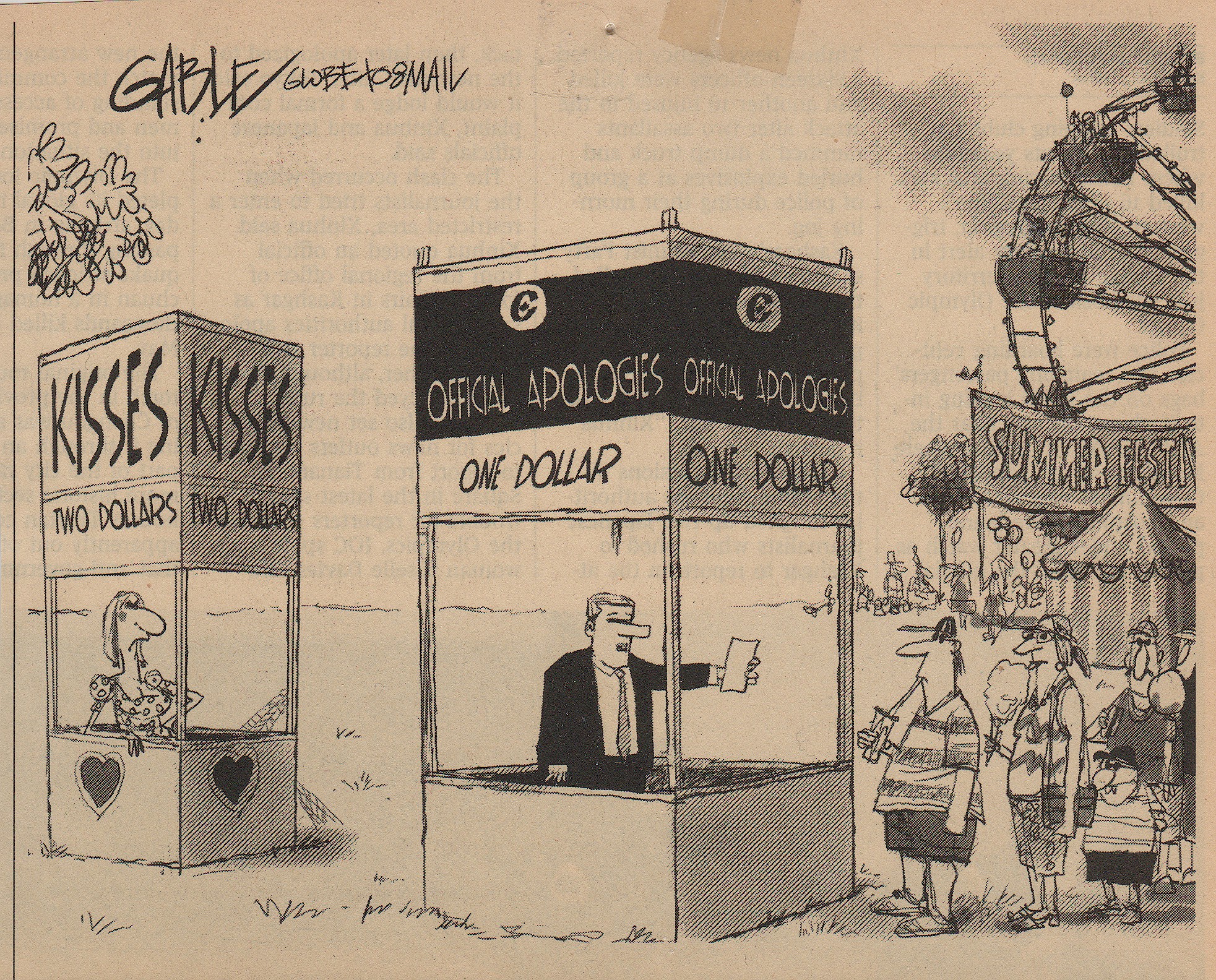
Couldn’t resist posting this cartoon regarding the Harper government’s apologies:

Harper appology cartoon

That being said, there is considerable merit to Marchi’s arguments against apologies, even if the train left the station many governments before. But agree with his proposals to have broader discussions with all groups would be more integrative and inclusive than targeted apologies (and the one to Italian-Canadians is controversial as Michael Petrou’s article indicates The harm done by Justin Trudeau’s apology to Italian-Canadians might require an apology of its own:

Later this month, Prime Minister Justin Trudeau plans to issue a formal apology to the Italian-Canadian community over how some of our fellow citizens were interned during the Second World War. This would his fifth apology for past injustices since being elected prime minister in 2015.

To be fully transparent, while I was an Opposition MP, I, too, argued for apologies towards Japanese and Italian Canadians, based on how they were treated during that war. But I feel differently today.

I have since moved towards former prime minister Pierre Trudeau’s position. He argued that the obligation of a government is not to right the past. In the House of Commons, he stated, “It is our purpose to be just in our times.” He refused to play Monday morning quarterback. He instead encouraged us to learn from history, rather than apologize for it.

Source: Marchi: Apologizing to Italian Canadians — maybe there’s a better way to make amends